
Could working directly with the seller’s agent actually leave you with less negotiating leverage, even if it seems like the simpler route? If you’re wondering why not to use the seller’s agent, the key issue is representation: the listing agent is engaged to serve the seller’s interests, not to act as your dedicated buyer advocate.
It’s reasonable to want a smoother deal, avoid extra costs, and get clear answers about a property’s condition. But who pays an agent’s commission is negotiable, and going without your own representation doesn’t automatically mean you’ll pay less or have stronger negotiating power. In Florida’s 2026 market, understanding the difference between a single agent and a transaction broker also matters. These relationships come with different duties and protections.
With informed buyer representation, you can approach offers with a clearer strategy, ask focused questions about potential property concerns, and understand compensation terms before moving forward. This article explains the risks of relying on the seller’s agent, how Florida’s brokerage relationships work, and what dedicated representation can do to help you pursue the right price and terms with confidence.
Key Takeaways
- Understand whose interests the listing agent is engaged to serve, and why that distinction can shape offer strategy and communication.
- Before discussing your budget or urgency with the seller’s agent, consider how what you share could affect negotiations.
- Learn why not to use the seller’s agent as your sole guide, and how dedicated buyer representation can strengthen your position.
- Review representation and compensation terms carefully so you know what duties apply and how your agent may be paid.
- See how experienced buyer representation can help assess residential, commercial, and investment opportunities, including potential off-market options.
Understanding the Fiduciary Divide: Who Does the Listing Agent Really Work For?
Start with the listing agreement. It establishes the agent’s relationship with the seller and authorizes the agent to market the property and negotiate on the seller’s behalf. The seller generally wants the strongest offer the market will support. You, as the buyer, want a price and terms that make sense for you. Those aims can overlap, but they aren’t the same.
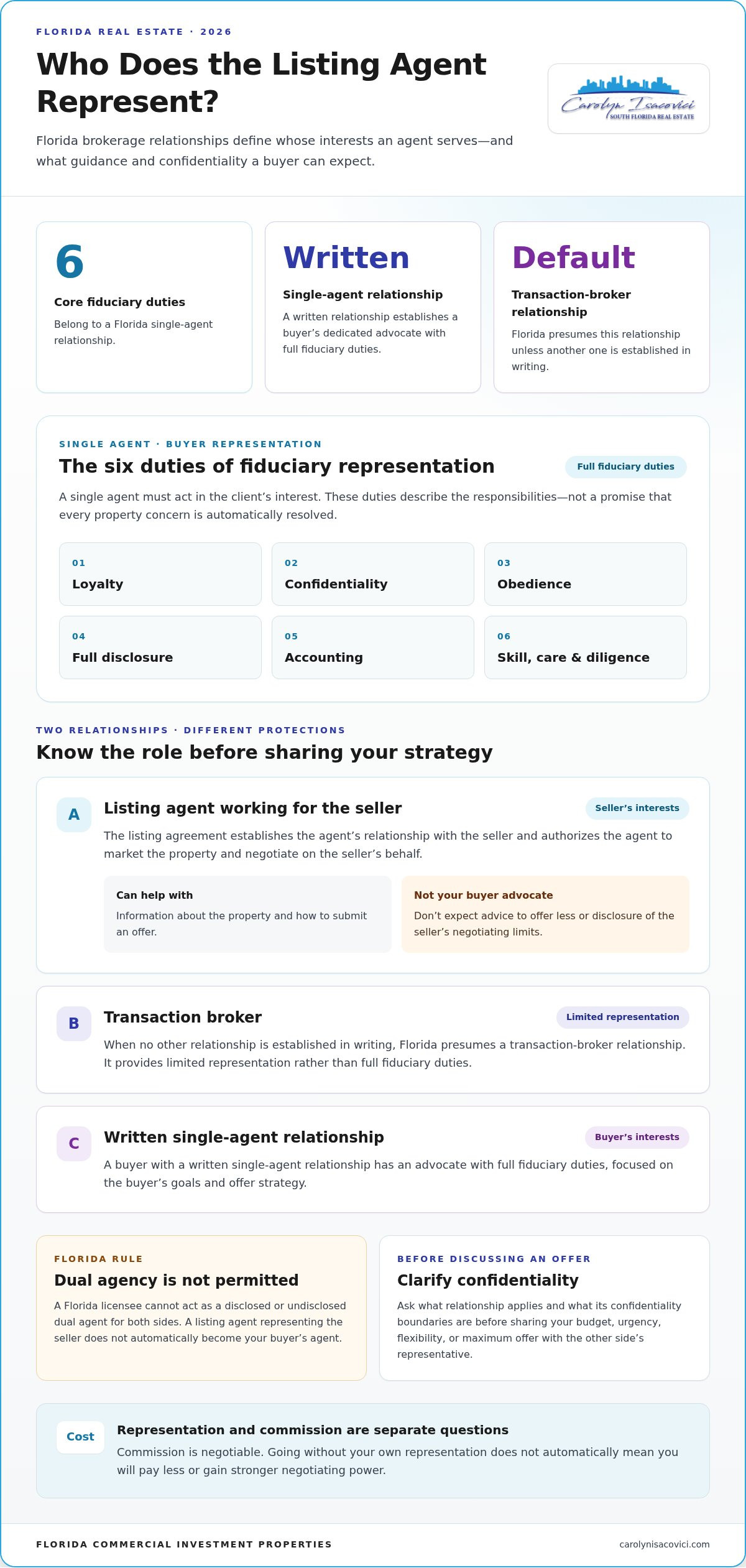
Can one person truly serve two masters with opposing financial goals? In Florida residential transactions, a licensee can’t act as a disclosed or undisclosed dual agent for both sides. But that doesn’t automatically mean a buyer has a single agent advocating for them. Unless another relationship is established in writing, Florida presumes a transaction-broker relationship, which provides limited representation rather than full fiduciary duties.
The Listing Agent’s Legal Handcuffs
In a 2026 Florida property sale, fiduciary duty is the legal obligation of a single agent to act in the client’s interest with loyalty, confidentiality, obedience, full disclosure, accounting, and skill, care, and diligence. A listing agent working for the seller must protect the seller’s interests and confidential information. That doesn’t make the agent unfair; it defines whom the agent represents.
The agent may explain how to submit an offer, but you shouldn’t expect them to coach you to offer less or reveal the seller’s negotiating limits. That kind of advice could work against the seller. Likewise, don’t assume your own budget, urgency, or maximum offer will be kept confidential when you’re speaking with the other side’s representative. Clarify the brokerage relationship and its confidentiality boundaries before sharing strategy.
The Difference Between Customer and Client
“Customer” and “client” describe different levels of representation, not how seriously your questions are treated. A listing agent can provide a buyer with information and facilitate a transaction without becoming that buyer’s advocate. In Florida, the specific duties depend on the relationship established, so don’t assume that working directly with the listing agent creates a buyer-client relationship.
With a written single-agent relationship, a buyer gains an advocate with full fiduciary duties. That distinction can matter in Florida commercial real estate for sale, where evaluating a property involves more than reacting to its asking price. An experienced buyer representative can help you assess the opportunity against your goals, identify questions to investigate, and shape a considered offer.
Dedicated representation isn’t a sign that you distrust the seller or the listing agent. It’s a sign that you understand the value of aligned advice. An Exclusive Buyer Agent is a useful reference for the buyer-only representation model. For buyers asking why not to use the seller’s agent, the core answer is simple: you deserve guidance focused on your interests, not the other party’s.
The Inherent Conflict of Interest in Real Estate Transactions
A listing agent knows the property and the seller’s priorities, but that doesn’t make the agent your confidential source of negotiating intelligence. “The inside scoop” may be limited to information the seller has authorized the agent to share. Details you volunteer about your budget, urgency, or flexibility can also influence how your offer is received. Before discussing strategy, clarify the agent’s role and the confidentiality duties that apply.
There’s a difference between presenting a property in its best light and concealing a material issue. A listing naturally emphasizes strengths, such as renovated features, location, or potential uses. Your job is to test those claims against your goals and the property’s condition. A dedicated buyer’s representative can help you investigate relevant questions and keep your negotiating plans separate from the seller’s interests.
Negotiation Leverage and the Bottom Line
Suppose an inspection identifies repairs. The listing agent can convey your request, but their role isn’t to press the seller as your advocate or advise you on the most aggressive terms to seek. A buyer’s agent can help organize the evidence, present a reasoned request, and keep the exchange professional. That buffer can make it easier to focus on the deal rather than the emotion of bargaining directly with the seller.
For an investor, a lower offer is more persuasive when supported by the property’s numbers and intended role in a portfolio, not just a hunch. Reviewing Florida real estate portfolio building considerations can help frame how a prospective acquisition fits broader investment objectives. A listing agent may share information, but your buyer representative helps assess it from your side of the table.
The Risk of Limited Due Diligence
Will the listing agent volunteer every potential concern about the surrounding area, such as a proposed zoning change? Don’t make that your due diligence plan. Information may be incomplete, and an agent’s role doesn’t replace your own review of public records, property documents, inspections, and relevant local information. During the inspection period, an independent perspective can help turn observations into focused follow-up questions.
For investment property, look beyond the listing description. Consider the property’s condition, operating assumptions, intended use, and how each factor affects your acquisition goals. The guide to how to evaluate investment property in Florida offers a framework for assessing those metrics. Local conditions in Miami, Palm Beach, or Port Saint Lucie may also shape the questions worth investigating, so connect property-level research with knowledge of the specific market.
That’s the practical answer to why not to use the seller’s agent as your only adviser: access to information doesn’t make an agent’s advice buyer-focused. For a considered perspective on Florida residential and investment opportunities, explore Carolyn Isacovici’s real estate guidance.
The Myth of the ‘Commission Discount’: Why You Might Actually Pay More
Going directly to the listing agent doesn’t automatically reduce the home’s price or put the seller’s agent compensation in your pocket. In Florida, the listing agreement sets the terms between the seller and listing broker, while compensation for a buyer’s representative is negotiable and can be addressed separately in the purchase contract. A seller isn’t required to offer buyer-agent compensation through the MLS. The details depend on the agreements involved, so don’t assume that removing your own representative creates an automatic discount.
Commission rates aren’t fixed. If someone promises that skipping buyer representation will save a certain percentage, ask what that estimate is based on and how the listing agreement and offer terms would actually change. A variable-rate provision, if included in an agreement, can affect compensation under its stated terms; it doesn’t prove that the listing agent will keep “the whole pie” or that you’ll receive a lower purchase price. Review the written compensation terms rather than relying on assumptions.
Price vs. Value in the 2026 Market
A small apparent saving can be overshadowed by an offer that’s too high, weak protections, or missed negotiating opportunities. But there’s no reliable rule that a commission discount is offset by a particular percentage of overpayment. The outcome depends on the property, competing interest, contract terms, and negotiation. Your focus should be the total value of the deal, not a headline discount.
Buyer representation can help you test asking price against comparable properties, condition, location, and your investment objectives. For Miami acquisitions, reviewing Miami real estate market trends can add context to potential growth, while keeping in mind that market trends don’t guarantee a property’s future performance. A sound purchase decision weighs both upside and risk.
The Hidden Costs of Unrepresented Buying
The purchase price is only one part of the financial picture. Depending on the property and contract, negotiation may also involve repair requests, seller concessions, inspection periods, and contingencies. Overlooking a needed repair credit or accepting terms that leave too little time to investigate can affect your costs and flexibility after closing. An advocate can help you evaluate these trade-offs and present requests with a clear rationale.
New construction deserves careful review, too. Builders’ processes, included features, timelines, and contract provisions can differ, so buyers should understand what they’re agreeing to rather than treating a new home as a risk-free purchase. This guide to new construction homes in Florida can help frame the questions to consider. Ultimately, why not to use the seller’s agent as your only guide comes down to alignment: a dedicated buyer representative helps you assess price, terms, and longer-term value from your side of the transaction.
Navigating Florida’s Transaction Brokerage and Dual Agency Laws
Florida’s default relationship can surprise buyers. Unless a single-agent or no-brokerage relationship is established in writing, a real estate licensee is presumed to be acting as a transaction broker. That’s a limited form of representation, not full fiduciary advocacy. A transaction broker must deal honestly and fairly, but doesn’t owe the buyer or seller the full fiduciary duties associated with single-agent representation.
The distinction matters in a complex purchase. An investor comparing properties, uses, or long-term potential may want a representative whose formal duties include loyalty, confidentiality, and full disclosure to the buyer. A transaction broker can facilitate a deal, but buyers shouldn’t mistake that role for having an advocate whose fiduciary responsibility is exclusively theirs.
Transaction Broker vs. Single Agent
“Neutral party” can be misleading. A transaction broker facilitates the transaction under limited duties; that doesn’t mean the broker serves as a buyer’s strategist or can provide the same buyer-focused advocacy as a single agent. A single agent owes full fiduciary duties to their client, including loyalty and confidentiality. Florida buyers should clarify their agency relationship in writing before the first showing, and review the written buyer-representation agreement describing duties and compensation.
Florida prohibits a licensee from acting as a disclosed or undisclosed dual agent for both sides in a residential transaction. Instead, if a buyer represented as a single agent wants a property listed through the same brokerage, the relationship may change to transaction brokerage only with the buyer’s written consent. That’s a change in the representation, not a way to preserve full single-agent duties for both parties. Commercial transactions have different rules: dual agency is permitted with written consent from both parties.
Local Nuances from Miami to Port Saint Lucie
Representation choices matter across Florida, but the property and its market context differ from one area to another. A Miami opportunity may call for a different evaluation than a property in Palm Beach or Port Saint Lucie. Location, property type, intended use, and market conditions all shape the questions a buyer should ask. Local knowledge helps put those details in context; a broader view across Florida can also help investors compare opportunities rather than assess each property in isolation.
Carolyn Isacovici brings experience with Florida residential and commercial assets and a steady perspective on the state’s market complexities. If you’re weighing a significant acquisition, explore buyer representation with Carolyn and clarify the agency relationship that will guide your search.
Securing Your Investment: The Strategic Advantage of Dedicated Representation
A successful acquisition is more than finding a property and making an offer. It’s a clear process: define your goals, identify suitable opportunities, assess each property against your criteria, shape the offer and terms, then manage the steps through closing. A buyer’s broker can help keep that process focused, coordinating the moving parts while keeping your investment objectives at the center.
That support can also widen the search. Alongside listed properties, an experienced broker may uncover opportunities through professional relationships and market knowledge, including properties that aren’t being broadly advertised. Off-market access isn’t guaranteed, but it can give investors another avenue to explore. The advantage is having a professional who can help assess whether an opportunity fits, rather than pursuing a property simply because it’s available.
Transforming Uncertainty into Opportunity
Property searches can bring competing priorities, unfamiliar documents, and difficult timing decisions. A calm, knowledgeable representative helps turn those uncertainties into practical questions: Does the property fit your intended use? What information is still needed? Do the offer terms support your goals? This is the role of a professional partner and strategist, providing guidance without losing sight of the decisions that remain yours.
Florida Commercial Investment Properties, led by Carolyn Isacovici, brings experience in residential and commercial sales, new construction, and investment opportunities across high-value Florida markets. That breadth supports a broader perspective when comparing assets and considering how a property may fit into a larger investment plan.
Your Path to a High-Value Florida Portfolio
Timing matters, but sound decisions come from pairing market awareness with property-specific due diligence. In Florida’s 2026 market, clarify your acquisition goals, understand the representation and compensation terms in writing, and evaluate each opportunity on its own merits. A broker aligned with your objectives can help you move deliberately, from early discovery through the closing process, while keeping potential risks and long-term value in view.
If you’ve been weighing why not to use the seller’s agent, consider the benefit of having a dedicated representative whose role is to guide your purchase from your perspective. For a discussion about your Florida investment goals, partner with Carolyn Isacovici for expert Florida buyer representation.
Move Forward with Buyer-Focused Guidance
The decision isn’t about assuming the listing agent will act unfairly. It’s about understanding who they represent, what your Florida brokerage relationship means, and whether you have an advocate focused on your goals. That’s the practical answer to why not to use the seller’s agent as your sole guide: clear representation can help you assess price, negotiate terms, and make informed decisions about potential property concerns.
Commission arrangements are negotiable, and skipping buyer representation doesn’t guarantee a lower purchase price or better terms. Look beyond an assumed discount and consider the full value and risks of the transaction, especially when evaluating an investment asset.
Florida Commercial Investment Properties, led by Carolyn Isacovici, provides specialized brokerage for high-yield Florida assets, with expertise in Miami, Fort Lauderdale, and Palm Beach markets. Carolyn’s advisory approach brings a steady perspective to complex market cycles and residential, commercial, and investment opportunities.
Ready to take your next step with a dedicated buyer’s advocate? Secure your Florida investment with a dedicated buyer’s advocate. With clear goals and thoughtful guidance, you can approach your next real estate decision with greater confidence.
Frequently Asked Questions
Can I save money on the purchase price by not using a buyer’s agent?
Not automatically. A buyer’s agent’s compensation is negotiable, but choosing not to use one doesn’t require the seller to reduce the purchase price or pass along a commission saving. The listing agreement and your offer terms affect how compensation is handled. If you’re considering why not to use the seller’s agent, compare the written costs and terms with the value of having a representative focused on your interests.
Is it legal for a seller’s agent to represent me in Florida?
In Florida residential transactions, an agent can’t act as a disclosed or undisclosed dual agent representing both buyer and seller as fiduciary clients. A listing agent may facilitate a sale under a transaction-broker relationship, which is limited representation, but that isn’t the same as serving as your single agent. If a single-agent relationship changes to transaction brokerage, the buyer’s written consent is required.
What is a Transaction Broker in Florida real estate?
A transaction broker provides limited representation and facilitates a real estate transaction without a fiduciary duty to either party. Florida presumes this relationship unless a single-agent or no-brokerage relationship is established in writing. The broker must still deal honestly and fairly, but buyers shouldn’t assume they’ll receive the full loyalty and confidentiality duties associated with a single-agent relationship. Clarify the relationship and its duties in writing.
Who pays the buyer’s agent commission in 2026?
Buyer-agent compensation is negotiable and should be addressed in the written buyer-representation agreement. The buyer may pay the agreed compensation, or the parties may negotiate a seller concession in the purchase contract. Sellers aren’t required to offer compensation to a buyer’s agent through the MLS. Review the agreement before touring homes so you understand the compensation terms and how they may apply to a purchase.
What happens if I find a property on my own and want to buy it?
You can pursue a property you found yourself, but first review any buyer-representation agreement you’ve signed. It may explain which properties or transactions are covered and set out compensation terms. If you’re working directly with the listing agent, remember that the agent’s relationship and duties still matter; finding the property independently doesn’t make that agent your buyer advocate. Clarify representation before sharing your offer strategy.
Can a listing agent tell me the seller’s lowest acceptable price?
Usually, you shouldn’t expect the listing agent to disclose the seller’s confidential negotiating limits. The agent represents the seller’s interests and may share only information the seller has authorized them to disclose. Ask about the seller’s preferred terms or offer process, but base your offer on the property, your goals, and available information. Avoid revealing your maximum price or urgency unless you’re comfortable with the seller learning it.
How do I fire a buyer’s agent if I’m not happy?
Start by reviewing your written buyer-representation agreement for its term, scope, cancellation process, and any continuing obligations. Then raise your concerns with the agent or their broker and document any agreed change or termination in writing. Don’t assume that stopping communication ends the agreement or resolves compensation obligations. The written terms govern, so get clear written confirmation of the next steps before proceeding with another representative.
Why is dedicated representation critical for new construction homes?
New construction involves more than choosing a floor plan. Buyers need to understand the written terms, what features and finishes are included, important deadlines, and how inspections and changes are handled. A dedicated buyer representative can help you organize questions, assess the purchase against your goals, and keep your interests in view while communicating with the builder. This guidance can be valuable in markets such as Miami, Fort Lauderdale, and Palm Beach.
Leave a Reply