
What if the best Miami multi-family property isn’t the one with the most units, but the one that fits your plans and holds up under closer review? Searching Miami multi-family homes for sale can be challenging when listings use different labels, unit descriptions, and levels of detail. A duplex, triplex, or larger building may look comparable online, but location, operating needs, and address-specific details can lead to very different buying decisions.
Looking beyond the headline details is essential. A promising listing needs to make sense for your intended use, whether you’re investing or considering living in one unit. The listing page is only a starting point. This guide explains how to compare property types using consistent criteria, assess location and operating fit, and identify the address-level details to review before moving forward. With a clear framework, you can narrow your shortlist and approach a purchase with greater confidence.
Key Takeaways
- Understand how duplexes, triplexes, fourplexes, and larger apartment properties fit under the multi-family category.
- Compare Miami multi-family homes for sale using verified unit count, layout, occupancy, condition, and property records.
- Evaluate Miami, Miami Beach, and nearby locations by access, surrounding land uses, property format, and your operating plans.
- Follow a practical due-diligence sequence that distinguishes county records from municipal records where relevant.
- Build a clear acquisition plan, from defining your requirements and shortlisting properties to reviewing fit and preparing an offer.
What counts as a Miami multi-family home for sale?
A multi-family property is a residential property arranged to house multiple households in separate dwelling units. In Miami listings, that may mean a duplex, triplex, fourplex, or a larger apartment property. The general category includes a range of building formats, as outlined in What is a Multi-Family Home?, but the label on a listing is only a starting point for evaluating a specific property.
A property’s advertised description is a marketing snapshot; its records and on-site configuration help establish what you’re actually evaluating. A listing that says “four units,” for example, doesn’t by itself establish that each space is a permitted dwelling, that all units are currently occupied, or that the layout works for your plans. Compare advertised details with available property records and information gathered during the transaction.
That distinction matters when reviewing Miami multi-family homes for sale because listing language can vary. Look for the stated unit count, but also note how the spaces are arranged, whether entrances are separate, which areas are shared, and whether the listing describes current occupancy. Treat unanswered details as questions to resolve, not as settled facts.
Duplex, triplex, fourplex, or apartment building?
A duplex has two separate residential units, a triplex has three, and a fourplex has four. An apartment building contains multiple units, typically beyond the four-unit format. These plain-language labels help you sort listings, but they don’t mean every property is treated identically for permitted use or financing. The building’s configuration and records matter.
Consider how the unit mix and circulation support your intended use. Two units with separate entrances may offer a different experience from units reached through a shared interior area. Shared laundry, parking, outdoor space, or hallways can affect privacy and day-to-day management. A floor plan with a studio and a larger unit may suit different occupants or a different rental approach than several similarly sized units.
Investor purchase or owner-occupant search?
Start with your plan. An investor may focus on the number and configuration of units, existing occupancy, and how the property can be operated. A buyer planning to live on-site may give greater weight to privacy, the location of their own unit, access to shared areas, and how occupied units could affect a move-in timeline.
Neither approach makes one building type automatically better. Write down your priorities before comparing listings, including how much separation you want between your household and other occupants and whether you prefer an existing rental setup or a property whose layout better matches your plans. This makes it easier to distinguish a promising property from one that only looks suitable in photos. Buyers weighing property strategies can also explore commercial versus residential investment in Florida as they define their criteria.
How to assess a Miami multi-family listing beyond its photos
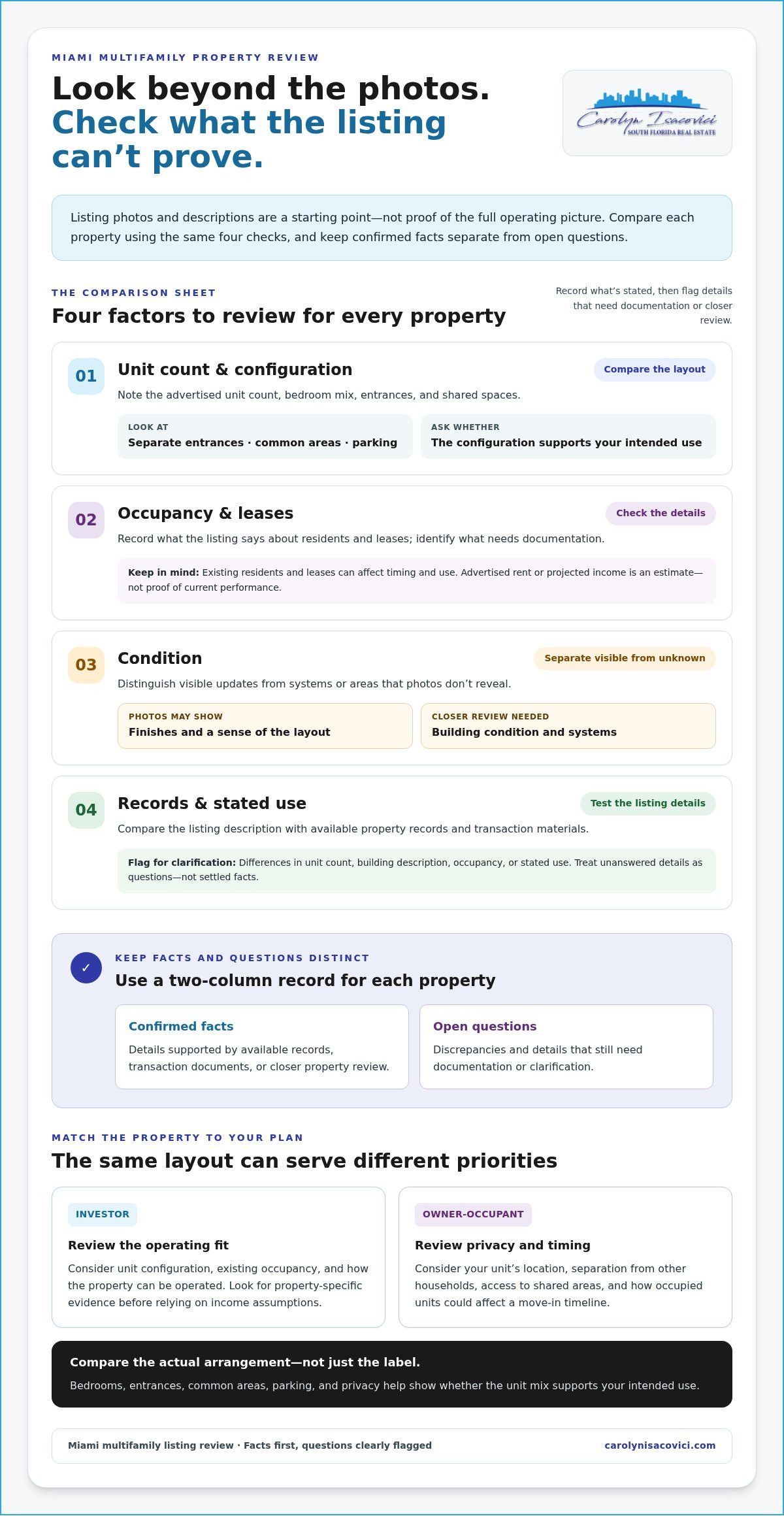
Photos can show a property’s finishes and give you a sense of its layout. They can’t establish the full operating picture. As you compare Miami multi-family homes for sale, separate what the listing states from what you can verify through available records, transaction documents, and a closer review of the property. That distinction helps you build a realistic shortlist instead of relying on polished images or broad marketing language.
Start a comparison sheet for each property. Record:
- Unit count and configuration: Note the advertised count, bedroom mix, entrances, and shared spaces.
- Occupancy: Record what the listing says about residents and leases, then identify which details need documentation.
- Condition: Separate visible updates from systems or areas that photos don’t reveal.
- Records and stated use: Compare the listing description with available property records and transaction materials.
Keep confirmed facts and open questions in separate columns. If the listing describes four units but available records or documents show a different configuration, flag the discrepancy for review rather than making an assumption. This gives you a clearer path for transaction due diligence.
Match the property’s unit mix to your plan
Does the layout support the way you intend to use the property? Compare bedrooms, entrances, common areas, parking, and privacy with your planned occupancy. A buyer who expects to live in one unit may value separation from other households, while an investor may focus on how the unit mix fits the intended rental operation.
Existing residents and leases can also shape timing and use. Treat advertised rent or projected income as an estimate, not proof of current performance. Look for property-specific evidence in operating documents and transaction materials before relying on income assumptions.
Read the listing alongside property records
A listing description is useful for comparison, but it isn’t a substitute for reviewing available records. Use the listing to identify a property; use records and transaction documents to test whether its advertised details match the evidence. Pay particular attention to differences in unit count, building description, occupancy, or stated use, and keep a written list of items to clarify during the transaction.
Condition deserves the same measured approach. Photos may show a renovated kitchen, for example, but won’t tell you the full condition of the building or its systems. Note visible concerns, then distinguish them from matters that require a closer property review. The goal isn’t to rule out every listing with unanswered questions; it’s to understand which questions could affect your decision.
For a broader framework that connects property details to investment goals, review how to evaluate investment property in Florida. A thoughtful comparison of layout, occupancy, records, and property-specific income evidence can help you assess fit without assuming a return. Buyers organizing a search and purchase can also explore brokerage guidance for property sales as they move from evaluation toward the next transaction steps.
Compare Miami multi-family locations by property fit
A neighborhood name can help narrow a search, but it can’t tell you whether an individual address suits your plans. Compare each property by how residents would reach daily services, what uses surround the site, what building formats are present, and how the location fits your intended operation. For buyers comparing Miami multi-family homes for sale, the address and its immediate setting deserve as much attention as the broader area.
Florida Commercial Investment Properties supports real estate sales and investment brokerage across Florida, including searches in Miami, Miami Beach, Hollywood, Fort Lauderdale, Palm Beach, Palm Beach Gardens, Stuart, Jupiter, Palm City, Port St. Lucie, Fort Pierce, Vero Beach, and Melbourne. Use this table as a starting framework, not a ranking. Conditions vary by street and parcel, so investigate each candidate address rather than assuming a location performs a certain way.
| Location group | Access to assess | Surrounding uses and property format | Fit questions |
|---|---|---|---|
| Miami | Map routes to the services and destinations important to your residents or household. | Review adjacent uses and compare the specific building’s format with nearby properties. | Does this address support your planned occupancy and operating approach? |
| Miami Beach | Assess practical routes to everyday needs, not just distance on a map. | Study the immediate block, neighboring uses, and how the property is arranged. | Does the location and layout align with your priorities for access, privacy, and use? |
| Nearby Miami-Dade locations | Compare routes from the actual address to the places that matter to intended occupants. | Check the parcel’s surroundings and building type rather than relying on the area label. | Would this setting work for your intended residents and management plan? |
Compare the address, not only the neighborhood name
Two properties within a short distance can differ in their nearby services, transportation options, surrounding land uses, and immediate setting. Check routes at the address level, observe what is next door, and consider whether the property’s entrances, shared areas, and format support your plan. A location may look convenient on a broad map but feel less suitable once you examine the actual routes and block.
There’s no universal “best” neighborhood for every buyer. A location that fits an owner-occupant’s daily routine may not match an investor’s operating priorities. Broader context can help frame your search; Miami real estate market trends for 2026 offers another lens, while each property still calls for its own assessment.
Include Miami-Dade location and resilience factors
Check the address in FEMA’s Flood Map Service Center and note what the map indicates. A map is one source of information, not a guarantee of how a specific property will experience flooding or a complete measure of its condition, insurability, or risk. Consider the building’s visible condition and exposure to local weather risks as separate parts of your review.
Finally, establish which county and municipal records apply to the parcel, then review current records and requirements for that specific address. This address-first approach keeps location comparison grounded in evidence and helps you judge property fit with greater confidence.
Miami multi-family due diligence before making an offer
Before making an offer on Miami multi-family homes for sale, turn your initial impressions into a property-specific review. A clear sequence helps you catch gaps early without treating a listing description as proof of permitted use, condition, or future operations.
- Verify the property. Match the listing to the correct street address and parcel, then compare its advertised unit count and building description with available records.
- Review records. Identify the applicable county and municipal jurisdictions, then review relevant property, zoning, and building information.
- Assess condition and occupancy. Examine available inspection information and maintenance history, and review lease or occupancy documents where applicable.
- Evaluate transaction documents. Read the documents available for the sale and note unresolved questions that could affect your decision or planned use.
Verify unit count, use, and public records
Start with the parcel, not just the listing. Miami-Dade County records may be relevant, while properties within the City of Miami may also involve municipal records; other incorporated municipalities have their own jurisdictions. Confirm which applies to the address. Compare records with the listing’s unit count and stated use, and identify zoning or permitted-use questions tied to your plan. Current use alone doesn’t establish future use rights.
Keep discrepancies specific. If the listing describes more units than a record appears to show, or the building description differs, record the conflicting details and include them in your transaction review. Zoning and local-use requirements depend on the parcel and jurisdiction, so avoid applying a general description of Miami rules to an individual property without checking current sources.
Review condition, flood exposure, and occupancy
Next, assess available inspection information, building systems, maintenance history, and visible repair needs. Check the address through FEMA’s Flood Map Service Center, while keeping in mind that a map is a planning resource, not a guarantee of conditions at the property. Building condition, local weather exposure, and insurance considerations also call for address-specific review.
If residents or leases are in place, examine the related documents before relying on an expected operating plan or income. Note lease terms, stated occupancy, and any timing implications for your intended use. Treat insurance assumptions the same way: base your evaluation on current, property-specific information rather than a broad estimate or a promise about future costs.
Bring unresolved questions together with the sale documents so they can be considered as part of the transaction. Florida Commercial Investment Properties provides brokerage support for commercial and residential sales, including investment property acquisitions, and manages the sales process from property search through closing. Review brokerage guidance for your Miami multi-family property search as you prepare a focused acquisition plan.
Buy Miami multi-family property with a clear acquisition plan
A focused acquisition plan turns a broad search into a series of practical decisions. Define what you want to buy, identify listings that may fit, compare each property against your intended use, and use verified information to guide your next steps. The goal isn’t to rush toward an offer. It’s to recognize which opportunities merit closer consideration and prepare to act with a clear understanding of the property and your priorities.
Turn your goals into a focused property brief
Before reviewing Miami multi-family homes for sale, write a short brief that captures your intended use, preferred unit mix, location range, and essential property characteristics. Separate must-haves from flexible preferences. For example, a preferred area may be flexible, while a particular layout or the ability to occupy one unit may be central to your plan.
A written brief gives each listing the same point of comparison. It also helps you spot trade-offs: a property may match your location preference but differ from your desired unit mix, or meet your layout needs in an area outside your first choice.
- Intended use: Clarify whether you plan to operate the property as an investment or occupy one of its units.
- Unit mix: Identify the configuration and shared-space arrangements that support your plan.
- Location range: Name preferred Miami-area locations and how far you’re willing to consider alternatives.
- Property priorities: Separate essential characteristics from features you’d welcome but could reconsider.
Move from shortlist to purchase decision
Once you have a shortlist, assess each candidate against the brief and the information available for that specific property. Keep confirmed details, open questions, and points that may affect your decision distinct. This makes it easier to compare opportunities consistently and decide which ones deserve further attention.
Florida Commercial Investment Properties provides brokerage services for commercial buildings, residential homes, new construction, and investment property sales. The firm manages the sales process from property search through closing, supporting buyers as they compare properties and work through transaction steps. That support can be useful whether you’re investing or considering an owner-occupant strategy. Your goals, preferred locations, and timing provide the foundation for a focused search, while property-specific information informs the next steps.
Before preparing an offer, revisit your brief and consider how the property’s verified details align with your plans. If a key question remains unresolved, make it part of the transaction discussion rather than relying on an assumption. A thoughtful process leaves room to weigh alternatives without losing sight of what matters most to you.
Ready to explore your next steps? Explore Miami multi-family property opportunities with Carolyn and discuss the goals, timeline, and locations shaping your search.
Take the Next Step Toward the Right Property
Your acquisition plan doesn’t need every decision settled before you begin. It should give you a clear basis for recognizing a promising fit, refining your priorities, and deciding what deserves a closer look. As you consider Miami multi-family homes for sale, let your requirements guide the search while staying open to opportunities that meet your core goals in a different way.
Carolyn Isacovici’s Florida brokerage supports residential and investment property sales, helping buyers move through the process from property search to closing. With a steady guide, you can keep your goals at the center of each decision and approach the next step with greater clarity.
Explore your Miami multi-family purchase options with Carolyn and start shaping a search around the property, location, and ownership approach that fit you. A thoughtful plan can turn a complex search into a confident next move.
Frequently Asked Questions
Is a Miami multi-family property a good fit for a first-time real estate buyer?
It can be, if the property’s demands match your experience, resources, and plan. Before touring, decide who will manage routine upkeep, how you’ll handle vacancies, and whether you’re comfortable coordinating work across multiple units. Then compare those responsibilities with the property’s condition and occupancy. Miami multi-family homes for sale can differ substantially in complexity, so a clear plan and careful review matter more than simply choosing a smaller building.
Can I live in one unit of a Miami multi-family home and rent the others?
Some buyers plan to occupy one unit and rent others, but the arrangement depends on the property and the buyer’s plans. For example, a layout with separate entrances may offer more privacy than one where occupants share key areas. Existing residents can also affect when you could move in. Consider financing and ongoing management as part of your planning, and verify the property’s use and occupancy details before relying on that strategy.
How much rental income can a Miami multi-family property generate?
There’s no single figure that applies to every property. Income depends on factors such as address, unit mix, condition, and actual occupancy. Use documented leases and relevant rental comparisons to develop property-specific estimates, then account for recurring expenses such as maintenance, insurance, and periods without rent. A listing’s projected income is an assumption, not a guarantee. Test different scenarios so you can judge whether the opportunity still fits your plan if income differs from expectations.
What happens if a Miami multi-family listing has tenants in place?
Tenants may affect property access, your move-in timing, and how you plan to operate the building after closing. Review available leases and occupancy records, and compare them with the seller’s description. For instance, an owner-occupant buyer should consider whether the intended unit is occupied and how that affects their plans. Don’t assume you can immediately change occupancy or lease terms based only on what a listing says.
Do Miami multi-family homes for sale always have the advertised number of units?
No. Treat the advertised count as a detail to verify, not as conclusive evidence. Compare it with available property records and sale documents, noting any differences in how spaces are described or used. If a listing counts a converted area as a separate unit, for example, that detail deserves closer review before you base an offer or operating plan on it. The relevant county or municipal records depend on the property’s address.
Should I check flood information before buying a multi-family property in Miami?
Yes, check flood information for the specific address as part of your review. FEMA’s flood maps can help identify mapped flood hazards, but they don’t predict every property-level condition or outcome. Consider the map alongside the building’s condition and available insurance information. If you’re comparing properties in Miami, Miami Beach, or elsewhere in Miami-Dade County, review each address independently rather than assuming nearby properties share the same circumstances.
Leave a Reply