
What if the property that fits your investment goals never appears on a public listing? Finding off-market real estate deals in Miami can open another path when listed properties miss your target location, property type, or timing. But private access alone doesn’t make an opportunity a good fit, and reaching an owner who hasn’t advertised a sale takes a focused approach.
Start by defining what you want to buy, then choose sourcing methods that fit your target and capacity to follow up. This guide covers practical ways to find potential Miami opportunities, including broker relationships, public-record research, and direct owner outreach. You’ll also learn how to assess seller interest, compare a property with your acquisition criteria, and identify details to verify, such as ownership, permitted use, condition, and property records. The same framework can help you assess residential or commercial opportunities in Miami and nearby markets, including Miami Beach, Hollywood, Florida, and Fort Lauderdale.
Key Takeaways
- “Off-market” describes how a property is marketed, not whether it is discounted or a strong investment.
- Set clear criteria for property type, target area, intended use, size, condition, and financial boundaries before starting your search.
- Compare broker-led searches, direct owner outreach, and relationship-based discovery to choose sourcing routes suited to your goals.
- Screen promising leads by checking ownership, permitted use, condition, and financial fit before taking the next step.
- Use a consistent process for finding off-market real estate deals in Miami, then turn the strongest lead into an informed acquisition discussion.
Finding Off-Market Real Estate Deals in Miami: What Counts as Off-Market?
Off-market describes how a property is being marketed, not what it is worth or whether it is a good investment. That distinction is a useful starting point for finding off-market real estate deals in Miami. An off-market property isn’t actively promoted through public listing channels. It may be known only to its owner and a prospective buyer, or shared privately with a limited group of brokers and clients.
Private circulation can take different forms. An owner might speak with a potential buyer directly, or a broker might share a property with selected clients before broader marketing. Owners may prefer limited exposure for personal or business reasons, or want to gauge interest before deciding whether to market publicly. None of those circumstances establishes the owner’s motivation, willingness to negotiate, or readiness to sell.
What makes a Miami property an off-market opportunity?
A potential conversation may begin when an owner responds to a direct inquiry, a broker shares a property privately, or a professional or investment contact introduces a buyer. These are ways of learning about a property, not evidence that it will be available on favorable terms.
For example, an investor focused on a particular type of residential property in Coral Gables might hear that an owner is considering a sale before public marketing begins. A buyer seeking a commercial property in Coconut Grove might learn about an opportunity through a broker’s limited circulation. These examples illustrate possible sourcing routes, not current inventory or a claim that properties in either neighborhood are available.
Marketing status can change. A privately discussed property may later appear in public channels, and an owner who initially welcomes inquiries may decide not to sell. Clarify how the property is being marketed now and whether the seller is open to a conversation. That keeps the label from standing in for facts.
Does off-market mean a better deal?
No. Private marketing doesn’t guarantee a lower price, seller urgency, flexible terms, or strong investment potential. Limited exposure can offer an access advantage: you may learn about a property before it reaches a broader audience. But access is only a starting point. The owner’s expectations, the property’s fundamentals, and your readiness to proceed determine whether the opportunity merits attention.
Keep the questions separate. First, does the property match your strategy and target area? Then, do the seller’s expectations and the property’s characteristics align with your objectives? Understanding Real Estate Investing can help frame how strategy and property type shape an investor’s choices, but a general overview can’t determine whether a specific Miami property fits your plans.
Give a private lead the same scrutiny as a public listing. Treat “off-market” as a description of access, not a shortcut around evaluating the opportunity. To recognize a relevant lead, start by defining what you want to buy and where.
How to Build a Focused Miami Off-Market Property Search
A productive search starts before you approach an owner or ask a broker about private opportunities. Decide what you’re trying to acquire and why. A buyer seeking a home to occupy has different needs from an investor considering a rental property or commercial asset. Clear criteria turn a broad search into a brief that a broker or potential contact can understand and act on.
Miami-Dade includes varied neighborhoods and property types, so searching the entire county without priorities can produce leads that don’t fit. For broader context on local conditions, explore this Miami real estate market trends guide. Use market context to sharpen your questions, not to assume that a particular location or property type guarantees a return.
Turn your investment goal into clear acquisition criteria
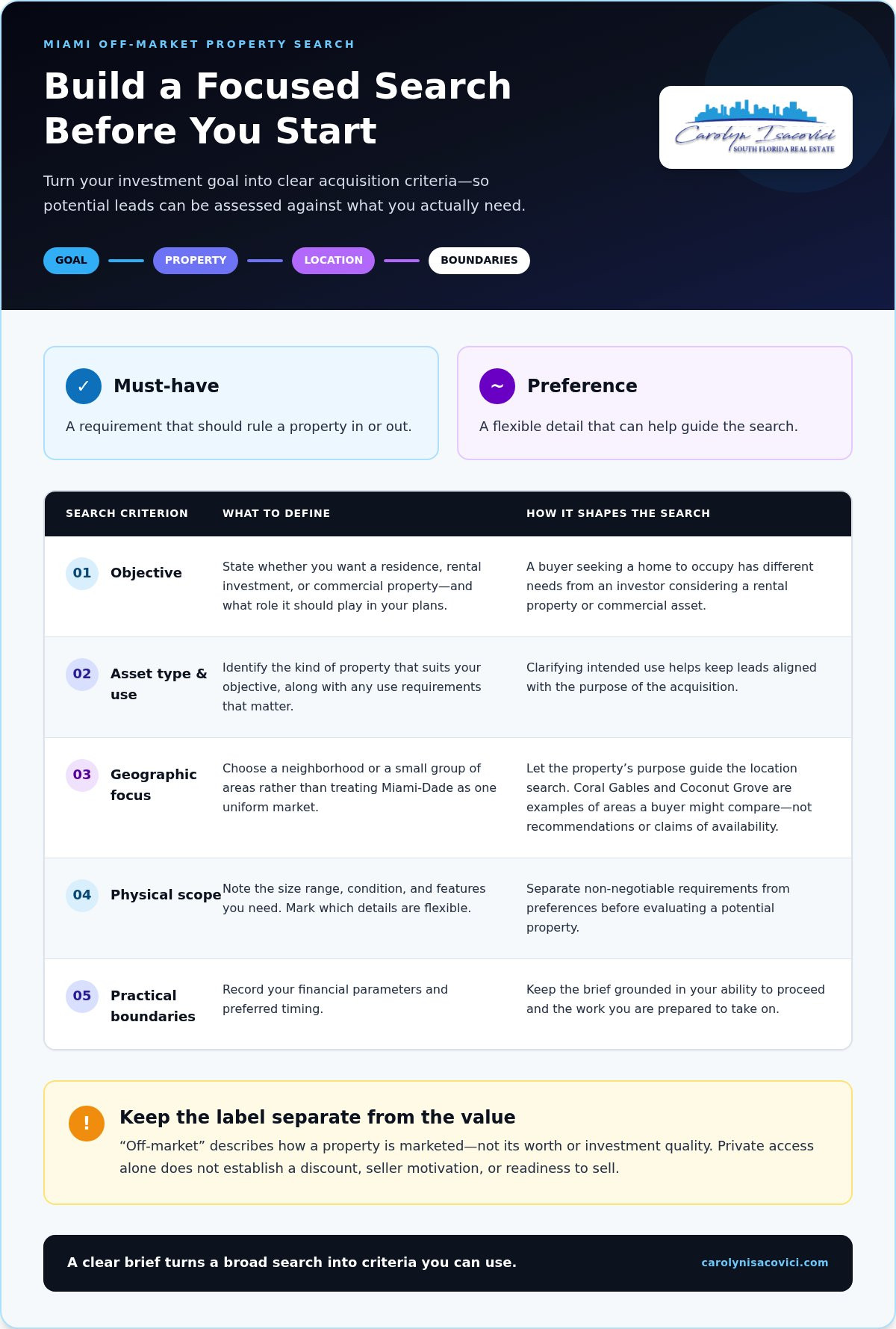
Begin with intended use, then separate non-negotiable requirements from preferences. Be specific about property type, target area, size, condition, timing, and financial boundaries. A preference can guide the search; a must-have should rule a property in or out. Keep the brief realistic for your ability to proceed and the work you’re prepared to take on.
- Set the objective. State whether you’re looking for a residence, rental investment, or commercial property, and what role it should play in your plans.
- Name the asset type and use. Identify the kind of property that suits that objective, along with any use requirements that matter to you.
- Choose a geographic focus. Start with a neighborhood or a small group of areas, rather than treating Miami-Dade as one uniform market.
- Define the physical scope. Note the size range, condition, and features you need, then mark which details are flexible.
- Set practical boundaries. Record your financial parameters and preferred timing so a potential lead can be discussed in a grounded way.
Map the Miami search before approaching owners
Let the property’s purpose guide the location search. A buyer looking for a particular residential setting might compare Coral Gables and Coconut Grove based on property needs and personal priorities. A commercial buyer may map a different set of locations around the intended business use. These are examples for shaping a search, not recommendations or claims about current availability.
For investors comparing locations beyond Miami, the broader South Florida market includes Miami Beach, Hollywood, Fort Lauderdale, Palm Beach, Palm Beach Gardens, Stuart, Jupiter, Palm City, Port St. Lucie, Fort Pierce, Vero Beach, and Melbourne. These are distinct local markets, so define which areas fit your property type and intended use rather than treating them as interchangeable.
Precise criteria make off-market leads more relevant by showing owners and brokers what fits your plans and what doesn’t. With a concise brief, you can explain your target clearly, respond thoughtfully when an opportunity surfaces, and avoid pursuing properties that don’t match your objective. Update the brief when your needs or readiness change.
Once your criteria are in place, a focused conversation can connect them with local property knowledge and a practical search. Buyers considering Miami investment property acquisitions can discuss their acquisition objectives with a Florida real estate professional and refine their next steps.
Compare Miami Off-Market Sourcing Routes Before You Commit
There’s more than one way to hear about a property that isn’t being publicly marketed. The right route depends on how specific your target is, how much time you can devote to outreach, and whether professional guidance would help you navigate an acquisition. Combining approaches can make the search more practical than relying on one channel. No sourcing route guarantees access or a completed purchase.
| Route | Reach and effort | Relationship context | Useful for |
|---|---|---|---|
| Broker-led sourcing | A broker can focus research and conversations around your brief; buyer effort goes into defining needs and evaluating relevant leads. | Professional relationship shaped by your acquisition objectives. | Buyers with a specific property type, area, or use in mind. |
| Direct owner outreach | You identify owners and initiate contact, which takes research, time, and consistent follow-through. | Direct conversation with an owner, if they choose to respond. | Buyers targeting a particular property or tightly defined area. |
| Relationship-based discovery | Leads may emerge through personal, professional, or investor connections; the reach depends on the network. | Introductions can provide context about a property or potential seller interest. | Buyers willing to build connections alongside a focused search. |
When broker-led sourcing can help a Miami buyer
A clear acquisition brief gives a broker a useful frame for property research and relevant owner conversations. Instead of searching broadly, the work can center on your target asset, location, intended use, and practical boundaries. For commercial acquisitions, the Florida commercial real estate investor’s guide offers additional context for thinking through the investment landscape.
Brokerage guidance can help connect a potential opportunity with your objectives and navigate the acquisition process, from an initial discussion toward a considered next step. It doesn’t remove the need to evaluate a property carefully. Its value is a focused working relationship and informed guidance as you assess whether a lead merits further attention.
What direct outreach and local relationships can, and cannot, do
Direct outreach gives you a way to ask whether an owner might consider a conversation, even if no sale is being advertised. Make the message relevant rather than generic: explain why you’re reaching out, state your interest clearly, and respect the owner’s choice not to engage. A response, seller interest, or transaction isn’t guaranteed.
Relationships can surface local context or lead to an introduction that might not arise through a public search. A referral is still only a starting point, not proof that a property fits your objectives. Apply the same screening process to a relationship-sourced lead as to any other opportunity.
For finding off-market real estate deals in Miami, match the sourcing route to the task: use broker guidance for a defined acquisition search, direct outreach when you have a specific target, and local relationships to broaden discovery. If you’re weighing those routes for an investment acquisition, you can discuss your acquisition objectives with a Florida real estate professional.
Screen a Miami Off-Market Property Before Moving Forward
A promising lead deserves a structured review before you invest time in negotiations. Private marketing doesn’t make a property’s details easier to verify, so move from basic facts to deeper questions in a deliberate order. Initial research can help you identify what’s known and what’s missing, but it doesn’t replace professional review of title, zoning, condition, or financial assumptions.
Verify the property and its local context
Start with the property’s address and identifying details, then use relevant Miami-Dade public records to research ownership and recorded information. County property records can provide a starting point for identifying the owner of record, while recorded-document searches can surface filings associated with the property. Treat these as initial checks: records may require interpretation, and ownership or other details should be verified through appropriate review before you rely on them.
Next, investigate the property’s permitted use. Don’t assume an existing use, a seller’s description, or activity at a nearby property establishes what’s allowed for this specific parcel. Zoning and use requirements are property-specific. Have the relevant information reviewed through appropriate professional channels before building an acquisition plan around it.
Test deal fit before making an offer
Compare the property with your acquisition brief, not just with the appeal of getting early access. Does its condition fit your intended use? Are income assumptions supported by information you can verify? What work may be needed, and how could that affect your decision? For deeper analysis of investment metrics, consult this Florida investment property evaluation guide.
Use this screening sequence to organize what you know and what still needs attention:
- Ownership: Compare the seller’s information with relevant Miami-Dade property and recorded-document records, then identify any details that need further verification.
- Condition: Note visible concerns and arrange appropriate inspections or specialist assessments to understand the property’s condition and potential work.
- Permitted use: Identify the intended use and seek property-specific zoning review before relying on it.
- Financial fit: Revisit purchase assumptions, expected income, operating costs, and required work. Mark estimates clearly so they aren’t mistaken for verified figures.
- Next-step diligence: List unanswered questions and identify which records, inspections, or professional reviews are needed before deciding whether to proceed.
Off-market status does not replace due diligence; careful verification is just as essential as with any other property. If ownership records, use permissions, condition, or financial projections remain unclear, resolve those gaps before allowing urgency to drive your decision. Finding off-market real estate deals in Miami is most effective when a lead can withstand thoughtful scrutiny.
To connect a potential lead with your acquisition goals, discuss your Miami investment property objectives with a Florida real estate professional.
Turn Miami Off-Market Research Into a Clear Next Step
A lead becomes actionable when you know what you’re seeking, how you’ll look for it, and what you need to learn before deciding whether to proceed. Keep the process steady: refine your criteria, choose sourcing routes that suit your target, assess each lead against your objectives, and prepare focused questions for the owner or broker. This keeps the search moving without treating every private opportunity as the right one.
Prepare a buyer-ready acquisition brief
A concise brief gives a broker or owner a clear picture of the opportunity you’re pursuing. Include the property type, preferred Miami areas, intended use, essential features, and any requirements that would rule out a lead. Add your decision timeline and readiness to evaluate a suitable property, so conversations reflect what you can realistically consider. Keep preferences distinct from must-haves, and update the brief if your plans change.
Before a sourcing conversation, use this checklist to make sure your brief is practical and complete:
- Property type: Identify the residential or commercial asset that aligns with your acquisition objective.
- Preferred areas: Name the Miami locations you’re considering and, if useful, areas you’d exclude.
- Intended use: Describe how you expect to use the property or what role it may serve in your investment plans.
- Essential requirements: Note the size, condition, or other characteristics that matter most, separating necessities from preferences.
- Readiness and questions: State when you’re prepared to evaluate a lead and list what you’d need to understand before taking a next step.
Compare each opportunity with your brief and write down what remains unknown. Ask focused questions about the property, the seller’s expectations, the information available for review, and the steps involved if you decide to explore further. You don’t need every answer before an initial conversation, but knowing what needs clarification helps you respond thoughtfully instead of rushing.
If you’re still shaping your search, discussing your acquisition objectives with a Florida real estate professional can help connect your criteria with local market context and a considered approach to investment property acquisitions and sales.
Discuss your Miami investment objectives with a local broker
Carolyn Isacovici’s Florida market brokerage experience can help buyers bring structure to the acquisition process, from clarifying objectives to considering relevant property opportunities. For finding off-market real estate deals in Miami, that guidance can keep sourcing conversations aligned with your goals while you assess each lead on its own merits. It doesn’t replace careful evaluation of the property.
Ready to put your search into focus? Discuss your Miami investment property goals with Carolyn Isacovici. A disciplined search and careful evaluation matter more than off-market status alone.
Take the Next Step With a Clear Investment Lens
Finding off-market real estate deals in Miami isn’t a race to collect leads. It’s a way to focus on what deserves your attention and what you’re prepared to pursue. Some opportunities won’t fit, and passing on them is part of making a considered decision. Keep your attention on the investment outcome you want, not the appeal of being offered a property privately.
Your perspective can sharpen as you learn which trade-offs matter most. Carolyn Isacovici specializes in the Florida real estate market, offering brokerage guidance across commercial, residential, and investment property sales in Miami and other South Florida markets. That local perspective can help you clarify your acquisition goals and the questions to bring to a conversation about a potential opportunity.
When you’re ready to explore your next move, discuss your Miami investment property goals with Carolyn. A focused conversation can help you move forward with greater clarity.
Frequently Asked Questions
What does off-market real estate mean in Miami?
In Miami, off-market real estate refers to property that isn’t actively promoted through public listing channels. A property privately discussed between an owner and a prospective buyer, or shared within a limited professional network, may fit that description. A publicly listed property is marketed through public channels. Neither label tells you whether a property is fairly priced, well maintained, or suitable for your plans, so assess those facts independently.
How can I find off-market properties in Miami?
Start with a defined acquisition objective, then combine broker-led sourcing, direct owner outreach, and local professional or investor relationships. For finding off-market real estate deals in Miami, specificity helps: a search for a small commercial property in a chosen area is easier to discuss than a general request for “a good deal.” These routes can surface leads, but neither property access nor seller interest is guaranteed.
Are off-market properties in Miami cheaper than listed properties?
No, off-market properties in Miami aren’t automatically cheaper than publicly listed ones. A seller’s expectations, the property’s condition and characteristics, and the terms under discussion all influence price. Limited exposure may affect who learns about a property, but it doesn’t establish its value. Before judging an asking price or proposed terms, compare available property information with relevant market evidence and your intended use.
Can I approach a Miami property owner directly about buying?
Yes, you can make a respectful, specific inquiry to an owner after taking reasonable steps to identify the correct property and owner. Keep the message brief, explain why you’re reaching out, and make clear that you’re asking whether a conversation is welcome, not assuming a sale is planned. An owner may decline or not respond. Respect that choice and avoid repeated pressure.
How do I verify ownership of a Miami property?
Use relevant Miami-Dade public property information and recorded-document records as starting points for checking a specific property. Match the address and other identifying details carefully, since similar addresses or parcel information can lead to confusion. Treat an online search as preliminary research, not a final determination: public records may need careful interpretation, and ownership details should be reviewed appropriately before you rely on them in an acquisition decision.
What should I check before pursuing an off-market property in Miami?
Check who owns the property, whether its permitted use matches your plans, its physical condition, and whether your financial assumptions are supported by reliable information. Don’t treat projected rental income or estimated repair needs as established facts without supporting evidence. The right review depends on the property and intended use. Consider professional review of zoning, title, condition, and financial details before making a commitment.
Do I need a real estate broker to find off-market deals in Miami?
No. Buyers may search through direct owner contact, personal or professional relationships, or broker-led sourcing. Brokerage guidance can help organize property research, shape acquisition planning, and navigate the sales process, particularly when a buyer is weighing residential, commercial, or investment property options in Miami. Working with a broker doesn’t guarantee access to a private opportunity, seller interest, favorable terms, or a completed transaction.
Leave a Reply