A Florida residential property acquisition isn’t one big leap; it’s a series of decisions to check before closing. Finding a home you love is exciting, but it’s also important to assess whether the location, property condition, insurance options, and title details hold up to closer review.
A clear process can make those questions easier to manage. This guide covers the key stages, from setting priorities and comparing Florida communities to making an offer, completing due diligence, and preparing to close. It also explains which property-specific and location-specific checks to consider before you commit.
Florida markets and property types vary, so the right choice depends on more than a listing price or photos. A residential broker can help you compare options, discuss an offer, and coordinate the transaction. Lenders, attorneys, inspectors, insurance professionals, and title professionals provide guidance in their respective areas. Knowing who to involve, and when, can help you move from search to closing with greater clarity.
Key Takeaways
- Understand the stages of a Florida residential property acquisition, from clarifying your purpose to completing due diligence and closing.
- Make your search more focused by defining your intended use, preferred areas, finances, and timing before comparing homes.
- Check property-specific flood exposure, insurance options, title details, and community obligations before committing.
- Review purchase contract terms carefully, especially the deadlines and obligations that determine your next steps.
- Know how a residential broker can support your search and offer discussions, and when to involve lenders, attorneys, inspectors, insurers, and title professionals.
What Florida Residential Property Acquisition Involves, and Where to Begin
Florida residential property acquisition is the process of identifying a home, checking whether it fits your needs, making an offer, completing due diligence, and closing the purchase. It involves more than finding a listing. Each stage helps you make an informed decision before taking possession. In property terminology, real property generally refers to land and things permanently attached to it, rather than movable personal belongings.
Here, “acquisition” means a private buyer’s purchase of a residence. It differs from Florida’s conservation-land acquisition programs, which serve public purposes such as protecting land and natural resources. For a homebuyer, the practical roadmap is to clarify goals, prepare financially, search, assess options, make an offer, complete property and transaction checks, close, and take possession. Details vary by county, municipality, property type, and transaction, so use this as a guide rather than a one-size-fits-all formula.
Which Florida residential property are you acquiring?
Property type affects what you’ll need to evaluate. A single-family home, condominium, townhome, and new-construction property can each involve different considerations, including layout, upkeep, shared spaces, and community rules. Requirements tied to an HOA, condominium association, or other community depend on the specific property. Review applicable documents and obligations before committing.
Your purpose matters, too. For an owner-occupied home, consider day-to-day needs such as location, space, and timing. If you’re buying primarily as an investment, you may weigh different factors, including intended use and ongoing responsibilities. Neither purpose guarantees a particular financial outcome. If you’re weighing the two approaches, read this Florida residential investment comparison.
What should buyers decide before searching?
Start by setting your preferred areas, property needs, intended use, and timing. Then ask a lender to confirm a budget based on your financial circumstances. Local brokerage guidance can help you compare Florida communities, but your own priorities should determine which areas make the shortlist.
Separate non-negotiables from preferences. For example, a particular location or number of bedrooms may be essential, while a finish or extra living space may be flexible. This makes it easier to compare suitable properties without losing sight of what matters most. With your goals, budget, and timing in view, you’ll be better prepared to evaluate homes and make deliberate decisions.
Florida Residential Property Acquisition: The Steps from Search to Closing
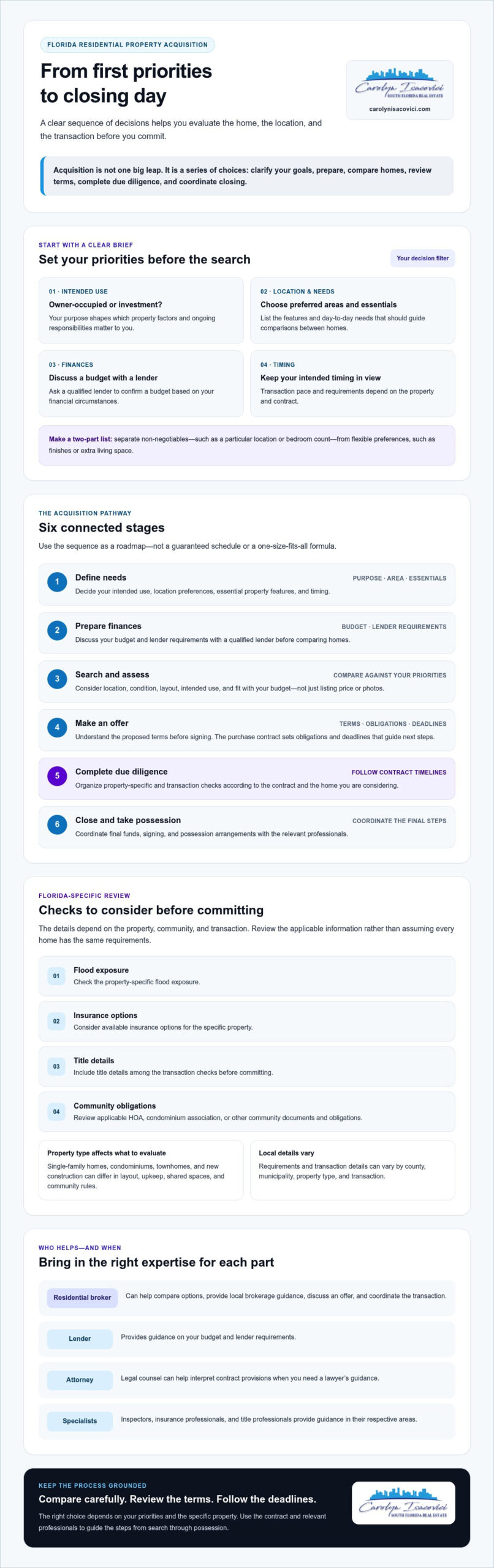
A well-managed Florida residential property acquisition moves through connected decisions, but its pace and details depend on the property and contract. A practical sequence is to define your needs, prepare your finances, search, assess properties, make an offer, investigate the property and transaction, then close and take possession. Use this as a roadmap, not a promise that every purchase follows the same schedule.
- Define needs: Set your intended use, location preferences, and essential property features.
- Prepare finances: Discuss your budget and lender requirements with a qualified lender.
- Search and assess: Compare properties by location, condition, layout, intended use, and budget.
- Offer and investigate: Agree on proposed terms, then complete the checks required by the contract.
- Close and take possession: Coordinate final funds, signing, and possession arrangements with the relevant professionals.
In short: A residential acquisition typically progresses from goals and financing through search, offer, due diligence, closing, and possession. The timing and requirements depend on the transaction.
From property search to an accepted offer
Compare each candidate against the same priorities instead of letting one attractive feature dominate. Consider the home’s location, condition, layout, intended use, and fit with your budget. Offer terms can address more than price, so understand what you’re proposing before signing. The purchase contract sets obligations and deadlines. Review it carefully, and seek legal counsel if you need a lawyer to interpret its provisions.
From due diligence to closing day
Once the contract is in place, use its timelines to organize property-specific investigations. Depending on the transaction, these may include inspections, title review, insurance research, and meeting lender requirements. Due diligence can uncover concerns, but it can’t guarantee that every risk or future issue will be identified. A buyer’s agent can help coordinate communication and track milestones, while the inspector, insurer, lender, title professional, and attorney address their respective areas of expertise.
Closing arrangements and required documents depend on the contract and transaction. Confirm the funds needed, signing logistics, and possession terms with the professionals handling those steps. If you’re selecting representation, check real estate licensing information through the Florida Real Estate Commission. For local perspective while comparing residential options, explore residential real estate sales guidance.
Florida-Specific Checks: Flood Exposure, Insurance, Title, and Community Rules
Statewide assumptions won’t tell you what a specific home may face. A statewide flood or insurance label can’t replace property-level checks of flood exposure, drainage, and coverage options. During a Florida residential property acquisition, look up current information for the address, including FEMA flood maps where relevant, and ask local professionals what the maps do and don’t establish. A map is one source of information, not a substitute for assessing the property and its surroundings.
How location can change a Florida buyer’s due diligence
Whether you’re comparing Miami-Dade with Broward, Palm Beach, the Treasure Coast, or Melbourne, don’t assume a finding about one city, neighborhood, or property applies to another. Check the individual address, local drainage information, and relevant municipal or county resources. Confirm that the information is current. Ask an insurance professional early about coverage availability, terms, and how property characteristics may affect your options. Answers vary by address and insurer, so investigate before late-stage transaction decisions.
Florida’s Department of Environmental Protection describes Florida’s official land acquisition process. It concerns state land acquisitions, not the standard process for a private home purchase. It may provide context about formal acquisition tasks, but residential buyers should rely on transaction-specific guidance from their own qualified professionals.
What to check in the home, title, and community documents
Keep the checks distinct. A qualified home inspector assesses observable conditions. Further specialist assessment may be appropriate if the inspection raises questions. Seller disclosures provide another source of information, but they don’t replace an inspection. A title professional can explain the ownership record, liens, exceptions, and closing documents. A survey may also be relevant. Ask the appropriate professional whether one is needed for your transaction.
For condominiums and HOA communities, request and review the applicable documents with qualified advisers. Depending on the property, useful items to understand may include budgets, rules, assessments, and approval requirements. Confirm which requirements apply and when decisions or submissions are due rather than assuming all associations follow the same process.
- Flood and drainage: Check current, address-specific information and ask follow-up questions.
- Insurance: Seek property-specific guidance early. Availability and terms can vary.
- Condition, title, and survey: Treat each as a separate inquiry handled by the relevant professional.
- Community obligations: Review the documents and confirm applicable requirements and deadlines.
These checks can help you make a more informed decision, but they can’t guarantee that every concern will be identified. The goal is to understand the property and its obligations before you commit.
How to Prepare for a Florida Home Purchase Without Rushing Decisions
Preparation isn’t about predicting every issue. It’s about clarifying your priorities and keeping open questions visible before a decision becomes urgent. A simple planning system can help you compare homes fairly, understand the ownership picture, and give your professional team time to address important details.
Before searching, write down your starting point:
- Finances: Ask a lender to confirm your budget and explain financing requirements that may affect your choices.
- Location: Shortlist preferred communities and note the practical needs each area must meet.
- Intended use: Decide whether the home will be owner-occupied or acquired primarily for investment.
- Property priorities: Separate must-haves from preferences, such as a required layout versus a desirable extra feature.
- Timing: Consider your desired move or purchase window, while allowing flexibility for transaction-specific steps.
Compare more than the asking price. Insurance, maintenance, and applicable community obligations can affect the ownership experience. For a Florida residential property acquisition, keep property-specific questions alongside your comparison notes instead of assuming one home’s answers apply to another.
Questions to answer before making an offer
Pause to check whether the home fits your intended use, location needs, and lender-confirmed financial limits. What questions remain about condition, flood exposure, insurance, title, or community rules? Record each one, identify the professional who can address it, and track the answer. Review contract dates and any contingencies with your professional team so you understand which deadlines need attention before proceeding.
A shared transaction checklist can help. Keep questions, document requests, responsible contacts, and contract deadlines in one place, then update it as answers come in. This makes it less likely that an unresolved item will get lost among emails or viewing notes.
When a new-construction purchase needs a different checklist
A newly built home may involve builder documents, specifications, construction milestones, and procedures for requesting changes. Review these carefully with qualified advisers, and verify what has been represented about the home, completion expectations, and applicable protections. Don’t assume a new build follows the same review process or timeline as a resale property.
Keep inspection, financing, title, and closing questions on your checklist throughout construction, not just near completion. If you’re considering a newly built home, this Florida new-construction acquisition guide offers a next step for exploring the process. For guidance with your residential search, discuss your home-buying priorities with a residential real estate broker.
Work with a Florida Residential Property Broker to Move Forward
A residential broker can help turn a broad search into a workable plan. By clarifying your priorities, a broker can help refine search criteria, compare properties, and navigate offer discussions. Local context can be useful when weighing communities, from Miami, Miami Beach, and Hollywood to Fort Lauderdale, Palm Beach, and Palm Beach Gardens. Buyers also compare options in Stuart, Jupiter, Palm City, Port Saint Lucie, Fort Pierce, Vero Beach, and Melbourne.
Brokerage has a defined role. A broker can support property search, offer strategy, and transaction coordination, but doesn’t replace the other professionals involved in a Florida residential property acquisition. Legal interpretation belongs with an attorney, financing questions with a lender, property condition with an inspector, coverage decisions with an insurance professional, and ownership records and closing documents with the appropriate title professional. Knowing who handles each question helps you get relevant advice without expecting one person to cover every specialty.
What to discuss with a Florida residential property broker
Start with the basics. Explain whether you’re buying a home to occupy or a property primarily for investment, which areas you’re considering, what the home needs to offer, and your preferred timing. Be clear about which criteria are essential and where you may have flexibility. That context can help shape a focused search and make comparisons more useful.
Ask how property options will be reviewed, how offer communication will work, and how transaction milestones will be coordinated. If a question involves contract interpretation, lending, inspections, insurance, or title, clarify which qualified professional should address it. Clear roles make collaboration easier and keep decisions grounded in the right expertise.
Turn your acquisition plan into a clear next step
Before starting or resuming your search, summarize your intended use, preferred locations, property requirements, financial limits, and timeline. Add unresolved questions or document requests so you can address them as suitable properties come into view. You don’t need every decision settled before beginning, but knowing what’s confirmed and what still needs research can make the next conversation more productive.
If you’re ready to discuss your priorities, connect with Carolyn Isacovici’s Florida real estate team about residential property options. A step-by-step approach won’t remove every uncertainty, but it can make complex choices easier to organize and evaluate.
Take Your Next Step with a Clear Plan
A confident Florida residential property acquisition starts with clear priorities and careful decisions, not rushing toward a closing date. Define how you’ll use the property, compare locations and property types against your needs, and keep questions about flood exposure, insurance, condition, title, and community requirements on your checklist. Then track transaction deadlines and involve the right professionals when their expertise is needed.
Florida Commercial Investment Properties provides residential real estate sales and investment-property brokerage across Florida communities from Miami and Miami Beach through Palm Beach and the Treasure Coast to Melbourne. Whether you’re beginning a search or refining one already underway, discussing your goals, preferred locations, property type, and timing can help clarify your next steps.
Discuss your Florida residential property goals with Carolyn Isacovici. A thoughtful process and appropriate professional support can help you evaluate each decision with greater clarity and move forward at a pace that fits your circumstances.
Frequently Asked Questions
What does residential property acquisition mean in Florida?
Residential property acquisition means the process of searching for, evaluating, making an offer on, completing due diligence for, and closing on a home. It can involve an owner-occupied house, condominium, townhome, or a property bought primarily for investment. The steps and checks depend on the property, its location, and the transaction. It’s distinct from public land acquisition, which involves government programs and purposes rather than a private home purchase.
What are the steps to buying a residential property in Florida?
The usual path is to define your needs, discuss financing with a lender, search and compare properties, make an offer, investigate the home and transaction, close, and take possession. The purchase contract sets the obligations and deadlines for that specific transaction, so review its terms carefully and ask an attorney for legal interpretation if needed. Property checks may include inspection, flood exposure, insurance, title, and applicable community documents.
Do I need a real estate agent to buy a home in Florida?
You can explore buying without an agent, but a residential broker can help refine your search, compare options, communicate about offers, and coordinate transaction milestones. Brokerage isn’t a substitute for advice from a lender, attorney, inspector, insurer, or title professional. If you’re comparing areas such as Miami, Fort Lauderdale, Palm Beach, Stuart, or Melbourne, local market guidance may help you assess how locations and property types fit your priorities.
What should I check before buying a home in Florida?
Review the home’s condition, property-specific flood exposure, insurance availability and terms, title information, and any survey needs. Check seller disclosures, but don’t treat them as a substitute for an inspection by a qualified professional. If the property is in a condominium or HOA community, review applicable rules, budgets, assessments, and approval requirements with qualified advisers. Confirm contract deadlines with your professional team so important investigations and decisions stay on track.
Can I buy a Florida home if it is in a flood zone?
A flood-zone designation doesn’t automatically mean you can’t buy the home. Review current information for the specific address, including FEMA mapping where relevant, and ask an insurance professional about coverage availability and terms. Also consider drainage, the property’s condition, and any lender requirements that apply to your transaction. Maps are useful reference points, but they don’t replace property-specific research or professional guidance about the home and its risks.
How long does a residential property purchase take in Florida?
There isn’t one timeline for every Florida home purchase. Timing depends on the contract, financing, due diligence, title work, property type, and how quickly required information and documents are available. New construction may follow construction milestones rather than the schedule of a resale home. Review the contract dates with your professional team, and ask your lender and closing professionals about the steps that affect your particular transaction.
What is different about buying a Florida condo compared with a house?
A condo purchase involves reviewing not only the individual unit but also the applicable condominium documents and community obligations. Ask qualified advisers to help you understand rules, budgets, assessments, and any approval requirements, and confirm relevant deadlines. A house may have different maintenance responsibilities and may also belong to an HOA, so don’t assume every house is free of community rules. The specific property documents determine what applies.
Leave a Reply