
A lower purchase price doesn’t automatically make a Florida condo the better investment. A condo may make sense when its location and rental appeal justify the costs, and the building’s finances and rental rules fit your plan.
Miami may attract investors with seasonal demand and sought-after amenities, but weigh those advantages against ongoing expenses and quieter rental periods. Other Florida markets may offer a different balance of purchase costs, tenant demand, and tourism exposure. This guide compares Miami with markets across the state and explains how maintenance, association reserves, insurance, rental restrictions, and seasonal demand affect the decision, helping you assess the numbers and trade-offs against your investment goals.
Key Takeaways
- Compare Miami with other Florida markets by weighing rental demand against HOA fees, amenities, and the building’s financial health.
- Clarify which repairs the association handles and which remain your responsibility before estimating ongoing ownership costs.
- Match your rental plan to the condo’s rules, since short-term rental restrictions can affect how you earn income.
- Build room in your investment analysis for insurance costs and possible special assessments tied to major repairs or renovations.
- Assess how tourism and seasonal demand may affect occupancy, then compare markets against your investment timeline and goals.
Is Buying a Condo in Miami a Good Investment?
A Miami condo may suit an investor when its rental appeal outweighs recurring costs and shared-building trade-offs. Compare monthly HOA fees, association finances, amenities, and your control as an owner before assessing its investment potential through Florida Commercial Investment Properties.
Condo Fees and Association Finances
In South Florida, associations typically cover exterior maintenance, landscaping, and shared common areas. That makes the building’s services and financial records essential comparison points.
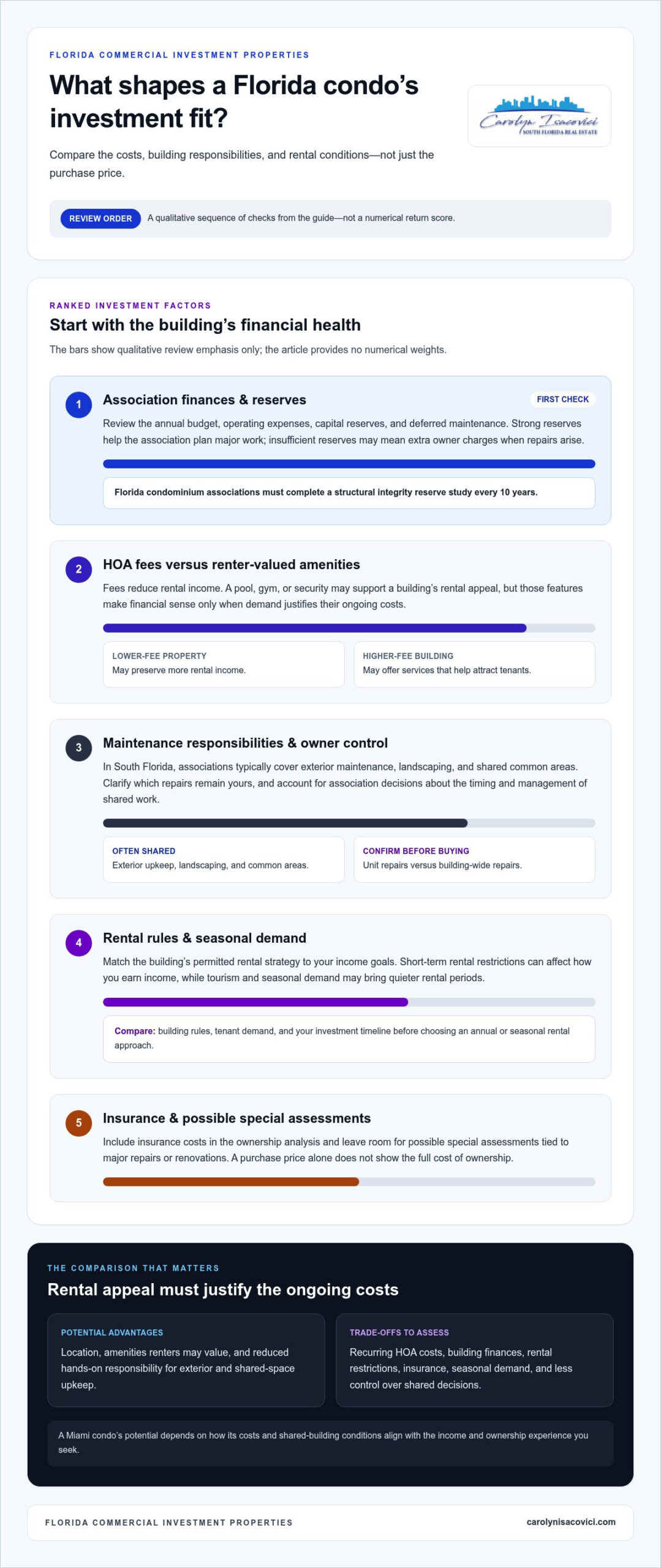
Review the association’s annual budget for operating expenses, capital reserves, and deferred maintenance. Florida condominium associations must complete a structural integrity reserve study every 10 years. A well-funded association can plan for major work; an underfunded one may leave owners facing extra charges when repairs arise.
Fees, Reserves, and Investment Returns
HOA fees reduce rental income after ownership expenses, so weigh them against amenities renters may value. A pool, gym, or security may enhance a building’s appeal, but those features make financial sense only when demand justifies their ongoing costs. A lower-fee property may preserve more income, while a higher-fee building may offer services that help attract tenants.
Reserve funds can help make costs predictable, while insufficient reserves may lead to extra charges for major repairs. Review the budget, reserve study, and deferred-maintenance plans before estimating returns. The purchase price alone won’t show the full cost of ownership.
Noise and Limited Control
Shared walls, hallways, elevators, and busy amenities can create noise in ways owners of standalone properties may not experience. In a Miami building with a pool or active shared spaces, consider how the unit is situated in relation to those areas. Noise can affect both owner comfort and a renter’s experience, so assess the specific unit and building rather than assuming every condo feels alike.
Condo owners have less control over building changes and HOA decisions than owners of standalone properties. Association rules and shared decisions shape maintenance, amenities, and common areas. Before buying, review how the association communicates decisions and handles building-wide needs. These processes affect daily ownership as well as long-term costs.
| Option | Monthly HOA fee | Investment consideration |
|---|---|---|
| Florida condo, varying amenities and location | Varies by property size and age | Compare services with ongoing costs |
| Luxury beachfront condo | Higher monthly dues | Assess whether amenities support rental appeal |
| Condo in some markets | Moderate to high | Account for the larger recurring expense |
Compare the association’s budget and reserves with its fees, amenities, and your rental plan. A Miami condo’s potential depends on how costs and shared-building conditions align with the income and ownership experience you seek.
Maintenance responsibilities
A condo shifts some upkeep from individual owners to shared building management, but maintenance decisions still matter. Before comparing a condo with a family home, identify who handles unit repairs, common areas, and building-wide work.
Shared Maintenance Expenses
Shared maintenance expenses fund work that benefits multiple owners, such as caring for common areas or addressing building-wide repairs. Unlike a family home, where one owner coordinates upkeep, a condo relies on association decisions and shared funding. Understand how the association plans and communicates maintenance work.
For a practical comparison, list recurring work around the unit and building: interior upkeep, shared corridors, landscaping, and exterior repairs. Then identify which costs are covered by association expenses and which remain your responsibility. This distinction helps investors estimate ongoing obligations without treating every repair as an individual expense.
Building Management and Amenities
Building management coordinates shared upkeep and helps maintain amenities such as a pool, gym, or landscaped courtyard. These features can benefit residents, but they require attention and can shape maintenance priorities. Compared with a property without shared facilities, an amenity-rich condo may involve more common-area upkeep.
Assess management by reviewing how it handles maintenance requests, communicates work, and prioritizes building needs. For example, a clear process for reporting a hallway repair helps residents understand what happens next. Day-to-day management affects both the living experience and the condition of shared spaces.
Reduced Owner Responsibilities
Condo ownership can reduce the exterior and shared-space work an owner coordinates personally. In South Florida, associations typically cover exterior maintenance, landscaping, and common areas. That differs from a family home, where the owner generally manages outdoor upkeep directly. The trade-off is less control over when shared work happens and how the association makes decisions.
Less hands-on maintenance can suit an investor who wants to focus on the unit and rental plan. Still, understand which repairs are your responsibility and which fall under shared management. Review the association’s governing and maintenance documents before purchasing. Use examples such as a damaged interior fixture or a common-area repair to clarify responsibility.
For buyers comparing condo ownership with a family home, residential real estate sales can help frame the property choice around upkeep and ownership priorities.
Should You Buy a Condo in Florida?
A Florida condo can work as a rental investment when its permitted rental strategy matches your income goals. Compare the building’s rules, likely operating costs, and tenant demand before choosing between annual and seasonal rentals.
Compared with a single-family rental, a condo may offer shared amenities and less direct responsibility for some common areas, while adding association rules and fees. Other real estate investments have different costs and operating demands, so compare them using net operating income and purchase price. Cap rate is net operating income divided by purchase price.
Short-Term Rental Potential and Restrictions
Short-term rentals target visitors, while annual leases focus on longer stays. Miami daily, seasonal, or vacation rentals typically yield a 5% to 8% cash-on-cash return. This is a reported range, not a cap rate. The building’s rental rules matter: restrictions may rule out short stays even when the location appeals to visitors.
Before buying in Miami Beach or Fort Lauderdale, match your intended booking pattern to the association’s rules. Estimate income using permitted rental periods, expected occupancy, and ongoing costs. This makes a seasonal strategy comparable with an annual lease, rather than relying on peak-period income alone.
Long-Term Rental Markets
Annual rentals offer a different approach from visitor-focused stays. Miami annual rental condos typically return 3% to 5%. Compare that figure with the seasonal cash-on-cash range using the same assumptions for expenses and ownership costs.
For a practical analysis, estimate annual rent, subtract operating expenses, and divide net operating income by purchase price to calculate cap rate. Cash-on-cash return uses cash invested as its denominator, so it answers a different question. Keep the measures separate when comparing condos with single-family rentals or other investments.
Rental Rules and Association Restrictions
Association rules can determine which tenants a condo can serve. Review the building’s rental terms before purchase, including limits on short-term stays and occupancy. Some Florida condo associations limit occupancy to 2 residents per bedroom, which can affect the suitable tenant profile.
Compare the rules with your planned lease length and likely renter. A condo in Palm Beach or Stuart with annual-rental terms suits a different plan from a Miami property intended for seasonal guests. Include only permitted rental activity in your income estimate.
| Rental option | Reported return | Key decision factor |
|---|---|---|
| Miami annual condo rental | 3% to 5% annually | Longer lease and operating costs |
| Miami seasonal or vacation rental | 5% to 8% cash-on-cash | Association rules and allowed stays |
| Single-family rental comparison | Depends on property income and costs | Compare net income and owner responsibilities |
Choose the property whose permitted rental plan and full operating costs best match your investment goals.
Special assessments and insurance costs
A condo’s purchase price is only one part of its investment cost. Recurring association expenses, insurance, and possible building repairs also affect returns. Compare these with the upfront cost of family homes and other property types.
Special Assessments and HOA Costs
HOA fees cover recurring association expenses, while special assessments can fund costly renovations or repairs. Florida condo owners may face higher fees or assessments when an association undertakes expensive work.
How have Florida condo special assessments and HOA fees changed in recent years? Costs can rise when associations undertake expensive renovations, and owners may face extra charges when reserves cannot cover major repairs. Review the association’s budget, reserve information, and planned work to understand how recurring costs and potential assessments could affect your investment property.
Purchase price is another factor in the comparison. A condo’s initial cost may appear more affordable, but that figure doesn’t include insurance or future assessments.
Insurance Costs and Coverage
Insurance adds an annual expense that varies by location and risk.
How do insurance costs and coverage affect investment returns? Insurance costs and policy terms can affect investment returns and the protection available for covered losses. Compare annual premiums and coverage with projected rental income, association expenses, and the property’s location. For example, a coastal condo’s insurance expense may weigh more heavily on returns than an inland property’s.
Hurricane, Flooding, and Climate Risks
Hurricanes and flooding can expose Florida condo investments to repair costs, insurance expenses, and rental interruptions. Exposure varies by property: location, building condition, and insurance coverage all shape the potential financial impact. These factors distinguish coastal condos from properties farther inland.
Assess location and building condition alongside the association’s repair planning and insurance costs. Damage to shared areas may affect owners through association expenses, while damage inside a unit may affect the owner’s finances directly. Include potential disruption as well as premiums in your annual return analysis.
Compare the purchase price, recurring fees, insurance, and association repair planning before deciding whether a condo’s upfront advantage holds over time. This fuller cost picture helps you evaluate the investment against your goals.
Tourism and seasonal-market sensitivity
Florida condo prices and rental demand vary by location, while tourism can amplify seasonal shifts. Compare local purchase ranges, rental demand, and appreciation before deciding which market fits your investment timeline.
Prices Across Florida Condo Markets
South Florida purchase ranges vary across counties. These differences help buyers compare markets, but purchase price alone doesn’t show expected returns.
Market conditions also matter. Florida’s 2024 median condo sales price was down 1.3% from its pandemic-level peak. Condos generally appreciate more slowly than single-family homes, so homeowners should consider appreciation alongside rental income and monthly costs. A lower entry price can be an advantage, but it doesn’t establish stronger long-term growth.
Compare properties using the same criteria: purchase range, rental strategy, recurring costs, and expected holding period. For example, Miami-Dade and Broward have different price ranges and demand drivers. Assess how each location fits your investment goals.
Market Volatility
Markets that depend heavily on tourism or seasonal residents can be more sensitive to shifts in visitor demand. In South Florida, changes in tourism may affect rental activity and resale interest. A condo tied to vacation demand can behave differently from housing sought by year-round tenants.
During economic downturns, condos in vacation or luxury markets may lose value more quickly or see lower rental demand. That exposure matters when projected returns depend on busy travel periods. Compare a property’s seasonal appeal with its potential for other renters, and consider how a quieter period could affect income.
For Miami, Fort Lauderdale, or Palm Beach, compare the planned rental calendar with ownership expenses across the full year, not only peak months. Explore residential property options against your investment timeline, rental approach, and preferred level of seasonal exposure.
Florida Commercial Investment Properties: Commercial Property Sales
Florida Commercial Investment Properties helps investors move from comparing condo markets to evaluating commercial or residential real estate opportunities. Its Commercial Property Sales and Investment Property Sales are relevant when your goals extend beyond a single condo or include comparing property types. For a residential purchase, Residential Real Estate Sales and New Construction Homes offer additional paths to consider.
Turn to the firm when you’re ready to assess a specific acquisition against your investment priorities, whether you’re considering a condo, another residential property, or a commercial asset. A focused conversation can help clarify which property type best fits your plans and what to consider next.
Contact Florida Commercial Investment Properties to discuss your Florida investment property goals.
Turn Your Market Research Into a Clear Next Step
Your next move is to define what a successful investment means to you. Is your priority rental income, long-term ownership, or a property that supports a broader portfolio? Set that goal before comparing opportunities, so you can measure each against the same priorities.
Understanding the Florida condo investment pros and cons can help you decide whether to focus on condos or consider other property types. Florida Commercial Investment Properties offers Commercial Property Sales, Residential Real Estate Sales, and New Construction Homes, giving you options to explore as your plans take shape.
Bring your priorities and preferred property type into the next conversation. Discuss your Florida property goals with Florida Commercial Investment Properties and take a considered step toward your next investment decision.
Frequently Asked Questions
Do condos have the potential to appreciate significantly over time?
Yes, a Florida condo can appreciate significantly, though growth depends on location, building condition, and buyer demand. Miami’s three-year home-price appreciation was 14.87%, measured by the U.S. CoreLogic S&P Case-Shiller Index; that figure describes home prices, not condo-specific returns. For an individual condo, compare local sales trends with the unit’s condition, association maintenance planning, and nearby housing choices. Appreciation is one part of the investment case, alongside income and ownership costs.
Why Consider Condos?
Condos can suit buyers who value shared amenities and less personal responsibility for property upkeep. For example, an investor seeking a unit near Miami’s employment or visitor attractions may prioritize location and building services over a standalone home. Shared facilities can support convenient living, while the association coordinates common-area care. The trade-off is that building decisions and rental options follow association rules, making condos a better fit for buyers comfortable with shared ownership.
What are the main pros and cons of investing in a Florida condo?
The main advantages are shared amenities, less direct responsibility for some common-area upkeep, and potential rental income. The main drawbacks are recurring association costs, possible assessments, insurance expenses, and limits on rental activity or owner control. These Florida condo investment pros and cons matter differently depending on your plan: an annual tenant strategy involves different building rules than seasonal rentals. Compare the unit’s permitted use and full operating expenses with your investment goals.
What are typical Florida condo purchase prices, HOA fees, and property taxes by city?
Florida HOA fees are described as monthly, with luxury beachfront fees also described as monthly. Property taxes depend on assessed value and local tax rates, so compare them for each property.
Which Florida cities and regions offer the best condo investment prospects?
No single Florida market fits every investor. Miami and Miami Beach may suit plans tied to visitor demand, while Fort Lauderdale, Hollywood, and Palm Beach offer other South Florida locations to compare. Palm Beach Gardens, Stuart, Jupiter, Palm City, Port St. Lucie, Fort Pierce, Vero Beach, and Melbourne broaden the regional comparison. Rank each market by intended tenant, rental rules, purchase budget, and tolerance for seasonal demand shifts.
What steps and costs are involved in buying and renting out a Florida condo?
Start by matching your rental plan to the association’s rules, then review building finances, insurance, and expected income before purchase. Florida condo closing costs are described as usually at least 2%-3% of the purchase price. Lenders typically require a 20% to 25% down payment for investment properties, including condos. After purchase, follow the building’s rental requirements and include recurring ownership expenses when estimating the income available from a tenant or seasonal booking.
Leave a Reply