
What if the best way to estimate a Miami rental renovation wasn’t to start with a price per square foot? If you’re estimating renovation costs for a rental property Miami buyers are considering, begin with the property’s condition and intended rental use. Those details are more useful than a broad citywide average for defining the work and building a planning estimate.
A simple benchmark can miss the details that shape the scope: the condition of the roof, windows, plumbing, and electrical systems, as well as permitting and weather-related considerations. Condo rules and approval processes may add another layer. It’s understandable to want a reliable number early, especially when renovation assumptions affect your expected rental income and the deal’s potential return.
This guide shows you how to build a practical, categorized estimate around the property instead of relying on a one-size-fits-all figure. You’ll learn which condition and location factors may influence scope, timing, or approvals, and how to weigh renovation assumptions alongside rental income when assessing an investment acquisition. A clear record of known work and open questions makes it easier to compare a property’s condition and investment potential.
Key Takeaways
- For estimating renovation costs for a rental property Miami investors are assessing, treat the estimate as a scoped planning tool, not a guaranteed final cost.
- Build a room-by-room record of conditions, quantities, photos, and open questions so you can review and revise assumptions.
- Account for how building type, shared systems, access, approvals, humidity, water intrusion, and storm exposure may affect project scope.
- Separate essential work needed before occupancy from optional upgrades that could be phased, then compare more than one renovation scenario.
- Bring the estimate, assumptions, and scenario outcomes into your acquisition analysis. Treat projections as assumptions, not guaranteed results.
Why rental-property renovation estimates in Miami need a property-specific starting point
A useful estimate begins with the property, not a citywide average. A broad cost-per-square-foot figure can provide early context, but it can’t show whether a particular unit needs plumbing work, replacement windows, surface repairs, or only a modest refresh. Use square-foot averages to frame an early conversation, not to define the work a specific rental needs.
Think of an estimate as a scoped planning tool, not a contractor quote or guaranteed final cost. The scope should reflect the building’s condition, whether it’s a condo, multifamily property, or detached home, the intended rental strategy, and the chosen finish level. A worn but functional kitchen may need a different plan from one with damaged cabinets or signs of water intrusion. The general idea of Renovation (also called remodeling) is the process of improving broken, damaged, or outdated structures. For an investor, the key is deciding which improvements support a functional, durable rental and which are preferences.
Separate the work into three groups: essential repairs that address observed problems, rental-readiness updates that support the intended use, and optional improvements to consider later. This distinction helps you see what appears necessary before occupancy and what could be phased, instead of blending every possible upgrade into one total.
What should a rental renovation estimate include?
Organize the estimate by work category, with separate lines for labor, materials, permits, design, and other project-specific allowances. For each line, record the relevant quantity, the assumption behind it, any exclusions, and your confidence in the estimate. Include visible repairs, but flag suspected concealed conditions, such as moisture behind a finish, for further investigation rather than treating them as confirmed work.
For example, a bathroom line item could describe the visible surface condition and the work assumed, while noting that the condition behind a wall hasn’t been established. This makes clear which budget items are based on observed conditions and which remain open questions. A documented estimate is easier to revise than a single total because you can update specific assumptions as new information becomes available.
How rental goals shape the renovation scope
Start with the intended tenant profile and rental positioning, then connect each proposed improvement to a practical purpose. Safety, function, and durability generally deserve attention before cosmetic preferences. Choose finishes to suit the property and expected use, not simply personal taste. Avoid assuming an upgrade will command higher rent or improve returns without property-specific evidence. Treat those outcomes as assumptions to test in the investment analysis.
That’s why estimating renovation costs for a rental property Miami investors are evaluating requires more than choosing a finish level or applying an average. A clear scope helps compare the property’s condition with its investment potential while keeping known work, uncertain conditions, and optional choices distinct. This gives you a more useful basis for deciding whether the renovation assumptions make sense before moving forward with an acquisition.
How to build a Miami rental renovation estimate step by step
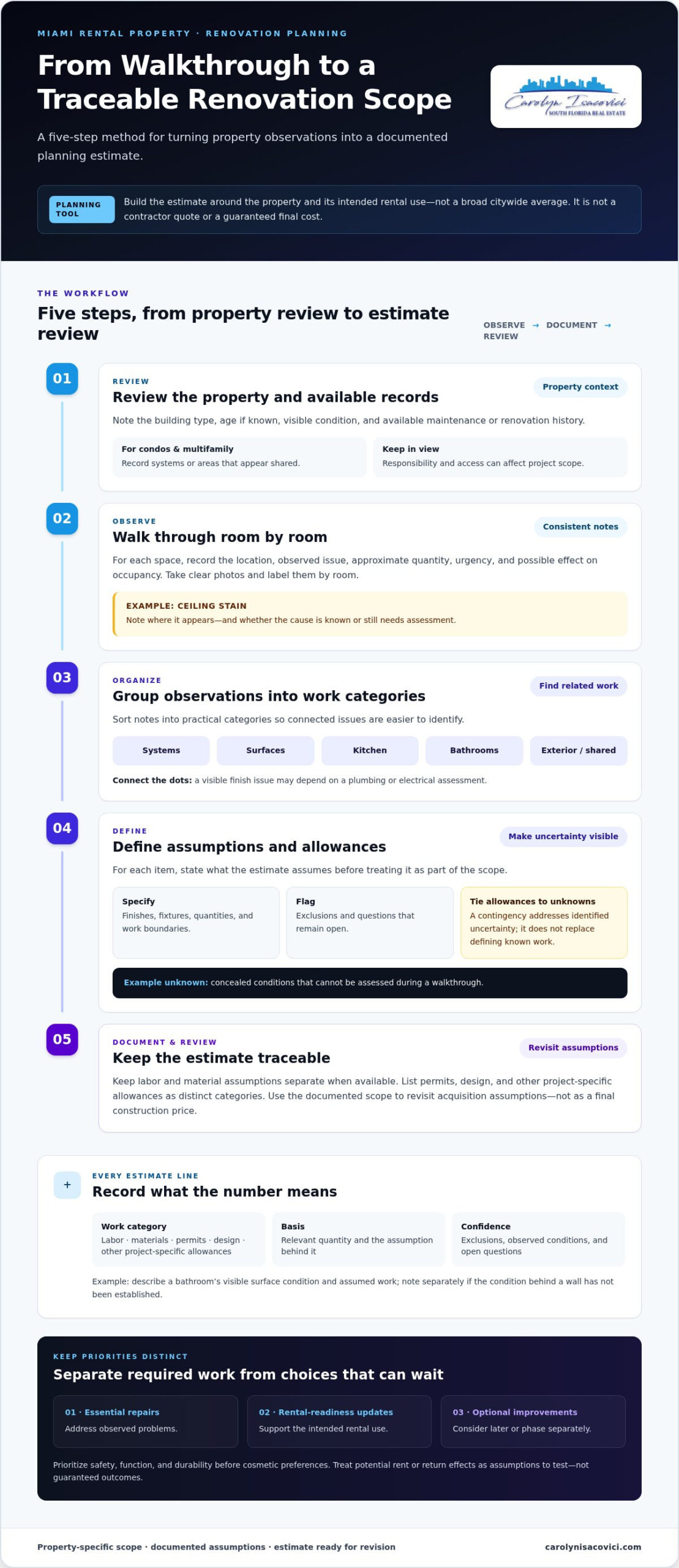
Turn observations into a traceable scope, then use that scope to test the acquisition assumptions. The phrase “estimating renovation costs for a rental property Miami” may sound like a search for one local number, but a useful estimate comes from a sequence of property-specific decisions.
- Review the property and available records. Note the building type, age if known, visible condition, and any available maintenance or renovation history. For condos and multifamily properties, record which systems or areas appear to be shared. Responsibility and access can affect what belongs in the project scope.
- Walk through room by room. Use a consistent record for each space: location, observed issue, approximate quantity, urgency, and possible effect on occupancy. Take clear photos and label them by room. For example, note where a ceiling stain appears and whether its cause is known or still needs assessment.
- Group observations into work categories. Sort items under systems, surfaces, kitchen, bathrooms, and exterior or shared areas. This makes related work easier to spot, such as a visible finish issue that may depend on a plumbing or electrical assessment.
- Define assumptions and allowances. Record assumed finishes, fixtures, quantities, work boundaries, exclusions, and open questions. A contingency is an allowance for identified uncertainty, not a substitute for defining known work. Tie each allowance to a specific unknown, such as concealed conditions that can’t be assessed during a walkthrough.
- Document and review the estimate. Keep labor and material assumptions separate when available, and list permits, design, and other project-specific allowances as distinct categories. Use the documented scope to revisit the acquisition analysis instead of treating the estimate as a final construction price.
Turn the property walkthrough into a defined scope
Not every observation means the same thing. A cracked tile is a visible condition; the cause of recurring dampness may need further assessment. Record each issue’s location, urgency, and potential effect on occupancy, then note whether the next step is defined work or investigation. The GAO’s review of how institutional investors adapted their single-family rental strategies is a reminder that investment decisions depend on market and property context, not renovation totals alone.
Make the scope specific enough to compare: “replace damaged flooring in the living room” is clearer than “update flooring.” If a quantity is approximate, label it that way. State what’s included and excluded so an assumption doesn’t quietly become an expectation.
Compare estimates on a like-for-like basis
Before comparing totals, align the work boundaries, quantities, finish assumptions, exclusions, and allowances. One estimate may include fixture replacement while another assumes the fixtures remain. The totals aren’t comparable until that difference is visible. Note missing categories or unusually broad allowances in the project records so you can account for them.
This process helps investors connect property condition with investment potential. For a broader acquisition perspective, investment-property acquisition guidance can help frame how renovation assumptions fit into a property comparison.
Which Miami property and project factors can change renovation assumptions?
Two properties with similar layouts can require different work plans. Building type affects access, responsibility for shared systems, and review procedures. Miami’s climate also makes moisture and storm exposure important inspection considerations. There is no single set of assumptions for every Miami rental property. Neighborhood names such as Brickell and Coral Gables are context, not cost proxies.
How building type and location affect the work plan
A condo may involve elevator or loading access, work-hour rules, common elements, and association review. In a multifamily building, clarify which systems and spaces serve multiple units and how work may affect residents or shared areas. A detached home has property-specific exterior components to assess, including its roof and windows. Treat each as a question about the individual property, not a blanket rule about its neighborhood.
Use the comparison below to turn those differences into estimate questions and due-diligence steps. The answers help clarify what belongs in the scope, what needs further review, and which assumptions remain open.
| Factor | Scope questions | Possible estimate effect | Due diligence |
|---|---|---|---|
| Condo access and association | Are there access limits, work-hour rules, common elements, or review procedures? | May affect work sequencing, scope boundaries, or planning allowances. | Review building documents and association requirements for the unit. |
| Multifamily shared systems | Which plumbing, electrical, mechanical, or exterior components serve more than one unit? | May change what work is unit-specific and what needs broader coordination. | Clarify system boundaries, access, and responsibility for shared areas. |
| Detached home and exterior | What is the condition of the roof, windows, and other relevant exterior components? | May add repair or investigation items beyond interior finishes. | Review available property records and assess visible exterior conditions. |
| Humidity, water, and storms | Are there signs of moisture, water intrusion, or storm-related wear? | Further investigation may expand the scope if concealed damage is found. | Prioritize relevant checks of moisture-prone areas, roofing, windows, and mechanical systems. |
| Permits and local requirements | Does the planned work require permits or other approvals? | May affect project scope, documentation, and schedule assumptions. | Verify requirements with Miami-Dade County or the relevant municipal authority. |
Climate, permits, and existing-condition uncertainty
Visible staining or damaged finishes can signal a concern without revealing its cause or full extent. Record the evidence, then distinguish confirmed repairs from conditions needing specialist assessment. Permit requirements depend on the work and applicable jurisdiction, so don’t base the estimate on a general rule. Verify current requirements with the relevant local authority, and list unresolved conditions as explicit questions in the acquisition review.
How to test whether the renovation budget fits the rental investment
A renovation estimate becomes more useful when you test what it means for the acquisition, not just whether the total seems manageable. Separate work needed before the property can be rented from improvements that can wait. Then test how the scope, potential vacancy, and unresolved inspection findings affect your assumptions. This won’t predict rent or returns, but it can show how much the decision depends on estimates that may change.
Compare essential, planned, and optional work
Classify each item by purpose. Safety and basic function can affect rental readiness; durability helps determine whether a finish or system suits expected use. Tenant appeal may inform the rental strategy, while personal preference can be considered separately. This keeps cosmetic choices from obscuring work that appears necessary before occupancy.
- Essential: Work tied to safety, function, or a condition that could prevent the intended use.
- Planned: Improvements that support durability or the property’s rental positioning.
- Optional: Cosmetic or preference-led updates that may be phased if the acquisition assumptions support them.
A finish upgrade might be attractive, but don’t assume it will justify higher rent or property value without relevant evidence. Record the expected benefit as an assumption to test, not a guaranteed result. The Florida investment property evaluation guide offers a broader framework for weighing a property’s condition against its investment potential.
Stress-test assumptions before deciding
Build at least two versions from documented scope items. A base scenario can include defined essential work and a realistic set of planned updates. A higher-scope scenario can show the effect of adding unresolved inspection findings or work that may be needed once conditions are better understood. Keep each change visible so you can see what drives the difference.
- Set the base case. Use the current scope, quantities, exclusions, and estimate confidence. Identify any condition that still needs assessment.
- Build the higher-scope case. Add plausible work tied to specific unknowns, rather than applying an unexplained blanket increase.
- Test timing. Consider how sequencing or a longer vacancy period could affect the acquisition plan and your expected cash flow.
- Keep categories distinct. Review renovation assumptions separately from ongoing operating expenses and financing assumptions, then consider them together in the investment analysis.
If the decision only works under the base case, note that sensitivity clearly. A disciplined approach to estimating renovation costs for a rental property Miami investors are assessing means understanding what could change, not treating a projection as a promise.
For an investment-property acquisition, discuss your property investment goals as part of comparing condition, scope assumptions, and potential.
Use a renovation estimate to make a more informed Miami rental-property decision
An estimate earns its place in an acquisition decision when it makes assumptions visible. Bring the scope, estimated costs, exclusions, open questions, and scenario comparisons together in one decision file. That record helps you see what’s known, what still needs investigation, and how much the investment case depends on unresolved conditions. It won’t replace property due diligence, but it can help identify where more information could change your view.
A concise pre-purchase renovation review
Before relying on the estimate, check that it reflects the property’s current observed condition and intended rental use. Keep confirmed work separate from allowances and unresolved questions. If an important assumption changes, revisit the acquisition analysis instead of carrying forward an outdated figure.
- Scope: Summarize proposed work by area or system, with quantities and stated assumptions.
- Estimate: Record amounts by work category, including allowances, exclusions, and confidence notes.
- Open items: List conditions needing further assessment, permit or association questions, and information still to obtain.
- Scenarios: Capture the base and higher-scope versions, noting which changes drive the difference.
This file also helps separate a property’s present condition from potential future improvements. A buyer comparing two rentals can consider whether one has more clearly defined work while the other carries larger unanswered questions. That distinction may matter even when a single estimated total makes the properties appear similar.
Connect renovation planning with investment-property selection
Renovation scope is one input in a broader acquisition comparison. Consider it alongside the property’s intended use, operating assumptions, and other due-diligence findings, without treating projected rent or returns as certain. Florida Commercial Investment Properties supports commercial and residential property sales and investment-property acquisitions in Miami, Miami Beach, Hollywood, Fort Lauderdale, Palm Beach, Palm Beach Gardens, Stuart, Jupiter, Palm City, Port St. Lucie, Fort Pierce, Vero Beach, and Melbourne.
Keep the decision file current as new information becomes available. If a suspected condition is confirmed, an approval question is resolved, or the planned scope changes, update the estimate and reconsider the acquisition assumptions. This creates a clearer basis for comparing opportunities without confusing a planning estimate with a final project cost or a substitute for full due diligence.
Estimating renovation costs for a rental property Miami investors are considering is ultimately part of deciding whether a property’s condition and potential align with their goals. Florida Commercial Investment Properties provides brokerage support for investment-property acquisitions and sales across Florida. If you’re exploring your next opportunity, explore Florida investment property opportunities.
Make your next property decision with greater clarity
A renovation estimate isn’t a verdict on a property. It’s a tool for deciding what you need to learn next, where uncertainty matters most, and whether the opportunity still fits your investment priorities as new information comes in. Keep assumptions open to revision and let the evidence guide your next step.
For investors estimating renovation costs for a rental property Miami, an estimate can also provide a useful comparison point across potential acquisitions. Consider the property’s condition alongside its broader investment case, without treating projected rent or future value as guaranteed. Florida Commercial Investment Properties supports residential, commercial, and investment-property sales, with brokerage guidance for evaluating and acquiring investment properties.
Ready to explore what may fit your goals? Explore Florida investment property opportunities and take your next step with a clearer sense of direction.
Frequently Asked Questions
How do I estimate renovation costs for a rental property in Miami?
Start with the property’s observed condition, then define the intended rental use and the work needed to support it. For estimating renovation costs for a rental property Miami investors should review room-level findings, confirm quantities where possible, and separate known work from conditions that still need assessment. For example, note whether an appliance is missing, visibly damaged, or simply older than preferred. Use the resulting estimate as an acquisition assumption, not a final price.
Is cost per square foot a reliable way to estimate a Miami rental renovation?
It’s useful for rough comparisons, but it isn’t reliable enough to price an individual property on its own. Two homes with the same floor area may differ in system condition, layout, finish choices, and access for work. A per-square-foot figure can help flag whether an early assumption seems unusually high or low, but define the actual scope before relying on it in an offer or investment analysis.
What renovation items should I include in a rental-property budget?
Include costs tied to getting the property into the condition you intend to rent, plus project needs that can be easy to miss. Depending on the scope, consider appliance replacement, debris removal, temporary protection, inspections or assessments, and required documentation alongside visible work. Record recurring maintenance separately from one-time renovation items so you don’t treat every property expense as part of the same project total.
Do Miami rental-property renovations require permits?
Some projects may require permits, but the answer depends on the specific work and the property’s jurisdiction. A cosmetic change and an alteration involving building systems may be treated differently, so don’t assume all renovations follow the same approval path. Before finalizing the project budget, identify the work being considered and verify applicable requirements with Miami-Dade County or the relevant municipal authority. Condo or association review may also be a separate consideration.
How should I budget for unexpected repairs in an older Miami rental property?
Don’t rely on an arbitrary cushion to cover every unknown. First identify where the property’s age or visible condition raises unanswered questions, such as aging equipment or signs of prior moisture. Keep those items separate from confirmed repairs, then consider how different outcomes would affect the acquisition decision. If an important condition remains unassessed, reflect that uncertainty directly instead of presenting a single precise-looking total.
Can renovation costs affect whether a Miami rental property is a good investment?
Yes. Renovation assumptions can change how a property compares with alternatives and how much uncertainty you’re accepting before rental operations begin. Assess the work alongside expected rent, vacancy, ongoing expenses, and your investment criteria, but don’t treat projected income or returns as guaranteed. A property with a larger scope isn’t automatically a poor investment. The key is whether the assumptions remain reasonable when you account for known work and unresolved conditions.
What should I compare when reviewing renovation estimates for a rental property?
Compare the work included, quantities, finish assumptions, exclusions, and allowances, not just the bottom-line totals. Check whether each estimate addresses the same rooms and systems. For example, one may include appliance installation while another excludes it, creating a misleading price difference. Also note whether labor and materials are itemized and how uncertain conditions are treated. A clear comparison makes gaps visible before you use the figures in your acquisition analysis.
Leave a Reply