The right turnkey investment property for sale in Florida is the one that fits your rental strategy, not simply the one with the lowest asking price.
Purchase price matters, but property type, location, and ownership approach also shape how an investment fits your goals. A residential rental and a commercial property involve different considerations, and South Florida markets offer distinct options to explore.
This guide explains how to find and compare turnkey rental properties, including Florida listings, and how individual and institutional ownership approaches differ. You’ll also consider markets such as Miami, Fort Lauderdale, and Palm Beach to build a clearer framework for your next investment decision.
Key Takeaways
- Compare turnkey listings by property type and rental strategy, not asking price alone; location and ownership costs also shape the fit.
- Individual ownership and institutional ownership operate at different scales, so consider which approach aligns with your investment goals and capacity.
- South Florida listings include varied property types; assess property details alongside projected rental performance to narrow your options.
- Markets such as Miami, Fort Lauderdale, and Palm Beach differ, making a location-by-location comparison useful when choosing where to invest.
How to Find Turnkey Investment Properties For Sale?
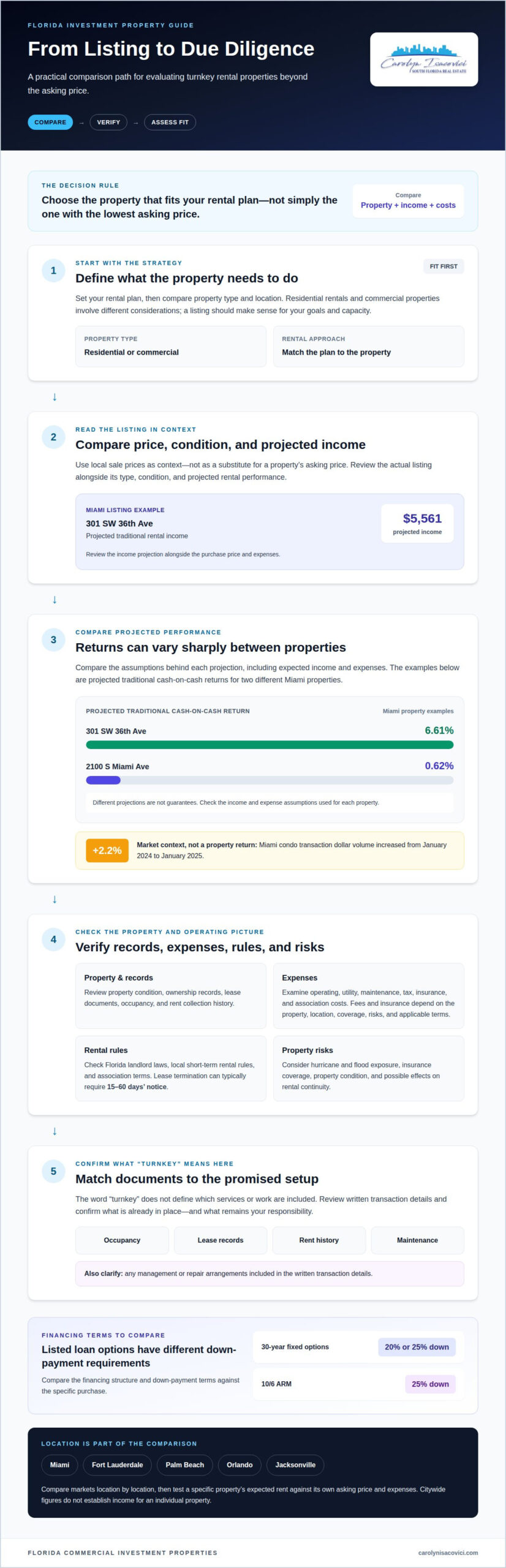
A turnkey investment property for sale in Florida should fit your rental plan, not just your budget. Compare the property, potential income, and ownership costs before deciding whether a listing suits your goals.
Listings and Asking Prices
Use local sale prices as context, not as a substitute for a property’s asking price. These figures describe different market measures. For a turnkey investment property for sale in Florida, compare the actual listing price with the property type, condition, and projected rental performance.
A listed Miami property at 301 SW 36th Ave has projected traditional rental income of $5,561. Review its income projection alongside the purchase price and expenses.
Rental Yields and Property Prices
Price alone can’t show whether a rental is financially suitable. The Miami property at 301 SW 36th Ave has a projected traditional cash-on-cash return of 6.61%, while 2100 S Miami Ave has a projected traditional cash-on-cash return of 0.62%. These examples demonstrate how projected returns can differ between properties and rental approaches. Compare the assumptions behind each projection, including expected income and expenses.
Miami condo transaction dollar volume increased by 2.2% from January 2024 to January 2025. This market indicator is useful context, but it doesn’t establish a specific property’s return.
Due Diligence and Investment Risks
Before purchasing, review property condition, ownership records, lease documents, and projected operating expenses. What landlord laws and short-term rental rules apply in Florida? Lease termination can typically require 15-60 days’ notice; short-term rental permissions may also depend on local rules and association terms.
What taxes, insurance, and HOA fees apply? Property taxes vary by property and location, insurance costs depend on coverage and property risks, and association fees follow the applicable terms. Include these expenses in your analysis. What risks affect rental investments, including hurricanes and flooding? Consider storm exposure, flood risk, insurance coverage, and potential effects on property condition and rental continuity. Compare these factors with projected income before proceeding.
Individual and institutional rental property ownership
Ownership scale shapes how investors buy, operate, and evaluate rental properties. Individual buyers and institutions can pursue different strategies, even within the same Florida market.
In the United States, investors owned and rented about 18.2 million one-unit homes in 2017. Those homes provided housing for about 42 percent of the nation’s 43 million renter households. In 2019, about 14.7 million households rented single-family homes, representing 45.2 million residents. These figures show the substantial role individual rental homes play in housing.
Institutional ownership is a smaller part of that landscape: institutions owned 200,000 U.S. single-family homes, or 0.2 percent of more than 90 million single-family units. Individual ownership may suit investors seeking direct control over a property, while larger organizations can hold portfolios. Neither approach guarantees an exceptional return; property selection, operating expenses, and rental demand matter.
What does “turnkey” include? The term alone doesn’t specify which services or work come with a property. Review the written transaction details for occupancy, lease records, rent collection history, maintenance information, and any management or repair arrangements. These records help establish what is already in place and what remains part of ownership.
Jacksonville offers a useful affordability comparison. Compare expected rent with the specific property’s expenses rather than treating citywide rent as a property-level forecast.
How can you verify occupancy, rent, and expenses? Match lease documents with payment records, confirm occupancy during the property review, and examine utility, maintenance, tax, insurance, and association expenses. For investor-friendly rental property loans, compare the financing structure and down payment terms: listed 30-year fixed options require 20% or 25% down, depending on the option, while a 10/6 ARM requires 25%. The right fit depends on the purchase and financing terms.
Turnkey investment property listings in Orlando
Orlando listings span several property types and price points. These examples show why comparing properties by type and intended use matters as much as comparing asking prices.
Inventory can also be presented by community. One investment-property listing shows 74 available properties across 6 communities, giving buyers multiple locations and housing types to consider. Treat each listing as a starting point: review its property details, occupancy information, rental assumptions, and ownership costs before judging how it fits your plans. A listing’s investment label alone doesn’t establish that it is turnkey or indicate which services are included.
For clients looking closer to our primary service area, Florida Commercial Investment Properties also tracks opportunities in South Florida markets, which offer a different set of possibilities. Property type, location, and asking price provide useful comparison points, but rental assumptions still need property-level review.
Explore listings in Florida cities and towns across our core coverage regions. These examples span different scales, from a duplex to multifamily housing. Compare each property’s intended rental use and relevant expenses before weighing its potential against other listings.
Florida investment property markets
Florida’s cities offer different combinations of asking prices, rents, and property types. Compare each market with your rental plan rather than assuming one statewide trend describes every investment.
Buyers can use those figures as market context, then assess whether a specific property’s expected rent supports its price and expenses. A citywide rent figure doesn’t establish income for an individual home.
Together, those figures help frame local affordability and rent levels, but they don’t replace property-specific calculations. Compare expected rent with ownership costs and the property’s condition.
Key West has a distinct listing profile. Last month, the market had 66 condos, 47 townhouses, and 28 multi-family units for sale. Buyers can use this mix to compare property formats and listing activity, while recognizing that asking prices and time on market vary by property.
Pensacola vacation rental room rates rose by 8.7% to $164.84 as of January 2025, a different measure that shouldn’t be treated as a long-term home rental rate. Gainesville’s median sale price increased by 21.3% from February 2023 to February 2024. These city-level contrasts show why buyers should match each data point to its property type and rental strategy.
Compare Florida markets by intended rental use, property type, and local price and rent context. Explore Florida investment property options as you narrow your target market.
Florida Commercial Investment Properties
Florida Commercial Investment Properties helps buyers explore Florida real estate opportunities and investment property acquisitions. If you’re weighing a residential rental against a commercial asset or new construction, the firm’s sales offerings provide a way to consider those property types in light of your investment goals.
Turn to Florida Commercial Investment Properties when you’re ready to discuss an acquisition, compare property options, or move forward with a real estate purchase. The firm handles investment property sales, residential real estate sales, commercial property sales, and new construction homes. Share the property type and investment approach you’re considering to focus the conversation on relevant opportunities.
Contact Florida Commercial Investment Properties to discuss your Florida investment property plans.
Make Your Next Investment Move
A considered investment begins with a clear picture of what you want ownership to look like. Before moving forward, define the role you want the property to play, the level of involvement you’re comfortable with, and the trade-offs you’re prepared to manage. Those priorities can help you avoid turning a promising listing into a mismatched purchase.
For a turnkey investment property for sale in Florida, connect your goals with the right property type and acquisition approach. Florida Commercial Investment Properties can help you explore real estate opportunities that align with your plans, whether you’re shaping an investment strategy or ready to discuss a specific acquisition.
Start a focused conversation about your objectives and the kind of property you’re considering. Contact Florida Commercial Investment Properties to discuss your next step, and move forward with a clearer sense of direction.
Frequently Asked Questions
What does turnkey investment property mean in Florida?
A turnkey property is presented as ready for an investor to rent or operate, but the label alone doesn’t define what work or services are included. A listing may describe a home as turnkey while the buyer still needs to review its lease, condition, and operating arrangements. Clarify the property’s actual occupancy and responsibilities before treating it as ready to generate rental income.
Where in Florida are turnkey rental properties for sale?
Turnkey rental listings appear in Florida markets including Orlando, Ocala, Palm Coast, Key West, and Stock Island. Options can range from a single-family home to a duplex or multifamily property. For example, the listed duplex at 13 Unique Ct. in Palm Coast offers a different ownership format from the Saddlewood multifamily property in Ocala. Compare locations and property types with your intended rental strategy.
What are current prices for turnkey investment properties in Florida?
Asking prices vary by location, property type, and scale. These are prices for specific listings, not a statewide price range.
What rental income and cap rates do Florida turnkey properties offer?
Projected rental income and returns vary by property and rental approach. The Orlando listing at 1025 S Hiawassee Rd #2226 shows projected traditional rental income of $1,427 and a projected traditional cash-on-cash return of 5.91%. Cash-on-cash return is not the same measure as cap rate. Compare income projections with operating costs, then assess the calculation method before using it to compare properties.
What are the best Florida cities for turnkey rental property investing?
The best fit depends on your target property and rental strategy, not on one city ranking highest for every buyer. Compare each market’s property mix, asking prices, and likely expenses before choosing.
What financing options are available for Florida investment properties?
Financing options in the available examples include 30-year fixed loans and a 10/6 adjustable-rate mortgage. The listed 30-year fixed options require a 20% or 25% down payment, depending on the option; the 10/6 ARM requires 25% down. These terms are examples, not a recommendation. Compare payment structure, down payment, and how the financing fits the property’s expected rental income.