
The lowest asking price can be the least attractive deal. When searching for distressed commercial properties for sale Miami buyers need to look beyond the apparent bargain: Can you gain control, understand the repair scope, and identify a credible path to income?
Financial distress, foreclosure, and physical deterioration are different conditions, and each can bring its own risks. A low price may still come with costly repairs, title complications, tenant concerns, or operating issues. In Miami, flood exposure, zoning, and property records also deserve careful review before you move forward.
This 2026 guide explains how to identify opportunities that fit your goals and assess each one using consistent criteria. You’ll learn what to review, how local factors can shape a property’s potential, and how to move from an initial look to a clear purchase plan. The aim is simple: pursue a distressed property only when control, repair scope, and income potential align.
Key Takeaways
- Distress can take several forms. Identify what’s driving a property’s situation before judging its potential.
- Use a consistent review sequence, from intended use and property records to condition and income. Separate verified facts from claims that need checking.
- Compare distressed commercial properties for sale Miami with stabilized alternatives based on condition, occupancy, diligence needs, and fit for your goals.
- Organize due diligence around the property, title, finances, land use, and transaction documents. Sale procedures can vary depending on how the property is being sold.
- Turn your goals, risk tolerance, and diligence capacity into a focused search brief, then use commercial brokerage guidance to assess opportunities through the purchase process.
What Makes a Commercial Property Distressed in Miami?
A distressed commercial property faces financial, legal, physical, occupancy, or operating pressure that may affect its value or use. Distress is a reason to investigate, not proof of a bargain. A building that needs cosmetic updates may be in sound working order, while a property with a low asking price may have deeper issues that aren’t obvious during a first visit.
For buyers considering distressed commercial properties for sale Miami, start by identifying the specific signal and the evidence that could clarify it. Different problems call for different questions:
- Financial pressure: A seller may be under financial strain, but the buyer still needs to assess the property and transaction. Don’t assume the seller’s circumstances create value.
- Foreclosure: A foreclosure indicates a lender-related legal process. Review the sale terms and property information rather than treating foreclosure status as a measure of investment quality.
- Vacancy: Empty space may point to leasing challenges, a planned transition, or a temporary gap. Examine occupancy history, current condition, and realistic demand for your intended use.
- Deferred maintenance: Visible wear or overdue upkeep can range from manageable repairs to issues that affect building function. Inspection findings help define the scope.
- Operational underperformance: A property may be occupied yet produce weak results because of expenses, lease terms, or how it’s operated. Review operating records and tenant arrangements where available.
These signals can overlap, but they aren’t interchangeable. A vacant building may be physically sound; a fully occupied one may need substantial work. Keep observable facts, seller representations, and items requiring professional or official verification separate. This helps prevent assumptions from becoming part of your investment calculation.
Financial distress, foreclosure, and physical distress are not interchangeable
The owner’s financial position and the building’s condition are separate questions. A seller’s urgency doesn’t establish that repairs are needed, and a neglected building doesn’t reveal why the owner is selling. Foreclosure describes the transaction context, not whether the property fits your plans. Focus on verifiable property details, sale documents, and inspection evidence. Treat claims about financial pressure as claims until they’re supported.
Why Miami location and property context matter
Miami is a varied commercial market, so an asset’s suitability depends on its specific location and intended use. Access for customers, employees, deliveries, or tenants can matter, as can nearby uses and flood exposure. Miami-Dade County records can help establish parcel and property details. Check zoning, flood mapping, and permitting information against current official sources.
Location context changes the questions. A site that works for one business or investment plan may not suit another, even if the buildings appear similar. Consider whether the location, access, surrounding environment, and verified land-use information support your intended use. Florida Commercial Investment Properties supports commercial and investment property sales in Miami and other local markets, including Miami Beach, Hollywood, Fort Lauderdale, Palm Beach, Palm Beach Gardens, Stuart, Jupiter, Palm City, Port St. Lucie, Fort Pierce, Vero Beach, and Melbourne. The goal isn’t to label every challenge a dealbreaker. It’s to understand what each signal means before deciding whether the opportunity is worth pursuing.
How to Evaluate a Distressed Commercial Property in Miami
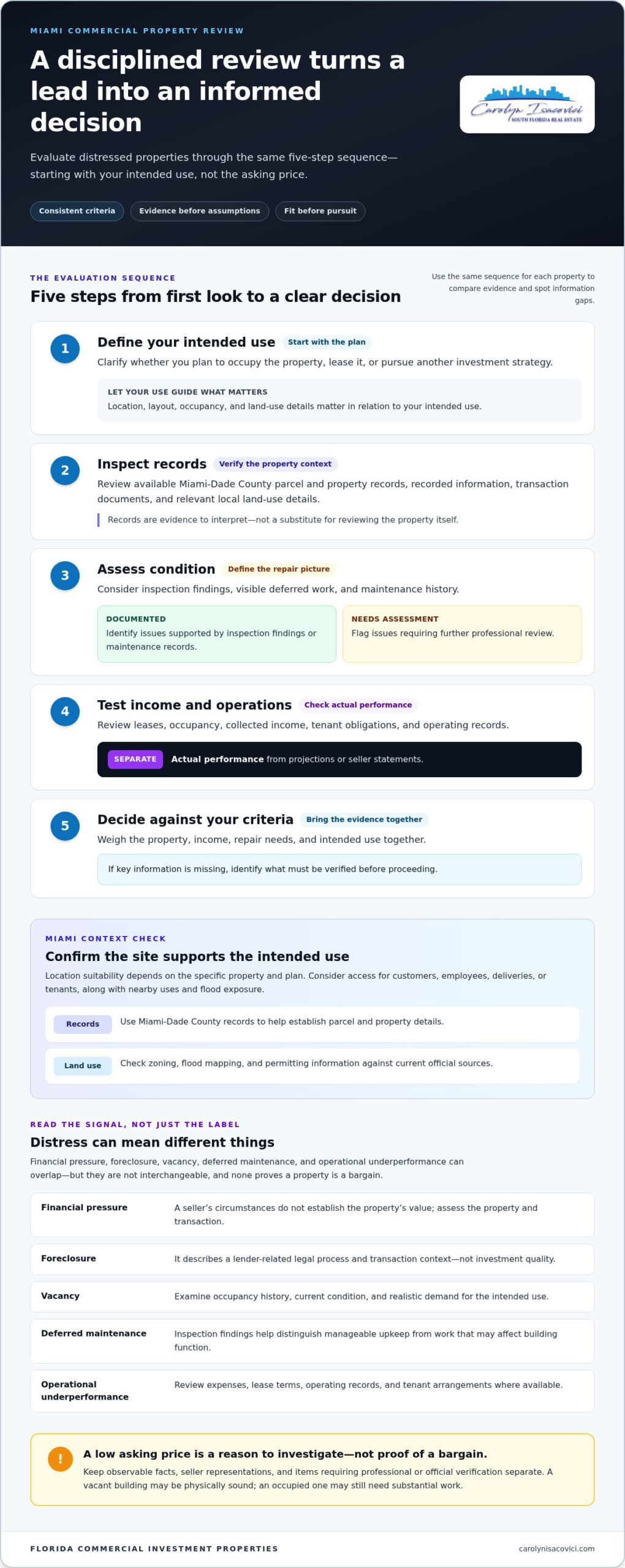
A disciplined review turns a promising lead into an informed decision. For distressed commercial properties for sale Miami, don’t begin with the asking price alone. Work through the same sequence for each property so you can compare evidence, identify gaps, and decide whether the opportunity fits your intended use and capacity to address its risks.
- Define your intended use. Clarify whether you plan to occupy the property, lease it, or pursue another investment strategy. Your intended use shapes which location, layout, occupancy, and land-use details matter most.
- Inspect records. Review available Miami-Dade County parcel and property records, recorded information, transaction documents, and relevant local land-use details. Treat records as evidence to interpret, not a substitute for reviewing the property itself.
- Assess condition. Consider inspection findings, visible deferred work, and maintenance history. Identify which issues are documented and which require further professional assessment.
- Test income and operations. Compare leases, occupancy, collected income, tenant obligations, and operating records. Distinguish actual performance from projections or seller statements.
- Decide against your criteria. Weigh the property, income, repair needs, and intended use together. If key information is missing, determine what must be verified before you proceed.
Review property condition, leases, and operating information
Look beyond surface appearance. Inspection findings and maintenance records can help reveal whether visible work is routine upkeep or part of a broader repair need. For an occupied asset, review lease terms, vacancy, tenant responsibilities, and evidence of income collected. Compare operating statements with assumptions about future performance. Gaps or inconsistencies call for additional diligence, not optimistic guesswork.
Test Miami-specific records and property constraints
Use Miami-Dade County property records to review parcel details and recorded information, then check applicable zoning and permitted uses with the relevant local jurisdiction. Review the property on FEMA flood maps and consult current local records as well. Mapping and land-use information can change or require interpretation, so verify the details that matter to your plan before relying on them.
Keep three categories separate as you build your assessment: known facts supported by records or inspection findings, seller representations that describe the property or its performance, and items requiring verification through appropriate professional review or official sources. This makes it easier to see what you know, what you’ve been told, and what remains unresolved.
Distress alone cannot establish investment value; value depends on verified condition, realistic income potential, and fit with your intended use. If the property’s fundamentals still look promising, commercial brokerage guidance can help you structure the opportunity review and understand the sales process. Florida Commercial Investment Properties provides brokerage support for commercial property sales and investment property acquisitions.
How to Compare Miami Distressed Properties With Other Opportunities
Don’t judge a distressed asset against an idealized version of itself. Compare it with stabilized commercial properties and other available opportunities using the same criteria, then ask which one best fits your intended use and ability to manage uncertainty. A lower asking figure alone doesn’t show the full acquisition exposure. Repair needs, vacancy, operating responsibilities, title matters, and transaction requirements can all affect the decision.
Use a side-by-side framework to make differences visible rather than relying on the distress label:
| Comparison factor | Distressed opportunity | Stabilized property |
|---|---|---|
| Purchase rationale | Potential to address a specific problem or reposition the asset. Identify what creates the opportunity. | Existing operations may support a more immediate-use strategy. Verify how sustainable they are. |
| Condition | Repair scope may be uncertain or require further assessment. Separate visible work from verified needs. | Current condition may be more established, but ongoing maintenance still matters. |
| Occupancy | Vacancy or tenant changes may affect income and the plan for the space. | Existing tenants can provide continuity, subject to lease terms and actual performance. |
| Diligence needs | There may be more open questions about records, title, repairs, or operations. | Records still need review, including leases, expenses, and property information. |
| Intended use | Consider whether your plan depends on repairs, leasing, or a change in how the property operates. | Assess whether existing uses and operations align with your goals. |
Compare the complete investment case, not the distress label
Compare potential income and vacancy alongside repair scope and expected operating responsibilities. A property with tenants may still require careful review of lease obligations and collected income, while a vacant building may need a leasing plan before its potential can be assessed. Include title or transaction concerns where they apply. Mark projections as assumptions, not assured outcomes, and identify which assumptions would most change your decision if they prove wrong.
Match the property to your acquisition strategy
Are you seeking an asset with current operations, or are you prepared to manage repairs, leasing, and repositioning? Neither approach is inherently better. The right fit depends on intended use, the ownership role you’re ready to take on, and how much uncertainty your plan can absorb. If the plan relies on several unverified assumptions, consider whether you have the time and capacity to resolve them before committing.
For broader acquisition context, explore this Florida commercial real estate investor’s guide. Readers weighing wider property metrics can also use the Florida investment property evaluation guide to frame their comparison. For distressed commercial properties for sale Miami, a consistent framework helps turn competing options into a clearer choice based on evidence, fit, and manageable risk.
Miami Due Diligence and Purchase Steps for Distressed Commercial Real Estate
Good due diligence is organized, not improvised. For distressed commercial properties for sale Miami, build a property file that makes it easy to see what’s documented, what needs professional review, and what could affect your decision. The exact scope depends on the asset and sale method, so coordinate qualified legal, inspection, environmental, and financial professionals where appropriate.
Build a diligence file before making a commitment
Start collecting available records as early as possible. A shared checklist can keep separate workstreams moving and make missing information visible. Review findings in context: an incomplete record isn’t proof of a problem, but it does mean an assumption shouldn’t be treated as established fact. Focus diligence on questions that could change your intended use, operating plan, or decision to proceed.
- Property: Gather inspection materials, maintenance history, permits, and available building records. Compare documented work with visible conditions, and identify areas requiring further inspection.
- Title and recorded documents: Assemble available title information and recorded documents. Have appropriate legal professionals review matters that could affect ownership, access, use, or the transaction.
- Financial: Request available leases, income and expense records, and tenant information. Compare reported figures with supporting records and distinguish collected income from projections or verbal claims.
- Land use and environmental: Review applicable zoning, permitting, environmental information, and any constraints tied to the property’s intended use. Verify local records with the relevant authorities and use qualified professionals to assess technical findings.
- Insurance: Investigate insurance considerations specific to the building and location. Clarify what information is available and how unresolved property conditions could affect your ownership plan.
- Transaction documents: Keep offers, disclosures, sale terms, deadlines, and related correspondence together. Track which conditions or access arrangements are set out in writing.
Gaps deserve attention, but not guesswork. Note the question, who can assess it, and whether the answer is needed before a commitment or closing. This creates a practical way to prioritize diligence instead of treating every unknown as equally urgent.
Understand the route from offer to closing
In a negotiated purchase, contract terms define key deadlines, contingencies, and property access. Auction and lender-related sales may use different procedures, documents, and timelines. Don’t assume buyer protections match those in a negotiated transaction. Confirm the current requirements for the specific property and sale method, then align inspections, record reviews, and professional input with the actual diligence window.
As information comes in, update your assessment and resolve material questions before moving ahead. Brokerage guidance can help structure an opportunity review and keep the commercial sales process in view. Discuss a Miami commercial property search when you’re ready to consider a focused acquisition plan.
Find and Pursue the Right Distressed Commercial Property in Miami
A focused search starts with your plan, not a listing. Before pursuing distressed commercial properties for sale Miami, decide what you want the property to do for you and how much time and uncertainty you can manage. That clarity helps narrow the field and makes it easier to assess new opportunities against the same priorities.
Prepare a focused Miami acquisition brief
Write down your preferred property type, target areas, intended use, and practical operating requirements. Consider access needs, space configuration, occupancy preferences, and whether you expect to operate the property or oversee an investment. Set criteria for condition, information gaps, and the level of uncertainty you’re prepared to accept.
- Must-haves: Define the features and location factors essential to your plan.
- Flexible criteria: Identify preferences that could change if the property offers a strong fit elsewhere.
- Condition and occupancy: Decide what level of repair or vacancy aligns with your resources and timeline.
- Diligence capacity: Consider the records, assessments, and follow-up you can realistically manage.
- Decision boundaries: Note which unresolved issues would pause or rule out a purchase.
Keep the brief specific enough to guide the search, but flexible enough to compare unlike opportunities objectively. A vacant property and an occupied building may each merit review for different reasons. Your criteria make the comparison about fit, not simply which listing looks most compelling at first glance.
Move from property search to informed next steps
Once your priorities are clear, use them to assess each opportunity and decide what deserves further review. Florida Commercial Investment Properties provides commercial and investment property brokerage, helping organize the search, consider transaction fit, and guide you through the commercial property sales process toward a potential purchase.
Carolyn Isacovici leads Florida Commercial Investment Properties and specializes in the Florida market. Her local-market focus brings context to a Miami search as you evaluate options and plan next steps. A property’s fit still depends on your goals and review of the relevant information.
Bring a target area, property type, and investment objective to start a focused conversation about your acquisition priorities. Discuss your Miami commercial property goals.
Take the Next Step With a Clear Acquisition Plan
The right opportunity is one that fits both your commercial goals and the way you’re prepared to own and operate a property. As you consider distressed commercial properties for sale Miami, turn your priorities into a practical brief: define your target area, property type, intended use, and the information you’ll need to make a confident decision. That gives each new opportunity a useful point of comparison and helps keep the search focused.
Florida Commercial Investment Properties provides commercial and investment property brokerage, with sales support for commercial properties across Florida. Led by Carolyn Isacovici, a Florida real estate professional, the brokerage can help you structure a Miami search and consider transaction fit as you move toward a potential purchase.
Ready to put your goals into motion? Discuss your Miami commercial property goals and take a thoughtful next step toward an opportunity that fits your plans.
Frequently Asked Questions
Is a distressed commercial property always in foreclosure?
No. A commercial property may be described as distressed because of financial pressure, vacancy, deferred maintenance, or operating difficulties, while foreclosure is a specific legal process. A property can have one issue without the others. Before relying on a foreclosure label, check reliable records and transaction documents for the property’s actual status. Then assess the building and its investment potential independently, rather than treating the sale circumstances as proof of a good opportunity.
How much below market value are distressed commercial properties in Miami?
There’s no dependable, fixed discount for distressed commercial properties for sale Miami. An apparent price gap depends on the individual asset, its condition and occupancy, title matters, seller circumstances, and sale method. Compare the full acquisition assumptions, including potential repairs and operating needs, instead of relying on a market-wide percentage. For example, a lower asking figure may be less compelling if key records are missing or the property’s income depends on unverified assumptions.
Can an out-of-state investor buy a distressed commercial property in Miami?
Yes, an out-of-state investor can pursue a Miami commercial acquisition, but distance calls for deliberate local coordination. Before proceeding, map out who will gather property information, arrange access, review operating records, and track transaction deadlines. For instance, a remote buyer should plan how inspection findings and time-sensitive documents will reach them promptly. Build a qualified team and confirm the legal, tax, and other professional considerations that apply to your circumstances.
Can I inspect a distressed commercial property before buying it at auction?
Possibly, but access depends on the property, auction process, and stated terms. Don’t assume you can enter the building or complete the same review available in a negotiated sale. Before bidding, establish what inspection access and records are offered, note any deadlines, and decide how you’ll handle questions that can’t be resolved beforehand. If important unknowns remain, consider whether you’re comfortable making a commitment without answers.
What happens to existing tenants when a distressed commercial property is sold?
Existing tenant arrangements may affect a buyer’s plans, but a sale alone doesn’t establish which obligations or rights continue. Review leases, amendments, payment history, and any documents describing tenant responsibilities or access. For example, a space that appears occupied may have terms that differ from what a brief listing description suggests. Have qualified guidance review the relevant documents, and don’t count uncertain rent or assumed vacancy timing as established income.
Do distressed commercial property listings include building and financial records?
Not always. The information provided varies by property and sale process, and a listing description isn’t independent verification of condition, income, or legal status. Make a document request list that fits your decision, such as leases, operating statements, permits, or inspection materials, then track what arrives and what remains unavailable. If a missing record affects your plans, treat that as an unresolved question and account for it before deciding how to proceed.
Can I negotiate directly with a lender on a distressed commercial property?
Sometimes, but don’t assume a lender controls or negotiates every distressed-property sale. The seller, decision-maker, and offer process depend on the specific transaction. First establish who has authority to consider an offer and how proposals must be submitted. A commercial brokerage can help organize the acquisition discussion and sales steps, while qualified legal and financial professionals can address their respective areas. This helps keep roles clear as the transaction moves forward.
Should I buy a distressed commercial property without visiting Miami?
You can evaluate an opportunity remotely, but listing photos and summaries can’t answer every property or neighborhood question. Arrange suitable local inspection access, review available records, and learn how the immediate surroundings relate to your intended use. If you can’t visit, arrange for qualified local professionals to document relevant findings and communicate issues promptly. Set a clear process for reviewing evidence before making a commitment, especially if access or records are limited.
Leave a Reply