Tag: Cap Rates

  • Tampa Commercial Property: 2026 Investor’s Strategy Guide

    Tampa Commercial Property: 2026 Investor’s Strategy Guide

    Did you know that Tampa has climbed to the number seven spot among U.S. metros for investment intentions in 2026? It’s a remarkable rise that explains why the search for commercial property for sale Tampa has reached a fever pitch. You’ve likely felt the weight of information overload from endless listing sites lately. Is it truly possible to identify a high-yield asset without the constant fear of overpaying in such a competitive market? We believe the answer is a definitive yes.

    This guide provides the steady, expert insights you need to navigate the competitive Tampa commercial market and transform uncertainty into opportunity. We’ll examine the 2026 zoning landscape together, evaluate essential metrics like Cap Rates and NOI, and break down the rigorous due diligence required for Florida acquisitions. You’ll gain a clear roadmap to connect with opportunities that prioritize investment metrics over simple sales. Let’s move past the noise and focus on the clarity required for your next successful move.

    Key Takeaways

    • Identify why the I-4 corridor remains a powerhouse for logistics and how these infrastructure shifts create unique openings for savvy investors.
    • Navigate the selection process for high-performing asset classes, specifically focusing on the resilience of industrial flex space and multi-family housing.
    • Pinpoint the high-growth neighborhoods currently defining the market, from the luxury tech hubs of Water Street to the established corporate strength of Westshore.
    • Streamline your search for commercial property for sale Tampa by applying a rigorous acquisition roadmap that prioritizes yield requirements and precise financial pre-qualification.
    • Learn how to leverage the insight of a seasoned advisor to access off-market opportunities and navigate the complexities of Florida’s specific due diligence standards.

    The Tampa Commercial Real Estate Landscape in 2026

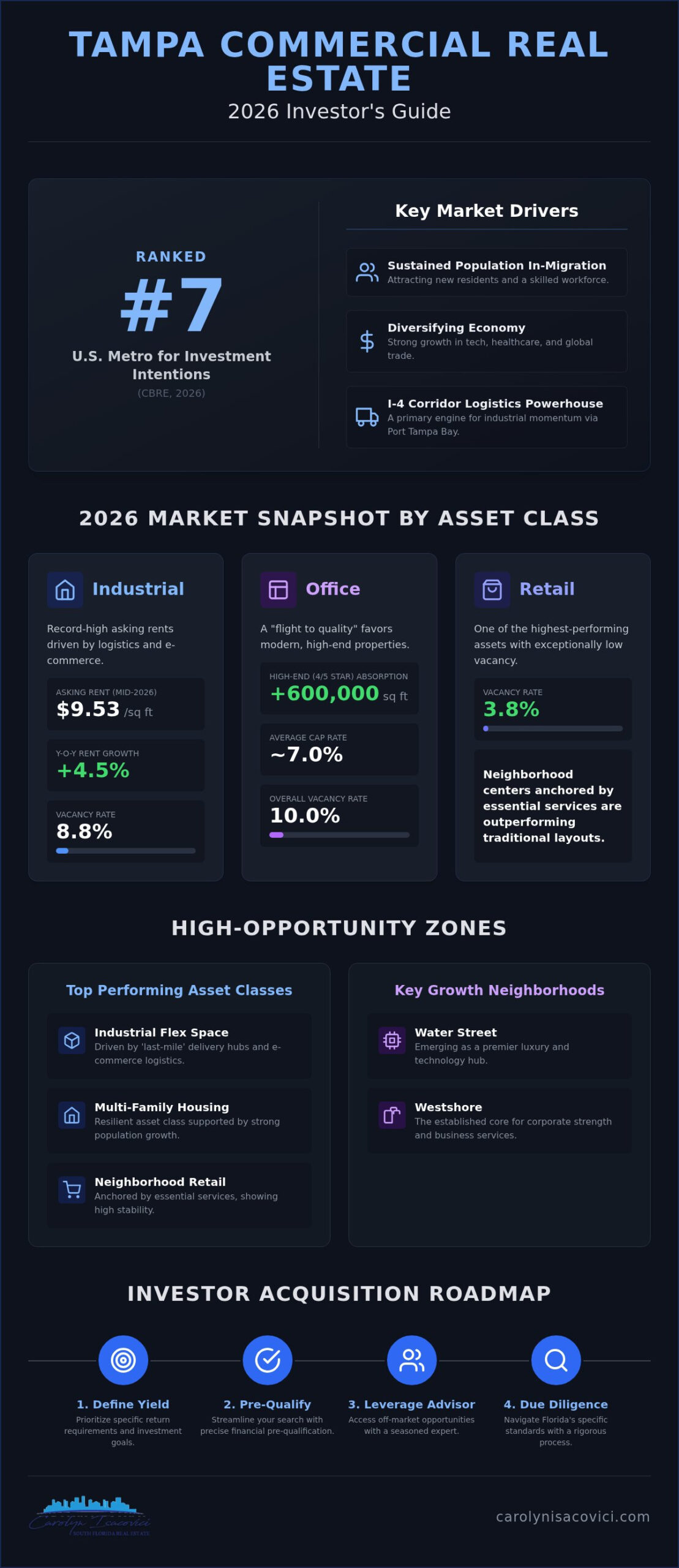
    Why has Tampa become such a magnetic force for capital in 2026? It’s simple. The city now ranks as the number seven metro in the United States for investment intentions according to CBRE data. This isn’t just a fleeting trend. It’s the result of sustained population in-migration and a diversifying economy. When you look for commercial property for sale Tampa, you aren’t just buying a building; you’re investing in one of the nation’s most resilient growth stories.

    The I-4 corridor remains a primary engine for this momentum. Industrial asking rents hit a record high of $9.53 per square foot in mid-2026, marking a 4.5% year-over-year increase. While other markets struggle with oversupply, Tampa’s industrial vacancy sits at a healthy 8.8%. This stability is reassuring for investors who want predictable returns in a shifting global economy.

    Tampa’s Economic Drivers: More than Just Sunshine

    What keeps the local economy moving beyond tourism? Port Tampa Bay serves as a massive catalyst for industrial real estate demand, acting as a gateway for global trade that requires extensive warehousing support. Additionally, the tech sector’s migration to Tampa, Florida has created a specific appetite for modern workspace. While the overall office vacancy is 10.0%, high-end 4 and 5-star properties saw a positive absorption of 600,000 square feet over the past year. This flight to quality shows that businesses are willing to pay for premium environments. Healthcare infrastructure expansion also plays a vital role, providing a recession-resistant anchor for retail and office assets near major medical hubs.

    2026 Market Outlook: Stability vs. Growth

    Are we entering a period of stagnation? Not at all. We view the current climate as a transition from rapid acceleration to healthy stabilization. In 2026, office cap rates average around 7.0%, while retail remains incredibly tight with a vacancy rate of only 3.8%. This makes retail one of the highest-performing asset classes in the region.

    While interest rates continue to influence deal structures, the underlying demand remains robust. Institutional investors are increasingly pivoting toward Tampa’s secondary markets as they seek higher yields compared to the compressed cap rates found in South Florida hubs like Miami. It’s a strategic shift that rewards those who look beyond the obvious listings. Success here requires a steady hand and a focus on income-producing assets that can weather any cycle.

    Evaluating Tampa Asset Classes: Where to Place Your Capital

    Which asset class offers the most resilience in today’s market? While the answer depends on your specific yield goals, 2026 is rewarding investors who prioritize functional, high-demand spaces. The search for commercial property for sale Tampa often starts with a broad net, but the most successful portfolios are currently narrowing their focus. We’re seeing a distinct evolution in retail, where neighborhood centers anchored by essential services are outperforming traditional big-box layouts. With retail vacancy rates sitting below 4%, these assets provide a level of stability that is hard to find elsewhere. This trend mirrors the “flight to quality” occurring in the office sector. In districts like Westshore and Downtown, tenants are gravitating toward modern, amenity-rich buildings, leaving older Class B assets to consider creative re-positioning or conversion.

    Success in this market isn’t about following the crowd. It’s about identifying the specific metrics that drive long-term value. For retail, that means looking at foot traffic and local population density. For office, it’s about the technology and wellness features that attract top-tier tenants. By focusing on these fundamentals, you can build a portfolio that thrives even as market cycles shift.

    The Rise of Industrial Flex Space

    Why are ‘last-mile’ delivery hubs the current darlings of the Tampa market? It’s a matter of logistical necessity. As e-commerce remains a dominant force, the demand for industrial flex space near Tampa International Airport has reached an all-time high. Investors should pay close attention to technical specs like clear heights and loading dock ratios. These aren’t just details; they’re the factors that determine your property’s long-term tenant retention and rent growth potential. With industrial asking rents hitting record highs of $9.53 per square foot, the competition for these assets is fierce. To better understand the regional support for these industries, reviewing resources from Hillsborough County Economic Development can provide valuable context on local expansion initiatives and infrastructure support.

    Multi-Family Opportunities in Emerging Corridors

    Does the surge in new construction threaten existing multi-family assets? Not necessarily, if you understand the “Value-Add” play. Many investors are currently looking at Florida commercial real estate for sale through a multi-family lens, specifically targeting older properties in emerging corridors. When evaluating commercial property for sale Tampa, savvy investors look for assets that offer significant upside through strategic renovations. Cap rates for multi-family in Tampa are currently hovering between 5.5% and 7.0%, offering a compelling balance of risk and reward. Success here involves navigating Florida’s 2026 residential-to-commercial zoning shifts with precision. When you partner with an investment strategist, you gain the clarity needed to distinguish between a risky bet and a high-yield opportunity. It’s about finding that intersection where urban demand meets smart acquisition strategy.

    Top Tampa Neighborhoods for Commercial Investment

    Where should you focus your search for commercial property for sale Tampa? The answer depends on your appetite for risk and your desired asset class. While the entire region is growing, specific pockets are experiencing a fundamental transformation. Downtown Tampa and the massive Water Street expansion have redefined the city’s skyline, creating a luxury tech hub that rivals any in the Southeast. This isn’t just about new buildings; it’s about a complete shift in the city’s center of gravity. For investors, this means looking at high-density retail and Class A office spaces that cater to a high-earning, live-work-play demographic.

    East Tampa and the I-4 Junction remain the undisputed industrial powerhouses of the region. This area serves as the spine of Florida’s logistics network. When you evaluate land or warehouse space here, you’re tapping into a corridor that connects the Gulf Coast to the Atlantic. To find the most strategic locations, many savvy investors consult Hillsborough County’s Competitive Sites Program. This initiative helps identify parcels with the right infrastructure and zoning for major industrial projects, taking the guesswork out of the site selection process.

    Westshore: The Corporate Hub

    Westshore isn’t just a business district. It’s Florida’s largest office market, boasting over 12 million square feet of commercial space. Why do regional headquarters keep flocking here? The proximity to Tampa International Airport is a primary driver, but the synergy between office assets and high-end retail at International Plaza is equally important. We see Westshore as a “safe harbor” for capital. While other areas might offer higher speculative growth, Westshore provides the stability of established corporate demand. Future-proofing your investment here involves looking closely at upcoming transit developments designed to ease congestion and improve connectivity to the rest of the bay area.

    The Ybor City Revitalization

    Ybor City is currently shedding its reputation as purely a nightlife destination. It’s becoming a premier mixed-use commercial center. Creative agencies and tech startups are hungry for the “creative” office space found in Ybor’s historic brick buildings. These properties offer a character that modern glass towers simply can’t replicate. We’re also keeping a close eye on land values near the proposed Brightline expansion. If you’re searching for commercial property for sale Tampa with significant appreciation potential, Ybor’s blend of historic charm and modern infrastructure makes it a compelling candidate for your 2026 strategy. It’s a neighborhood that rewards those who can see the potential in a classic facade.
    Tampa Commercial Property: 2026 Investor's Strategy Guide

    The Acquisition Process: A Roadmap for Commercial Investors

    How do you move from browsing listings to owning a high-yield asset? The process requires more than just a signature. It’s a methodical journey that transforms a search for commercial property for sale Tampa into a tangible addition to your portfolio. We view this roadmap as a way to turn complexity into a clear path forward, ensuring every decision is backed by data rather than emotion.

    Step 1 involves defining your investment criteria and yield requirements with absolute clarity. Are you seeking immediate cash flow or long-term appreciation? Once those goals are set, Step 2 focuses on financial pre-qualification. Sourcing Florida-specific lending is crucial because local institutions understand the specific nuances of the Tampa market, from local zoning quirks to the economic impact of the I-4 corridor. The subsequent steps move quickly. Step 3 involves the Letter of Intent (LOI) and initial negotiations, where the framework of the deal is established. Step 4 is the due diligence phase, an exhaustive period of environmental, structural, and financial audits. Finally, Step 5 concludes with closing the transaction and the vital transition to asset management.

    Mastering Due Diligence in the Florida Market

    Why does evaluating investment property Florida require such a focused look at insurance? In 2026, premiums remain a primary operating expense that can significantly impact your net operating income. We also insist on a thorough review of rent rolls and estoppel certificates for any multi-tenant building. These documents confirm that the tenant’s understanding of the lease matches the seller’s claims. Finally, always include a Phase I Environmental Site Assessment. It’s a standard but vital protection against historical contamination that could become your legal liability.

    Calculating the Real ROI: Beyond the Cap Rate

    Does a high cap rate always mean a good deal? Not necessarily. When evaluating commercial property for sale Tampa, you must factor in Florida’s property tax reassessments. These typically occur upon a sale and can cause a sharp increase in your annual tax bill. You also need to account for 2026 property management fees and maintenance reserves to keep the asset in top-tier condition. To see the most accurate picture of your performance, focus on the Cash-on-Cash return, which is the annual pre-tax cash flow divided by the total amount of initial cash invested.

    If you’re ready to navigate this process with a steady hand, you can connect with a specialized commercial broker who prioritizes your long-term success over a simple transaction.

    Partnering with a Florida Commercial Investment Expert

    Why settle for the public listings that everyone else is already dissecting? A specialized broker identifies the commercial property for sale Tampa that often never hits the open market. These ‘off-market’ opportunities are frequently the highest-yield assets because they haven’t been bid up by the masses. We believe that true strategic advantage comes from access, not just information. Is it enough to just look at a website? We don’t think so. You need a partner who can see the potential that others overlook.

    The value of a navigator who understands both South Florida and Tampa dynamics cannot be overstated. While our firm is based in South Florida, we provide expert guidance for acquisitions statewide. This dual-market perspective allows us to spot trends in Tampa before they become common knowledge. Carolyn Isacovici brings a seasoned perspective that has weathered every market cycle since 2006. She approaches each deal with the analytical mind of a strategist, focusing on Cap Rates and NOI to ensure your capital is working as hard as possible. This advisory approach transforms the typical stress of an acquisition into a sense of genuine opportunity.

    The Advantage of Local Brokerage Expertise

    Navigating the complexities of Florida’s commercial contracts requires a steady, experienced hand. It isn’t just about the price. It’s about the contingencies, the timelines, and the local customs that vary by county. We leverage an extensive network of inspectors, lenders, and specialized attorneys to protect your interests at every turn. We also understand that a robust portfolio often requires variety. This is how we bridge the gap between residential assets and new construction homes Florida for investors looking to diversify their holdings across different asset classes.

    Ready to Explore Tampa Commercial Opportunities?

    How do you get started with a custom property search? It begins with a conversation about your specific goals for 2026. Timing is everything in this current market cycle. As Tampa transitions into a period of healthy stabilization, the window for securing prime assets at sustainable valuations is open. We’re here to lead you through that process with clarity and confidence. The first step is a simple portfolio review to align your capital with the highest-growth neighborhoods we’ve discussed. Contact Florida Commercial Investment Properties today for a strategic consultation and let’s begin reviewing your goals for the year ahead.

    Positioning Your Portfolio for Tampa’s Next Era

    Are you ready to capitalize on the stabilization of one of the nation’s top investment metros? We’ve seen how the intersection of infrastructure growth and specific asset demand creates unique value in neighborhoods from the I-4 junction to the historic streets of Ybor City. Success in 2026 isn’t just about finding any commercial property for sale Tampa; it’s about navigating the specific complexities of Florida’s due diligence and tax landscapes with a steady hand.

    You don’t have to face these shifting market cycles alone. Since 2006, our firm has provided expert brokerage for high-yield investment properties across the state. We offer a “calm expert” approach that transforms the stress of acquisition into a clear, manageable strategy. Whether you’re focused on industrial flex space or diversifying with residential assets, having a seasoned navigator ensures your portfolio is built for long-term resilience.

    Secure Your Next Strategic Investment with Carolyn Isacovici. We look forward to helping you turn today’s insights into tomorrow’s returns.

    Frequently Asked Questions

    Is Tampa a good place to buy commercial property in 2026?

    Yes, Tampa is currently ranked as the number seven U.S. metro for investment intentions according to CBRE data. This high ranking reflects the city’s robust population growth and a diversifying economy that isn’t dependent on a single sector. While the market is transitioning to a phase of stabilization, the fundamental demand across industrial and retail sectors remains exceptionally strong. It’s an ideal environment for investors seeking long-term value in a resilient Florida hub.

    What is the average cap rate for commercial property in Tampa?

    Average cap rates in Tampa vary by asset class, with office properties currently averaging around 7.0%. If you’re looking at the industrial sector, you’ll typically find rates near 7.5%, while retail centers range between 6.4% and 6.8%. Multifamily assets remain highly competitive, often hovering between 5.5% and 7.0%. These figures provide a healthy baseline for evaluating the potential yield of a specific asset against your overall portfolio goals.

    How much is the down payment for a commercial property in Florida?

    Most commercial lenders in Florida require a down payment ranging from 20% to 35% of the purchase price. This percentage depends heavily on the property type, the tenant’s creditworthiness, and your own financial history. While some specialized programs might offer lower entry points, a larger down payment often secures more favorable interest rates. It’s a strategic move that can significantly improve your cash-on-cash return over the life of the investment.

    What are the most popular commercial real estate sectors in Tampa right now?

    The retail and industrial sectors are currently the most sought-after categories for investors searching for commercial property for sale Tampa. Retail storefronts led active tenant searches at nearly 64% in early 2026, followed closely by warehouse and logistics spaces at 27.5%. This demand is driven by limited new construction in retail and the ongoing need for last-mile delivery hubs. These sectors offer the tightest vacancy rates and the most consistent rent growth.

    Can I buy commercial property in Tampa if I live in another state?

    You can absolutely acquire Tampa assets as an out-of-state investor. Many of our clients manage their portfolios from across the country by leveraging local brokerage expertise and professional property management. The key to success is having a “boots on the ground” partner who understands local zoning and market nuances. We help bridge that distance, ensuring you have the same level of insight as a local investor while you build your Florida presence.

    What is the difference between Class A, B, and C commercial buildings in Tampa?

    These classifications define a building’s age, amenities, and location. Class A properties are the newest, high-end buildings in prime spots like Water Street, currently seeing positive absorption of 600,000 square feet. Class B buildings are older but well-maintained, often serving as “value-add” opportunities. Class C assets are basic structures that typically require significant renovation. Choosing between them depends on whether you prioritize immediate stability or the potential for forced appreciation through capital improvements.

    How do property taxes work for commercial buildings in Florida?

    Property taxes in Florida are based on the assessed value of the asset as determined by the county appraiser. For 2026, the City of Tampa adopted a millage rate of 6.2076 mills. It’s vital to remember that assessments often reset to the full purchase price upon sale, which can lead to a significant tax increase. However, a proposed constitutional amendment on the November 2026 ballot could lower the annual assessment cap on commercial properties from 10% to 5%.

  • Florida Commercial Property Investment Returns: 2026 Strategic Outlook

    Florida Commercial Property Investment Returns: 2026 Strategic Outlook

    Did you know that $62.6 billion in Florida commercial real estate loans are maturing between 2026 and 2027? While some see a hurdle, the seasoned investor recognizes a unique window to optimize Florida commercial property investment returns. You’ve likely encountered a flood of conflicting data lately, making it difficult to calculate true ROI or decide which sub-markets are still on the rise. It’s natural to seek a sense of order in such a high-growth environment. We believe that with the right guidance, this complexity becomes your greatest opportunity for long-term success.

    This guide provides the clear benchmarks you need, covering cap rates from 5.0% for prime retail to 8.5% in emerging industrial hubs. We’ll explore why Florida’s 23.4 million residents and 3.1% unemployment rate continue to anchor the market’s resilience. You’ll gain a practical framework for evaluating deals and the confidence to choose specific regions that align with your goals. Let’s walk through the data together, moving from market observation to decisive, informed action.

    Key Takeaways

    • Understand how Florida’s continued population influx and economic resilience create a stable foundation for commercial yields in the 2026 landscape.
    • Gain clarity on current Florida commercial property investment returns by comparing benchmark cap rates for Class A and Class B assets across major metropolitan hubs.
    • Identify high-performing sectors such as multifamily and industrial logistics that are currently serving as the primary engines for portfolio growth.
    • Learn to navigate regional nuances, from the high-appreciation potential of Miami and Fort Lauderdale to the balanced growth found along the Treasure Coast.
    • Discover how strategic brokerage partnerships help investors uncover off-market opportunities and navigate complex transactions in Florida’s most competitive markets.

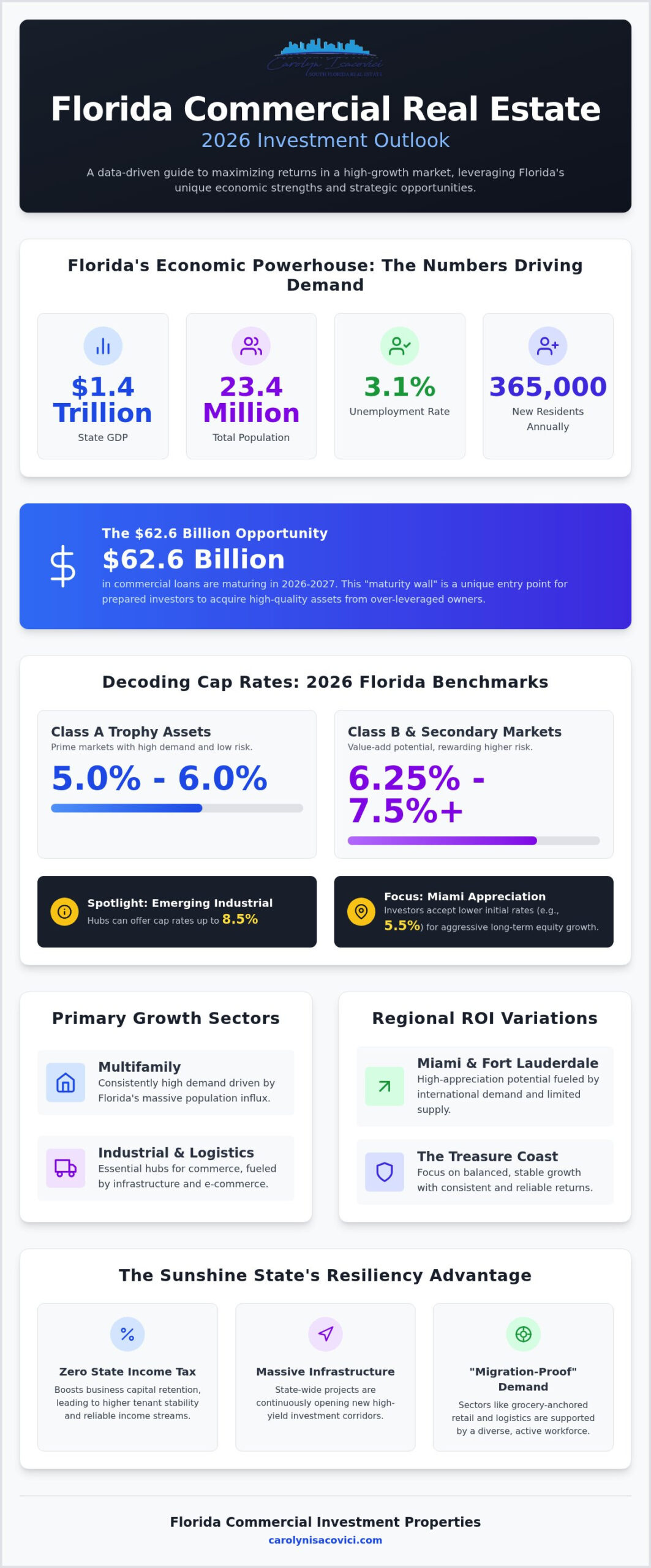
    Florida’s economy is hitting its stride in 2026. With a state GDP of $1.4 trillion and a robust growth rate of 4.2%, the numbers tell a story of sustained strength. You might wonder if the rapid pace of previous years can last. The answer lies in the 365,000 new residents arriving annually, pushing the total population to 23.4 million. This influx isn’t just a statistic; it’s a constant engine for demand that stabilizes Florida commercial property investment returns even when other regions feel a chill. As new businesses and residents move into the region, Vision Movers provides the professional relocation services necessary to support this ongoing growth. Institutional capital continues to flow into the state, providing the liquidity needed to keep the wheels of commerce turning smoothly.

    The “Sunshine State” Advantage in a 2026 Economy

    Why do tenants stay put here? Zero state income tax is a massive factor. It allows businesses to retain more capital, which translates directly into higher tenant stability and more reliable rental income for landlords. Understanding commercial property fundamentals helps you see how these tax advantages, combined with massive infrastructure projects, are opening new high-yield corridors across the state. These “migration-proof” sectors, such as grocery-anchored retail and essential logistics, are becoming the bedrock of a resilient investment portfolio in 2026.

    Transforming Uncertainty into Strategic Opportunity

    The “maturity wall” is a topic that causes some concern, yet it shouldn’t. Approximately $62.6 billion in commercial loans are maturing between 2026 and 2027. For the prepared investor, this represents a unique entry point rather than a crisis. It’s a chance to acquire high-quality assets from owners who may be over-leveraged and need to exit. Timing is everything this year, and taking an advisory approach helps you separate the noise from the signal. Market resilience is the capacity of an asset to maintain value and generate consistent cash flow through economic shifts by leveraging localized demand and structural advantages; part of this strategy involves finding ways to lower overhead, such as when you explore Commercial property energy cost saving analysis to maximize the profitability of newly acquired assets.

    By focusing on these structural strengths, you can look past temporary headlines and see the long-term potential. Florida’s 3.1% unemployment rate reflects a diverse, active workforce that supports every asset class from Miami’s office trophy buildings to industrial warehouses in the Treasure Coast. This is a moment for Florida commercial property investment returns to be maximized through strategic, well-timed acquisitions. Don’t let the complexity of the market hold you back; instead, let it be the map that guides you to your next successful deal.

    Decoding the Math: Cap Rates and ROI Metrics for Florida Assets

    Numbers provide the clarity you need to move from interest to action. In 2026, the Capitalization Rate remains the cornerstone of any smart acquisition because it provides a snapshot of an asset’s yield without the influence of debt. For those seeking Florida commercial property investment returns that outperform national averages, understanding these benchmarks is vital. Class A trophy assets in primary markets often see cap rates between 5.0% and 6.0%. Meanwhile, Class B properties or those in secondary markets might offer 6.25% to 7.5% or higher, rewarding investors for the additional management or location risk they take on.

    Precision matters. With the Federal Reserve target rate sitting at 3.50% to 3.75% as of mid-2026, calculating your cash-on-cash return becomes a more nuanced exercise. It’s not just about the entry point. A long-term portfolio relies heavily on the Internal Rate of Return (IRR), which accounts for both ongoing cash flow and the eventual sale price. Staying informed on 2026 Commercial Real Estate Issues helps you factor in capital flow shifts that influence these long-term projections and ensures your math remains grounded in reality.

    Understanding Cap Rate for Miami Investment Property

    Miami is a category of its own. High international demand and a limited supply of land often compress yields here compared to the rest of the state. Investors frequently accept lower initial cap rates in exchange for aggressive appreciation potential. You can dive deeper into these specifics in our guide on Cap Rate for Miami Investment Property. Even in a competitive environment, savvy buyers look for “path of progress” neighborhoods where a 5.5% cap rate today could transform into significant equity tomorrow as the area matures.

    Beyond the Percentage: Evaluating Total Investment Value

    Your Net Operating Income (NOI) is the heartbeat of your math. It’s the income left after all operating expenses are paid, but before debt service. One factor you can’t ignore is the 35% rise in property insurance costs since 2023. Successful investors mitigate this by prioritizing newer construction or hardened assets that command lower premiums and offer better long-term stability. Before committing to any acquisition, completing thorough investment property due diligence Florida investors rely on is essential to accurately projecting your NOI and avoiding costly surprises. In the 2026 Florida market, a higher cap rate generally signals a greater perception of risk or a need for more intensive asset management. If you’re ready to see how these formulas apply to a specific deal, you can consult with a strategic investment partner to refine your analysis and confirm your projections.

    Sector Analysis: Where are the Highest Yields in 2026?

    Which sector holds the most promise for your portfolio this year? It depends on your specific goals for cash flow and appreciation. While our previous sections explored the macro-economic foundations, the real magic happens when you select the right asset class. In 2026, Florida commercial property investment returns are increasingly driven by a “flight to quality.” Investors are moving away from speculative plays and toward sectors with proven, “migration-proof” demand. Multifamily remains a steady favorite, with rent growth normalizing to a sustainable 2% to 4% annual increase, providing a reliable shield against volatility.

    Industrial and logistics properties continue to be the powerhouse of the state’s economy. With vacancy rates hovering between 3.6% and 5.4%, the demand for warehouse space is relentless. This sector benefits directly from Florida’s role as a global trade hub and the continued expansion of e-commerce; for a deeper look into the maritime traffic supporting these logistics hubs, you can discover Adimar Shipping, Inc. and their specialized agency services for vessels transiting the Panama Canal. Whether it’s a last-mile distribution center or a large-scale logistics park, these assets offer some of the most resilient yields in the current market.

    High Yield Investment Property Florida: Growth Sectors

    If you are looking for the most aggressive growth, you’ll find it in specialized niches. Our analysis of High Yield Investment Property Florida highlights how industrial assets near Port Miami and Port Everglades are commanding premium returns. These locations are land-constrained, which creates a natural barrier to entry and protects your long-term value. Additionally, new construction commercial assets in high-growth corridors are attracting institutional tenants who prioritize modern energy-efficient systems and lower long-term maintenance costs.

    Retail is also experiencing a surprising “renaissance.” Vacancy rates have hit a 15-year low of 4.2%, particularly for grocery-anchored centers and luxury high-street retail in enclaves like Palm Beach and Miami’s Design District. Meanwhile, the office market is splitting in two. While suburban Class B buildings face higher vacancies, boutique medical offices and “trophy” Class A spaces in Brickell are seeing rents exceed $130 per square foot. This bifurcation means that success in the office sector now requires a surgical focus on location and tenant type.

    Comparing Returns Across Commercial Asset Classes

    How do you choose between these options? It’s a balance of risk and reward. Unanchored strip centers might offer higher cap rates in the 6.25% to 7.5% range, but they require more active management than a stabilized multifamily building. For those interested in value-add plays, older office buildings in urban cores can be repositioned into medical suites or creative lofts, though this requires significant capital and local expertise. Grocery-anchored retail and Class A industrial assets currently offer the most compelling risk-adjusted returns for the 2026 Florida market; for investors looking to apply similar retail-focused strategies in emerging European markets, Petram House provides specialized investment advisory within the Polish commercial sector.

    Florida Commercial Property Investment Returns: 2026 Strategic Outlook

    Regional ROI Variations: From Miami to the Treasure Coast

    Florida isn’t a monolith, and treating it as one is a mistake many out-of-state investors make. Yields and appreciation potential shift significantly as you move from the dense urban corridors of Miami up through the coastal reaches of the Treasure Coast. In 2026, Florida commercial property investment returns are increasingly defined by hyper-local migration patterns and specific infrastructure projects. For those managing portfolios remotely, Miami Video Production provides broadcast-quality livestreaming for South Florida investment events and site tours, offering the clarity needed for distant decision-makers. While one city might offer a safe haven for capital preservation, another represents the “path of progress” where equity can grow rapidly. Understanding these regional nuances is the difference between a standard return and a strategic victory.

    The South Florida Powerhouse: Miami to Palm Beach

    Miami and Miami Beach continue to command the highest entry prices in the state. Why do investors still flock here? It’s the unparalleled appreciation potential and the status of “trophy” assets. In the Brickell district, Class A office rents have climbed over $130 per square foot, driven by a 4.0% year-over-year rent growth. Moving north, West Palm Beach has solidified its reputation as “Wall Street South,” attracting financial firms that prioritize luxury office space and proximity to high-net-worth enclaves. Fort Lauderdale and Hollywood offer a middle ground, balancing stable urban growth with slightly higher yields than their neighbors to the south. If you are currently browsing Florida commercial real estate for sale, these primary markets offer the most liquidity but require a sophisticated approach to navigate their competitive bidding environments.

    Emerging High-Yield Markets: Stuart to Melbourne

    Why is the Treasure Coast suddenly on every strategist’s radar? It’s simple. As Miami and Palm Beach become increasingly land-constrained, capital is rippling north into Martin and St. Lucie counties. Port St. Lucie is currently a standout performer, experiencing a surge in demand for industrial warehouses and medical office suites to support its growing population. These secondary markets often provide a “yield play” where cap rates are more attractive than in the primary South Florida hubs. Strategic advantages in Vero Beach and Melbourne include lower barriers to entry and a more favorable relationship between acquisition costs and Net Operating Income. This northern migration creates a unique window for investors to capture high-yield opportunities before these sub-markets reach full maturity.

    Selecting the right region requires a partner who understands the ground-level reality of each neighborhood. Whether you are targeting a boutique retail space in Palm Beach Gardens or a logistics hub in Stuart, the right location is the foundation of your success. If you are ready to identify a specific asset that aligns with your goals, you can view our current commercial property sales to find the perfect fit for your 2026 portfolio strategy.

    Strategic Portfolio Growth with Expert Brokerage Guidance

    Why do some investors consistently find the best off-market opportunities while others struggle with stale public listings? It’s often the result of a deep, localized network. A seasoned broker doesn’t just show you what’s available; they show you what’s possible. This standard of excellence is universal; for example, in the Fraser Valley, Steve Kooner & Associates provides this level of specialized insight for both residential and commercial clients. In a market where Florida commercial property investment returns are highly competitive, having a partner like Florida Commercial Investment Properties who can uncover hidden value is your greatest advantage. We believe that every transaction should be more than just a sale; it should be a strategic step toward your long-term financial goals.

    Scaling your portfolio from residential assets into the commercial sphere is a logical progression for many high-net-worth individuals. To ensure your long-term health and financial security are just as well-managed as your investments, you can visit Safe Harbor Financial Resources to explore specialized insurance and retirement solutions in Palm Beach Gardens. While the underlying drivers of supply and demand remain consistent, the nuances of triple-net leases and industrial zoning require a specialized eye. Leveraging market experience that dates back to 2006, Florida Commercial Investment Properties helps you bridge this gap with confidence. We focus on the identification of high-yield opportunities, ensuring you aren’t just buying a building, but acquiring a high-performing asset.

    The Value of a Seasoned Florida Real Estate Navigator

    At Florida Commercial Investment Properties, Carolyn Isacovici provides the steady hand you need in a fast-moving environment. This expertise isn’t built on reports alone; it’s the result of “boots on the ground” from the high-rises of Miami to the industrial corridors of the Treasure Coast. Our team at Florida Commercial Investment Properties transforms complex market data into clear investment decisions, guiding you through the end-to-end sales process for commercial buildings and new construction assets. Whether you’re navigating a complex transaction in Palm Beach or looking for a stable entry point in Stuart, we act as your strategic partner every step of the way.

    Success starts with a rigorous assessment of the asset’s potential. The role of a broker at Florida Commercial Investment Properties is central to evaluating investment property in Florida, ensuring that your Florida commercial property investment returns are protected by sound due diligence. Our experts look beyond the surface to identify high-yield opportunities that others might overlook, providing the clarity you need to move forward with conviction.

    Your Next Steps in the Florida Commercial Market

    What should your first move be in 2026? Start by preparing a due diligence checklist that accounts for the rising insurance costs and debt maturity trends we’ve discussed. Once your criteria are clear, a portfolio strategy consultation with Florida Commercial Investment Properties can align your capital with the specific sectors and sub-markets poised for growth. It’s about timing, insight, and having the right people in your corner. If you’re ready to see what’s possible, you can explore high-yield commercial opportunities with Carolyn Isacovici and Florida Commercial Investment Properties and take the first step toward a more resilient investment future.

    Positioning Your Portfolio for 2026 and Beyond

    We’ve navigated the structural shifts of the 2026 landscape, from the significant “maturity wall” of older debt to the high-demand industrial corridors of the Treasure Coast. The path to superior Florida commercial property investment returns lies in selecting “migration-proof” assets like logistics hubs and grocery-anchored retail. By understanding these regional nuances and the math behind the yields, you can transform market complexity into a clear roadmap for your financial growth. It’s about recognizing that every cycle offers a unique window for those who are prepared to act with precision and local insight.

    Since 2006, our firm has specialized in high-yield commercial and investment property sales across Miami, Palm Beach, and the Treasure Coast. We provide the “boots on the ground” expertise needed to navigate competitive bidding environments and uncover the off-market deals that others often miss. Whether you’re scaling a portfolio or entering the Florida market for the first time, we’re here to act as your strategic partner. Secure your next high-yield Florida investment with Carolyn Isacovici and move forward with the confidence that only two decades of market experience can provide. The opportunities in the Sunshine State remain robust, and we’re ready to help you capture them.

    Frequently Asked Questions

    What is a good cap rate for commercial property in Florida in 2026?

    A good cap rate in 2026 typically falls between 5.0% and 8.5% depending on the specific asset class and its location. Primary markets like Miami often see lower cap rates for Class A trophy assets, while industrial outdoor storage or unanchored retail in secondary markets can reach the higher end of that spectrum. You’ll want to balance this yield against the property’s appreciation potential to ensure it aligns with your total return goals.

    How much can I expect to earn from a multifamily investment in Miami?

    Multifamily investments in Miami currently yield cap rates between 5.25% and 7.0% as the market stabilizes from previous highs. While rent growth has normalized to about 0.7% annually in this sector, the long-term value remains tied to high occupancy and the city’s status as a global destination. It’s a strategy focused on capital preservation and steady cash flow rather than the rapid rent spikes seen in previous years.

    Is industrial or retail property a better investment in South Florida right now?

    Both sectors are performing exceptionally well, but they serve different strategic purposes for your portfolio. Industrial property offers high demand with vacancy rates under 5.4%, driven by logistics needs. Retail is experiencing a renaissance with a 15-year low vacancy rate of 4.2%, especially in grocery-anchored centers. Your choice depends on whether you prefer the stability of e-commerce logistics or the high-street appreciation potential of luxury retail enclaves.

    How do Florida’s property taxes affect my total investment returns?

    Property taxes are a significant line item that directly impacts your Net Operating Income. While Florida offers the advantage of no state income tax, property taxes are reassessed upon sale, which can lead to a tax spike for new owners. It’s vital to calculate your pro-forma returns based on the projected reassessed value rather than the current owner’s tax bill to avoid surprises that could diminish your cash flow.

    Can a residential investor easily transition into Florida commercial real estate?

    Yes, many investors successfully transition by applying their knowledge of market demand to commercial asset classes. The primary shift involves moving from individual tenant management to analyzing complex leases like triple-net agreements. To master these nuances, check out Multifamily Schooled for specialized educational resources. Starting with a multifamily property or a small medical office suite is often a great way to scale your portfolio while leveraging the expertise of a specialized commercial broker who understands the nuances of the local market.

    What are the fastest-growing commercial real estate markets in Florida for 2026?

    Port St. Lucie and the Treasure Coast are currently among the fastest-growing markets due to the ripple effect of capital moving north from Miami. These regions offer a compelling mix of available land, growing populations, and higher yields than primary urban centers. Investors are also finding strong opportunities in Melbourne and the Space Coast, where aerospace and technology sectors are driving a surge in office and industrial demand throughout 2026.

    How do I calculate the ROI on a new construction commercial building in Florida?

    Calculating ROI on new construction requires looking at the yield on cost compared to current market cap rates. You’ll factor in your total development costs against the projected Net Operating Income once the building is stabilized. Since new assets often command higher rents and lower insurance premiums, they can significantly enhance Florida commercial property investment returns compared to older, less efficient buildings that may require significant capital expenditures. To explore how to manage these expenses, check out SI Insurance for specialized coverage options.

    What role does location play in determining Florida commercial property returns?

    Location is the single most important factor in determining your risk-adjusted return. A trophy location in Brickell or Palm Beach provides lower initial yields but offers a safe haven for capital and high appreciation potential. In contrast, tertiary markets offer higher immediate cash flow but may carry more vacancy risk. Matching the right sub-market to your specific risk tolerance is the key to securing successful Florida commercial property investment returns.

  • Miami Commercial Buildings: 2026 Market Guide

    Miami Commercial Buildings: 2026 Market Guide

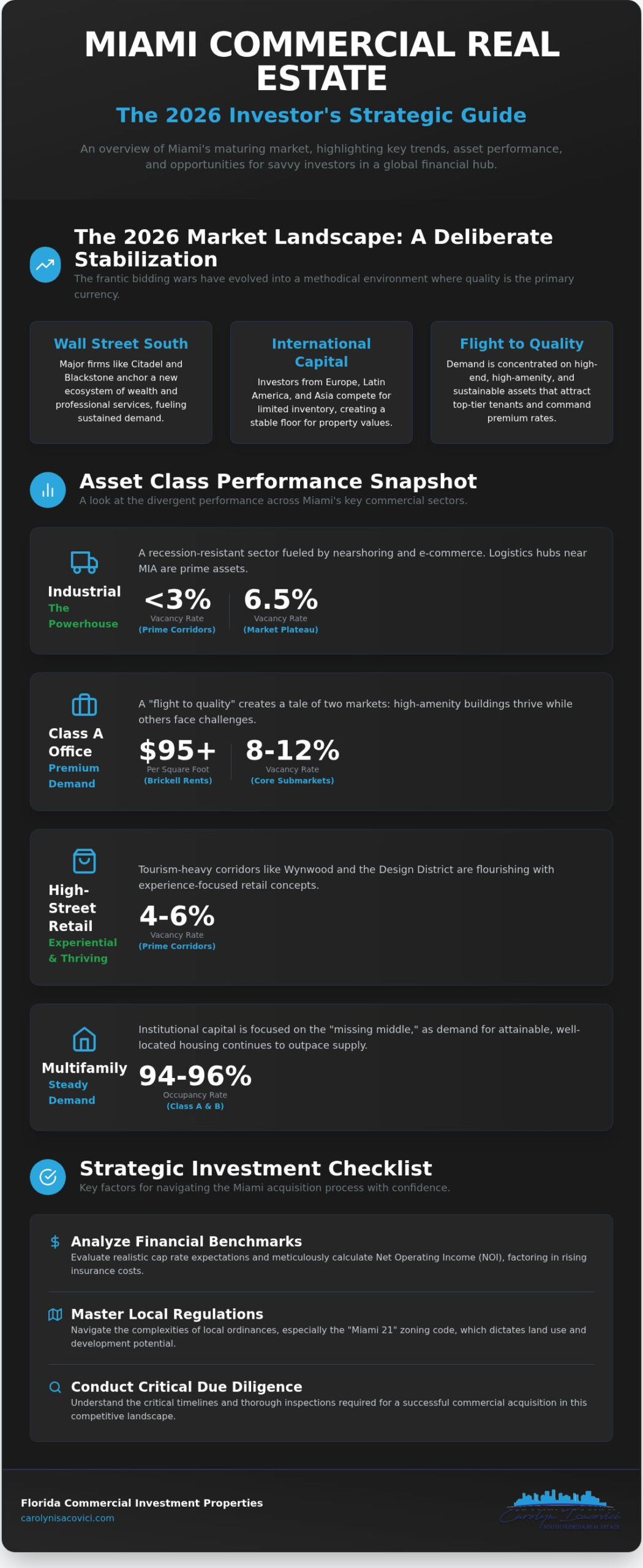
    In 2026, the era of simply buying and holding Miami real estate has evolved into a high-stakes game of strategic positioning where neighborhood-specific infrastructure dictates your ultimate return. Are you feeling overwhelmed by a flood of low-quality listings or concerned about hidden volatility in certain sub-sectors? It’s a common frustration for even the most seasoned investors. Finding the right commercial buildings for sale Miami offers requires more than just a search engine; it requires a deep understanding of why the industrial vacancy rate has plateaued at a remarkably low 6.1% to 6.9% while Class A office rents in Brickell have climbed to over $95 per square foot.

    You deserve a clear path through the maze of complex zoning and rising insurance costs that define the current landscape. This guide will help you identify high-yield commercial assets and decode the 2026 neighborhood growth projections that are reshaping the city. We’ll explore how the “Wall Street South” transformation and nearshoring trends are creating unique opportunities for those who know where to look. By the end, you’ll have the expert strategies needed to secure your next investment with confidence and clarity.

    Key Takeaways

    • Understand why 2026 represents a crucial stabilization phase and how Miami’s role as a global financial hub creates a resilient environment for your capital.
    • Learn to evaluate specific asset classes, from high-street retail to industrial logistics, to find the most promising commercial buildings for sale Miami has to offer right now.
    • Master the financial benchmarks of the current market, including realistic cap rate expectations and the essential steps to calculate Net Operating Income amidst rising insurance costs.
    • Navigate the complexities of local regulations by mastering the “Miami 21” zoning code and the critical timelines required for successful commercial due diligence.
    • Discover the advantage of a strategic partnership that transforms market uncertainty into a clear, actionable investment roadmap tailored to your long-term goals.

    The 2026 Landscape for Commercial Buildings in Miami

    Miami is no longer just a gateway to the Americas; it’s a global financial titan. Have you noticed the shift in the skyline? It’s not just about height anymore. It’s about sophistication. As we move through 2026, we’re seeing the market enter a deliberate stabilization phase. This isn’t a slowdown. It’s a maturing process that rewards the patient, strategic investor. The frantic bidding wars of the early 2020s have given way to a more methodical environment where quality is the primary currency. When you look at commercial buildings for sale Miami provides, you’ll see a market that has found its footing at a high, stable base.

    International capital continues to flow into the city, viewing South Florida as a beacon of stability. Investors from Europe, Latin America, and Asia are competing for the limited inventory. They aren’t just looking for square footage. They’re looking for ‘flight to quality’ assets. These are properties that offer high-end amenities, sustainable technology, and the kind of prestige that attracts top-tier tenants. This global interest provides a floor for property values that many other cities simply don’t have. It’s a reassuring sign for those looking to protect and grow their wealth through tangible, high-performing assets.

    Key Economic Drivers in South Florida

    Why does demand remain so high? The ‘Wall Street South’ migration is a massive factor. Major firms like Citadel and Blackstone haven’t just arrived; they’ve anchored a new ecosystem of wealth and professional services. This influx is supported by a robust Florida’s economic landscape that prioritizes growth through tax-friendly policies. Infrastructure is keeping pace too. The expansion of the Brightline rail system and our major ports has transformed how people and goods move, directly increasing the intrinsic value of nearby commercial properties. These projects aren’t just about convenience; they’re the lifeblood of long-term commercial viability.

    Defining Commercial Value in a Mature Market

    What defines a ‘prime’ building in the current market? It’s flexibility. The most successful assets in 2026 are those that can adapt. Can an office floorplate easily shift to a creative studio? Is there a retail component that serves the local neighborhood? The best commercial buildings for sale Miami features are often mixed-use gems that provide multiple revenue streams. In a city where developable land is increasingly rare, value is found in existing structures that offer both legacy prestige and modern utility. You’ll find that the most resilient investments are those that prioritize the end-user experience above all else.

    In the context of 2026 scarcity, commercial real estate value in Miami is the intersection of high-amenity infrastructure and the long-term resilience of a global financial hub.

    Have you found yourself wondering which asset class holds the most resilience in a stabilizing market? The answer isn’t universal. It depends entirely on your specific goals. In 2026, we’re seeing a fascinating divergence across sectors. While the broader office market shows a vacancy rate of 14.3%, Class A spaces in core submarkets remain tight at 8% to 12%. This “flight to quality” means that investors focusing on commercial buildings for sale Miami offers are increasingly looking for high-amenity assets that can command premium rents. Meanwhile, the industrial sector remains the city’s powerhouse. With vacancy rates in prime logistics corridors sitting below 3%, industrial properties near Miami International Airport (MIA) have become true recession-resistant plays. These hubs benefit from the ongoing nearshoring trend, as more companies move supply chains closer to home.

    Retail is also undergoing a sophisticated transformation. High-street retail in tourism-heavy corridors like Wynwood and the Design District is thriving, with vacancy rates between 4% and 6%. It’s no longer just about selling products; it’s about creating an experience. On the residential side, institutional capital has shifted its focus toward the “missing middle” in the multifamily market. With average occupancy for Class A and B buildings holding steady at 94% to 96%, the demand for well-located, attainable housing continues to outpace supply. Identifying these nuances is easier when you have access to the latest commercial real estate market reports, which provide the data-driven clarity needed to move forward with confidence.

    Neighborhood Spotlight: Where to Invest

    Brickell remains the undisputed crown jewel of the financial core. Here, Class A office rents have reached $65 to $95+ per square foot, driven by the massive influx of financial firms. If you prefer a creative or luxury angle, Wynwood and the Design District offer flagship retail opportunities where rents can exceed $100 per square foot. For those seeking the backbone of the region’s logistics, Doral and Medley are essential. Doral’s Class A logistics base rents currently range from $22 to $34 per square foot, reflecting its status as the region’s premier industrial hub.

    Emerging Corridors for 2026

    Are you looking for the next growth frontier? The “North Miami” boom is real. The corridor between Miami and Fort Lauderdale is seeing significant interest as investors seek value outside the dense urban core. Coconut Grove also stands out for its boutique office market. It’s a high-demand, low-supply environment where vacancy is minimal. Strategic opportunities also exist in Hollywood, where diversified portfolios can find a balance of retail and multifamily assets at a different entry point. Finding the right fit requires a nuanced eye for detail. For a broader view of where capital is flowing across the state, our best commercial real estate opportunities Florida roundup for 2026 reveals the highest-growth sectors and emerging geographic hubs that are currently undervalued. You might also consider exploring our latest investment property sales to see how we translate these neighborhood trends into actionable opportunities for our partners.

    Financial Benchmarks: Analyzing ROI and Cap Rates

    How do you determine if a property is a sound acquisition or a potential burden? In 2026, the answer lies in a nuanced understanding of yield that goes far beyond the surface. While Tier 1 cities like New York or Los Angeles often struggle with extreme rent control or stagnant growth, Miami remains a land of opportunity for those who value resilience. If you are currently navigating the West Coast market, The Seabrooke Group offers specialized expertise in California commercial real estate sales to help you compare your current portfolio against Florida’s emerging potential. When evaluating commercial buildings for sale Miami features, you’ll find that cap rates have stabilized into a healthy range. For core industrial assets, expect cap rates between 5.0% and 5.8%, while non-core or value-add opportunities can reach up to 6.5%. Multifamily Class A assets typically hover between 4.0% and 5.0%, reflecting a market that has matured into a reliable destination for institutional-grade capital.

    Debt service coverage ratios (DSCR) are more critical than ever in this phase of the cycle. With interest rate trends in 2026 requiring a more disciplined approach to leverage, your Net Operating Income (NOI) must be ironclad. Calculating true NOI in Florida requires a sharp eye for operating expenses that competitors often overlook. It’s not just about the gross rent; it’s about what stays in your pocket after the unique costs of the region are satisfied. This methodical approach ensures you aren’t just buying an asset, but securing a predictable stream of income.

    The Florida Insurance Landscape

    Rising property insurance premiums are a reality in South Florida, particularly in the multifamily sector where occupancy remains high at 94.2%. However, this challenge presents a strategic opportunity for the savvy investor. By prioritizing “building hardening” and resilience, you don’t just protect the physical structure; you actively mitigate insurance costs. Resilience is no longer a “nice-to-have” feature; it’s a mandatory financial metric. Investors who focus on LEED-certified or storm-resilient commercial buildings for sale Miami provides often see more favorable terms from carriers, directly boosting the asset’s long-term valuation and marketability.

    Tax Advantages and 1031 Exchanges

    Are you looking to transition from a residential portfolio into something more scalable? Many investors are utilizing 1031 Exchanges to move equity from residential units into high-yield commercial assets. If you are liquidating properties on the West Coast to facilitate these moves, you can visit Nadia Kafaipour for expert residential real estate support in Northern California. This strategy allows you to defer capital gains while stepping into the professional management environment of the commercial sector. When forecasting your return, remember to account for local property tax assessments, which can shift significantly upon a change of ownership. By eliminating the burden of state-level income taxation, Florida inherently increases the net cash flow available to investors, providing a significant structural advantage over high-tax jurisdictions.

    Miami Commercial Buildings: 2026 Market Guide

    Due Diligence and the Miami Acquisition Process

    How do you ensure your investment stands on solid ground before the ink is dry? In the fast-moving world of South Florida real estate, due diligence isn’t just a checklist; it’s a strategic deep dive. When you are evaluating commercial buildings for sale Miami offers, you’ll typically encounter a 30 to 45 day window to verify every detail. This timeline is tight, but it’s your opportunity to uncover the hidden value or potential risks that others might overlook. You aren’t just looking for physical defects. You’re looking for the structural and legal integrity that secures your long-term ROI. In a market where a significant portion of assets are owned by international investors, you must also be prepared for complex approval processes and potentially slower decision-making during the contract phase.

    Is the property actually zoned for your intended use? You’ll find the answer within the ‘Miami 21’ code. This form-based zoning code is unique because it focuses on the relationship between buildings and the street rather than just the usage. It dictates redevelopment potential and density, which are the primary drivers of future value. Beyond zoning, your environmental assessments (Phase I and II) are non-negotiable. In 2026, climate resilience has become a core financial metric. You must verify flood zone designations and evaluate how the building’s elevation might impact future insurance premiums. Reviewing rent rolls is equally critical. In our current post-inflationary era, landlords increasingly favor Triple Net (NNN) leases to pass through rising tax and insurance costs, protecting the property’s Net Operating Income.

    Legal and Regulatory Hurdles

    Navigating the Miami-Dade County building department requires a steady hand and local insight. Have you accounted for the 40-year recertification, or the more recent 25 and 30-year safety inspections? These are mandatory hurdles that can lead to significant unexpected capital expenditures if ignored. This is why partnering with a local commercial real estate attorney is essential. They help you navigate the nuances of local permits and ensure your ‘Highest and Best Use’ (HBU) study is accurate. An HBU study is particularly vital for older Miami buildings, as it determines if the current structure is truly the most profitable use of the land in a city where developable space is at a premium.

    The Role of the Commercial Broker

    Why do some of the best deals never hit the public portals? The answer lies in ‘pocket listings’ and off-market opportunities. A seasoned Miami commercial real estate broker acts as your eyes and ears on the ground, providing access to inventory that isn’t visible to the general public. Working with a Miami Commercial Real Estate Broker gives you a distinct advantage in a competitive landscape where timing is everything. Negotiation in 2026 goes far beyond the purchase price. It involves crafting contingencies, defining repair credits, and managing the expectations of diverse ownership groups. If you’re ready to move from analysis to action, we invite you to consult with our acquisition team to ensure your next investment is built on a foundation of verified data.

    Partnering for Success: Your Strategic Florida Navigator

    Why face the intricacies of the South Florida market alone? You shouldn’t. As we’ve explored, the 2026 landscape is defined by a “flight to quality” and a shift toward high-amenity assets. Navigating these nuances requires more than just access to a public database. It requires a partner who understands that every acquisition is a vital piece of a larger financial legacy. Florida Commercial Investment Properties, led by Carolyn Isacovici, serves as your strategic navigator in this evolving environment. With over 20 years of experience established through diverse market cycles, we provide the steady hand needed to transform complexity into a clear sense of opportunity. Whether you’re analyzing the most promising commercial buildings for sale Miami currently features or evaluating a redevelopment project under the “Miami 21” code, our boutique approach ensures you receive personalized attention backed by institutional-grade data.

    We don’t just find listings; we identify high-yield assets that align with your specific risk-adjusted goals. Being a boutique firm allows us to move with a level of agility and discretion that larger, tech-first aggregators simply can’t match. We’re deeply invested in your long-term success, acting as a consultant who understands the analytical mind of a strategist. From the initial identification of an off-market opportunity to the final signatures at the closing table, we’re with you at every phase. You deserve a professional partner who remains unruffled by change and remains a reliable source of truth. Understanding how a Miami commercial real estate broker builds long-term wealth strategies can help you appreciate the full value of this kind of specialized partnership.

    Our Specialized Brokerage Services

    Our approach is methodical and educational, designed to build trust through results. We offer custom property sourcing that targets your specific yield requirements, whether you’re seeking the 5.0% to 5.8% cap rates found in core industrial assets or the higher returns of value-add retail. Our expertise in both commercial and new construction assets means we can guide you through the 8 to 10 million square foot industrial construction pipeline with precision. We also specialize in portfolio diversification strategies, helping you find stability in Coconut Grove’s boutique office market or growth in the emerging North Miami corridors. We’ll help you look past the purchase price to find the true intrinsic value of an asset.

    Ready to Explore Miami Commercial Opportunities?

    The 2026 outlook for Miami is one of grounded optimism. While the market has moderated from the frantic surge of previous years, the underlying economic drivers, like the “Wall Street South” migration and nearshoring trends, remain incredibly strong. If you’re ready to move from research to acquisition, the next step is a clear-eyed assessment of your goals. Don’t let the volume of low-quality listings or complex regulations hold you back from securing a high-yield asset. We’re ready to help you turn these market conditions into a strategic advantage. Contact Florida Commercial Investment Properties for a Strategic Consultation and let’s begin identifying the commercial buildings for sale Miami offers that best fit your vision.

    Your Future in Miami’s Evolving Commercial Landscape

    The transition into a mature, stabilized market represents a unique window of opportunity for the disciplined investor. By focusing on high-amenity “flight to quality” assets and mastering the nuances of local zoning and insurance, you’ve already positioned yourself ahead of the competition. Success in 2026 isn’t just about finding square footage; it’s about identifying the resilient infrastructure and neighborhood growth that drive long-term yield. Whether you’re targeting industrial logistics hubs or boutique office spaces, the path to a high-performing portfolio is paved with verified data and strategic foresight. To broaden your perspective beyond Miami, understanding the best commercial real estate opportunities Florida offers statewide in 2026 can help you identify where your capital will work hardest across the entire region.

    Are you ready to transform these insights into a tangible acquisition? Finding the ideal commercial buildings for sale Miami provides requires a navigator who has seen every cycle over the last two decades. With a specialized focus on high-yield investment properties and new construction assets, we’re here to ensure your next move is both confident and calculated. Secure Your Miami Commercial Asset with Expert Guidance and let’s turn the complexities of today’s market into your strategic advantage. Your next great investment is waiting, and we’re honored to help you find it.

    Frequently Asked Questions

    Are commercial buildings in Miami a good investment in 2026?

    Yes, they remain a resilient choice because the market has stabilized at a fundamentally elevated base. Total commercial sales in Miami-Dade grew by 32% in 2025, reaching $7.1 billion. This growth is anchored by the “Wall Street South” transformation and a steady influx of international capital. It’s a market that rewards those who prioritize quality and strategic location over speculative volume.

    What is the average cap rate for Miami commercial property right now?

    Average cap rates vary by asset class, with core industrial properties typically ranging between 5.0% and 5.8%. If you’re looking at Class A multifamily assets, expect rates between 4.0% and 5.0%. Single-tenant NNN retail properties often offer slightly higher yields, generally falling between 5.5% and 7.0%. These figures reflect a mature market where stability and long-term growth are the primary drivers of value.

    How does the ‘Miami 21’ zoning code affect property value?

    The ‘Miami 21’ zoning code directly influences value by prioritizing form-based urban design over traditional land-use restrictions. It dictates building density, setbacks, and how a structure interacts with the public realm. Understanding these regulations is essential for identifying redevelopment potential. Properties with favorable zoning designations under this code often command a premium because they offer greater flexibility for future mixed-use expansion.

    What are the most profitable commercial neighborhoods in Miami for 2026?

    Brickell remains the powerhouse for Class A office space, while Doral and Medley are the undisputed leaders for industrial logistics. For those seeking retail opportunities, Wynwood and the Design District continue to see record-breaking rents for flagship spaces. If you’re looking for emerging growth, the North Miami corridor offers a compelling balance of value and appreciation potential for those seeking commercial buildings for sale Miami.

    Can I use a 1031 Exchange to buy commercial property in Florida?

    You can absolutely utilize a 1031 Exchange to defer capital gains taxes when transitioning into Miami commercial assets. This is a common strategy for investors moving from residential portfolios into larger, professionally managed commercial buildings. Florida’s lack of state income tax further enhances the benefits of this exchange, allowing more of your capital to remain active and generating yield within the local market.

    What is the difference between a Triple Net (NNN) and a Gross lease in Miami?

    In a Triple Net (NNN) lease, the tenant pays for property taxes, insurance, and maintenance in addition to rent, whereas a Gross lease includes these costs in the base rent. NNN structures are increasingly popular in 2026 because they protect landlords from rising operating expenses. This setup is particularly beneficial in South Florida, as it shifts the burden of fluctuating insurance premiums and property tax assessments directly to the tenant.

    How do high insurance rates in Florida impact commercial property ROI?

    High insurance rates impact ROI by increasing operating expenses, but they also create a clear divide between standard and high-quality assets. Buildings with LEED certification or advanced storm-hardening features often qualify for lower premiums, directly improving their Net Operating Income. Smart investors mitigate these costs by targeting resilient commercial buildings for sale Miami features that are better equipped to handle the region’s unique environmental and regulatory landscape.

    Why should I work with a local Miami commercial broker instead of using an online portal?

    A local broker provides access to off-market “pocket listings” that never appear on public portals, giving you a significant competitive advantage. Beyond inventory, a seasoned partner navigates the complexities of local zoning, environmental recertifications, and negotiation nuances that digital platforms ignore. We act as your strategic navigator, ensuring that your acquisition is based on deep local insight rather than just surface-level data.