
Tag: Industrial Real Estate

  • Best Commercial Real Estate Opportunities in Florida: 2026 Investor Roundup

    Best Commercial Real Estate Opportunities in Florida: 2026 Investor Roundup

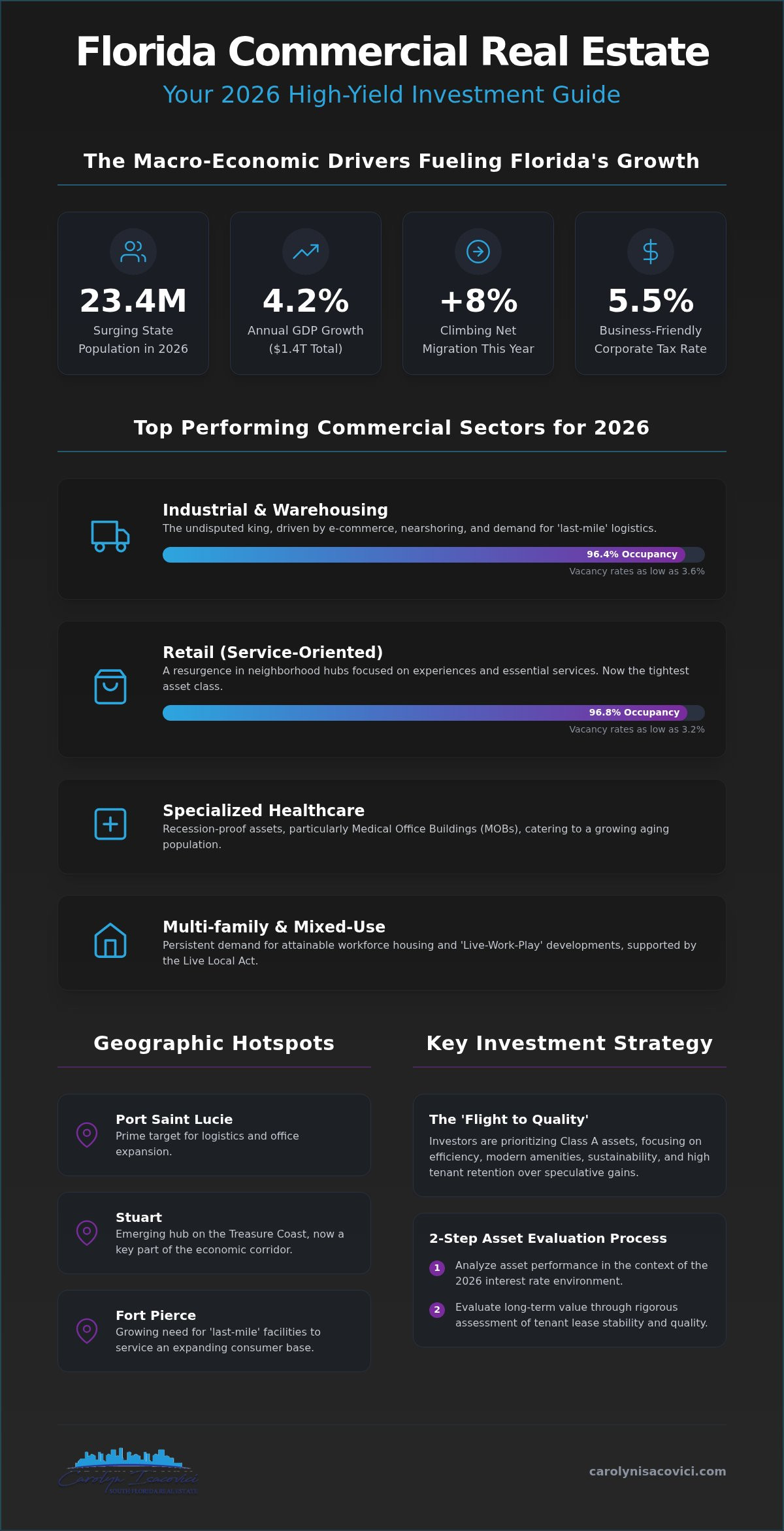
    What if the most stable path to high-yield returns in 2026 lies in the very sectors most investors ignored just three years ago? With Florida’s population surging to 23.4 million and net migration climbing by over 8% this year, the traditional investment playbook has fundamentally changed. It’s completely natural to feel a sense of hesitation amidst market volatility or the sheer noise of generic real estate advice. You aren’t just looking for a property; you’re looking for a strategic advantage that protects your capital while capturing the state’s 4.2% GDP growth.

    We understand that securing the best commercial real estate opportunities Florida has to offer requires a blend of macro-level data and the specific South Florida nuances that only a local expert can provide. This roundup will help you cut through the information overload to identify the highest-growth sectors and emerging geographic hubs that are currently undervalued. We’ll explore the continued dominance of the industrial sector, where vacancy rates sit as low as 3.6%, and analyze how the Live Local Act 4.0 is reshaping multifamily prospects in hubs like Port Saint Lucie. By the end of this guide, you’ll have a clear, professional roadmap to maximize your 2026 investment portfolio with confidence.

    Key Takeaways

    • Understand how continued net migration is driving commercial demand toward emerging Treasure Coast hubs like Stuart and Port Saint Lucie.
    • Pinpoint the best commercial real estate opportunities Florida provides by targeting high-performing industrial assets and logistics-driven properties.
    • Learn a specific two-step process for evaluating assets that accounts for the 2026 interest rate environment and tenant lease stability.
    • Gain the confidence to secure high-yield assets in a competitive market through a personalized, boutique brokerage approach that prioritizes your success.

    The 2026 Florida Commercial Real Estate Landscape

    Have you ever wondered why Florida’s market remains resilient while other regions face stagnation? It isn’t just luck. It’s a combination of deliberate policy, massive infrastructure investment, and shifting demographics. Florida has transitioned from the frantic recovery phase of the early 2020s into a period of mature, strategic growth. With the state population reaching 23.4 million in 2026, the demand for commercial infrastructure isn’t just growing; it’s evolving to meet a more sophisticated workforce.

    Investors are looking beyond surface-level statistics to find the best commercial real estate opportunities Florida provides. They want to understand the foundational Florida’s Economic Landscape, which currently boasts a $1.4 trillion GDP. This 4.2% year-over-year increase signals a robust environment for those seeking long-term stability. While national headlines might suggest a cooling period, local nuances in Broward County and the Treasure Coast tell a different story of sustained, high-level activity. Local knowledge beats national data every time in a market this fragmented.

    Economic Drivers Fueling Florida’s Growth

    Why do corporate headquarters keep moving to South Florida? The answer lies in the 5.5% corporate income tax rate and a business-friendly regulatory environment that rewards growth. For international enterprises looking to establish a foothold, the Israel Cross Border Law Firm provides the specialized legal support necessary for facilitating business and investment between Israel and the United States. Infrastructure is also playing a massive role. The continued expansion of the Brightline rail system has effectively shrunken the distance between Miami and the Treasure Coast. This connectivity transforms cities like Port Saint Lucie and Stuart into prime targets for logistics and office expansion. It’s no longer about being in a single city; it’s about being part of a connected economic corridor.

    The ‘Flight to Quality’ in 2026

    Have the requirements for a premium property changed? Absolutely. In 2026, we’re seeing a distinct flight to quality across all asset classes. Class A office spaces, rich with modern amenities and deep tech-integration, now account for up to 60% of leasing activity in South Florida. Investors are no longer just buying square footage. They’re buying efficiency, sustainability, and tenant retention. While market cycles can feel daunting, they actually create ideal entry points for the prepared investor. By focusing on high-performing assets rather than chasing speculative gains, you can secure a portfolio that thrives. We believe that clarity and timing are the ultimate tools for success in this mature market.

    Top Commercial Sectors for High-Yield Opportunities

    Which sectors are truly driving the highest returns in this mature 2026 market? While the landscape is broad, a few key areas stand out as the best commercial real estate opportunities Florida currently offers. It’s no secret that the industrial sector remains the undisputed king. With vacancy rates across the state hovering between 3.6% and 5.4%, the demand for logistics space is simply outpacing supply. This isn’t just about massive distribution centers. It’s about ‘last-mile’ facilities that can service the growing consumer base in areas like Port Saint Lucie and Fort Pierce.

    Industrial & Warehousing: The Backbone of E-commerce

    The industrial market in Florida continues to lead the nation, driven by e-commerce and a significant trend toward nearshoring. In South Florida’s industrial corridors, vacancy remains remarkably low, making it a landlord’s market where lease terms are increasingly favorable for owners. In 2026, Florida industrial cap rates have largely stabilized as investors prioritize long-term rental growth over immediate yield compression. This stability provides a reassuring foundation for those looking to park capital in assets with high tenant retention and consistent cash flow.

    What about the retail sector? Interestingly, it has become the tightest asset class in South Florida, with vacancy rates sitting between 3.2% and 3.5%. This resurgence is driven by service-oriented neighborhood hubs where people visit for experiences and essential services. Similarly, specialized healthcare properties, particularly medical office buildings, are proving to be recession-proof assets as the state’s aging population grows. For instance, the Miami CDL/DOT Physical Exam Center highlights how medical office space can cater to the essential logistics workforce. Meanwhile, the traditional office market continues its pivot; we’re seeing a decline in massive, centralized footprints in favor of boutique flex spaces that cater to a hybrid workforce.

    Multi-family & Mixed-Use Developments

    Why is everyone talking about workforce housing? The pivot toward attainable rental inventory is a direct response to the persistent demand for quality living spaces. The ‘Live-Work-Play’ model is thriving in neighborhoods like Hollywood FL and Miami Beach, where residents want everything within walking distance. The Live Local Act 4.0, which became effective on July 1, 2026, has further incentivized these developments by expanding eligible sites for affordable housing and tightening height protections. If you’re looking to evaluate the income potential of a high-density investment property sales opportunity, now’s the time to look at these emerging mixed-use corridors. By aligning your portfolio with these high-growth sectors, you transform market complexity into a clear path for wealth preservation.

    Geographic Hotspots: Where to Invest in 2026

    Where should you place your capital in 2026? While established cities provide stability, the map of opportunity has expanded significantly this year. Identifying the best commercial real estate opportunities Florida has available requires a dual focus: maintaining a presence in proven urban centers while securing early positions in emerging corridors. As net migration continues at a rate of 365,000 people annually, the demand for commercial infrastructure is following the rooftops into previously overlooked regions.

    The Miami & Fort Lauderdale Powerhouse

    Miami’s financial districts are no longer just for international banks; they’ve become primary hubs for domestic private equity and tech-driven startups. Fort Lauderdale has similarly matured, transforming into a maritime and tech powerhouse that rivals major national cities in terms of Class A demand. These areas reward investors who seek high-credit tenants and long-term stability in a mature market environment. If you’re looking for a structured approach to these high-density urban markets, our resource on Navigating Commercial Real Estate in South Florida provides a detailed framework for 2026.

    Broward County remains a sweet spot for mid-market acquisitions. Cities like Hollywood FL are seeing a revitalization of their commercial corridors, offering a balance of high demand and slightly more approachable entry prices compared to Miami’s core. Meanwhile, the inland expansion is well underway. As coastal land becomes scarce, logistics and distribution centers are moving deeper into Central-South Florida, following the infrastructure of the Brightline and major highways to service the state’s 23.4 million residents. This shift is creating a new tier of value for those focused on the logistics sector.

    Emerging Markets: The Treasure Coast and Beyond

    Is the Treasure Coast the next big thing? We believe so. Stuart and Palm City are currently seeing a surge in boutique commercial opportunities, where appreciation potential is driven by a steady influx of high-net-worth residents seeking a coastal lifestyle. Jupiter also remains a favorite for investors looking for high-end professional suites and medical offices. Further north, the aerospace and healthcare sectors are fueling growth in Vero Beach and Melbourne, creating a diverse range of assets for those willing to look beyond the major metros.

    Port Saint Lucie has emerged as the 2026 leader for industrial land acquisition. This isn’t a fluke. With the state’s GDP growing at 4.2%, the need for localized distribution is critical to support the expanding population. This city provides the space and connectivity that older, denser markets simply can’t offer. By diversifying across these hotspots, you’re not just buying property; you’re investing in the very fabric of Florida’s future. We see these emerging markets as the key to balancing a portfolio with both stability and high-growth potential.
    Best Commercial Real Estate Opportunities in Florida: 2026 Investor Roundup

    How to Evaluate a Commercial Opportunity in 2026

    How do you distinguish a genuine value from a property that’s simply priced to sell? In 2026, the margin for error has narrowed, requiring a more analytical eye than the market frenzy of years past. Identifying the best commercial real estate opportunities Florida offers today isn’t just about finding a low price; it’s about securing a sustainable yield in a stabilizing interest rate environment. With the Federal Reserve holding the funds rate between 3.50% and 3.75% as of April 2026, the spread between your cap rate and borrowing costs has become the most critical metric for success. It’s a time for precision, not speculation.

    Metrics That Matter: Beyond the Asking Price

    Understanding Net Operating Income (NOI) in a 2026 inflationary context is vital for protecting your capital. You must account for the 11% floating interest rate for taxes and the 5.5% corporate income tax rate when calculating your true bottom line. For private commercial investors, the cash-on-cash return often tells a more compelling story than the cap rate alone, especially when commercial mortgage rates for multifamily assets are starting around 5.78%. If you’re looking for a structured way to run these numbers, our Florida Commercial Real Estate: 2026 Investor’s Guide provides the necessary templates to ensure your projections remain grounded in reality.

    Beyond the spreadsheets, you must evaluate the ‘highest and best use’ for older commercial stock. Could an underperforming retail strip be reimagined as a medical hub? With the Live Local Act 4.0 now in full effect, many industrial and commercial sites are being rezoned for residential use, creating massive value-add potential for the prepared investor. It’s about seeing the future of the land, not just the current state of the building.

    The Importance of Local Due Diligence

    Local due diligence is your ultimate shield against market volatility. Navigating zoning laws in specific municipalities like Miami Beach requires a vastly different approach than in Stuart or Port Saint Lucie. You also need to factor in the potential impact of Proposed Property Tax Amendment 3, which could cap annual assessment increases for commercial buildings at 5% starting in 2027. A broker’s local network serves as the ultimate due diligence tool because it uncovers the off-market history and municipal nuances that raw data alone cannot capture. Environmental and flood zone assessments remain non-negotiable in the Florida market, ensuring your high-yield asset doesn’t come with unforeseen liabilities. If you’re ready to move from analysis to action, our team specializes in commercial property sales that align with your long-term wealth goals.

    Securing Your Florida Commercial Investment with Expert Guidance

    Does a large, national brokerage truly understand the pulse of a specific neighborhood in Hollywood FL or the subtle industrial zoning shifts in Port Saint Lucie? In the competitive 2026 market, the answer is often found in a more focused, boutique approach. While massive firms offer scale, they frequently lack the granular, on-the-ground insight required to secure the best commercial real estate opportunities Florida currently presents. You need a partner who sees beyond the generic data to find the strategic advantage hidden within market shifts. In a landscape defined by 5.78% multifamily rates and a 4.2% GDP growth, the difference between a good deal and a great one often comes down to who is navigating the transaction for you.

    The Carolyn Isacovici Advantage

    Carolyn Isacovici brings a unique blend of analytical strategy and empathetic mentorship to every transaction. With deep roots in the South Florida and Treasure Coast commercial markets, our firm doesn’t just list properties; we facilitate end-to-end investment property sales that align with your specific financial goals. Whether you’re an institutional investor or an individual looking to expand your portfolio, you deserve a navigator who has seen various cycles and remains unruffled by change. We prioritize transparent, data-driven advice that transforms the complexity of 2026 into a sense of clear opportunity. Our expertise spans from the high-value districts of Miami and Fort Lauderdale to the surging industrial hubs of Stuart and Vero Beach, ensuring you have a steady hand in every major Florida market.

    Start Your 2026 Investment Journey Today

    How do you move from interest to acquisition with total confidence? The first step is a confidential portfolio consultation to assess your current holdings and identify untapped potential in this mature market. Many of the most lucrative assets in Miami and the surrounding regions never reach public listing sites. By partnering with a local expert, you gain access to off-market commercial buildings for sale and first-hand knowledge of emerging hubs before they become mainstream. This “calm expert” approach ensures you don’t overpay in a competitive environment, even as net migration continues to drive demand across the state.

    The 2026 market is one of maturity and stability, but it rewards those who move with intention and professional guidance. We believe the best time to invest in Florida is always now, provided you have a trusted guide by your side to ensure every decision is grounded in wisdom and timing. Let’s work together to transform today’s market conditions into your next high-yield success story. Your path to a more robust, resilient commercial portfolio starts with a single, strategic conversation.

    Your Strategic Path Forward in Florida’s 2026 Market

    Success in 2026 isn’t about chasing the frenzy. It’s about recognizing that Florida has matured into a premier destination for strategic, long-term capital. You’ve seen how industrial assets and specialized multifamily developments are leading the way, particularly as emerging hubs in the Treasure Coast offer fresh inventory and high appreciation potential. By focusing on the best commercial real estate opportunities Florida provides, you’re positioning your portfolio to benefit from the state’s consistent GDP growth and massive population influx. It’s a time for precision and clarity.

    You don’t have to navigate these complex cycles alone. With over 20 years of experience and a specialized focus on high-yield investment property acquisitions across Miami, Broward, and the Treasure Coast, we’re here to transform market uncertainty into your strategic advantage. It’s time to move beyond generic data and secure assets that truly perform. Secure your next high-value Florida commercial asset with Carolyn Isacovici and step into the market with total confidence. The future of Florida commercial real estate remains bright, and with a trusted guide by your side, your investment journey is just beginning.

    Frequently Asked Questions

    What is considered a ‘good’ cap rate for Florida commercial real estate in 2026?

    A good cap rate in 2026 typically sits between 6.5% and 7.5% for stable assets like retail or industrial properties. Because commercial mortgage rates for multifamily loans are starting around 5.78%, investors look for a spread that ensures positive leverage. Achieving this range requires a disciplined approach to property selection and a clear understanding of current Net Operating Income (NOI) versus projected expenses.

    Is it better to invest in Miami or emerging markets like Port Saint Lucie?

    The choice depends on whether you prioritize immediate stability or long-term appreciation potential. Miami offers Class A assets with high-credit tenants and global prestige, while Port Saint Lucie provides lower entry costs and higher growth prospects for industrial and logistics space. Many of the best commercial real estate opportunities Florida currently provides are found by balancing a portfolio across both these established powerhouses and high-growth secondary markets.

    What are the biggest risks for commercial real estate investors in Florida right now?

    Refinancing gaps and rising insurance premiums remain the primary concerns for most investors. With a significant volume of commercial loans maturing between 2026 and 2030, it’s vital to ensure your property has a robust cash flow to meet new lending requirements. We manage these risks by conducting deep-dive due diligence on tenant health and meticulously analyzing force majeure clauses in every lease agreement.

    How do I find off-market commercial real estate opportunities in Florida?

    Securing off-market deals requires a partnership with a local broker who maintains deep, multi-generational roots in the South Florida community. Many high-value assets are traded privately to maintain confidentiality and avoid the noise of public listing sites. By tapping into a professional network, you gain early access to properties before they become the subject of a competitive bidding war.

    Are there specific tax benefits for investing in Florida commercial property?

    Florida’s tax-friendly environment includes the absence of a state personal income tax and a competitive 5.5% corporate income tax rate. Additionally, investors should watch the November 2026 ballot for Proposed Property Tax Amendment 3. If passed, this would cap annual assessment increases for non-homestead properties at 5%, providing a more predictable and stable expense outlook for commercial owners starting in 2027.

    How much liquid capital is typically required for a commercial real estate down payment?

    Most commercial lenders in the current 2026 environment require a down payment ranging from 25% to 35% of the total purchase price. While this varies based on the asset type and your specific credit profile, having this capital ready allows you to move quickly when a high-yield opportunity arises. It’s also wise to set aside additional liquidity for closing costs and potential capital expenditures during the first year of ownership; for comprehensive property finance and private equity solutions, you can visit The Federal Group.

    What is the outlook for retail commercial space in Florida for 2026?

    Retail is currently the tightest asset class in the region, with vacancy rates in South Florida sitting remarkably low between 3.2% and 3.5%. The demand is driven by service-oriented neighborhood hubs that cater to the daily needs of Florida’s 23.4 million residents. This sector has proven to be incredibly resilient because it focuses on essential services and experiences that cannot be easily replicated by online competitors.

    Why should I use a commercial broker instead of searching on public listing sites?

    Public listing sites often feature stale information or properties that have already been passed over by savvy institutional buyers. A specialized broker acts as your navigator, providing “first look” access to the best commercial real estate opportunities Florida has to offer while handling the complex negotiations that protect your interests. We transform a stressful search into a strategic acquisition process, ensuring you have a steady expert hand at every stage of the closing.
  • Miami Commercial Buildings: 2026 Market Guide

    Miami Commercial Buildings: 2026 Market Guide

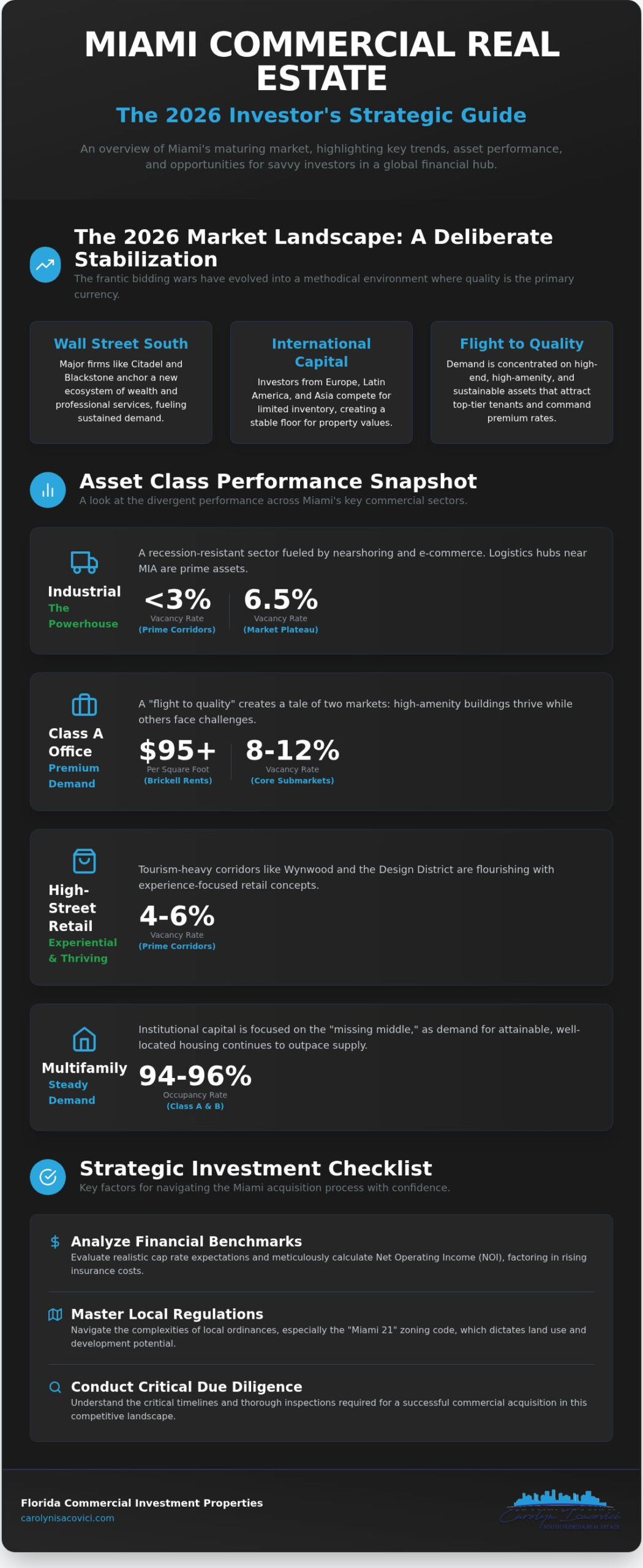
    In 2026, the era of simply buying and holding Miami real estate has evolved into a high-stakes game of strategic positioning where neighborhood-specific infrastructure dictates your ultimate return. Are you feeling overwhelmed by a flood of low-quality listings or concerned about hidden volatility in certain sub-sectors? It’s a common frustration for even the most seasoned investors. Finding the right commercial buildings for sale Miami offers requires more than just a search engine; it requires a deep understanding of why the industrial vacancy rate has plateaued at a remarkably low 6.1% to 6.9% while Class A office rents in Brickell have climbed to over $95 per square foot.

    You deserve a clear path through the maze of complex zoning and rising insurance costs that define the current landscape. This guide will help you identify high-yield commercial assets and decode the 2026 neighborhood growth projections that are reshaping the city. We’ll explore how the “Wall Street South” transformation and nearshoring trends are creating unique opportunities for those who know where to look. By the end, you’ll have the expert strategies needed to secure your next investment with confidence and clarity.

    Key Takeaways

    • Understand why 2026 represents a crucial stabilization phase and how Miami’s role as a global financial hub creates a resilient environment for your capital.
    • Learn to evaluate specific asset classes, from high-street retail to industrial logistics, to find the most promising commercial buildings for sale Miami has to offer right now.
    • Master the financial benchmarks of the current market, including realistic cap rate expectations and the essential steps to calculate Net Operating Income amidst rising insurance costs.
    • Navigate the complexities of local regulations by mastering the “Miami 21” zoning code and the critical timelines required for successful commercial due diligence.
    • Discover the advantage of a strategic partnership that transforms market uncertainty into a clear, actionable investment roadmap tailored to your long-term goals.

    The 2026 Landscape for Commercial Buildings in Miami

    Miami is no longer just a gateway to the Americas; it’s a global financial titan. Have you noticed the shift in the skyline? It’s not just about height anymore. It’s about sophistication. As we move through 2026, we’re seeing the market enter a deliberate stabilization phase. This isn’t a slowdown. It’s a maturing process that rewards the patient, strategic investor. The frantic bidding wars of the early 2020s have given way to a more methodical environment where quality is the primary currency. When you look at commercial buildings for sale Miami provides, you’ll see a market that has found its footing at a high, stable base.

    International capital continues to flow into the city, viewing South Florida as a beacon of stability. Investors from Europe, Latin America, and Asia are competing for the limited inventory. They aren’t just looking for square footage. They’re looking for ‘flight to quality’ assets. These are properties that offer high-end amenities, sustainable technology, and the kind of prestige that attracts top-tier tenants. This global interest provides a floor for property values that many other cities simply don’t have. It’s a reassuring sign for those looking to protect and grow their wealth through tangible, high-performing assets.

    Key Economic Drivers in South Florida

    Why does demand remain so high? The ‘Wall Street South’ migration is a massive factor. Major firms like Citadel and Blackstone haven’t just arrived; they’ve anchored a new ecosystem of wealth and professional services. This influx is supported by a robust Florida’s economic landscape that prioritizes growth through tax-friendly policies. Infrastructure is keeping pace too. The expansion of the Brightline rail system and our major ports has transformed how people and goods move, directly increasing the intrinsic value of nearby commercial properties. These projects aren’t just about convenience; they’re the lifeblood of long-term commercial viability.

    Defining Commercial Value in a Mature Market

    What defines a ‘prime’ building in the current market? It’s flexibility. The most successful assets in 2026 are those that can adapt. Can an office floorplate easily shift to a creative studio? Is there a retail component that serves the local neighborhood? The best commercial buildings for sale Miami features are often mixed-use gems that provide multiple revenue streams. In a city where developable land is increasingly rare, value is found in existing structures that offer both legacy prestige and modern utility. You’ll find that the most resilient investments are those that prioritize the end-user experience above all else.

    In the context of 2026 scarcity, commercial real estate value in Miami is the intersection of high-amenity infrastructure and the long-term resilience of a global financial hub.

    Have you found yourself wondering which asset class holds the most resilience in a stabilizing market? The answer isn’t universal. It depends entirely on your specific goals. In 2026, we’re seeing a fascinating divergence across sectors. While the broader office market shows a vacancy rate of 14.3%, Class A spaces in core submarkets remain tight at 8% to 12%. This “flight to quality” means that investors focusing on commercial buildings for sale Miami offers are increasingly looking for high-amenity assets that can command premium rents. Meanwhile, the industrial sector remains the city’s powerhouse. With vacancy rates in prime logistics corridors sitting below 3%, industrial properties near Miami International Airport (MIA) have become true recession-resistant plays. These hubs benefit from the ongoing nearshoring trend, as more companies move supply chains closer to home.

    Retail is also undergoing a sophisticated transformation. High-street retail in tourism-heavy corridors like Wynwood and the Design District is thriving, with vacancy rates between 4% and 6%. It’s no longer just about selling products; it’s about creating an experience. On the residential side, institutional capital has shifted its focus toward the “missing middle” in the multifamily market. With average occupancy for Class A and B buildings holding steady at 94% to 96%, the demand for well-located, attainable housing continues to outpace supply. Identifying these nuances is easier when you have access to the latest commercial real estate market reports, which provide the data-driven clarity needed to move forward with confidence.

    Neighborhood Spotlight: Where to Invest

    Brickell remains the undisputed crown jewel of the financial core. Here, Class A office rents have reached $65 to $95+ per square foot, driven by the massive influx of financial firms. If you prefer a creative or luxury angle, Wynwood and the Design District offer flagship retail opportunities where rents can exceed $100 per square foot. For those seeking the backbone of the region’s logistics, Doral and Medley are essential. Doral’s Class A logistics base rents currently range from $22 to $34 per square foot, reflecting its status as the region’s premier industrial hub.

    Emerging Corridors for 2026

    Are you looking for the next growth frontier? The “North Miami” boom is real. The corridor between Miami and Fort Lauderdale is seeing significant interest as investors seek value outside the dense urban core. Coconut Grove also stands out for its boutique office market. It’s a high-demand, low-supply environment where vacancy is minimal. Strategic opportunities also exist in Hollywood, where diversified portfolios can find a balance of retail and multifamily assets at a different entry point. Finding the right fit requires a nuanced eye for detail. For a broader view of where capital is flowing across the state, our best commercial real estate opportunities Florida roundup for 2026 reveals the highest-growth sectors and emerging geographic hubs that are currently undervalued. You might also consider exploring our latest investment property sales to see how we translate these neighborhood trends into actionable opportunities for our partners.

    Financial Benchmarks: Analyzing ROI and Cap Rates

    How do you determine if a property is a sound acquisition or a potential burden? In 2026, the answer lies in a nuanced understanding of yield that goes far beyond the surface. While Tier 1 cities like New York or Los Angeles often struggle with extreme rent control or stagnant growth, Miami remains a land of opportunity for those who value resilience. If you are currently navigating the West Coast market, The Seabrooke Group offers specialized expertise in California commercial real estate sales to help you compare your current portfolio against Florida’s emerging potential. When evaluating commercial buildings for sale Miami features, you’ll find that cap rates have stabilized into a healthy range. For core industrial assets, expect cap rates between 5.0% and 5.8%, while non-core or value-add opportunities can reach up to 6.5%. Multifamily Class A assets typically hover between 4.0% and 5.0%, reflecting a market that has matured into a reliable destination for institutional-grade capital.

    Debt service coverage ratios (DSCR) are more critical than ever in this phase of the cycle. With interest rate trends in 2026 requiring a more disciplined approach to leverage, your Net Operating Income (NOI) must be ironclad. Calculating true NOI in Florida requires a sharp eye for operating expenses that competitors often overlook. It’s not just about the gross rent; it’s about what stays in your pocket after the unique costs of the region are satisfied. This methodical approach ensures you aren’t just buying an asset, but securing a predictable stream of income.

    The Florida Insurance Landscape

    Rising property insurance premiums are a reality in South Florida, particularly in the multifamily sector where occupancy remains high at 94.2%. However, this challenge presents a strategic opportunity for the savvy investor. By prioritizing “building hardening” and resilience, you don’t just protect the physical structure; you actively mitigate insurance costs. Resilience is no longer a “nice-to-have” feature; it’s a mandatory financial metric. Investors who focus on LEED-certified or storm-resilient commercial buildings for sale Miami provides often see more favorable terms from carriers, directly boosting the asset’s long-term valuation and marketability.

    Tax Advantages and 1031 Exchanges

    Are you looking to transition from a residential portfolio into something more scalable? Many investors are utilizing 1031 Exchanges to move equity from residential units into high-yield commercial assets. If you are liquidating properties on the West Coast to facilitate these moves, you can visit Nadia Kafaipour for expert residential real estate support in Northern California. This strategy allows you to defer capital gains while stepping into the professional management environment of the commercial sector. When forecasting your return, remember to account for local property tax assessments, which can shift significantly upon a change of ownership. By eliminating the burden of state-level income taxation, Florida inherently increases the net cash flow available to investors, providing a significant structural advantage over high-tax jurisdictions.

    Miami Commercial Buildings: 2026 Market Guide

    Due Diligence and the Miami Acquisition Process

    How do you ensure your investment stands on solid ground before the ink is dry? In the fast-moving world of South Florida real estate, due diligence isn’t just a checklist; it’s a strategic deep dive. When you are evaluating commercial buildings for sale Miami offers, you’ll typically encounter a 30 to 45 day window to verify every detail. This timeline is tight, but it’s your opportunity to uncover the hidden value or potential risks that others might overlook. You aren’t just looking for physical defects. You’re looking for the structural and legal integrity that secures your long-term ROI. In a market where a significant portion of assets are owned by international investors, you must also be prepared for complex approval processes and potentially slower decision-making during the contract phase.

    Is the property actually zoned for your intended use? You’ll find the answer within the ‘Miami 21’ code. This form-based zoning code is unique because it focuses on the relationship between buildings and the street rather than just the usage. It dictates redevelopment potential and density, which are the primary drivers of future value. Beyond zoning, your environmental assessments (Phase I and II) are non-negotiable. In 2026, climate resilience has become a core financial metric. You must verify flood zone designations and evaluate how the building’s elevation might impact future insurance premiums. Reviewing rent rolls is equally critical. In our current post-inflationary era, landlords increasingly favor Triple Net (NNN) leases to pass through rising tax and insurance costs, protecting the property’s Net Operating Income.

    Legal and Regulatory Hurdles

    Navigating the Miami-Dade County building department requires a steady hand and local insight. Have you accounted for the 40-year recertification, or the more recent 25 and 30-year safety inspections? These are mandatory hurdles that can lead to significant unexpected capital expenditures if ignored. This is why partnering with a local commercial real estate attorney is essential. They help you navigate the nuances of local permits and ensure your ‘Highest and Best Use’ (HBU) study is accurate. An HBU study is particularly vital for older Miami buildings, as it determines if the current structure is truly the most profitable use of the land in a city where developable space is at a premium.

    The Role of the Commercial Broker

    Why do some of the best deals never hit the public portals? The answer lies in ‘pocket listings’ and off-market opportunities. A seasoned Miami commercial real estate broker acts as your eyes and ears on the ground, providing access to inventory that isn’t visible to the general public. Working with a Miami Commercial Real Estate Broker gives you a distinct advantage in a competitive landscape where timing is everything. Negotiation in 2026 goes far beyond the purchase price. It involves crafting contingencies, defining repair credits, and managing the expectations of diverse ownership groups. If you’re ready to move from analysis to action, we invite you to consult with our acquisition team to ensure your next investment is built on a foundation of verified data.

    Partnering for Success: Your Strategic Florida Navigator

    Why face the intricacies of the South Florida market alone? You shouldn’t. As we’ve explored, the 2026 landscape is defined by a “flight to quality” and a shift toward high-amenity assets. Navigating these nuances requires more than just access to a public database. It requires a partner who understands that every acquisition is a vital piece of a larger financial legacy. Florida Commercial Investment Properties, led by Carolyn Isacovici, serves as your strategic navigator in this evolving environment. With over 20 years of experience established through diverse market cycles, we provide the steady hand needed to transform complexity into a clear sense of opportunity. Whether you’re analyzing the most promising commercial buildings for sale Miami currently features or evaluating a redevelopment project under the “Miami 21” code, our boutique approach ensures you receive personalized attention backed by institutional-grade data.

    We don’t just find listings; we identify high-yield assets that align with your specific risk-adjusted goals. Being a boutique firm allows us to move with a level of agility and discretion that larger, tech-first aggregators simply can’t match. We’re deeply invested in your long-term success, acting as a consultant who understands the analytical mind of a strategist. From the initial identification of an off-market opportunity to the final signatures at the closing table, we’re with you at every phase. You deserve a professional partner who remains unruffled by change and remains a reliable source of truth. Understanding how a Miami commercial real estate broker builds long-term wealth strategies can help you appreciate the full value of this kind of specialized partnership.

    Our Specialized Brokerage Services

    Our approach is methodical and educational, designed to build trust through results. We offer custom property sourcing that targets your specific yield requirements, whether you’re seeking the 5.0% to 5.8% cap rates found in core industrial assets or the higher returns of value-add retail. Our expertise in both commercial and new construction assets means we can guide you through the 8 to 10 million square foot industrial construction pipeline with precision. We also specialize in portfolio diversification strategies, helping you find stability in Coconut Grove’s boutique office market or growth in the emerging North Miami corridors. We’ll help you look past the purchase price to find the true intrinsic value of an asset.

    Ready to Explore Miami Commercial Opportunities?

    The 2026 outlook for Miami is one of grounded optimism. While the market has moderated from the frantic surge of previous years, the underlying economic drivers, like the “Wall Street South” migration and nearshoring trends, remain incredibly strong. If you’re ready to move from research to acquisition, the next step is a clear-eyed assessment of your goals. Don’t let the volume of low-quality listings or complex regulations hold you back from securing a high-yield asset. We’re ready to help you turn these market conditions into a strategic advantage. Contact Florida Commercial Investment Properties for a Strategic Consultation and let’s begin identifying the commercial buildings for sale Miami offers that best fit your vision.

    Your Future in Miami’s Evolving Commercial Landscape

    The transition into a mature, stabilized market represents a unique window of opportunity for the disciplined investor. By focusing on high-amenity “flight to quality” assets and mastering the nuances of local zoning and insurance, you’ve already positioned yourself ahead of the competition. Success in 2026 isn’t just about finding square footage; it’s about identifying the resilient infrastructure and neighborhood growth that drive long-term yield. Whether you’re targeting industrial logistics hubs or boutique office spaces, the path to a high-performing portfolio is paved with verified data and strategic foresight. To broaden your perspective beyond Miami, understanding the best commercial real estate opportunities Florida offers statewide in 2026 can help you identify where your capital will work hardest across the entire region.

    Are you ready to transform these insights into a tangible acquisition? Finding the ideal commercial buildings for sale Miami provides requires a navigator who has seen every cycle over the last two decades. With a specialized focus on high-yield investment properties and new construction assets, we’re here to ensure your next move is both confident and calculated. Secure Your Miami Commercial Asset with Expert Guidance and let’s turn the complexities of today’s market into your strategic advantage. Your next great investment is waiting, and we’re honored to help you find it.

    Frequently Asked Questions

    Are commercial buildings in Miami a good investment in 2026?

    Yes, they remain a resilient choice because the market has stabilized at a fundamentally elevated base. Total commercial sales in Miami-Dade grew by 32% in 2025, reaching $7.1 billion. This growth is anchored by the “Wall Street South” transformation and a steady influx of international capital. It’s a market that rewards those who prioritize quality and strategic location over speculative volume.

    What is the average cap rate for Miami commercial property right now?

    Average cap rates vary by asset class, with core industrial properties typically ranging between 5.0% and 5.8%. If you’re looking at Class A multifamily assets, expect rates between 4.0% and 5.0%. Single-tenant NNN retail properties often offer slightly higher yields, generally falling between 5.5% and 7.0%. These figures reflect a mature market where stability and long-term growth are the primary drivers of value.

    How does the ‘Miami 21’ zoning code affect property value?

    The ‘Miami 21’ zoning code directly influences value by prioritizing form-based urban design over traditional land-use restrictions. It dictates building density, setbacks, and how a structure interacts with the public realm. Understanding these regulations is essential for identifying redevelopment potential. Properties with favorable zoning designations under this code often command a premium because they offer greater flexibility for future mixed-use expansion.

    What are the most profitable commercial neighborhoods in Miami for 2026?

    Brickell remains the powerhouse for Class A office space, while Doral and Medley are the undisputed leaders for industrial logistics. For those seeking retail opportunities, Wynwood and the Design District continue to see record-breaking rents for flagship spaces. If you’re looking for emerging growth, the North Miami corridor offers a compelling balance of value and appreciation potential for those seeking commercial buildings for sale Miami.

    Can I use a 1031 Exchange to buy commercial property in Florida?

    You can absolutely utilize a 1031 Exchange to defer capital gains taxes when transitioning into Miami commercial assets. This is a common strategy for investors moving from residential portfolios into larger, professionally managed commercial buildings. Florida’s lack of state income tax further enhances the benefits of this exchange, allowing more of your capital to remain active and generating yield within the local market.

    What is the difference between a Triple Net (NNN) and a Gross lease in Miami?

    In a Triple Net (NNN) lease, the tenant pays for property taxes, insurance, and maintenance in addition to rent, whereas a Gross lease includes these costs in the base rent. NNN structures are increasingly popular in 2026 because they protect landlords from rising operating expenses. This setup is particularly beneficial in South Florida, as it shifts the burden of fluctuating insurance premiums and property tax assessments directly to the tenant.

    How do high insurance rates in Florida impact commercial property ROI?

    High insurance rates impact ROI by increasing operating expenses, but they also create a clear divide between standard and high-quality assets. Buildings with LEED certification or advanced storm-hardening features often qualify for lower premiums, directly improving their Net Operating Income. Smart investors mitigate these costs by targeting resilient commercial buildings for sale Miami features that are better equipped to handle the region’s unique environmental and regulatory landscape.

    Why should I work with a local Miami commercial broker instead of using an online portal?

    A local broker provides access to off-market “pocket listings” that never appear on public portals, giving you a significant competitive advantage. Beyond inventory, a seasoned partner navigates the complexities of local zoning, environmental recertifications, and negotiation nuances that digital platforms ignore. We act as your strategic navigator, ensuring that your acquisition is based on deep local insight rather than just surface-level data.