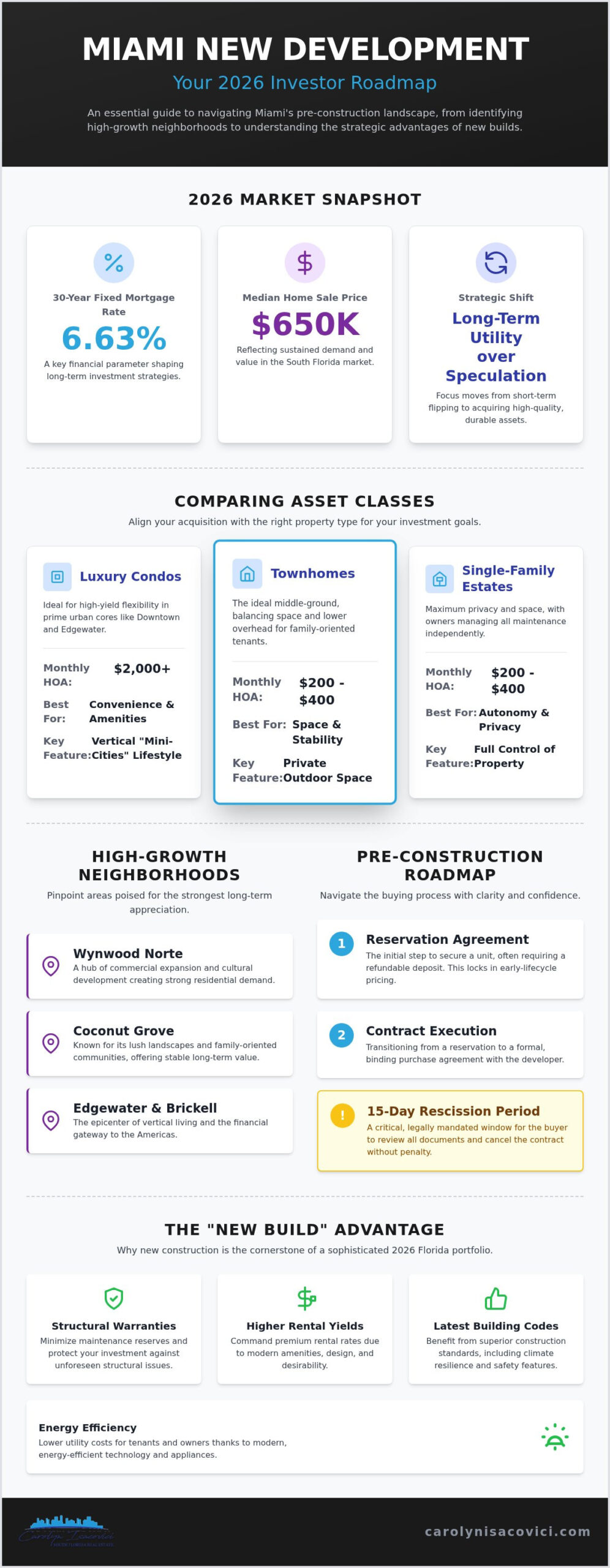
What if the greatest risk in the current market isn’t buying at the peak, but waiting for a correction that doesn’t come? It’s a question many investors ask as they survey the skyline, feeling a mix of excitement and legitimate caution. You likely feel the pressure to get the timing right, yet the complexity of pre-construction agreements can feel like a barrier. Finding the right new development homes Miami has to offer requires more than just luck; it demands a clear-eyed strategy. With 30-year fixed mortgage rates currently near 6.63%, the focus has shifted from speculative flipping to securing assets with genuine, long-term utility.
We’re here to help you move past the noise and find the opportunity. This guide provides a comprehensive roadmap to the 2026 landscape, ensuring you understand exactly how to identify neighborhoods with the highest appreciation potential. You’ll gain a clear perspective on the specific steps needed to secure a pre-construction unit with confidence. From the rise of integrated “mini-cities” in Edgewater to the nuances of the 2% property tax rate, we’ll cover the essential data you need to make an informed, sophisticated investment. Clarity is power.
Key Takeaways
- Understand the strategic shift toward integrated vertical communities and how these “mini-cities” provide enhanced resilience and lifestyle value in the 2026 market.
- Compare the distinct advantages of luxury high-rise condos versus family-oriented townhomes to align your acquisition with the specific needs of modern tenants.
- Pinpoint high-growth neighborhoods like Wynwood Norte and Coconut Grove where new development homes Miami offers are poised for the strongest long-term appreciation.
- Navigate the pre-construction roadmap with total clarity, from the initial reservation agreement through the critical 15-day rescission period.
- Evaluate the financial benefits of the “New Build” premium, including the ability to command higher rental yields while minimizing maintenance reserves through structural warranties.
Understanding the Miami New Development Landscape in 2026
What exactly defines a “new development” in today’s sophisticated market? It isn’t just a building with a fresh coat of paint or a few modern appliances. In the current cycle, new development homes Miami offers are characterized by ground-up construction or major adaptive reuse projects that transform underutilized urban footprints into modern landmarks. We’re witnessing a decisive shift toward ‘live-work-play’ vertical communities. These aren’t merely residential towers; they’re self-contained ecosystems where your office, your wellness center, and your favorite dining spots are all accessible via the same elevator bank. This evolution reflects a growing desire for efficiency and integrated living that older inventory simply can’t provide.
Is there enough room for everyone in this expanding skyline? While the luxury sector remains robust, 2026 has brought a much-needed focus on balancing high-end branded residences with attainable housing designed for the professionals who fuel the city’s growth. Choosing new construction over the resale market offers a clear strategic advantage right now. With the median home sale price sitting at $650,000 as of June 2026, many buyers find that the value proposition of a brand-new unit outweighs the maintenance risks of older stock. You’re buying into the latest building codes, superior energy-efficient technology, and architectural designs that resale properties can’t match without significant capital investment.
Why Miami Remains a Global Hub for New Construction
Sustained domestic migration continues to underpin residential demand across South Florida. As people relocate for lifestyle and tax advantages, the need for modern housing grows. This isn’t just about sunshine; the commercial expansion in Brickell and Wynwood creates a permanent resident base that needs to live close to high-value employment centers. Understanding Miami’s economic and demographic profile reveals why this growth is a structural evolution rather than a temporary trend. The ‘Miami Premium’ in 2026 real estate represents the tangible value added by world-class amenities, climate resilience, and the city’s unique status as the financial gateway to the Americas.
Inventory Cycles and Strategic Timing
Timing your entry is vital for maximizing upside. We’re currently seeing a “delivery wave” where several major projects are hitting the market simultaneously, providing buyers with more leverage than they’ve had in years. Buying early in the development lifecycle allows you to lock in pricing before the final completion surge. Even with 30-year fixed mortgage rates hovering around 6.63%, developers are offering creative incentives to move inventory. These include interior upgrade credits or temporary rate buy-downs that make new development homes Miami projects more accessible than the headline figures might suggest. Staying informed about these cycles ensures you’re positioned to act when the intersection of price and quality is most favorable.
Comparing Asset Classes: Condos, Townhomes, and Single-Family Estates
Which asset class aligns best with your 2026 goals? The answer depends on whether you prioritize high-yield flexibility or long-term family stability. We’re seeing a distinct resurgence in luxury condos within the Downtown and Edgewater corridors, where the vertical lifestyle offers unparalleled convenience. For those seeking a balance, townhome developments have emerged as the ideal middle-ground. They offer more square footage than a typical apartment while maintaining lower overhead than a detached estate. Finding the new development homes Miami offers often involves weighing these trade-offs, especially regarding lifestyle amenities versus private outdoor space.
Maintenance and HOA structures vary significantly across these categories. For instance, new luxury condos often carry HOA fees of $2,000 or more per month to support extensive staff and elite facilities. In contrast, townhouses and single-family communities typically range between $200 and $400 monthly. While the condo fee is higher, it covers structural insurance and shared amenities that a single-family owner must manage independently. Understanding these recurring costs is essential for calculating your true net return before committing to a contract.
The 2026 Condo Market: Beyond the Skyline
Flexibility is the hallmark of the modern Miami condo. Many new projects are designed specifically as short-term rental-capable developments, often referred to as condo-hotels. These units allow owners to generate income while they’re away, catering to the city’s robust tourism and business travel sectors. Beyond the financial upside, the value is driven by lifestyle infrastructure like integrated wellness centers, high-tech co-working spaces, and exclusive private clubs. If you’re exploring these options, our Buying New Construction Homes in Florida guide provides deeper insight into the specific tax and legal considerations for 2026 investors.
New Construction Single-Family Trends
Where do you find space in a densifying city? The search often leads to historic neighborhoods like Coconut Grove or Coral Gables, where new builds are characterized by modern tropical architecture. This style blends floor-to-ceiling glass with natural materials and lush landscaping to create a seamless indoor-outdoor experience. These estates now include smart home integration as a standard feature, alongside rigorous hurricane-resilient construction and energy-efficient roofing. When choosing among the new development homes Miami is currently delivering, consulting with a seasoned advisor can help you identify the most promising infill projects before they hit the open market.
Strategic Neighborhood Spotlights: Where Growth is Happening
How do you separate a temporary trend from a structural shift in value? In the 2026 market, the answer lies in the intersection of commercial infrastructure and residential density. We’re seeing a fascinating evolution in Wynwood Norte, where updated zoning has paved the way for mid-rise projects that blend seamlessly with the area’s creative legacy. These aren’t just housing units; they’re parts of a broader urban revitalization that includes new office spaces and retail hubs. Similarly, the Design District has matured into a global luxury destination, making new development homes Miami offers in the surrounding blocks highly coveted for their proximity to world-class culture.
If you prefer a more established atmosphere, Coconut Grove continues to deliver exceptional luxury infill. It’s a neighborhood where historic charm meets modern engineering, offering a sense of permanence that’s rare in a rapidly growing city. For those looking for the next “undiscovered” pocket, Little River and West Miami are attracting savvy investors. These areas are benefiting from the ‘halo effect’ of nearby high-value districts, offering a lower entry point while commercial infrastructure projects, such as new transit links and tech hubs, signal future appreciation. Following the cranes often leads you to the most resilient opportunities.
The Brickell-Downtown Corridor
Vertical living in the urban core has reached a new level of sophistication. The rise of ‘branded residences’ associated with elite fashion and automotive names has transformed the skyline, offering buyers a level of service and prestige that was previously unavailable. Proximity to the Brightline station remains a primary value anchor, providing seamless connectivity that appeals to the modern, mobile professional. The concentration of global corporate headquarters in the financial district directly fuels the sustained demand for high-income rentals, providing a reliable safety net for new development homes Miami investors.
Suburban Expansion: Broward and Beyond
Is the urban core the only place to find value? Not for everyone. Many investors are finding success by looking toward New Construction Homes in Broward County, where the focus shifts to master-planned communities and expansive family-oriented layouts. These developments cater to a growing demographic that prioritizes space and school districts without sacrificing modern construction standards. Infrastructure improvements across South Florida have significantly reduced commute times, making these suburban hubs a viable and attractive alternative for professionals who want the best of both worlds. Whether you stay in the heart of the city or venture north, the key is to align your purchase with these long-term infrastructure plays.
The Pre-Construction Buying Process: A Numbered Roadmap
How do you move from a digital rendering to a set of keys in your hand? The journey of acquiring new development homes Miami developers are currently building follows a structured, multi-year timeline that offers unique protections for the buyer. Unlike a traditional resale, where the process is often frantic, pre-construction allows for a methodical approach. It’s a path designed to build equity while the structure rises from the ground.
- Reservation Agreement: You start by selecting a specific unit and placing a small, fully refundable deposit. This stage locks in the current price while the developer prepares the final legal documents.
- The Contract Stage: Once the offering plan is finalized, you move to a formal contract. This usually requires an additional deposit, bringing your total commitment to approximately 20% of the purchase price.
- Construction Milestones: Payments are tied to physical progress, often referred to as the ‘Deposit Schedule.’ You’ll typically pay installments at groundbreaking, when construction reaches the amenity level, and at the ‘top-off’ of the roof.
- Finishing and Inspections: As completion nears, you’ll select your final finishes and conduct a detailed walkthrough. This inspection ensures the unit meets the promised standards before you take possession.
- Final Closing: The remaining balance is paid, often through a mortgage or cash, and the title is officially transferred to you. This usually occurs shortly after the building receives its Temporary Certificate of Occupancy (TCO).
Navigating the 15-Day Rescission Period
One of the most significant advantages of the Florida market is the mandatory 15-day rescission period. This window begins the moment you receive the developer’s prospectus. It’s your opportunity to review the ‘fine print’ with a professional eye, ensuring the rules regarding rentals, pets, and common areas align with your long-term goals. Our Buying a New Construction Home in Miami Guide breaks down exactly what to look for in these dense documents. Having a seasoned broker by your side during this phase is essential for peace of mind.
Understanding Developer Fees and Closing Costs
Closing on a new build involves different financial considerations than a resale property. You should anticipate developer fees, which generally cover the developer’s attorney fees and administrative costs. Additionally, most projects require a working capital contribution to fund the initial HOA reserves. In the 2026 landscape, we’re seeing more opportunities to negotiate ‘builder credits’ to offset these costs, especially as inventory levels stabilize. If you’re ready to explore current opportunities, you can contact our advisory team to review specific project availability and deposit structures for new development homes Miami is delivering this year.
Why New Construction is the Cornerstone of a 2026 Florida Portfolio
Why do sophisticated investors prioritize the “New Build” premium over seemingly cheaper resale options? The answer lies in the net operating income. In the 2026 landscape, tenants are increasingly selective, gravitating toward properties that offer the latest in wellness infrastructure and smart home integration. These new development homes Miami is currently producing command higher rental rates precisely because they align with the modern lifestyle. When you invest in new construction, you aren’t just buying a property; you’re acquiring a high-performance asset designed to outperform the broader market.
Financial predictability is another pillar of this strategy. One of the most significant advantages of new builds is the 10-year structural warranty, which dramatically reduces the need for heavy maintenance reserves in the first decade of ownership. While older buildings may face mounting costs related to aging infrastructure, a new project allows you to focus on growth rather than repairs. Balancing your commercial assets with residential new developments creates a resilient, diversified portfolio that can weather various economic cycles. Carolyn Isacovici, with her firm’s established expertise since 2006, facilitates this transition by applying a strategist’s lens to every acquisition.
Tax Advantages and Insurance Benefits
Did you know that your choice of construction date directly impacts your insurance premiums? Homes built to the current 2026 Florida Building Codes are significantly more resilient to extreme weather, often leading to lower insurance costs compared to older structures. Additionally, many of these energy-efficient builds qualify for specific property tax mitigations, helping to offset the average 2.0% tax rate in Miami-Dade County. Investing in modern construction standards ensures a higher long-term ROI by minimizing non-discretionary expenses from day one.
Securing Your Future in the Miami Market
How do you find the best opportunities before they become public knowledge? A specialized broker plays a vital role in identifying ‘off-market’ developer inventory and early-access pricing that isn’t available on standard listing sites. This insider perspective is essential for navigating complex transactions and securing the most promising units in a competitive environment. Your next step is to move from observation to action. Scheduling a consultation to review current site plans and deposit structures will give you the clarity needed to move forward. We invite you to contact Florida Commercial Investment Properties to explore 2026 developments and begin your journey toward a more strategic Miami acquisition.
Your Path to a Resilient Miami Portfolio
Success in the 2026 market isn’t just about finding a beautiful property; it’s about identifying the intersection of timing and infrastructure. By focusing on emerging districts like Wynwood Norte or the vertical integration of the Brickell corridor, you’re aligning your capital with the city’s structural growth. The financial benefits of modern construction, from lower insurance premiums to higher rental yields, provide a clear advantage over older inventory. Finding the right new development homes Miami offers is a process of navigating complexity with a steady, informed hand.
Are you ready to move from observation to acquisition? With over 20 years of South Florida market expertise, Carolyn Isacovici serves as a strategic advisor for both commercial and residential portfolios, specializing in identifying high-yield investment properties. You don’t have to navigate these cycles alone. Secure your place in Miami’s future with Carolyn Isacovici’s expert guidance and gain the clarity needed for a sophisticated investment. The opportunities are here, and the path forward is clear. Let’s begin your next chapter with confidence.
Frequently Asked Questions
Is it better to buy a new development home or a resale home in Miami?
Choosing between new development homes Miami offers and a resale property often comes down to your tolerance for maintenance. New construction provides the latest hurricane-resilient standards and energy-efficient systems, which can significantly lower your insurance premiums. While resale homes might offer immediate occupancy, they often require hidden capital expenditures for modernizing infrastructure. A new build ensures you’re entering the market with a high-performance asset that meets 2026 building codes from day one.
What is the typical deposit structure for pre-construction in Miami?
Most pre-construction projects require a total deposit of 30% to 50% of the purchase price, spread across specific construction milestones. You’ll typically pay 10% at the reservation or contract stage, followed by additional 10% installments at groundbreaking and when the building reaches the amenity level. The final balance is due at closing. This structured approach allows you to build equity as the project progresses without needing to secure a mortgage until the building is near completion.
Can I customize the floor plan of a new development home?
Customization options depend heavily on the stage of construction and the type of property. In large-scale luxury condo developments, you can often select from a curated palette of finishes, flooring, and cabinetry, but structural floor plan changes are rarely permitted due to engineering constraints. However, in boutique townhome projects or single-family infill builds, developers may offer more flexibility if you enter the contract during the early design phases. It’s best to ask about buyer selections before signing.
How long does it typically take for a new Miami development to be completed?
The timeline for completion varies by the project’s scale. A major luxury high-rise in the urban core typically takes three to four years from groundbreaking to delivery. In contrast, boutique townhome developments or single-family homes often reach completion within 12 to 18 months. We recommend reviewing the developer’s estimated “topping off” date and the scheduled issuance of the Temporary Certificate of Occupancy (TCO) to align with your personal relocation or investment timeline.
Are there any risks associated with buying pre-construction real estate?
While pre-construction offers significant upside, it’s important to consider potential delivery delays or shifts in mortgage rates during the build cycle. You can mitigate these risks by working with established developers who have a proven track record of finishing projects on schedule. Additionally, the Florida 15-day rescission period provides a vital safety net, allowing you to review the prospectus and ensure the contract terms are favorable before your deposit becomes non-refundable.
What are the most popular neighborhoods for new developments in 2026?
In 2026, the most active corridors for new development homes Miami has are Edgewater, Wynwood Norte, and the Brickell financial district. These areas are attracting investment due to their integrated “live-work-play” infrastructure and proximity to major transit hubs like the Brightline. For those seeking a more residential feel, Coconut Grove and Coral Gables remain top choices for luxury infill projects that combine modern design with the historic charm of Miami’s most established communities.
Do new development homes in Miami come with a warranty?
Yes, Florida law requires developers to provide specific warranties for new construction. Most notably, you receive a one-year warranty on workmanship and materials, a two-year warranty on systems like plumbing and electrical, and a ten-year structural warranty. This provides immense peace of mind compared to the resale market, where you often inherit the maintenance liabilities of previous owners. These protections ensure your investment remains secure as the building settles into its first decade.
How do I choose the right developer for a new construction project?
Choosing a developer requires a thorough review of their past performance and financial stability. We advise looking for firms that have successfully delivered similar projects in South Florida through various market cycles. Visit their completed buildings to inspect the quality of finishes and speak with current residents about their experience. A developer with a transparent history and a commitment to quality is your best partner for a successful, low-stress acquisition in the new construction space.