
Nearly 70% of Miami’s housing market is occupied by renters, yet many newcomers still treat South Florida as a high-stakes speculative gamble. The real opportunity lies in long-term discipline. Executing an intelligent buy and hold real estate strategy Miami investors can rely on means prioritizing durable net yields over volatile, short-term appreciation.
You’re likely wrestling with genuine headwinds: rising property insurance rates, mandatory condo milestone inspections under SB 4-D, and sudden HOA reserve assessments. It’s completely natural to wonder where sustainable rent growth ends and speculative pricing begins. When approached with steady underwriting and clear local data, however, these shifting market dynamics actually create exceptional opportunities for patient capital.
In this guide, you’ll discover how to build enduring wealth and predictable cash flow using a disciplined buy-and-hold framework tailored for today’s market. We’ll examine resilient property types insulated from seasonal tourism swings, pinpoint neighborhoods driven by organic employment growth, and demonstrate how thorough due diligence protects your equity across every cycle.
Key Takeaways
- Mastering a buy and hold real estate strategy Miami portfolio requires underwriting for sustainable net rental yields rather than counting on speculative price spikes.
- Evaluating residential, multi-family, and commercial assets through a unified framework reveals which property classes offer optimal cash flow relative to active management demands.
- Proactive due diligence around Florida SB 4-D reserve requirements, wind mitigation, and property tax reassessments shields your returns from unexpected operational expenses.
- Adopting a disciplined, five-step acquisition roadmap ensures every purchase is supported by conservative financials and strong local submarket fundamentals.
- Scaling your footprint thoughtfully across South Florida unlocks operational efficiencies and builds lasting resilience against localized market shifts.
What Is the Buy and Hold Real Estate Strategy in Miami?
At its foundation, executing a buy and hold real estate strategy Miami investors favor means purchasing income-producing residential, commercial, or multi-family properties to retain them across multi-year cycles. Rather than pursuing fleeting speculative margins, this model generates predictable monthly cash flow while capturing compounding structural appreciation. While short-term trading often leaves capital vulnerable to shifting seasonal headwinds, embracing a traditional buy-and-hold investment strategy grounds your portfolio in tangible, productive land and physical square footage.
Miami has experienced a decisive evolution away from hyper-leveraged flippers toward institutional-grade wealth preservation. Expanding corporate hubs across financial services, healthcare, and technology continue drawing affluent households to South Florida. This continuous influx deepens an already substantial tenant pool, transforming local rental property into an indispensable, yield-generating vehicle.
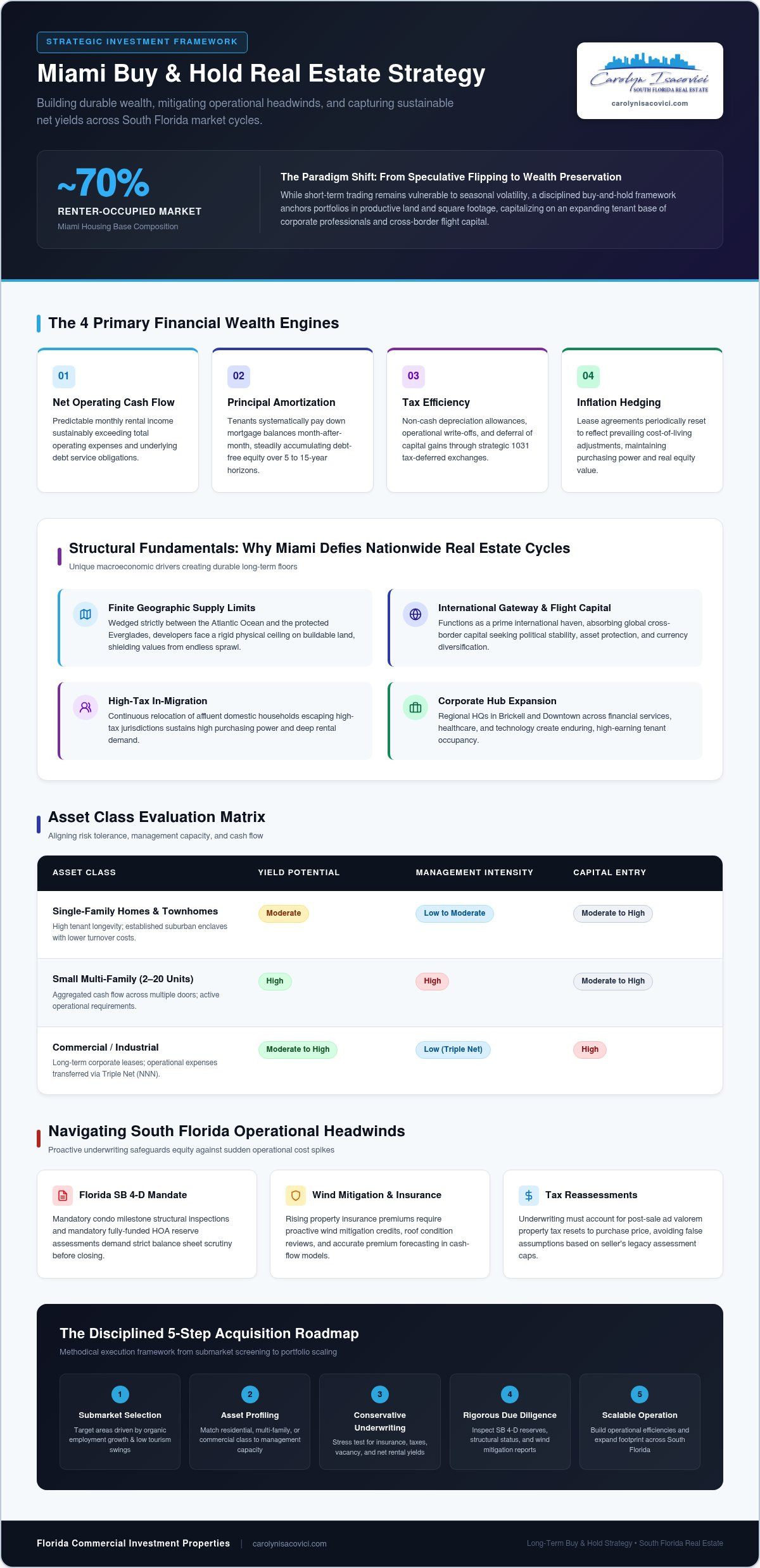
Every successful long-term hold relies on four primary financial engines:
- Net Operating Cash Flow: Monthly rental income exceeding total operating costs and debt obligations.
- Principal Reduction: Tenants systematically pay down underlying mortgage balances month after month.
- Tax Efficiency: Non-cash paper depreciation allowances, operating expense write-offs, and deferred gains via 1031 exchanges.
- Natural Inflation Hedging: Lease agreements reset regularly to match rising living costs, protecting real buying power.
The Core Wealth Engines of Long-Term Miami Ownership
Durable wealth in South Florida begins with recurring cash flow. As national corporations establish regional headquarters in Brickell and Downtown, the influx of high-earning professionals sustains robust rental occupancy. Over a 5 to 15-year horizon, tenant-funded debt amortization quietly builds formidable equity. Paired with federal tax depreciation allowances and future 1031 tax-deferred exchanges, real returns compound substantially without annual tax drag diminishing your capital base.
Why Miami Defies Nationwide Real Estate Cycle Norms
National real estate rules rarely apply cleanly here. South Florida functions as a primary international gateway, continuously absorbing cross-border flight capital seeking political stability and asset protection. Simultaneously, severe geographic limits define the region; wedged tightly between the Atlantic Ocean and the protected Everglades, developers face finite developable land. This strict supply ceiling, combined with steady in-migration from high-tax states, creates structural support for long-term values.
Comparing Miami Asset Classes for Long-Term Hold Strategies
Every successful buy and hold real estate strategy Miami investors deploy begins with matching the right property type to your liquidity and risk tolerance. Rather than treating all rentals identically, sophisticated buyers evaluate assets through three core variables: cash-flow stability, operational management intensity, and capital expenditure exposure. Understanding these dynamics alongside our practical framework on how to evaluate investment property Florida ensures you build a sustainable foundation from day one.
Historical trends tracked by the Miami-Dade County House Price Index reflect steady long-term appreciation across cycles, but individual asset performance varies widely:
| Asset Class | Yield Potential | Management Intensity | Capital Entry |
|---|---|---|---|
| Single-Family Homes | Moderate | Low to Moderate | Moderate to High |
| Small Multi-Family (2-20 Units) | High | High | Moderate to High |
| Commercial / Industrial | Moderate to High | Low (Triple Net) | High |
Single-Family Homes and Townhomes
Single-family rentals consistently deliver tenant longevity. Families settle into established suburban enclaves, treating the residence like their own and keeping turnover costs low. However, due diligence must include Homeowners Association (HOA) rules. Associations frequently enforce strict leasing waiting periods or annual rental caps that can disrupt cash flow unexpectedly.
Small to Mid-Sized Multi-Family Properties
Duplexes, triplexes, and garden apartments between 2 and 20 units provide built-in vacancy protection. If one tenant relocates, remaining rental units keep debt service covered. Valuations for properties with five or more units depend strictly on net operating income rather than subjective consumer comps, giving you direct control over equity growth through rent optimization.
Commercial and Mixed-Use Assets
Industrial storage bays, boutique urban retail, and flex spaces offer powerful defensive holdings across expanding transit corridors. Utilizing triple-net (NNN) leases shifts insurance, property taxes, and maintenance burdens directly onto business tenants, as detailed in our guide comparing commercial vs residential investment Florida. If you want to explore vetted inventory across these sectors, consulting a seasoned team like Florida Commercial Investment Properties provides the clear market visibility you need to proceed with confidence.
Navigating Miami Market Realities: Insurance, Taxes, and Regulations
Can an investor still achieve strong net cash flow given South Florida’s operational expenses? The answer is yes, provided you underwrite with precision rather than broad national assumptions. Executing a profitable buy and hold real estate strategy Miami requires moving past generic guidelines and directly factoring in localized line items like windstorm insurance, tax resets, and structural compliance. Grounding your pro-forma in realistic figures transforms potential market headwinds into clear strategic advantages.
Accounting for operating costs also means pairing state-level assessments with federal deductions outlined in IRS Publication 527 rental property rules. Writing off repairs, depreciation, and insurance premiums preserves yield. The key is knowing what those expenses will look like before you close.
Underwriting Property Insurance and Wind Mitigation in Miami-Dade
Insurance premiums vary dramatically based on structural resilience. During due diligence, acquiring both a 4-point inspection and an updated wind mitigation report is essential. Properties with impact-rated windows, roof-to-wall hurricane clips, and secondary water barriers often secure windstorm premium credits ranging between 20% and 50%. While Citizens Property Insurance remains a common backstop, Florida’s private carrier market has expanded with flat and reduced rate filings, offering competitive alternatives for hardened buildings.
Understanding Florida Property Taxes and Non-Homestead Caps
Never base your tax projections on a seller’s historical tax bill. On January 1 following a change in ownership, the assessed value resets to current market purchase value. In Miami-Dade, effective millage rates typically range from 1.6% to 2.0% of fair market value. Once established, Florida Statutes cap subsequent annual taxable assessment increases at 10% for non-homestead residential and commercial holdings, offering long-term tax stability against sudden inflationary jumps.
Navigating Building Recertifications and Condo Milestone Inspections
Regulatory compliance under Florida SB 4-D and HB 913 directly influences multi-story investments. Mandatory milestone inspections apply to buildings with three or more habitable stories reaching 30 years of age, or 25 years in designated coastal corridors:
- Structural Integrity Reserve Studies (SIRS): Completed studies prevent boards from waiving reserve funding for roofs, load-bearing walls, foundations, and waterproofing.
- Special Assessment Audits: Reviewing association balance sheets and meeting minutes reveals whether upcoming capital repairs will generate unexpected cash calls.
- Due Diligence Contingencies: Verifying reserve funding health during the inspection period shields your capital before purchase contracts become non-refundable.
How to Execute a Miami Buy-and-Hold Purchase: Step-by-Step
Moving from high-level planning to actual execution demands an unemotional, structured process. Relying on speculative double-digit appreciation is never a viable strategy. Instead, executing a disciplined buy and hold real estate strategy Miami requires evaluating opportunities through actual in-place yield, localized tenant demand, and rigorous risk control. Aligning your timeline with broader macro patterns outlined in our analysis of Miami real estate market trends 2026 provides the clear perspective needed to deploy capital effectively.
Step 1 & 2: Define Geographic Submarkets and Screen Financials
Begin by pinpointing established employment corridors across Miami-Dade, Broward, and Palm Beach that demonstrate steady wage growth. Once you identify candidate properties, screen them against verifiable trailing twelve-month financials. Avoid glossy marketing projections. Calculate your capitalization rate, debt service coverage ratio (DSCR), and cash-on-cash return using actual historical collections, realistic vacancy buffers, and up-to-date operating expense quotes.
Step 3 & 4: Conduct Physical Due Diligence and Secure Financing
Physical inspections must look past cosmetic finishes to evaluate heavy mechanical components. In South Florida, that means thoroughly inspecting roofs, plumbing stacks, commercial chillers, and electrical service panels. Concurrently, your acquisition team must pull municipal open-permit searches and code compliance records to uncover unpermitted additions or pending municipal liens. On the capital side, arrange tailored financing whether utilizing commercial DSCR loans or private portfolio debt early in your contract contingency period.
Step 5: Implement Professional Management and Asset Optimization
Closing the transaction is just the beginning of your hold period. Handing operations to a skilled local property management firm ensures that preventative maintenance protects against humid coastal weather. Thoughtful, scheduled rent adjustments aligned with local wage growth steadily optimize your yield over time. Ready to identify vetted commercial and residential opportunities across South Florida? Partner with Florida Commercial Investment Properties to source and evaluate resilient assets for your portfolio.
Building a Resilient South Florida Real Estate Portfolio
Why stop at a single acquisition? While owning one rental property creates a reliable income stream, scaling thoughtfully across South Florida unlocks compounding economies of scale. Bundling service contracts, property insurance, and routine maintenance across multiple units materially reduces your per-door operating costs. Moving from an isolated purchase to an expansive buy and hold real estate strategy Miami investors rely on transforms opportunistic buys into an enduring wealth engine. To examine scaling principles in detail, explore our framework for strategic Florida real estate portfolio building.
Strategic Geographic Diversification Within South Florida
Concentrating capital in a single neighborhood leaves returns vulnerable to hyper-local fluctuations. Balancing dense urban infill assets in Miami with high-growth suburban opportunities across Broward and Palm Beach provides true income stability. Urban multi-family properties capture corporate professionals and international arrivals, while suburban single-family rentals attract long-term families seeking top school districts. Mixing residential workforce units with neighborhood commercial properties along regional transit expansions insulates your cash flow against sector-specific slowdowns.
Partnering with an Experienced Local Brokerage Team
How do private investors uncover premier opportunities before they hit public listing platforms? In South Florida, relationships drive access. Sourcing off-market commercial properties, new construction developments, and multi-family parcels requires deep, cycle-tested roots in the local brokerage community.
Established circa 2006, Florida Commercial Investment Properties, led by Carolyn Isacovici, brings two decades of experience navigating Florida market cycles. With dual expertise spanning both residential multi-family and commercial property sales across Miami, Miami Beach, Fort Lauderdale, and Palm Beach, our advisory approach focuses on identifying resilient assets with verified cash flow. We provide calm, specialized guidance during physical and financial due diligence to safeguard your equity against hidden liabilities. Take the next strategic step toward executing your portfolio vision by scheduling a consultation with Florida Commercial Investment Properties.
Securing Your Long-Term Position in Miami Real Estate
Building lasting wealth in South Florida doesn’t require chasing unpredictable market peaks. When you execute a disciplined buy and hold real estate strategy Miami fundamentals reward, your capital compounds safely through recurring cash flow, steady debt reduction, and strategic tax efficiency. Factoring in Florida-specific operational expenses early and selecting resilient property types positions your portfolio to thrive across changing economic tides.
Navigating this dynamic landscape becomes straightforward when you have an experienced guide at your side. Serving Florida investors with cycle-tested advisory guidance since 2006, our brokerage delivers specialized dual expertise across residential multi-family and commercial asset classes throughout Miami-Dade, Broward, and Palm Beach counties. If you’re ready to identify resilient acquisitions that match your long-term wealth goals, partner with Carolyn Isacovici to secure high-performing Miami investment properties and take confident control of your financial future.
Frequently Asked Questions
Is a buy and hold real estate strategy still viable in Miami given current insurance rates?
Yes, executing a buy and hold real estate strategy Miami investors rely on remains highly viable when you target structurally hardened properties and secure accurate underwriting upfront. While baseline windstorm rates are elevated across coastal South Florida, recent legislative reforms have stabilized the private market. Selecting assets with impact glass, updated roofs, and complete wind mitigation credits cuts insurance carrying costs significantly, ensuring cash flow remains resilient.
What capitalization rate should an investor expect for a Miami rental property in 2026?
Investors can generally expect entry capitalization rates between 5.0% and 6.5% for well-located Miami-Dade multi-family and commercial properties. Prime core assets in high-demand submarkets like Brickell or Coconut Grove often trade at the tighter end around 4.5% to 5.0% due to strong appreciation fundamentals. In contrast, value-add workforce housing in developing suburban corridors can reach upward of 6.5% to 7.0% net operating cap rates.
How do Florida’s condo safety laws and milestone inspections impact buy-and-hold investors?
Structural safety laws under SB 4-D and HB 913 create both pricing discounts and reserve liabilities for condo buyers. Buildings at 30 years of age require comprehensive milestone inspections, and associations cannot waive structural reserve funding. While this triggers special assessments for some older towers, it allows disciplined cash buyers to negotiate discounted acquisitions on well-managed properties that have already completed necessary structural compliance.
Can out-of-state investors manage a buy-and-hold property in South Florida effectively?
Out-of-state investors successfully manage South Florida holdings by partnering with specialized third-party property management companies. Local management firms handle tenant screening, rent collection, municipal compliance, and storm preparation seamlessly. By engaging an experienced local real estate brokerage during your initial purchase, you gain immediate access to trusted networks of licensed property managers, field contractors, and commercial vendors across Miami, Fort Lauderdale, and Palm Beach.
How much should I budget for non-homestead property taxes after buying an investment property in Miami?
You should budget approximately 1.6% to 2.0% of your total purchase price for first-year ad valorem taxes in Miami-Dade County. Because the seller’s prior assessment cap resets to full market value on January 1 following acquisition, historical tax bills are misleading. Once your new assessed baseline takes effect, Florida’s statutory 10% non-homestead annual cap protects your investment against aggressive future tax hikes.
What are the primary differences between holding single-family rentals versus multi-family in Miami?
Single-family rentals typically yield longer tenant occupancies and minimal common-area maintenance, making them ideal for stable capital preservation. In contrast, multi-family properties provide diversified rental income that prevents total vacancy risk when one resident departs. Multi-family valuations also track operational net income rather than neighborhood residential comps, providing clearer opportunities to actively force property appreciation through professional management. Executing a buy and hold real estate strategy Miami across either category depends on your liquidity and active management preferences.
What happens if a property I purchase has open building permits or code violations in Miami-Dade?
Open permits and uncorrected code violations transfer with property ownership, exposing buyers to daily municipal fines and severe title encumbrances. In Miami-Dade, these unresolved issues can freeze future building applications or prevent certificates of occupancy. Always mandate a comprehensive municipal lien and permit search during contract contingencies, requiring sellers to close out all open permits and satisfy outstanding violations before final settlement.
Leave a Reply