Tag: Real Estate Investing

  • Income Producing Properties Miami: The 2026 Strategic Investor’s Guide

    Income Producing Properties Miami: The 2026 Strategic Investor’s Guide

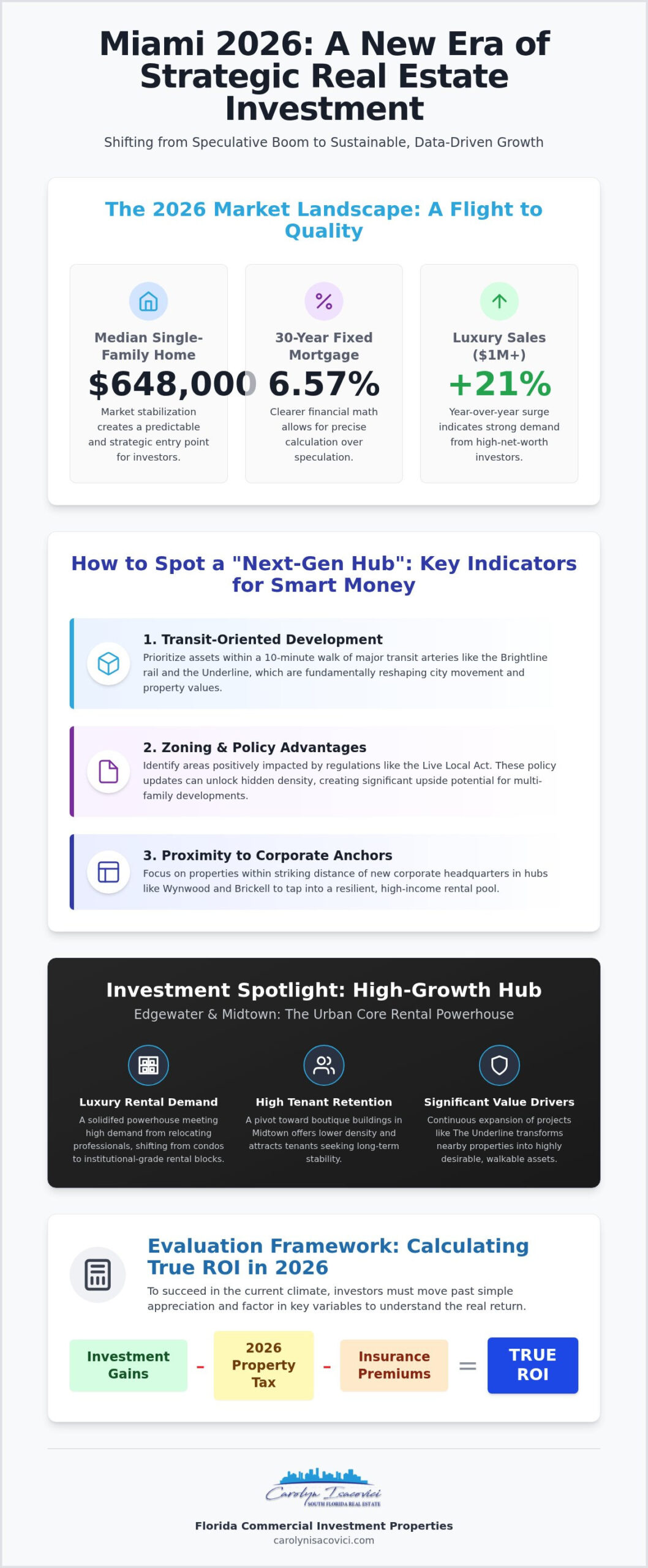
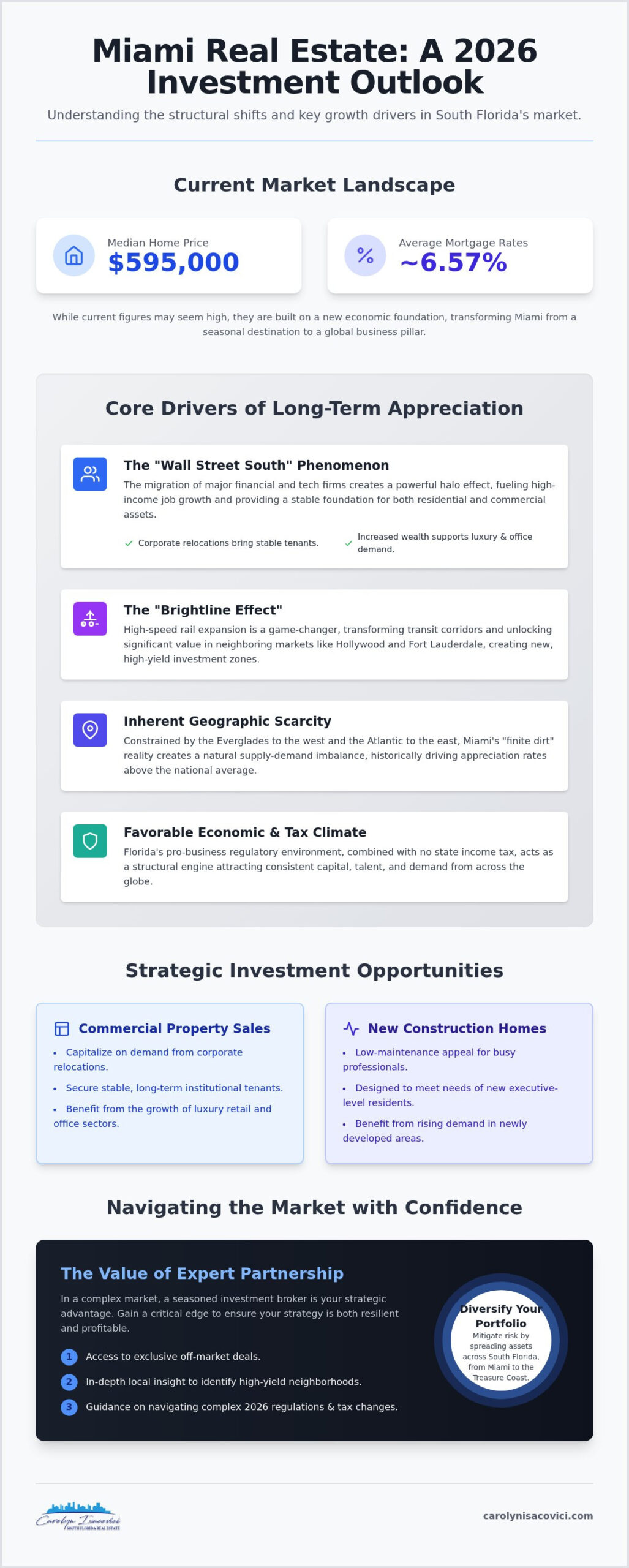
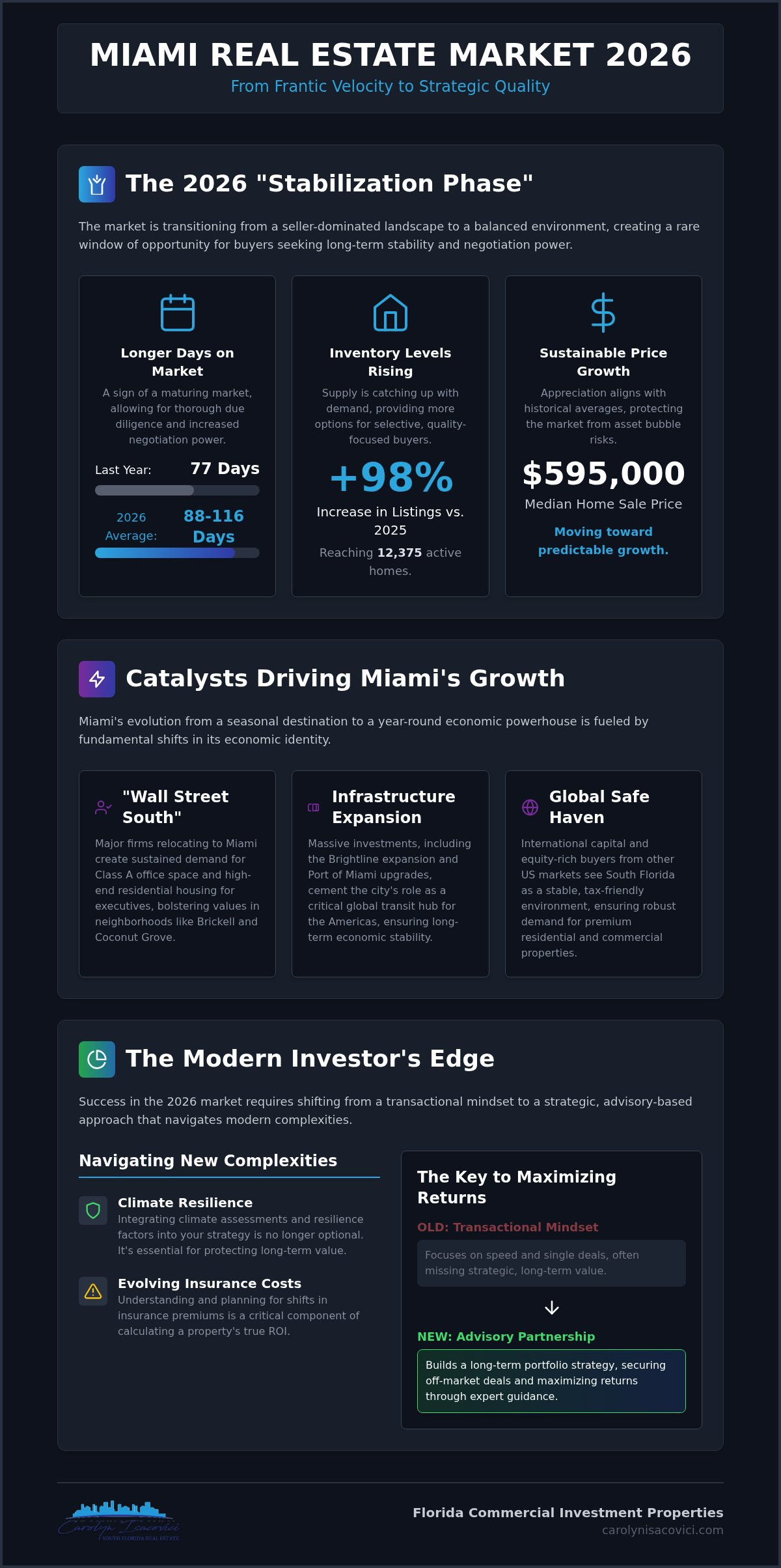
    Could the most lucrative investment in the 2026 market actually be the one that requires the least amount of your time? It’s a question many investors are asking as they evaluate the current landscape of income producing properties Miami offers. You’ve likely noticed that while median sale prices have stabilized around $595,000, the entry point for the urban core remains high; meanwhile, the fear of hidden maintenance costs in older buildings keeps many on the sidelines. You want the legendary growth Florida provides, but you don’t want the stress of unpredictable repairs or complex tax implications.

    This guide is designed to transform that uncertainty into a clear strategic advantage. You’ll learn how to identify high-yield assets that prioritize quality and lease structure over raw unit count. We will examine the nuances of NNN leases versus residential yields and provide a 2026 roadmap for a diversified, low-maintenance portfolio. By focusing on asset quality and professional insight, you can build a resilient wealth stream that thrives regardless of market shifts. It is time to move past the confusion and start securing assets that work as hard as you do.

    Key Takeaways

    • Learn why Miami’s unique mix of population growth and tax status continues to solidify its position as a top-tier destination for rental revenue in 2026.
    • Contrast the hands-off stability of Commercial Net Lease (NNN) properties with the robust, traditional cash flow found in residential multi-family investments.
    • Gain the tools to accurately calculate Cap Rates and Cash-on-Cash returns to ensure the income producing properties Miami has available meet your yield requirements.
    • Explore the strategic expansion of growth corridors from Miami to Port Saint Lucie to build a diversified portfolio that minimizes localized risk.
    • Understand the “pocket listing” advantage and why the most lucrative, low-maintenance assets often require a navigator with deep local roots to uncover.

    What Defines Income Producing Properties in Miami for 2026?

    What exactly makes a property “income producing” in the eyes of a seasoned strategist? At its core, the term refers to assets specifically acquired to generate recurring rental revenue. While appreciation is a welcome bonus, your primary objective is the consistent monthly check that lands in your account. Understanding the Fundamentals of real estate investing is essential here, as it shifts your focus from being a mere homeowner to becoming a strategic business owner. In the current market, identifying the right income producing properties Miami offers means looking beyond the stucco and paint to the underlying numbers.

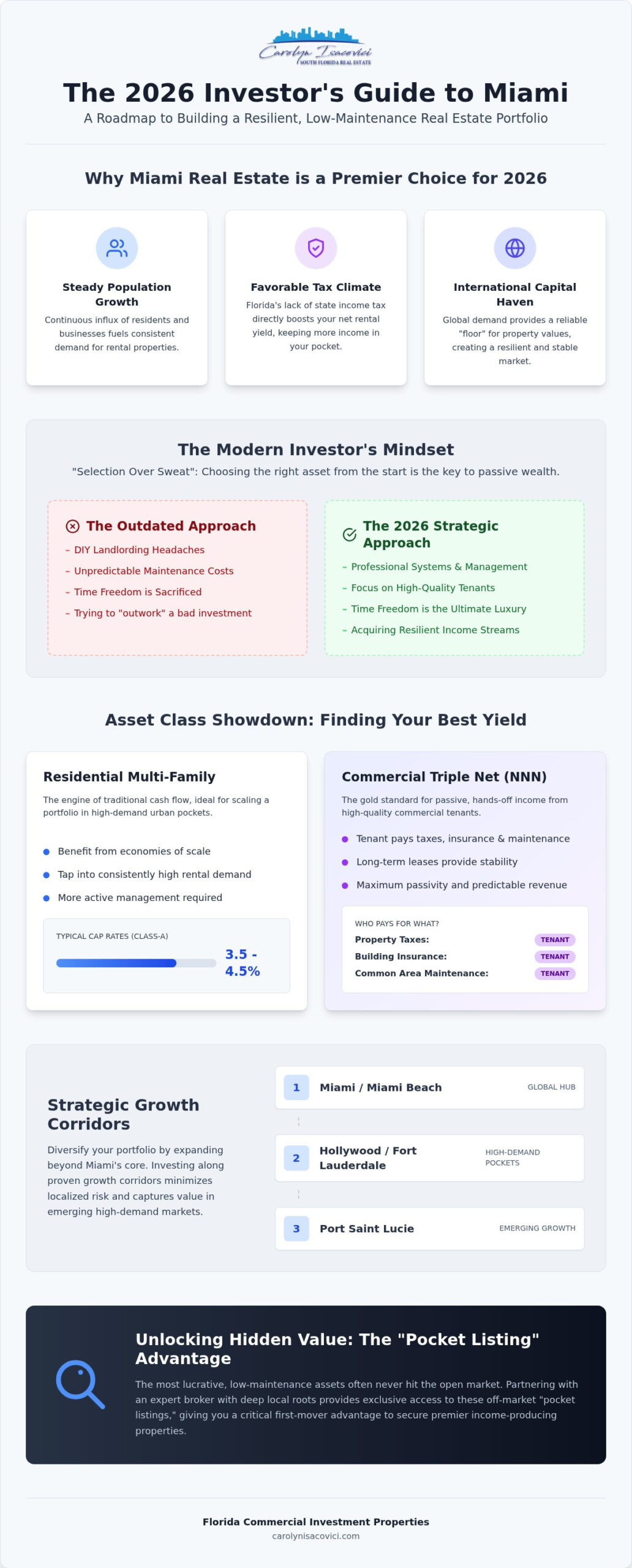
    Why does Miami remain a global capital haven in 2026? The answer lies in a powerful combination of steady population growth and a favorable tax climate. Investors are no longer just looking for a place to park cash; they are seeking a “Passivity Spectrum” where their involvement is minimal but their returns are optimized. This leads to a mandatory mantra for the modern high-net-worth individual: “Selection over Sweat.” Choosing the right asset at the start is far more valuable than trying to outwork a bad investment later. It’s about finding properties with high-quality tenants and low-maintenance needs from day one.

    The Shift Toward Strategic Passivity

    The 2026 investor is moving away from the headache of DIY landlording. Why spend your weekends managing tenants when professional systems can do it for you? Time freedom has become the ultimate luxury, and securing it requires a shift in mindset. When you begin Florida real estate portfolio building, you aren’t just buying buildings; you’re acquiring income streams. Professional management doesn’t just protect your time. It ensures your asset remains in peak condition, preserving its value for the long haul. This approach transforms a stressful job into a resilient wealth engine.

    Miami’s Unique Economic Advantage

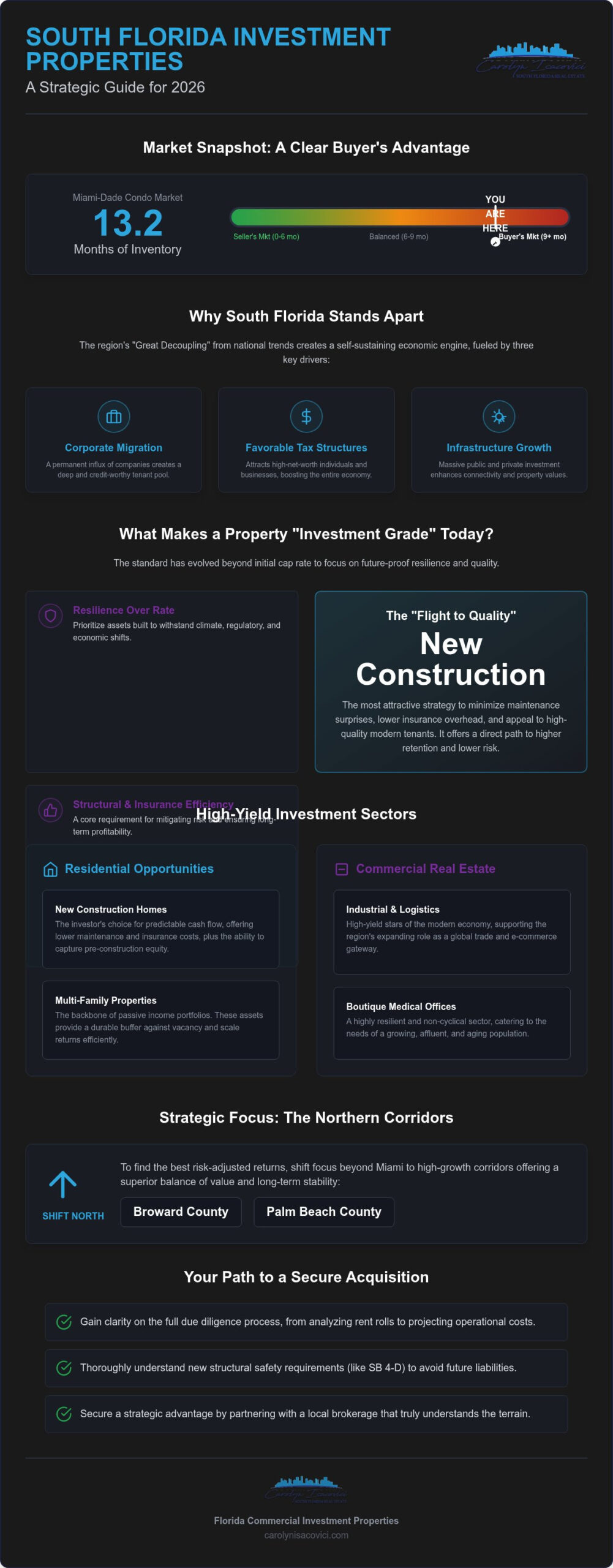
    Florida’s lack of state income tax is a massive tailwind for your net rental yield. It’s a simple calculation: more of your rental income stays in your pocket compared to high-tax states. We see significant growth trends in areas like Miami Beach and Hollywood, FL, where demand for rental housing continues to outpace supply. For Class-A multi-family assets, cap rates are currently hovering in the 3.5% to 4.5% range, reflecting the stability of the market. International demand provides a reliable “floor” for Miami property values. Because Miami is a global destination, it attracts capital from around the world, making the market less susceptible to local economic dips. This global interest creates a resilient market that feels both stable and full of opportunity for those who act with precision.

    Comparing Asset Classes: Which Miami Property Produces the Best Yield?

    Which asset class truly aligns with your financial goals? Selecting from the diverse pool of income producing properties Miami offers requires more than just looking at the sticker price. It’s about matching the property type to your desired level of involvement. While residential multi-family units provide the traditional backbone of local cash flow, commercial Triple Net (NNN) leases are often viewed as the gold standard for those seeking a truly hands-off experience. Both paths offer distinct advantages, but the right choice depends on whether you prioritize raw yield or maximum passivity.

    Multi-Family: Scaling Your Residential Income

    Residential multi-family remains a favorite for a reason. It’s intuitive. You might start by evaluating 2-4 unit properties in high-demand pockets like Fort Lauderdale, where rental demand stays consistently high. As you move into larger buildings, you benefit from significant economies of scale. One roof, one landscaping contract, and one insurance policy cover multiple rent checks. If you’re weighing these options, it helps to review a detailed commercial vs residential investment Florida guide to see which path fits your risk profile. While multi-family requires more active management than commercial assets, the sheer volume of renters in South Florida provides a reliable safety net for your investment.

    The Power of the Triple Net (NNN) Lease

    For the investor who values time above all else, the Triple Net lease is the ultimate vehicle. In this structure, the tenant takes on the responsibility for property taxes, insurance, and all maintenance costs. This shifts the operational burden away from you entirely. Institutional investors favor these assets because they offer long-term, low-stress wealth. Finding credit-worthy tenants in the Miami and Palm Beach markets is the key to success here. Think of national pharmacies or established medical groups. These tenants are unlikely to vanish, providing a level of stability that residential leases sometimes lack.

    Beyond these common choices, specialized assets like industrial property for sale Miami or medical office spaces offer unique advantages when looking for income producing properties Miami investors can trust. These sectors have shown remarkable resilience in 2026, driven by the ongoing need for logistics hubs and healthcare infrastructure. Each class has its own rhythm and requirements. If you feel overwhelmed by the choices, reaching out to a specialized investment broker can help clarify which asset will best serve your long-term vision. The goal is to build a portfolio that doesn’t just grow, but stays secure through every market cycle.

    The Investor’s Math: Decoding Miami Property Metrics

    How do you separate a high-performing asset from a stagnant one? Identifying the best income producing properties Miami offers requires a blend of current yield and future potential. The answer lies in mastering the metrics that seasoned investors prioritize. While surface-level prices tell part of the story, the underlying math reveals the true potential for wealth creation. Understanding these numbers doesn’t just make you a better buyer; it gives you the confidence to act when others are hesitant. You need a clear framework for how to evaluate investment property Florida assets to ensure every dollar is working efficiently.

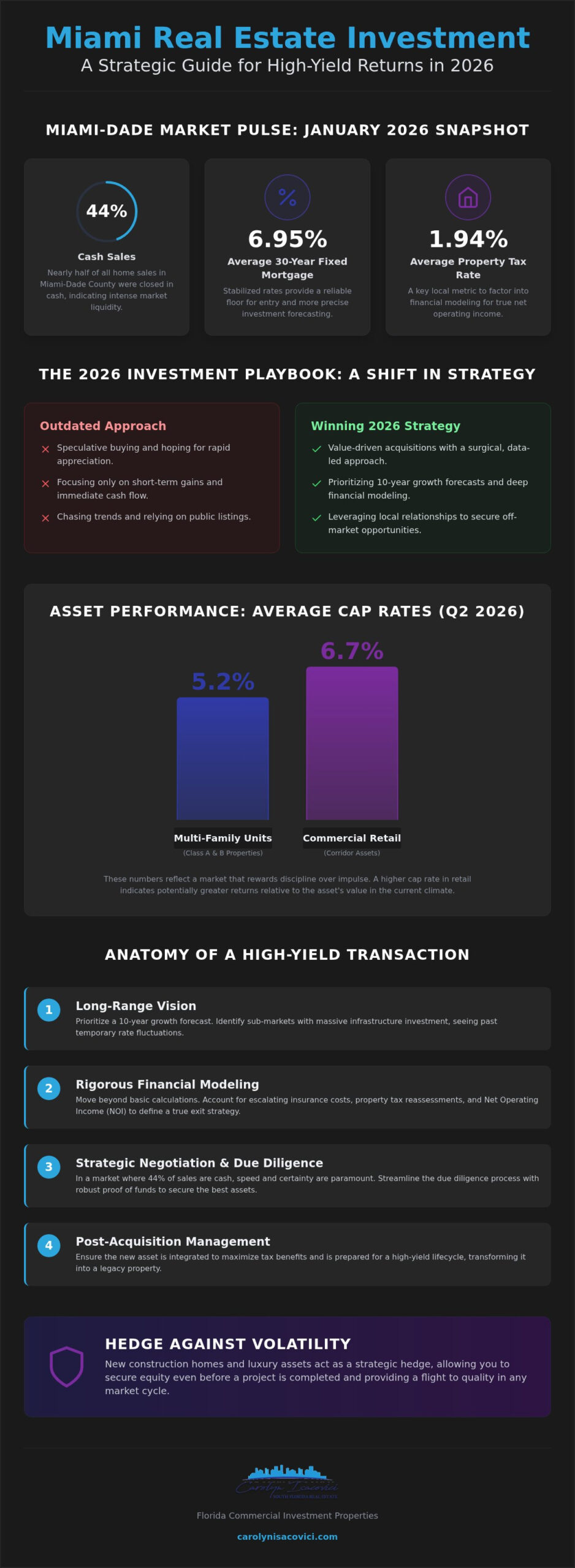
    Cap rates are the starting point for any serious discussion. Cap Rate is the Net Operating Income divided by the current market value. In 2026, a “good” rate depends entirely on the district and asset class. While short-term rentals can generate gross yields of 6% to 9%, Class-A multi-family properties in the Miami core typically hover between 3.5% and 4.5%. With mortgage rates currently ranging from 6.375% to 6.75%, the strategic use of leverage is more important than ever. Financing allows you to boost your Cash-on-Cash return, provided the asset’s yield exceeds the cost of debt.

    Analyzing Cap Rates Across South Florida

    Is a higher yield always better? Not necessarily. Lower cap rates in premier Miami districts usually signal a flight to quality. These are assets with high occupancy and credit-worthy tenants. If you’re looking for higher initial cash flow, you might look toward emerging markets like Stuart or Jupiter. These areas often offer more approachable entry prices compared to the Miami median list price of $640,000, allowing for a higher cap rate even if the long-term appreciation curve differs. Balancing your portfolio across these regions is a smart way to manage risk while maintaining steady growth.

    Total Return: Cash Flow + Appreciation

    True wealth is built by looking at the total return, which combines monthly cash flow with long-term appreciation. In areas like Miami Beach, the “Appreciation Factor” can often outweigh the initial cash flow. Property values here have shown incredible resilience, often rising even when broader market conditions fluctuate. You can also take control of this growth through “forced appreciation” by making strategic property improvements that increase the rental value. To see which neighborhoods are poised for the most significant growth, check the latest Miami real estate market trends 2026 forecasts. This data-driven approach ensures you aren’t just buying a building, but a growing financial engine that secures your future.
    Income Producing Properties Miami: The 2026 Strategic Investor’s Guide

    Strategic Locations for Income Producing Properties in 2026

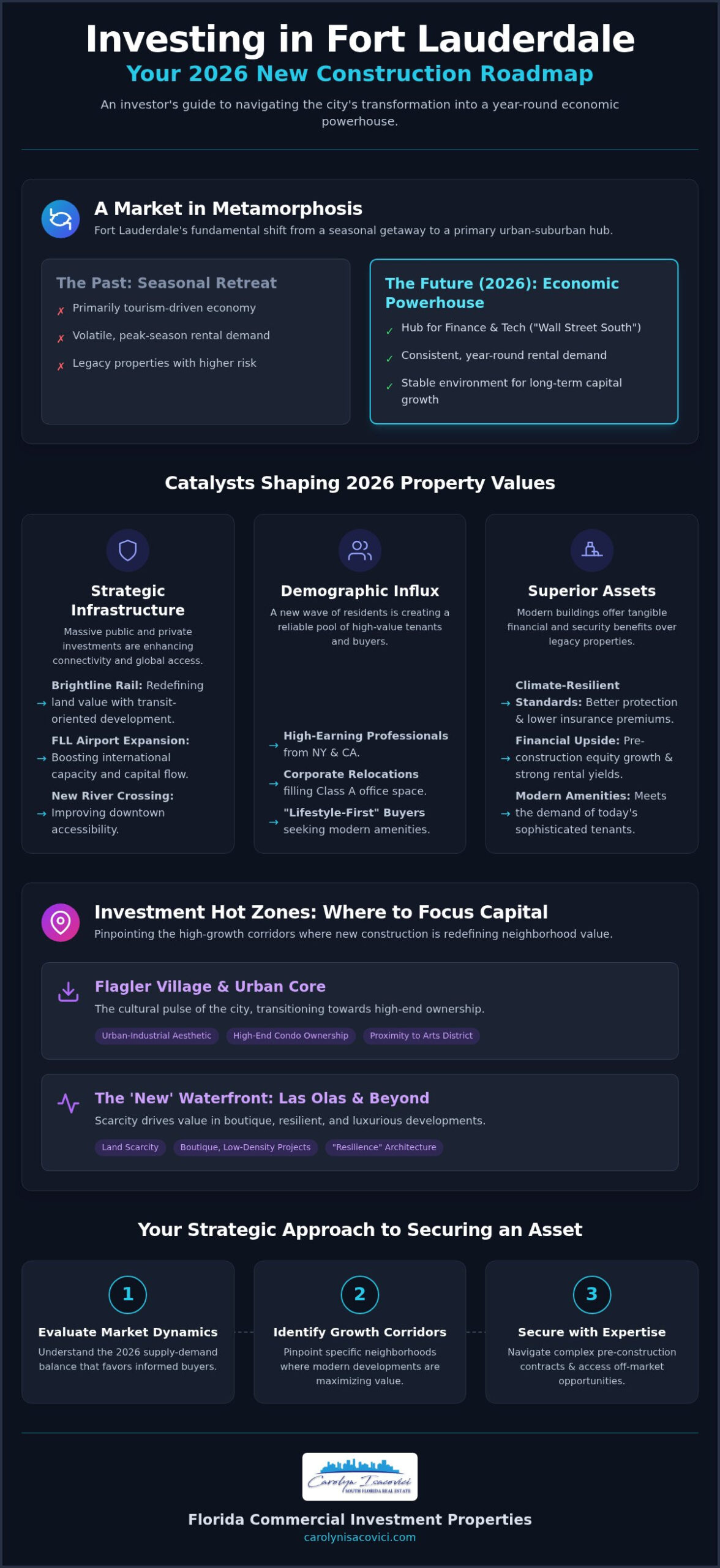
    Where should you point your compass for the best returns? While the Miami core remains an iconic destination for global capital, the 2026 growth story extends far beyond the city limits. The I-95 and Turnpike corridors have become the primary lifelines of the South Florida economy, connecting established hubs with emerging residential centers. For those seeking income producing properties Miami investors can rely on, the secret lies in geographic diversification. Spreading your portfolio across Miami-Dade, Broward, and Palm Beach counties doesn’t just increase your options. It acts as a shield against localized risk, such as specific municipal tax shifts or zoning changes.

    Many successful investors are now looking toward the “New Construction” strategy to maximize their strategic passivity. By 2026, the preference for modern, hurricane-resistant builds has shifted from a luxury to a requirement for many high-quality tenants. Buying into these projects early allows you to capture equity before the first tenant even moves in. It’s a calculated move that prioritizes long-term stability over the constant repair cycle often found in older coastal buildings. If you’re ready to explore these opportunities, you can browse current investment property sales to see which districts are currently showing the strongest momentum.

    The New Construction Advantage

    Why are new construction homes Florida becoming the preferred choice for the hands-off investor? The answer is simple: predictability. New builds come with extensive builder warranties that protect your bottom line from major capital expenditures in the early years. High-quality tenants are naturally drawn to these properties for their modern finishes and energy efficiency, which often leads to longer lease terms and lower turnover costs. Pre-construction pricing provides a unique window to secure an asset below its future market value, effectively “baking in” equity from day one.

    Emerging Hubs: Stuart, Jupiter, and Beyond

    The “commuter effect” is reshaping rental demand in Northern Palm Beach County. As more professionals seek a balance between urban access and suburban tranquility, cities like Stuart and Jupiter have seen a surge in interest. Evaluating cash flow investment property Florida in these secondary markets often reveals a more favorable entry price compared to Miami’s $799,900 median for single-family homes. Further north, the long-term play in Port Saint Lucie and Fort Pierce remains strong. These areas offer “Cash Flow Pockets” where rental demand is driven by a growing local workforce, providing a reliable foundation for residential income. Looking even further to Vero Beach and Melbourne can uncover high-yield opportunities that the average aggregator often misses.

    How to Secure High-Yield Assets: The Expert Brokerage Advantage

    Why do the most lucrative deals often remain invisible to the public? In a market as competitive as South Florida, the highest-quality income producing properties Miami offers are frequently traded before they ever hit a public listing site. Relying solely on aggregators means you’re often seeing the leftovers. A broker with dual expertise in both commercial and residential investment provides a distinct advantage. They understand the nuances of a multi-family cap rate just as clearly as the legal intricacies of a commercial lease. This specialized knowledge ensures that your acquisition aligns with your long-term wealth strategy rather than just being another line item on a spreadsheet.

    Success isn’t just about the purchase. It’s about the due diligence that happens behind the scenes. Your broker should act as a shield, ensuring your passive income doesn’t transform into an active headache. This involves verifying rent rolls, assessing hidden maintenance liabilities, and positioning your portfolio for future growth. For many, this includes planning for a 1031 exchange. This powerful tool allows you to defer taxes and roll your equity into larger, more productive assets, accelerating your path to financial freedom. It’s about looking three steps ahead to ensure your capital is always working at its highest potential.

    Accessing Off-Market “Pocket Listings”

    Carolyn Isacovici of Florida Commercial Investment Properties brings nearly 20 years of local roots, providing a bridge to unlisted deals. These “pocket listings” are the lifeblood of the strategic investor. Having a “calm expert” navigator in a fast-moving market is essential. You gain the competitive advantage of seeing commercial opportunities before the general market can react. This isn’t just about speed; it’s about the professional relationships built since 2006 that open doors others don’t even know exist. Whether you’re looking in the Miami core or along the coast toward Melbourne, these off-market connections are often where the best yields are found.

    Transitioning from Buyer to Portfolio Owner

    What happens after the closing? The most successful investors view brokerage as a partnership, not just a transaction. Your post-sale roadmap should include connections to reliable property managers and tax strategists who understand the Florida landscape. This holistic approach ensures your transition from buyer to portfolio owner is seamless and secure. By surrounding yourself with a team of experts, you transform a single property into a resilient wealth engine. Ready to define your roadmap? Carolyn Isacovici and the team at Florida Commercial Investment Properties can help. You can schedule a consultation for personalized Florida investment planning today. Let’s turn your vision of a high-yield portfolio into a reality.

    Charting Your Path to Resilient Wealth

    Building a successful portfolio in South Florida is no longer about chasing every available listing. It’s about precision. By 2026, the most effective strategy for income producing properties Miami offers is one that prioritizes asset quality and professional insight over sheer volume. You’ve seen how the right math and a focus on strategic locations like the I-95 corridor can transform a simple purchase into a generational wealth engine. Whether you’re leaning toward the stability of a Triple Net lease or the robust cash flow of multi-family units, the key is to act with clarity and confidence.

    With nearly 20 years of expertise since 2006, Carolyn Isacovici provides the seasoned guidance you need to navigate this dynamic market. From identifying off-market “pocket listings” to securing high-yield assets from Miami to Melbourne, FL, you don’t have to walk this path alone. It’s time to move from observation to action. Start Your Miami Investment Journey with Carolyn Isacovici and secure the professional partnership your success deserves. Your future in Florida real estate is bright, and the right opportunity is waiting for you to claim it.

    Frequently Asked Questions

    Is Miami still a good place for income producing properties in 2026?

    Miami continues to be a premier destination for capital due to its unique tax climate and steady population influx. While prices have stabilized, the demand for income producing properties Miami investors seek remains robust because of the international “floor” on property values. You aren’t just buying real estate; you’re securing a position in a global market that historically resists local downturns. It’s an environment where strategic selection leads to long-term resilience.

    What is the average cap rate for a multi-family property in Miami?

    For Class-A multi-family assets in the urban core, you can expect cap rates between 3.5% and 4.5% in 2026. If you look at the broader residential market, some yields average closer to 6.84%, though these often involve higher maintenance or different risk profiles. Understanding this math is vital for aligning your purchase with your specific financial goals. A lower cap rate often signals a high-quality, lower-risk asset with more reliable appreciation potential.

    Are commercial NNN leases more passive than residential rentals?

    Commercial Triple Net (NNN) leases are significantly more passive than traditional residential rentals. In an NNN structure, the tenant is responsible for property taxes, insurance, and all maintenance costs. This shifts the operational burden entirely away from you. It’s the ideal choice for those who want a monthly check without the “sweat equity” of managing repairs or tenant disputes. This setup offers institutional-grade stability for your personal wealth stream and long-term time freedom.

    How much down payment is typically required for a Florida investment property?

    Most investment property acquisitions in Florida require a down payment of 20% to 25% of the purchase price. You should also account for buyer’s closing costs, which typically range from 2% to 5%. While mortgage rates in late 2026 are between 6.375% and 6.75%, the strategic use of leverage can still boost your cash-on-cash return. Proper planning ensures you have the liquidity needed to secure high-yield assets without overextending your capital reserves.

    Can I manage a Miami income property if I live in another state?

    Managing a property from out of state is completely feasible when you prioritize “Selection over Sweat.” By choosing low-maintenance assets or new construction, you reduce the frequency of issues that require physical presence. Most successful out-of-state investors partner with local property managers to handle daily operations. This allows you to focus on the high-level strategy of your Florida portfolio while your assets generate income and appreciation without requiring your constant daily attention.

    What are the best neighborhoods in Miami for rental yield right now?

    High rental yields are currently found in areas with strong demand and growing infrastructure, such as Hollywood, FL, and parts of Miami Beach. If you’re looking for higher initial cash flow, the growth corridors along I-95 toward Port Saint Lucie and Vero Beach offer lower entry prices and rising demand. Diversifying across these “Cash Flow Pockets” allows you to balance the high appreciation of the Miami core with the higher immediate yields of secondary markets.

    How does new construction compare to older properties for income potential?

    New construction generally offers higher income potential through reduced maintenance costs and premium rental rates. Older buildings in Miami can hide significant repair liabilities that eat into your net yield. A new build comes with warranties and energy-efficient features that attract high-quality tenants and keep your occupancy high. It’s a strategic move for the 2026 investor who values predictability and wants to avoid the stress of unexpected or hidden capital expenditures.

    What is a 1031 exchange and how can it help my Florida portfolio?

    A 1031 exchange is a tax-deferred strategy that allows you to sell an investment property and reinvest the proceeds into a “like-kind” asset. This helps your portfolio grow by deferring capital gains taxes, effectively giving you more capital to purchase larger or higher-yielding properties. It’s a powerful tool for scaling your wealth over time. By rolling your equity forward, you can transition from smaller residential units into institutional-grade commercial assets like industrial property for sale in Miami without a major tax hit.
  • Cash Flow Investment Property Florida: 2026 Strategic Examples and Yield Analysis

    Cash Flow Investment Property Florida: 2026 Strategic Examples and Yield Analysis

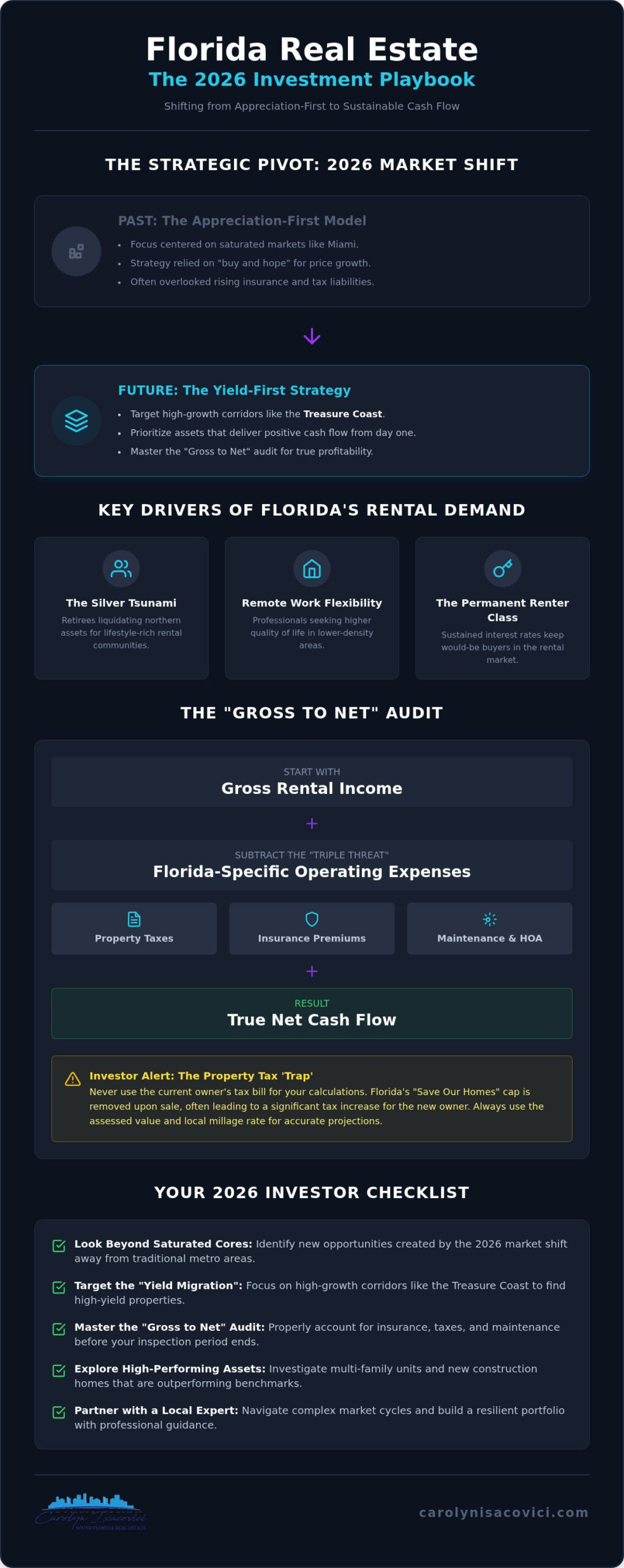
    The traditional Florida real estate playbook, once centered solely on the glittering skyline of Miami, has officially been rewritten for 2026. You’ve likely noticed that finding a cash flow investment property Florida is becoming a more complex puzzle as insurance premiums and entry prices in the major metros continue to climb. It’s natural to feel a bit of hesitation when the old rules no longer seem to apply. Is it still possible to find a double-digit yield in a market that feels this crowded? The answer is a definitive yes, provided you know where to look.

    We’ve seen these cycles before, and we know that uncertainty is often just another word for opportunity. This article will show you exactly how to pivot your strategy toward the yield migration currently moving into high-growth corridors like the Treasure Coast. You’ll gain a clear framework for calculating true net cash flow in today’s environment, along with specific geographic examples that offer the best balance of risk and reward. Let’s explore how to approach the 2026 market with the confidence of a seasoned strategist and a professional partner by your side.

    Key Takeaways

    • Learn why the 2026 market shift actually creates new opportunities for investors who look beyond the saturated coastal cores.
    • Discover how to identify a high-yield cash flow investment property Florida by targeting the “yield migration” toward high-growth corridors like the Treasure Coast.
    • Master the “Gross to Net” audit to properly account for insurance, taxes, and maintenance before your inspection period ends.
    • Explore specific examples of multi-family assets and new construction homes that are currently outperforming traditional benchmarks.
    • Understand how a local expert partner helps you navigate complex market cycles to build a resilient and profitable real estate portfolio.

    Is Cash Flow Still Possible in Florida? The 2026 Reality Check

    If you spend any time on investment forums, you’ve likely heard the chorus of skeptics claiming that the sun has set on the Sunshine State. They point to rising insurance premiums and high entry prices as evidence that a cash flow investment property Florida is a relic of the past. However, we’ve seen these cycles before; while the market has certainly matured, the narrative of “impossible cash flow” often overlooks the strategic shifts happening on the ground. Yield hasn’t disappeared. It has simply migrated.

    Success in 2026 requires a disciplined definition of profitability. In this modern context, cash flow is the net income remaining after all operational expenses, mortgage obligations, and the critical 2026 “Florida Insurance Premium” adjustment have been fully satisfied. While the noise on social media focuses on the hurdles, seasoned investors are focusing on the underlying math. High costs don’t kill yield if rental demand scales proportionally, and in Florida, that demand remains remarkably resilient.

    The Shift from Appreciation to Yield

    The era of “buy and hope” appreciation has evolved into a sophisticated, yield-first approach. Investors are no longer banking on double-digit price growth to justify an acquisition. Instead, they’re looking for assets that perform on day one. This shift is supported by Florida’s favorable tax climate; the absence of state income tax allows more of your gross rental income to flow directly to your bottom line, a factor that often offsets higher insurance costs when compared to high-tax states. It’s vital to distinguish between “Paper Cash Flow,” which looks good in a brochure, and “Real-World Yield,” which accounts for the actualities of 2026 property management and localized tax assessments.

    Migration Patterns and Rental Demand

    Where are the 2026 inbound residents actually landing? While Miami-Dade continues to attract global capital and corporate headquarters, we’re seeing a significant “yield migration” toward the Treasure Coast. This area offers a more accessible entry point for a cash flow investment property Florida while benefiting from the same massive population tailwinds. Several factors are driving this sustained demand:

    • The Silver Tsunami: Retirees continue to liquidate high-value northern assets to find lifestyle-rich rental communities in Florida.
    • Remote Work Flexibility: Professionals are choosing the lower density and higher quality of life found in areas like Port Saint Lucie and Vero Beach.
    • The Permanent Renter Class: Sustained interest rates have kept many would-be buyers in the rental market, creating a deep pool of qualified tenants in South Florida.

    By positioning your portfolio in the path of these migration patterns, you aren’t just buying real estate; you’re securing a piece of an ongoing demographic shift that supports long-term rental stability. The key is to look where the people are going, not just where they’ve already been.

    The Mechanics of Florida Cash Flow: Taxes, Insurance, and Cap Rates

    Understanding the mechanical drivers of yield is what separates a speculative purchase from a sound acquisition. In Florida, this means mastering the “Triple Threat”: property taxes, HOA fees, and homeowners insurance. While these figures might seem daunting at first glance, they are simply variables in a larger equation. By applying a structured how to evaluate investment property Florida framework, you can strip away the noise and focus on the net numbers that actually matter for your portfolio.

    Insurance often dominates the headlines, yet the 2026 carrier landscape is showing signs of stabilization as new capacity enters the market. A calm approach involves sourcing quotes early and looking for properties with recent mitigation upgrades that attract more competitive premiums. Is a 5% cap rate in Miami better than an 8% cap rate in Port Saint Lucie? Not necessarily. The answer depends on your long-term objectives for a cash flow investment property Florida and your tolerance for different risk profiles. High-growth areas often command lower initial caps because the market expects significant future rent growth.

    Understanding the Florida Property Tax ‘Trap’

    Many new investors make the mistake of looking at the current owner’s tax bill. It’s a dangerous baseline. In Florida, the “Save Our Homes” cap limits annual assessment increases for primary residents, but this protection vanishes the moment the property sells. As an investor, you must calculate your holding costs based on the new purchase price. This reassessment can lead to a significant jump in expenses that catches the unprepared off guard. Working with an expert in investment property sales ensures you have an accurate forecast of these carrying costs before you commit capital.

    Cap Rate Analysis for 2026 Markets

    In a high-interest environment, the spread between your cap rate and your mortgage rate is tighter than in previous years. This makes “Cash-on-Cash” return a more vital metric for those using leverage. For a Miami investment property in 2026, a “good” cap rate often hovers around 4.5% to 5.5% for Class A assets, reflecting the city’s global desirability and long-term stability. If you’re seeking higher immediate flow, you might look for “value-add” opportunities. These are properties where strategic renovations or management efficiencies allow you to force appreciation and increase the monthly yield simultaneously. Identifying these pockets of value requires a seasoned guide who understands the nuances of local submarkets.

    Strategic Examples: Where Cash Flow Meets Opportunity

    Theory only takes an investor so far. To truly understand where the 2026 market is moving, we must look at specific corridors where the numbers align with long-term growth. Identifying a cash flow investment property Florida today requires a balance between established urban cores and emerging secondary markets. While the high-profile glitz of the coast captures headlines, the most resilient yields are often found in the strategic “middle ground” where rental demand outpaces supply.

    In Miami’s urban core, we’re seeing a sophisticated pivot toward industrial and commercial assets. These properties often provide more stable, long-term lease structures that are less sensitive to the seasonal fluctuations of the residential market. Investors seeking to capitalize on this trend should explore the growing demand for industrial property for sale Miami, where last-mile logistics and global supply chain dynamics are creating compelling yield opportunities in submarkets like Hialeah. For those focused on residential data, staying informed on Miami real estate market trends is essential for pinpointing which neighborhoods are currently undervalued relative to their income potential. It’s about finding the intersection of local lifestyle shifts and institutional capital flow.

    The Treasure Coast: The New Frontier for Yield

    Port Saint Lucie and Fort Pierce have transitioned from sleepy coastal towns into primary targets for yield-hungry investors. The 2026 market shows a distinct trend: South Florida commuters are moving north in search of affordability, bringing high rental demand with them. This “yield migration” offers lower entry prices compared to Broward or Miami-Dade, allowing for more favorable cash-on-cash returns. We frequently recommend exploring new construction homes in these areas. Modern builds offer a significant “New Construction Advantage” because they feature the latest wind-mitigation technology, which leads to lower insurance premiums and minimal maintenance reserves in your first five years of ownership.

    Miami and Broward: The Commercial and Multi-Family Play

    For investors with higher capital reserves, the multi-family property for sale Miami market remains a powerful hedge against inflation. In areas like Hollywood and Fort Lauderdale, multi-family assets benefit from a dense population and a shortage of workforce housing. This creates a reliable environment for steady monthly income. While the debate between short-term rentals and long-term leases continues in Miami Beach, many are finding that long-term stability in pockets like Hollywood or Palm Beach Gardens offers a more predictable cash flow investment property Florida. These submarkets provide:

    • Consistent Occupancy: Proximity to major employment hubs in Fort Lauderdale and West Palm Beach.
    • Management Efficiency: Concentrated units allow for streamlined operations and lower per-unit costs.
    • Appreciation Potential: Continued infrastructure investment in Broward County supports long-term asset value.

    Success isn’t about finding the “perfect” city, but rather the perfect asset within a city that matches your specific yield requirements. Investors seeking to maximize returns should also explore the full spectrum of income producing properties Miami offers, from NNN-leased commercial assets to high-quality residential rentals that prioritize lease structure and long-term stability. By looking at these strategic examples, you can begin to see how 2026 market cycles are creating fresh opportunities for the observant investor.

    Cash Flow Investment Property Florida: 2026 Strategic Examples and Yield Analysis

    Calculating Your Path to Passive Income: A Due Diligence Checklist

    Turning a vision into a viable asset requires more than just local knowledge. It requires a rigorous, data-driven approach to due diligence. While the potential for a cash flow investment property Florida is significant, the margin for error has narrowed. This checklist serves as your roadmap to ensure that every dollar of capital is protected and positioned for growth.

    A “Gross to Net” audit is your first line of defense. It’s easy to get caught up in high rental rates, but your net income is what pays the bills. We recommend factoring in a 10% vacancy rate and a 5% maintenance reserve as non-negotiable line items in your projections. Next, prioritize your insurance quote. In the 2026 market, you must secure a firm quote before your inspection period ends. If the premium is higher than anticipated, you need that information while you still have the leverage to renegotiate or exit the contract. Finally, verify zoning and local regulations. This is especially vital for short-term rental plays, as Florida municipalities frequently update their ordinances. Your exit strategy must be robust; a quality asset should remain profitable even if you are forced to hold through a market down-cycle.

    The Investor’s Due Diligence Toolkit

    Utilizing a comprehensive investment property due diligence Florida checklist is the best way to avoid expensive surprises. A specialized commercial broker acts as your eyes and ears on the ground, identifying “hidden” costs like impending HOA assessments or deferred maintenance that a standard inspection might miss. Protecting your passive income also means vetting property management companies with the same intensity you use to vet the property itself. A poor manager can turn a high-performing asset into a headache overnight.

    Financing for Cash Flow

    The lending environment in 2026 offers sophisticated tools for the modern investor. Debt Service Coverage Ratio (DSCR) loans have become a staple, as they focus on the property’s ability to generate income rather than just your personal debt-to-income ratio. For those looking to maximize early-phase cash flow, “Interest-Only” periods can be a strategic choice. This reduces your monthly debt service during the initial years, allowing you to build up a healthy cash reserve. Whether you choose a traditional mortgage or portfolio lending, your financing should align with your long-term goals. If you are ready to move from analysis to acquisition, contact our investment property sales team to review current opportunities that meet these strict criteria.

    Building Your Florida Portfolio with Expert Guidance

    Success in the current market isn’t a matter of luck; it’s a matter of design. A robust Florida real estate portfolio building strategy requires more than just access to the MLS. It demands a local partner who can interpret shifting regulations and identify the quiet signals of growth before they become common knowledge. Carolyn Isacovici has spent decades transforming market uncertainty into clear opportunity for both global and local investors. By moving beyond a single-asset mindset, you can create a diversified collection of Florida real estate holdings that weather different economic climates with resilience.

    We believe that 2026 is a year for the strategic, not the swift. While the temptation to rush into a deal is always present, the most profitable portfolios are built through methodical acquisition and disciplined management. Transitioning from a single residential unit to a sophisticated mix of assets allows you to spread risk and capture yield across various sub-markets. This balanced approach ensures that your wealth isn’t just growing, but is also protected against localized shifts in demand or insurance costs.

    Why Experience Matters in the Florida Market

    Navigating the hyper-local sub-markets of Miami and Fort Lauderdale is a nuanced task. One block might offer prime rental demand while the next faces zoning restrictions that could stifle your yield. We provide the bridge between raw data and street-level reality. Our clients often gain access to “off-market” commercial and residential opportunities that never reach public listings. This insider access is a critical advantage when searching for a cash flow investment property Florida in a competitive environment. You need a broker who speaks the language of cap rates and net operating income while understanding the cultural heartbeat of the neighborhoods.

    Next Steps: Your 2026 Investment Roadmap

    The most successful investors are those who act with deliberation. Your journey begins by setting very specific criteria for what constitutes a viable cash flow investment property Florida within your unique risk profile. Whether you’re looking to acquire your first multi-family unit or expand into commercial assets, a structured roadmap is essential for long-term success. We invite you to schedule a strategic consultation to review your goals and analyze current market inventory through the lens of a seasoned guide. Ready to take the first step toward a more profitable future? Contact Carolyn Isacovici to start your Florida investment journey.

    Charting Your Path to Florida Real Estate Success in 2026

    The landscape of Florida real estate has shifted, but the fundamental promise of yield remains for those who move with precision. By focusing on high-growth corridors like the Treasure Coast and performing a rigorous “Gross to Net” audit, you can bypass the skepticism of the crowd and secure assets that perform on day one. Finding a cash flow investment property Florida today is about using local insight to turn market complexity into a strategic advantage. It’s a journey that rewards the patient, the analytical, and the well-advised.

    With a proven track record in Florida real estate since 2006, Carolyn Isacovici provides expert brokerage for Miami, Broward, and the Treasure Coast. We specialize in high-yield commercial and residential assets, helping you navigate the “Triple Threat” of taxes, insurance, and fees with a steady hand. We don’t just find properties; we partner with you to build a resilient portfolio designed for long-term stability.

    Secure Your High-Yield Florida Investment Property with Carolyn Isacovici

    The market cycle of 2026 is full of potential for the prepared investor. We’re here to ensure you navigate it with confidence and clarity.

    Frequently Asked Questions

    What is a good cash flow for an investment property in Florida in 2026?

    A strong benchmark for a cash flow investment property Florida in 2026 typically ranges between 5% and 8% depending on the specific asset class. While core Miami properties often trade at lower cap rates due to their high appreciation potential, you can find higher immediate yields in growth markets like the Treasure Coast. It’s vital to balance your desire for monthly income with the long-term stability of the neighborhood to ensure your portfolio remains resilient.

    How do I calculate the ‘True Net’ cash flow for a Miami property?

    Calculating “True Net” involves subtracting every possible expense from your gross rental income. Start with your projected rent, then deduct property taxes reassessed at your purchase price, current insurance premiums, and any HOA fees. Don’t forget to set aside 10% for vacancy and 5% for ongoing maintenance. This disciplined approach ensures you aren’t surprised by hidden costs, allowing you to move forward with the confidence that your investment is truly profitable.

    Is it better to invest in Miami or the Treasure Coast for cash flow?

    Both regions offer unique advantages. Miami provides global desirability and significant long-term appreciation, making it ideal for wealth preservation. In contrast, the Treasure Coast currently offers a more accessible entry point and higher immediate yield due to lower property taxes and insurance costs. Choosing between them depends on whether you prioritize monthly cash flow or capital growth. We often recommend a diversified approach that includes assets from both areas to maximize your total return.

    How does Florida property insurance affect my monthly cash flow?

    Insurance is a significant factor in your monthly expenses, but it doesn’t have to be a deal-breaker. By selecting properties with modern wind-mitigation features or newer construction, you can often secure more competitive rates. It’s essential to obtain a firm insurance quote before your inspection period ends. This proactive step allows you to adjust your cash flow projections accurately and ensures that the property’s yield meets your specific investment criteria before you close the deal.

    Can I find cash-flowing new construction homes in Florida?

    You certainly can, particularly in high-growth corridors like Port Saint Lucie or Vero Beach. New construction homes are highly attractive for a cash flow investment property Florida because they require minimal maintenance reserves and benefit from lower insurance premiums due to modern building codes. These properties often attract high-quality tenants who are willing to pay a premium for a brand-new living space, creating a stable and predictable stream of passive income for your portfolio.

    What is a DSCR loan and how does it help with cash flow?

    A DSCR loan stands for Debt Service Coverage Ratio, and it’s a powerful tool for scaling your portfolio. Unlike traditional mortgages that focus on your personal income, these loans qualify you based on the property’s ability to cover its own debt service. This allows you to acquire more properties without being limited by personal debt-to-income ratios. It’s an excellent option for investors who want to focus purely on the cash-flowing potential of their real estate assets.

    Are there still high-yield investment properties in South Florida?

    High-yield opportunities still exist in South Florida for investors who look beyond the obvious residential listings. Strategic pockets in Hollywood, Fort Lauderdale, and Miami’s urban core offer commercial and multi-family assets with strong income potential. Success in these areas requires a “value-add” mindset, where you identify properties that can benefit from management efficiencies or light renovations. These improvements allow you to force appreciation and increase your monthly yield, even in a mature market. For a deeper look at the full range of assets available, reviewing the landscape of income producing properties Miami has to offer can help you identify which asset classes best align with your yield and management goals.

    How do property taxes change after I buy an investment property in Florida?

    In Florida, property taxes are reassessed upon the sale of a property, typically based on the new purchase price. It’s a common mistake to rely on the seller’s current tax bill, which may be artificially low due to the “Save Our Homes” cap. As an investor, you won’t benefit from that primary-resident protection. We always advise calculating your holding costs using an estimated tax rate of 1.5% to 2% of the purchase price to ensure your projections are accurate.

  • Strategic Florida Real Estate Portfolio Building: The 2026 Investor Guide

    Strategic Florida Real Estate Portfolio Building: The 2026 Investor Guide

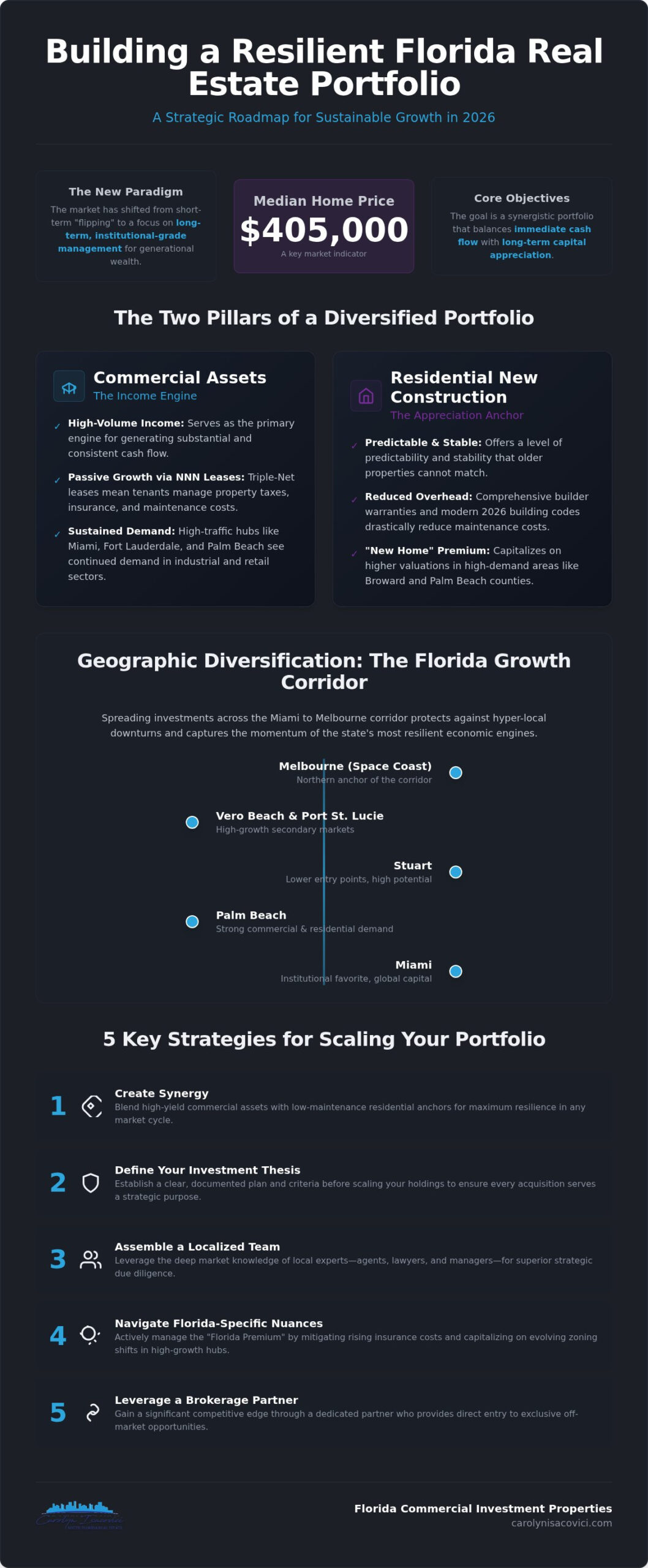
    What if the secret to enduring wealth isn’t about timing the market perfectly, but about building a structure that thrives regardless of the cycle? It’s a question many investors are asking as they look at a landscape where median home prices sit at $405,000 and insurance costs remain a primary conversation piece. You likely feel the tension between the desire for high-yield growth and the need for a protective shield against volatility. Successful Florida real estate portfolio building requires more than just capital; it demands a strategic eye that can see the potential in a Miami commercial space just as clearly as a new construction home in Melbourne.

    You deserve a strategy that treats diversification as your greatest defense. We’re going to move past the noise of fast-paced due diligence to provide you with a clear, actionable roadmap for 2026. This guide shows you how to scale a diversified property portfolio that balances sustainable cash flow with long-term capital appreciation. We’ll examine the specific geographies showing the most resilience and the exact steps needed to transition from a single asset to a robust, multi-sector collection of properties across the Sunshine State.

    Key Takeaways

    • Successful Florida real estate portfolio building relies on creating synergy between diverse asset classes; it’s about seeing the big picture rather than an isolated transaction.
    • Can you blend high-yield commercial assets with low-maintenance residential anchors? We show you how to create a balanced mix for maximum resilience in any market cycle.
    • Scale your holdings with confidence by establishing a clear investment thesis and assembling a localized team of experts to guide your strategic due diligence.
    • How do you mitigate the “Florida Premium”? Learn to manage insurance costs and capitalize on zoning shifts in high-growth hubs like Port Saint Lucie and Vero Beach.
    • Gain a competitive edge through a dedicated brokerage partner who provides direct entry to exclusive off-market commercial and residential opportunities.

    Defining Florida Real Estate Portfolio Building in 2026

    What does it mean to build a portfolio in the current climate? It’s no longer just about buying a single property and hoping for the best. Instead, Florida real estate portfolio building in 2026 is the art of curating a synergistic collection of residential and commercial assets. Each piece must serve a purpose. We’ve moved past the frenetic, speculative “flipping” cycles of the early 2020s. Today, the focus has shifted toward institutional-grade management and long-term stability.

    The migration waves between 2021 and 2025 reshaped our economy. Now that the dust has settled, we’re seeing a more mature market. It’s a pivotal moment. Investors are prioritizing Florida real estate portfolio building as a tool for generational wealth rather than quick wins. For instance, does your commercial holding in Miami benefit from the residential growth in the surrounding suburbs? This interconnected thinking is what separates a collection of buildings from a true, high-yield portfolio.

    The Core Objectives of a Florida Portfolio

    Why pursue this path? The goals are clear: balancing immediate cash flow with the promise of capital appreciation. By engaging in real estate investing through a strategic lens, you unlock benefits that single-asset owners often miss. This includes Florida’s favorable tax environment and the natural inflation hedge provided by tangible land. Structures in high-demand zones don’t just sit; they grow in value while paying you to hold them. It’s about creating a machine that generates revenue while protecting your principal from market fluctuations.

    Why Diversification Within Florida is Essential

    Concentration is a risk you don’t need to take. Spreading your interests across the Miami to Melbourne corridor protects you from hyper-local downturns. Secondary markets like Stuart and Port Saint Lucie have emerged as powerful anchors, offering lower entry points with high growth potential. The Florida Growth Corridor is the region stretching from Miami all the way to the Space Coast. By diversifying within this belt, you capture the momentum of the state’s most resilient economic engines. You aren’t just buying real estate; you’re buying a stake in Florida’s continued expansion.

    Selecting High-Yield Asset Classes: Commercial vs. Residential

    How do you decide where to place your next capital allocation? The choice between commercial and residential assets often feels like a fork in the road. It isn’t. In a sophisticated Florida real estate portfolio building strategy, these two classes work in tandem to provide both defensive stability and aggressive growth. While residential properties often offer a more intuitive entry point, commercial real estate South Florida serves as the primary engine for high-volume income generation.

    Commercial Assets: The Income Engine

    Commercial property is the bedrock of professional cash flow. Why is this the case? It’s because the lease structures are fundamentally different. Triple-net (NNN) leases are a particular favorite in 2026 for those seeking passive portfolio growth. These agreements allow you to collect rent while the tenant manages the property taxes, insurance, and maintenance costs. In high-traffic hubs like Fort Lauderdale and Palm Beach, industrial and retail spaces are seeing sustained demand as the state’s logistics infrastructure expands. Miami remains the institutional favorite, offering competitive Cap rates and a Net Operating Income (NOI) profile that continues to attract global investment capital. For investors focused specifically on maximizing returns in the urban core, exploring income producing properties Miami offers a detailed look at how NNN lease structures and asset quality drive superior yields in this market.

    Residential New Construction: The Appreciation Play

    If commercial is the engine, new construction homes Florida are the anchor. They offer a level of predictability that older “fixer-uppers” simply cannot match. When you invest in new construction investment property Florida, you’re buying peace of mind through comprehensive builder warranties. This drastically reduces the maintenance overhead that can otherwise erode your monthly returns.

    There’s also a clear financial “New Home” premium in Broward and Palm Beach counties. Modern building codes are the silent hero here. Because these homes are built to the most recent 2026 standards, they often qualify for better insurance assessments. This is a significant advantage considering that the average annual homeowners insurance premium in Florida is approximately $8,200. Multi-family units in Miami act as the perfect bridge, combining the high demand of residential housing with the scalability of a commercial asset. If you’re ready to explore these high-yield opportunities, connecting with a strategic investment partner can help you identify the precise mix needed to reach your financial milestones.

    5 Steps to Scale Your Florida Real Estate Holdings

    How do you move from owning a single rental to managing a high-performance collection? Scaling isn’t just about adding more units; it’s about adding better units. Successful Florida real estate portfolio building follows a disciplined sequence that turns initial equity into a diversified empire. It requires a shift in mindset from simply “buying a house” to executing a repeatable, data-driven system. It’s about looking at your assets as a unified machine rather than isolated parts.

    Step 1 & 2: Strategy and Team Building

    Your journey begins with a firm investment thesis. You must establish a clear “Buy Box” that defines your preferred geography, asset type, and risk tolerance. This process starts with evaluating investment property Florida metrics like cap rates and cash-on-cash return to ensure every acquisition fits your long-term goals. Do you have the right people in your corner? You can’t do this alone. You need a specialized power team that understands the nuances of both residential and commercial sectors. The ideal Florida investment broker acts as a market navigator rather than just a transaction agent, steering you away from pitfalls and toward high-growth corridors.

    Steps 3 to 5: Acquisition and Optimization

    Once your strategy is set, identify your first “Anchor Asset.” This is typically a high-liquidity residential or multi-family property that provides immediate cash flow. As this asset appreciates, you can implement a 1031 Exchange strategy. This allows you to defer capital gains taxes while “trading up” into larger commercial holdings or industrial spaces. Executing due diligence in 2026 means looking beyond the surface. You must account for Florida-specific environmental laws and zoning shifts that could impact your future land use. For non-homestead properties, remember that your annual assessment increase is capped at 10%, which provides a level of predictability for your tax liabilities.

    Optimization doesn’t stop at the closing table. You must continuously audit your holdings against current Miami real estate market trends to ensure your portfolio remains balanced. A healthy portfolio requires annual rebalancing to maintain diversity across sectors and geographies. This ensures that a shift in one local market doesn’t compromise your entire financial foundation. Leveraging the equity from your initial gains allows you to fund larger acquisitions without depleting your cash reserves, turning a series of purchases into a resilient wealth engine. To understand exactly what yields to expect from each asset type, reviewing detailed cash flow investment property Florida examples and analysis can sharpen your acquisition criteria significantly.

    Strategic Florida Real Estate Portfolio Building: The 2026 Investor Guide

    How do you account for the unique variables that come with a coastal economy? It’s a question every serious investor must answer. Successful Florida real estate portfolio building requires more than just picking high-growth spots; it means mastering the “Florida Premium.” This involves a clear-eyed look at insurance and taxes. While the average homeowners insurance premium sits at approximately $8,200, there’s a light on the horizon. Effective July 1, 2026, Citizens Property Insurance implemented a statewide average rate decrease of 8.8% for multiperil policies. This shift signals a stabilizing market where proactive mitigation becomes a competitive advantage.

    Are you watching the land use shifts in Port Saint Lucie and Vero Beach? These rapidly growing areas are redefining the state’s residential and commercial boundaries. For out-of-state and international investors, Florida’s tax policies remain a primary draw. The 10% annual assessment cap on non-homestead properties provides a vital shield against runaway holding costs in high-valuation environments. This predictability allows for more accurate long-term cash flow modeling, ensuring your strategy remains grounded in reality rather than speculation.

    Environmental and Regulatory Due Diligence

    Flood zone designations are not just checkboxes; they are indicators of long-term asset value. You should prioritize “Wind Mitigation” in any residential new construction purchase. These structural enhancements don’t just protect the building; they significantly lower your insurance overhead. In areas like Palm Beach Gardens, staying aligned with local municipality growth plans ensures your acquisition remains a part of the city’s future, not an outlier. It’s about buying into a vision that the local government is already funding.

    Financial Risk Management

    How do you balance the current interest rate environment with your growth goals? With 30-year fixed rates hovering between 6.48% and 6.95% in August 2026, liquidity planning is essential. You must ensure your portfolio can withstand cycles without forcing a premature sale. One of the most effective ways to manage this is through diversifying across the commercial vs residential investment Florida spectrum to balance volatility. This blend provides the steady income of commercial assets alongside the liquidity of residential holdings. If you need a specialized brokerage partner to evaluate these localized risks, our team is ready to provide the insight you need.

    Executing Your Strategy with Expert Brokerage Support

    What is the most valuable asset in your collection? It isn’t the brick and mortar or the land beneath it. It’s the specialized insight that guides your next move. In the complex world of Florida real estate portfolio building, a dedicated broker serves as your primary strategist. They provide the clarity needed to transform a vision into a high-yield reality. While many investors rely on public listings, a seasoned partner opens doors to off-market commercial opportunities in Miami and Fort Lauderdale that never reach the general public. This access is the difference between following the market and leading it.

    Carolyn Isacovici brings a unique advantage to this process. With brokerage expertise dating back to 2006, she offers a perspective that spans the entire Miami to Melbourne corridor. This multi-city reach is essential for investors looking to expand across different economic hubs. Unlike working with a single developer who only shows you their own inventory, an independent broker evaluates the entire landscape. They prioritize your specific financial outcomes over a single transaction. This partnership ensures that every acquisition, whether it’s a new construction home or a retail space, strengthens the synergy of your overall holdings.

    The Value of Localized Insight

    How do you find the “Path of Progress” before prices peak? It starts with identifying neighborhoods on the verge of revitalization. Localized insight allows you to spot these trends early. Expert negotiation also plays a critical role here. Whether it’s securing builder incentives for residential new construction or favorable lease terms for a commercial asset, these small wins compound over time. Consider the transition from a few residential units to a diversified commercial holding. This shift requires a deep understanding of zoning and tenant profiles that only a local expert can provide. They help you navigate these complexities with a steady, confident hand.

    Your Next Steps in Florida Real Estate

    Are you ready to move from planning to execution? Your first 2026 acquisition begins with preparation. You can start by organizing your financial documentation for Florida investment property sales to ensure you’re ready to act when a high-value opportunity arises. We recommend setting up a customized market alert system for Miami and surrounding areas to stay ahead of the competition. The most impactful step you can take today is scheduling a strategic portfolio review. This consultation allows us to align your current assets with your long-term wealth goals, providing a clear path forward in this fast-paced market. Let’s turn your investment potential into a sustainable legacy.

    Step Into Your Next Phase of Growth

    The path to sustainable wealth in 2026 is paved with intentionality. You’ve seen how the synergy between residential new construction and high-yield commercial assets creates a foundation that resists market volatility. By focusing on the high-growth corridor from Miami to Melbourne, you aren’t just buying property; you’re investing in the continued expansion of Florida’s economic engine. Strategic Florida real estate portfolio building is about more than just transactions. It’s about having a partner who understands the nuances of local zoning, insurance mitigation, and off-market opportunities.

    Are you ready to transform these insights into a tangible roadmap? With expertise in commercial, residential, and new construction sales since 2006, Carolyn Isacovici provides the steady hand you need to navigate this fast-paced market. It’s time to move from planning to action with a strategist who is deeply invested in your long-term success. Start Building Your Florida Portfolio with Expert Guidance Today. The opportunities are waiting for you, and the right moment to begin is now.

    Frequently Asked Questions

    Is it better to start a Florida portfolio with residential or commercial property?

    Starting with residential property provides a high-liquidity anchor for your collection, especially with new construction homes that offer lower maintenance. However, commercial assets are the true income engine for professional cash flow. Most successful strategies in Florida real estate portfolio building involve a blend of both. You might begin with a residential multi-family unit in Miami to learn the market before scaling into larger industrial or retail spaces.

    How much capital is typically required to begin building a Florida real estate portfolio?

    While entry points vary, you should prepare for down payments typically ranging from 20% to 25% for investment properties. With Florida’s median home price at $405,000 as of early 2026, an initial residential investment might require around $80,000 to $100,000 in liquid capital plus closing costs. Commercial acquisitions generally demand higher reserves. Your capital strategy should also include a buffer for holding costs like the $8,200 average annual insurance premium.

    What are the best cities in Florida for real estate portfolio growth in 2026?

    The “Path of Progress” currently highlights the corridor from Miami to Melbourne as the premier growth zone. Miami remains the institutional favorite for commercial stability, while Port Saint Lucie and Vero Beach offer high-growth residential opportunities. Don’t overlook secondary markets like Stuart, which provide lower entry points with significant appreciation potential. These cities benefit from the ongoing migration shifts that have redefined the state’s economic landscape over the last five years.

    Can I build a Florida property portfolio if I live out of state or abroad?

    You can absolutely build a robust portfolio from anywhere in the world by leveraging a localized “power team.” A specialized Florida broker acts as your eyes and ears on the ground, identifying off-market opportunities you won’t find on public portals. Digital closing processes and professional property management make it easier than ever to manage Florida real estate portfolio building remotely. Your success depends on having a trusted partner who understands local zoning and market nuances.

    What is the role of a 1031 Exchange in scaling a real estate portfolio?

    A 1031 Exchange is a powerful tax-deferral tool that allows you to sell an investment property and reinvest the proceeds into a “like-kind” asset. This strategy is vital for scaling because it keeps your capital working for you instead of losing a portion to immediate taxes. It’s the primary mechanism investors use to “trade up” from smaller residential holdings into larger, more complex commercial properties without depleting their equity.

    How does new construction differ from existing homes for Florida investors?

    New construction offers a superior maintenance profile and builder warranties that existing homes simply cannot match. In the 2026 market, these properties also qualify for significant insurance savings due to modern wind mitigation and building codes. While existing homes might offer lower initial price tags, the hidden costs of aging roofs or outdated systems can quickly erode your returns. New homes provide a level of predictability that is essential for sustainable scaling.

    What are the main risks of investing in Florida real estate right now?

    The primary risks involve navigating the “Florida Premium” of insurance and managing interest rate sensitivity. While Citizens Property Insurance recently implemented a rate decrease, coverage remains a significant line item in your budget. You must also account for climate-related risks by focusing on properties with high-elevation designations or modern storm protection. Diversifying across different geographies and asset classes helps mitigate these risks and ensures your portfolio remains resilient through various cycles.

    How do I choose the right Florida real estate broker for an investment portfolio?

    Look for a broker who demonstrates deep expertise in both the commercial and residential sectors. You need a “market navigator” who understands the synergy between different asset classes rather than just a transaction agent. Ensure they have a proven track record in the specific regions you are targeting, from Miami to Melbourne. A broker who acts as a strategic partner will prioritize your long-term financial outcomes over a quick sale.

  • Florida Market Real Estate Opportunities 2026-2026: The Strategic Investor’s Roundup

    Florida Market Real Estate Opportunities 2026-2026: The Strategic Investor’s Roundup

    What if the market cooling of late 2025 was actually the strategic reset your portfolio needed? It was. While it’s natural to feel a bit of hesitation when headlines mention rising inventory or shifting prices, these changes signal a healthier cycle. You’ve likely watched the Florida market real estate opportunities 2025 landscape with a mix of curiosity and caution, wondering if the peak has passed. You aren’t alone in feeling that the ground is shifting. However, seasoned investors recognize that a rebalancing market is often where the most sustainable wealth is built. It is about finding clarity in the noise.

    This guide will show you exactly how the 2025 market shift has paved the way for high-yield residential and commercial opportunities in 2026. We’ll look at why the current 5.1 months of single-family inventory and the recent 8.8 percent decrease in Citizens Property Insurance rates are signals of a more predictable environment. You’ll gain a clear framework for evaluating 2026 assets, from new construction to commercial brokerage. We’re moving past the hype to identify the regions and asset classes that offer genuine growth and strategic advantage for the year ahead.

    Key Takeaways

    • Learn why the 2025 market stabilization has created a strategic entry point for high-yield growth in the 2026 rebound.
    • Identify the most resilient Florida market real estate opportunities 2025 set in motion, specifically within the new construction and multi-family sectors.
    • Explore the economic heart of the Miami to Palm Beach corridor and find out why the Treasure Coast is the next frontier for value-driven investors.
    • Master a framework for evaluating assets that accounts for “hidden” costs like insurance and HOAs to protect your long-term cash flow.
    • Understand how expert guidance can help you navigate the complexities of both commercial and residential acquisitions across Florida’s east coast.

    Why the 2025 Florida Market Cooling Created the 2026 Opportunity

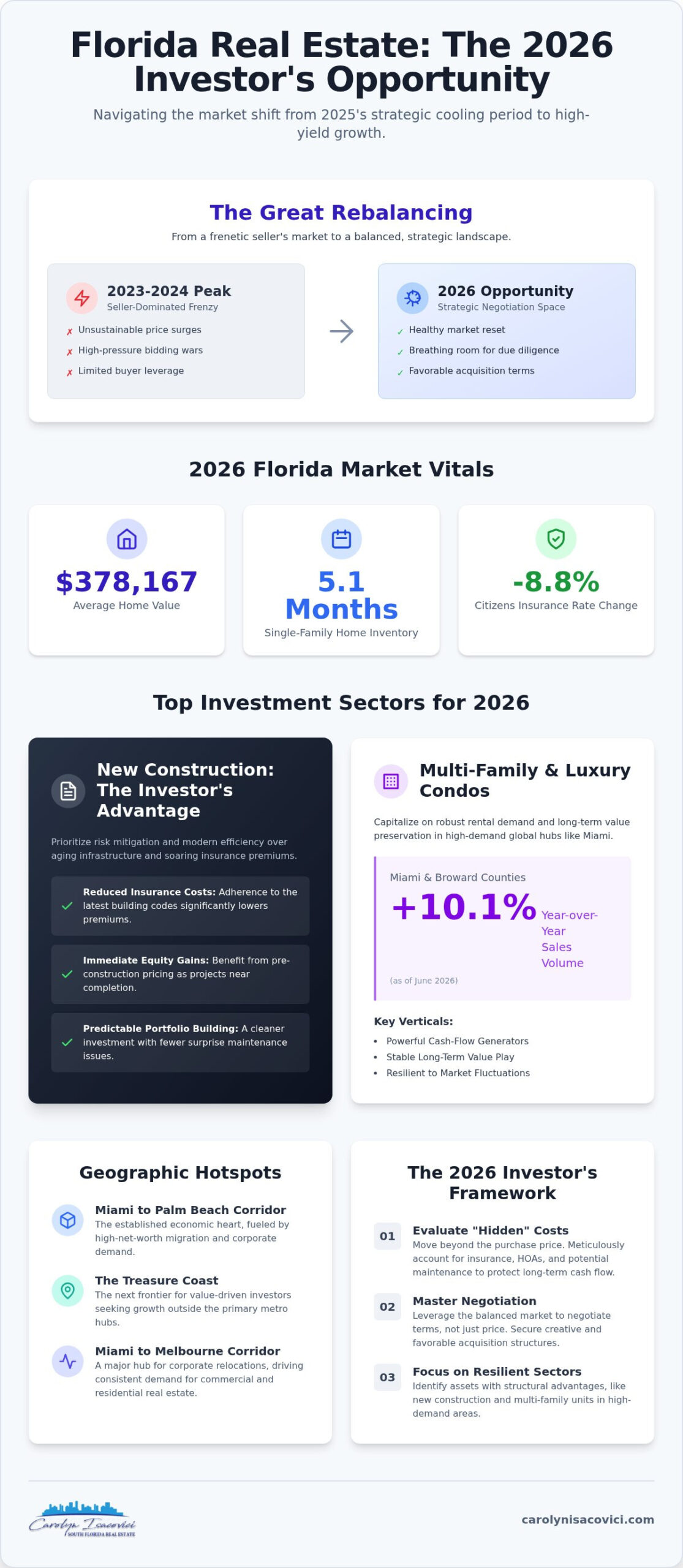
    The frenetic energy of the 2023-2024 peak has evolved into a more measured, rhythmic stride. This transition wasn’t a sudden halt; it was a necessary cooling period. During 2025, the market moved away from the unsustainable price surges of previous years toward a period of stabilization that savvy investors are now leveraging. While some observers feared a downturn, the reality is a healthy reset that has cleared the path for sustainable growth. By identifying the Florida market real estate opportunities 2025 left in its wake, you can position yourself for the 2026 rebound with confidence.

    As of mid-2026, the average home value in Florida sits at approximately $378,167. This price moderation, combined with an inventory supply of roughly 5.1 months for single-family homes, signals a return to equilibrium. It’s a landscape where buyers finally have the breathing room to conduct due diligence without the pressure of a forty-eight-hour bidding war. This shift represents a strategic entry point rather than a market exit.

    The Impact of Interest Rate Stabilization

    The “wait-and-see” attitude that defined much of 2025 created a significant backlog of motivated buyers. As mortgage rates eased toward the 6.8 percent range in early 2026, this sidelined capital began to move. The 2026 rebound effect is the measurable surge in transaction volume triggered when a backlog of sidelined buyers re-enters the market following a period of price and rate stabilization. We have moved from a seller-dominated environment to a balanced, strategic negotiation space. You now have the leverage to negotiate terms that were impossible only twenty-four months ago, allowing for more creative and favorable acquisitions.

    Migration and Demographics: The Florida Engine

    The broader Economy of Florida continues to outpace national averages, providing a sturdy foundation for these real estate shifts. High-net-worth migration to South Florida remains the primary market driver, as individuals seek both tax advantages and a lifestyle upgrade. This isn’t just a residential trend. Corporate relocations are fueling demand for commercial property and new construction developments across the Miami to Melbourne corridor. As businesses move their headquarters to the Sunshine State, the need for infrastructure and high-quality housing follows. This steady influx of residents ensures that demand remains resilient, even when national headlines suggest a broader slowdown. The population growth isn’t just a statistic; it’s the engine that keeps Florida real estate as a premier asset class for 2026 and beyond.

    Top Residential and Commercial Investment Sectors for 2026

    How do you choose the right asset when the market is rebalancing? It’s about precision. While the broader Florida market real estate opportunities 2025 created a foundation of stability, 2026 is the year of the specialist. We’re seeing a distinct move toward assets that offer structural advantages, such as lower maintenance costs and higher efficiency. According to the 2026 Housing Forecast, the market is finding its footing, making this the ideal time to diversify across residential and commercial sectors. Identifying these high-yield pockets requires a move away from the “buy anything” mentality of the past and toward a more calculated, data-driven approach.

    New Construction: The Investor’s Advantage

    Why are savvy buyers prioritizing new construction homes Florida over older, existing stock? The answer is found in risk mitigation. Older homes often come with aging infrastructure and soaring insurance premiums. In contrast, new developments adhere to the latest building codes, which can significantly reduce insurance costs. Pre-construction pricing also allows for immediate equity gains as the project nears completion. It is a cleaner, more predictable way to build a portfolio. You’re not just buying a property; you’re buying peace of mind and modern efficiency.

    Multi-family properties in Miami and Broward counties continue to serve as powerful cash-flow generators. With a 10.1 percent increase in year-over-year sales volume as of June 2026, the demand for rental housing remains robust. Similarly, the luxury condo sector in Miami has proven its resilience. It provides a stable long-term value play for those looking to preserve capital in a high-demand global hub. These sectors benefit from the constant influx of new residents who need quality housing immediately upon arrival.

    Commercial Real Estate: Retail and Industrial Hubs

    Is commercial real estate still a viable path? Absolutely. We’re seeing a rise in medical and industrial spaces within suburban corridors. Service-oriented retail in growing neighborhoods is thriving because it meets the daily needs of the expanding population. Industrial opportunities near Port Saint Lucie and Fort Pierce are particularly attractive due to their roles as logistics hubs. If you’re considering transitioning from residential holdings to Florida commercial real estate for sale, the current landscape offers several high-yield entry points. Working with a broker who understands these nuances can make the difference between a good investment and a great one. You can explore these high-value investment property sales to see which sectors align with your goals.

    Geographic Hotspots: From Miami to the Treasure Coast

    Where should you actually plant your capital? While broad trends tell one story, the local geography tells another. The Miami-Dade to Palm Beach corridor remains the economic engine of the state, but the map of opportunity is expanding. By looking closely at the Florida market real estate opportunities 2025 brought to the surface, we see a shift toward regions that offer a blend of lifestyle appeal and commercial viability. It isn’t just about the biggest cities anymore; it’s about the corridors connecting them.

    The South Florida Powerhouse: Miami and Broward

    Miami continues to be a magnet for global capital. However, the way investors approach it has changed. Understanding the latest Miami real estate market trends is essential for those targeting high-end residential assets. We’re seeing a “flight to quality” where luxury assets in Palm Beach Gardens and Fort Lauderdale remain resilient. Interestingly, Hollywood, FL has emerged as a preferred alternative to Miami Beach. It offers a similar coastal lifestyle but with a more attractive entry point, making it a strategic choice for those seeking value without sacrificing the South Florida vibe. It’s a pragmatic move for the long-term holder.

    The Treasure Coast Expansion

    Have you considered the Treasure Coast? This region, stretching from Jupiter up through Stuart and Port Saint Lucie, is the new frontier for value. Stuart and Jupiter have become top choices for high-net-worth “lifestyle” investors who want more space and a slower pace. Meanwhile, Port Saint Lucie has solidified its role as one of the fastest-growing residential markets in the region. It isn’t just for homeowners. The expansion here creates a massive need for infrastructure, which translates to commercial potential.

    Melbourne and Fort Pierce are the sleeper hits of 2026. Melbourne’s growth is fueled by a burgeoning tech sector, while Fort Pierce is seeing a rise in industrial and commercial demand. These areas benefit from the logistical advantages of the I-95 corridor and proximity to major ports. If you’re looking for assets with long-term appreciation potential, these northern reaches of the corridor offer a compelling narrative. They represent the next logical step in Florida’s northward economic expansion. It’s where the growth is heading, not just where it has been.

    Florida Market Real Estate Opportunities 2026-2026: The Strategic Investor’s Roundup

    The 2026 Investor’s Framework: Evaluating Opportunities

    How do you move from observing the market to securing a high-value asset? Success in this environment isn’t about luck; it’s about following a disciplined framework. While the Florida market real estate opportunities 2025 revealed provide a strong starting point, your final decision must be rooted in hard data. By moving through a structured evaluation process, you can transform uncertainty into a clear strategic advantage. It is about looking past the surface to find the true value beneath.

    Calculating the Real ROI in Florida

    Understanding your potential return starts with Net Operating Income (NOI). You must account for all operational expenses before you can determine if the Cap Rate aligns with your goals. For a deeper dive into these metrics, you can explore our guide on how to evaluate investment property Florida. In the current landscape, cash-on-cash return is the metric to watch in 2026 because it reflects the actual liquidity your investment generates after debt service. Don’t forget to factor in the “hidden” costs of ownership. While property tax increases are capped for homesteaded properties, non-homesteaded assets require a sharper pencil. You must also assess HOA fees and the recent shifts in insurance premiums to ensure your margins remain healthy.

    Due Diligence in a Stabilized Market

    Due diligence is where your strategy meets reality. In a stabilized market, you have the time to be thorough. Professional inspections are non-negotiable, specifically focusing on Florida-specific concerns like roof age, HVAC efficiency, and flood zone designations. If you are looking at multi-family or retail spaces, a meticulous review of rent rolls and commercial lease terms is essential for long-term stability. Consider these strategic steps:

    • Track the Path of Progress: Monitor new infrastructure projects, school developments, and hospital expansions to identify future demand.
    • Balance Your Portfolio: Combine the steady cash flow of commercial stability with the long-term appreciation potential of residential assets.
    • Verify the Asset Class: Remember that timing the market is less important than finding the right asset class that fits your risk profile.

    Finding the right balance requires a steady hand and local insight. If you are ready to apply this framework to your next acquisition, you can reach out to our team for expert investment property sales guidance. We help you navigate the complexities so you can focus on the growth of your portfolio.

    Securing Your Florida Portfolio with Expert Guidance

    Why do some investors thrive while others struggle with the same data? It often comes down to the quality of the partnership. While the Florida market real estate opportunities 2025 shift provided the entry points, navigating the closing process requires a steady, experienced hand. A broker who understands both commercial and residential nuances offers a perspective that automated platforms simply can’t match. This dual expertise allows you to see how a new residential development might impact nearby retail demand, or how a commercial rezoning could lift local home values. Success in this environment requires a guide who sees the whole map.

    Carolyn Isacovici navigates the Miami to Melbourne market with a focus on long-term wealth preservation. From the initial identification of a high-value asset to the final signatures at closing, our firm provides end-to-end support for your acquisitions. This includes uncovering off-market opportunities that never reach the public portals. Local expertise isn’t just about knowing the streets; it is about having the relationships that lead to the best deals before they are widely known. You deserve a partner who is as invested in your success as you are.

    A Personalized Approach to Real Estate Wealth

    Real estate wealth isn’t built on a single transaction. It is built through a rhythmic, advisory partnership that evolves with your goals. When you work with a seasoned guide, you gain access to a trusted network of local inspectors and contractors who understand the specific environmental challenges of the Florida coast. This isn’t just about buying property; it’s about building a long-term Florida real estate strategy that accounts for market cycles and demographic shifts. We move with you, providing the clarity needed to make bold, informed decisions in a changing landscape.

    Transforming Uncertainty into Opportunity

    Does the future still feel uncertain? It shouldn’t. By leveraging the framework we’ve discussed, 2026 becomes the year you transform market stabilization into a significant competitive advantage. The cooling of 2025 was the reset the market needed to offer sustainable entry points for those who know where to look. We are here to help you identify those points and secure your place in Florida’s economic future. The opportunities are there for those ready to take a strategic step forward.

    We invite you to take that step today. You can reach out for a tailored market analysis that reflects your specific investment goals. Connect with Carolyn Isacovici for a strategic market consultation and let’s begin building your Florida portfolio with confidence.

    Your Path to Strategic Growth in 2026

    Are you ready to move from observation to action? The Florida real estate landscape has undergone a necessary transformation. By understanding how the Florida market real estate opportunities 2025 cooling period created a more balanced environment, you can now enter the 2026 market with a clear advantage. We’ve explored the resilience of the Miami to Palm Beach corridor and the untapped potential of the Treasure Coast. Success now depends on applying a disciplined framework that accounts for hidden costs while focusing on high-yield residential and commercial property sales.

    Navigating these complexities is easier when you have a seasoned partner by your side. With over 20 years of experience across the Miami, Fort Lauderdale, and Treasure Coast markets, Carolyn Isacovici specializes in securing high-yield assets for her clients. It’s time to transform today’s uncertainty into tomorrow’s portfolio growth. Secure your strategic Florida real estate consultation with Carolyn Isacovici and take the first step toward your next successful acquisition. The future of your portfolio starts with a single, informed decision. We look forward to helping you build lasting wealth in the Sunshine State.

    Frequently Asked Questions

    Is the Florida real estate market expected to crash in 2026?

    No, a widespread crash is not anticipated for 2026. Instead, we’re seeing a strategic rebalancing from the pandemic era peak toward a more sustainable pace. With single family inventory at roughly 5.1 months, the market is moving into a healthy equilibrium. This shift provides more negotiating power for buyers while maintaining steady underlying demand from domestic migration. It’s an ideal environment for those looking for long term stability rather than speculative bubbles.

    Which Florida cities offer the best real estate opportunities in 2025 and 2026?

    High growth areas include the Miami to Palm Beach corridor and the expanding Treasure Coast. Specifically, Port Saint Lucie remains one of the fastest growing residential markets, while Stuart and Jupiter attract high net worth investors seeking lifestyle assets. Hollywood, FL has also emerged as a strategic choice for those seeking coastal value. These regions represent the best Florida market real estate opportunities 2025 and 2026 have to offer for diversified portfolios.

    What is the average cap rate for commercial property in Miami right now?

    Cap rates in Miami vary significantly by asset class and specific neighborhood. Generally, luxury multi family and well located retail properties see tighter rates due to high demand and limited supply. However, the rebalancing market of 2026 has allowed for more favorable entries compared to the 2023 peak. It’s essential to calculate your Net Operating Income accurately, accounting for current property tax assessments and the 2026 homestead exemption caps where applicable.

    Are new construction homes a better investment than existing homes in Florida?

    New construction homes often provide a strategic edge regarding maintenance and insurance. Because these properties are built to the latest 2026 codes, they frequently qualify for lower insurance premiums compared to aging inventory. Additionally, pre construction pricing can offer immediate equity gains upon completion. While existing homes may offer character, the efficiency and reduced risk of a new build often make it the superior choice for high yield investment goals.

    How do high insurance rates affect Florida real estate investment returns?

    Insurance costs are a critical factor in calculating your real ROI. While rates have been a challenge, the recent 8.8 percent average rate decrease for Citizens Property Insurance policies provides some relief for investors. High rates require a sharper focus on modern construction and flood zone designations to protect margins. By factoring these “hidden” costs into your initial due diligence, you can ensure your cash on cash returns remain healthy and sustainable.

    What should I look for when buying an investment property in Stuart or Jupiter?

    Focus on the “path of progress” and local infrastructure developments. Stuart and Jupiter are primary targets for high net worth migration, so proximity to high end amenities and top rated schools is vital. You should also evaluate the property’s elevation and compliance with modern building standards to manage long term insurance costs. These coastal communities offer a unique blend of privacy and accessibility, making them resilient choices for investors who prioritize long term appreciation.

    Can I use a 1031 exchange for Florida commercial investment properties?

    Yes, a 1031 exchange is a powerful tool for deferring capital gains taxes when selling and purchasing like kind investment properties. This strategy is frequently used by our clients to transition from residential holdings into larger commercial assets or new construction developments. It allows you to keep more of your capital working within the Florida market. Expert guidance is recommended to ensure you meet the strict federal timelines and requirements for a successful exchange.

    What is the difference between investing in Miami Beach vs. Hollywood, FL?

    The primary difference lies in the entry point and the nature of the demand. Miami Beach is a mature, global luxury market with high price points and international appeal. Hollywood, FL serves as a strategic value alternative, offering similar coastal access and lifestyle benefits at a more accessible cost basis. For investors, Hollywood often provides higher initial yields, while Miami Beach remains a premier choice for capital preservation and long term prestige in a high demand hub.

  • Best Neighborhoods to Invest in Miami: The 2026 Strategic Investor’s Guide

    Best Neighborhoods to Invest in Miami: The 2026 Strategic Investor’s Guide

    What if the “peak” of the Miami market isn’t a ceiling, but rather the foundation of a more sophisticated, institutional-grade era of growth? It’s natural to feel a sense of hesitation right now. You’re likely balancing the allure of South Florida’s legendary returns against the very real pressure of rising insurance costs and the fear of buying at the top of a cycle. When every corner of the city is labeled the “next big thing,” the noise can become deafening. Identifying the best neighborhoods to invest in Miami requires moving past the hype and looking toward the data.

    This guide cuts through the clutter to reveal where the market is actually heading in 2026. We’ve analyzed the precise locations where major infrastructure projects, shifting zoning laws like the Live Local Act, and lifestyle trends converge to create genuine, long-term value. You’ll gain a clear framework for evaluating the synergy between residential demand and commercial growth, transforming market uncertainty into a strategic advantage.

    We will explore the specific drivers behind Miami’s most resilient hubs, from the luxury surge in Pinecrest to the “flight to quality” in Brickell’s evolving office sector. By the end of this guide, you’ll have the analytical tools and the confidence needed to move past the research phase and secure assets with significant upside potential.

    Key Takeaways

    • Understand why 2026 marks a transition from rapid appreciation to a sophisticated market where institutional capital and infrastructure drive sustainable growth.
    • Identify the best neighborhoods to invest in Miami by utilizing a data-driven “Next-Gen Hub” framework that prioritizes proximity to major transit and commercial centers.
    • Uncover the strategic link between booming industrial corridors and residential demand to pinpoint high-yield “value-add” opportunities in emerging districts.
    • Learn how to accurately calculate true ROI in the current climate by factoring in 2026 property tax rates and specific insurance premium adjustments.
    • Gain the confidence to build a balanced portfolio by leveraging professional brokerage insights to bridge the gap between lifestyle-driven residential assets and commercial returns.

    The 2026 Miami Investment Landscape: From Boom to Strategic Growth

    Has the window of opportunity closed in South Florida? Quite the opposite. While the frantic bidding wars of the early 2020s have faded, they’ve been replaced by a market that is far more predictable and professional. 2026 represents a sophisticated entry point because the “noise” of speculative flippers has quieted, leaving the floor to strategic investors who prioritize long-term fundamentals. Understanding Miami’s economic landscape reveals a city that has successfully transitioned from a seasonal vacation spot into a global corporate powerhouse. Choosing the best neighborhoods to invest in Miami now requires looking at where institutional capital is landing rather than following social media trends.

    We’ve entered an era of “data-backed acquisition.” With the median single-family home price stabilizing around $648,000 and 30-year fixed mortgage rates averaging 6.57 percent, the math has become clearer. Investors are no longer guessing about future growth; they’re calculating it based on confirmed corporate relocations and massive infrastructure completions. This shift from speculation to strategy is exactly what a seasoned portfolio needs to thrive in the coming decade. For a broader view of how the late 2025 market reset has created a more predictable foundation, the Florida market real estate opportunities 2025 roundup offers essential context on inventory shifts and insurance reforms shaping the current cycle.

    Understanding the 2026 Market Cycle

    The current market cycle is defined by a “flight to quality.” We’re seeing this most clearly in the luxury sector, where sales for properties over $1 million surged by 21 percent year-over-year. High-net-worth individuals and institutional funds aren’t just looking for any roof; they’re looking for assets in areas with limited supply and high barriers to entry. Miami’s tax-friendly environment remains a primary magnet for this capital, especially as other states grapple with shifting fiscal policies. It’s a reassuring environment for those who value stability over volatility. Investors seeking to capitalize on this trend should explore Miami luxury condos for investment, where scarcity assets and global brand equity are redefining what it means to own a premier property in this market.

    Identifying the ‘Smart Money’ Indicators

    How do you spot a “Next-Gen Hub” before the rest of the market catches on? You follow the transit. The expansion of the Brightline and the continuous development of the Underline have fundamentally changed how residents move through the city. Properties with high “Walk Scores” and proximity to these transit arteries are seeing faster appreciation than isolated suburban pockets. Mixed-use developments are proving to be the safest bet for 2026 portfolios because they diversify risk. When a single building combines high-end residential units with ground-floor commercial space, it creates its own ecosystem of demand. This synergy is the hallmark of the best neighborhoods to invest in Miami right now.

    • Transit Proximity: Look for assets within a ten-minute walk of major rail extensions.
    • Zoning Advantages: Pay attention to areas affected by the 2026 updates to the Live Local Act, which can unlock hidden density.
    • Corporate Anchors: Areas within striking distance of new headquarters in Wynwood or Brickell offer the most resilient rental pools.

    Top 5 Neighborhoods for Residential and Multi-Family Investment

    Selecting the right location is about matching your specific risk profile with a neighborhood’s unique growth stage. In 2026, the market isn’t a monolith. It’s a collection of micro-markets, each offering different levers for wealth creation. Whether you’re seeking high-yield multi-family assets or stable residential holdings for asset preservation, the current landscape offers distinct pockets of opportunity. Identifying the best neighborhoods to invest in Miami requires a look beyond the skyline to the infrastructure and zoning changes driving long-term value.

    Edgewater & Midtown: The Urban Core Rental Market

    Edgewater has solidified its position as a luxury rental powerhouse. By 2026, the condo-to-rental ratio has shifted as more institutional investors have secured blocks of units to meet the demand from relocating professionals. We’re seeing a notable pivot toward Midtown’s boutique buildings, where investors find lower density and higher tenant retention. The continuous expansion of the Underline project has acted as a significant value driver, turning nearby properties into walkable, high-demand assets. These areas remain some of the best neighborhoods to invest in Miami for those prioritizing the urban core’s resilient rental pool.

    Allapattah & Little Haiti: The Next Appreciation Wave

    Allapattah has emerged as the premier “Value-Add” frontier for multi-family investment. Investors are successfully converting older industrial structures into modern residential units, capturing a demographic that wants proximity to the Health District without the Brickell price tag. Nearby, the Magic City Innovation District in Little Haiti serves as a massive catalyst, drawing in tech-oriented residents and long-term capital. Understanding how the City of Miami’s Real Estate Portfolio is strategically managed provides a reassuring look at the city’s commitment to revitalizing these emerging corridors through smart public-private synergy.

    For investors focused on family-driven demand and long-term stability, Kendall is the standout winner of 2026. With a median single-family home price that remains attractive compared to the coast, it offers a reliable hedge against volatility. On the other end of the spectrum, Coconut Grove continues to be the “Blue Chip” choice for luxury asset preservation. Its historic charm and strict zoning create high barriers to entry, ensuring your capital is protected in one of the most desirable residential enclaves in the country. If you’re looking to identify specific residential real estate sales that align with these growth drivers, having a seasoned guide to navigate the local nuances is your most valuable asset.

    • Edgewater: High-density luxury with institutional-grade rental demand.
    • Allapattah: The top choice for industrial-to-residential “Value-Add” plays.
    • Kendall: Unmatched stability fueled by family demographics and school proximity.
    • Coconut Grove: Limited inventory and high prestige for capital preservation.

    Commercial and Industrial Corridors Driving Investment Value

    Why do seasoned investors look at warehouse data when they’re planning to buy residential property? It’s because commercial activity is the most reliable leading indicator of future housing demand. In 2026, the synergy between where people work and where they live has never been tighter. While many focus solely on beachside condos, the “smart money” is tracking the industrial and corporate engines that power the city’s economy. Identifying the best neighborhoods to invest in Miami requires understanding these commercial corridors, as they provide the high-quality tenant pool and economic stability that every portfolio needs.

    The Doral Industrial Powerhouse

    Doral has become the backbone of Miami’s logistics-driven growth. The “Amazon Effect” and the rising trend of nearshoring have kept industrial vacancy rates remarkably low, hovering between 6.1 percent and 6.9 percent in early 2026. Average industrial rents have reached between $16.40 and $17.56 per square foot (NNN), reflecting a robust demand for flex-space and warehousing. This industrial strength directly impacts the local residential market. As more logistics firms establish roots here, the demand for workforce housing and new construction homes in the area continues to climb. It’s a reassuring cycle of growth for those seeking stable, long-term assets.

    Wynwood & Design District Commercial Synergy

    Wynwood has completed its evolution from an artsy enclave into a premier corporate headquarters hub. We’re seeing a consistent influx of tech and finance firms that prefer the neighborhood’s modern, high-quality office spaces over traditional high-rises. With gross asking rents for office space hitting a historic high of $62.75 per square foot, the commercial upside is undeniable. This corporate energy spills over into the Design District and Buena Vista, where high-end retail and “micro-offices” are accelerating neighborhood gentrification. These micro-offices are particularly influential, as they allow smaller firms to plant a flag in high-traffic areas, further stabilizing the local economy.

    Don’t overlook the Health District, often referred to as the Civic Center. It remains a recession-proof investment anchor due to the massive concentration of medical and legal institutions. The constant flow of high-earning professionals into this district ensures that nearby residential properties maintain high occupancy rates. When you analyze these corridors, you aren’t just looking at buildings; you’re looking at the best neighborhoods to invest in Miami based on verified economic drivers. Bridging the gap between commercial investment ROI and residential lifestyle is the key to a truly diversified Florida portfolio.

    • Industrial Vacancy: 6.1 percent to 6.9 percent in Doral, indicating high demand.
    • Office Rents: Historic highs of $62.75 per square foot in corporate hubs like Wynwood.
    • Recession-Proof Anchors: The Health District provides unmatched stability for nearby rental assets.
    • Flex-Space Growth: Rising demand for industrial-residential synergy in logistics corridors.

    Best Neighborhoods to Invest in Miami: The 2026 Strategic Investor's Guide

    Evaluation Framework: Analyzing ROI in the 2026 Market

    How do you separate a “good deal” from a “great asset” in today’s stabilized environment? It comes down to the quality of your math. While historical appreciation was the primary driver for years, the 2026 landscape demands a more balanced approach between current cap rates and future growth potential. Identifying the best neighborhoods to invest in Miami is only half the battle. The other half is applying a rigorous due diligence framework to ensure your net yield remains protected against evolving costs.

    Calculating the Real Cost of Ownership

    Many investors fall into the trap of looking at “Gross Yield.” This is a dangerous metric in 2026. To find your true ROI, you must account for the “Florida Factor.” This includes property taxes, which in Miami-Dade average about 1.94 percent of the property’s assessed fair market value. Recent insurance reforms have begun to stabilize the market, but premiums still vary significantly based on the age of the building and its proximity to the coast. Projecting a five-year appreciation in a stabilized market requires a conservative eye. You can find a step-by-step breakdown of these variables in our How to Evaluate Investment Property in Florida guide.

    New Construction as an Investment Hedge

    Why are so many institutional players shifting toward new builds? It’s often a strategic hedge against maintenance and insurance volatility. New construction homes in Miami are built to the latest building codes. This frequently translates to lower insurance premiums and higher tenant demand. When you look at the 2026 pipeline, pre-construction opportunities in areas like Edgewater or Doral offer a way to lock in today’s prices for tomorrow’s delivery. For a deeper look at navigating these contracts, see our guide on Buying New Construction Homes in Florida.

    Success in this cycle isn’t about chasing the highest possible number on a flyer. It’s about building a resilient portfolio that can withstand market shifts. If you’re ready to move beyond the spreadsheets and identify the best neighborhoods to invest in Miami for your specific goals, we can help you navigate investment property sales with confidence. Our team focuses on finding the intersection of lifestyle and institutional-grade returns.

    • Property Tax Baseline: Factor in approximately 1.94 percent to 2.0 percent for Miami-Dade assessments.
    • Insurance Advantage: Prioritize new construction to secure lower premiums and modern resilience.
    • Cap Rate Focus: Look for Class A and B multi-family properties maintaining 94-96 percent occupancy.
    • Appreciation Strategy: Target neighborhoods with confirmed infrastructure completions in the 2026-2027 window.

    Building Your Portfolio with Florida Commercial Investment Properties

    How do you move from identifying the best neighborhoods to invest in Miami to actually owning a high-performing asset? It’s about execution. In 2026, the most successful investors aren’t just looking for one-off deals; they’re building multi-asset portfolios that balance the stability of residential real estate with the high-yield potential of commercial property sales. This dual approach provides a safety net during market shifts while maximizing your exposure to South Florida’s economic expansion. By bridging the gap between where residents live and where businesses thrive, you create a portfolio that is resilient, diversified, and prepared for long-term growth.

    Strategic Diversification in South Florida

    While the best neighborhoods to invest in Miami often steal the spotlight, a truly strategic investor looks at the entire tri-county area. Balancing your Miami holdings with assets in Broward or Palm Beach can provide a necessary hedge against hyper-local volatility. For instance, while Miami offers unmatched urban energy, neighboring counties might offer different entry points for industrial or multi-family acquisitions. You can explore a broader perspective on these shifts in our Miami Real Estate Market Trends 2026 guide. This regional view ensures that your capital is always positioned in the path of progress, regardless of which specific zip code is leading the current cycle.

    Your Partner in Florida Real Estate

    The complexities of the Florida market, from the 20.03 millage rates in the city to evolving insurance requirements, require more than just a broker. They require a seasoned guide. Carolyn Isacovici has been navigating these cycles since 2006, providing the “calm expert” persona needed to transform uncertainty into opportunity. Whether you’re interested in new construction homes or complex investment property sales, the focus remains on a bespoke advisory experience. We don’t just show properties; we identify the strategic drivers that align with your specific wealth goals, ensuring that every acquisition is backed by data and professional insight.

    Starting your journey is a methodical process designed to build trust and clarity. It begins with an initial consultation to define your risk tolerance and target yield. From there, we leverage local brokerage expertise to uncover off-market opportunities that never reach the public portals. We guide you through every stage of the transaction, from rigorous due diligence to a successful closing and beyond. If you’re ready to move from research to acquisition, Contact Florida Commercial Investment Properties for a Portfolio Review today. 2026 is the year of the strategic buyer, and with the right partner, the path forward is clear.

    • Multi-Asset Strategy: Combine residential stability with commercial yield for a balanced portfolio.
    • Bespoke Advisory: Leverage expertise in navigating 2026 tax and insurance complexities.
    • Off-Market Access: Discover high-value opportunities through deep local brokerage connections.
    • Regional View: Consider the synergy between Miami-Dade, Broward, and Palm Beach assets.

    Securing Your Strategic Advantage in South Florida

    The 2026 Miami market offers a unique moment for the disciplined investor. We’ve moved past the era of speculative frenzy into a period where infrastructure, institutional capital, and corporate relocations define real value. By focusing on the best neighborhoods to invest in Miami, from the industrial corridors of Doral to the luxury enclaves of Coconut Grove, you can build a portfolio that thrives on fundamental demand rather than market hype. Success now requires a sharp eye for detail. It’s especially true when calculating the impact of taxes and insurance on your long-term yield.

    Managing these complexities is easier with a seasoned guide by your side. Since 2006, Carolyn Isacovici has provided specialized brokerage support for those seeking high-yield commercial and residential assets. Our team offers comprehensive end-to-end sales management, ensuring every acquisition aligns with your broader wealth strategy. Are you ready to transform these insights into a concrete action plan? You can Schedule a Strategic Investment Consultation with Carolyn Isacovici to review your holdings or identify your next acquisition. The opportunities in South Florida are vast. The right partnership makes all the difference.

    Frequently Asked Questions

    What is the best neighborhood in Miami for first-time real estate investors in 2026?

    Kendall is arguably the premier choice for first-time investors seeking stability and predictable entry costs. With a median single-family home price hovering around $699,990, it offers a reliable family-driven demographic that stays resilient during market shifts. First-time buyers often find the lower volatility here reassuring compared to the high-density urban core. It’s a strategic starting point for building a Florida portfolio while learning the nuances of property management and local tax assessments.

    How do Florida’s insurance costs affect investment property ROI right now?

    Insurance premiums act as a significant line item that reduces your gross yield, though recent 2025 and 2026 reforms have brought much-needed stability to the market. Smart investors now prioritize newer construction or properties with updated wind-mitigation features to secure more favorable rates. While these costs are higher than in previous decades, they’re manageable when factored into a conservative ROI calculation. We recommend budgeting for these premiums early in your due diligence process.

    Is Brickell still a good place to invest in 2026, or is it overpriced?

    Brickell remains a top-tier choice for investors prioritizing rental cash flow and institutional-grade assets. While prices have stabilized, the area continues to see historic high gross asking rents for office space at $62.75 per square foot. This corporate growth ensures a steady stream of high-earning tenants for residential units. It isn’t overpriced for those seeking long-term stability; however, it’s no longer a neighborhood suited for speculative, short-term flipping.

    Should I focus on residential or commercial property in Miami for better cash flow?

    Commercial properties, particularly in the industrial and flex-space sectors, often provide higher yield and longer lease terms in the current market. Industrial vacancy rates in hubs like Doral stay low, between 6.1 percent and 6.9 percent, driving consistent returns. However, residential real estate sales offer more liquidity and are often easier for individual investors to finance. A balanced approach that combines both asset classes usually yields the most resilient and diversified results.

    What are the emerging ‘up-and-coming’ neighborhoods in Miami for 2026?

    Allapattah and Little Haiti are the primary emerging hubs where we see the most significant appreciation potential. These areas are benefiting from a direct spillover of interest from Wynwood and the Design District. Allapattah is specifically gaining traction as one of the best neighborhoods to invest in Miami for industrial-to-residential conversions. The Magic City Innovation District continues to act as a massive catalyst, drawing tech-focused capital and younger professionals into these evolving corridors.

    How does the Brightline expansion affect property values in South Florida?

    The Brightline expansion has created a noticeable “transit premium” for properties located within a ten-minute walk of its stations. We’ve observed that these areas experience faster appreciation and higher rental demand as residents seek to avoid highway congestion. This connectivity has effectively turned Miami, Fort Lauderdale, and West Palm Beach into a single, cohesive economic region. Investors who target these transit-oriented developments often see more resilient valuations even during broader market shifts.

    What is the average cap rate for multi-family properties in Miami in 2026?

    Average cap rates for multi-family properties generally range between 5 percent and 6.5 percent, depending on the asset class and specific location. Class A and B properties are maintaining high occupancy levels of 94 percent to 96 percent in early 2026, providing a reassuring floor for net operating income. While these rates are more compressed than in previous years, they reflect the increased institutional demand and the overall maturation of the market.

    Is it better to buy new construction or an existing property for an investment?

    New construction is often the better choice for investors looking to minimize maintenance headaches and secure lower insurance premiums. These buildings meet the strictest modern codes, which is a significant advantage in the current landscape. Conversely, existing properties offer “value-add” opportunities where you can increase equity through strategic renovations. Your choice should align with whether you prioritize immediate passive income or long-term forced appreciation through physical improvements and modern updates.

  • Miami Real Estate Investment Opportunities: A 2026 Strategic Guide

    Miami Real Estate Investment Opportunities: A 2026 Strategic Guide

    What if the market peak you’re dreading is actually the foundation of Miami’s next decade of growth? It’s natural to feel a sense of hesitation when the median home price sits at $595,000 and mortgage rates hover near 6.57%. You might worry that you’ve missed the window for the best Miami real estate investment opportunities, or perhaps the shifting tax regulations and building recertification rules feel like an overwhelming maze. We understand that uncertainty. It’s why we’re here to provide a steady hand and a clear perspective on why this city has evolved from a seasonal playground into a structural pillar of the global economy.

    You deserve to move forward with confidence rather than confusion. In this guide, you’ll discover how to identify high yield neighborhoods that are truly emerging in 2026 and receive a strategic framework for choosing between residential assets and commercial property sales. We’ll explore the economic drivers fueling Florida’s growth and help you navigate complex changes like bonus depreciation reductions and new building recertification timelines. By the end, you’ll have a professional roadmap to ensure your long term strategy is as resilient as it is profitable.

    Key Takeaways

    • Understand the structural shift that has transformed Miami into a primary global business hub, providing a stable foundation for long-term property appreciation.
    • Explore the “Brightline Effect” to see how new transit corridors are unlocking significant value in neighboring markets like Hollywood and Fort Lauderdale.
    • Evaluate diverse Miami real estate investment opportunities by comparing the strategic benefits of commercial property sales with the low-maintenance appeal of new construction homes.
    • Learn to mitigate risk through geographic diversification, spreading your assets across South Florida’s most promising regions from Miami to the Treasure Coast.
    • Discover how partnering with an expert broker grants you access to off-market deals and the local insight needed to navigate complex 2026 regulations.

    Why Miami Real Estate Remains a Global Investment Magnet in 2026

    Miami has matured far beyond its reputation as a sun-drenched getaway. It is now a sophisticated center of global commerce that continues to attract capital from every corner of the globe. Why does this momentum persist? The foundation lies in Florida’s economic landscape, which offers a rare combination of no state income tax and a pro-business regulatory environment. This fiscal advantage is not just a perk; it’s a structural engine that drives consistent demand for high-quality assets.

    For many, the current market feels complex. You might see fluctuating interest rates or new regulations and feel a sense of hesitation. However, experienced investors recognize that these periods of recalibration often unveil the most compelling Miami real estate investment opportunities. The city’s “Gateway to the Americas” status ensures a steady flow of international trade and human capital, making the local economy more resilient than many interior U.S. markets. When uncertainty causes others to pause, it often signals the ideal entry point for those with a long term vision.

    The Resilience of the South Florida Market

    Physical geography plays a silent but powerful role in protecting your investment. Miami is uniquely constrained by the Everglades to the west and the Atlantic Ocean to the east. This “finite dirt” reality means that supply cannot simply expand outward to meet demand. When you combine this limited land supply with the 2026 infrastructure improvements, including expanded transit corridors, you see a market built for long term appreciation rather than short term speculation. Historically, South Florida has frequently outpaced national appreciation averages because of this inherent supply-demand imbalance.

    The Shift Toward “Wall Street South”

    The migration of major financial institutions and tech giants to Miami and Palm Beach has reached a critical mass. This phenomenon, often called “Wall Street South,” has fundamentally changed the local demographic. High-income job growth is no longer a projection; it is a reality that fuels the residential sector and creates a significant halo effect for commercial property sales. This influx of institutional capital provides a layer of security for those seeking Miami real estate investment opportunities. You aren’t just buying a property; you’re taking a position in a city that is successfully competing with New York and London for global relevance.

    • Corporate relocations bring stable, long term tenants to the region.
    • Increased local wealth supports high-end luxury retail and office demand.
    • New construction homes are increasingly designed to meet the needs of executive-level professionals.

    Understanding the Drivers of Miami Property Appreciation

    What actually makes a property grow in value? In a high-demand coastal market like South Florida, appreciation isn’t a mystery; it’s a measurable result of scarcity meeting demand. While national trends might fluctuate, the local drivers here are deeply structural. One of the most visible catalysts is the “Brightline Effect.” This high-speed rail expansion has transformed formerly overlooked areas in Hollywood and Fort Lauderdale into transit-oriented hubs, significantly increasing property values for assets within walking distance of the stations.

    This growth is further fueled by demand-pull inflation. As out-of-state wealth continues to pour in from high-tax states, the purchasing power in the local market remains exceptionally buoyant. You can see the evidence in the Miami-Dade County Economic Reports, which highlight the steady rise in median household income and corporate investment. This influx doesn’t just impact luxury estates; it creates a lift across the entire spectrum of Miami real estate investment opportunities.

    Infrastructure and Urban Revitalization

    Have you noticed the transformation of the Design District or Wynwood? These aren’t just aesthetic upgrades. They are the result of strategic public-private partnerships that turn industrial zones into global cultural destinations. When a neighborhood gains a luxury retail anchor or a new transit hub, it creates a localized appreciation “pocket” where values can outpace the broader market. These revitalized districts attract a new demographic of high-earning professionals, making them prime targets for Miami real estate investment opportunities. Investors seeking to capitalize on this trend should also explore Miami luxury condos for investment, which are increasingly concentrated in these high-demand urban corridors.

    Supply Constraints and Zoning Impacts

    The supply of land is our greatest constraint. In Miami, prime waterfront and “in-fill” development sites are almost entirely accounted for. This scarcity naturally pushes asset values higher as developers compete for limited space. To address this, we’re seeing significant zoning changes designed to allow for higher density. These shifts create unique openings for commercial property sales, as older low-density structures are replaced by modern, high-yield mixed-use developments. Rising construction costs also play a role, setting a higher floor for new inventory and protecting the value of existing assets.

    Miami property appreciation is the result of sustained net-migration and corporate capital inflow. If you’re looking to identify which specific pockets are poised for the next growth spurt, consulting with a local investment broker can provide the clarity you need.

    Exploring High-Yield Miami Real Estate Investment Opportunities

    Which asset class aligns best with your financial goals? It’s the central question for anyone evaluating Miami real estate investment opportunities today. While residential assets offer familiarity, commercial sectors often provide the institutional edge needed for significant scaling. In 2026, we’re seeing a distinct trend toward high-yield multi-family units. These assets balance the stability of residential demand with the professional management structures of commercial property sales, providing consistent cash flow even as the market matures. By diversifying your holdings, you don’t just grow your wealth; you insulate it against localized shifts.

    Commercial Real Estate: The Institutional Edge

    Why are industrial and warehouse spaces the quiet winners of 2026? The answer lies in the continued logistics boom servicing the South Florida population. As more people move to the region, the demand for “last-mile” delivery centers remains relentless. Beyond large-scale warehouses, boutique office spaces are seeing a resurgence. As firms relocate to the region, they seek high-end, smaller footprints that offer prestige without the overhead of massive towers. This demand extends beyond the city core. Retail opportunities in high-growth corridors like Port Saint Lucie are becoming increasingly attractive as residential rooftops multiply along the Treasure Coast, creating new pockets of consumer demand.

    Residential and New Construction Strategies

    For many investors, the path to luxury appreciation leads north of the city. Areas like Palm Beach Gardens and Jupiter have become magnets for affluent families seeking a specific lifestyle, driving demand for high-end inventory. One of the most effective ways to capture this value is by buying new construction homes Florida investors can secure. Pre-construction pricing allows you to lock in today’s value while the property is being built, often resulting in immediate equity upon completion. These properties are particularly attractive to those seeking Miami real estate investment opportunities because they require minimal maintenance and appeal to the modern tenant’s preference for hurricane-resistant, energy-efficient designs.

    Identifying the difference between “established” and “emerging” neighborhoods is vital for timing your entry. Miami Beach remains an established anchor with high demand, but the stretch toward Stuart offers emerging pockets where the entry price is lower and the potential for long-term appreciation is higher. Success in this market isn’t just about finding a property; it’s about finding the right location at the right moment. Whether you’re looking at Miami luxury condos for investment in Brickell or a new construction home in the suburbs, the key is to prioritize assets that serve the growing professional class. Our in-depth analysis of the best neighborhoods to invest in Miami can help you pinpoint exactly where these opportunities are converging in 2026.

    Miami Real Estate Investment Opportunities: A 2026 Strategic Guide

    Strategic Portfolio Building: Timing and Risk in South Florida

    Is the South Florida market a bubble waiting to burst? It’s a question we hear often, especially with the median home sale price reaching $595,000 in August 2026. While the rapid growth of previous years has slowed to a more predictable pace, the underlying drivers remain solid. We aren’t seeing the speculative frenzy of decades past; instead, we’re witnessing a structural migration of wealth and industry. For those seeking Miami real estate investment opportunities, the most resilient path forward is a long-term hold strategy that prioritizes value over quick flips.

    Risk mitigation starts with geographic diversification. While Miami is the anchor, a balanced portfolio might include assets in Fort Lauderdale or as far north as Melbourne. This spread protects your capital from localized market shifts. To scale effectively, many of our clients utilize 1031 exchanges. This tool allows you to defer capital gains taxes by reinvesting proceeds into “like-kind” properties, effectively compounding your wealth within the Florida market without the immediate tax drag.

    Evaluating the Cap Rate and ROI

    How do you distinguish a good deal from a great one? It requires looking beyond the sticker price. You need a clear understanding of the how to evaluate investment property Florida investors should follow. While cash-on-cash return is vital for monthly liquidity, the total return on investment often comes from long-term appreciation in high-growth corridors. In 2026, successful investors are balancing these two metrics to ensure their portfolio remains healthy through various interest rate cycles.

    Navigating Insurance and Environmental Factors

    Rising insurance premiums are a reality, but they don’t have to be a deal-breaker. The key is to budget effectively and target “resilient” properties. We look for assets that meet modern building codes and sit at higher elevations to minimize risk. This is where new construction often shines. Because these buildings utilize the latest hurricane-resistant materials and energy-efficient designs, they frequently offer the best insurance-to-value ratio. By focusing on quality and compliance, you turn a potential obstacle into a competitive advantage. If you’re ready to build a portfolio designed for the future, consult with a strategic investment partner today.

    Why do some investors always seem to find the best deals before they ever hit the open market? It isn’t luck; it’s the “Insider Advantage.” In a competitive environment like South Florida, the most lucrative Miami real estate investment opportunities are often found through off-market channels and private networks. A seasoned broker doesn’t just provide data; they provide context. While a spreadsheet can show you that average rent in the region is $3,008, it won’t tell you why a specific block in Hollywood is poised for a value surge because of a planned boutique development nearby. We bridge that gap between cold numbers and local market sentiment.

    Are you an international investor looking for a stable US dollar hedge, or a domestic builder looking to scale a residential portfolio? The strategy for each is vastly different. International buyers often prioritize residential real estate sales in established zones like Brickell for their liquidity and prestige. Conversely, domestic investors might focus on high-yield commercial property sales or new construction homes along the Treasure Coast to capture higher cap rates. Understanding these nuances is essential for long-term success, as explored in our comprehensive Miami Real Estate Market Trends 2026: Investor Guide.

    The Florida Commercial Investment Properties Difference

    Our reach extends far beyond the neon lights of Miami. From the vibrant urban core to the quiet, rapid growth of Vero Beach, Florida Commercial Investment Properties operates with a deep local knowledge that spans the entire South Florida coastline. We specialize in navigating the complexities of commercial property sales and new developments, ensuring every acquisition is backed by rigorous analysis. We don’t see ourselves as salespeople; we are your “Professional Partner.” Our goal is to ensure you feel both informed and looked after throughout the entire lifecycle of your investment.

    Taking the Next Step in Your Investment Journey

    How do you turn these insights into a tangible asset? It starts with a conversation. We offer custom market analyses tailored to your specific target area, helping you visualize the potential ROI before you commit capital. A personal consultation allows us to align your portfolio goals with the specific trends of 2026, from navigating new building recertification rules to capitalizing on transit-oriented development. Don’t let market complexity lead to paralysis. It’s time to transform your insight into action and secure your place in the future of Florida real estate.

    Your Path to Long-Term Florida Prosperity

    Miami’s transition into a global financial and tech hub is a structural shift that offers lasting stability for your capital. While the pace of growth has normalized, the combination of limited land supply and consistent corporate migration ensures that high-quality assets remain in high demand. You now have a framework for identifying high-yield neighborhoods and understanding how infrastructure like the Brightline expansion creates localized pockets of value. Moving from analysis to action is the final step in securing your financial future.

    Identifying the most resilient Miami real estate investment opportunities requires more than just looking at listings; it demands a strategic approach to risk, timing, and local regulations. Whether you’re interested in new construction homes or complex commercial property sales, having a guide to navigate insurance shifts and tax deferral strategies is vital for your success. Our team provides the deep local expertise and strategic advisory needed to scale your portfolio from Miami to the Treasure Coast with absolute confidence.

    Are you ready to turn these market insights into a high-value reality? Secure your next high-value asset with Florida Commercial Investment Properties. We’re here to ensure your investment journey is as rewarding as it is clear. Let’s build your legacy together.

    Frequently Asked Questions

    Is Miami real estate still appreciating in 2026?

    Yes, though the market has transitioned to a more moderate and predictable pace compared to previous years. In August 2026, the median home sale price reached $595,000, reflecting steady demand. Appreciation is now driven by structural shifts, including corporate relocations and a finite supply of land, rather than speculative fever. This creates a stable environment for those pursuing Miami real estate investment opportunities over a long term horizon.

    What are the best neighborhoods for investment in Miami right now?

    The most compelling opportunities are currently found in transit-oriented zones and areas seeing significant urban revitalization. The “Brightline Effect” has made neighborhoods in Hollywood and Fort Lauderdale increasingly attractive for multi-family assets. For luxury seekers, Palm Beach Gardens and Jupiter continue to see strong demand from affluent families. Investors are also looking toward high-growth corridors in Port Saint Lucie where residential development is expanding rapidly along the Treasure Coast. For a data-driven breakdown of where to focus your capital, explore our guide to the best neighborhoods to invest in Miami in 2026.

    How does Florida’s tax structure benefit real estate investors?

    Florida offers a highly favorable environment because it lacks a state income tax, which significantly increases the net yield for property owners. Investors can also utilize 1031 exchanges to defer capital gains taxes, allowing for more efficient portfolio scaling. For primary residents, the Homestead Exemption can reduce the taxable value of a home by $51,411. These fiscal advantages make the region a premier destination for domestic and international capital alike.

    What is the average cap rate for commercial property in South Florida?

    Cap rates vary by asset class, but industrial and warehouse spaces currently lead the market with strong, stable returns. While retail and boutique office spaces in high-growth corridors are seeing competitive yields, the exact rate depends heavily on the property’s location and tenant strength. We recommend requesting a custom market analysis to calculate the real return on any specific commercial property sales you are considering in the current 2026 market.

    Should I invest in new construction or existing homes in Miami?

    New construction often provides a strategic advantage in 2026 due to modern building codes and hurricane-resistant materials. These features typically lead to lower insurance premiums and reduced maintenance costs compared to older assets. While existing homes may offer a lower initial entry price, new construction homes allow investors to lock in pre-construction pricing and appeal to the high-income professionals currently migrating to the South Florida region.

    How do I manage a Miami investment property if I live out of state?

    Successful out-of-state ownership relies on building a reliable local team. You’ll need a professional property management firm to handle day-to-day operations, tenant relations, and maintenance. Partnering with a seasoned investment broker is also essential, as they provide the boots-on-the-ground insight needed to monitor market shifts and identify when it is time to exit or reinvest. This collaborative approach allows you to scale your Florida portfolio with total confidence from anywhere.

    What are the risks of investing in the Miami real estate market?

    The primary risks in 2026 involve rising insurance premiums and evolving building recertification requirements. Properties located within three miles of the coastline now require recertification at 25 years of age. To mitigate these risks, we advise diversifying your assets across different geographic zones, such as moving inland or north toward Vero Beach. Focusing on resilient properties with modern elevation and building standards helps protect your capital against environmental and regulatory shifts.

    How can a Florida real estate broker help me find off-market deals?

    A seasoned broker provides access to private networks and “pocket listings” that never reach public platforms. We use our deep local reach to identify sellers who prefer discreet transactions, giving you an “Insider Advantage” in a competitive market. By bridging the gap between data and market sentiment, we help you secure Miami real estate investment opportunities that align perfectly with your specific financial goals and risk tolerance.

  • Investing in Fort Lauderdale New Construction: 2026 Market Trends & Opportunities

    Investing in Fort Lauderdale New Construction: 2026 Market Trends & Opportunities

    Is the sun setting on the South Florida boom, or are we simply entering the most sophisticated phase of growth yet? It’s natural to feel a sense of hesitation when looking at a maturing market. You might worry about buying at the top or feel overwhelmed by the intricate details of pre-construction contracts. These concerns are valid, but they shouldn’t cloud the reality of the current landscape. We’ve seen these cycles before, and the data suggests that investing in Fort Lauderdale new construction remains a premier choice for those seeking long-term equity. The city has transformed into a primary hub for urban-suburban infrastructure that continues to draw high-value residents.

    We’re here to help you move past the uncertainty. In this article, you’ll discover why the 2026 supply-demand dynamic favors the informed buyer. We’ll identify the specific growth corridors in Broward County that are outperforming the rest, from the evolving streets of Flagler Village to the rising waterfront. You’ll gain a clear understanding of how to navigate emerging neighborhoods and secure a pre-construction asset designed for appreciation. Let’s explore the roadmap to your next successful investment together.

    Key Takeaways

    • Understand how Fort Lauderdale has transitioned from a seasonal retreat into a year-round economic powerhouse, creating a stable environment for long-term capital growth.
    • Pinpoint the specific high-growth corridors like Flagler Village and Rio Vista where modern developments are currently redefining neighborhood value and lifestyle standards.
    • Evaluate the strategic financial advantages of investing in Fort Lauderdale new construction, focusing on pre-construction equity upside and updated 2026 rental yield projections.
    • Learn why modern, climate-resilient building standards often result in lower insurance premiums and better long-term protection for your assets compared to legacy properties.
    • Discover the methodology for navigating complex pre-construction contracts and accessing exclusive off-market opportunities through an advisory-led brokerage approach.

    The Evolution of Fort Lauderdale’s 2026 Real Estate Landscape

    Is the market merely expanding, or is it fundamentally changing? It’s the latter. Investing in Fort Lauderdale new construction in 2026 isn’t about chasing speculative bubbles; it’s about participating in a city’s coming-of-age. We’ve moved past the era of the seasonal getaway. Today, the skyline is dominated by mixed-use developments that cater to a permanent, professional population. This evolution provides a sense of security for investors who prioritize long-term stability over short-term volatility.

    Why is 2026 a pivotal year? It’s the moment where the massive wave of inventory initiated years ago is finally being absorbed by a steady stream of new residents. The city has transitioned into a legitimate finance and tech hub, often referred to as a key piece of the “Wall Street South” movement. This shift ensures that rental demand remains consistent throughout the year, rather than peaking only during the winter months. It’s a structural change that transforms the very nature of local property yields.

    Have you considered the impact of the Brightline? This high-speed rail hasn’t just improved travel; it’s redefined land value across Broward County. Transit-oriented development is the new standard, with developers prioritizing sites within a short radius of the station. This connectivity to Miami and West Palm Beach makes Fort Lauderdale the strategic “middle ground” for South Florida’s elite workforce, driving up the desirability of new residential assets in the urban core.

    Infrastructure Projects Shaping 2026 Property Value

    The Fort Lauderdale-Hollywood International Airport (FLL) expansion continues to be a massive catalyst for growth. By increasing international capacity, it’s opening the door for global capital to flow directly into the region. Meanwhile, the New River crossing improvements are finally addressing urban connectivity bottlenecks, making the downtown core more accessible than ever. Public-private partnerships are also hard at work, transforming once-neglected areas into vibrant, investable public spaces that drive up the desirability of adjacent new builds.

    Demographic Shifts: Who is Renting and Buying?

    We’re seeing a sustained influx of high-earning professionals from tax-heavy states like New York and California. They aren’t just looking for a roof; they’re looking for a lifestyle. Corporate relocations are no longer a future promise; they’re a present reality, with firms filling the new Class A office spaces downtown. This creates a reliable pool of tenants who prioritize modern amenities and proximity to work. The lifestyle-first buyer of 2026 is a sophisticated professional who values seamless connectivity, wellness-centric amenities, and the ability to walk to both high-end dining and their office.

    Hot Zones: Where New Construction is Redefining Neighborhoods

    Where should you place your capital? It is the most critical question for any strategic investor. In 2026, the answer lies in identifying the specific “hot zones” where neighborhood identity is being completely rewritten. While the city as a whole is thriving, certain pockets offer a unique blend of lifestyle appeal and equity potential. This isn’t just about finding a building; it’s about finding the right street in the right corridor.

    Flagler Village and the Urban Core Expansion

    Flagler Village continues its reign as the center of the urban-industrial aesthetic. However, the narrative is changing. We’re seeing a distinct transition from high-density multi-family rentals to exclusive, high-end condo ownership. While some worry about saturation, the reality is that the demand for ownership in this district is at an all-time high. Proximity to the F.A.T. Village arts district still commands a significant premium, as buyers prioritize being within walking distance of the city’s cultural pulse.

    The ‘New’ Waterfront: Las Olas and Beyond

    Scarcity is the primary driver along the waterfront and Las Olas. With virtually no vacant land left, developers are turning to boutique, low-density projects that emphasize privacy and high-spec finishes. These builds are at the forefront of “Resilience” architecture, integrating advanced flood protection and wind-resistant tech directly into the luxury design. If you’re exploring the possibilities of buying new construction homes in Florida, these resilient waterfront assets represent the pinnacle of the 2026 market.

    What about the inland markets? Savvy investors are increasingly looking toward Plantation and Sunrise. These areas serve as emerging hubs where entry price points are more approachable compared to the coastal corridors. You get more square footage and modern community infrastructure, which is particularly attractive to the growing demographic of remote-work families. The value proposition here is simple: high-quality living at a fraction of the beachfront cost, with plenty of room for appreciation as the urban sprawl continues westward.

    Even historic corridors like Rio Vista and Harbor Beach are evolving. Modern luxury infill projects are replacing older structures, offering the prestige of an established address with the efficiency of a 2026 build. Investing in Fort Lauderdale new construction requires this level of granular neighborhood insight to truly maximize your returns. We invite you to connect with our advisory team to pinpoint the exact sub-market that fits your financial objectives.

    Financial Dynamics of New Construction ROI in 2026

    Is the “pre-construction discount” a relic of the past or a present reality? It’s a question we hear often. In 2026, the financial logic of investing in Fort Lauderdale new construction has shifted from simple speculation to a more sophisticated equity play. While the days of massive, across-the-board discounts are behind us, the opportunity to lock in today’s prices for tomorrow’s finished asset remains a powerful wealth-building tool. It’s about securing a modern, efficient property that will command top-tier rents and resale value in a maturing market.

    When we compare Fort Lauderdale to its neighbors, the value proposition becomes even clearer. Miami often commands a higher entry price with compressed yields, while West Palm Beach has seen rapid price escalation that can limit the upside for new entrants. Fort Lauderdale sits in the “sweet spot.” It offers a more accessible entry point for luxury assets while maintaining a rental demand profile that rivals any major metro in the state. This balance is what makes it the premier choice for strategic portfolio growth this year.

    Florida’s tax environment also provides a steady hand for your balance sheet. While the “Save Our Homes” act primarily protects primary residents, the 10% cap on annual assessment increases for non-homestead properties ensures that your carrying costs remain predictable. This stability, combined with no state income tax, allows you to retain a larger portion of your rental income compared to high-tax states. It’s a structural advantage that continues to draw capital from across the country.

    Pre-Construction Pricing vs. Market Value at Completion

    The appreciation curve typically follows a predictable path from the initial ground-breaking to the final certificate of occupancy. Savvy investors look for “undervalued” phases, often found in the early releases of larger master-planned communities where developers are incentivized to build momentum. Historical data from South Florida’s development cycles indicates that pre-construction assets frequently see a value increase of 15% to 20% by the time they reach the certificate of occupancy stage. This built-in equity provides a significant buffer against market fluctuations.

    Rental Demand and Yield Projections

    Who is your ideal tenant in 2026? We’re focusing on the “Luxury Renter” demographic professionals who have the capital to buy but prefer the flexibility and amenities of a new build. This group provides consistent cash flow and tends to treat the property with more care. While short-term rental regulations (Airbnb) have become more nuanced in Fort Lauderdale, focusing on long-term luxury leases often yields more stable returns with lower turnover costs. Identifying developments with liberal rental policies remains key, as it gives you the maximum flexibility to pivot your strategy as market conditions evolve.

    Investing in Fort Lauderdale New Construction: 2026 Market Trends & Opportunities

    Future-Proofing Your Fort Lauderdale Investment

    How do you protect a real estate asset for the next thirty years? It starts with the foundation, both literal and contractual. Investing in Fort Lauderdale new construction is often the most effective hedge against the rising carrying costs that plague older properties. While legacy buildings face the daunting task of retrofitting for modern standards, new developments are born resilient. This inherent durability transforms a potential risk into a strategic advantage for the long-term holder.

    Are insurance premiums a concern? They should be. However, there is a clear divide in the 2026 market between the old and the new. New construction is significantly more affordable to insure because it adheres to the latest, most stringent wind and flood requirements. By choosing a modern build, you’re effectively locking in a lower expense profile from day one. This predictable cost structure is exactly what allows for more accurate cash flow projections and a healthier bottom line.

    Beyond physical durability, we must consider tenant retention. The high-value renters of 2026 view energy efficiency and “Smart Home” integration as standard requirements rather than luxury add-ons. Solar-ready roofs and high-efficiency HVAC systems do more than just lower the carbon footprint; they significantly reduce utility bills for your tenants. When a resident sees lower monthly overhead, they’re far more likely to renew their lease, providing you with the stability of consistent occupancy.

    Resilience and Sustainable Building Standards

    The 2026 Florida Building Code has set a new global benchmark for coastal resilience. Today’s residential developments prioritize LEED certification and solar readiness to stay ahead of both regulatory changes and market demand. Elevation is no longer just a recommendation; it’s a core design element. Integrated flood-mitigation technology and impact-rated glass aren’t just safety features. They’re value-preservation tools that ensure your property remains a premier asset regardless of the weather.

    Navigating Developer Reputation and Timelines

    Who is behind the project? In a maturing market, the developer’s track record is just as important as the floor plan. You need to verify that your partner has a history of delivering on time and within budget, even during complex market cycles. It’s essential to understand the “Sunset Clauses” and price escalation protections within your contract to safeguard your initial capital. For a deeper dive into these metrics, we recommend reviewing our guide on how to evaluate investment property in Florida.

    The complexity of pre-construction contracts shouldn’t be a barrier to your success. Our team specializes in dissecting these agreements to ensure your interests are protected at every stage of the build. We invite you to consult with our new construction experts to review the developers currently shaping the Fort Lauderdale skyline.

    Strategic Steps to Securing a Fort Lauderdale Asset

    Is timing the market the ultimate key to success? While it’s a common obsession, the truth is more nuanced. For those investing in Fort Lauderdale new construction, selecting the right sub-market often outweighs the exact date you sign the contract. A high-growth corridor like the urban core or a boutique waterfront site provides a built-in advantage that transcends minor market cycles. Your goal shouldn’t be to catch the absolute bottom, but to secure an asset in a location where the trajectory is undeniably upward.

    The path from interest to ownership follows a structured progression. It typically begins with a reservation agreement, allowing you to “lock in” a unit and price while you perform final due diligence. This moves into the formal contract phase, often requiring staggered deposit payments as the building hits specific construction milestones. Finally, the process culminates in the closing once the certificate of occupancy is issued. Understanding this timeline is essential for managing your liquidity and ensuring a smooth transition into your new investment.

    What about the capital? Financing new developments in 2026 requires a proactive approach. Lenders have become more focused on borrower liquidity and the specific track record of the developer. You’ll find that “Buy-to-Rent” strategies often require slightly higher reserves than in previous years, but the strength of the Fort Lauderdale rental market continues to make these deals attractive to major banks. Securing a pre-approval early in the reservation phase ensures you’re positioned to move quickly when the right unit becomes available.

    The Role of a Specialized Investment Broker

    Why do institutional investors rarely fly solo? They rely on local experts to navigate the complex “Developer-Broker” ecosystem. A specialized broker does more than just show you floor plans; they provide access to “Off-Market” units that never hit public listing sites. These early-access opportunities often come with the best pricing and floor plate selections. Beyond this, a seasoned guide helps you evaluate property management options and identifies high-yield “pockets” that might be overlooked by the general public. Their deep local knowledge transforms a standard transaction into a strategic acquisition.

    Leveraging Market Timing for Maximum Appreciation

    While location is paramount, understanding the 2026 seasonal cycle can offer extra negotiation leverage. We often see subtle shifts in developer incentives during the shoulder seasons, providing a window for more favorable terms. As you position your portfolio for the 2027-2030 growth phase, focus on assets that align with the infrastructure completions we’ve discussed. Ready to take the next step? Connect with Carolyn Isacovici today to find your next Fort Lauderdale opportunity and secure your place in this evolving market.

    Your Path to a Resilient Portfolio in 2026

    Are you ready to move from observation to action? Fort Lauderdale’s transition into a year-round economic powerhouse has created a unique window for strategic growth. By focusing on modern, climate-resilient assets in high-growth corridors, you’re not just buying property; you’re securing a future-proof investment. Investing in Fort Lauderdale new construction allows you to capitalize on the “Brightline Effect” and the influx of high-value residents while enjoying lower carrying costs compared to legacy buildings. These structural advantages provide a steady hand for your balance sheet as the market matures.

    The complexity of pre-construction contracts and neighborhood selection doesn’t have to be a barrier to your success. With decades of experience in both commercial and residential asset classes, Florida Commercial Investment Properties specializes in identifying high-yield South Florida opportunities that others might miss. It’s time to transform market uncertainty into your strategic advantage. Secure your Fort Lauderdale investment with expert guidance from Florida Commercial Investment Properties and begin building your South Florida legacy today. Your next great opportunity is waiting.

    Frequently Asked Questions

    Is it better to buy pre-construction or existing homes in Fort Lauderdale in 2026?

    While existing properties offer immediate occupancy, pre-construction assets typically provide a superior long-term value proposition. Investing in Fort Lauderdale new construction allows you to benefit from modern building codes and energy-efficient systems that older homes simply lack. This leads to lower maintenance costs and higher tenant retention. By securing a property during the build phase, you often lock in equity growth before the keys are even handed over.

    What are the most profitable neighborhoods for new construction in Broward County?

    Flagler Village and the emerging corridors in Plantation currently stand out as top choices for strategic growth. While the waterfront offers prestige, the urban core provides a higher density of professional renters seeking a walkable lifestyle. These areas are benefiting from significant infrastructure investment, which acts as a catalyst for property appreciation. Focusing on these high-growth pockets ensures your capital is positioned where the demand is most resilient.

    How do Fort Lauderdale property taxes work for new construction investors?

    Investors should expect annual taxes to be roughly 2% of the property’s assessed value. It’s important to remember that the initial tax bill might be based on the value of the vacant land, but this will reset once the development is complete. The 10% cap on annual assessment increases for investment properties helps maintain your cash flow predictability. This structured tax environment is a key reason why Florida remains a premier choice for real estate.

    Can I use a new construction home as a short-term rental in Fort Lauderdale?

    Many new developments are specifically designed with flexible rental policies to attract strategic investors. However, you must verify the specific condo association rules and city ordinances for your chosen neighborhood. Some buildings allow daily or weekly rentals, while others require a minimum of thirty days. Selecting a project with liberal policies gives you the maximum flexibility to pivot your strategy as market conditions evolve.

    What are the typical HOA fees for new luxury developments in Fort Lauderdale?

    Luxury developments usually see fees between $0.80 and $1.25 per square foot. These costs are a direct investment in the property’s longevity and marketability. They fund the sophisticated amenities like wellness centers and rooftop lounges that draw in high-value tenants. While these are monthly expenses, they are often offset by the higher rental rates that a full-service, modern building can command in the 2026 market.

    How has the Brightline train impacted Fort Lauderdale real estate prices?

    The impact has been profound. High-speed rail has turned Fort Lauderdale into a central hub for the South Florida workforce, significantly boosting land values near the station. Properties within the Brightline corridor have seen a distinct transit premium as connectivity becomes a top priority for modern renters. This infrastructure isn’t just a convenience; it’s a permanent driver of demand that supports long-term property values across the urban core.

    What should I look for in a 2026 Florida pre-construction contract?

    You should prioritize a clear Sunset Clause that defines the developer’s deadline for completion. It is also vital to ensure your deposit is protected in an escrow account and to understand any price escalation clauses. Investing in Fort Lauderdale new construction involves navigating these complex legal frameworks, so having professional guidance is essential. A well-structured contract protects your initial capital and ensures that the developer remains accountable to the agreed-upon timeline.

    Is new construction in Fort Lauderdale more resistant to hurricanes?

    Yes, the difference is substantial. Modern builds are engineered under the latest Florida Building Code, which requires impact-rated windows, reinforced masonry, and advanced roof-to-wall connections. These features don’t just offer physical security; they also translate into much lower insurance premiums. By choosing a 2026 development, you are acquiring an asset that is built to the highest safety standards, protecting both your physical property and your financial returns.

  • Miami Real Estate Market Trends 2026: Investor Guide

    Miami Real Estate Market Trends 2026: Investor Guide

    Is the sun finally setting on the South Florida boom, or are we simply watching the dawn of a more sophisticated investment era? You’ve likely felt the tension of conflicting data lately. One report highlights a 98% surge in inventory while another showcases a 26% jump in luxury sales, leaving many to wonder if they’re buying at a precarious peak. It’s natural to feel a bit of hesitation when the landscape feels this complex.

    The truth is that 2026 marks a transition from frantic velocity to strategic quality. By understanding the current Miami real estate market trends, you can move past the noise and focus on what actually drives value. We’re here to help you transform that uncertainty into a calculated advantage. This guide provides a clear roadmap for your Florida portfolio, identifying high-yield asset classes and the neighborhoods where growth is just beginning. We’ll look at how new legislative updates and climate assessments are shaping the market, ensuring you have the confidence to build a legacy that lasts.

    Key Takeaways

    • Understand why the 2026 “Stabilization Phase” is creating a rare window of opportunity for buyers seeking long-term stability over short-term volatility.
    • Discover how the “Wall Street South” migration and major infrastructure expansions continue to underpin property values across the region.
    • Identify the specific high-growth neighborhoods and asset classes, from luxury condos to emerging value pockets, that are currently outperforming the broader market.
    • Learn to navigate modern complexities like climate resilience and evolving insurance costs by integrating these factors into a robust Miami real estate market trends strategy.
    • See why shifting from a transactional mindset to an advisory partnership is the key to securing off-market deals and maximizing your 2026 portfolio returns.

    The 2026 Miami Landscape: Decoding Current Market Dynamics

    The frenzy has faded. After the unprecedented surge that defined the post-2020 era, the Miami real estate market trends in 2026 point toward a much-needed “Stabilization Phase.” It’s a transition that many seasoned investors find refreshing. Why is that? Because a balanced market allows for strategy rather than just speed. We’ve moved away from the seller-dominated landscape into an environment where buyers have room to breathe and negotiate. The 2026 market is a period of rationalization for South Florida assets.

    One of the most visible indicators of this shift is the increase in “days on market.” Recent data shows homes are selling in an average of 88 to 116 days, a noticeable climb from the 77-day average we saw last year. This isn’t a sign of weakness; it’s a sign of a maturing market. You now have the luxury of time to conduct thorough inspections and perform the due diligence that high-value investments require. This extra time translates directly into increased negotiation power, allowing you to secure terms that were simply impossible two years ago.

    Inventory Levels and Price Appreciation Trends

    Supply is finally catching up with demand. In August 2026, active listings in Miami reached 12,375 homes, representing a 98% increase compared to 2025. This growth in inventory across the Miami metropolitan area is helping to moderate price growth. While the median home sale price stood at $595,000 this August, the rate of appreciation is aligning more closely with historical averages rather than the double-digit spikes of the recent past.

    • Institutional Support: Large-scale investors continue to hold properties, creating a stable price floor that prevents significant downward volatility.
    • Inventory Growth: The surge in listings provides more options for selective buyers who prioritize quality over quick acquisition.
    • Sustainable Growth: Price appreciation is moving toward a more predictable range, protecting the market from the risks of an asset bubble.

    The Impact of the Secondary Market Cooling

    How does the broader U.S. economy affect our local landscape? As secondary markets across the country experience a cooling period, Miami’s status as a global hub only strengthens. We’re seeing a high concentration of “equity-rich” buyers who are liquidating assets in other regions to reinvest in South Florida’s stability. Additionally, Miami remains a premier safe haven for international capital. Global investors recognize the long-term value of Florida’s tax-friendly environment and its position as a gateway to the Americas, ensuring that demand for premium residential and commercial property remains robust despite shifts in other states.

    Catalysts for Growth: What is Driving Miami Real Estate in 2026?

    What makes Miami different in 2026? It’s the evolution from a seasonal playground to a year-round economic powerhouse. While other metropolitan areas are struggling with stagnant growth, the Miami real estate market trends we’re seeing today are fueled by a fundamental shift in the city’s economic identity. We’ve moved beyond the “sun and sand” narrative into a reality where Miami serves as a global center for finance, technology, and logistics. This transformation is anchored by massive infrastructure investments, such as the completed Brightline expansion and recent upgrades to the Port of Miami, which have cemented our role as a critical transit hub for the Americas.

    Corporate Relocation and the Commercial Ripple Effect

    The “Wall Street South” movement isn’t just a headline; it’s a structural change. As major firms continue to establish permanent headquarters here, they create a sustained demand for Class A office space. This commercial activity has a direct and positive impact on residential values. When a high-profile firm relocates, it brings a wave of executives and professionals who need high-end housing. If you’re looking to understand how these business moves translate into investment opportunities, our Florida Commercial Real Estate: 2026 Investor’s Guide provides a deeper dive into these localized dynamics. This corporate influx has kept rental yields strong in “Executive Neighborhoods” like Brickell and Coconut Grove, where the proximity to new office hubs remains a top priority for affluent tenants.

    New Construction and Pre-Construction Momentum

    Why are so many savvy investors pivoting toward new construction homes Florida this year? It comes down to a preference for efficiency and modern resilience. In 2026, the allure of pre-construction isn’t just about the potential for appreciation; it’s about the security of hurricane-resistant materials and energy-efficient systems that lower long-term carrying costs. Additionally, new state legislation like the 2026 update to the “Live Local Act” (HB 1389) has encouraged developers to increase supply in strategic areas, offering more variety for those looking to enter the market at a competitive price point.

    Locking in pre-construction pricing allows you to capture value while the surrounding infrastructure matures. If you’re ready to explore how these emerging pockets fit into your long-term portfolio, seeking expert guidance can help you identify the projects with the highest growth potential before they reach the open market. This proactive approach is what separates a standard purchase from a truly strategic investment in the current Florida landscape.

    Neighborhood and Asset Class Performance: Where the Value Lies

    Where is the smart money moving this year? As we navigate the current Miami real estate market trends, a clear distinction has emerged between asset classes. While the entire region is stabilizing, single-family homes in the luxury sector are outperforming nearly everything else. In the second quarter of 2026, sales for single-family homes priced at $1 million and above jumped by 26% year-over-year. Luxury condominiums also showed strength with a 12% increase, yet the preference for land and privacy continues to drive the highest appreciation in the residential sector.

    If you find the core Miami prices a bit steep, you aren’t alone. Many investors are looking just north to “Value Pockets” like Hollywood, Fort Lauderdale, and Stuart. These areas offer a compelling entry point with similar lifestyle draws but more room for capital growth. For a comprehensive overview of where to focus your capital right now, our guide to Miami real estate investment opportunities breaks down the high-yield neighborhoods and asset classes that are truly emerging in 2026. For those focused on consistent cash flow, the resilience of multi-family property for sale Miami remains a cornerstone of a healthy portfolio. Rental demand stays high as the population grows, providing a safety net that single-asset investments sometimes lack.

    To help you visualize the current landscape, here is a breakdown of estimated Cap Rates across South Florida’s primary sub-markets for 2026:

    Sub-Market Estimated Cap Rate (2026) Primary Asset Driver
    Brickell / Downtown Miami 4.2% to 4.8% Corporate Finance Hub
    Fort Lauderdale 5.1% to 5.8% Marine & Tech Growth
    Hollywood / Hallandale 5.5% to 6.3% Tourism & Redevelopment
    Stuart / Port Saint Lucie 6.0% to 6.9% Industrial & Logistics

    Emerging Neighborhoods to Watch in 2026

    Are you looking for the next big growth area? Palm Beach Gardens and Jupiter have become the gold standard for high-value residential migration, attracting executives who want a blend of luxury and tranquility. Further north, we’re seeing an industrial boom in Port Saint Lucie and Fort Pierce, driven by the need for regional distribution centers. Meanwhile, Stuart and Palm City are attracting long-term portfolio builders who recognize the value of limited inventory and high demand for quality waterfront living. For a data-driven breakdown of where infrastructure, zoning changes, and lifestyle trends are converging to create genuine long-term value, our analysis of the best neighborhoods to invest in Miami provides a precise framework for evaluating each sub-market in 2026.

    Commercial vs. Residential: A 2026 Strategic Pivot

    The most successful investors this year are those willing to pivot. While residential property offers stability, the yield spreads in “Mixed-Use” developments are currently the winner for institutional-grade portfolios. These projects, which combine retail, office, and residential units, capitalize on the modern desire for “live-work-play” environments. We are also seeing a significant rise in “Build-to-Rent” communities. These developments offer the privacy of a home with the professional management of an apartment complex, meeting the needs of a mobile, high-income workforce that isn’t quite ready to commit to a 30-year mortgage. Investors who want to scale across multiple asset classes will find that a disciplined approach to Florida real estate portfolio building is the most effective way to balance yield, diversification, and long-term resilience in today’s market.

    Miami Real Estate Market Trends 2026: Investor Guide

    Strategic Implementation: Navigating Risks and Climate Resilience

    How do we handle the “insurance elephant” in the room? It’s a question many investors ask when reviewing Miami real estate market trends in 2026. While the headlines often lean toward the alarmist, the reality is far more manageable for the informed buyer. State regulators recently approved a statewide average rate cut for Citizens Property Insurance Corporation policies, effective July 1, 2026. This move, including an 8.8% reduction for multiperil policies, signals a stabilizing trend that rewards proactive owners who prioritize resilient assets. We view these conditions not as a deterrent, but as a filter that separates high-quality investments from speculative risks.

    Success in this environment hinges on a commitment to rigorous investment property due diligence Florida. By framing climate resilience as a tangible value-add, you can identify properties that will command a significant premium as we move toward 2030. Use this four-point checklist to evaluate “Climate-Ready” assets during your search:

    • Elevation and Drainage: Verify the property’s specific height relative to local flood mitigation infrastructure.
    • Structural Integrity: Confirm the completion of milestone inspections for condos or hurricane-resistant upgrades for single-family homes.
    • Energy Efficiency: Prioritize homes with impact-resistant windows and insulated roofing that qualify for insurance credits.
    • Disclosure Compliance: Ensure all lease agreements include the mandatory 2026 written flood disclosures for tenants.

    Mitigating the Cost of Ownership in South Florida

    Managing the “bottom line” requires a sophisticated approach to property taxes and assessments. For residential owners, the 2026 homestead exemption has increased to $51,411, providing a helpful buffer against inflation. In the condo market, the “Surfside” legislation has matured. While mandatory structural reserves have increased some monthly assessments, they have also made buildings more attractive to conventional lenders. Investing in properties that meet modern construction standards is the most effective way to lower long-term carrying costs and secure your equity.

    The Long-Term Forecast: Miami in 2030 and Beyond

    What does the future hold? We are seeing a distinct “High Ground” premium emerge, where natural elevation is becoming a primary driver of land value. However, the most strategic moves involve following the “Path of Progress.” This means looking beyond the immediate water view and focusing on neighborhoods benefiting from municipal sea-level rise mitigation projects. These public investments act as a catalyst for private property appreciation, ensuring your portfolio remains resilient for decades. If you are ready to secure a property that stands the test of time, reach out for a strategic portfolio review today.

    The Competitive Edge: Leveraging Expert Brokerage in an Evolving Market

    Is your current strategy built for a sprint or a marathon? In 2026, the era of the “transactional” agent has passed, replaced by the necessity of the “Advisory Broker.” As we have seen throughout this guide, the Miami real estate market trends currently favor those who prioritize due diligence over speculative speed. You don’t just need someone to find a listing; you need a partner who understands the underlying 20-year market cycle. Florida Commercial Investment Properties specializes in this precise level of strategic navigation. Since 2006, Carolyn Isacovici has guided investors through every peak and valley of the South Florida landscape, providing the steady hand needed to avoid common “cycle traps” and identify value where others see uncertainty.

    One of the primary advantages of working with a seasoned brokerage is access to the invisible market. While public inventory has grown, many of the highest-yield opportunities remain off-market. Our deep-rooted connections across the Miami real estate market trends allow us to identify these “quiet” deals before they reach the general public. We don’t just present you with data; we interpret it through the lens of your specific financial goals, ensuring that every acquisition serves as a pillar for your long-term Florida portfolio.

    Customized Portfolio Strategy for 2026

    How do you effectively balance a high-yield multi-family asset in Miami with a resilient new construction home in Stuart? It starts with a unified vision and local boots-on-the-ground knowledge. We help our clients bridge the gap between commercial and residential sectors, providing end-to-end sales management for both individual and institutional investors. Whether you are analyzing the industrial boom in the Treasure Coast or the luxury high-rise stabilization in Miami Beach, our team provides the granular insights required for success. We ensure your portfolio is strategically aligned with the infrastructure and migration catalysts that are currently reshaping the state.

    Next Steps: Securing Your Florida Position

    Are you ready to move from observation to execution? Securing your position in the 2026 market requires more than just awareness; it requires a partner who can transform those trends into actionable results. We provide specialized brokerage support for new construction, high-value residential sales, and complex commercial acquisitions. The path forward is built on clarity and professional wisdom. You can Schedule your 2026 Miami market strategy session with Carolyn Isacovici today to begin refining your approach and identifying your next high-value opportunity. Let’s turn the current market dynamics into your most significant competitive advantage.

    Building Your South Florida Legacy in a Stabilized Market

    How do we move from market insight to meaningful action? The 2026 landscape isn’t about chasing the next frantic spike; it’s about securing high-quality assets that offer long-term stability and growth. We’ve explored how corporate relocations and massive infrastructure upgrades are creating a permanent floor for property values. By focusing on emerging value pockets and prioritizing climate resilience, you’re doing more than just buying a property. You’re building a resilient Florida portfolio that can weather any cycle.

    Staying ahead of Miami real estate market trends is only the first step. The real advantage comes from strategic execution. Since 2006, our team has specialized in navigating these complex conditions across Miami, Broward, and Palm Beach. We combine deep local knowledge with a specialized focus on commercial and high-value residential sales to ensure your investments are protected and positioned for success. Are you ready to transform these insights into your next strategic move? Partner with Florida Commercial Investment Properties for your 2026 strategy. The future of South Florida is bright, and we are here to help you navigate it with confidence.

    Frequently Asked Questions

    Is the Miami real estate market expected to crash in 2026?

    No, the market is currently in a stabilization phase rather than a crash. While inventory has increased by 98% compared to 2025, the demand from institutional investors and corporate relocations provides a strong price floor. We’re seeing a transition to a balanced market where days on market have increased to over 80 days. This shift allows for more rational decision-making and negotiation power for buyers, which is a healthy sign of a maturing economic landscape.

    Which Miami neighborhoods offer the best ROI for investors in 2026?

    High-growth “value pockets” like Hollywood, Fort Lauderdale, and Stuart are offering some of the best returns this year. While core Miami areas remain strong, these secondary markets provide lower entry points with significant upside from regional expansion. We also see high performance in Palm Beach Gardens for luxury residential and Port Saint Lucie for industrial assets. These locations benefit from the continued migration of high-earning professionals who prioritize lifestyle and accessibility over traditional urban cores. For a detailed breakdown of where to focus your capital, explore our guide to Miami real estate investment opportunities in 2026.

    How are high insurance rates affecting Miami property values?

    While insurance is a major talking point, recent Miami real estate market trends show that property values remain resilient due to proactive state regulations. Effective July 1, 2026, Citizens Property Insurance Corporation implemented an 8.8% rate cut for multiperil policies, helping to ease the cost of ownership. Investors are focusing on modern, hurricane-resistant construction to secure lower premiums and protect long-term value. This flight to quality ensures that well-maintained assets continue to appreciate despite broader regional costs.

    Should I invest in commercial or residential property in Florida right now?

    The choice depends on your specific goals, but 2026 is seeing a significant pivot toward mixed-use developments and multi-family assets. These asset classes offer diversified income streams and capitalize on the “live-work-play” lifestyle currently in high demand. Residential properties, particularly luxury single-family homes, still show strong appreciation, but commercial retail and office spaces in corporate hubs like Brickell are providing attractive yields for those seeking a more institutional-grade portfolio strategy.

    What is the “Brightline effect” on Florida real estate trends?

    The “Brightline effect” refers to the substantial increase in property values and rental demand near high-speed rail stations. By connecting Miami to Fort Lauderdale, West Palm Beach, and Orlando, the rail system has expanded the viable “commuter belt” for high-income professionals. This connectivity makes neighborhoods that were once considered remote much more attractive for residential and commercial investment. It’s a fundamental shift that rewards investors who position themselves along these primary transit corridors.

    Are new construction homes a better investment than resale properties in Miami?

    New construction homes are often the superior choice in 2026 because they meet the newest building codes and energy efficiency standards. These modern features translate directly into lower insurance premiums and reduced maintenance costs over the first decade of ownership. While resale properties may offer more established locations, the peace of mind and structural resilience of a new build are highly valued by today’s sophisticated tenants and buyers in the Florida market.

    How does climate change impact real estate investment in South Florida?

    Climate change has introduced a “high ground” premium where natural elevation and municipal mitigation projects directly influence land value. Forward-thinking investors aren’t avoiding the market; they’re performing deeper due diligence on flood infrastructure and sea-level rise projections. Miami-Dade’s inclusion of climate vulnerability in property assessments means that assets with modern resilience features are becoming more valuable. Investing in the “path of progress” now involves looking at both infrastructure and environmental readiness.

    What are the benefits of working with a specialized investment broker in Florida?

    A specialized investment broker acts as a navigator who can identify off-market opportunities and help you avoid common “cycle traps.” With a perspective dating back to 2006, our team understands the nuances of both commercial and residential sectors across South Florida. We move beyond simple transactions to provide a comprehensive portfolio strategy. This level of advisory support is essential for navigating modern complexities like new state legislation, insurance shifts, and localized growth catalysts.

  • Miami Investment Property Sales: A Strategic 2026 Case Study for High-Value Returns

    Miami Investment Property Sales: A Strategic 2026 Case Study for High-Value Returns

    Did you know that nearly half of all local real estate transactions are now closed in cash? In January 2026, cash sales accounted for 44% of all home sales in Miami-Dade County. This figure highlights the intense competition and liquidity currently defining the landscape. Is it still possible to find high-value opportunities amidst such a fast-paced environment? Absolutely. Success in this cycle simply requires a more surgical approach to acquisition and a steady hand at the helm.

    We understand that the current market can feel complex. Between 30-year fixed mortgage rates averaging 6.95% and the intricacies of new structural integrity laws, you might wonder if the window for high-yield returns is narrowing. It isn’t. This guide provides the exact strategies and market insights required to navigate Miami investment property sales with confidence and precision in 2026. You will discover how to identify true off-market value, manage the nuances of South Florida due diligence, and secure the long-term capital appreciation your portfolio deserves. We will break down the shift toward luxury assets and the impact of recent insurance rate cuts to ensure your next move is your most profitable one yet.

    Key Takeaways

    • Identify the shift from speculative buying to value-driven acquisitions to maintain growth in the resilient 2026 Miami market.
    • Master a two-step framework for high-yield transactions that prioritizes long-term growth forecasts and deep financial modeling over short-term gains.
    • Compare the performance metrics of multi-family units against commercial retail corridors to refine your approach to Miami investment property sales in the current climate.
    • Explore how new construction homes and luxury assets act as a hedge against volatility, allowing you to secure equity before a project is even completed.
    • Learn how to transition from a traditional buyer to a strategic partner by aligning with expert brokerage support to build a diversified Florida legacy.

    Is the Miami market still a viable arena for high-value returns? The answer is a resounding yes, though the rules of engagement have changed. In 2026, we’ve moved past the era of buying and hoping. Resilience has replaced rapid speculation as the primary driver of growth. While looking at the historical context of Florida’s land booms reminds us of the region’s cyclical nature, today’s market is underpinned by permanent shifts in where people work and live. We are no longer seeing the frantic, uncalculated surges of the past; instead, we are witnessing a deliberate flight to quality that rewards the patient, informed investor.

    The 2026 Market Pulse: Opportunity vs. Noise

    Why does Miami continue to attract global capital? It’s the persistent concentration of wealth and the ongoing tech migration that hasn’t slowed. With interest rates stabilizing around 6.95% for 30-year fixed loans as of August 2026, investors have finally found a reliable floor for entry. This stability allows for more precise forecasting when evaluating South Florida investment properties. The noise of market volatility often masks the underlying strength of the region. By focusing on the “sweet spot” in Miami-Dade and Broward where infrastructure is expanding, you can identify assets that offer both immediate cash flow and long-term security. Success here isn’t about chasing the latest trend, it’s about recognizing which neighborhoods have the staying power to weather any cycle.

    Key Metrics for the Modern Miami Investor

    What metrics actually matter right now? Price per square foot is a helpful starting point, but net operating income (NOI) and future cap rates are the real North Star for 2026. In the second quarter of 2026, multifamily cap rates for Class A and B properties in Miami averaged 5.2%, while retail assets reached 6.7%. These numbers reflect a market that rewards discipline over impulse. You must also account for the local tax landscape, particularly the 1.94% average property tax rate in Miami-Dade. Navigating these costs requires a strategic partner who can uncover off-market opportunities that never reach public listings. In a landscape where high-quality inventory is constrained, the most successful Miami investment property sales are those secured through deep local relationships rather than generic search engines.

    Ultimately, the 2026 landscape is one of maturity. It’s a market where the calm expert thrives by looking past the headlines and focusing on the underlying data. Whether you are looking at a commercial strip in a bustling corridor or a residential portfolio in an emerging neighborhood, the goal remains the same: sustainable, high-value returns. By aligning your strategy with these current realities, you transform market complexity into a distinct competitive advantage.

    The Anatomy of a High-Yield Miami Real Estate Transaction

    What does a successful acquisition look like on the ground? It begins with a shift in perspective. While many look at immediate cash flow, the highest performers in Miami investment property sales prioritize a 10-year growth forecast. This long-range view allows you to see past temporary interest rate fluctuations and focus on sub-markets with massive infrastructure investment. Once you have identified a target, rigorous financial modeling is the next non-negotiable step. We often tell our clients that the first year is just the beginning. You must account for escalating insurance costs and property tax reassessments to understand your true exit strategy.

    Negotiating a close in 2026 requires more than just a high offer. With cash sales making up 44% of the market, your proof of funds and speed of due diligence are your greatest assets. We help you move from the initial walkthrough to a signed contract by streamlining the complex due diligence process inherent to South Florida. Finally, post-acquisition management ensures your new asset integrates seamlessly into your existing portfolio. This phase maximizes the tax benefits of Florida’s unique regulatory environment while preparing the asset for a high-yield lifecycle.

    Evaluating the Cap Rate: A Miami Specific View

    How do you determine if a deal is actually a deal? To accurately evaluate investment property Florida metrics, you must look beyond the surface. Coastal properties carry specific expenses, such as the new structural integrity requirements for older condos and the evolving insurance landscape. While Miami’s multifamily cap rates averaged 5.2% in Q2 2026, comparing these to the slightly higher yields in Fort Lauderdale or the luxury stability of Palm Beach is essential. This context ensures you aren’t just buying a property, but investing in a specific yield profile that matches your long-term legacy goals.

    The Broker Advantage in Transactional Execution

    Why involve a broker in a high-demand market? A seasoned expert identifies red flags, like deferred maintenance or zoning hurdles, long before they become liabilities. The art of the offer isn’t just about the price; it’s about positioning your capital to win without overpaying in a low-inventory environment. By leveraging local relationships, we can often secure access to off-market inventory that never hits the public eye. This “insider” access is often the difference between a standard return and a truly exceptional one. If you are ready to refine your strategy, exploring professional investment brokerage can provide the clarity needed to move forward with certainty.

    Case Study: Multi-Family vs. Commercial Asset Performance

    Are you torn between the steady hum of residential rent and the structured stability of a commercial lease? This choice often defines the trajectory of your portfolio. In 2026, Miami investment property sales have branched into two distinct paths, each offering unique advantages depending on your tolerance for management and your desire for yield. We’ve seen that the most successful investors don’t just pick a category; they pick a scenario that aligns with their five year exit strategy. Let’s look at how these two asset classes performed in the most recent quarter to find the right fit for your capital.

    Multi-Family Success: The Income Generator

    Consider a recent 12-unit acquisition in Hollywood, FL. This emerging neighborhood has become a magnet for professionals priced out of the urban core. In the second quarter of 2026, multifamily cap rates for Class A and B properties in the region averaged 5.2%. Why does this matter? It shows that demand for housing remains incredibly resilient despite shifting interest rates. In this specific case study, the investor focused on a value-add play, upgrading interiors to capture the 22% growth in luxury rental demand seen earlier in the year. By implementing professional management, the owner was able to maintain a 96% occupancy rate, proving that residential assets are the ultimate hedge against market fluctuations. It’s about turning a physical building into a predictable, high-yield income stream.

    Commercial Assets: The Stability Play

    On the other side of the coin, we have the rebound of Miami office space for sale. While some feared for the future of the office, Class B and C properties in established corridors saw cap rates average 7.9% in Q2 2026. This is a significant spread compared to residential yields. The commercial play is often built on the back of Triple-net (NNN) leases. These agreements are a favorite for passive investors because the tenant handles taxes, insurance, and maintenance. By securing a diverse tenant mix, from boutique law firms to tech startups, investors in this sector have enjoyed long-term lease stability that residential units simply can’t match. It’s a “set it and forget it” strategy for those who prioritize time as much as they do returns.

    The lessons learned from this cycle are clear. The ongoing debate regarding commercial vs residential investment Florida isn’t about which is “better” in a vacuum. It’s about whether you want the high-touch, high-growth potential of multifamily or the hands-off, high-cap-rate stability of commercial corridors. Both paths lead to a diversified Florida legacy if you navigate them with the right data. We’re here to help you weigh these scenarios against your specific financial goals, ensuring your next acquisition is a strategic triumph.

    Miami Investment Property Sales: A Strategic 2026 Case Study for High-Value Returns

    Strategic Selection: Why New Construction and Luxury Assets Win

    Why is the luxury sector thriving while other segments stabilize? In the first quarter of 2026, sales of homes priced over $1 million in South Florida increased by 22% year-over-year. This surge isn’t accidental. Investors are increasingly viewing high-end assets as “recession-resistant” stores of value. When you engage in Miami investment property sales within the luxury tier, you aren’t just buying a building; you’re securing a piece of a globally recognized brand. From the vertical growth in Brickell to the curated exclusivity of the Design District, “New Miami” hubs are redefining what a high-value portfolio looks like.

    The Pre-Construction Investor Roadmap

    The 2026 surge in new construction homes Florida serves as a powerful hedge against the maintenance costs of older inventory. By locking in a pre-construction price, you effectively secure equity before the project is even finished. However, success requires a clear roadmap. You must vet developer reputations and understand the specific deposit structures that characterize these deals. Is the project’s long-term viability supported by local infrastructure? We help you answer these questions by timing your exit strategy, whether you plan to hold for appreciation or flip for a tactical gain.

    Luxury Residential as a High-Value Asset

    Why does residential investment property Miami continue to act as a global magnet? The data tells the story. Foreign buyers invested $4.4 billion in South Florida real estate in 2025, a 42% increase from the previous year. This influx of capital targets scarcity. Waterfront locations and premium zip codes never go out of style, even as broader market conditions shift. In June 2026, while the condo supply sat at 12.9 months, the luxury segment maintained a competitive edge with a sale-to-list price ratio of 94.68%. This stability allows you to leverage high-value real estate for true portfolio diversification.

    If you’re ready to explore these exclusive opportunities, our team can guide you through the latest new construction sales to find the perfect fit for your legacy. We specialize in identifying projects that offer the best balance of luxury and long-term financial security.

    Securing Your Florida Legacy with Expert Brokerage Support

    How do you bridge the gap between a single transaction and a multi-generational legacy? It requires a fundamental shift in perspective. You aren’t just looking for a vendor; you’re seeking a strategic partner who views your success as their own. In the high-stakes arena of Miami investment property sales, having a guide who has navigated various market cycles since 2006 is invaluable. Carolyn Isacovici and her team at Florida Commercial Investment Properties provide more than just access to listings. They offer the analytical mind of a strategist combined with the steady hand of a seasoned consultant. This approach transforms the stress of acquisition into a structured path toward high-yield returns. By aligning yourself with an expert who understands the nuances of both residential and commercial sectors, you ensure your capital is working its hardest.

    The Florida Commercial Investment Properties Difference

    What sets this approach apart? It’s the depth of experience in both commercial buildings and new construction. We’ve seen the market’s ebbs and flows, and we remain unruffled by temporary shifts. Our expertise is rooted in high-yield acquisitions for both institutional and individual investors. We don’t just present data; we interpret it within the context of your specific goals. Whether you’re looking for passive income from a retail corridor or capital appreciation from luxury residential assets, our advisory remains focused on the long-term health of your portfolio. We believe that clarity is the ultimate competitive advantage.

    Your Next Steps: From Inquiry to Closing

    Are you ready to move from observation to execution? Your journey begins with a portfolio consultation designed to align your financial objectives with the current 2026 market reality. This isn’t a generic sales pitch. It’s a deep dive into the metrics that matter most to you, from cap rates to tax reassessments. From there, we provide access to exclusive, off-market investment listings that never reach the public eye. These hidden gems often represent the best value in a low-inventory environment. By executing with confidence and precision, you can secure your place in Florida’s future. The 2026 market offers a unique sense of opportunity for those who are prepared. We invite you to take that first step with a partner who values your legacy as much as you do.

    Building Your Florida Legacy in 2026 and Beyond

    Is the 2026 market complex? Yes, but it’s also filled with unprecedented opportunity for the strategic investor who knows where to look. We’ve explored how a shift toward value-driven acquisitions and a clear-eyed view of asset class performance can transform market volatility into a distinct advantage. Whether you’re prioritizing the steady cash flow of a multi-family unit or the stability of a new construction luxury asset, the key is execution backed by deep local insight. Navigating Miami investment property sales requires more than just a list of properties; it demands a partner who has seen various cycles and remains unruffled by change.

    With over 20 years of Florida market expertise, Carolyn Isacovici specializes in high-yield commercial and residential assets. Her proven track record in new construction acquisitions ensures that your portfolio is built on a foundation of quality and foresight. You don’t have to navigate these waters alone. Contact Carolyn Isacovici to start your Miami investment journey today and turn your long-term vision into a tangible Florida legacy. The future of your portfolio starts with a single, confident step forward.

    Frequently Asked Questions

    Is Miami real estate still a good investment in 2026?

    Yes, Miami remains a premier destination for capital due to sustained tech migration and high net-worth interest. In the first quarter of 2026, luxury sales rose by 22%, signaling that the top end of the market is incredibly resilient. While interest rates have stabilized around 6.95%, the influx of foreign buyers, who invested $4.4 billion in 2025, continues to drive demand. It’s a market built on solid growth rather than just speculation.

    What is the average cap rate for Miami investment properties right now?

    Cap rates vary significantly by asset class according to Q2 2026 data. Multifamily and industrial properties currently average 5.2%, reflecting their high demand and stability. If you are looking for higher yields, retail properties average 6.7%, while Class B and C office spaces reach approximately 7.9%. These figures provide a clear benchmark for evaluating Miami investment property sales and help you determine which sector aligns best with your specific cash flow requirements.

    How do I choose between commercial and residential investment in Florida?

    Your choice depends on your desired involvement level and risk appetite. Residential properties often provide higher liquidity and benefit from the 22% growth in the luxury sector we saw early this year. Commercial investments, particularly those with Triple-net (NNN) leases, offer a more hands-off experience with tenants covering taxes and insurance. We recommend evaluating your long-term legacy goals before deciding which asset class will anchor your diversified Florida portfolio.

    What are the best neighborhoods in Miami for high-yield rental property?

    High-yield opportunities are currently concentrated in emerging neighborhoods and established luxury hubs. Areas like Hollywood, FL, are seeing strong multifamily performance with cap rates around 5.2%. For luxury seekers, the Design District and Brickell remain global magnets, supported by the 44% of transactions closed in cash this year. Identifying the right pocket requires looking at 10-year infrastructure plans rather than just current occupancy rates to ensure sustainable, long-term appreciation for your assets.

    How does a 1031 exchange work for Florida investment property sales?

    A 1031 exchange allows you to defer capital gains taxes by reinvesting proceeds from one property sale into a “like-kind” replacement. This is a powerful tool for scaling your Florida real estate portfolio without immediate tax liabilities. You must follow strict IRS timelines, including identifying a new property within 45 days and closing within 180 days. It’s an essential strategy for investors looking to transition from residential units into larger commercial buildings.

    Can I buy Miami investment property through an LLC?

    Purchasing through an LLC is a standard practice for sophisticated investors in the Florida market. This structure provides a vital layer of asset protection by separating your personal liabilities from your real estate holdings. Additionally, an LLC can offer tax flexibility and ease the process of transferring ownership among multiple partners. It’s a strategic move that aligns well with the professional and institutional nature of modern Miami investment property sales.

    What are the closing costs for commercial property in Florida?

    Closing costs in Florida generally range between 2% and 5% of the total purchase price. For commercial transactions, these costs include title insurance, documentary stamp taxes on the deed, and professional surveys. You should also budget for environmental assessments and specialized inspections, which are critical in South Florida’s coastal environment. While we don’t provide legal services, we help you factor these concrete expenses into your initial financial modeling to ensure no surprises.

    Why should I work with a specialized investment broker like Carolyn Isacovici?

    Working with a specialist like Carolyn Isacovici gives you a distinct advantage in a low-inventory market. With expertise dating back to 2006, she provides access to exclusive off-market listings that generic platforms simply cannot offer. Her team focuses on the end-to-end sales process for high-yield acquisitions, combining the analytical mind of a strategist with deep local relationships. This ensures your investment is backed by two decades of wisdom and a commitment to your success.

  • South Florida Investment Properties: The 2026 Strategic Roundup for Investors

    South Florida Investment Properties: The 2026 Strategic Roundup for Investors

    Did you know that while many national markets are tightening, Miami-Dade’s condo sector currently holds a 13.2-month supply of inventory? This shift signals a clear buyer’s market, offering a rare window for those looking to secure South Florida investment properties at a more favorable entry point than we have seen in years.

    You have likely felt the pressure of rising insurance premiums and the weight of new structural safety regulations like SB 4-D. It is natural to feel cautious when these complexities dominate the conversation. However, we believe these moments of transition are exactly when the most disciplined investors find their greatest opportunities. It is simply a matter of having the right data and a steady hand to guide your capital toward the most resilient assets.

    We will help you transform that uncertainty into a confident strategy for 2026. This roundup identifies high-growth corridors across Broward and Palm Beach counties, explains the essential balance between residential and commercial assets, and provides the clarity you need to choose a local brokerage partner who truly understands the terrain. By the end of this guide, you will have a clear path to high-yield opportunities in an evolving market.

    Key Takeaways

    • Explore how new construction homes provide a reliable path to lower maintenance and higher tenant retention in an evolving market.
    • Uncover the high-yield potential within the commercial sector, focusing on the strategic growth of industrial logistics and boutique medical office spaces.
    • Shift your focus to the northern corridors, where Broward and Palm Beach counties offer a unique balance of value and long-term stability.
    • Secure a strategic advantage by identifying South Florida investment properties that offer the best risk-adjusted returns through 2026 and beyond.
    • Gain clarity on the due diligence process, from analyzing rent rolls to understanding structural safety requirements, to ensure a secure and profitable acquisition.

    The South Florida Investment Landscape in 2026

    Capital doesn’t just wander; it seeks stability and growth. Why does the South Florida region continue to attract record levels of domestic and international investment? It’s because this market has achieved what analysts call the “Great Decoupling.” While other national markets may struggle with volatility, South Florida’s unique mix of corporate migration, favorable tax structures, and massive infrastructure growth creates a self-sustaining economic engine. We view these cycles not as hurdles, but as opportunities to refine your strategy with a steady, confident hand.

    What defines South Florida investment properties in this current environment? It’s no longer just about buying a piece of the sun. In 2026, an investment property is defined by its ability to withstand climate and regulatory shifts while tapping into the influx of high-net-worth residents. Corporate relocations to hubs like Miami and West Palm Beach have shifted from a trend to a permanent fixture of the economy, providing a deep pool of credit-worthy tenants for both residential and commercial assets.

    The Shift Toward Resilient Asset Classes

    Are you looking for safety or scale? Investors are increasingly prioritizing recession-resistant assets that offer predictable cash flow. Multi-family housing remains a cornerstone of the 2026 portfolio because the demand for quality rentals continues to outpace supply. Similarly, industrial and logistics properties have become high-yield stars as they support the region’s growing role as a global trade gateway. The “South Florida Corridor” represents a unified investment zone stretching from the urban density of Miami through the commercial hubs of Broward and into the high-wealth enclaves of Palm Beach.

    What Makes a Property “Investment Grade” Today?

    Is the market overpriced? This is the question we hear most often. While entry costs are higher than in previous decades, “investment grade” is now measured by future-proofing rather than just the initial cap rate. Today, a top-tier property must account for structural integrity and insurance efficiency from the outset. This is why new construction has become so attractive; it offers a “flight to quality” that minimizes maintenance surprises and appeals to modern tenants. Identifying high-growth neighborhoods requires looking beyond the obvious luxury zip codes to areas where infrastructure projects are just beginning to break ground. By focusing on these fundamentals, you can navigate the competitive environment with the wisdom of a seasoned strategist.

    Residential Opportunities: From New Construction to Multi-Family

    The residential sector is undergoing a significant transformation. According to the latest housing market data, home sales across the state increased by 7.8% in the first half of 2026. This momentum isn’t just a byproduct of population growth; it’s a reflection of a fundamental shift in where capital is moving. Investors are increasingly seeking South Florida investment properties that offer a blend of capital appreciation and operational simplicity. While the statewide median single-family home price reached $425,000 in July 2026, the real story lies in the specific pockets of growth where demand remains insatiable.

    The Case for New Construction Homes in Florida

    Why are seasoned investors prioritizing new builds? It comes down to predictability. Modern energy standards and comprehensive builder warranties significantly reduce the maintenance overhead that can often erode rental margins. When buying new construction homes Florida, you’re essentially securing an asset that is already “future-proofed” against the rising costs of insurance and repairs. In markets like Broward County, where the median sale price hit $645,000 in June 2026, securing pre-construction pricing allows you to capture equity before the first tenant even moves in. This “flight to quality” is particularly relevant given the recent structural safety regulations affecting older buildings.

    Miami Multi-Family: Scaling Your Portfolio

    Multi-family assets remain the backbone of passive income. Whether you’re looking at a duplex in an emerging neighborhood or a small apartment complex near a major employment hub, these properties provide a necessary buffer against vacancy. Finding the right residential investment property Miami requires a keen eye for transit corridors and corporate relocation trends. With the median home price in Miami holding at $584,000 as of August 2026, the rental market continues to see strong pressure from professionals who prefer the flexibility of high-end rentals. Managing these assets effectively involves understanding local regulations and maintaining a standard that attracts long-term, reliable tenants. For investors seeking a deeper understanding of how transactions are structured in this environment, our analysis of Miami investment property sales reveals how nearly half of all local deals are now closed in cash and what that means for your acquisition strategy.

    The path to a resilient portfolio is built on clarity and timing. If you’re ready to see how these trends translate into specific opportunities, you can view our current residential inventory to find a property that fits your strategic vision. We’re here to ensure your transition into the South Florida market is both profitable and seamless.

    Commercial Real Estate: Diversifying into High-Value Sectors

    While residential assets provide a familiar entry point, the commercial sector offers a distinct brand of stability. Why do sophisticated investors often pivot toward commercial assets? It’s the security of long-term leases and the potential for triple-net structures that shift maintenance costs to the tenant. According to a recent Southeast Florida housing market analysis, the regional economy is diversifying rapidly, creating a ripple effect across industrial and office sectors. For those seeking South Florida investment properties with lower turnover, commercial assets are the logical next step in a strategic portfolio.

    Industrial Property for Sale: The Logistics Boom

    Industrial assets have become the high-yield stars of the 2026 market. This isn’t a coincidence. Proximity to PortMiami and the Fort Lauderdale-Hollywood International Airport is critical for businesses managing global supply chains. As e-commerce matures, the demand for “last-mile” delivery warehouses has intensified, keeping vacancy rates low. In the first half of 2026, cap rates for South Florida commercial assets ranged from 3.5% to 6.5%, depending on the specific class and location. Broward County multifamily and industrial assets, for instance, averaged between 4.5% and 5.5%, offering a compelling balance of risk and reward for those looking to scale beyond single-family homes.

    Boutique Office and Medical CRE

    The office market isn’t disappearing; it’s evolving. We are seeing a powerful “flight to quality” where tenants prioritize modern, boutique spaces over sprawling, dated floor plans. This trend is particularly evident when looking at Miami office space for sale, where high-end amenities and prime locations in Edgewater or Wynwood command a premium. Medical office buildings also show incredible resilience. Florida’s demographic shift continues to drive demand for healthcare services, making medical CRE a cornerstone for investors who value long-term tenant retention and recession-resistant income. Retail opportunities are also shifting toward high-traffic mixed-use developments, where foot traffic is built into the design, ensuring that your commercial investment remains a vibrant part of the community’s daily life.

    South Florida Investment Properties: The 2026 Strategic Roundup for Investors

    Strategic Markets: Beyond Miami to the Gold Coast

    Is your capital limited to Miami’s skyline? While Miami often captures the headlines, the most savvy capital is quietly moving north along the coast. We believe the true strength of South Florida investment properties in 2026 lies in the “Gold Coast” corridor, where value and stability meet. In Broward County, the market has transitioned into a clear buyer’s territory with a 9.84-month supply of inventory. With a median sale price of $645,000 as of June 2026, Broward offers a strategic middle ground between Miami’s intensity and the premium pricing of the northern enclaves.

    High-density zones like Hollywood and Hallandale Beach are seeing significant interest. These areas benefit from their proximity to major transit hubs and coastal amenities, yet they often provide more accessible entry points for multi-family and residential investors. It’s about finding the balance between current yield and future growth. We see these pockets as essential for a diversified portfolio that seeks to hedge against the volatility of single-city exposure.

    Palm Beach County: Stability and Appreciation

    Why are institutional investors moving North to secure South Florida investment properties that offer both luxury and stability? It is the “Wall Street South” effect. As financial firms relocate to West Palm Beach, the demand for high-end residential and boutique commercial space has surged. Palm Beach County saw a remarkable 11.82% year-over-year price increase, reaching a median of $700,000 by mid-2026. Markets like Palm Beach Gardens and Jupiter are no longer just retirement havens; they are now primary targets for long-term appreciation. This northward migration of wealth is creating a “flight to quality” that stabilizes the market even during broader economic shifts.

    The Treasure Coast: The Next Frontier

    Looking for the next wave of growth? The Treasure Coast, including Port Saint Lucie and Vero Beach, represents the frontier of affordability. This region is attracting a new generation of remote professionals and families seeking lower costs of living without sacrificing the Florida lifestyle. New construction trends in Palm City and Fort Pierce are particularly strong, as developers respond to the demand for modern, storm-resilient homes. Long-term appreciation forecasts for these northern markets remain optimistic, driven by infrastructure improvements and a steady influx of residents from higher-priced southern counties.

    The geographic diversity of the region is its greatest asset. If you are ready to explore these high-growth pockets, you can contact our team for a personalized market analysis. We are here to help you navigate these diverse sub-markets with the confidence and precision that only deep local knowledge can provide.

    Why do some acquisitions become cornerstones of wealth while others create unforeseen friction? The answer often lies in the depth of the partnership between the investor and their guide. In a market as nuanced as this one, having a specialized broker isn’t just a convenience; it’s a strategic necessity. We’ve seen various cycles since 2006, and we know that the most successful South Florida investment properties are those secured through a combination of analytical rigor and local intuition.

    Evaluating the “True” Cap Rate in 2026 requires looking beyond the immediate cash flow. With interest rates for investment properties currently hovering between 7.3% and 7.8%, your margin for error is slimmer than in previous years. You must account for the 0.75% effective property tax rate and the rising costs of insurance, which can range from $4,200 to over $10,000 annually depending on coastal proximity. A resilient strategy isn’t built on optimistic guesses; it’s built on a steady, clear-eyed assessment of every operational expense. Understanding the competitive dynamics of Miami investment property sales in 2026, where cash buyers account for nearly half of all transactions, is essential context for structuring a winning offer.

    The Due Diligence Process

    Are you prepared for the complexities of Florida’s regulatory landscape? The due diligence phase is where the most critical work happens. For commercial assets, this means a deep dive into environmental reports and a meticulous audit of rent rolls to ensure tenant stability. In the residential sector, especially with older condominiums, you must verify the status of the Structural Integrity Reserve Study (SIRS) mandated by SB 4-D before the December 31, 2026, deadline. Understanding how to evaluate investment property Florida involves more than just checking a price tag; it requires a comprehensive look at the financial health of the association or the physical state of the building. Local market knowledge is the lens that brings a property’s true potential into focus, turning raw data into a reliable roadmap.

    Closing the Deal and Managing Growth

    How do you transition from a successful closing to long-term asset management? The end-to-end sales process involves navigating closing costs that typically range from 2% to 5% of the purchase price. Once the keys are in hand, the focus shifts to preserving value and maximizing growth. Whether you are managing a multi-family complex in Broward or a boutique office space in Miami, your strategy must remain flexible enough to adapt to market normalization. We believe that a well-structured portfolio is one that grows with the region, benefiting from the steady influx of capital and residents that defines this unique economy. Ready to explore? Contact Florida Commercial Investment Properties today to begin your next chapter with a partner who is deeply invested in your success.

    Building Your Resilient Future in the Sunshine State

    Success in this market isn’t about chasing the latest headline; it’s about identifying the steady currents of growth that others might overlook. We’ve explored how the Gold Coast corridor and the Treasure Coast are offering new value plays, and how modern, energy-efficient construction is becoming the gold standard for risk-averse investors. By shifting your focus toward these resilient asset classes and maintaining a rigorous approach to due diligence, you can transform market complexity into a distinct strategic advantage.

    Finding the right South Florida investment properties requires a partner who has navigated every cycle since 2006. Our advisory-led approach ensures that every acquisition in Miami, Fort Lauderdale, or the Palm Beaches is backed by deep local insight and a commitment to your long-term success. We handle the intricacies of the end-to-end sales process so you can focus on the growth of your portfolio with total confidence.

    Are you ready to turn these insights into action? Secure Your Next South Florida Investment Opportunity with Carolyn Isacovici and benefit from expert brokerage services designed for the modern investor. The opportunities of 2026 are within reach, and we are here to guide you every step of the way.

    Frequently Asked Questions

    Is South Florida a good place for real estate investment in 2026?

    South Florida remains a premier choice for 2026 because the market has stabilized after years of rapid growth. While national trends might show volatility, this region benefits from a “Great Decoupling” driven by continuous corporate relocations and a favorable tax climate. Investors find confidence in the steady demand for both housing and commercial space. It’s a landscape where timing and local insight allow you to transform market normalization into a long-term strategic advantage.

    What is the average cap rate for Miami investment property?

    Average cap rates in the region vary significantly by asset class and specific location. For luxury condos in Miami-Dade, you can expect cap rates between 3.5% and 4.5%. If you are looking for slightly higher yields, multifamily assets in Broward County have recently averaged between 4.5% and 5.5%. These figures reflect a healthy, balanced market where investors can still find reliable returns by matching their capital to the right neighborhood and property type.

    How does commercial vs residential investment in Florida compare?

    Choosing between commercial and residential assets depends on your goals for stability versus liquidity. Commercial properties often provide longer lease terms and triple-net structures, which shift maintenance costs to the tenant. Residential properties, particularly multi-family units, offer consistent demand and easier entry points for many investors. Both sectors are currently benefiting from the region’s economic diversification, allowing you to build a balanced portfolio that captures both high-yield logistics growth and steady rental income.

    Are there still affordable investment opportunities in South Florida?

    Affordable opportunities are still available if you look beyond the traditional luxury centers of Miami. The Treasure Coast, specifically Port Saint Lucie and Vero Beach, offers more accessible price points with significant growth potential. Additionally, pockets of Broward County currently indicate a buyer’s market with nearly 10 months of inventory. These areas allow you to secure South Florida investment properties without the high entry costs of the urban core while still benefiting from the region’s overall appreciation.

    What are the benefits of buying new construction homes in Florida as an investor?

    Investing in new construction offers a “flight to quality” that significantly reduces your operational risks. These properties come with builder warranties and meet the latest energy standards, which translates to lower maintenance costs and higher tenant appeal. Perhaps most importantly, new builds often qualify for lower insurance premiums because they adhere to the most stringent modern building codes. This predictability makes new construction a cornerstone for investors who prioritize long-term stability and minimal management friction.

    How do I find high-yield commercial real estate opportunities in Florida?

    Finding high-yield opportunities requires focusing on sectors with high barriers to entry and sustained demand, such as industrial logistics and medical offices. Industrial properties near PortMiami or Fort Lauderdale-Hollywood International Airport are particularly resilient due to the ongoing e-commerce boom. Medical office buildings also offer stability, as Florida’s demographic shifts ensure a constant need for healthcare services. Partnering with a broker who understands these micro-markets is essential for identifying assets before they hit the open market.

    What cities in South Florida have the highest property appreciation?

    Palm Beach County has recently led the region in appreciation, with single-family home prices rising 11.82% year-over-year to a median of $700,000. Cities like Jupiter and Palm Beach Gardens are seeing a surge in value as high-net-worth professionals migrate north. Broward County cities like Hollywood and Hallandale Beach also show strong potential due to high-density development. These areas provide a reassuring combination of luxury appeal and long-term capital growth for disciplined investors.

    Do I need a local broker to buy South Florida investment properties?

    A local broker is indispensable for navigating the unique complexities of the Florida market, such as the SB 4-D condo safety laws. We provide the deep due diligence and “calm expert” guidance needed to ensure you don’t overpay in a competitive environment. Since 2006, our team has helped investors identify the most resilient South Florida investment properties. Having a partner on the ground ensures you understand every multi-city regulation and can close deals with absolute confidence.