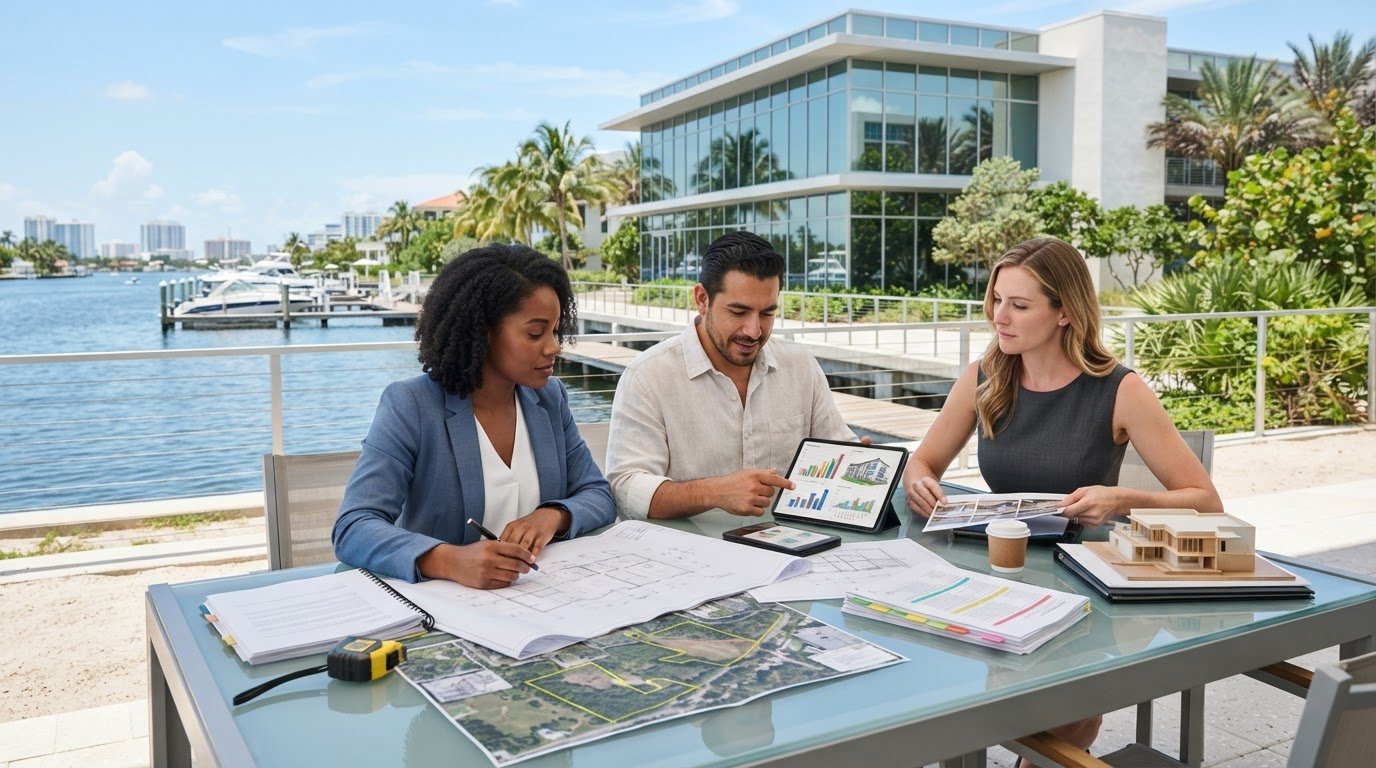
What if the biggest risk in a Florida commercial property purchase isn’t visible during a tour? A commercial real estate due diligence checklist Florida buyers can use should do more than collect documents. It should test whether the property, its finances, and its location support your plans. Flood exposure, insurance, zoning, environmental conditions, leases, and operating expenses can all affect a purchase, so it helps to know what to check and who can verify it.
The goal isn’t to find a perfect property. It’s to uncover important risks early and decide whether the findings still fit your intended use and investment assumptions. This Florida-focused checklist helps you review the property’s condition, verify income and expenses, examine leases and records, and assess location-specific concerns before you commit.
You’ll also see when to involve qualified inspectors, legal, environmental, or insurance specialists, and how brokerage guidance can help organize transaction questions and next steps. With a methodical review, due diligence becomes less of a document hunt and more of a clear process for making an informed decision.
Key Takeaways
- Adapt a commercial real estate due diligence checklist to assess property, financial, and location risks before committing.
- Verify that zoning and the property’s documented condition align with your planned use, and direct technical questions to qualified specialists.
- Compare leases, rent rolls, operating records, and seller financials to test whether projected income and expenses are supported by evidence.
- Track contract dates, access requirements, requested records, and open questions in one diligence log, with counsel advising on deadlines and remedies.
- Use verified strengths, material risks, and unresolved questions to decide whether to proceed, seek revised terms, request more evidence, or pause.
What Florida Commercial Real Estate Due Diligence Should Establish Before You Buy
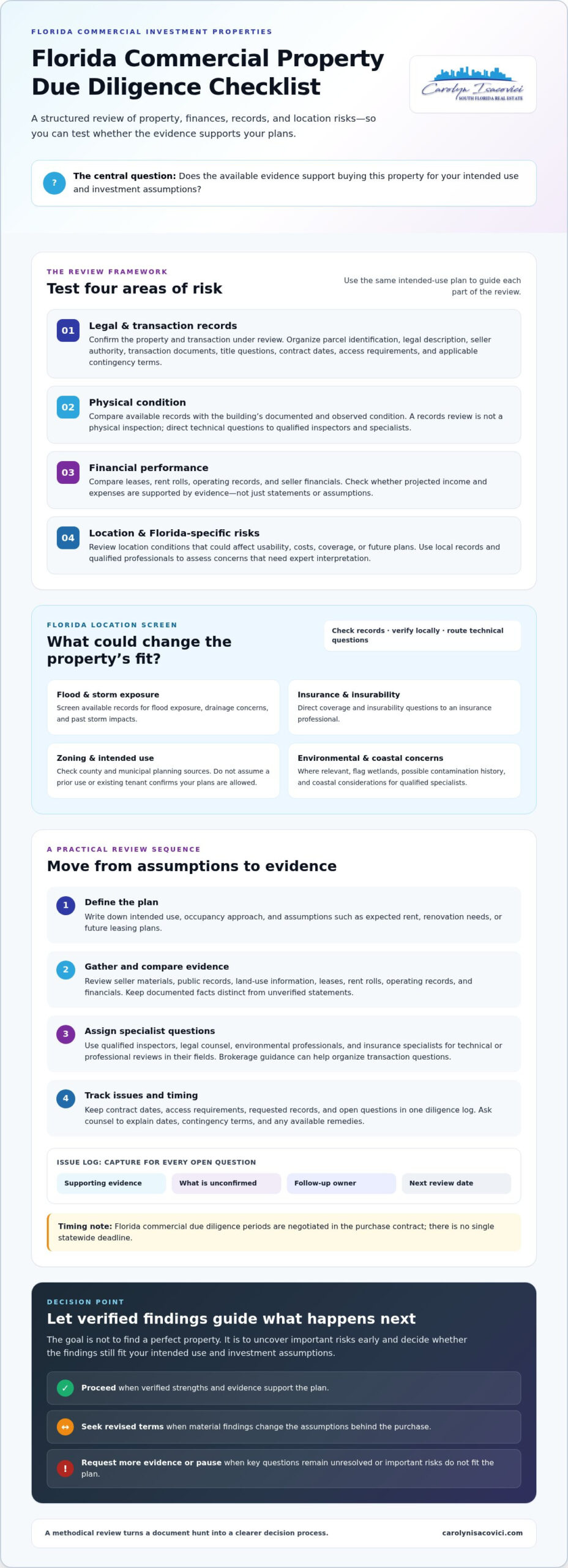
Your review should answer one central question: Does the available evidence support buying this property for your intended use, based on the assumptions behind your investment decision? A commercial real estate due diligence checklist Florida buyers can use should organize that evidence across four areas: legal and transaction records, physical condition, financial performance, and location risks.
In practical terms, commercial real estate due diligence is a structured investigation of a property and its related records to identify risks and assess whether the purchase fits the buyer’s plans. It turns seller statements and initial impressions into questions that can be checked. The broader due diligence concept provides useful background, but a real estate transaction also requires property-specific review by appropriate professionals.
A preliminary review helps identify what needs verification. It doesn’t replace an inspection, title work, environmental assessment, insurance review, or legal advice. A broker can help organize transaction questions and assess whether a property appears to fit your plans, while qualified specialists handle technical and professional reviews in their fields.
Timing matters. Florida commercial due diligence periods are negotiated in the purchase contract, not set by one statewide deadline. Before relying on a contingency or scheduling a review, ask counsel to explain the contract dates, access requirements, applicable contingency terms, and any available remedies. Record the dates and responsibilities so a missing document or delayed inspection doesn’t go unnoticed.
What should a Florida commercial property buyer verify first?
Start by confirming that everyone is evaluating the same property and transaction. Ask qualified professionals to review the parcel identification, legal description, seller’s authority, and transaction documents. Then write down the planned use, occupancy approach, and assumptions behind your decision, such as expected rent, renovation needs, or future leasing plans. These assumptions help determine which records and specialist reviews to prioritize.
Keep an issue log from the outset. For each question, note the supporting evidence, what remains unconfirmed, who is responsible for follow-up, and the next review date. This makes it easier to distinguish a verified fact from a seller’s statement or an unanswered question.
How does Florida location affect the review?
Location can change a property’s usability and risk profile. Screen available records for flood exposure, drainage concerns, and past storm impacts, then direct coverage and insurability questions to an insurance professional. Check county and municipal planning sources for current zoning and intended-use questions. Don’t assume an existing tenant or prior use confirms that your plans are allowed.
Where relevant, flag wetlands, possible contamination history, and coastal considerations for environmental or other qualified specialists. You don’t need to resolve every technical question yourself. Identify which local conditions could affect the property’s fit, costs, or future plans, then obtain expert review before deciding how to proceed.
Review Florida Property Records, Zoning, Title, and Physical Condition
Once you’ve defined the property and your intended use, check whether the records and building support that plan. A commercial real estate due diligence checklist Florida buyers can use should bring together seller materials, public records, land-use information, and independent assessments, while making clear which questions still need expert review.
Records review establishes what documents say; physical inspection assesses what a qualified professional can observe and test at the property. Neither replaces the other. A permit file may describe approved work, for example, but it doesn’t establish the current condition of the systems involved. The National Association of REALTORS® Commercial Real Estate resource offers broader commercial real estate context. Property-specific conclusions should come from the appropriate professionals.
Which Florida records and land-use details belong on the checklist?
Gather the legal description, available surveys, title materials, recorded documents, permits, plans, and maintenance records. Compare seller-provided property details with county property appraiser records. Ask appropriate professionals to investigate discrepancies rather than assuming one source resolves them. A survey and title review can help identify easements, liens, restrictions, or boundary questions. Have a Florida real estate attorney interpret their significance to the transaction.
For land use, contact the relevant county or municipal planning department to verify current zoning, permitted uses, and questions about your intended operations. Review available permit and code information with the appropriate authorities. Don’t treat current occupancy or past use as confirmation that your proposed use is allowed.
How should buyers assess buildings and environmental conditions?
Arrange independent reviews suited to the property. Qualified inspectors can evaluate the building, roof, mechanical, electrical, and plumbing systems, along with accessibility concerns, visible deferred maintenance, and areas that may need further testing. Ask what the inspection did not cover. Limited access or concealed components may leave questions that require a separate assessment.
Review available environmental records and the property’s known history. Prior uses or other documented concerns may warrant further evaluation by an environmental professional, who can advise whether additional assessment is appropriate. Keep conclusions tied to evidence. A record search alone may not answer every site-specific question.
- Track each issue: Record the document or observation, the open question, the responsible specialist, and the follow-up date.
- Separate findings from estimates: Treat preliminary repair figures as estimates to confirm, not established transaction costs.
- Connect evidence to the plan: Note whether a zoning, condition, or title issue affects intended use, operations, or investment assumptions.
Clear records and independent reviews make it easier to prioritize questions. A commercial property broker can help organize transaction questions and assess property fit, while legal, inspection, and environmental matters belong with qualified specialists. Buyers considering commercial property sales or investment property sales in Florida can also explore commercial and investment property opportunities.
Compare Florida Commercial Property Risks Against Leases and Investment Assumptions
Do the property’s reported numbers hold up when compared with source documents? A commercial real estate due diligence checklist Florida buyers use should connect each finding to the property’s asset type, tenant profile, intended use, and investment plan. A rent roll may look strong at first glance, but upcoming lease expirations or unverified expense recoveries could change the income picture. A comprehensive due diligence checklist can help identify records to request. The key is testing what those records mean for this specific purchase.
How can buyers verify leases, income, and operating expenses?
Reconcile the rent roll against executed leases, amendments, security-deposit records, and available payment histories. Note differences in rent, occupied space, concessions, renewal rights, options, and lease end dates. Have counsel review tenant obligations and lease language, including which party is responsible for expenses, repairs, or other obligations. Compare reported operating costs with available invoices and records. Unexplained variances need follow-up, not an assumption that the seller’s figures are complete.
Test the investment case against documented evidence. If the plan depends on stable occupancy, examine vacancy and payment history. If it assumes tenants will renew, review lease terms and available tenant information rather than treating renewal as certain. If future returns depend on limited capital work, compare that assumption with inspection findings and maintenance records. Separate confirmed income and expenses from projections.
How should buyers compare location and asset-specific risks?
Location risks aren’t uniform across Florida. Use FEMA flood information as an initial screen, not a complete property-level conclusion, and seek qualified interpretation of exposure, drainage, and storm-related concerns. Ask an insurance professional about availability, exclusions, and coverage terms for the specific property. Consider these issues alongside access, permitted use, tenant needs, and planned capital work. A location concern may affect buyers differently depending on how the property is used and who occupies it.
Use a comparison table to turn review findings into decisions. Assign each open question to the specialist best positioned to address it, and record a practical next step.
| Evidence | Finding | Investment impact | Specialist | Next action |
|---|---|---|---|---|
| Lease and rent roll | Rent or expiration details don’t align | Income or renewal assumptions may need revision | Real estate attorney | Reconcile documents and confirm lease terms |
| Operating records | Expense variance lacks support | Projected operating costs may be understated | Accountant or relevant professional | Request backup and update analysis |
| Flood information and insurance review | Exposure or coverage questions remain | Could affect property operations or risk assumptions | Qualified insurance professional | Obtain property-specific interpretation |
This comparison helps distinguish a manageable open question from a mismatch with your investment plan. Record the evidence, its implications, and the next action before deciding whether your assumptions still hold.
Follow a Practical Commercial Real Estate Due Diligence Checklist Florida Buyers Can Adapt
A clear process keeps contract dates, document requests, and specialist reviews moving together. Ask counsel to interpret the purchase contract’s deadlines, access requirements, contingency terms, and potential remedies. Due diligence periods are negotiated in the contract, so don’t assume a standard timeline applies. Build your schedule around the signed agreement and the time needed to obtain reliable answers.
What should the buyer request and schedule first?
Create a transaction-specific request list, then coordinate document delivery and property access through the appropriate transaction contacts. The request may include leases and amendments, rent rolls, operating expenses, plans, permits, and maintenance records. Schedule independent inspections or other specialist reviews based on the property and your intended use. For broader acquisition context, see this Florida commercial real estate investor guide.
- Set up one diligence log: Track each requested record, when it was received, who is reviewing it, and whether follow-up is needed.
- Label the evidence: Separate confirmed facts from seller statements, preliminary estimates, and questions requiring independent verification.
- Assign next steps: Give each open issue an owner, the evidence needed to resolve it, and a decision date tied to the contract schedule.
Keep the process focused on decision-making, not just collecting files. Prioritize issues by safety, legality, financial impact, fit with the intended use, and how readily they can be resolved. If records conflict or a specialist identifies a concern, request clarification, supporting documents, or additional professional review. Don’t treat an unanswered question as a confirmed fact.
How should buyers prioritize open issues before a decision?
Start with the issue that could most change your decision. An unresolved permitted-use question, for example, may affect whether the property supports your plan at all. A repair estimate may need confirmation before you can assess its effect on your investment assumptions. Compare investment metrics with due diligence findings, and note which figures are supported by records and which remain projections.
A commercial broker can help organize transaction questions and assess whether a property fits your goals. For guidance on commercial property sales or investment property sales in Florida, discuss commercial property fit with a Florida broker. Legal, technical, and insurance questions should go to the appropriate qualified specialists.
Decide Whether to Proceed, Renegotiate, or Pause on a Florida Commercial Property
Due diligence should leave you with a decision, not just a folder of documents. Before moving forward, summarize what’s verified, what could materially affect the purchase, and what still needs an answer. Compare those findings with your planned use, tenant expectations, and investment assumptions. A commercial real estate due diligence checklist Florida buyers can use helps make that comparison clear, but it can’t decide what level of risk is right for you.
There isn’t one right response to every finding. You might proceed if the evidence supports your plan, seek revised terms if a verified issue changes the property’s fit or economics, request more documentation when the record is incomplete, or pause while a material concern receives specialist review. Discuss contract options, deadlines, and formal notice requirements with counsel before acting. A broker can help frame property-fit and transaction questions, but legal, inspection, environmental, lending, and insurance decisions belong with qualified providers.
When should a buyer seek clarification or reconsider the transaction?
Revisit your assumptions if verified records materially conflict with seller information or your underwriting. Documented expenses or lease terms that differ from the figures used in your analysis, for example, may change the investment case. Ask the relevant professional what evidence would resolve the discrepancy, then have counsel explain available contract options before a deadline or formal notice. If significant title, property-condition, environmental, or insurance questions remain open, consider pausing for qualified input rather than treating uncertainty as confirmation.
A useful decision summary can be brief, as long as it separates:
- Verified strengths: Evidence that supports the property’s intended use and investment plan.
- Material risks: Confirmed issues that could affect operations, use, or financial assumptions.
- Unresolved questions: Missing or inconsistent evidence, who is reviewing it, and when an answer is needed.
- Decision implications: Whether findings support proceeding, seeking revised terms, requesting more evidence, or pausing, subject to contract advice.
How can a Florida commercial real estate broker support the next step?
Brokerage guidance can help you assess whether an asset aligns with your location, use, tenant, and investment criteria, and keep transaction communication organized. It doesn’t replace independent professional findings. A broker can help frame questions and assess property fit; qualified specialists should address their respective legal, technical, financial, and insurance matters.
For a discussion about your goals and potential property fit, discuss Florida commercial property opportunities. Whether the next step is moving ahead or gathering more evidence, a clear plan helps you act on what’s known and identify what still needs review.
Make Your Next Property Decision With Clarity
Strong due diligence is more than checking off documents. It connects verified property, lease, financial, and location findings to your intended use and investment plan, so you can decide what needs resolution before moving forward. A commercial real estate due diligence checklist Florida buyers can use brings structure to that review, while qualified legal, inspection, environmental, lending, and insurance professionals address questions within their fields.
Not every open issue means a purchase is the wrong fit. Some call for more evidence or specialist input; others may lead you to revisit assumptions, discuss revised terms with the appropriate parties, or pause. The value is making that choice with a clear view of what’s confirmed and what remains uncertain.
Florida Commercial Investment Properties provides commercial and investment property brokerage, with stated markets including Miami, Miami Beach, Hollywood, Fort Lauderdale, Palm Beach, Palm Beach Gardens, Stuart, Jupiter, Palm City, Port St. Lucie, Fort Pierce, Vero Beach, and Melbourne. To discuss your goals and possible next steps, contact Florida Commercial Investment Properties about your Florida commercial property goals.
Frequently Asked Questions
What is included in commercial real estate due diligence in Florida?
A commercial real estate due diligence checklist Florida buyers can use commonly covers title and survey materials, zoning and intended use, leases and financial records, building condition, environmental history, permits, and location-specific concerns such as flooding or drainage. The right scope depends on the property, purchase contract, and your plans. A Florida real estate attorney and qualified technical professionals can help determine which reviews apply to the specific asset.
How long does commercial real estate due diligence take in Florida?
There’s no single timeline for every Florida transaction. The review period depends on the purchase contract, property complexity, document availability, inspection needs, specialist schedules, and unresolved findings. Confirm dates, notice requirements, and other contract questions with your attorney. Start requesting records and arranging reviews promptly, then use a tracker to monitor missing information, follow-ups, and decisions that need attention before applicable contract dates.
Can a buyer rely on the seller’s inspection or property records?
Seller records and inspection materials can help identify questions, but they shouldn’t replace your own review. Documents may be incomplete, outdated, or prepared for a different purpose than your purchase decision. Ask qualified professionals to assess relevant materials and the property independently. Your attorney can explain how seller disclosures and contract terms apply to your transaction, including what steps may be appropriate if records conflict or important information is missing.
What happens if due diligence uncovers a serious property issue?
Document the finding and ask the relevant qualified specialist to explain its scope, supporting evidence, and potential implications. Then consult your attorney about the contract, applicable notice requirements, and available options before acting. Depending on the findings and agreement, you might request more information, discuss revised terms, proceed, or pause. The appropriate response depends on the specific transaction, so don’t assume a particular outcome or remedy is guaranteed.
Should Florida commercial property buyers check flood risk and insurance before closing?
Yes. Treat flood exposure and insurance as property-specific review areas. FEMA flood information can serve as an initial screen, but it doesn’t replace a site-specific assessment or insurance advice. Ask qualified professionals to review drainage and building exposure, and ask an insurance professional about coverage availability, terms, and exclusions for the particular property. Consider the findings alongside your intended use, since location conditions may affect different properties in different ways.
Who should be on a Florida commercial real estate due diligence team?
An appropriate team may include a Florida real estate attorney and qualified property inspectors, plus environmental, survey, insurance, accounting, lending, or engineering professionals as needed. Each provides independent guidance within their specialty. A commercial broker can support transaction communication and discuss property fit, not replace specialist review. Florida Commercial Investment Properties’ stated markets include Miami, Miami Beach, Hollywood, Fort Lauderdale, Palm Beach, Palm Beach Gardens, Stuart, Jupiter, Palm City, Port St. Lucie, Fort Pierce, Vero Beach, and Melbourne.
Is zoning approval guaranteed because a commercial property is already operating?
No. A property’s current operation doesn’t by itself confirm that your planned use is permitted or that every approval remains valid. Verify zoning, permits, occupancy details, and use-specific questions for the particular parcel with local authorities and qualified counsel. This check matters whether you plan to continue the existing use or make a change. Don’t rely on a tenant’s presence or a seller’s description as proof that your intended use is allowed.
Leave a Reply