
What if a Miami commercial property’s most impressive number is also the one most likely to mislead you? A high asking price, projected rent, or nearby sale tells only part of the story. Assessing commercial property value Miami investors can rely on means weighing income against genuinely comparable sales, the building’s condition, and risks tied to its specific location.
Choosing the right valuation method depends on the property’s use, submarket, zoning, and available records. Flood exposure and other location-specific factors can also affect the analysis, so a property that looks similar on paper may not be a useful comparison.
This guide explains how the income, market, and cost approaches work, when each can help, and how to compare their results without relying too heavily on one estimate. You’ll also learn which Miami-specific factors may shape value, what records to gather before a sale or purchase, and how market-aware brokerage guidance can support a more informed decision.
Key Takeaways
- Assessing commercial property value Miami works best when you define the valuation’s purpose, the property being assessed, and the effective date before choosing an approach.
- Compare income, sales, and cost methods to see which evidence best fits the asset, then use other relevant methods to test the estimate.
- Look beyond broad neighborhood trends: property use, access, condition, and location-specific flood exposure can all shape value.
- Gather leases, income and expense records, property details, and relevant sale evidence to make your estimate more useful.
- Recognize when missing records, limited comparable sales, or changing assumptions call for a more formal valuation or market-aware brokerage guidance.
Assessing Commercial Property Value in Miami: What the Estimate Really Means
Before settling on a number, decide what question the estimate needs to answer. A commercial property’s market value is an evidence-based estimate of what it could sell for under relevant market conditions, for a specific purpose and as of a defined date. The analysis may include buyer demand, property condition, income potential, and comparable transactions. Change the assumptions or effective date, and the conclusion may change too.
A listing price cannot establish a Miami property’s market value; it shows what the seller is asking, not what a buyer is likely to pay. That distinction matters when assessing a purchase, considering a sale, evaluating an investment, or preparing for refinancing. Each purpose may call for different evidence and a different level of detail.
What does a commercial property valuation actually measure?
A valuation brings relevant evidence together to estimate value. It is not simply a price copied from an advertisement or property record. A seller’s asking price is a marketing decision. An assessed value is determined for property-tax purposes and may not reflect current transaction conditions. Replacement cost estimates what it might take to replace a building, but it does not automatically account for income or what buyers would pay for that location. A lender’s underwriting figure is prepared for a financing decision and may reflect the lender’s criteria rather than a general estimate of market value.
An owner or investor can develop an informal estimate to guide early decisions by reviewing available income, expense, sale, and condition information. A formal appraisal, by contrast, is prepared for a defined purpose and relies on stated assumptions and supporting analysis. For an introduction to appraisal concepts and valuation methods, see this overview of real estate appraisal.
Why Miami location and intended use matter
“Miami” is not one uniform commercial market. A property’s submarket, street access, nearby businesses, customer or tenant demand, and surrounding uses all affect which properties make meaningful comparisons. For example, a retail site near compatible businesses may attract a different buyer pool from an industrial building, even if they are close geographically.
Permitted use matters, too. A buyer’s estimate may depend on whether the property’s existing or potential use fits their plans. Don’t assume nearby buildings share the same use options. For wider context on local conditions, explore the Miami real estate market trends guide. When assessing commercial property value Miami, keep the valuation’s purpose, date, and property-specific evidence clear. This gives you a more useful starting point for a purchase, sale, or investment decision.
Three Ways to Assess Commercial Property Value in Miami
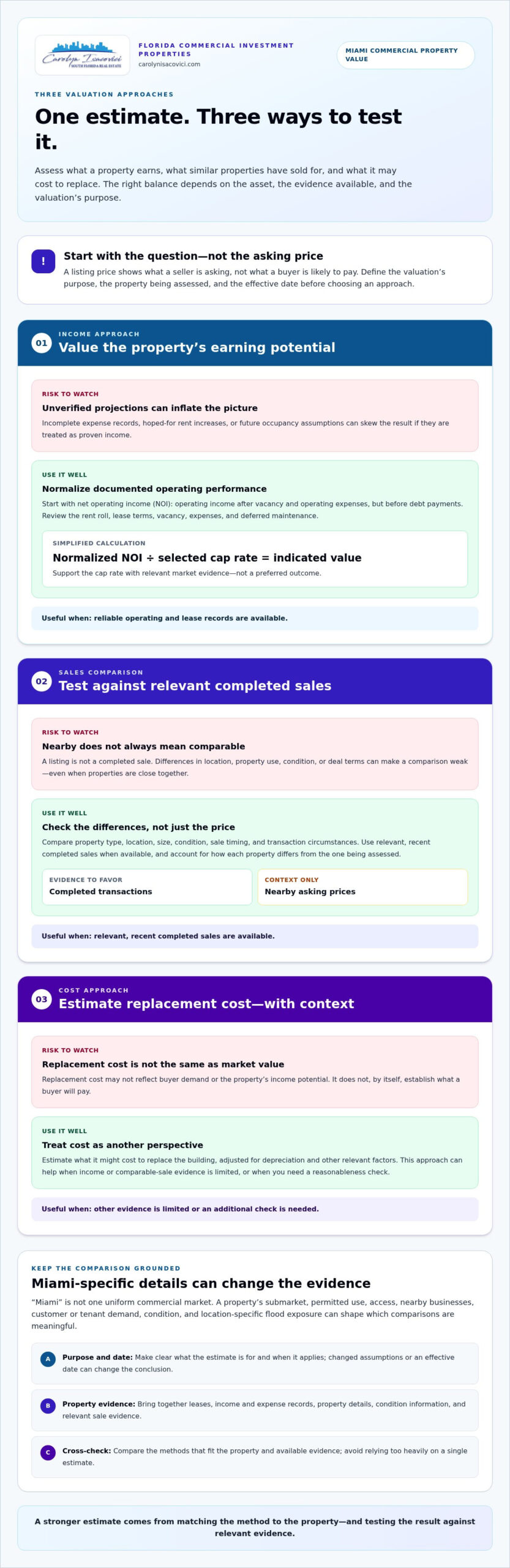
No single method fits every property. A practical framework for assessing commercial property value Miami investors can use is to compare what the asset earns, what similar properties have sold for, and what it might cost to replace. A reliable estimate tests relevant methods against the same property evidence. The right balance depends on property type, income history, available comparable sales, and the reason for the valuation.
| Approach | How it works | Useful when | Limitation |
|---|---|---|---|
| Income | Converts expected property income into an indication of value. | The property has reliable operating and lease records. | Unverified projections or incomplete expense records can skew the result. |
| Sales comparison | Compares the property with similar assets that have sold. | Relevant, recent completed sales are available. | Differences in location, condition, use, or deal terms may make comparisons weak. |
| Cost | Estimates replacement cost, adjusted for depreciation and other relevant factors. | Income or comparable-sale evidence is limited, or a reasonableness check is needed. | Replacement cost may not reflect buyer demand or the property’s income potential. |
When the income approach is useful
For an income-producing asset, start with net operating income (NOI): the property’s operating income after accounting for vacancy and operating expenses, but before debt payments. A capitalization rate, or cap rate, expresses the relationship between NOI and value. In a simplified calculation, divide normalized NOI by the selected cap rate to indicate value. Support the rate with relevant market evidence rather than choosing one simply to produce a preferred result.
Review the rent roll, lease terms, vacancy, operating expenses, and deferred maintenance. Separate documented historical performance from hoped-for rent increases or future occupancy. Projections may inform an estimate, but they should not be presented as proven income.
How comparable sales and replacement cost add context
Useful sales comparisons account for property type, location, size, condition, sale timing, and transaction circumstances. A nearby listing can offer context, but its asking price is not a completed sale price. Consider differences between the property and each comparable rather than overlooking them.
The cost approach provides another perspective, particularly when income records or comparable sales are scarce. It estimates replacement cost and considers depreciation, but it does not independently establish what a buyer will pay. Keep it distinct from assessed value: Florida’s property assessment guidelines provide state-specific context for property assessment, while a market valuation answers a different question. For a purchase or sale, Miami commercial property guidance can help put the evidence into transaction context.
Miami-Specific Factors That Can Shift a Commercial Property Estimate
Local context matters, but a neighborhood label is not a valuation. A site’s access, visibility, nearby businesses, customer or tenant demand, and connection to major routes can influence its appeal. These factors vary from property to property, even within the same submarket. For more reliable assessing commercial property value Miami, compare assets with similar uses and access instead of assuming a trend applies equally across an entire area.
Flood exposure, building condition, and operating risk
Flood exposure is a due-diligence question, not an automatic value deduction. Review current FEMA flood maps as one reference, then consider property-specific information such as elevation, drainage, and any available flood history or mitigation records. A map alone does not establish every site condition or replace further property-level investigation.
Building condition also shapes buyer expectations and potential operating costs. Review available records for the roof, HVAC, and other major systems, along with maintenance history and known deferred work. These details help distinguish a documented repair need from a general assumption that an older building must be worth less.
Insurance can affect projected expenses and ownership risk. Use current, property-specific policy and premium information, and consider coverage terms and availability as documented. Generic cost assumptions may not reflect the building’s actual coverage or renewal situation.
Zoning, use, and Miami submarket context
Confirm the property’s current use and relevant zoning information through records from the appropriate Miami-Dade County or municipal authority. Jurisdiction matters, and nearby properties may not share the same permitted uses. Treat a potential change in use as an assumption to verify, not as guaranteed value.
For sales comparisons, prioritize properties that align in use category, location, access, and physical characteristics. A retail property and an industrial building should not be treated as comparable just because they sit in the same broad area. Activity in one Miami submarket also does not automatically establish demand or value elsewhere in the county.
- Match comparison properties to the subject’s use and relevant submarket.
- Review current flood mapping alongside available property-specific information.
- Ground condition and insurance assumptions in records for the asset.
- Use local government records to understand current zoning and use context.
These checks make an estimate more specific and its assumptions easier to explain. For a wider view of acquisition considerations beyond a single Miami asset, see the Florida commercial real estate investor guide.
How to Assess a Miami Commercial Property Step by Step
A dependable estimate starts with organized evidence, not a spreadsheet full of guesses. Use this workflow to keep assumptions visible and make it easier to explain your conclusion when assessing commercial property value Miami.
- Define the purpose and effective date. State whether you’re assessing a purchase, possible sale, refinancing, or investment decision. Record the date the estimate applies to, since market conditions and property circumstances can change.
- Confirm the property facts. Assemble the address, property type, building and land details, current use, and relevant zoning research. Note the information source and flag details that still need verification.
- Organize income and expense records. Gather the rent roll, lease agreements, and operating statements. Review tax records and document which income and expenses are actual, estimated, or unusual. This creates a clearer basis for evaluating ongoing performance.
- Review comparable sales and physical condition. Record completed sales that may be relevant, then note differences in location, use, size, condition, and timing. Add available maintenance records, known repair needs, insurance information, and current flood-map references to the property file.
- Develop and compare value indications. Apply the methods that fit the property and available evidence. If you use an income approach, state the income and capitalization assumptions clearly. Compare that result with relevant completed sales and explain why the indications may differ.
- Test assumptions and document open questions. Consider how reasonable changes in rent, vacancy, or expenses affect the estimate. Keep projections separate from verified history, and record unresolved information rather than treating it as fact.
Gather the records that support an estimate
Build one organized file so key evidence is easy to review. Include the rent roll, leases, operating statements, tax records, property details, and available insurance and maintenance records. Add comparable-sale information with notes explaining why each sale may or may not be useful. Keep zoning research and flood-map references with the property materials, and identify their sources and dates.
Reconcile evidence and test assumptions
Different methods may indicate different values. Don’t average them automatically. Give more weight to the evidence that best fits the asset, and explain material gaps, such as limited comparable sales or uncertain projected income. Sensitivity checks can show whether a reasonable change in vacancy or expenses shifts the estimate substantially, without presenting a scenario as a forecast.
For a wider framework for evaluating investment opportunities, read the Florida investment property evaluation guide. If you’re preparing for a Miami commercial property purchase or sale, discuss your commercial property transaction with a market-aware brokerage professional.
Turn a Miami Commercial Property Estimate into a Clear Next Step
An estimate is most useful when it helps you decide what to do next. An owner’s or investor’s initial analysis can support early planning, such as screening a purchase, reviewing a potential sale, or identifying missing information. Treat the result as an evidence-based range, not a promised sale price. Actual transaction outcomes depend on buyer interest, negotiations, property-specific findings, and market conditions at the time.
The process of assessing commercial property value Miami can provide a useful planning framework, but the strength of its conclusion depends on the records and assumptions behind it. Incomplete leases or expense statements can weaken an income estimate. A small pool of relevant completed sales makes comparisons less conclusive. Changes in rents, vacancy, expenses, or the property’s condition can also shift the result. Keep assumptions visible and revisit them when the evidence changes.
When to seek a deeper valuation review
Consider a more detailed review when leases are complex, the property has an unusual use, comparable sales are limited, or valuation methods point to substantially different conclusions. A formal appraisal may be appropriate when a decision requires an independent valuation prepared for a defined purpose. Brokerage guidance can help buyers and sellers interpret market evidence and connect it to transaction planning, while legal, lending, and engineering questions involve different professional work. An informal estimate or brokerage discussion does not guarantee a particular price or transaction outcome.
Connect property value to a buying or selling strategy
For sellers, documented value drivers, such as reliable income records, relevant sales evidence, and a clear account of the property’s condition, can support a grounded marketing and transaction discussion. If the evidence is incomplete, identifying the gaps early can help set realistic expectations and clarify next steps.
For buyers, compare the asking price with the property’s income evidence, relevant completed sales, physical condition, and identified risks. Consider whether the assumptions behind the proposed value fit the asset and your intended use. A range can help frame negotiation and investment analysis, but it does not guarantee what a seller will accept or what the property will ultimately sell for.
A well-supported estimate turns uncertainty into a clearer set of questions and choices. If you’re considering a purchase or sale, discuss Miami commercial property opportunities and how the available evidence can inform your next move.
Use Better Evidence to Plan Your Next Move
A sound property estimate is not a single number pulled from a listing. It is a reasoned range supported by income, relevant completed sales, property condition, and Miami-specific context. Assessing commercial property value Miami becomes more useful when you choose methods that fit the asset, state your assumptions, and distinguish verified performance from projections.
Keep the estimate tied to its purpose and effective date, and treat missing records or limited comparable sales as important limitations. For buyers, the evidence can sharpen the questions behind an asking price. For sellers, it can help frame value drivers and support a grounded marketing discussion. Neither an initial estimate nor a range guarantees a final sale price, but both can guide a more informed decision.
Florida Commercial Investment Properties supports commercial and investment property sales across Florida, including Miami, Miami Beach, Hollywood, Fort Lauderdale, Palm Beach, Palm Beach Gardens, Stuart, Jupiter, Palm City, Port St. Lucie, Fort Pierce, Vero Beach, and Melbourne. Discuss your commercial property goals and take the next step with clearer evidence.
Frequently Asked Questions
How do you assess the value of a commercial property in Miami?
Assess value by combining the property’s income potential, relevant completed sales, physical condition, and location-specific factors. First define the purpose and effective date, then review leases, operating expenses, comparable transactions, and available building records. Choose valuation methods that fit the property and compare their indications rather than relying on one figure. A sound approach to assessing commercial property value Miami investors can use also makes assumptions and unresolved questions clear.
What are the three main methods for valuing commercial real estate?
The three main methods are the income, sales-comparison, and cost approaches. The income approach relates a property’s net operating income to an appropriate capitalization rate. The sales-comparison approach considers prices paid for similar properties, accounting for meaningful differences. The cost approach estimates replacement cost while accounting for depreciation and other relevant factors. Which method deserves the most weight depends on the property, available evidence, and valuation purpose.
Is cap rate enough to determine a Miami commercial property’s value?
No. A capitalization rate is one input, not a complete valuation. The income approach also depends on reliable net operating income, including supportable rent, vacancy, and expense information. If income is overstated or operating costs are incomplete, the resulting value indication may be misleading. Compare the income-based result with relevant completed sales and consider property condition, use, and location. State the assumptions behind the cap rate instead of treating it as a universal benchmark.
How do flood risk and insurance affect commercial property value in Miami?
Flood exposure and insurance can affect a property’s risk profile and expected operating costs, but their effect depends on the specific asset and available evidence. Review current FEMA flood maps as one reference, then examine property-specific elevation, drainage, flood history, and mitigation information where available. Check current insurance documents for premiums, coverage terms, and availability. These records support an estimate, but a map or general insurance assumption alone does not determine value.
Can asking price be used as a comparable for commercial property valuation?
An asking price can provide context, but it is not equivalent to a completed sale and should not be treated as conclusive evidence of market value. Sellers set listing prices as part of a marketing decision; the final transaction may differ. Give greater weight to completed sales with similar property type, location, size, condition, timing, and transaction circumstances. If you use active listings for context, label them clearly and avoid presenting their asking prices as sale results.
What information do I need to estimate a commercial property’s value?
Start with the property address, use, size, and other available property details. Gather the rent roll, lease agreements, operating statements, and records of vacancy and expenses. Add tax and insurance information, maintenance history, known repair needs, and relevant zoning or flood-map research. For a sales comparison, collect completed transactions and note how each differs in location, use, condition, and timing. Separate verified records from projections or assumptions so the estimate is easier to assess.
When should I get a formal appraisal for a commercial property?
A formal appraisal may be appropriate when a decision requires an independent valuation for a defined purpose, or when the property has complex leases, an unusual use, limited comparable sales, or conflicting value indications. An owner’s or investor’s estimate can help with early planning, but it is not a substitute when a formal appraisal is specifically required. Keep the valuation’s purpose and effective date clear, and don’t treat any estimate as a guaranteed sale price.
Leave a Reply