
What if the best Florida acquisition isn’t the most obvious property or market? For family offices, a promising opportunity needs to fit more than a location: it should align with the family’s priorities, time horizon, and comfort with risk. Finding Florida real estate for family offices starts with a clear investment brief, not a broad search.
Florida’s mix of commercial, residential, investment, and new-construction properties can make initial screening feel complex. Family members may bring different goals to a decision, while property-level details such as insurance, zoning, taxes, and flood exposure can affect how an opportunity fits. A consistent process helps bring those considerations into focus.
This guide explains how to identify property categories and Florida markets to evaluate, align a search with ownership objectives, and move from initial screening toward a transaction. It compares markets such as Miami, Fort Lauderdale, Palm Beach, and Stuart, and shows how local brokerage guidance can organize a search and support the sales process. The goal is a considered next step grounded in fit, governance, and execution.
Key Takeaways
- Start with the family’s decision-makers, investment objectives, hold horizon, and intended role for the property to shape a focused search.
- Compare property types and Florida markets against the family’s priorities instead of relying on broad rankings.
- Use an initial screening checklist to narrow options, then review property-specific considerations such as insurance, taxes, zoning, and flood exposure.
- Clarify decision criteria and approvals before evaluating individual properties so differing family priorities can be discussed against a shared framework.
- Move from acquisition brief to shortlist, comparison, property review, and transaction with a clear brokerage process.
Why Florida Real Estate Fits Some Family-Office Strategies
A deliberate, locally informed search makes Florida’s range of property opportunities easier to assess. Family-office real estate investing means acquiring property in line with a family’s capital priorities, not choosing an asset simply because it is available or attracting attention. Start by asking: “What role should this property play for the family?”
Those priorities vary. A family may seek income, long-term ownership, diversification across assets, or a property with a strategic use for family members or business interests. Each objective calls for different search criteria. A Florida property may suit one office’s plans and be a poor fit for another’s, even when both are considering the same city.
Investment objectives should guide property selection. A property’s value to a family depends on how well it serves the family’s priorities over time.
What a family office may seek from Florida property
Investment horizon, liquidity preferences, and stewardship priorities help turn broad goals into practical criteria. A long holding horizon may make ongoing ownership and oversight important factors to evaluate. A family that places more weight on liquidity may assess future flexibility differently. The family’s intended involvement in a property can also shape which opportunities merit closer review.
Property categories are starting points, not automatic answers. Commercial property may align with interest in business-use assets, while residential real estate may serve residential or investment objectives. Evaluate investment properties according to their intended role in the portfolio. New-construction homes may suit a search focused on newly built residential opportunities. In every case, the individual property still needs to meet the family’s criteria.
There’s no universal acquisition model. One family office may prioritize a single property with a clearly defined purpose; another may compare several property types before deciding where capital best fits. The Hoffmann Family of Companies offers a public example of a Florida-based family office with real estate holdings and investments in the state. It illustrates how property can form part of a family office’s activity, not a model every family should follow.
Why local context matters across Florida
Florida isn’t one uniform market. South Florida and the Treasure Coast are distinct search areas, and locations within each region call for their own comparisons. Miami, Fort Lauderdale, and Palm Beach offer separate geographic contexts; Stuart and Vero Beach are farther along the Treasure Coast. These locations help define the search, but they don’t replace evaluating a specific property and its surroundings.
For Florida real estate for family offices, local context connects the family’s brief to relevant commercial, residential, investment, or new-construction opportunities. Review current conditions and transaction details for each property, including applicable insurance, tax, zoning, and flood-related considerations. Local brokerage guidance can help organize property comparisons and the sales process around what the family values. A clear brief grounded in family priorities and local information is a practical place to begin.
How Family Offices Can Structure a Florida Property Search
Start with the people and priorities behind the purchase: who evaluates opportunities, who approves them, what objectives the property should serve, how long the family expects to hold it, and what role it should play. Putting these decisions on paper turns a broad interest in Florida property into defined search criteria.
Build an acquisition brief before reviewing listings
Separate essential requirements from preferences. Essentials might include a property category or geographic area; preferences are features the family would welcome but doesn’t require. Record who reviews opportunities, who makes the final decision, and how the rationale and approval will be documented. A shared brief keeps family members focused on common criteria while leaving room to discuss different views.
Set criteria for each property type. A commercial property search may focus on intended business use and property condition. For residential property, the family may weigh location, intended use, and ownership considerations. For new construction, pay attention to the proposed home and its stage of development. These are starting points, not substitutes for property-specific review. For wider sale-market context, the Florida Commercial Real Estate: 2026 Investor’s Guide can complement the family office’s acquisition brief.
Move from a shortlist to informed comparison
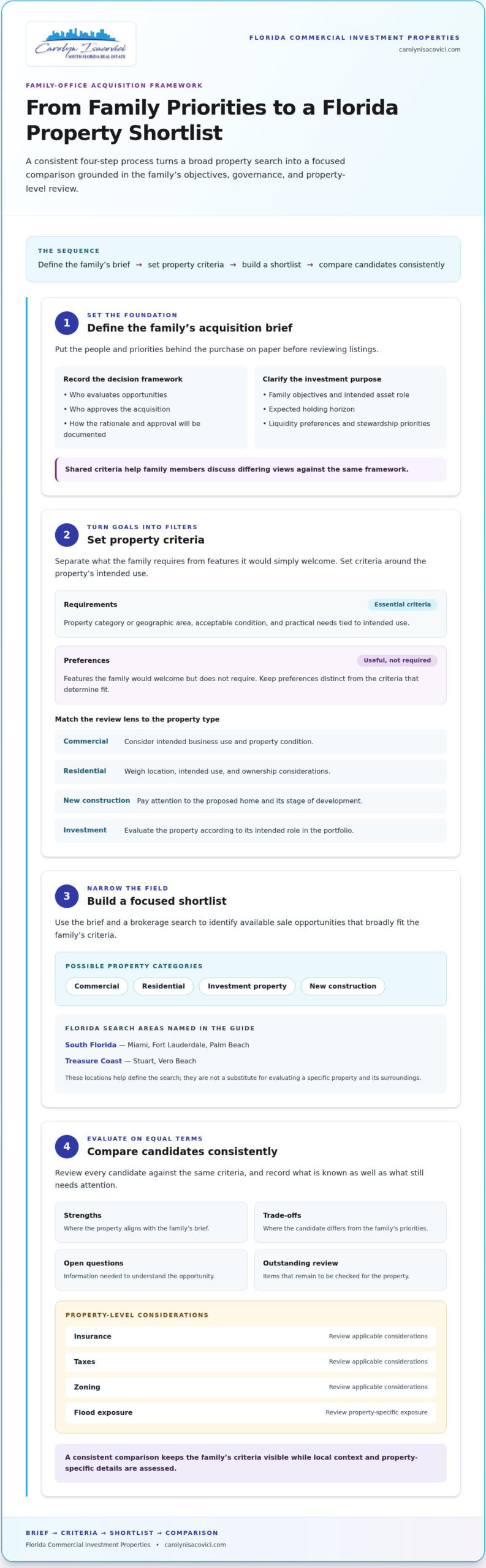
Once the brief is clear, use a consistent framework to narrow and compare available sale opportunities:
- Step 1: Define the brief. Document decision-makers, objectives, hold horizon, intended asset role, essential criteria, and preferences.
- Step 2: Set property criteria. Identify relevant categories, target locations, acceptable condition, and practical needs tied to the intended use.
- Step 3: Build a shortlist. Use a brokerage search to identify commercial, residential, investment, or new-construction opportunities that broadly fit the brief.
- Step 4: Compare consistently. Review each candidate against the same criteria. Record strengths, trade-offs, unanswered questions, and outstanding review items.
- Step 5: Advance deliberately. Decide which properties merit deeper consideration, then progress through transaction steps with responsibilities and approvals clear.
Consistency matters. A candidate that stands out for one feature may be less aligned overall than an option that better fits the family’s intended use, location priorities, and ownership horizon. A shared comparison record helps decision-makers see where preferences differ and distinguish a mismatch from an open question that needs further review.
Keep property-specific questions attached to each candidate. Track issues related to condition, insurance, taxes, zoning, flood exposure, and transaction details, and note what remains unresolved. Brokerage support can help organize the property search, compare sale opportunities, and facilitate the transaction process. For a locally organized search, explore Florida property brokerage guidance.
Comparing Florida Markets for Family-Office Property Acquisitions
Which Florida locations belong on a family office’s shortlist? The answer depends on the property, its intended use, and the family’s priorities, not a broad claim that one market is best. Compare search areas using consistent questions: What kind of asset is relevant? How will it be used? Which local conditions could affect ownership or oversight?
Assess a Florida location against the specific asset and the family’s objectives, rather than treating it as a standalone investment thesis. The prompts below help compare search areas without assuming current demand, returns, or property availability.
South Florida locations: Miami through Palm Beach
Miami, Miami Beach, Fort Lauderdale, Hollywood, and Palm Beach are separate search areas, even when a family considers several as part of one regional search. Compare each location against the proposed property type and intended use. For a commercial property, clarify its planned business use and relevant operating needs. For residential or new-construction opportunities, establish how the property would serve the family’s aims. A local comparison keeps broad geographic interest tied to the asset.
| Search area | Questions to guide comparison |
|---|---|
| Miami | Which property category fits the brief, and what local operating context matters for its intended use? |
| Miami Beach | How does the specific property’s location and condition align with the family’s use and ownership plans? |
| Fort Lauderdale | What commercial, residential, or investment opportunities match the defined criteria, and what would oversight involve? |
| Hollywood | Does the candidate meet the same location, condition, and intended-use requirements applied elsewhere? |
| Palm Beach | Is the search focused on commercial, residential, or new-construction property, and what asset-specific review is needed? |
Treasure Coast and nearby markets
Extend the comparison through Palm Beach Gardens, Jupiter, Stuart, Palm City, Port Saint Lucie, Fort Pierce, Vero Beach, and Melbourne. These locations define different geographic search areas and shouldn’t be collapsed into a single market label. Consider how the family’s preferred search radius affects site visits, local coordination, and practical oversight. A wider search may surface more options, but clear location criteria help keep candidates comparable.
| Search area | Questions to guide comparison |
|---|---|
| Palm Beach Gardens and Jupiter | Which specific locations and property types align with the brief, and how would the asset be used? |
| Stuart and Palm City | How does the property fit the family’s intended ownership role and practical oversight needs? |
| Port St. Lucie and Fort Pierce | What criteria keep candidates consistent across this part of the search area? |
| Vero Beach | Does the individual property meet the same use, condition, and location requirements as other shortlisted options? |
Across Florida real estate for family offices, geography is a screening tool, not a substitute for property-level review. For each candidate, review current flood exposure, insurance, taxes, zoning, condition, and transaction details. These factors can differ between properties, even within the same city. Comparing locations with shared questions helps a family office narrow its search, then focus closer review on properties that fit.
A Florida Family-Office Checklist for Evaluating Property
A consistent review helps a family office distinguish a promising listing from an acquisition that fits its priorities. For Florida real estate for family offices, work through the checklist in stages: screen for strategic fit, review the specific asset and its records, then bring findings to the family’s approval process. This prevents early interest from being mistaken for a completed assessment.
Screen the opportunity against family-office priorities
Begin with the acquisition brief. Does the property type, location, intended use, and expected ownership period match what the family agreed to pursue? If not, identify the gap before investing time in deeper review. For a property that passes this first screen, record the assumptions behind the assessment and distinguish verified information from estimates or open questions.
- Strategic fit: Does the asset serve the intended role, and is its location within the family’s defined search area?
- Use and occupancy: What is the property’s current occupancy, and does it align with the proposed use?
- Condition and records: What is known about the property’s condition, title information, and available documentation?
- Operating assumptions: Which expectations depend on current property records, market information, or further review?
Keep unknowns visible. A projection is an assumption to examine, not an established outcome. For a deeper look at financial measures, How to Evaluate Investment Property in Florida: A Strategic 2026 Guide can complement this property-focused checklist.
Review asset-specific details and current conditions
For a shortlisted property, organize a separate review of its records, condition, intended use, occupancy, and operating assumptions. Flag issues that vary by parcel or location, including flood exposure, insurance terms, taxes, and zoning. Review current details against relevant property information and records; don’t apply a general impression about a city or property category to an individual asset. Note the source and date for information that may change.
Title and other property documentation also merit appropriate diligence. The checklist can identify what needs review and who will handle each question, while keeping brokerage coordination distinct from legal or lending advice. If a detail remains unresolved, record it as an open item rather than allowing it to disappear inside an optimistic summary.
Coordinate review, reporting, and approvals
Assign clear roles: one person can organize property information, another can coordinate questions, and designated decision-makers can approve whether the opportunity advances. Before each approval point, prepare a concise record of the acquisition rationale, key findings, unresolved items, and any conditions attached to the next step. A shared record supports productive discussion when family members weigh the evidence differently.
Brokerage support can help coordinate the property search, organize sale information, and facilitate transaction steps as the family’s review progresses. To discuss a Florida property search aligned with your acquisition criteria, connect with Carolyn Isacovici.
From Florida Property Search to Family-Office Acquisition
A clear acquisition path turns a family office’s priorities into practical next steps. Define the brief, identify relevant properties, compare candidates, coordinate asset-specific review, and progress through the transaction. Connect each stage to the family’s decision process so the search stays focused without treating an appealing listing as an automatic fit.
- Confirm the acquisition brief. Agree on decision-makers, property categories, target locations, intended use, ownership horizon, and essential criteria. Record who can approve moving an opportunity forward.
- Identify relevant sale opportunities. Use the brief to focus the search on commercial, residential, investment, or new-construction properties that align with the family’s priorities.
- Compare candidates. Apply the same criteria to each property. Note how its location, condition, intended use, and known information fit, along with any open questions.
- Coordinate property review. Organize asset-specific information and flag matters such as title, occupancy, insurance, taxes, zoning, flood exposure, and condition for current review.
- Advance through the transaction. Once the family decides to proceed, keep responsibilities, approvals, and outstanding items visible as the sale process moves forward.
This sequence separates exploration from commitment. A property search reveals options; comparison helps the family decide which deserve closer attention; coordinated review brings important details into the decision record. For portfolio-level context, Strategic Florida Real Estate Portfolio Building: The 2026 Investor Guide can help frame how an individual acquisition relates to broader priorities.
What to expect from brokerage support
Brokerage support connects an acquisition brief to relevant property-sale opportunities and helps organize the steps involved in pursuing them. A Florida brokerage search can cover commercial, residential, investment, and new-construction sales, with comparisons guided by the family’s agreed criteria. As a property advances, sales-process guidance and transaction coordination help keep information, questions, and next steps organized. This supports the family’s process without replacing its approvals or property-specific review.
For family offices considering Florida real estate, the practical benefit is a structured route from a broad objective to a focused shortlist and an organized transaction. Local guidance can make the search relevant to the locations and property types in the brief, while the family remains clear about its priorities and decision-making.
Choose a clear next step for the Florida search
Begin by outlining the property types and locations the family wants to consider, the intended role of an acquisition, and the priorities that should guide comparison. An introductory conversation can help shape a focused property search around those criteria. The brief doesn’t need to resolve every question before the search begins; it should provide direction and make it easier to identify what needs further review.
To explore brokerage support for a Florida investment property search, connect with Carolyn Isacovici. A thoughtful first step can bring the family’s objectives, property opportunities, and transaction path into closer alignment.
Set Your Florida Acquisition Plan in Motion
A thoughtful property search can become a durable decision-making framework. By clarifying how the family will assess opportunities and revisit its priorities, the office can approach future acquisitions consistently, even as individual preferences evolve. That’s a useful foundation for making Florida real estate for family offices a deliberate part of the family’s plans, rather than a series of disconnected property decisions.
The next step doesn’t need to be a commitment to a particular asset. Begin with the acquisition priorities the family can agree on, then use them to guide a focused conversation about potential opportunities and the path from search to transaction. Clear criteria create room to explore, compare, and move forward in a way that suits the family’s decision process.
Explore Florida property opportunities with Carolyn Isacovici and take a considered first step toward a search shaped around your objectives. Discuss commercial, residential, investment, and new-construction property sales across Miami, Miami Beach, Hollywood, Fort Lauderdale, Palm Beach, Palm Beach Gardens, Stuart, Jupiter, Palm City, Port Saint Lucie, Fort Pierce, Vero Beach, and Melbourne.
Frequently Asked Questions
What types of Florida real estate can family offices consider?
Family offices can consider commercial properties, residential homes, investment properties, and new-construction homes. The right category depends on the asset’s intended role: for example, a family might compare a commercial building for business use with residential property for family use or investment. Treat each category as a separate search track, since the information needed to compare a completed property may differ from what’s available for a new-construction opportunity.
How can a family office start a Florida real estate search?
Start by identifying the family members involved and agreeing on the first decision the search should support. Then create a brief with target property types, preferred locations, intended use, and essential conditions for advancing a candidate. It also helps to identify who can authorize property tours or offers, so research and approval remain distinct.
Which Florida markets should family offices compare for property acquisitions?
Compare locations that fit the acquisition brief, including Miami, Miami Beach, Hollywood, Fort Lauderdale, Palm Beach, Palm Beach Gardens, Jupiter, Stuart, Palm City, Port Saint Lucie, Fort Pierce, Vero Beach, and Melbourne. Rather than ranking them, use the same questions in each search area: Does the property type fit? Is the location practical for its intended use? What local details require review? This keeps geography relevant to the specific asset.
What should family offices review before buying Florida property?
Review the property’s condition, occupancy, intended use, available title and transaction documents, and assumptions behind its operating expectations. Then identify information that needs current, asset-specific verification, such as insurance terms, taxes, zoning, and flood exposure. Keep a written list of unresolved items alongside the property comparison so decision-makers can distinguish documented facts from estimates or questions still being investigated.
Can a family office buy both commercial and residential property in Florida?
Yes. A family office can consider both commercial and residential property, assessing each against its own purpose and approval criteria. For example, the family may evaluate a commercial building for one intended use and a residential home for another, without assuming the same review questions apply to both. Separate comparison records help decision-makers see how each asset fits the family’s priorities and avoid treating unlike properties as interchangeable.
How can a real estate broker support a family office buying property in Florida?
A real estate broker can help identify relevant sale opportunities, provide guidance through the sales process, and coordinate transaction steps. For a family office, that support connects the search to agreed property criteria and helps keep candidate information and next actions organized. Brokerage support applies across commercial, residential, investment, and new-construction sales; the family’s decision-makers remain responsible for evaluating each opportunity and approving next steps.
What Florida property risks should family offices investigate?
Investigate issues that may vary by property and location, including flood exposure, insurance terms, tax details, zoning, occupancy, and physical condition. Review records for the specific asset rather than relying on general impressions about a city or property type. If an important detail is unresolved, record it as an open question and include it in the family’s decision process before moving forward with the transaction.
Leave a Reply