Tag: Real Estate Investment

  • Miami Luxury Condos: 2026 High-Value Investment Guide

    Miami Luxury Condos: 2026 High-Value Investment Guide

    What if the most significant risk to your portfolio isn’t the current supply of Miami luxury condos for investment, but rather the failure to distinguish a “vanity project” from a true scarcity asset? It’s natural to feel a sense of hesitation when headlines mention a buyer’s market or shifting lending regulations. You’ve likely felt the weight of these complexities while trying to decide between the allure of pre-construction and the proven stability of resale metrics. Is the market truly oversupplied, or are we simply seeing a flight to quality that leaves average buildings behind? The answer lies in understanding the 2026 drivers of value.

    We’re here to help you navigate this evolving landscape with a steady hand. You’ll discover how to evaluate “Scarcity Assets” that leverage global brand equity and limited geographic footprints to protect your capital. This guide provides a clear framework for identifying high-value opportunities, from the rise of branded residences to the impact of new structural reserve requirements. By the end, you’ll have the confidence to choose a long-term investment vehicle that aligns with your financial goals, turning market uncertainty into a strategic advantage.

    Key Takeaways

    • Learn to identify “Scarcity Assets” by looking beyond the skyline. True value in 2026 comes from limited geographic footprints and unique architectural integrity.
    • Master the new math of Miami luxury condos for investment. You’ll understand how to calculate the “Value Per Amenity” and why brand equity commands a significant resale premium.
    • Compare the long-term liquidity of branded residences against boutique developments. Discover which asset type offers better protection during market shifts.
    • Pinpoint high-growth corridors for 2026. You’ll learn to contrast the urban energy of Brickell with the secluded “Island Luxury” of Key Biscayne to find your ideal fit.
    • Gain a strategic edge with off-market access. Understand why a specialized broker is essential for securing ultra-luxury units before they reach the public eye.

    The Evolution of High Value Real Estate: Miami Luxury in 2026

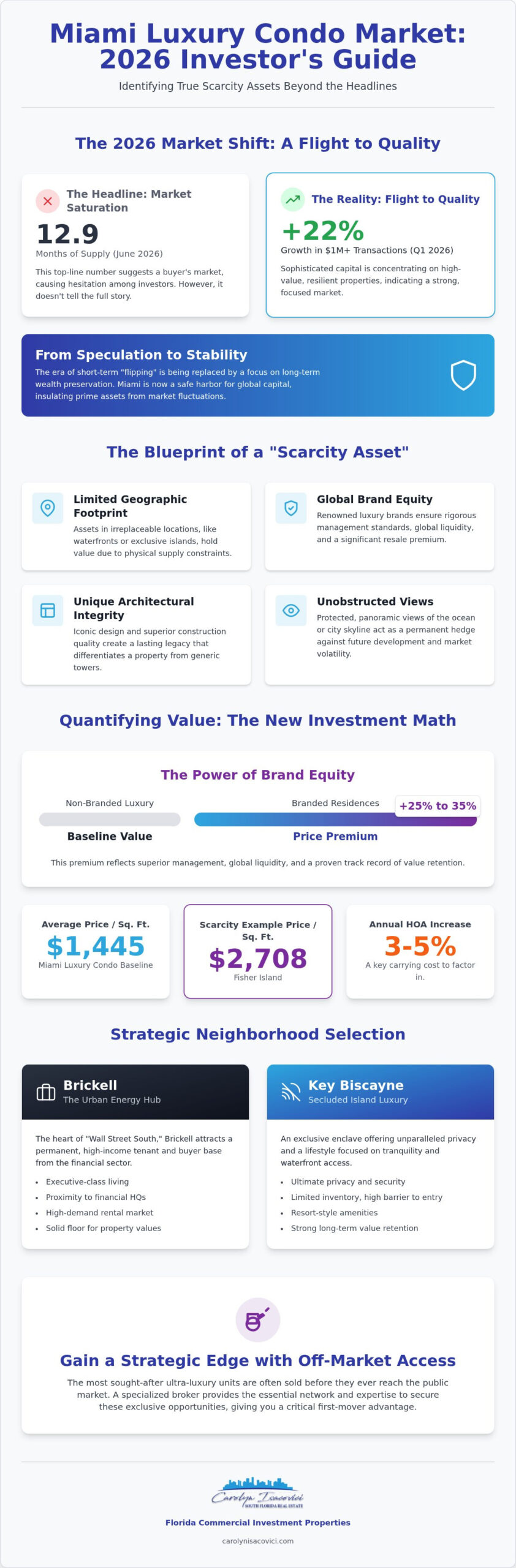
    The skyline tells one story; the ledger tells another. In the 2026 market, high-value real estate is no longer defined by gold-leafed lobbies or soaring heights alone. It’s defined by the stability of an “equity-rich” buyer base that prioritizes resilience over flash. While some observers point to the 12.9 months of supply recorded in June 2026 as a sign of saturation, a closer look at the data reveals a different reality. Transactions for properties priced at $1 million and above actually climbed by 22% in the first quarter of the year. Identifying the right Miami luxury condos for investment requires looking past these “saturation” headlines to see where the real capital is moving. This isn’t a market of excess. It’s a market of concentration.

    Global investors have pivoted. The era of speculative “flipping” has largely been replaced by a sophisticated focus on wealth preservation. Institutional players and private family offices now view Miami as a safe harbor, comparable to London or Zurich. They aren’t just buying square footage; they’re securing a piece of a limited geographic footprint that serves as a primary target for global capital. This shift ensures that high-quality assets remain insulated from the broader fluctuations often seen in more speculative tiers of the market.

    The “Wall Street South” Impact on Luxury Demand

    The migration of financial giants to South Florida has fundamentally altered the DNA of local demand. These corporate relocations aren’t temporary. They’ve established a permanent, high-income tenant and buyer base that requires “executive-class” living. Condos near financial hubs like Brickell have seen a direct correlation between local business growth and property appreciation. When a major hedge fund moves its headquarters, the demand for high-end residential units within walking distance doesn’t just rise; it solidifies. This creates a reliable floor for property values, as these units serve a specific, high-earning demographic that values proximity to their professional base.

    Wealth Preservation vs. Capital Gains

    Stability is the new luxury. Within the broader Florida housing market, investors are increasingly looking for low-volatility assets to anchor their portfolios. Miami luxury condos for investment now function as “vertical gold,” providing a tangible hedge against inflation and currency fluctuations. This shift toward long-term holding is a defining characteristic of the current cycle. Current Miami real estate market trends favor long-term holders who prioritize asset quality and location over quick exit strategies. This patient capital ensures that even during periods of higher inventory, the most prestigious addresses maintain their value and liquidity.

    Quantifying Investment Metrics for Miami Luxury Condos

    Why do two buildings on the same block often command vastly different resale values? The answer lies in the quantifiable power of brand equity. In the 2026 market, branded residences are not just lifestyle choices; they are strategic financial vehicles that typically command a 25% to 35% price premium over non-branded counterparts. This premium isn’t merely for the name on the door. It reflects the global liquidity and rigorous management standards that luxury brands bring to a property, ensuring the asset remains pristine and desirable over decades.

    While the average price per square foot for Miami luxury condos for investment stands around $1,445, savvy investors look beyond this baseline. They calculate the “Value Per Amenity” to determine how specific features, like private elevators or helipads, influence potential rental income and resale speed. It’s also vital to account for carrying costs. With median HOA fees for high-rise condos exceeding $1,900 per month, and ultra-luxury towers often reaching $10,000 or more, understanding the impact on your Net Operating Income (NOI) is essential for long-term success. These costs are currently rising by 3% to 5% annually, making efficient building management a key metric for asset selection. Investors who tracked the Florida market real estate opportunities 2025 cycle recognize that the late-2025 market rebalancing has created a more predictable environment for evaluating these carrying costs against long-term yield potential.

    The Scarcity Principle in Waterfront Real Estate

    Unobstructed views act as a permanent hedge against market volatility. In a city that continues to grow, “land-locked” neighborhoods like Fisher Island, which commands $2,708 per square foot, represent the pinnacle of physical scarcity. When new supply is physically impossible, your investment is shielded from the dilution that can affect mainland projects. You can apply the how to evaluate investment property Florida framework to these luxury assets to determine if the location’s geographic constraints justify the entry price. If you find yourself weighing these complex variables, consulting with a specialized luxury broker can provide the clarity needed to identify truly rare opportunities.

    Rental Yields in the High-End Segment

    The rise of the “Ultra-Luxury Rental” market has created a new revenue stream for owners. Transient executives and “snowbirds” are increasingly willing to pay a luxury premium for branded services and turnkey environments. While long-term leases provide steady cash flow, seasonal high-value rentals often yield higher gross returns in specific corridors like Sunny Isles Beach or Bal Harbour. Tenants in this segment aren’t just looking for a roof; they’re paying for a frictionless lifestyle. This demand for service-oriented living ensures that Miami luxury condos for investment remain competitive even as the broader rental market fluctuates.

    Branded Residences vs. Boutique Luxury: Strategic Comparisons

    Does your investment benefit more from a world-renowned name or a discreet, private address? In 2026, the choice between branded residences and boutique luxury has become a defining crossroads for those seeking Miami luxury condos for investment. Branded residences, often born from partnerships with elite hospitality or automotive giants, offer a turnkey lifestyle backed by institutional-grade management. This model provides a level of service consistency that is difficult to replicate in unbranded buildings. It isn’t just about the logo on the stationery; it’s about the global standards of excellence that protect the long-term value of the asset through every market cycle.

    Liquidity remains the primary driver for the branded segment. When you decide to exit, a branded unit has a built-in audience of global loyalists who recognize the name instantly. These buyers often search specifically for the brand, which can lead to a faster resale cycle and a more predictable price floor. Conversely, boutique luxury offers a compelling alternative for investors who prioritize exclusivity and low turnover. These smaller, intimate projects often attract long-term residents rather than transient tenants, creating a stable community that preserves the building’s prestige over time.

    The Branded Premium: Is it Worth the Entry Cost?

    Is a global brand name worth the additional capital outlay? For many, the answer is a resounding yes. While these developments typically command a significant price premium, they also benefit from massive global marketing budgets that individual owners could never match. When the brand promotes its latest project in London, Dubai, or Tokyo, they are indirectly marketing your unit to an international pool of high-net-worth individuals. This global reach is a cornerstone of the Miami real estate investment opportunities found in the branded sector, where the reputation of a partner acts as a secondary layer of insurance for your capital.

    Boutique Buildings: The Hidden Gems of South of Fifth

    Savvy investors often look toward buildings with fewer than 50 units to find “Quiet Luxury.” In neighborhoods like South of Fifth, these boutique gems offer a level of privacy that massive towers simply cannot provide. The appeal lies in the scarcity. With fewer units available, there is less internal competition when you choose to rent or sell your property. Additionally, boutique buildings often have lower overhead costs compared to massive towers with dozens of high-maintenance amenities. This leaner structure can lead to more stable HOA fees, protecting your net returns while still offering the high-end finishes and personalized service that discerning tenants demand.
    Miami Luxury Condos: 2026 High-Value Investment Guide

    Strategic Neighborhood Selection for Luxury Investors

    Where should you place your capital in a city that is growing in every direction? The answer depends entirely on your specific investment horizon. In 2026, neighborhood selection is no longer just about zip codes; it’s about identifying the specific corridors where infrastructure meets demand. While Brickell remains the heart of “Urban Luxury” with its executive-class towers and proximity to financial hubs, areas like Key Biscayne offer a secluded “Island Luxury” that appeals to a more conservative, privacy-focused investor profile. This contrast is vital for your strategy. Are you seeking the high-velocity rental market of the financial district or the generational wealth preservation of a land-locked island?

    Value isn’t just built; it’s connected. The continued expansion of the Brightline and significant port upgrades are reshaping how residents move and where they choose to live. These projects turn emerging residential hubs like Edgewater and Coconut Grove into primary targets for Miami luxury condos for investment. As accessibility improves, these neighborhoods transition from emerging markets to established luxury destinations, often yielding significant appreciation for early entrants who recognize the shift before the final ribbon-cutting. These infrastructure drivers provide a tangible foundation for growth that goes beyond aesthetic appeal.

    South of Fifth and Coconut Grove: The Blue-Chip Stabilizers

    Why do these two distinct areas consistently command the highest price-per-square-foot in the city? It’s a matter of physical inventory. Both South of Fifth and Coconut Grove are geographically constrained, leaving almost no room for massive new developments. This scarcity acts as a natural shield for your equity. When supply is capped but demand continues to surge from global buyers, values don’t just hold; they thrive. For those looking for street-level data on these high-demand pockets, the guide to the best neighborhoods to invest in Miami offers deeper insights into specific upcoming projects and historical performance.

    Sunny Isles and Bal Harbour: The Ultra-Luxury Strongholds

    Looking for market resilience at the highest level? Sunny Isles Beach and Bal Harbour represent the “Billionaire’s Row” of the Atlantic coast. The concentration of ultra-luxury assets here is staggering, and with an estimated 50% or more of transactions above $2 million closing in cash, these neighborhoods are remarkably insulated from broader economic fluctuations. The proximity to world-class retail like the Bal Harbour Shops provides a permanent draw for international wealth. As you evaluate the 2026 pipeline for oceanfront new construction homes Florida, you’ll find that these areas continue to set the global benchmark for luxury living. If you’re ready to explore these high-growth corridors, speak with an expert advisor who specializes in identifying off-market opportunities in Miami’s most exclusive enclaves.

    Securing Your Investment: The Role of a Specialized Miami Broker

    Why settle for a generalist when your capital is at stake? A standard real estate agent might help you find a residence, but a specialized broker acts as a strategic partner. In the high-stakes world of Miami luxury condos for investment, the most valuable assets often change hands before they ever reach a public listing. This “off-market” access is a hallmark of a seasoned professional who maintains deep relationships with developers and private sellers. It’s the difference between picking from the leftovers and having the first right of refusal on a trophy asset.

    Developer contracts for new construction are notoriously complex. These documents are often written to favor the builder, featuring intricate clauses regarding delivery timelines and finishes. A specialized broker knows exactly which terms to scrutinize, ensuring your interests are protected during the long lead times of a development cycle. They provide the “calm expert” perspective needed to navigate high-pressure negotiations, transforming a stressful transaction into a calculated business move. By maintaining a steady hand, your broker ensures that the excitement of a new project never clouds the reality of the investment’s potential.

    Due Diligence Beyond the Floor Plan

    It isn’t just about the view; it’s about the building’s structural and financial health. In 2026, Florida laws like HB 913 require insurance appraisals every 36 months and strict reserve thresholds. For the “catch-all” category, the official reserve threshold stands at $25,675. A broker analyzes these structural integrity reserve studies to ensure you aren’t walking into a building with massive upcoming special assessments. Since January 1, 2026, associations with 25 or more units must provide online access to documents, yet having access is only helpful if you know how to interpret the data. For international buyers, the broker serves as a central hub, coordinating with legal and tax advisors to manage the logistics of cross-border acquisitions.

    The Carolyn Isacovici Advantage

    Experience matters when market cycles shift. With brokerage expertise dating back to 2006, our firm has navigated every iteration of the South Florida landscape. We don’t just sell properties; we offer an advisory-first approach designed to build a diversified portfolio that stands the test of time. Whether you’re looking for new construction or a strategic commercial investment asset, we provide the steady hand you need to move forward with confidence. We focus on the numbers that matter, ensuring your next acquisition is a source of long-term security. Consult with Carolyn Isacovici to identify your next high-value Miami acquisition.

    Your Strategic Future in the Miami Skyline

    Miami’s 2026 market isn’t just about acquiring property; it’s about curating a portfolio of scarcity assets that withstand the test of time. The distinction between branded residences and boutique gems defines long-term liquidity. Success also requires looking beyond the floor plan to the structural health and association reserves of the building itself. Is your strategy ready for the next decade of growth? By prioritizing quality over volume and neighborhood-specific infrastructure over general trends, you’re positioned to capture the true essence of South Florida’s wealth migration.

    Securing the right Miami luxury condos for investment requires a partner who looks beyond the immediate sale to your long-term success. With over 20 years of Florida real estate expertise, Carolyn Isacovici serves as a strategic advisor for global investment portfolios, specializing in high-value commercial and residential brokerage. We don’t just find listings; we identify opportunities that align with your unique financial goals. Secure Your Miami Luxury Investment Strategy with Carolyn Isacovici. The future of the Miami skyline is bright, and with the right guidance, your investment can be just as brilliant.

    Frequently Asked Questions

    Are Miami luxury condos a good investment in 2026?

    Miami luxury condos for investment remain a strong choice for those prioritizing wealth preservation. While inventory has grown to 12.9 months of supply, the market for units above $1 million saw a 22% increase in transactions during early 2026. This indicates a flight to quality rather than a general slowdown. By focusing on scarcity assets in high-demand corridors, you can capitalize on a market that continues to attract global capital and institutional interest.

    What is the average ROI for a luxury condo in Miami?

    While individual returns depend on the specific asset, mainland luxury prices rose by 18% year-over-year in Q2 2026. Investors often see the best results by targeting properties that command high rental premiums, such as those in Brickell or Sunny Isles Beach. These areas benefit from a permanent high-income tenant base. Success in this segment requires looking beyond simple capital gains to the steady, executive-class rental yields that modern luxury towers provide.

    Should I buy pre-construction or resale luxury condos for investment?

    Choosing between pre-construction and resale depends on your risk appetite and cash flow needs. Pre-construction allows you to secure a unit at current prices with the latest architectural standards, which is ideal for long-term appreciation. Resale units, however, provide immediate Net Operating Income and a proven track record of association health. Both paths offer value, provided you perform deep due diligence on developer reputation or the building’s structural integrity reserve studies.

    How do high HOA fees impact Miami condo investment returns?

    High HOA fees directly impact your bottom line, with median monthly costs for high-rise units now exceeding $1,900. These fees are rising by 3% to 5% annually, making it essential to evaluate if the amenities justify the expense. A high fee is often acceptable if it maintains the building’s global prestige and attracts tenants willing to pay a luxury premium. We help you calculate the “Value Per Amenity” to protect your net returns.

    Which Miami neighborhoods have the highest luxury property appreciation?

    South Beach has recently led the market with a 37% year-over-year price gain, reaching $1,538 per square foot. Neighborhoods like Edgewater and Sunny Isles Beach also show strong appreciation potential due to limited oceanfront inventory and significant infrastructure improvements. Identifying these high-growth corridors early is a key strategy for Miami luxury condos for investment. Focusing on areas with physical geographic constraints ensures your equity remains shielded from the dilution of over-supply.

    What are the risks of investing in Miami luxury real estate?

    The primary risks in 2026 involve rising insurance costs and the elimination of “Limited Review” lending rules starting August 3, 2026. These changes require nearly all sales to undergo full reviews of association finances and structural health. You can mitigate these risks by choosing buildings with healthy reserves and clear milestone inspection reports. Working with a specialized broker ensures you don’t walk into a “condo cliff” scenario where financing becomes difficult for future buyers.

    How does the “Branded Residence” trend affect resale value?

    Branded residences typically command a 25% to 35% price premium over non-branded luxury condos. This trend significantly boosts resale value by tapping into a global network of brand loyalists who prioritize consistent service and institutional-grade management. These properties often see higher liquidity and faster resale cycles because the brand acts as a secondary layer of insurance for the buyer. It’s a powerful way to ensure your asset remains desirable in any market condition.

    Can international investors easily buy luxury condos in Miami?

    International investors can buy with relative ease, as evidenced by the $4.4 billion invested in South Florida real estate during 2025. While the process is straightforward, it does require careful coordination between legal and tax advisors to manage cross-border complexities. We specialize in assisting global clients with these high-value acquisitions, ensuring every step is handled with professional authority. Miami continues to be a safe harbor for global capital seeking stability and long-term growth.
  • Miami Office Space for Sale: The 2026 Strategic Buying Guide

    Miami Office Space for Sale: The 2026 Strategic Buying Guide

    What if the smartest hedge against market volatility isn’t found in a digital portfolio, but in the physical skyline of South Florida? You’ve probably noticed the headlines questioning the long-term value of commercial real estate, and it’s natural to feel a bit of hesitation. Finding the right Miami office space for sale in 2026 requires more than just capital; it requires a strategic eye for quality and timing. While others see uncertainty, seasoned investors recognize a unique window of opportunity as the market shifts toward premium, amenity-rich environments.

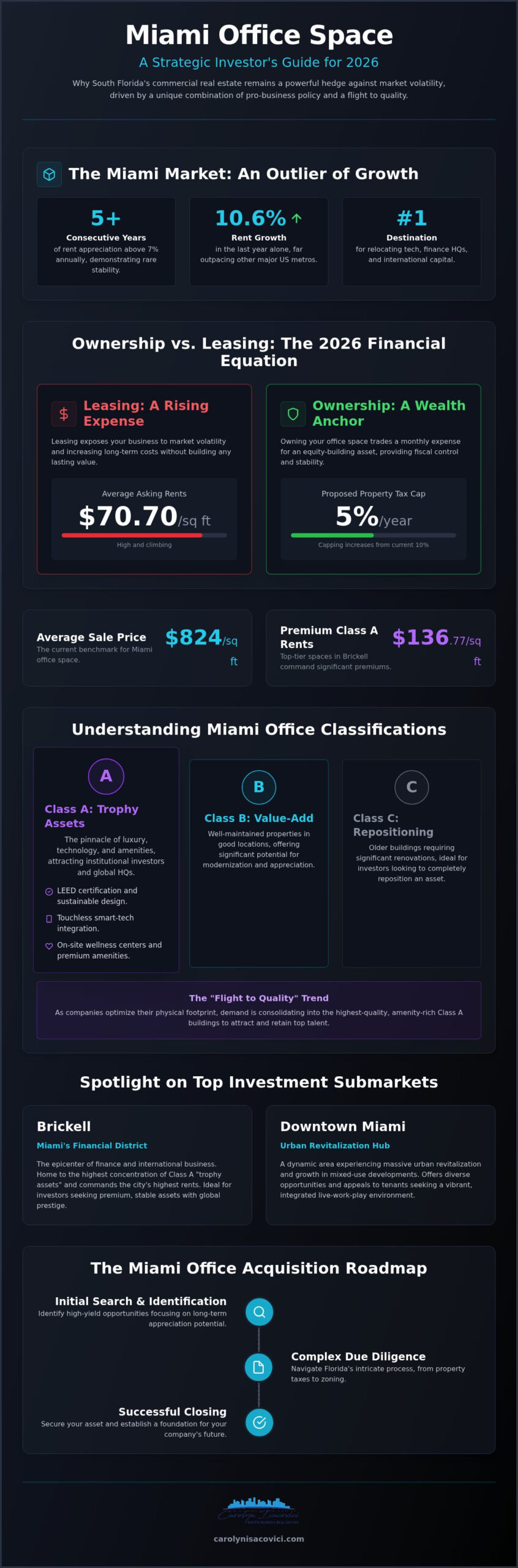
    We understand that the competition for Class A properties is fierce and the due diligence process in Florida can feel complex. That’s why we’ve designed this guide to help you identify and secure high-yield assets that serve as genuine wealth anchors. You’ll discover how to evaluate the total cost of ownership, from the current $824 per square foot average price to the impact of the latest property tax proposals. We’ll walk through the submarkets showing the strongest growth, ensuring your next acquisition isn’t just a building, but a foundation for your company’s future.

    Key Takeaways

    • Understand why Miami’s commercial market stays resilient as major firms continue to relocate their headquarters to South Florida’s business-friendly environment.
    • Learn how to identify high-yield opportunities in the current market for Miami office space for sale, focusing on assets that promise long-term appreciation.
    • Compare the strategic advantages of the Brickell financial district against the urban revitalization and mixed-use growth happening in Downtown Miami.
    • Follow a clear, step-by-step roadmap to navigate the complexities of the Florida market, from initial search to a successful closing.
    • Gain insights into the “flight to quality” trend and how premium amenities are defining the next generation of successful commercial investments.

    Why Miami Office Space for Sale is a Strategic Asset in 2026

    Why does the South Florida skyline continue to attract the world’s most sophisticated capital? It’s a question many investors ask as they look at the shifting national economy. The answer lies in the “Florida Factor,” a unique combination of pro-business policy and a high quality of life that has turned Miami-Dade into a global destination for corporate headquarters. While other major US metros struggle with high vacancy rates and declining values, Miami remains an outlier of growth and resilience.

    Choosing a Miami office space for sale isn’t just a real estate transaction; it’s a strategic move to anchor your wealth in a market that has seen five consecutive years of rent appreciation above 7%. This stability provides a sense of security that is increasingly rare in the commercial sector. By securing a physical asset here, you aren’t just buying square footage. You’re buying into a trajectory of growth that shows no signs of slowing down.

    The Economic Drivers of the Miami Market

    What is fueling this sustained momentum? The primary engine is the rapid expansion of the tech and finance sectors. We’ve seen a steady influx of hedge funds and family offices relocating from high-tax states to take advantage of Miami’s robust economy. This migration isn’t temporary. It’s supported by massive infrastructure projects and a growing pool of international talent that views Miami as the gateway to the Americas.

    International investment also plays a critical role. Buyers from Europe and Latin America continue to see Miami-Dade as a safe haven for capital. This global demand, paired with a limited supply of new construction, keeps property values high. Even with an average sale price of $824 per square foot, the long-term appreciation potential remains strong because the city’s geographical constraints limit how much new space can be built. For a deeper look at how cash-heavy competition and surgical acquisition strategies are shaping outcomes, our Miami investment property sales case study for 2026 provides essential context for any serious buyer.

    Ownership vs. Leasing: The 2026 Perspective

    Is it better to own or lease in today’s market? For many, the answer is clear. With average asking rents reaching $70.70 per square foot in mid-2026, leasing has become an increasingly expensive long-term proposition. Ownership allows you to trade a monthly expense for an equity-building asset. It also protects your business from the volatility of rising commercial rents, which grew by over 10.6% in the last year alone.

    Tax advantages further sweeten the deal. Florida’s lack of state income tax is a well-known benefit, but 2026 brings new opportunities. A proposed constitutional amendment on the ballot this November could soon cap annual property tax increases for commercial properties at 5%, down from the current 10%. Owning your office space doesn’t just provide a permanent brand presence; it offers a level of fiscal control that leasing simply cannot match.

    Understanding Miami Office Classifications: Class A, B, and C

    How do you distinguish a “trophy” asset from a diamond in the rough? It’s all about the classification system. When searching for Miami office space for sale, you’ll encounter a tiered hierarchy that dictates everything from your tenant profile to your long-term cap rates. Class A represents the pinnacle of luxury and technology, while Class B and C offer diverse opportunities for those willing to invest in a property’s evolution. Understanding these nuances is the first step in aligning your purchase with your specific financial goals.

    The choice between these classes often depends on your risk tolerance and your vision for the property. Are you looking for a stable, low-maintenance asset with global prestige? Or are you a “value-add” investor looking to modernize an older building and capture significant appreciation? Miami’s market in 2026 provides ample room for both strategies, provided you know exactly what you’re buying into.

    Class A: Premium Amenities and Global Appeal

    What makes a property a “trophy asset”? In 2026, it’s no longer just about a prestigious address in the heart of Brickell. Tenants now demand environments that prioritize well-being and efficiency. This means LEED certification, touchless smart-tech integration, and on-site wellness centers are standard requirements. These features command a significant premium. For instance, top-tier space in the Brickell submarket has commanded rents as high as $136.77 per square foot recently.

    Institutional investors prioritize these assets because they represent the “flight to quality” trend. As businesses consolidate their physical footprints, they’re choosing the best possible environments to entice employees back to the office. While the entry price for Class A Miami office space for sale is higher, the vacancy rates remain the lowest in the city, offering a reassuring level of stability for your portfolio.

    Class B and C: Finding Hidden Gems

    Is there still room for high ROI in a competitive market? Absolutely. Class B properties are often considered the “sweet spot” for investors. These buildings are typically older but well-maintained, offering functional workspaces at a more accessible price point. With average cap rates for Class B and C properties hovering around 7.9%, compared to 6.0% for Class A, the potential for immediate cash flow is significant. The strategy here often involves cosmetic renovations to attract boutique firms that want a Miami presence without the record-breaking rents.

    Class C properties represent the creative end of the spectrum. These are often older buildings in emerging neighborhoods that are ripe for redevelopment or conversion into “creative lofts.” However, it’s vital to evaluate the structural integrity and “bones” of these older structures before committing. Navigating these technical details is much easier when you partner with a seasoned commercial guide who understands local building codes and the history of South Florida’s architecture.

    Top Neighborhoods for Miami Office Space Investment

    Where should you plant your flag in the 2026 market? It’s a question that defines your long-term success. While Brickell remains the undisputed “Wall Street of the South,” the search for Miami office space for sale has expanded into a vibrant tapestry of neighborhoods, each offering a distinct strategic advantage. As wealth migrates into Florida, the traditional boundaries of the Central Business District are blurring, creating new pockets of value for the observant buyer.

    Brickell continues to command record-breaking figures, with top-tier rents reaching $136.77 per square foot. It’s the home of global finance and law, yet many investors are now looking toward Downtown Miami for better entry points. Downtown is currently the epicenter of urban revitalization, where massive mixed-use developments are transforming older blocks into high-density commercial hubs. If you’re seeking a balance between prestige and growth potential, the 2026 Downtown landscape offers a compelling narrative of transformation.

    For those who prefer a more established, sophisticated atmosphere, Coral Gables remains the gold standard. It’s the preferred choice for multinational corporations and high-end professional services. Recent activity here, including a significant portfolio sale closing at approximately $268 per square foot, proves that value still exists for those who know where to look. Meanwhile, Wynwood and Edgewater have emerged as the creative heartbeat of the city, attracting tech firms and family offices that prioritize “lifestyle” office environments over traditional skyscrapers.

    The Rise of Secondary Hubs

    Why is Coconut Grove suddenly on every investor’s radar? The answer is simple. High-end boutique office space is in short supply, and the Grove’s proximity to luxury residential enclaves makes it an ideal “work-near-home” destination. We’re seeing a similar trend in Miami Beach, where Class A space recently surpassed the $100 per square foot mark for the first time. The expansion of the Brightline rail system has also shifted demand, making neighborhoods near the stations increasingly attractive for firms that value regional connectivity.

    Doral continues to be the logical choice for logistics-based businesses and international trade firms. Its accessibility to the airport and major highways provides a functional advantage that the urban core cannot match. As you evaluate these options, it helps to consult a Florida Commercial Real Estate: 2026 Investor’s Guide to see how these local trends fit into the broader state-wide economic picture. Investors who want to broaden their perspective beyond Miami should also explore the South Florida investment properties landscape across Broward and Palm Beach counties to identify high-growth corridors that complement a Miami-focused strategy.

    Matching Your Business Goals to a Location

    How do you choose the right spot? It begins by identifying your primary objective. If your business is client-facing, the prestige of Brickell or Coral Gables might justify the higher cost of entry. However, if your focus is on employee retention and culture, the amenity-rich streets of Wynwood or Coconut Grove could be the better fit. Finding the right balance between employee commute times and property costs is essential. In a market with 1.24 million square feet currently under construction, your “ideal” location might be a project that is just now breaking ground.

    Miami Office Space for Sale: The 2026 Strategic Buying Guide

    The Miami Office Acquisition Roadmap: From Search to Closing

    Buying commercial property in a high-demand market requires more than just a high bid. It requires a sequence of precise, well-timed actions that turn a complex transaction into a manageable process. How do you move from a casual search to a successful closing? By following a roadmap that anticipates challenges before they arise, you can secure a Miami office space for sale with confidence and clarity.

    The first step is defining your investment criteria. Are you looking for a stable asset for your own business operations, or a value-add property with high appreciation potential? Once your financial parameters are set, the next move is leveraging local brokerage expertise. In Miami’s tight market, the most lucrative opportunities often never hit the public portals. These off-market deals are typically reserved for those with deep local connections who can identify value before the competition arrives. Understanding how successful Miami investment property sales are structured — including how to compete in a market where nearly half of all transactions close in cash — can give you a decisive edge at this stage.

    Rigorous due diligence follows the initial search. This is where you verify the physical and financial health of the asset. Simultaneously, you’ll need to navigate the Florida commercial financing landscape, which offers a variety of structures for different investor profiles. Finally, you’ll move to the negotiation of the Letter of Intent (LOI) and the formal Purchase Agreement. This is where your strategic interests are codified, ensuring that the final terms align with your long-term growth goals.

    Due Diligence: Avoiding Costly Miami Pitfalls

    Zoning laws in Miami-Dade are nuanced and can be restrictive depending on the submarket. You must confirm “Right of Use” permits early in the process to ensure your intended business can legally operate in the space. Another critical factor is the 40-year building recertification. This mandatory safety inspection in Florida can reveal structural requirements that significantly impact your total cost of ownership. Always evaluate current rent rolls and request tenant estoppel certificates to verify that all lease terms and payment histories are exactly as presented. To better understand these financial metrics, you can read our guide on How to Evaluate Investment Property in Florida.

    Financing Your Miami Commercial Purchase

    Capital remains accessible in 2026 for investors with a strong plan. Many owner-users are choosing SBA 504 loans, which offer lower down payments and fixed rates that provide long-term stability. Conventional commercial mortgages remain the standard for larger institutional plays, though they often require higher equity positions. If you find a time-sensitive Miami office space for sale, “hard money” lenders can provide the bridge financing needed to close quickly while you arrange permanent debt. If you’re ready to explore these options, consult with a seasoned commercial advisor to determine which path best supports your portfolio’s success.

    Securing Your Future with Florida Commercial Investment Properties

    How do you turn complex market signals into a definitive competitive advantage? You look beyond the numbers to the strategy behind them. Carolyn Isacovici doesn’t just present listings; she translates the 2026 market landscape into actionable steps for your business. Whether you’re looking for a Miami office space for sale in the heart of Brickell or a boutique building in an emerging creative hub, our “advisory first” approach ensures that every acquisition aligns with your broader financial goals. This philosophy transforms the stress of a high-stakes transaction into a sense of calculated opportunity.

    Choosing the right partner means finding someone who values your long-term success as much as the immediate closing. We understand that the South Florida market has its own unique rhythm and set of nuances. By treating every client as a strategic partner, we move past the traditional broker-client relationship. We act as your navigator, helping you avoid the pitfalls of high competition and complex due diligence while positioning you to capture high-yield assets that others might overlook.

    Why Experience Matters in a Competitive Market

    Experience is the ultimate stabilizer in a fast-moving market. With a 20-year track record in Florida real estate sales, Carolyn Isacovici provides the steady hand required for high-value negotiations. This deep local knowledge grants you access to an exclusive network of commercial property owners, often opening doors to off-market deals that never reach the public eye. We pride ourselves on maintaining a “calm expert” persona, ensuring that even the most complex due diligence remains a structured and predictable process. When the stakes are high, having a seasoned guide who has seen every market cycle is your greatest asset.

    Your Invitation to Strategy

    What does the start of your journey look like? The first 30 days of your search for Miami office space for sale are dedicated to refining your vision and establishing a rigorous baseline for success. We help you weigh all your options, including a commercial vs residential investment in Florida, to ensure your capital is deployed where it will work hardest. This methodical approach builds trust incrementally, giving you the confidence to move when the right opportunity appears. This is your invitation to move past the uncertainty and toward a secure, high-yield future. Contact Carolyn Isacovici today to explore Miami office opportunities.

    Your Path to Strategic Growth in the Miami Skyline

    Is the Miami market complex? Yes, but it’s also filled with unprecedented potential for those who approach it with a clear strategy. We’ve explored how the flight to quality redefines property values and why neighborhoods like Brickell and Downtown Miami remain essential anchors for corporate wealth. By following a disciplined acquisition roadmap, you can transform the challenge of high competition into a rewarding long-term investment.

    Securing the right Miami office space for sale requires more than just capital; it requires a partner who understands the local nuances that drive appreciation. With over two decades of Florida brokerage experience, we provide the end-to-end transaction support needed to navigate this evolving landscape. As a specialist in high-yield investment property sales, Carolyn Isacovici is dedicated to helping you find a location that supports both your brand’s presence and your portfolio’s growth.

    The 2026 market is waiting for those ready to act with confidence. Secure your strategic Miami office asset with Carolyn Isacovici today. Your next great business chapter starts with a single, well-informed decision.

    Frequently Asked Questions

    Is it better to buy or lease office space in Miami right now?

    Buying is often the superior choice for long-term stability as average asking rents reached $70.70 per square foot in mid-2026. When you purchase, you trade a recurring expense for an equity-building asset. This protects your business from the volatility of rent hikes, which saw a 10.6% year-over-year increase. Ownership also allows you to control your environment while benefiting from potential property appreciation in a supply-constrained market.

    What is the average price per square foot for Miami office space for sale in 2026?

    The average price for office space in Miami reached $824 per square foot as of August 2026. While this represents a significant investment, it reflects the high demand for premium locations across the city. Prices can vary significantly based on the submarket and building class. For instance, a recent portfolio sale in Coral Gables closed at approximately $268 per square foot, demonstrating that opportunities exist across different price points for the diligent buyer.

    Which Miami neighborhoods offer the best ROI for office investments?

    Brickell and Downtown Miami currently lead the market, but the best ROI is often found in high-growth secondary hubs. Neighborhoods like Coconut Grove and Wynwood are seeing intense interest due to their lifestyle amenities and proximity to executive housing. For investors seeking higher yields, Class B and C properties in these areas offer average cap rates of 7.9%. These “value-add” opportunities allow you to modernize spaces and capture significant rent growth.

    What are the common pitfalls to avoid when buying commercial property in Florida?

    Underestimating the total cost of ownership is a frequent mistake for new investors. You must account for Florida’s specific regulatory requirements, such as the mandatory 40-year building recertification and the nuances of local zoning laws. Ignoring potential property tax changes can also impact your bottom line. It’s essential to verify if the property is subject to the new 5% cap on annual tax increases, which could take effect in early 2027.

    How do I determine if a Class B office building is a good ‘value-add’ opportunity?

    A strong value-add opportunity begins with a building’s structural integrity and its location relative to transit hubs like the Brightline stations. Look for properties with stable rent rolls but below-market asking prices. If the building requires only cosmetic upgrades to attract higher-tier tenants, it’s likely a sound investment. We recommend analyzing the current vacancy rates, which averaged 14.9% in mid-2026, to ensure there is enough demand to support your post-renovation rent targets.

    What financing options are available for out-of-state commercial investors in Miami?

    Out-of-state investors have several robust financing paths, including conventional commercial mortgages and SBA 504 loans for owner-users. Many national lenders are active in the Miami market due to its high resilience compared to other US metros. If you need to close a transaction quickly to secure a competitive Miami office space for sale, bridge or “hard money” loans are also available. These options provide the flexibility needed to navigate a fast-moving acquisition process.

    How has the rise of remote work impacted the Miami office market specifically?

    Miami has bucked the national trend, seeing a positive net absorption of 344,000 square feet in the second quarter of 2026. While remote work exists, it has triggered a “flight to quality” rather than a market exit. Businesses are choosing premium spaces with high-end amenities to encourage in-person collaboration. This shift has supported rent growth for Class A properties, as supply remains limited while corporate relocations from other states continue.

    What due diligence is unique to the Miami-Dade commercial real estate market?

    Miami-Dade requires specific attention to building safety certifications and local environmental regulations. You must confirm that the property is up to date with its recertification schedule to avoid unexpected structural repairs. Additionally, be aware of the March 31 property tax deadline and the new HB 1293 law effective October 1, 2026. This law provides faster removal processes for fraudulent occupants, offering an extra layer of security for those purchasing Miami office space for sale.

  • Buying a New Construction Home in Miami: The 2026 Step-by-Step Guide

    Buying a New Construction Home in Miami: The 2026 Step-by-Step Guide

    What if the greatest risk in South Florida real estate isn’t the price you pay, but the contract you sign without a seasoned guide? While the skyline continues to evolve, it’s common to feel a sense of hesitation when buying new construction home Miami residences. You’ve likely spent hours comparing different Miami-Dade communities, wondering which neighborhood truly offers the best long term value. At Florida Commercial Investment Properties, we understand these concerns. It’s why we approach the market with a steady hand and a focus on your success.

    This 2026 guide provides professional strategies for selecting the right builders, securing significant incentives, and protecting your investment from the first signature. You’ll gain a clear roadmap from your initial deposit to the final closing. We’ll explore how to maximize builder credits and ensure your new property is positioned for lasting appreciation. By the end of this article, you’ll have the clarity and confidence to turn today’s market conditions into your greatest opportunity. Let’s begin by simplifying the complex landscape of Miami’s latest developments.

    Key Takeaways

    • Learn why modern hurricane-rated materials and energy-efficient designs are making 2026 the ideal year for new builds.
    • Master the “Builder Trinity” to verify reputation and financial stability before buying new construction home Miami properties.
    • Understand your legal rights during the Florida “Right of Rescission” period to ensure your deposit remains protected.
    • Identify “hidden” costs like impact fees and working capital contributions that often lie buried within developer-friendly contracts.
    • Discover how an independent broker provides a “zero-cost” advantage by countering high-pressure sales teams and prioritizing your long-term interests.

    Why Miami New Construction Dominates the 2026 Market

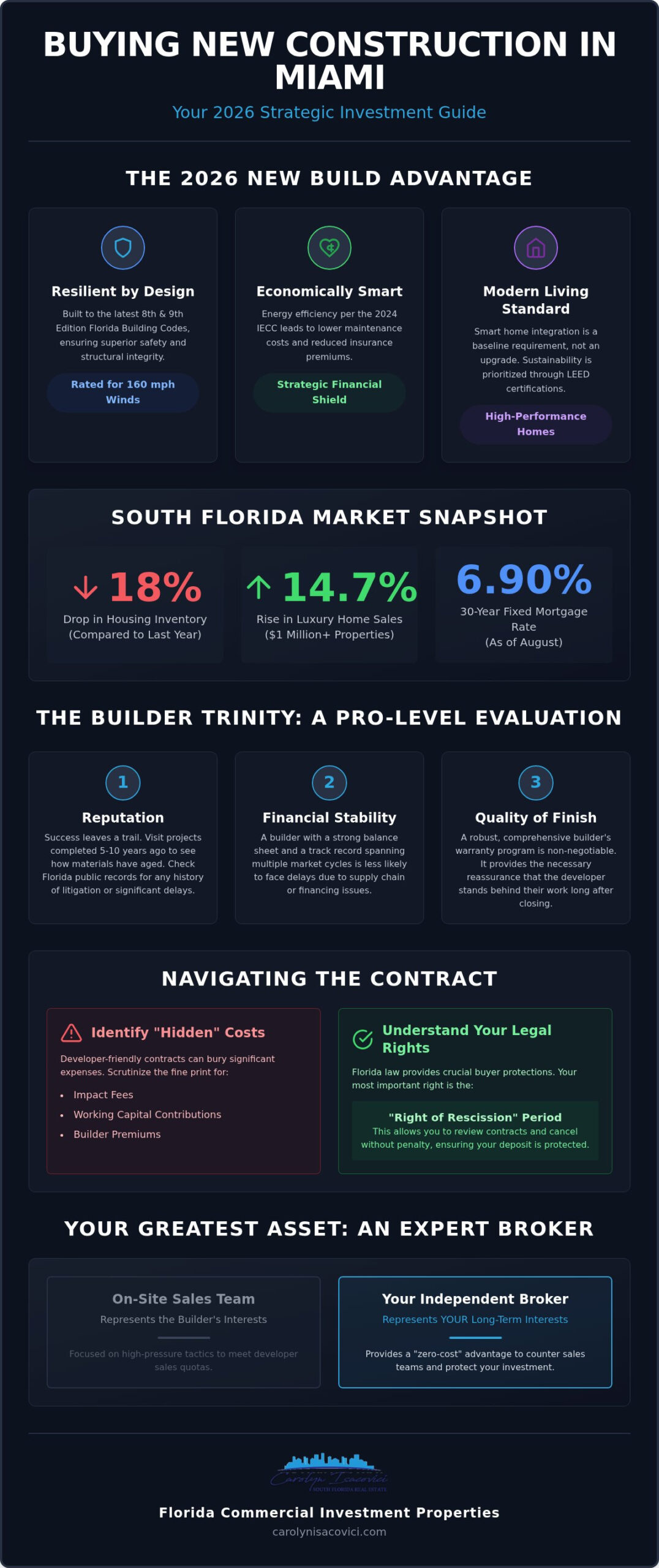
    Miami’s urban footprint is expanding vertically and into carefully curated master-planned communities. When we discuss buying new construction home Miami properties in 2026, we aren’t just talking about fresh paint. We’re talking about structures built to the 8th Edition of the Florida Building Code, with an eye toward the even stricter 9th Edition arriving this December. This “New Build Advantage” is tangible. It means energy efficiency that aligns with the 2024 International Energy Conservation Code and hurricane-rated materials designed for 160 mph wind loads. Lower maintenance costs and reduced insurance premiums aren’t just perks; they’re strategic financial shields for your capital.

    Why is 2026 a pivotal year? While 30-year fixed mortgage rates sit at 6.90% as of August, the real story is inventory. South Florida housing inventory has dropped 18% compared to last year. This scarcity makes new developments a sanctuary for buyers who are tired of bidding wars over aging assets. However, it’s vital to look past the “shiny object” of a designer model home. We help you evaluate the underlying investment value, ensuring the floor plan and location support long term appreciation rather than just short term aesthetic appeal. It’s about finding the intersection of lifestyle and equity.

    The Appeal of Modern Florida Architecture

    Miami developers are setting a global standard for contemporary design. In 2026, smart home integration is a baseline requirement, not an optional upgrade. You’ll find properties that prioritize sustainability through LEED certifications. This is a significant draw for the luxury market, where sales of $1 million-plus homes rose by 14.7% this year. These homes utilize high-performance glass and open-concept layouts to balance Miami’s tropical climate with sophisticated, indoor-outdoor living spaces.

    Inventory vs. Demand in South Florida

    Waterfront land in Miami Beach and Fort Lauderdale is a finite resource. This geographic reality creates a natural floor for property values. As land becomes scarcer, the value of the “new” becomes even more pronounced. Selecting a new build today is a move to secure a piece of a market that’s running out of room to grow outward. In Miami-Dade, the current absorption rate for new residential units reflects a market where demand consistently outpaces the delivery of finished inventory.

    How to Evaluate Builders and Communities Like a Pro

    How do you separate a glossy marketing brochure from a true architectural masterpiece? It begins with what we call the Builder Trinity: reputation, financial stability, and quality of finish. When buying new construction home Miami residences, many buyers are captivated by the renderings. However, the developer’s history is the true foundation of your investment. A builder with a strong balance sheet is less likely to face delays due to supply chain shifts or financing hiccups. We look for a track record that spans multiple market cycles, ensuring they have the resilience to see a project through to completion.

    It’s also essential to distinguish between different builder categories. Tract builders operate on a large scale, offering standardized plans and efficient timelines. Spec homes are built by developers on a speculative basis, often featuring high-end finishes designed to appeal to a broad luxury market. Custom developments provide the highest level of personalization but require a more intensive oversight process. Beyond the four walls of the house, the community amenities are equally vital. In 2026, the value of a property is tied directly to its surroundings. Resort-style clubhouses, integrated green spaces, and well-managed HOAs aren’t just lifestyle perks; they’re the infrastructure that protects your property’s resale appeal in the years to come.

    Vetting the Developer’s Portfolio

    Success leaves a trail. We encourage our clients to go beyond the sales center and visit projects the builder completed five or ten years ago. This allows you to see how the materials have aged and how the community has matured. Check Florida public records for any history of construction defect litigation or significant delays. A robust builder’s warranty program is also non-negotiable. It provides the necessary reassurance that the developer stands behind their work long after the final walkthrough is finished.

    Choosing the Right Miami Neighborhood

    Miami-Dade and Broward counties offer a diverse mix of established enclaves and emerging hotspots. While an established neighborhood offers predictable stability, emerging areas often provide a higher ceiling for property appreciation. Analyze local infrastructure plans, such as new transit extensions or school district upgrades, to gauge long-term ROI. For buyers expanding their search northward, our curated roundup of new construction homes in Broward County highlights the most promising 2026 communities with strong appreciation potential. For those focusing on the financial metrics of their purchase, you can learn how to evaluate investment property Florida assets to ensure the numbers align with your goals. If you’re looking for a partner to help filter the noise, connecting with a Miami real estate advisor is a smart first step toward a confident purchase.

    The Step-by-Step Process of Buying Pre-Construction

    Precision is the key to a stress-free purchase. When you’re buying new construction home Miami properties, the journey begins long before the first shovel hits the dirt. The process starts with a Reservation Agreement, which is essentially a “hold” on your specific unit. This is followed by the Purchase and Sale Agreement (PSA), a comprehensive document that outlines the developer’s obligations and your rights. Unlike a standard resale contract, the PSA is a developer-drafted document, which makes professional review vital to your success.

    The financial roadmap is defined by specific deposit milestones. While every project varies, a common structure includes:

    • 10% at Reservation: Secures your intent and unit choice.
    • 10% at Contract: Paid when the developer executes the PSA.
    • 10% at Groundbreaking: Paid when the foundation work begins.
    • 10% at Topping Out: Paid when the building reaches its highest structural point.
    • Final Balance at Closing: Typically the remaining 50-60%, paid upon delivery.

    Once the structure is underway, you’ll visit the Design Center. This is where your vision comes to life through the selection of cabinetry, flooring, and fixtures. We recommend focusing on timeless finishes that support long-term resale value rather than fleeting trends. Finally, the process concludes with the issuance of the Certificate of Occupancy and your final walkthrough, ensuring every detail meets the agreed-upon standards.

    Mastering the Pre-Construction Timeline

    Expectations must meet reality. A typical high-rise can take two to four years from groundbreaking to completion. To protect your interests, we look for the “outside date” in your contract, which is the drop-dead date by which the developer must deliver the unit or allow you to exit the deal. Under Florida law, buyers of new residential condominiums have a 15-day rescission period to review all documents and cancel the contract for any reason without penalty.

    The Crucial Final Walkthrough

    Don’t let the excitement of a new home cloud your judgment. A third-party inspector is non-negotiable, as they have the expertise to spot structural or mechanical issues that aren’t visible to the naked eye. We help you create a detailed punch list of cosmetic and functional items that the builder must address before you sign the final papers. It’s also critical to verify that all municipal permits are officially closed, ensuring your investment is legally sound from day one.

    Buying a New Construction Home in Miami: The 2026 Step-by-Step Guide

    Standard residential contracts in Florida, known as FAR/BAR, are designed to be balanced between buyer and seller. Developer contracts are different. They’re written by the builder’s legal team to prioritize the project’s completion and the developer’s protection. This shift in perspective can be jarring if you aren’t prepared. When you’re buying new construction home Miami residences, you’ll encounter “hidden” costs that don’t exist in the resale market. For instance, Miami-Dade mobility fees for a single-family residence can range from $9,275 to $10,625 depending on the zone; plus a 2% administrative fee. There’s also a school impact fee of $612 per unit plus $0.918 per gross square foot. These are often passed directly to the buyer at closing.

    Is the price actually fixed? Many sales agents will tell you that prices are non-negotiable. While the base price might be firm, the total value of the deal is often flexible. We focus on strategic negotiation, looking for credits toward closing costs or premium design upgrades. In the 2026 market, builders are often more willing to offer “soft” concessions that don’t lower the recorded sales price but significantly reduce your out-of-pocket expenses. This approach transforms a rigid transaction into a genuine opportunity for value. For a deeper look at how to identify the best new development homes Miami has to offer and position yourself ahead of the competition, our 2026 Strategic Buyer’s Guide provides the comprehensive framework you need.

    Decoding Developer Contracts

    Escalation clauses are a critical point of focus. These allow builders to increase the purchase price if material costs spike during construction. We work to cap these increases or eliminate them entirely. Another vital factor is assignability. Can you sell your right to purchase before the building is finished? This is a key strategy for many, and you can explore this further in our 2026 Investor’s Guide to New Construction. Understanding these clauses ensures you aren’t caught off guard by changing market conditions.

    Maximizing Your Financial Position

    Builders frequently offer incentives to use their affiliated lenders. These “preferred lender” credits can be substantial, sometimes covering 2% to 3% of the purchase price. However, don’t sacrifice a competitive interest rate for a one-time credit. Always compare these offers against independent financing. Additionally, new Florida residents should prepare for the tax implications. While the Save Our Homes cap provides long-term protection, your initial property tax bill will be based on the fully assessed value of the new structure. If you need a Miami real estate expert to review these contract nuances with you, we’re here to help.

    Why an Expert Broker is Your Greatest Asset in New Development

    Why would you enter a high-stakes negotiation without an advocate in your corner? Many buyers assume that walking into a sales center solo will net them a better deal. It’s a common misconception. The reality is that the friendly agent behind the desk represents the developer’s interests, not yours. When buying new construction home Miami properties, having an independent broker is your greatest strategic advantage. The best part? It’s a “zero-cost” benefit. The developer has already factored the commission into their marketing budget, meaning you receive professional guidance without any additional out-of-pocket expense.

    Independent representation provides a “calm expert” to counter the high-pressure environment of a luxury sales gallery. We’ve seen various market cycles and remain unruffled by developer tactics. This perspective allows us to focus on the “inside track.” We often have access to pre-launch pricing and off-market inventory that isn’t visible to the general public. Transitioning from a curious buyer to a long-term property owner requires a partner who understands both the residential allure and the commercial metrics of the South Florida market. We’re here to ensure your capital is working as hard as possible.

    The Value of Objective Advice

    A developer’s job is to sell their specific building. Our job is to compare all available options across Miami-Dade and Broward counties to find the one that fits your lifestyle and financial goals. We provide a neutral analysis of different builders, comparing their past performance and current financial health. A 12 to 24 month build cycle is an emotional journey; we act as your steady hand through the highs of groundbreaking and the logistical hurdles of construction. We review every contract with an eye for your specific investment objectives, ensuring the deal remains as attractive at closing as it was at the initial reservation.

    Your Next Steps in Miami Real Estate

    Timing is everything in new development. If you’re ready to see these communities in person, we can coordinate site tours that give you a true sense of the project’s scale and quality. One critical rule to remember: you must register your broker during your very first visit to a community sales center. This ensures your right to independent representation is protected throughout the transaction. Ready to explore the possibilities of the 2026 market? Contact Carolyn Isacovici today to start your new construction journey with a partner you can trust.

    Taking Your Next Step Toward a Miami New Build

    The path to buying new construction home Miami properties is filled with opportunity for those who move with intention and expert guidance. We’ve explored how to vet developer portfolios, navigate the intricacies of pre-construction contracts, and leverage builder incentives to your advantage. By looking past the initial aesthetic appeal to the underlying investment metrics, you ensure that your new home is a foundation for long term wealth. The 2026 market favors the prepared, and you now have the roadmap to navigate it with confidence.

    Success in the South Florida market requires more than just a search; it demands a strategist. Since 2006, Carolyn Isacovici has provided strategic advisory for high-value asset acquisitions across Miami, Fort Lauderdale, and the Palm Beaches. With deep expertise in both residential and commercial brokerage, she offers the insight necessary to secure your future in this evolving landscape. Are you ready to transform market uncertainty into a clear competitive advantage? Secure your Miami new construction strategy with Carolyn Isacovici today. Your vision for a modern Florida lifestyle is within reach, and we’re honored to lead the way.

    Frequently Asked Questions

    Is it cheaper to buy a new construction home or a resale in Miami?

    Generally, the initial purchase price for new construction is higher per square foot than a resale. However, the long term ownership costs are often significantly lower. New builds feature modern energy efficient systems and hurricane rated materials that reduce monthly utility bills and insurance premiums. While a resale might have a lower sticker price, the cost of updating older systems can quickly bridge that financial gap.

    Do I need a Realtor if I am buying directly from a builder in Florida?

    Yes, you absolutely should have independent representation. The sales agent in the developer’s office works exclusively for the builder, not for you. Having a broker ensures that someone is looking out for your interests during contract negotiations and inspections. Since the developer pays the commission, you receive professional advisory at no additional cost when buying new construction home Miami properties.

    What are the hidden costs of buying a new build in Miami-Dade County?

    Buyers must account for impact fees and developer fees that are often passed down at closing. In Miami-Dade, mobility fees for single family homes can range from $9,275 to $10,625 plus administrative charges. You’ll also encounter school impact fees and working capital contributions to the HOA. These “soft costs” can add several percentage points to your final closing statement if they aren’t identified early.

    How long does it typically take to finish a new construction home in Miami?

    The timeline depends on the project’s complexity. A single family home typically takes 12 to 24 months from groundbreaking to completion, while high rise condominiums can take up to four years. We always check the “outside date” in your contract. This clause protects you by setting a definitive deadline for the developer to deliver the unit or return your deposit.

    Can I negotiate the price of a new construction home with a developer?

    While builders rarely lower the base price to protect appraisals for other buyers, they’re often flexible with incentives. You can frequently negotiate for design center credits, upgrades, or contributions toward your closing costs. In the 2026 market, these concessions are common tools that developers use to move inventory without officially reducing the recorded sales price of the community.

    What happens if my new construction home is delayed beyond the contract date?

    Your contract should outline specific remedies for construction delays. Most agreements include a grace period for “force majeure” events like extreme weather. However, if the builder misses the final “outside date” specified in the contract, you usually have the right to cancel and receive a full refund. It’s vital to have an expert review these clauses before you sign the agreement.

    Are new construction homes in Miami built to withstand hurricanes?

    Yes, they are built to some of the toughest standards in the world. Projects currently follow the 8th Edition of the Florida Building Code, with the 9th Edition taking effect in late 2026. These regulations require impact resistant glass and structural reinforcements designed for wind speeds of 160 mph. This level of protection is a primary reason why buying new construction home Miami residences is a smart safety move.

    What is the 15-day right of rescission for new condos in Florida?

    Florida law provides a mandatory 15 day “cooling off” period for buyers of new residential condominiums. This window begins once you’ve received the formal prospectus and all required disclosure documents. During these 15 days, you can cancel the contract for any reason and get your deposit back. It’s a critical safety net that allows you to perform final due diligence without financial risk.