
Can a Miami property be the right replacement asset if your exchange clock is already running? The opportunity may be compelling, but timing and investment fit need to work together. For Miami real estate for 1031 exchange, planning before you sell can help you search with clear priorities and avoid leaving key decisions until a deadline is close.
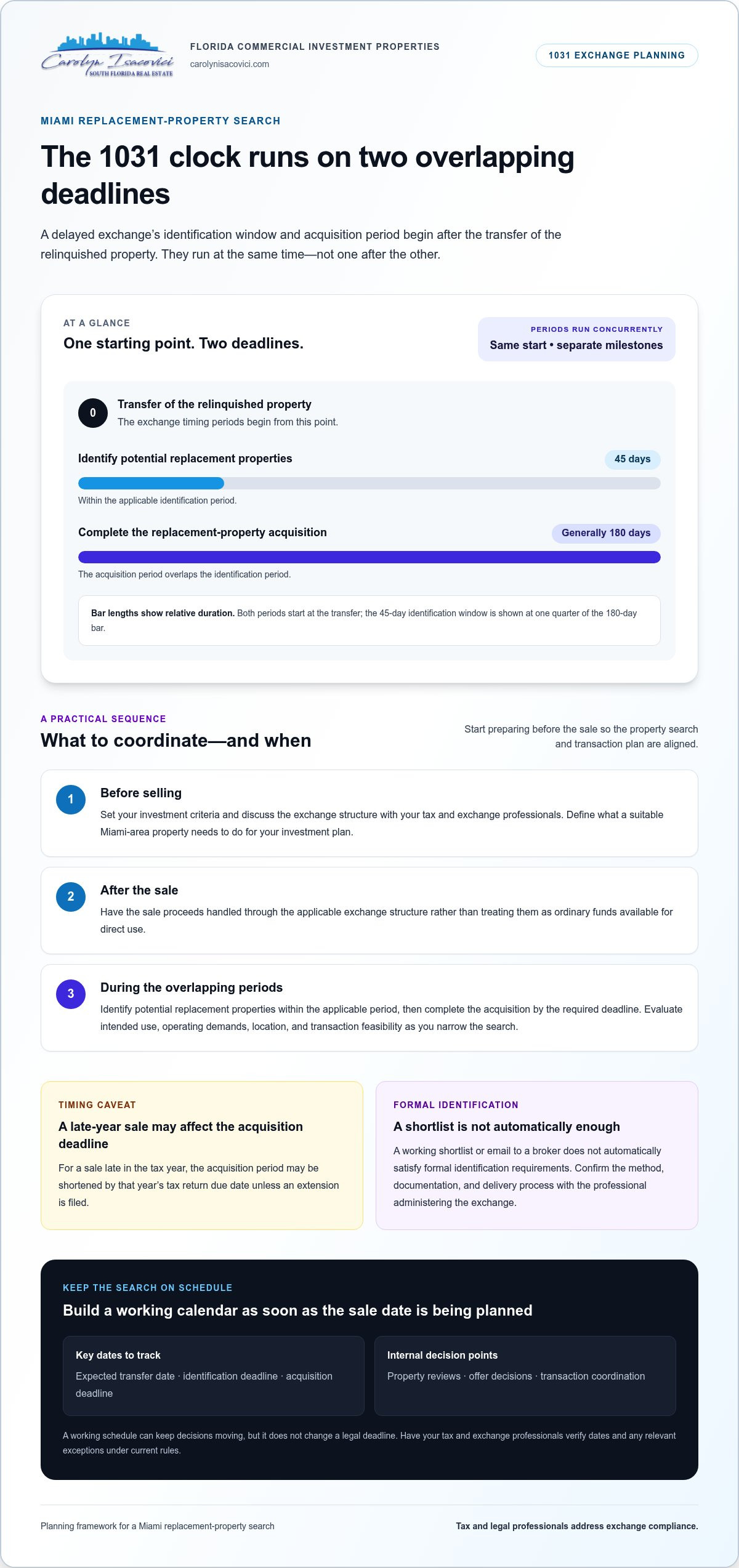
In a typical 1031 exchange, you have 45 days after selling to identify replacement properties and 180 days to complete the acquisition. Both periods run concurrently. The rules also shape which properties may qualify and how you identify them, so have your tax and legal professionals guide the exchange requirements.
This guide explains the framework to understand before listing, then shows how to build a Miami-area search around your investment goals, property type, and transaction timing. Local brokerage support can help identify and evaluate replacement-property opportunities and coordinate the sale and acquisition, while your tax and legal advisers handle exchange compliance.
Key Takeaways
- Understand which investment or business real-property considerations may affect whether a 1031 exchange fits your plans.
- Plan your Miami real estate for 1031 exchange search around clear acquisition criteria, transaction timing, and investment goals.
- Compare residential and commercial opportunities by intended use, income strategy, management needs, and due-diligence priorities.
- Prepare a written investment brief and transaction calendar to keep sale and acquisition decisions aligned.
- Use local brokerage support to identify and evaluate properties while your tax and legal professionals address exchange compliance.
What Miami Real Estate for a 1031 Exchange Actually Means
A Miami purchase isn’t automatically a 1031 replacement property. Section 1031 may let an investor defer recognition of certain gains by exchanging qualifying real property held for business or investment for other qualifying real property. It’s a potential tax deferral, not tax elimination: deferred gain may still have tax consequences later. The 1031 exchange overview offers background, but your specific transaction must be assessed under current federal rules.
Eligibility depends on more than the address. Property use, taxpayer identity, ownership structure, and transaction arrangements can all matter. For example, the same taxpayer that transfers the relinquished property generally must acquire the replacement property. A brokerage can support real estate sale and acquisition decisions, while tax and legal professionals address eligibility, exchange administration, and legal interpretation. This guide focuses on planning a Miami replacement-property search, not providing tax, legal, or intermediary services.
Which real estate may fit a 1031 exchange?
The central distinction is purpose: qualifying real property must generally be held for business or investment, rather than used solely as a personal home. Like-kind real estate is interpreted broadly, so properties don’t necessarily need to be identical in type. Still, personal residences, property held primarily for resale, mixed personal and rental use, and unusual ownership arrangements can raise specific questions. Have your tax professional assess the facts before relying on an exchange.
A property’s label alone doesn’t settle its eligibility. A home rented to tenants may have a different use profile from a residence occupied by its owner, while a property used partly for business or personal purposes calls for closer review. Consider intended and actual use, ownership entity, and transaction structure together, rather than treating them as isolated boxes to check.
Why investors consider Miami replacement property
Miami is one possible market for reinvestment, not a promise of appreciation, rental income, or a suitable exchange outcome. Residential investment property and commercial property offer different acquisition paths, operating demands, tenant considerations, and due-diligence priorities. Start with the investment role you want the property to play, then assess opportunities against that objective instead of choosing by location alone.
An investor seeking residential rentals may prioritize property use and ongoing management needs, while a commercial buyer may focus on the asset’s business purpose and operational profile. These are starting points, not exchange-eligibility conclusions. A Florida investment property evaluation guide can help frame acquisition questions before you narrow the search to Miami.
Keep the sequence clear: first understand your exchange structure with your tax and legal professionals, then define the property criteria that support your investment plan. Local brokerage support can help identify and evaluate Miami-area commercial, residential, and investment opportunities while the appropriate professionals handle tax treatment and compliance.
How 1031 Exchange Timing Shapes a Miami Property Search
In an exchange, the clock affects the search as much as the property criteria do. Planning before you sell gives you room to compare Miami opportunities, clarify acquisition priorities, and coordinate the transaction sequence with the professionals overseeing the exchange. Waiting until the sale closes to begin looking can leave less time to assess whether a property fits your investment plan.
For a commonly used delayed exchange, the sequence is straightforward in outline, though each step needs careful coordination:
- Before selling, set your investment criteria and discuss the exchange structure with your tax and exchange professionals.
- After the sale, have the proceeds handled through the applicable exchange structure rather than treating them as ordinary funds available for direct use.
- Identify potential replacement properties within the applicable period, then complete the acquisition by the required deadline.
Under commonly applicable federal rules, the identification period is 45 days after the transfer of the relinquished property, and the acquisition period is generally 180 days. These deadlines run at the same time, not one after the other. For a sale late in the tax year, the acquisition period may be shortened by the tax return due date for that year unless an extension is filed. Transaction details and current rules can affect how a deadline applies, so have your tax and exchange professionals verify the dates and any relevant exceptions.
What happens during the identification period?
Within the applicable 45-day period, the investor must identify potential replacement property under the exchange rules. An early search gives you time to assess location, intended use, operating demands, and transaction feasibility before choices narrow. A working shortlist or email to a broker doesn’t automatically meet formal identification requirements. Confirm the required method, documentation, and delivery process with the professional administering the exchange.
Build a calendar as soon as the sale date is being planned. Include the expected transfer date, identification deadline, acquisition deadline, and internal decision dates for reviewing properties and offers. A working schedule won’t change a legal deadline, but it can keep the Miami search focused and decisions moving.
How delayed and reverse exchanges differ
A delayed exchange generally means you sell the relinquished property first and acquire the replacement property afterward. A reverse exchange changes that sequence: the replacement property is acquired before the relinquished property is sold, using specialist arrangements that need advance planning. It isn’t simply a delayed exchange with the dates reversed. In either structure, exchange administration and funds handling belong with the appropriate exchange professional, not the real estate brokerage.
For investors pursuing Miami real estate for 1031 exchange, local brokerage support can turn acquisition criteria into a practical property search and coordinate real estate sale or purchase steps with the broader timeline. Local real estate brokerage support can help keep property decisions connected to your investment objectives while your exchange and tax professionals address compliance.
How to Compare Miami Replacement Properties for an Exchange
A replacement property should make sense for your investment plan, not just fit a search result or exchange timeline. Compare each candidate using the same criteria, then investigate its specific location and operating needs. Miami, Miami Beach, and other South Florida markets aren’t interchangeable; evidence for one area may not describe another.
Use this framework to keep the comparison consistent:
- Intended use: Consider whether the property will serve a residential investment or commercial purpose, and how that use aligns with your ownership plans.
- Income strategy: Review the planned operating model, tenant profile, and relevant property-specific leasing or rental evidence. Avoid relying on assumed future income.
- Management demands: Compare the time, oversight, and operational responsibilities each property may require, including the support you expect to have in place.
- Location: Assess access, surrounding uses, and current local indicators relevant to the property’s intended use.
- Due diligence: Identify records and property conditions that need review, including flood exposure, insurance, zoning, association documents, and operating costs.
Match the property type to your investment objectives
Commercial and residential investment properties call for different operating approaches. A commercial asset may involve business tenants and property-specific operational considerations; residential property may involve a different tenant profile and management routine. Neither is automatically better. Compare the responsibilities with your experience, available management capacity, and intended holding strategy without assuming either type will produce a particular return.
Keep two questions separate: does the property suit your investment objectives, and may it qualify under the exchange rules? A promising investment isn’t automatically eligible for a 1031 exchange, and potential eligibility doesn’t establish that it’s a sound fit for your portfolio. Tax professionals can assess exchange treatment while you evaluate the asset’s business case.
Assess Miami-area location and property-level factors
Compare locations using current, property-specific evidence rather than broad neighborhood reputations. Examine access and nearby land uses in relation to the intended tenant or occupant, then review relevant leasing or rental information for the particular area and asset. Miami and Miami Beach may have different surroundings and operating considerations, so don’t assume data from one market applies to the other. The same approach applies when comparing opportunities in Hollywood, Fort Lauderdale, Palm Beach, Palm Beach Gardens, Stuart, Jupiter, Palm City, Port St. Lucie, Fort Pierce, Vero Beach, or Melbourne.
For each candidate, make a diligence list before moving forward. Review flood exposure and insurance considerations, applicable zoning information, association documents where relevant, and expected operating expenses. These factors can affect ownership responsibilities and the viability of your plan, even when a property looks attractive at first glance. Use qualified professionals to review technical, legal, and financial details.
As you compare Miami real estate for 1031 exchange, record what supports each conclusion and what remains unanswered. A broader view of local conditions can add context; the Miami real estate market trends guide can help frame your research, while property-level analysis keeps the final comparison grounded in the asset you’re considering.
A Practical Miami 1031 Exchange Preparation and Due-Diligence Checklist
A clear process keeps two priorities in view: meeting the exchange requirements and making a sound property decision. They’re related, but one doesn’t replace the other. A calendar and written acquisition brief can help you coordinate the people, documents, and property reviews involved without letting the exchange timeline become your only measure of readiness.
Prepare the sale and acquisition workstreams
Before signing sale documents, discuss the planned transaction sequence with your tax and legal professionals. Clarify who is responsible for exchange administration, tax advice, legal review, financing, inspections, and brokerage coordination. These roles are distinct: a real estate brokerage can support the sale and purchase, while exchange compliance and funds handling belong with the appropriate exchange professionals.
Then write a Miami search brief. Note the property type, preferred locations, investment purpose, management capacity, and non-negotiable criteria. Add sale assumptions and a transaction calendar, with dates and document owners visible to the people involved. Update the brief as the sale and acquisition plans develop.
Review local property risks before committing
For each candidate, create a property-specific diligence file rather than relying on general market impressions. Review title information, physical condition, leases, operating records, and relevant association materials. Check flood exposure, insurance considerations, zoning, and local restrictions using current authoritative records and qualified transaction professionals. The applicable records and questions will vary by property and location.
If commercial assets are part of your search, consider how tenant arrangements, operating records, and property responsibilities fit your investment plan. A broader Florida commercial real estate investor’s guide can help frame that evaluation, while diligence on a specific asset should be based on its own documents and circumstances.
Use a staged checklist
Organize the work into stages so important reviews don’t disappear amid deadline pressure:
- Before the sale: Set acquisition criteria, clarify professional responsibilities, and establish a shared calendar.
- During the search: Compare candidate properties against the brief, record open questions, and keep transaction documents organized.
- Before committing: Review title, condition, leases, operating information, insurance considerations, zoning, and applicable association materials.
- As the transaction progresses: Track decisions and document handoffs with the professionals responsible for each workstream.
This approach helps distinguish a property that appears to fit from one examined against your actual objectives. If commercial and residential options are both under consideration, record the management and operating demands of each rather than assuming one category is better. For Miami real estate for 1031 exchange, local brokerage support can help organize the property search and coordinate real estate transaction steps alongside your broader professional team.
For an overview of Carolyn Isacovici’s real estate services, see commercial, residential, and investment-property brokerage support.
How a Miami Real Estate Brokerage Can Support Your 1031 Search
A focused property search starts with a clear picture of what you want to acquire. A local real estate brokerage can translate your investment criteria into a practical Miami-area search, identify relevant commercial, residential, and investment-property opportunities, and support the real estate steps involved in a sale or purchase. That support helps keep property decisions connected to your goals and transaction schedule.
The roles should remain clear. A brokerage supports real estate transactions; it doesn’t determine tax eligibility, interpret exchange rules, handle exchange funds, provide legal advice, or arrange financing. Your tax, legal, exchange, and financing professionals address those parts of the transaction. The brokerage can coordinate property-related communication with the wider team without taking on their responsibilities.
What to bring to an initial investment-property discussion
You don’t need every decision finalized to begin a productive conversation. Bring an outline of the property being sold, the replacement-property type you’re considering, preferred Miami or wider Florida locations, and your target schedule. Include investment criteria such as intended use, management capacity, and the property features that matter most.
It also helps to note questions you’re preparing for your tax, legal, and exchange professionals. Share the information needed to shape the real estate search, while keeping confidential tax or financial details with the professionals advising you on those matters.
Move from exchange planning to a focused Miami search
Once your priorities are clear, brokerage support can organize them into workable search criteria. If you’re weighing commercial and residential options, the conversation can compare property types and locations that align with your intended use and management plans. As market options and transaction timing evolve, refine the search around the criteria that remain essential.
This process creates a deliberate way to evaluate opportunities and coordinate real estate decisions, while your tax and legal professionals guide exchange compliance. For investors considering Miami real estate for 1031 exchange, clear communication among the brokerage and the professionals handling other parts of the transaction can help everyone work from the same property goals and timeline.
Before a discussion, summarize the property you’re selling, preferred acquisition type and locations, key investment criteria, and the timing you’re working toward. Carolyn Isacovici supports commercial, residential, and investment-property transactions in Miami and across Florida, helping investors connect acquisition goals with relevant real estate opportunities.
Learn about Florida investment property brokerage support for commercial, residential, and investment-property transactions.
Turn Your Investment Priorities Into a Clear Next Step
The next move isn’t choosing a property in a hurry. Define what a successful acquisition needs to do for your portfolio, then use those priorities to guide conversations with the professionals involved. For Miami real estate for 1031 exchange, a focused brief can keep property decisions connected to your broader investment direction as opportunities emerge.
Local insight makes that planning more practical. Carolyn Isacovici supports commercial, residential, and investment-property transactions across Florida, including Miami and nearby South Florida locations. Brokerage guidance can help you explore relevant property options and coordinate real estate transaction steps, while your tax and legal professionals advise on exchange requirements.
Ready to put your acquisition priorities into motion? Discuss your Florida investment property goals and start shaping a focused search around your objectives, preferred locations, and transaction timing.
Frequently Asked Questions
Can I exchange investment property in another state for real estate in Miami?
Yes, a 1031 exchange may involve qualifying U.S. real property in different locations. Moving to Miami doesn’t by itself establish that the transaction qualifies. If you’re considering selling a business-use property in another state to acquire Miami real estate for 1031 exchange, your tax professional should assess the use, ownership, and structure of both properties before you commit to the purchase.
Can I use a 1031 exchange to buy a vacation home in Miami?
A vacation home used mainly for personal enjoyment may not fit the investment or business-use purpose required for an exchange. Mixed rental and personal use needs a fact-specific review; renting the home for part of the year doesn’t automatically establish eligibility. Be prepared to explain how the property has been used and how you plan to use it. Have your tax professional assess those details before structuring the transaction.
What happens if the Miami replacement property costs less than the property I sold?
A lower-priced replacement property may affect the amount of gain that can be deferred, and cash or other value received in the exchange may have tax consequences. The result depends on the complete transaction, including liabilities and expenses, so a purchase-price difference alone doesn’t tell you what you’ll owe. Before closing, have your tax professional review the exchange figures and explain how the proposed acquisition affects your specific situation.
Can I identify more than one possible replacement property?
Yes, exchange rules may allow multiple potential replacement properties, subject to identification limits and valuation tests. Common approaches include identifying up to three properties, applying a combined-value limit when naming more, or meeting a high acquisition-percentage test. The applicable method and formal notice requirements matter. A broker’s working list of Miami options isn’t automatically a compliant identification, so coordinate the property list and delivery process with your exchange and tax professionals.
Can I buy the Miami property before selling my current investment property?
Possibly. A reverse exchange may be structured for an acquisition that occurs before the sale of the current investment property, but it requires specialist arrangements and careful planning. It isn’t simply a delayed exchange completed in a different order. Before signing or closing, discuss the proposed sequence, ownership, and timing with qualified exchange and tax professionals. Brokerage support can focus on the real estate search and transaction, not exchange-fund handling.
Does a 1031 exchange eliminate capital gains taxes?
No. A 1031 exchange is generally a tax-deferral strategy for qualifying real-property transactions, not automatic tax forgiveness. Tax consequences may arise when the replacement property is sold or when part of the transaction falls outside the rules for deferral. The outcome can depend on your basis, property use, ownership, and transaction details. Ask your tax professional to evaluate your circumstances rather than treating a deferral as permanent tax elimination.
Can a 1031 exchange include newly constructed Miami property?
New construction may be considered as a potential replacement-property path, but the exchange structure, ownership, construction schedule, and completion details can affect the analysis. A signed contract alone doesn’t confirm that the eventual property will meet exchange requirements. Coordinate project milestones and acquisition timing with your tax and exchange professionals, then review the property’s investment case through ordinary diligence. Brokerage support can help with property opportunities and real estate transaction steps.
Leave a Reply