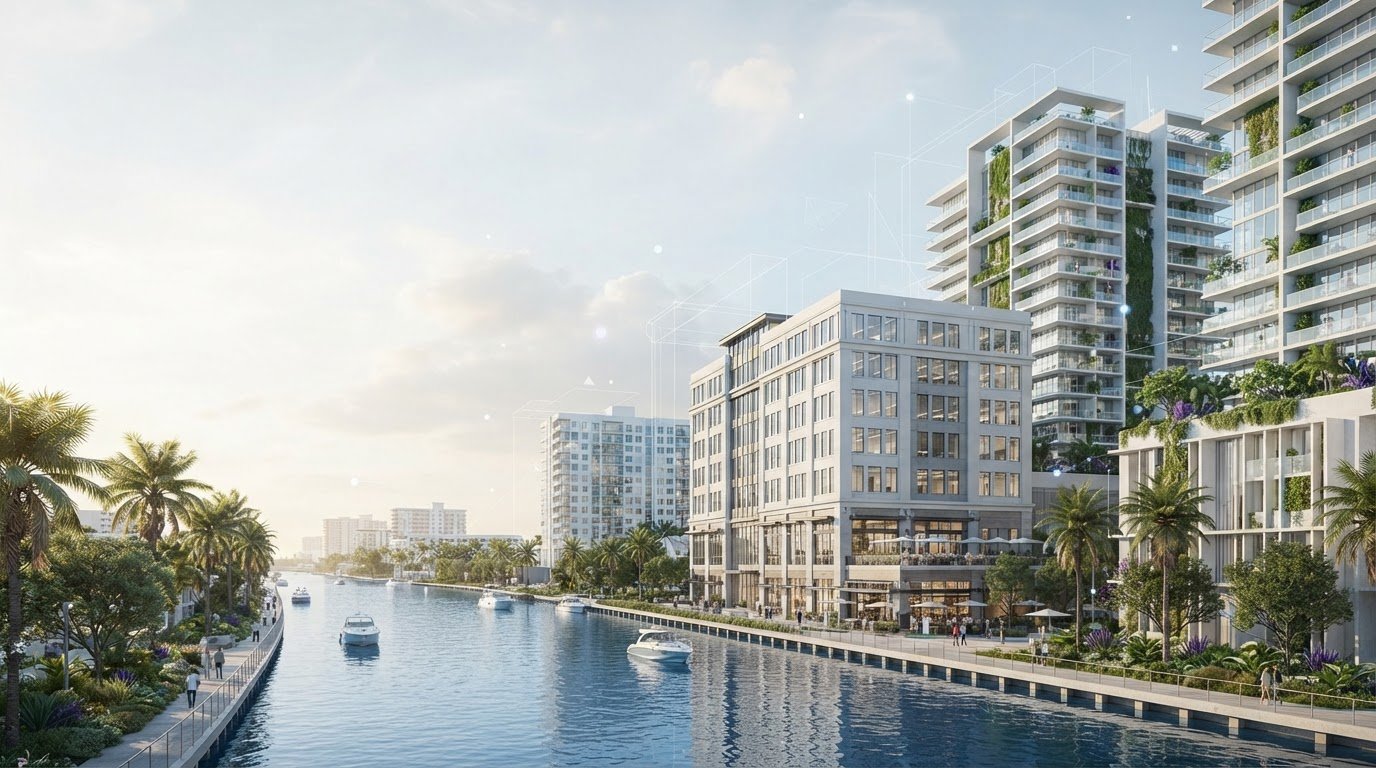
Fort Lauderdale’s commercial real estate market forecast for 2026 points to a selective market, not a broad-based surge: in Broward County, multifamily demand has outweighed supply over the past 18 months, while commercial property transaction activity is projected to stay flat in 2026 and 2027, with gradual improvement in 2028. Available prime office space is expected to become scarcer by year-end 2026.
That mix matters. Stronger apartment demand may support leasing and occupancy, but it does not mean every property type or location will perform alike. Look beyond headline growth and weigh asset quality, tenant demand, rents, and the feasibility of repurposing office buildings.
This forecast explains how multifamily supply and demand, occupancy, leasing, rents, and office reuse could shape opportunities in Fort Lauderdale during 2026. It also puts local signals in context, so you can distinguish durable demand from an improving market that still calls for careful property-level decisions. The goal is a clearer basis for deciding when to hold, lease, reposition, or pursue an acquisition.
Key Takeaways
- Assess multifamily opportunities by weighing new supply against renter demand and the property’s ability to sustain occupancy.
- Compare leasing conditions and rent potential by asset and location before making plans for a commercial property.
- Evaluate office repurposing by considering whether a building’s layout and use can align with changing tenant needs.
- Use local market signals to guide timing and property selection when considering a sale or investment acquisition.
Broward County multifamily demand and supply
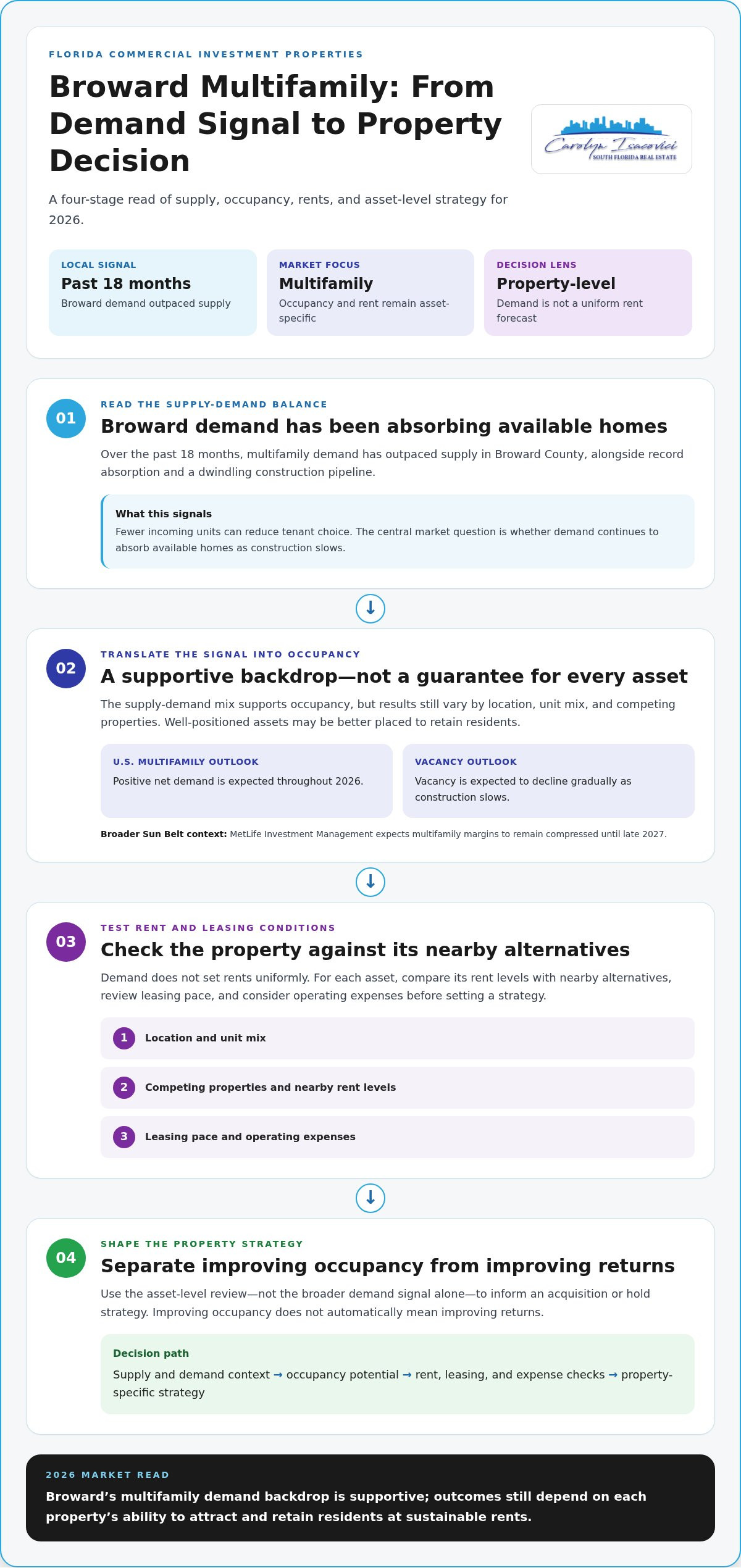
Demand has outpaced supply in Broward County over the past 18 months, alongside record absorption and a dwindling construction pipeline. For the Fort Lauderdale multifamily market in 2026, that combination supports occupancy, but it does not set rents uniformly: rental performance still depends on location, unit mix, and competing properties. The development pipeline matters because fewer incoming units can reduce tenant choice, while well-positioned assets may be better placed to retain residents. The market’s key question is whether demand continues to absorb available homes as construction slows.
Sun Belt trends reinforce a measured outlook. U.S. multifamily is expected to see positive net demand throughout 2026, while vacancy is expected to decline gradually as construction slows. However, MetLife Investment Management expects Sun Belt multifamily margins to remain compressed until late 2027. Investors should therefore distinguish improving occupancy from improving returns. For each asset, compare its rent levels with nearby alternatives, review leasing pace, and consider operating expenses before setting acquisition or hold strategies.
Broward office supply and demand require a separate property-level read. Prime space is expected to become scarcer by year-end 2026, but that signal alone does not establish countywide occupancy or pricing. For an office asset, assess available competing space, tenant requirements, lease terms, and building suitability. These factors help explain whether demand supports rent negotiations or favors repositioning instead.
Retail supply remains limited relative to its pre-pandemic construction average. South Florida had 2.4 million square feet under construction in Q2 2026, nearly 26% below that average, although the pipeline grew for five consecutive quarters after its 2025 Q1 low. Broward retail vacancy reached 4.1% by midyear 2026, up 10 basis points quarter-over-quarter and year-over-year. South Florida vacancy was 3.6% in Q2 2026. Healthcare adds a different supply signal: U.S. construction completions are expected to drop sharply in 2026. For healthcare rents, tenant demand and competing space remain important considerations; the completion outlook alone does not determine local rent performance.
Broward County’s multifamily construction pipeline is dwindling as demand and absorption outpace new supply. South Florida retail had 2.4 million square feet under construction in Q2 2026, nearly 26% below its pre-pandemic average, though the pipeline had grown for five consecutive quarters after its 2025 Q1 low.
Fort Lauderdale commercial real estate occupancy, leasing, and rents
For occupiers, leasing conditions depend on building quality, location, and the flexibility of lease terms. Compare total occupancy costs, renewal options, and space needs before negotiating; these details can matter more than headline rent. In Fort Lauderdale, available prime office space is expected to become scarcer by year-end 2026, making timing and suitable locations increasingly important for tenants seeking high-quality space. For companies planning their footprint across shifting regional markets, advisors like Resolute Global provide occupier-focused guidance to help align lease commitments with broader operational goals.
Office activity is improving nationally. U.S. office net absorption exceeded 14 million square feet in Q3 2025, while national vacancy fell 30 basis points since the start of 2025 to 18.7% in Q3 2025. Office leasing is expected to surpass 2019 levels in 2026, and leasing activity is expected to continue recovering from its 2024 low. For local owners, stronger demand could support occupancy and income, but rent negotiations still depend on a property’s condition, competing space, and tenant requirements.
What about Fort Lauderdale commercial property prices and cap rates in 2026? Property value depends on income, lease durability, location, and building condition; nationally, cap rates for most commercial property types are expected to compress by 5 to 15 basis points in 2026. Compare those property-level fundamentals before weighing a potential return.
For industrial assets, U.S. vacancy is expected to peak around the middle of 2026, while annual leasing volume is expected to improve slightly in 2026. Local rents and construction prospects depend on available space, tenant demand, and incoming projects. Data centers add another leasing consideration: U.S. activity is expected to reach an all-time high in 2026, while power access can influence a site’s practical appeal.
Pipeline and zoning affect which projects can add supply, so assess planned development, permitted use, and infrastructure around a property. Insurance costs, climate exposure, and interest rates can also shape ownership expenses and investment decisions. For a property sale, commercial property sales guidance can help connect market conditions with asset-specific considerations.
Office demand and potential building repurposing
What economic forces could shape Fort Lauderdale commercial real estate in 2026? South Florida’s consistent net positive migration since the pandemic brings retirees and employment-aged residents, supporting demand across housing, services, and workplaces. Nationally, CBRE forecasts U.S. GDP growth of 2.0% in 2026, adding a broader economic signal for leasing and investment decisions.
Office conditions are shifting, but recovery varies by asset. U.S. office values reached their low in 2Q25, and office leasing activity is expected to surpass 2019 levels in 2026. That outlook makes tenant demand and building quality central to any Fort Lauderdale office analysis. High-value employment can support demand for well-located, functional space, while older buildings may need a different strategy if their layouts do not suit current occupiers.
Repurposing can offer an alternative to conventional office leasing, but start with a practical property review. Examine floor plates, natural light, access, existing infrastructure, and surrounding uses. Then compare likely tenant or resident demand with the work required to adapt the building. A change of use should suit the property and its location, not just follow a general trend.
Multifamily is one possible direction to assess. U.S. multifamily is expected to see positive net demand throughout 2026, with vacancy gradually declining as construction slows. For tenant retention, owners can focus on responsive upkeep, suitable unit features, and clear lease terms. Those choices help a property compete without assuming every renter prioritizes the same amenities.
Retail demand also connects to changing consumer patterns. The top 10% of U.S. earners accounted for 50% of consumer spending in 2Q25, a concentration that makes tenant mix and customer base relevant to retail-space analysis. For life sciences, the remaining U.S. speculative lab/R&D construction pipeline is expected to be delivered by year-end 2026. That incoming supply is a useful factor when evaluating lab demand, prospective tenants, or an office-to-lab concept.
Fort Lauderdale commercial real estate
Fort Lauderdale’s outlook is selective rather than uniformly expansionary. Commercial real estate transaction activity is projected to remain flat in 2026 and 2027, with gradual improvement in 2028. The commercial real estate market forecast Fort Lauderdale 2026 is best used as a set of decision signals, not as an assumption that every asset will grow. Compare a building’s income, tenant demand, condition, and location before treating regional trends as a guide to its performance.
Capital may become more active nationally. U.S. commercial real estate investment activity is expected to increase 16% to $562 billion in 2026, nearly matching the annual average from 2015 through 2019. Cap rates for most U.S. property types are expected to compress by 5 to 15 basis points in 2026. These national trends offer context, not a Fort Lauderdale pricing estimate. Local value still depends on property income, vacancy, leases, and buyer interest.
Financing uncertainty also matters. More than $950 billion in U.S. commercial real estate loans matured in 2025, and loan maturities were expected to remain at peak levels for another two years after 2025. Owners considering a sale and investors evaluating an acquisition can weigh lease durability and operating performance alongside capital needs. Use the commercial real estate market forecast Fort Lauderdale 2026 to frame that review, while keeping the individual property’s fundamentals at its center.
Retail shows a different local signal. South Florida retail investment activity moderated from its 2025 spike, while the region’s construction pipeline remained below its pre-pandemic average in Q2 2026. Pair those trends with the property’s tenant mix, nearby competition, and customer base to assess its prospects.
A practical strategy is to compare each asset with its closest local alternatives, then test the income outlook against vacancy, lease terms, and planned supply. This keeps decisions grounded during a flat transaction period while leaving room to respond as conditions change. If you’re weighing a purchase or sale, explore commercial property sales guidance for a property-focused next step.
Florida Commercial Investment Properties: Commercial Property Sales
Florida Commercial Investment Properties helps owners considering a sale and investors evaluating a commercial acquisition through Commercial Property Sales and Investment Property Sales. Turn to the firm when market trends need to be weighed against a specific property’s location, condition, income potential, and tenant profile. Reviewing these factors can help clarify your priorities, whether you are assessing an asset, preparing for a transaction, or comparing investments. The firm also handles Residential Real Estate Sales and New Construction Homes. To discuss your property goals, contact Florida Commercial Investment Properties or visit carolynisacovici.com.
Turn the 2026 outlook into your next move
The commercial real estate market forecast for Fort Lauderdale in 2026 is most useful when translated into clear decision points for your property. Before acting, define what would make you hold, sell, or pursue an acquisition. For example, identify the occupancy, lease stability, or property condition changes that would prompt a closer review. This turns broad market signals into a practical framework you can revisit as circumstances shift.
Keep the process focused. Compare your property’s income prospects and potential use with your objectives, then consider whether a sale or investment purchase supports your next step. A thoughtful plan can bring clarity to an uncertain market without relying on a single headline.
Florida Commercial Investment Properties offers Commercial Property Sales to support owners considering a transaction. Contact Florida Commercial Investment Properties to discuss your real estate goals and take a considered next step.
Frequently Asked Questions
What is the Fort Lauderdale commercial real estate market forecast for 2026?
The commercial real estate market forecast for Fort Lauderdale in 2026 depends on property type, location, and the income a property can support. Office, retail, and investment properties can follow different paths, so evaluate each asset using current comparable leases, available inventory, tenant demand, and operating costs. Compare Fort Lauderdale with nearby markets such as Hollywood, Miami, and Miami Beach to understand which opportunities best fit your investment goals.
What is the Fort Lauderdale office market forecast for 2026 for vacancy, rents, and absorption?
Assess Fort Lauderdale office vacancy, rents, and absorption building by building, using active listings, signed leases, renewals, and space entering the market. An office with modern layouts and convenient access may compete differently from one that needs substantial upgrades. Review concessions alongside asking rents: incentives can change a tenant’s actual occupancy cost and an owner’s net income.
What is the Fort Lauderdale retail real estate market outlook for 2026 for vacancy and rents?
The retail outlook depends on a center’s tenant mix, visibility, access, and fit with nearby consumer activity, not a single citywide vacancy or rent figure. A neighborhood storefront and a larger shopping center serve different customer patterns and leasing needs. Compare Fort Lauderdale properties with those in Palm Beach, Palm Beach Gardens, and Jupiter, then assess occupied space, lease terms, and prospective tenant demand at each location.
What is the Fort Lauderdale commercial real estate sales and investment activity forecast for 2026?
Sales and investment activity will depend on buyer demand, financing conditions, property income, and how closely sellers’ expectations align with comparable transactions. Investors can compare Fort Lauderdale opportunities with alternatives in Stuart, Palm City, Port St. Lucie, Fort Pierce, Vero Beach, and Melbourne. Florida Commercial Investment Properties provides Commercial Property Sales and Investment Property Sales brokerage support for owners considering a sale and buyers evaluating an acquisition.
Fort Lauderdale industrial market 2026 vacancy rents construction forecast
U.S. industrial vacancy is expected to peak around mid-2026, while annual leasing volume is expected to improve slightly. Fort Lauderdale-area rents and construction prospects depend on available space, tenant demand, and incoming projects.
Fort Lauderdale commercial real estate construction pipeline and zoning changes 2026
Broward County’s multifamily construction pipeline is dwindling as demand and absorption outpace new supply. Pipeline activity and zoning influence which projects can add supply. Review planned development, permitted use, and nearby infrastructure; no specific zoning changes are identified.
Leave a Reply