
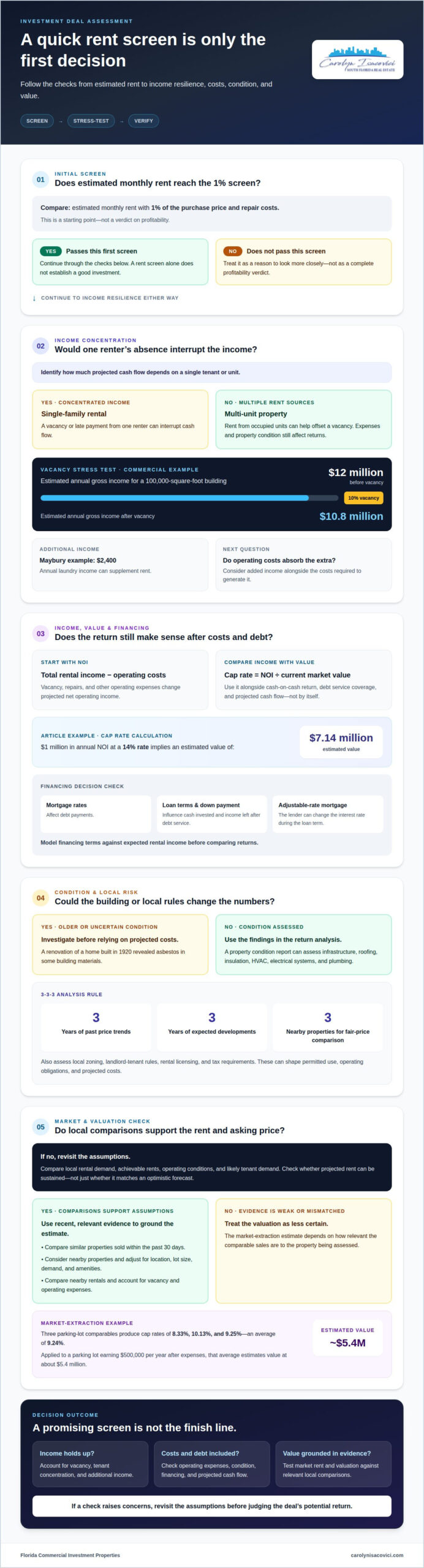
A deal can pass a quick rent test and still be a poor investment. When evaluating a real estate investment deal, the 1% rule offers an initial screen: compare estimated monthly rent with 1% of the purchase price and repair costs. It’s a starting point, not a verdict.
Potential income matters, but profitability depends on more than rent. Operating costs, vacancy, financing, market conditions, and the property’s likely value all shape the result.
This guide explains how to assess income, returns, and valuation. You’ll see how comparing markets and income sources can reveal risk, and why location and property condition can complicate an otherwise promising deal. A clear view of the numbers and the assumptions behind them can help you make a more informed investment decision.
Key Takeaways
- Compare single-family and multi-unit properties by looking beyond rent to vacancy exposure, operating costs, and the stability of potential income.
- Assess how location and income sources affect a property’s resilience, including how vacancies can change projected cash flow.
- Use market analysis, comparable sales, and the market-extraction method to develop a grounded view of a property’s value.
- Account for valuation challenges such as property condition and nearby features that may affect tenant demand or achievable rent.
1. Will this real estate investment be profitable?
Compare a single-family rental with a multi-unit property by examining income concentration, vacancy exposure, and operating costs. A vacancy or late payment from one renter can interrupt a single-family property’s cash flow. With multiple units, rent from occupied units can help offset a vacancy, although expenses and property condition still affect the return.
Assess income in relation to value, too. A capitalization rate is net operating income divided by current market value. For example, $1 million in annual net operating income at a 14% rate implies an estimated value of $7.14 million. Consider cap rate alongside cash-on-cash return, debt service coverage, and projected cash flow rather than relying on a single metric.
Financing changes the picture. Mortgage rates affect debt payments, while loan terms and the down payment influence the cash invested and the income left after debt service. An adjustable-rate mortgage allows the lender to change the interest rate during the loan term, according to the U.S. Government Accountability Office. Model the financing terms against expected rental income before comparing returns.
Due diligence also includes the property’s age and condition. A renovation of a home built in 1920 revealed asbestos in some building materials, illustrating why older buildings need careful evaluation. A property condition report can assess infrastructure, roofing, insulation, HVAC, electrical systems, and plumbing. These findings can help identify issues that may affect expenses or rental income.
The 3-3-3 analysis rule reviews three years of past price trends, developments expected over the next three years, and three nearby properties for a fair-price comparison. Also assess local zoning, landlord-tenant rules, rental licensing, and tax requirements. These factors can shape permitted use, operating obligations, and projected costs. Together, these checks create a fuller picture of whether an investment property can generate a sustainable return.
2. Diversifying by market and income source
Spread risk across markets and income streams, not just properties. A market analysis compares local rental demand, achievable rents, operating conditions, and likely tenant demand before you assess individual assets. It can reveal whether projected income depends heavily on one neighborhood or tenant group. Market selection also shapes rent growth: a property’s return depends partly on sustaining local market rent, not simply matching an optimistic forecast.
Rental estimates should account for vacancy as well as occupied units. In a commercial example, a 100,000-square-foot building’s estimated annual gross income falls from $12 million to $10.8 million with a 10% vacancy rate. Additional income sources, such as laundry facilities, can supplement rent. The Maybury example includes $2,400 in annual laundry income. Even with added income, consider whether operating costs consume the extra cash flow.
Net operating income, or NOI, is total rental income minus operating costs. To assess future value, discount projected net cash inflows by the required return, then subtract the total investment cost. This net present value approach accounts for when income arrives rather than treating every future dollar as equal. Rent assumptions, vacancy, repairs, and other operating expenses all affect projected NOI and the resulting rate of return.
Long-term analysis weighs appreciation and rent growth against resale costs. One example assumes annual property appreciation of 2%, but projected value growth alone doesn’t show the investment’s full outcome. Rent growth affects operating income over time, while transaction costs reduce proceeds when an asset is sold. Assess these factors alongside vacancy and operating expenses, then compare expected cash flow and sale proceeds with the original investment.
3. What’s a property investment analysis?
A property investment analysis brings market conditions and property-level numbers together to assess whether an acquisition fits its investment goals. When evaluating a real estate investment deal, start with market research and review local trends before selecting an individual rental property. Assess whether it can achieve area-average rent and sustain that rent over time. A useful analysis connects demand, expected income, operating expenses, and value.
Market context matters across private and public real estate markets. Publicly traded real estate investments can be compared through market pricing, while private property deals require closer attention to the specific asset, its location, and comparable transactions. In either case, consider how demand and local conditions may affect income. Review mortgage assumptions when financing shapes projected performance.
For direct property sales, compare similar properties sold within the past 30 days. The 3-3-3 analysis rule also considers three nearby properties when assessing a fair market price. Adjust for differences that affect value, including location, lot size, demand, and amenities. This comparison helps determine whether an asking price aligns with recent transactions rather than relying on a broad market average.
The market-extraction method uses comparable sales to derive capitalization rates, then applies the average to the subject property’s net operating income. In one example, three parking-lot comparables produce rates of 8.33%, 10.13%, and 9.25%, averaging 9.24%. A parking lot earning $500,000 per year after expenses is estimated at about $5.4 million using that average. The estimate depends on how relevant the comparables are.
Rent comparisons test whether projected income fits local conditions. Examine nearby rental properties and assess whether the subject can realistically achieve the area’s average rent. Then account for vacancy and operating expenses, since advertised rents alone don’t establish reliable income. Together, these comparisons give investors a stronger basis for evaluating a real estate investment deal and its potential performance.
4. Real estate valuation challenges
A valuation is an estimate shaped by assumptions, not a fixed answer. Different methods can produce different figures because they weigh income, comparable sales, and property condition differently. An apartment’s monthly rent may look attractive, but repairs, vacancy, or weaker demand can reduce the income supporting its estimated value. Examine those assumptions together instead of treating one calculation as conclusive.
Cap rate comparisons also depend on the properties selected. A market average can obscure differences in location, tenant demand, building condition, and operating expenses. Comparable sales can help anchor an estimate, but a nearby property is not automatically comparable if its amenities or income profile differ. Interpret sale prices alongside the subject property’s actual earning potential.
Physical surroundings can affect that potential. A railway nearby may make a property harder to rent because of noise, affecting tenant interest and achievable rent. Similar challenges arise when a property’s features don’t match local demand. Consider how location and amenities influence rental prospects, then reflect those factors in income assumptions rather than relying only on a broad market average.
Building condition creates another source of uncertainty. A condition assessment can identify concerns involving infrastructure, roofing, insulation, HVAC, electrical systems, and plumbing. Deferred work can increase future expenses or interrupt rental income. Older properties also require attention to building materials: a renovation of a home built in 1920 revealed asbestos in some materials. This illustrates why age alone cannot capture a property’s risks.
A sound estimate makes its assumptions clear: expected rent, likely vacancy, operating expenses, comparable sales, and observed condition. If a small change in rent or expenses shifts the result substantially, give that sensitivity careful attention before deciding. To explore residential property options, visit Florida Commercial Investment Properties.
Florida Commercial Investment Properties: Residential Real Estate Sales
When your analysis points toward a residential acquisition or investment property purchase, Florida Commercial Investment Properties offers Residential Real Estate Sales and Investment Property Sales. The firm also handles Commercial Property Sales and New Construction Homes. These Florida property options can help you move from assessing market value, income potential, and property condition to considering a purchase that fits your objectives.
Florida Commercial Investment Properties serves buyers across markets including Miami, Miami Beach, Hollywood, Fort Lauderdale, Palm Beach, Palm Beach Gardens, Stuart, Jupiter, Palm City, Port St. Lucie, Fort Pierce, Vero Beach, and Melbourne. As you consider a property transaction, bring your preferred property type and investment objectives into the discussion.
Contact Florida Commercial Investment Properties to discuss your real estate goals.
Turn your analysis into a confident next step
A useful decision begins with a clear investment brief: what role the property should play, which risks fit your plans, and which assumptions matter most. Before moving forward, align your priorities with the kind of asset you’re considering and the time and attention it may require. That clarity helps turn evaluating a real estate investment deal from a comparison of estimates into a decision grounded in your goals.
There’s no need to force a property to fit. Connect your intended use and investment objectives with the type of asset you’re pursuing. Florida Commercial Investment Properties handles commercial and residential property sales, investment property sales, and new construction homes in Florida.
Ready to discuss your plans? Contact Florida Commercial Investment Properties to take the next step.
Frequently Asked Questions
What’s a property investment analysis?
It’s an assessment of whether a property’s expected performance fits an investor’s objectives. Connect local demand with achievable rent, likely expenses, financing, and the property’s condition to build a decision-ready picture. For a Florida rental, market context matters across Miami, Miami Beach, Hollywood, Fort Lauderdale, Palm Beach, Palm Beach Gardens, Stuart, Jupiter, Palm City, Port St. Lucie, Fort Pierce, Vero Beach, and Melbourne.
Will this real estate investment be profitable?
Assess potential profitability by testing whether projected income supports operating expenses, debt payments, and the investor’s return objectives. Examine how results change if rent, vacancy, or sale value differs from the base estimate. For example, a property may show positive operating income but leave little cash flow after debt service. Profitability depends on how the full set of assumptions works together.
How do professionals calculate cap rate, cash-on-cash return, and cash flow for a rental property?
Cap rate equals net operating income divided by current market value. Cash-on-cash return equals annual pre-tax cash flow divided by total cash invested. To assess cash flow, account for rental income, operating costs, and debt payments, then compare what remains with the investor’s cash contribution. These measures answer different questions, so use them together rather than treating one figure as a complete performance assessment.
Which operating expenses, vacancy rate, and maintenance costs do professionals include in a real estate deal analysis?
Include costs such as property taxes, insurance, utilities, management, and routine upkeep when estimating operating performance. Account for income lost during vacancies instead of assuming every unit is occupied continuously. Maintenance assumptions reflect the building’s age and condition; one estimate recommends allocating 5% to 15% of rent, depending on those factors. A property condition review can help refine that estimate.
How do professionals estimate rental income and verify comparable rents in a local market?
Compare the property with nearby rentals that have relevant features, then assess whether local demand supports the expected rent. Consider location, amenities, property condition, and the type of tenants the area attracts. For an affordability check, projected monthly rent can be compared with 30% of monthly median household income. This gives rent assumptions more context than relying on an asking rent alone.
What due diligence do professionals perform before a client buys an investment property?
Review the property’s market position, income assumptions, expenses, and condition, then examine how sensitive the investment is to changes in those assumptions. A condition report can assess roofing, insulation, HVAC, electrical systems, plumbing, and infrastructure. Also consider zoning, rental licensing, landlord-tenant rules, and tax requirements because these affect use and operating costs. Nearby features, including railway noise, may influence tenant demand.