
A seller’s strongest starting point is a researched opening offer grounded in comparable sales or leases, the property’s condition and location, its income potential, and the other party’s likely motivations. This gives both sides a reasoned anchor for discussion and reduces the risk of letting an unsupported price set the tone. It’s one of the most practical commercial real estate negotiation tactics because it pairs a clear position with evidence.
Protecting value does not have to shut down a productive conversation. Preparation makes the difference: know which terms matter most, where you can be flexible, and what the other party may need to move forward. This article explains how to build an opening offer, assess the other side’s priorities, and negotiate lease terms such as rent escalations, duration, renewal options, and tenant improvements. It also covers when professional representation can help bring perspective to a complex transaction.
Key Takeaways
- Build an opening offer around comparable transactions and property-specific evidence to establish a credible starting point.
- Identify the other party’s priorities and your own must-haves before deciding where you can be flexible.
- Assess lease duration, rent escalations, renewal options, and improvement terms as connected parts of the agreement.
- Use clear, objective criteria to support your position and keep the discussion focused on workable solutions.
- Consider professional representation when the transaction’s complexity makes experienced guidance especially valuable.
Negotiating rent escalations, lease duration, renewal options, and tenant improvements
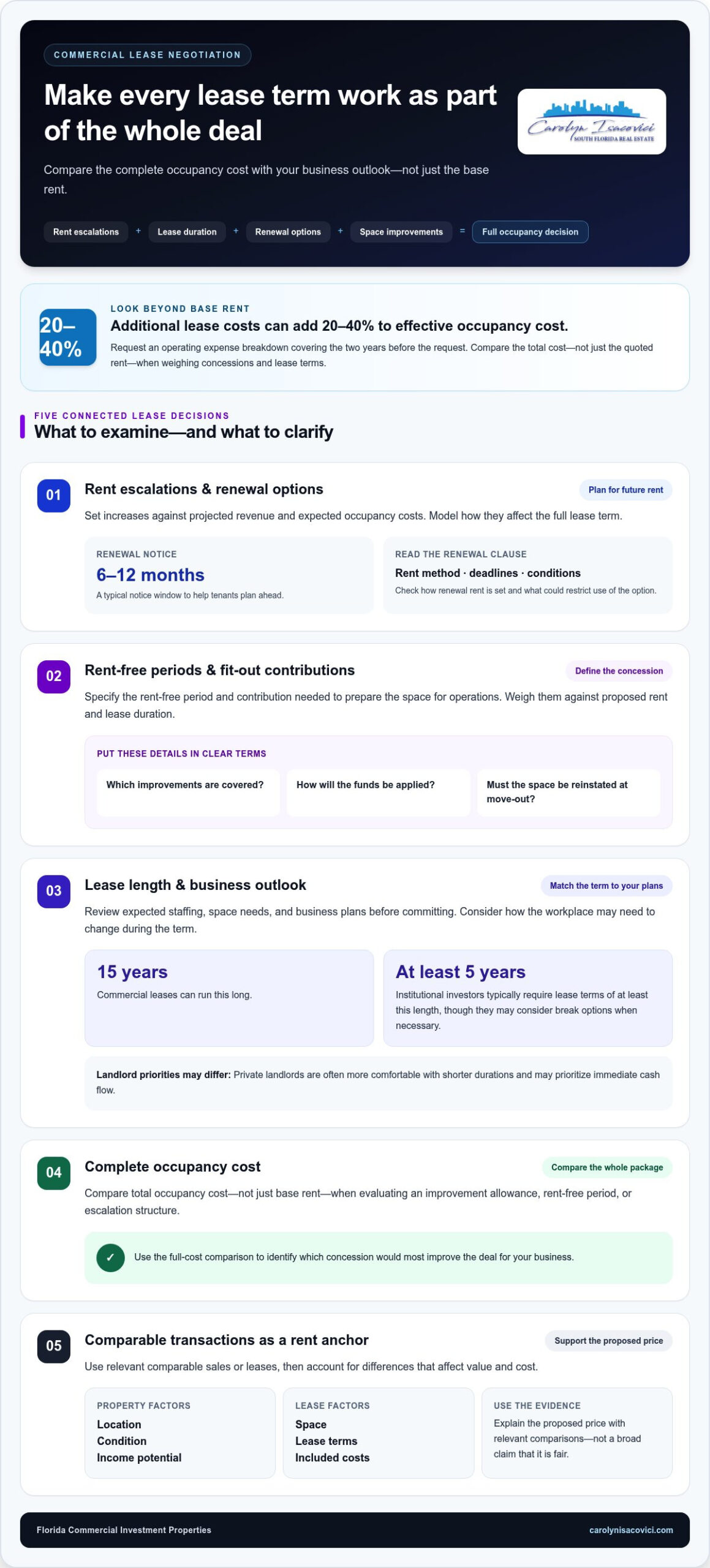
Compare the full lease cost with your business outlook, then negotiate terms that support your occupancy needs and future flexibility.
-
Negotiate Rent Escalations and Renewal Options
Ask for rent escalations that fit projected revenue and expected occupancy costs, and model how increases affect the full lease term. Seek a renewal option with reasonable notice, typically 6-12 months, so tenants can plan ahead. Read the contract for the renewal rent-setting method, deadlines, and any conditions that could restrict using the option.
-
Negotiate Rent-Free Periods and Fit-Out Contributions
Specify the rent-free period and fit-out contribution you need to prepare the space for operations. Weigh those concessions against the proposed rent and lease duration, since a longer commitment may support different terms than a shorter one. Clarify which improvements the contribution covers, how funds will be applied, and whether the lease requires you to reinstate the space when you leave.
- Choose a lease length that matches your outlook. Review expected staffing, space requirements, and business plans before committing. Commercial leases can run for 15 years, so consider how the workplace might need to change during the term. Institutional investors typically require lease terms of at least five years, although they may consider break options when necessary. Private landlords are often more comfortable with shorter durations and may prioritize immediate cash flow.
- Compare the complete occupancy cost. Request an operating expense breakdown covering the two years prior to the request. Some additional lease costs can add 20-40% to a tenant’s effective occupancy cost. Compare that total, not just base rent, when weighing a rent-free period, improvement allowance, or escalation structure. Use the comparison to identify which concession would most improve the deal for your business.
- Anchor rent discussions in comparable transactions. Support your proposed price with comparable sales or leases, then account for location, property condition, and income potential. A sound comparison considers the space, lease terms, and included costs together.
What is the single most effective negotiation tactic for sellers?
Research the property, market, comparable transactions, and the other party before setting your position. U.S. negotiation practices and costs vary by state and local market, shaped by local laws, customs, lending trends, intended use, and transaction timing.
-
Research Market Conditions and Comparable Transactions
Build your position using comparable sales or leases, market values, industry practices, costs, and expert opinions. Match each comparison to the property’s location, condition, income potential, and intended use. A nearby property may look similar but have different operating needs or income. Use the closest relevant examples to support your proposal, and don’t treat an asking price as proof of market value.
-
Assess the Property and Other Party
Review the property’s strengths, limitations, and likely income before choosing your negotiating range. Consider what the other party may value, such as timing, certainty, cash flow, or specific transaction terms. Ask focused questions, listen to concerns, and communicate your priorities clearly. This preparation turns market knowledge into a practical strategy, helping you separate firm requirements from terms you can adjust.
-
Use Market Rents and Days on Market
Compare market rents and similar properties to see whether a proposed price fits local conditions. Account for differences in location, condition, and income potential. In Miami or Palm Beach, compare a property’s time on the market with similar local listings and consider buyer interest. Treat listing duration as context, not guaranteed leverage. Discuss property flaws or market trends honestly to preserve trust.
-
Negotiate Financing and Terms in Competitive Bids
For financing, compare the proposed interest rate, loan terms, contingencies, and timing with the transaction’s needs. Buyers can strengthen an offer with clear terms while allowing time for due diligence and bank approval. Banks often need six weeks or more to review a commercial purchase. In competitive bidding, assess the complete offer rather than raising the price without a reason. Keep structural and environmental assessments within due diligence.
- Search beyond widely marketed properties. Define the location, property type, condition, and income profile that fit your goals. Review public listings alongside direct inquiries about properties that may not be publicly advertised. Compare each opportunity using consistent criteria, including condition and income potential, so a lower asking price doesn’t distract from a poor fit. A disciplined search can reveal alternatives and give you stronger context for your next offer.
Using researched opening offers as anchors
A researched opening offer gives both parties a reasoned starting point for negotiating price and terms. Use the anchor as evidence of value, not as a way to force agreement.
-
Research the Opening Offer
Gather comparable sales or leases, then assess the property’s location, condition, and income potential against them. Note where each transaction differs, since similar-looking assets may have different operating needs or value. Use relevant market information to explain your proposed price instead of relying on a broad claim that the offer is fair.
Consider the other party’s likely priorities as you prepare. A seller may value timing or certainty; a buyer may focus on future cash flow or property condition. Separate verifiable details from assumptions, and organize the evidence so each part of your offer has a clear rationale. This helps keep the discussion focused on the transaction rather than unsupported impressions.
Before presenting an offer, identify the terms that support your position. Pair a price proposal with a practical timeline or clear conditions. Keep your explanation concise, specific, and consistent with the transaction evidence. If a comparable lease includes different costs, account for that difference instead of treating its rent as directly equivalent.
-
Set an Initial Offer as an Anchor
Set an initial offer that creates an advantageous starting point without losing credibility. A well-supported anchor can reduce the risk of the other party setting a disproportionately high price. Explain how the evidence supports your position, and avoid an aggressive figure detached from market conditions. The goal is to start a useful discussion, not make the other party feel dismissed.
Present your proposal, then give the other party time to respond. A pause can make room for a considered answer rather than prompting an immediate concession. If the response is far from your position, return to the comparable transactions and property-specific factors behind your offer. Ask which terms matter most to the other side before revising your proposal.
Plan concessions in advance. Begin with items that matter less to you, then move gradually toward more significant terms. Make each concession conditional on progress elsewhere, such as agreement on timing or another term. This prevents the discussion from becoming a series of one-sided price reductions.
-
Negotiate Offer Price and Terms
Negotiate the full proposal, not just the headline price. Consider timing, contingencies, and other terms alongside the amount offered, since each can affect the transaction’s practicality. A seller who needs predictable cash flow, for example, may value a clear timeline, while a buyer may need time to assess the property.
Keep the discussion transparent and honest. State your priorities clearly while respecting information that must remain confidential. If new information changes the property’s condition or income potential, explain how it affects your position. Avoid reopening terms already agreed: repeated changes can erode trust and waste time.
Before accepting a counteroffer, compare it with your original objectives and the evidence behind your anchor. Record which terms have changed and which remain agreed. A steady process helps each party understand the reasoning behind the final position, even when neither side gets every preferred term.
Professional representation in complex negotiations
Use experienced representation when a transaction’s terms, risks, or competing priorities become difficult to manage alone. Clear roles help the parties address concerns while keeping decisions tied to the deal’s objectives.
Key risks include inaccurate representations or warranties, unclear responsibility for losses, and seller obligations for property upkeep or insurance. Review these terms alongside the purchase agreement: they can shift risk and lead to claims if statements prove inaccurate or obligations are breached.
-
Assess Legal and Financial Risks
List the statements, responsibilities, and financial exposures assigned to each party in the agreement. Representations and warranties can allocate potential losses, shift risk, support a direct claim if inaccurate or breached, and form the basis for indemnification obligations. Sellers should review commitments to obtain rights before entering new leases or contracts, maintain and repair the property, and maintain insurance at the levels in place on the contract date.
Compare each commitment with the property’s operating realities. For example, a seller’s promise to maintain the building needs a clear scope and timeframe; an inaccurate statement could lead to a claim after closing. Buyers should understand which statements they rely on and which losses may be allocated through indemnification. Track unresolved concerns in writing rather than assuming a broad clause answers every question.
Separate commercial judgment from legal interpretation. A real estate representative can help the parties understand transaction context and negotiate business terms, while agreement language and legal exposure require appropriate legal review. This distinction clarifies responsibilities without overlooking the financial consequences of a negotiated clause.
-
Use Professional Representation in Complex Deals
Bring in representation when multiple parties, substantial lease obligations, or complicated property terms make a negotiation difficult to manage. A representative can organize priorities, communicate proposals, and keep the discussion focused on practical outcomes. For tenants, a tenant representation advisor can compare space needs with lease terms and identify concerns that require focused discussion.
Before discussions begin, give your representative a written brief covering must-haves, flexible terms, timing, and information to keep confidential. A tenant, for example, may prioritize expansion options, while a seller may focus on maintaining operations during the transaction. Clear instructions help your representative present your position consistently and avoid trading away terms that matter to your plans.
Set decision points for offers and counteroffers. Ask your representative to summarize changes, open issues, and potential effects on the transaction before you approve a response. In a complex sale, professional support can provide perspective on commercial property negotiations, but it does not replace your review of the terms or the legal advice needed for contract language.
Assessing counterpart needs and negotiating positions
Start by separating each party’s stated position from the business need behind it. In commercial property negotiations, careful listening can reveal practical trade-offs that a price-only discussion misses.
- Map your priorities before discussing terms. Write down your essential outcomes, flexible points, and likely alternatives. A tenant, for example, may need a particular location for customer access, while an owner may prioritize reliable rental income. This comparison helps you explain your position and decide which changes could still support a successful agreement.
- Assess how much the location matters to the other party. A commercial property owner can weigh a tenant’s reliance on the location against the potential rental income from another tenant. Ask what operations depend on the site and what alternatives exist. If the tenant serves nearby customers or relies on a specific layout, those needs may shape the value of renewal, expansion, or other lease terms.
- Consider the time and experience each side brings. Landlords negotiate commercial leases regularly, while tenants may negotiate one only once every five to ten years. That difference can affect familiarity with lease language and negotiating routines. List unfamiliar terms and clarify your priorities before responding. A tenant who understands their operational needs can participate more confidently without treating every landlord proposal as fixed.
- Look ahead to space and growth needs. A tenant taking the last 5,000 square feet in a building may have limited opportunity to obtain more space later. Discuss foreseeable expansion before committing, and consider whether adjacent availability or a future option matters to the business. In a building with ten-year lease terms, a tenant seeking more space two years later may not be able to obtain it. Raise that possibility while terms remain open.
- Listen for interests, then develop options. Ask open questions about timing, cash flow, space, and operational concerns, and explain your own needs plainly. If the other party resists a proposed term, explore what problem that term is meant to solve. The CCIM Institute’s Interest-based Negotiations Model is a 3-step process; use interest-based discussion to move beyond fixed positions and find terms that address both parties’ underlying concerns.
If a residential property decision is part of your plans, discuss your residential real estate goals as you consider your next move.
Florida Commercial Investment Properties: Commercial Property Sales
Florida Commercial Investment Properties handles commercial property sales for buyers and sellers evaluating a transaction. Turn to the firm for guidance assessing a property, weighing your investment objectives, or preparing for a sale. A clear understanding of your priorities and negotiating position helps keep decisions focused on the opportunity.
For related real estate goals, the firm also handles investment property sales, residential real estate sales, and new construction homes. These services can support readers considering different property types alongside a commercial purchase or sale. Weigh how each property fits your plans and intended use.
To discuss your real estate goals, contact Florida Commercial Investment Properties.
Take Your Next Negotiation Step with Confidence
Turn preparation into a clear decision by defining what a successful outcome means to you, identifying the terms you can adjust, and deciding what information would change your position. This focus helps you use commercial real estate negotiation tactics with purpose instead of reacting to each offer as it arrives.
For Florida property goals, Florida Commercial Investment Properties offers Commercial Property Sales, Residential Real Estate Sales, and New Construction Homes. If you’re ready to discuss a commercial property opportunity or another real estate goal, contact Florida Commercial Investment Properties.
Define the outcome you want, then take your next step with confidence.
Frequently Asked Questions
What are the most effective commercial real estate negotiation tactics for buyers and tenants?
Effective commercial real estate negotiation tactics start with clear priorities, relevant evidence, and a workable alternative if talks stall. Buyers can compare a property’s income potential and condition with their intended use; tenants can map space needs against the lease’s full obligations. In Miami or Palm Beach, make sure the location supports your actual operating plans rather than relying on broad assumptions about demand.
How do commercial real estate buyers determine a property’s fair market value and opening offer?
Buyers estimate value by comparing relevant sales or leases and weighing differences in location, condition, income potential, and intended use. Set an offer those comparisons support instead of treating the asking price as conclusive evidence. Build a purchase budget beyond the price itself: include due diligence, renovations, moving, transition downtime, legal fees, contingencies, and any applicable transfer tax or commission.
What due diligence contingencies should buyers negotiate in a commercial property purchase?
Negotiate enough time to assess the building, its financial records, and potential environmental or structural issues before removing contingencies. Buyers commonly request property tax statements, utility bills, and repair and capital improvement records covering five years. Allow time for financing review: banks often need six weeks or more to review a commercial purchase. Keep assessment conditions in place while the bank reviews the contract.
How can commercial tenants negotiate rent, tenant improvement allowances, and free rent?
Tenants can negotiate these terms as a package tied to the space’s readiness and their planned operations. A tenant facing a lengthy fit-out, for example, could prioritize rent relief during preparation, while another may value landlord contributions toward specified improvements. Clarify which work qualifies, when contributions apply, and how the lease treats completed improvements at departure. Compare total obligations, not just base rent.
Which commercial lease clauses are most important to negotiate, including renewals, CAM charges, and exclusivity?
Prioritize clauses that affect future occupancy, variable expenses, and your ability to operate. For renewal options, clarify notice requirements and how the rent will be determined. For common area maintenance (CAM), define included expenses, allocation methods, and how records can be reviewed. An exclusivity clause should specify the protected business activity and its scope. In a Miami retail lease, these details can shape how a tenant uses the space.
How do sellers negotiate earnest money, closing timelines, and contingencies in a commercial property sale?
Sellers should assess the proposed deposit, its release conditions, the buyer’s contingencies, and the closing timeline together. A shorter timeline is attractive only if the buyer can complete financing review and due diligence within it. State each deadline and responsibility clearly in the contract, including what happens if a contingency remains unresolved. In markets such as Fort Lauderdale or Stuart, tailor the proposal to the property and transaction rather than assuming one structure suits every sale.
How do commercial real estate negotiation practices and costs vary by U.S. state and local market?
Practices and costs vary with local laws and customs, lending trends, intended use, and transaction timing.
Leave a Reply