The Florida city with the strongest rental demand may not be the best fit for your investment. The best Florida cities for long-term rental investments depend on more than tenant interest: purchase price, property type, insurance costs, flood exposure, and local rental rules can all shape a property’s potential. Because market comparisons may use different dates and measures, a clear ranking is only useful when you understand what it compares.
A city-level rent figure can help you build a shortlist, but it can’t tell you whether a specific property’s income will support its ongoing costs. Compare markets using consistent measures, then test the numbers and risks for each property you consider.
This guide compares Florida cities through rental demand, property fit, and ownership considerations. You’ll see how major metros and other local markets stack up, what market-level evidence can and can’t tell you, and which checks deserve attention before an acquisition. Use the comparison to narrow your research, then assess individual opportunities in Miami, Miami Beach, Hollywood, Fort Lauderdale, Palm Beach, Palm Beach Gardens, Stuart, Jupiter, Palm City, Port St. Lucie, Fort Pierce, Vero Beach, and Melbourne.
Key Takeaways
- Compare markets against your investment goals, property criteria, and operating assumptions rather than relying on a statewide ranking.
- Use consistent indicators to assess rental demand, and distinguish observed market data from estimates that still need property-level review.
- Research Miami and Fort Lauderdale separately, alongside other Florida markets, to identify which areas merit a closer look.
- The best Florida cities for long-term rental investments are only a starting point; assess insurance, flood exposure, taxes, vacancy, and maintenance for each property.
- Turn your shortlist into an acquisition plan by setting criteria, reviewing comparable rentals, and evaluating individual assets with local brokerage guidance.
Best Florida cities for long-term rentals: why the right fit matters more than a statewide ranking
A long-term rental investment is a residential property intended for ongoing tenancy rather than frequent vacation turnover. That distinction affects what to evaluate: whether the home fits the needs of potential long-term residents, and whether its costs and risks align with your investment plan.
Rental demand is important, but it’s only one part of the picture. Purchase and operating costs, property condition, local risks, and your own goals all affect whether an opportunity deserves further review. A renter pool that suits one property type may not translate to demand for another. Citywide figures can also conceal differences between neighborhoods and individual properties.
A city can look attractive on paper, but only property-level analysis can show how a specific investment may perform.
What makes a Florida city worth researching for long-term rentals?
Start with indicators that help explain who might rent locally and what housing they may need: renter demand, access to employment, population patterns, and the range of available homes. Florida’s economy spans multiple sectors, so the Economy of Florida offers broader context. For an investment decision, narrow your research to current conditions in the city and submarket you’re considering.
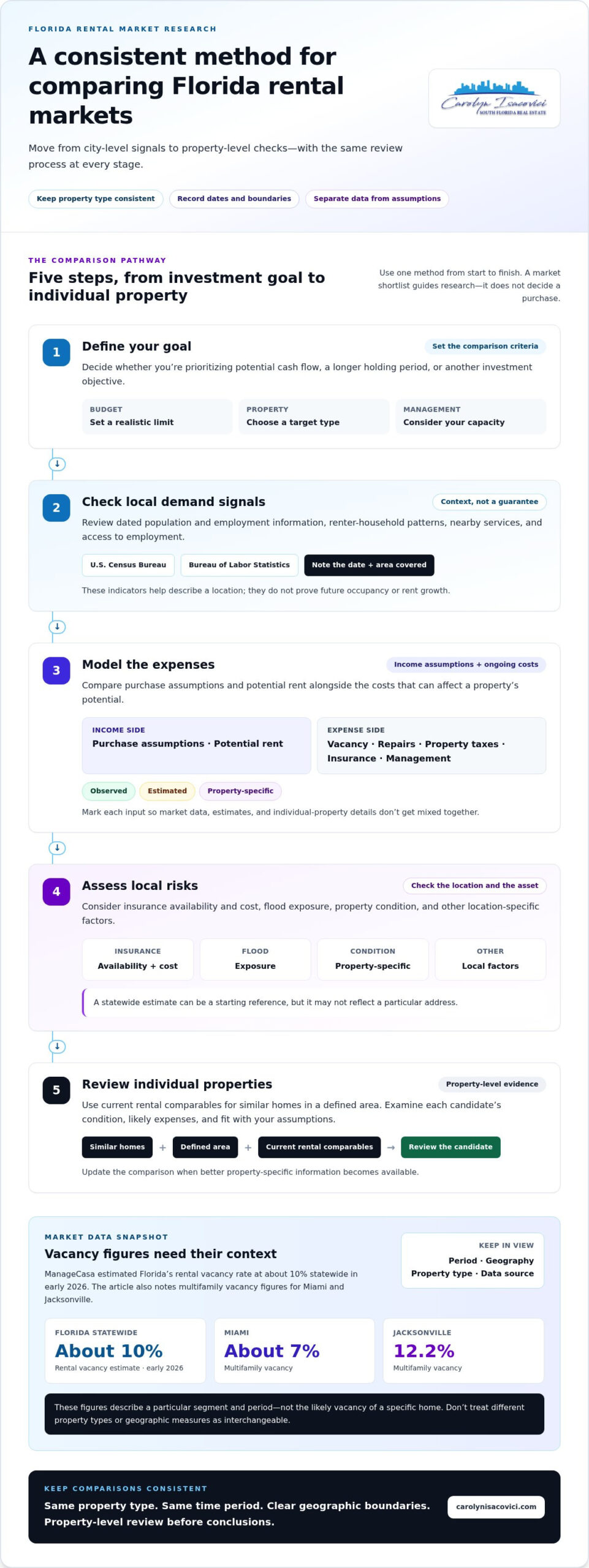
Use data with care. ManageCasa estimated Florida’s rental vacancy rate at about 10% statewide in early 2026, with multifamily vacancy varying from about 7% in Miami to 12.2% in Jacksonville. Those figures describe a particular segment and period, not the likely vacancy of a specific home. When comparing indicators, note their dates, geographic boundaries, and property types. Employment access and population growth can inform research, but neither guarantees occupancy or rent growth.
Why one statewide ranking may not fit every investor
Investor priorities differ. Someone focused on potential cash flow may emphasize entry cost, expected rent, and recurring expenses. A longer-horizon investor may also weigh neighborhood change, property suitability, and plans for holding the asset. Neither approach makes a city universally “best.” Budget, preferred property type, financing assumptions, and capacity to oversee the investment all influence which locations belong on a shortlist.
A single-family home and a condo can involve different operating considerations, even within the same city. The useful comparison isn’t one city’s headline rent against another’s. It’s whether a specific property, its expected income, and its costs align with your objectives and assumptions. Keep estimates separate from observed market data, and revise them as you learn more about a property.
A shortlist should guide research, not decide the purchase. Use the same review process to move from city-level signals to comparable properties and individual costs. The Florida investment property evaluation guide can help structure that next step. Local brokerage guidance can also connect your preferred markets with property acquisition research.
How to compare Florida rental markets using demand, costs, and local conditions
A useful market comparison follows the same method from start to finish. Keep the property type, time period, and geographic boundaries consistent wherever possible, and separate published indicators from estimates and assumptions. A rent figure for an entire metro, for example, may not describe a particular neighborhood or type of home.
- Define your goal. Decide whether you’re prioritizing potential cash flow, a longer holding period, or another investment objective. Set a realistic budget, target property type, and management capacity before choosing cities.
- Check local demand signals. Review dated population and employment information from sources such as the U.S. Census Bureau and Bureau of Labor Statistics. Consider renter-household patterns, nearby services, and access to employment as context, not proof of future occupancy or rent growth.
- Model expenses. Compare purchase assumptions and potential rent alongside vacancy, repairs, property taxes, insurance, and management. Mark each input as observed, estimated, or specific to an individual property.
- Assess local risks. Consider how insurance availability and cost, flood exposure, property condition, and other location-specific factors could affect the investment. A statewide estimate can be a starting reference, but it may not reflect a particular address.
- Review properties. Use current rental comparables for similar homes in a defined area, then examine each candidate’s condition, likely expenses, and fit with your assumptions. Update the comparison when better property-specific information becomes available.
Which local demand signals should investors compare?
Use the same geographic lens for each comparison. Miami-Dade, Broward, Palm Beach County, and the Treasure Coast are distinct research areas, not interchangeable labels for one South Florida market. Within each, note the date and boundaries of population, employment, and rental data. Nearby services and renter-household patterns help describe a location, but they don’t establish what a future tenant will choose.
Rental figures also need clear labels: city or submarket, property type, and reporting period. A citywide median rent, for example, should not be compared directly with a figure for a different property type or a broader metro area without noting the difference. Apply the same care to vacancy and employment indicators.
How to build a realistic property-level comparison
Keep market evidence separate from underwriting. A published rent or tax figure is an observed indicator; assumptions about achievable rent, vacancy, repairs, or management are estimates until assessed for the property. Don’t treat an asking rent as a guaranteed lease amount, and include insurance and property taxes rather than relying on gross rent alone.
City averages can help you screen markets, but they can’t replace property-level underwriting. A side-by-side model makes assumptions visible and easier to revise as you review individual assets. The Florida investment property metrics guide can support that evaluation. Once your criteria are clear, local brokerage guidance can connect your shortlist to investment-property acquisition research through Florida investment property brokerage support.
Florida cities to compare for long-term rental investments in 2026
Rather than rank cities by one headline number, use the same questions to decide which markets deserve deeper research. The tables highlight rent evidence where available and identify property types and risks to investigate, not guaranteed winners. For the best Florida cities for long-term rental investments, validate each signal with current local data and property-specific analysis.
South Florida: Miami, Fort Lauderdale, and nearby markets
Miami, Miami Beach, Hollywood, and Fort Lauderdale are distinct research areas. VoucherMatch reported July 2026 median rents of $2,773 for Miami and $2,610 for Fort Lauderdale across its city-level dataset. These figures are broad indicators, not expected rents for a particular home. For Miami Beach and Hollywood, compare current local rental evidence using the same period and property type.
| City or area | Demand evidence to compare | Property types to investigate | Risks to research |
|---|---|---|---|
| Miami | July 2026 median rent: $2,773 (VoucherMatch). | Single-family, multifamily, and condos. | Address-level insurance, flood exposure, taxes; condo reserves. |
| Miami Beach | Current neighborhood rents, vacancy, employment access. | Multifamily and condos; compare building and unit specifics. | Insurance, flood exposure, taxes, and condo assessments. |
| Hollywood | Current rents and vacancy by property type and submarket. | Single-family and multifamily homes. | Insurance, flood exposure, maintenance, and taxes. |
| Fort Lauderdale | July 2026 median rent: $2,610 (VoucherMatch). | Single-family, multifamily, and condos. | Address-level insurance, flood exposure, taxes; condo reserves. |
Neighborhood boundaries matter. A citywide median can hide differences in housing stock, services, and property expenses. Compare similar rentals and review each candidate’s location rather than treating a metro as uniform.
Palm Beach County, the Treasure Coast, and Melbourne
Compare these locations with the same data checklist, but don’t assume they share demand drivers. For Palm Beach, Palm Beach Gardens, Jupiter, Stuart, Palm City, Port St. Lucie, Fort Pierce, Vero Beach, and Melbourne, check current rental comparables, employment and population indicators, and property-level costs. These are starting points for research, not forecasts of returns.
| City or area | Demand evidence to compare | Property types to investigate | Risks to research |
|---|---|---|---|
| Palm Beach | Current rents, vacancy, employment, and renter households. | Condos, multifamily, and single-family homes. | Insurance, flood exposure, taxes; condo reserves. |
| Palm Beach Gardens | Local rental comparables and employment access. | Single-family homes, multifamily, and condos. | Insurance, flood exposure, taxes, and maintenance. |
| Jupiter | Rents and vacancy by submarket and property type. | Single-family and multifamily homes. | Insurance, flood exposure, taxes, and repairs. |
| Stuart | Current rents, vacancy, and local employment indicators. | Single-family and multifamily homes. | Insurance, flood exposure, taxes, and maintenance. |
| Palm City | Comparable rents and renter-household patterns. | Single-family homes and small multifamily properties. | Insurance, flood exposure, taxes, and repairs. |
| Port St. Lucie | Rents, vacancy, population, and employment trends. | Single-family and multifamily homes. | Insurance, flood exposure, taxes, and maintenance. |
| Fort Pierce | Current local rents and employment access. | Single-family and multifamily homes. | Insurance, flood exposure, taxes, and repairs. |
| Vero Beach | Rental comparables and vacancy by submarket. | Single-family, multifamily, and condos. | Insurance, flood exposure, taxes; condo reserves. |
| Melbourne | Current rents, vacancy, and employment indicators. | Single-family and multifamily homes. | Insurance, flood exposure, taxes, and maintenance. |
Use the same comparison period and geographic definitions across the list, then narrow it to properties that fit your objectives. A Florida real estate portfolio strategy guide can help frame how individual markets fit into a broader investment approach.
What can undermine a promising Florida rental market?
Strong renter demand and an appealing projected rent can make a market worth investigating, but neither shows what may remain after expenses. Insurance, flood exposure, repairs, vacancy, property taxes, and management all affect an asset’s operating picture. A city can look promising while a particular property’s costs, condition, or restrictions make it a poor match for your plan.
Insurance, flood exposure, and recurring ownership expenses
Risk can vary from one property to the next, even within the same city. Check the specific address using authoritative flood mapping, such as FEMA’s Flood Map Service Center, and treat the map as one part of due diligence rather than a complete assessment of site conditions. Review current insurance availability and coverage assumptions for the property; statewide averages won’t establish the terms or cost for an individual asset.
Build an operating model that accounts for recurring expenses as well as rent. Include property taxes, insurance, expected maintenance, a vacancy allowance, and management costs. A roof or building system nearing the end of its useful life, for example, may need more attention in your analysis than a headline rent figure suggests. Engaging a professional inspection service such as Lin Inspects can help uncover physical issues early to ensure your maintenance forecasts remain realistic. These checks aren’t a substitute for individualized insurance, tax, or professional advice, but they can help identify assumptions that need closer review.
Rental rules and property-level due diligence
Rental requirements can depend on location and property type. Before pursuing an acquisition, review current state, city, and county requirements, along with any applicable association rules and property-specific restrictions. Distinguish a long-term residential tenancy from a short-term rental model, since the relevant requirements and operating assumptions may differ. Regulations can change, so use current rules for the property’s jurisdiction rather than relying on an old summary.
Use this checklist to organize a first-pass review:
- Check the property’s flood exposure and identify site-specific questions for further review.
- Review current insurance availability and coverage assumptions for the asset.
- Include taxes, maintenance, vacancy, and management in the operating model.
- Confirm applicable rental requirements and any association or property-level restrictions.
- Compare expected rent with current, relevant rental evidence for similar homes.
These steps help you test whether a market’s appeal carries through to an individual property. Broader context, including the Florida real estate market trends guide, can inform research, but it shouldn’t replace asset-specific review. The best Florida cities for long-term rental investments still require careful underwriting at the address level.
Ready to move from market research to property review? Explore investment property acquisition support as you assess potential Florida assets.
Turn your Florida city shortlist into a property acquisition plan
A city shortlist becomes useful when it leads to specific property criteria. Before you search, write down what the investment needs to do for you, which types of homes you’ll consider, and which operating assumptions matter most. That focus helps you compare potential acquisitions on their merits instead of letting a promising market name make the decision.
From market shortlist to property-specific review
Use a consistent sequence to turn research into action. Prioritize the markets that best align with your objectives, then define the location, property type, intended tenancy, and operating criteria you’ll use to screen opportunities. Review current rental comparables for similar properties in the same area and period, and keep assumptions such as rent and vacancy distinct from verified figures.
- Rank your research priorities. Select the markets that fit your goals and practical constraints, then note what evidence supports including each one.
- Set property criteria. Specify the home type, location characteristics, tenancy plan, and condition factors you’re prepared to consider.
- Review comparable rentals. Compare similar property types using current local evidence, with the time period and geographic area clearly defined.
- Assess each candidate. Examine the individual property’s condition, expected operating costs, and fit with your assumptions before moving toward an acquisition decision.
Keep the comparison consistent across candidates. If one property’s rent estimate is based on a different home type or a wider area, label that difference rather than treating the figures as equivalent. Market context can help explain why a location is worth considering, but the asset’s condition and costs still matter. A city may fit your strategy while a particular property within it does not.
How Florida brokerage guidance can support an acquisition
At this stage, brokerage support can help connect market research with property acquisition. Carolyn Isacovici provides brokerage support for Florida residential, commercial, and investment-property sales. Local insight can add context to a search across Miami, Miami Beach, Hollywood, Fort Lauderdale, Palm Beach, Palm Beach Gardens, Stuart, Jupiter, Palm City, Port St. Lucie, Fort Pierce, Vero Beach, and Melbourne, while your criteria keep the review centered on your investment objectives. Brokerage guidance supports the sales process; it doesn’t promise a particular return or replace your property-level analysis.
The best Florida cities for long-term rental investments are the ones that merit a closer look against your goals and the facts of each candidate property. You don’t need to resolve every question at the city-shortlist stage. Move forward methodically, refine your criteria as you review real opportunities, and keep market assumptions separate from property-specific findings.
If you’re ready to discuss your Florida investment property search, connect with Carolyn Isacovici to explore brokerage support for your acquisition research.
Take the next step toward a focused Florida acquisition
Your city shortlist is most valuable when it helps you recognize a property that fits your goals, not when it pressures you to choose quickly. Keep refining your criteria as you review opportunities, and let new property-level evidence sharpen your search. That steady approach can help turn research into a clearer path forward among the best Florida cities for long-term rental investments.
When you’re ready to explore specific opportunities, local brokerage support can help you navigate investment-property acquisitions and Florida property sales. Carolyn Isacovici works across South Florida, the Treasure Coast, and Melbourne, connecting market research with the next stage of your search without promising a particular investment outcome.
Explore support for your Florida investment property acquisition and take your next step with confidence. A well-defined plan gives you a stronger foundation for making a thoughtful decision.
Frequently Asked Questions
Which Florida cities should I compare for a long-term rental investment?
Start with the markets that fit your budget and property criteria, such as Miami, Fort Lauderdale, Palm Beach, Jupiter, Stuart, Port St. Lucie, Vero Beach, or Melbourne. Then narrow the comparison to specific neighborhoods and similar property types. For example, compare single-family homes with single-family homes, not with condos, and use rental evidence from the same period. A smaller, relevant comparison set is more useful than a statewide ranking.
Is Florida a good state for long-term rental investments?
Florida may suit investors seeking residential rental opportunities, but the state alone can’t determine whether an acquisition is appropriate. The answer depends on your goals, the location, property condition, expected income, and ongoing costs. Before deciding, test whether your plan still works under less favorable assumptions, such as a longer vacancy or an unexpected repair. Treat state-level appeal as a reason to research, not as evidence that a specific property will perform well.
How much rental income can a Florida investment property generate?
There’s no single reliable income figure for every Florida rental. Rent depends on the property’s location, size, condition, and comparable homes available to tenants. To estimate potential income, gather recent listings or leases for similar nearby properties and note the dates and property details. Then distinguish gross rent from what might remain after vacancy and operating expenses. Use the estimate to screen an opportunity, not as a promise of collected rent.
Can I compare Miami with Treasure Coast cities for a long-term rental?
Yes, but make the comparison useful by holding key assumptions steady. Match property type, tenancy plan, data period, and geographic level, then compare factors such as rent evidence, purchase assumptions, and recurring expenses. Miami and a Treasure Coast city may have different housing options and cost profiles, so a regional average can hide important differences. Compare individual submarkets and properties before deciding which fits your investment plan.
What happens if a Florida rental property is in a flood-risk area?
A flood-risk designation is a prompt for further property-specific review, not an automatic verdict on an acquisition. Check the address using authoritative flood mapping, then investigate how the site’s exposure may affect insurance availability, coverage assumptions, maintenance planning, and your operating model. Mapping has limits and doesn’t replace an assessment of the property itself. Discuss insurance questions with a qualified insurance professional, and avoid assuming a citywide risk description applies equally to every parcel.
Should I choose a long-term rental or a short-term rental in Florida?
Choose the model that matches your objectives, capacity, and the property’s permitted use. Long-term rentals focus on ongoing residential tenancy, while short-term models may involve more frequent guest turnover and different operating needs. Compare expected revenue only after accounting for vacancy, furnishing, cleaning, maintenance, and any applicable local requirements. Don’t use short-term rental figures as a direct proxy for long-term income; the business models and comparable data are different.
Do Florida rental rules vary by city or property?
They can. A rental plan may be affected by requirements that apply to its location as well as documents or restrictions tied to the property, such as association rules. The relevant details can depend on whether the plan involves ongoing residential tenancy or short-term stays. Before committing, identify the property’s jurisdiction and review current applicable requirements and governing documents. For legal interpretation or advice about a specific obligation, consult a qualified legal professional.
Leave a Reply