
Tag: Property Investment Guide

  • Miami Luxury Condos: 2026 High-Value Investment Guide

    Miami Luxury Condos: 2026 High-Value Investment Guide

    What if the most significant risk to your portfolio isn’t the current supply of Miami luxury condos for investment, but rather the failure to distinguish a “vanity project” from a true scarcity asset? It’s natural to feel a sense of hesitation when headlines mention a buyer’s market or shifting lending regulations. You’ve likely felt the weight of these complexities while trying to decide between the allure of pre-construction and the proven stability of resale metrics. Is the market truly oversupplied, or are we simply seeing a flight to quality that leaves average buildings behind? The answer lies in understanding the 2026 drivers of value.

    We’re here to help you navigate this evolving landscape with a steady hand. You’ll discover how to evaluate “Scarcity Assets” that leverage global brand equity and limited geographic footprints to protect your capital. This guide provides a clear framework for identifying high-value opportunities, from the rise of branded residences to the impact of new structural reserve requirements. By the end, you’ll have the confidence to choose a long-term investment vehicle that aligns with your financial goals, turning market uncertainty into a strategic advantage.

    Key Takeaways

    • Learn to identify “Scarcity Assets” by looking beyond the skyline. True value in 2026 comes from limited geographic footprints and unique architectural integrity.
    • Master the new math of Miami luxury condos for investment. You’ll understand how to calculate the “Value Per Amenity” and why brand equity commands a significant resale premium.
    • Compare the long-term liquidity of branded residences against boutique developments. Discover which asset type offers better protection during market shifts.
    • Pinpoint high-growth corridors for 2026. You’ll learn to contrast the urban energy of Brickell with the secluded “Island Luxury” of Key Biscayne to find your ideal fit.
    • Gain a strategic edge with off-market access. Understand why a specialized broker is essential for securing ultra-luxury units before they reach the public eye.

    The Evolution of High Value Real Estate: Miami Luxury in 2026

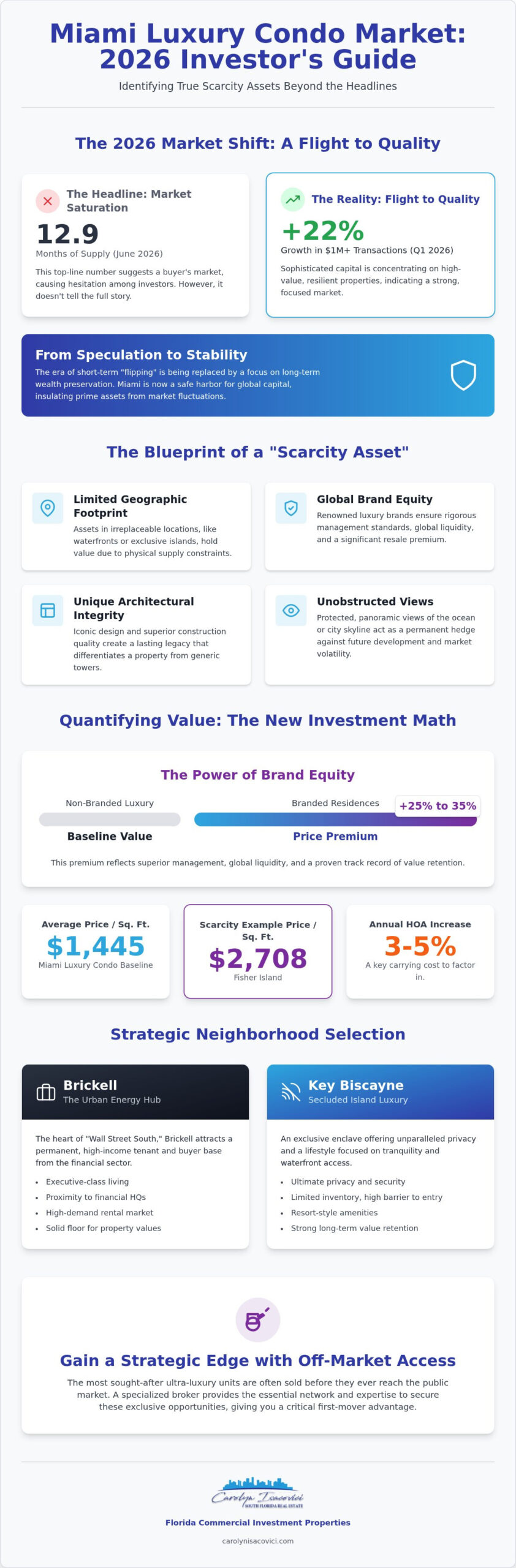
    The skyline tells one story; the ledger tells another. In the 2026 market, high-value real estate is no longer defined by gold-leafed lobbies or soaring heights alone. It’s defined by the stability of an “equity-rich” buyer base that prioritizes resilience over flash. While some observers point to the 12.9 months of supply recorded in June 2026 as a sign of saturation, a closer look at the data reveals a different reality. Transactions for properties priced at $1 million and above actually climbed by 22% in the first quarter of the year. Identifying the right Miami luxury condos for investment requires looking past these “saturation” headlines to see where the real capital is moving. This isn’t a market of excess. It’s a market of concentration.

    Global investors have pivoted. The era of speculative “flipping” has largely been replaced by a sophisticated focus on wealth preservation. Institutional players and private family offices now view Miami as a safe harbor, comparable to London or Zurich. They aren’t just buying square footage; they’re securing a piece of a limited geographic footprint that serves as a primary target for global capital. This shift ensures that high-quality assets remain insulated from the broader fluctuations often seen in more speculative tiers of the market.

    The “Wall Street South” Impact on Luxury Demand

    The migration of financial giants to South Florida has fundamentally altered the DNA of local demand. These corporate relocations aren’t temporary. They’ve established a permanent, high-income tenant and buyer base that requires “executive-class” living. Condos near financial hubs like Brickell have seen a direct correlation between local business growth and property appreciation. When a major hedge fund moves its headquarters, the demand for high-end residential units within walking distance doesn’t just rise; it solidifies. This creates a reliable floor for property values, as these units serve a specific, high-earning demographic that values proximity to their professional base.

    Wealth Preservation vs. Capital Gains

    Stability is the new luxury. Within the broader Florida housing market, investors are increasingly looking for low-volatility assets to anchor their portfolios. Miami luxury condos for investment now function as “vertical gold,” providing a tangible hedge against inflation and currency fluctuations. This shift toward long-term holding is a defining characteristic of the current cycle. Current Miami real estate market trends favor long-term holders who prioritize asset quality and location over quick exit strategies. This patient capital ensures that even during periods of higher inventory, the most prestigious addresses maintain their value and liquidity.

    Quantifying Investment Metrics for Miami Luxury Condos

    Why do two buildings on the same block often command vastly different resale values? The answer lies in the quantifiable power of brand equity. In the 2026 market, branded residences are not just lifestyle choices; they are strategic financial vehicles that typically command a 25% to 35% price premium over non-branded counterparts. This premium isn’t merely for the name on the door. It reflects the global liquidity and rigorous management standards that luxury brands bring to a property, ensuring the asset remains pristine and desirable over decades.

    While the average price per square foot for Miami luxury condos for investment stands around $1,445, savvy investors look beyond this baseline. They calculate the “Value Per Amenity” to determine how specific features, like private elevators or helipads, influence potential rental income and resale speed. It’s also vital to account for carrying costs. With median HOA fees for high-rise condos exceeding $1,900 per month, and ultra-luxury towers often reaching $10,000 or more, understanding the impact on your Net Operating Income (NOI) is essential for long-term success. These costs are currently rising by 3% to 5% annually, making efficient building management a key metric for asset selection. Investors who tracked the Florida market real estate opportunities 2025 cycle recognize that the late-2025 market rebalancing has created a more predictable environment for evaluating these carrying costs against long-term yield potential.

    The Scarcity Principle in Waterfront Real Estate

    Unobstructed views act as a permanent hedge against market volatility. In a city that continues to grow, “land-locked” neighborhoods like Fisher Island, which commands $2,708 per square foot, represent the pinnacle of physical scarcity. When new supply is physically impossible, your investment is shielded from the dilution that can affect mainland projects. You can apply the how to evaluate investment property Florida framework to these luxury assets to determine if the location’s geographic constraints justify the entry price. If you find yourself weighing these complex variables, consulting with a specialized luxury broker can provide the clarity needed to identify truly rare opportunities.

    Rental Yields in the High-End Segment

    The rise of the “Ultra-Luxury Rental” market has created a new revenue stream for owners. Transient executives and “snowbirds” are increasingly willing to pay a luxury premium for branded services and turnkey environments. While long-term leases provide steady cash flow, seasonal high-value rentals often yield higher gross returns in specific corridors like Sunny Isles Beach or Bal Harbour. Tenants in this segment aren’t just looking for a roof; they’re paying for a frictionless lifestyle. This demand for service-oriented living ensures that Miami luxury condos for investment remain competitive even as the broader rental market fluctuates.

    Branded Residences vs. Boutique Luxury: Strategic Comparisons

    Does your investment benefit more from a world-renowned name or a discreet, private address? In 2026, the choice between branded residences and boutique luxury has become a defining crossroads for those seeking Miami luxury condos for investment. Branded residences, often born from partnerships with elite hospitality or automotive giants, offer a turnkey lifestyle backed by institutional-grade management. This model provides a level of service consistency that is difficult to replicate in unbranded buildings. It isn’t just about the logo on the stationery; it’s about the global standards of excellence that protect the long-term value of the asset through every market cycle.

    Liquidity remains the primary driver for the branded segment. When you decide to exit, a branded unit has a built-in audience of global loyalists who recognize the name instantly. These buyers often search specifically for the brand, which can lead to a faster resale cycle and a more predictable price floor. Conversely, boutique luxury offers a compelling alternative for investors who prioritize exclusivity and low turnover. These smaller, intimate projects often attract long-term residents rather than transient tenants, creating a stable community that preserves the building’s prestige over time.

    The Branded Premium: Is it Worth the Entry Cost?

    Is a global brand name worth the additional capital outlay? For many, the answer is a resounding yes. While these developments typically command a significant price premium, they also benefit from massive global marketing budgets that individual owners could never match. When the brand promotes its latest project in London, Dubai, or Tokyo, they are indirectly marketing your unit to an international pool of high-net-worth individuals. This global reach is a cornerstone of the Miami real estate investment opportunities found in the branded sector, where the reputation of a partner acts as a secondary layer of insurance for your capital.

    Boutique Buildings: The Hidden Gems of South of Fifth

    Savvy investors often look toward buildings with fewer than 50 units to find “Quiet Luxury.” In neighborhoods like South of Fifth, these boutique gems offer a level of privacy that massive towers simply cannot provide. The appeal lies in the scarcity. With fewer units available, there is less internal competition when you choose to rent or sell your property. Additionally, boutique buildings often have lower overhead costs compared to massive towers with dozens of high-maintenance amenities. This leaner structure can lead to more stable HOA fees, protecting your net returns while still offering the high-end finishes and personalized service that discerning tenants demand.
    Miami Luxury Condos: 2026 High-Value Investment Guide

    Strategic Neighborhood Selection for Luxury Investors

    Where should you place your capital in a city that is growing in every direction? The answer depends entirely on your specific investment horizon. In 2026, neighborhood selection is no longer just about zip codes; it’s about identifying the specific corridors where infrastructure meets demand. While Brickell remains the heart of “Urban Luxury” with its executive-class towers and proximity to financial hubs, areas like Key Biscayne offer a secluded “Island Luxury” that appeals to a more conservative, privacy-focused investor profile. This contrast is vital for your strategy. Are you seeking the high-velocity rental market of the financial district or the generational wealth preservation of a land-locked island?

    Value isn’t just built; it’s connected. The continued expansion of the Brightline and significant port upgrades are reshaping how residents move and where they choose to live. These projects turn emerging residential hubs like Edgewater and Coconut Grove into primary targets for Miami luxury condos for investment. As accessibility improves, these neighborhoods transition from emerging markets to established luxury destinations, often yielding significant appreciation for early entrants who recognize the shift before the final ribbon-cutting. These infrastructure drivers provide a tangible foundation for growth that goes beyond aesthetic appeal.

    South of Fifth and Coconut Grove: The Blue-Chip Stabilizers

    Why do these two distinct areas consistently command the highest price-per-square-foot in the city? It’s a matter of physical inventory. Both South of Fifth and Coconut Grove are geographically constrained, leaving almost no room for massive new developments. This scarcity acts as a natural shield for your equity. When supply is capped but demand continues to surge from global buyers, values don’t just hold; they thrive. For those looking for street-level data on these high-demand pockets, the guide to the best neighborhoods to invest in Miami offers deeper insights into specific upcoming projects and historical performance.

    Sunny Isles and Bal Harbour: The Ultra-Luxury Strongholds

    Looking for market resilience at the highest level? Sunny Isles Beach and Bal Harbour represent the “Billionaire’s Row” of the Atlantic coast. The concentration of ultra-luxury assets here is staggering, and with an estimated 50% or more of transactions above $2 million closing in cash, these neighborhoods are remarkably insulated from broader economic fluctuations. The proximity to world-class retail like the Bal Harbour Shops provides a permanent draw for international wealth. As you evaluate the 2026 pipeline for oceanfront new construction homes Florida, you’ll find that these areas continue to set the global benchmark for luxury living. If you’re ready to explore these high-growth corridors, speak with an expert advisor who specializes in identifying off-market opportunities in Miami’s most exclusive enclaves.

    Securing Your Investment: The Role of a Specialized Miami Broker

    Why settle for a generalist when your capital is at stake? A standard real estate agent might help you find a residence, but a specialized broker acts as a strategic partner. In the high-stakes world of Miami luxury condos for investment, the most valuable assets often change hands before they ever reach a public listing. This “off-market” access is a hallmark of a seasoned professional who maintains deep relationships with developers and private sellers. It’s the difference between picking from the leftovers and having the first right of refusal on a trophy asset.

    Developer contracts for new construction are notoriously complex. These documents are often written to favor the builder, featuring intricate clauses regarding delivery timelines and finishes. A specialized broker knows exactly which terms to scrutinize, ensuring your interests are protected during the long lead times of a development cycle. They provide the “calm expert” perspective needed to navigate high-pressure negotiations, transforming a stressful transaction into a calculated business move. By maintaining a steady hand, your broker ensures that the excitement of a new project never clouds the reality of the investment’s potential.

    Due Diligence Beyond the Floor Plan

    It isn’t just about the view; it’s about the building’s structural and financial health. In 2026, Florida laws like HB 913 require insurance appraisals every 36 months and strict reserve thresholds. For the “catch-all” category, the official reserve threshold stands at $25,675. A broker analyzes these structural integrity reserve studies to ensure you aren’t walking into a building with massive upcoming special assessments. Since January 1, 2026, associations with 25 or more units must provide online access to documents, yet having access is only helpful if you know how to interpret the data. For international buyers, the broker serves as a central hub, coordinating with legal and tax advisors to manage the logistics of cross-border acquisitions.

    The Carolyn Isacovici Advantage

    Experience matters when market cycles shift. With brokerage expertise dating back to 2006, our firm has navigated every iteration of the South Florida landscape. We don’t just sell properties; we offer an advisory-first approach designed to build a diversified portfolio that stands the test of time. Whether you’re looking for new construction or a strategic commercial investment asset, we provide the steady hand you need to move forward with confidence. We focus on the numbers that matter, ensuring your next acquisition is a source of long-term security. Consult with Carolyn Isacovici to identify your next high-value Miami acquisition.

    Your Strategic Future in the Miami Skyline

    Miami’s 2026 market isn’t just about acquiring property; it’s about curating a portfolio of scarcity assets that withstand the test of time. The distinction between branded residences and boutique gems defines long-term liquidity. Success also requires looking beyond the floor plan to the structural health and association reserves of the building itself. Is your strategy ready for the next decade of growth? By prioritizing quality over volume and neighborhood-specific infrastructure over general trends, you’re positioned to capture the true essence of South Florida’s wealth migration.

    Securing the right Miami luxury condos for investment requires a partner who looks beyond the immediate sale to your long-term success. With over 20 years of Florida real estate expertise, Carolyn Isacovici serves as a strategic advisor for global investment portfolios, specializing in high-value commercial and residential brokerage. We don’t just find listings; we identify opportunities that align with your unique financial goals. Secure Your Miami Luxury Investment Strategy with Carolyn Isacovici. The future of the Miami skyline is bright, and with the right guidance, your investment can be just as brilliant.

    Frequently Asked Questions

    Are Miami luxury condos a good investment in 2026?

    Miami luxury condos for investment remain a strong choice for those prioritizing wealth preservation. While inventory has grown to 12.9 months of supply, the market for units above $1 million saw a 22% increase in transactions during early 2026. This indicates a flight to quality rather than a general slowdown. By focusing on scarcity assets in high-demand corridors, you can capitalize on a market that continues to attract global capital and institutional interest.

    What is the average ROI for a luxury condo in Miami?

    While individual returns depend on the specific asset, mainland luxury prices rose by 18% year-over-year in Q2 2026. Investors often see the best results by targeting properties that command high rental premiums, such as those in Brickell or Sunny Isles Beach. These areas benefit from a permanent high-income tenant base. Success in this segment requires looking beyond simple capital gains to the steady, executive-class rental yields that modern luxury towers provide.

    Should I buy pre-construction or resale luxury condos for investment?

    Choosing between pre-construction and resale depends on your risk appetite and cash flow needs. Pre-construction allows you to secure a unit at current prices with the latest architectural standards, which is ideal for long-term appreciation. Resale units, however, provide immediate Net Operating Income and a proven track record of association health. Both paths offer value, provided you perform deep due diligence on developer reputation or the building’s structural integrity reserve studies.

    How do high HOA fees impact Miami condo investment returns?

    High HOA fees directly impact your bottom line, with median monthly costs for high-rise units now exceeding $1,900. These fees are rising by 3% to 5% annually, making it essential to evaluate if the amenities justify the expense. A high fee is often acceptable if it maintains the building’s global prestige and attracts tenants willing to pay a luxury premium. We help you calculate the “Value Per Amenity” to protect your net returns.

    Which Miami neighborhoods have the highest luxury property appreciation?

    South Beach has recently led the market with a 37% year-over-year price gain, reaching $1,538 per square foot. Neighborhoods like Edgewater and Sunny Isles Beach also show strong appreciation potential due to limited oceanfront inventory and significant infrastructure improvements. Identifying these high-growth corridors early is a key strategy for Miami luxury condos for investment. Focusing on areas with physical geographic constraints ensures your equity remains shielded from the dilution of over-supply.

    What are the risks of investing in Miami luxury real estate?

    The primary risks in 2026 involve rising insurance costs and the elimination of “Limited Review” lending rules starting August 3, 2026. These changes require nearly all sales to undergo full reviews of association finances and structural health. You can mitigate these risks by choosing buildings with healthy reserves and clear milestone inspection reports. Working with a specialized broker ensures you don’t walk into a “condo cliff” scenario where financing becomes difficult for future buyers.

    How does the “Branded Residence” trend affect resale value?

    Branded residences typically command a 25% to 35% price premium over non-branded luxury condos. This trend significantly boosts resale value by tapping into a global network of brand loyalists who prioritize consistent service and institutional-grade management. These properties often see higher liquidity and faster resale cycles because the brand acts as a secondary layer of insurance for the buyer. It’s a powerful way to ensure your asset remains desirable in any market condition.

    Can international investors easily buy luxury condos in Miami?

    International investors can buy with relative ease, as evidenced by the $4.4 billion invested in South Florida real estate during 2025. While the process is straightforward, it does require careful coordination between legal and tax advisors to manage cross-border complexities. We specialize in assisting global clients with these high-value acquisitions, ensuring every step is handled with professional authority. Miami continues to be a safe harbor for global capital seeking stability and long-term growth.
  • Navigating Commercial Real Estate in South Florida: A 2026 Investor Guide

    Navigating Commercial Real Estate in South Florida: A 2026 Investor Guide

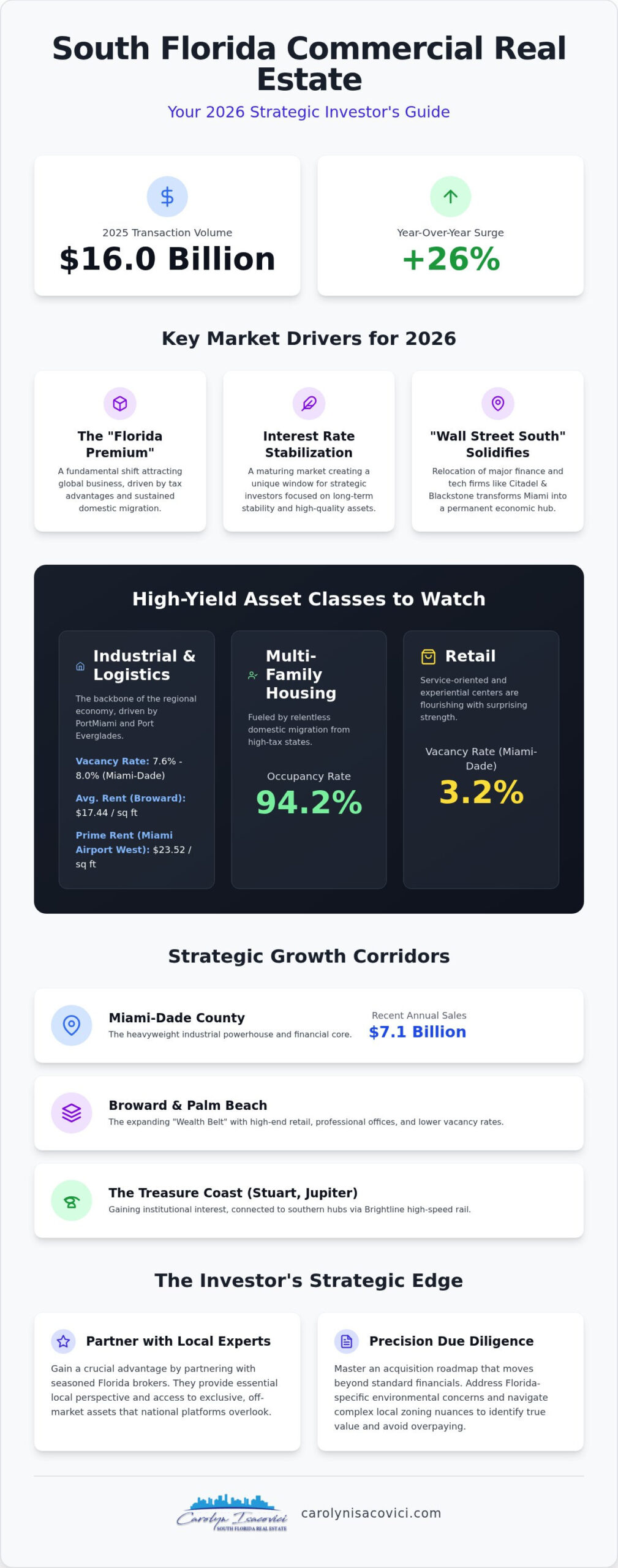
    Did you know that transaction volume for commercial real estate South Florida reached a staggering $16.0 billion in 2025? It’s a 26% year-over-year surge that confirms the market has transitioned from a temporary frenzy into a stable, high-liquidity powerhouse. You likely feel the pressure of rising entry costs and the complexity of local zoning laws. Is it possible to secure a high-value asset without overpaying in such a competitive landscape? Absolutely, provided you have the right map.

    Strategic clarity. This guide is your compass for identifying the region’s most resilient corridors. We’ll show you how to leverage the recent repeal of the commercial lease tax and pinpoint the 2026 growth zones that offer the best long-term yields. By the end of this article, you’ll have the insights needed to establish a partnership with a trustworthy local broker and move forward with the confidence of a seasoned investor.

    Key Takeaways

    • Understand how interest rate stabilization and the “Florida Premium” are shaping a unique window of opportunity for strategic investors in 2026.
    • Identify the specific high-yield potential within the industrial logistics and multi-family housing sectors across the region’s most resilient corridors.
    • Learn to navigate the diverse landscape of commercial real estate South Florida by comparing the high-appreciation Miami core with the stable Palm Beach “Wealth Belt.”
    • Master a precision due diligence roadmap that addresses Florida-specific environmental concerns and moves beyond standard financial pro-formas.
    • Discover the strategic advantage of partnering with a local expert to secure exclusive off-market assets that national platforms often overlook.

    Understanding the South Florida Commercial Real Estate Landscape in 2026

    Why does capital continue to flood into the Sunshine State even as other national markets face cooling periods? The answer lies in the “Florida Premium.” This isn’t just a tax advantage; it’s a fundamental shift in how global businesses view the South Florida region. By 2026, the market has matured from the post-pandemic frenzy into a sophisticated, high-performance environment where strategic timing meets long-term stability. While conventional commercial mortgage rates currently hover between 5.63% and 8.93%, the demand for high-quality assets remains remarkably resilient.

    The 2026 outlook is defined by a delicate balance. We are seeing interest rate stabilization paired with a “flight to quality” that rewards investors who prioritize Class A assets. This is no longer just a tourism economy. The solidification of “Wall Street South,” led by the relocation of major firms like Citadel and Blackstone, has transformed Miami and West Palm Beach into permanent hubs for finance and technology. To succeed here, you must look past the surface. Localized zoning nuances and the recent repeal of the Florida commercial lease tax have created a landscape where a local perspective is mandatory to avoid overpaying and to identify true value.

    The Resilience of the Florida Market

    Is the South Florida market truly recession-proof? While no market is entirely immune to global shifts, local experts point to the relentless engine of domestic migration as a primary safeguard. As people move from high-tax states in the Northeast, they bring a consistent need for office space, retail centers, and housing. While national markets often face volatility, the 2026 South Florida commercial landscape remains anchored by a 94.2% multifamily occupancy rate and a robust $16 billion annual transaction volume. This stability provides a reassuring foundation for those looking to secure commercial real estate South Florida assets that can weather various economic cycles.

    Key Regions: From Miami-Dade to the Treasure Coast

    Understanding the geography of opportunity is the first step in building a resilient portfolio. While Miami-Dade remains the heavyweight with $7.1 billion in recent annual sales, the “Wealth Belt” is expanding. Broward and Palm Beach counties offer a mix of high-end retail and professional office spaces that appeal to institutional investors seeking lower vacancy rates. We are also seeing a significant move northward. Areas like Stuart, Jupiter, and Port Saint Lucie are gaining institutional interest as the Brightline high-speed rail connects these corridors to the southern hubs. Geographic diversification across these counties protects your investment portfolio by tapping into different sub-market strengths, from the industrial power of Miami Airport West to the luxury stability of the Treasure Coast.

    High-Yield Asset Classes: Where to Invest in 2026

    Where should you place your capital to maximize returns in this maturing market? The answer depends on your appetite for growth versus stability. While the broader market has shifted from a sprint to a steady marathon, specific sectors of commercial real estate South Florida continue to offer exceptional yields. According to the Emerging Trends in Real EstateĀ® 2026 report, the region’s success is increasingly tied to operational excellence and proximity to major infrastructure. This shift rewards investors who move beyond speculation and focus on assets with high utility and strong demographic support.

    Industrial assets remain the undeniable backbone of the regional economy. With Miami-Dade industrial vacancy rates holding steady between 7.6% and 8.0%, we’re seeing a market that has absorbed new supply without losing its competitive edge. In high-demand areas like Miami Airport West, rents are commanding $23.52 per square foot (NNN). Retail is also showing surprising strength. A 3.2% vacancy rate in Miami-Dade retail spaces proves that service-oriented and experiential centers are flourishing. If you’re looking for high-value opportunities, exploring current investment property sales can help you identify assets that align with these high-performance trends.

    The Industrial Boom in Broward and Miami-Dade

    Why is industrial space still a primary target? It’s all about the ports. The proximity to PortMiami and Port Everglades creates a permanent value driver for logistics firms. We’ve seen a significant rise in “last-mile” delivery hubs in suburban Hollywood and Fort Lauderdale, where Broward County industrial rents average $17.44 per square foot. These assets are critical for the modern supply chain. They provide the necessary speed for e-commerce and local distribution that residents now expect as a standard, ensuring that these properties remain occupied even during broader economic shifts.

    Multi-Family and Residential Investment Sales

    Multi-family housing remains a cornerstone for risk-averse investors seeking predictable cash flow. With a regional occupancy rate of 94.2% as of late 2025, the demand for rental units continues to outpace supply. We’re also seeing investors diversify by incorporating new construction homes into their portfolios to capture the steady influx of new residents; for instance, some high-net-worth individuals also choose to buy off plan property Dubai to achieve global diversification in another premier real estate market. While the Miami core is premium, growth is pushing northward. Port Saint Lucie and Fort Pierce have become essential hubs for affordable multi-family growth, offering lower entry costs than the southern counties while benefiting from the same demographic tailwinds. It’s a strategic way to build a balanced portfolio across the entire region.

    Strategic Hubs: Comparing South Florida’s Growth Corridors

    Where do you find the best balance between immediate yield and long-term appreciation? The answer depends on your specific investment horizon. The commercial real estate South Florida market isn’t a monolith; it’s a collection of distinct corridors, each with its own rhythm and risk profile. To navigate this successfully, you have to look beyond the general headlines and understand the localized data that drives value in each county.

    Miami remains the region’s heavyweight for appreciation. Class A office space in Miami-Dade averages $66.87 per square foot, but prime locations in Brickell frequently exceed $90 to $100. It’s a high-entry market, but the global prestige and liquidity are unparalleled. For investors seeking a detailed breakdown of neighborhood-specific dynamics and zoning considerations, our 2026 guide to commercial buildings for sale in Miami provides the sub-market intelligence needed to identify true value. Conversely, the Palm Beach “Wealth Belt” offers a different kind of strength. With office rents averaging $52.75 per square foot, this area provides stability through a concentration of luxury retail and professional services that cater to a high-net-worth demographic. Cap rates across these established hubs remain competitive, with core industrial properties trading between 4.0% and 5.5%, while NNN retail typically lands in the 5.0% to 6.5% range.

    Established Markets: Miami and Fort Lauderdale

    Miami Beach and Hollywood have evolved into year-round commercial engines, moving far beyond their seasonal tourism roots. Much of this shift is fueled by infrastructure. The Brightline high-speed rail has fundamentally changed property values near its stations, creating transit-oriented hubs that didn’t exist a decade ago. In Palm Beach Gardens and Jupiter, we see a consistent trend in investment property sales as businesses follow the wealth migration northward. These areas offer a blend of high-end lifestyle amenities and modern office space that attracts top-tier corporate tenants.

    The Treasure Coast Opportunity

    Why are institutional investors now targeting Vero Beach and Melbourne? These are the new frontiers for 2026. Strategic hubs like Stuart and Palm City offer significant advantages for industrial investors who need coastal proximity without the intense competition of the southern counties. In Fort Pierce and Vero Beach, you’ll find much lower price-per-square-foot opportunities compared to Miami or Fort Lauderdale. We forecast Melbourne will see substantial growth over the next five years, driven by the expanding aerospace industry and a tech-focused workforce that values the area’s lower cost of living and high quality of life.

    Navigating Commercial Real Estate in South Florida: A 2026 Investor Guide

    The Acquisition Roadmap: Precision Due Diligence in Florida

    How do you transition from identifying a promising listing to securing a high-value asset? The path is paved with data and meticulous verification. In the competitive arena of commercial real estate South Florida, precision during the due diligence phase is what separates a high-yield success from a costly oversight. We approach this through a methodical roadmap that transforms market complexity into a series of manageable, strategic steps. It’s about looking past the marketing brochures to find the structural and financial truth of a property.

    The 2026 acquisition process requires a steady hand. You’ll start with financial modeling that moves beyond the seller’s pro-forma to reflect real-world cap rates, which for core industrial properties currently range from 4.0% to 5.5%. Physical inspections follow, focusing on Florida-specific environmental resilience. Next, a rigorous legal and zoning review ensures the property matches your intended use case. Finally, we navigate the closing process within a lending environment where conventional mortgage rates typically range from 5.63% to 8.93%. If you want to ensure your next move is backed by this level of expertise, partner with us for comprehensive investment property sales support to protect your capital.

    Evaluating Investment Property Metrics

    Calculating a realistic cap rate for a Miami multi-family asset requires an understanding of the current 4.0% to 5.0% trading range. However, the numbers on the page are only half the story. You must account for 2026 property tax assessments and insurance “gotchas” that can impact your net operating income. We also emphasize the importance of 1031 Exchange timing. In a high-liquidity market, the 45-day identification period moves quickly, making it essential to have your next target identified before you close your current sale.

    Navigating Local Regulations

    Zoning laws in Miami-Dade often differ wildly from the requirements in Palm Beach County. What is permissible in a high-density urban corridor like Brickell may be strictly prohibited in the more suburban “Wealth Belt” neighborhoods. Environmental due diligence has also become more sophisticated. Investors must now evaluate sea-level rise projections and adhere to updated coastal construction requirements. Successfully working with local municipalities for new development approvals requires a seasoned guide who understands the nuances of local boards and the specific needs of the South Florida ecosystem.

    Partnering for Success: The Value of a Seasoned Florida Broker

    Why settle for a generic algorithm when you can have an advocate who knows the local corridors by heart? National aggregators offer volume, but they lack the nuance required to navigate a market as diverse as commercial real estate South Florida. A listing on a portal tells you the price; a seasoned broker tells you why that price exists and what the future holds for that specific block. It’s about shifting from a passive search to an active, strategic acquisition. In a landscape where transaction volumes have reached $16 billion, having an “ear to the ground” isn’t just a luxury. It’s a necessity for protecting your capital. Understanding how to select and work with a Miami commercial real estate broker who can transform property transactions into long-term wealth-building strategies is one of the most critical decisions you’ll make in this market.

    In addition to market expertise, high-net-worth investors often discover Klein & Fortune, P.A. to ensure their commercial holdings are properly structured for long-term asset protection.

    The most valuable assets in this region often change hands without ever appearing on a public database. These “off-market” opportunities are the lifeblood of successful portfolios, and they’re accessible only through deep-rooted local relationships. At Florida Commercial Investment Properties, we simplify the end-to-end sales process by acting as your eyes and ears on the ground. We don’t just find properties; we identify the underlying value and potential zoning advantages that others might miss. This proactive approach transforms market uncertainty into a clear, strategic advantage for our clients.

    Our Approach to Commercial Investment Sales

    We provide personalized guidance that scales with your specific goals. Whether you’re an individual investor looking for your first multi-family asset or an institution targeting a large-scale industrial hub, our approach remains thorough and results-oriented. With experience dating back to 2006, we’ve navigated multiple market cycles with a steady, confident hand. Our unique ability to manage commercial property sales alongside residential and new construction investment allows us to offer a holistic view of the Florida landscape. This breadth of expertise ensures that every recommendation we make is grounded in a comprehensive understanding of the regional economy.

    Your Next Steps in the Florida Market

    Preparing your portfolio for 2026 acquisitions requires more than just capital. It requires a clear vision and a partner who can provide the analytical mind of a strategist with the empathetic ear of a consultant. Uncertainty in the market is often just a lack of specific, localized information. We’re here to provide that clarity, helping you identify which growth corridors from Miami to Melbourne align with your risk tolerance and yield expectations. The first step is a professional consultation to refine your criteria and begin the search for assets that offer true long-term resilience.

    Ready to secure your position in one of the nation’s most resilient markets? Don’t leave your success to chance. Schedule a strategy session with Carolyn Isacovici today and let’s turn your investment goals into reality.

    Charting Your Path to Florida Investment Success

    Success in this market isn’t about following the crowd; it’s about anticipating where the crowd will be tomorrow. You’ve seen how the “Florida Premium” and infrastructure-driven growth are reshaping the region’s landscape. By focusing on precision due diligence and identifying high-yield corridors from Miami to Melbourne, you can transform current market complexities into a significant strategic advantage. Whether you’re targeting industrial hubs or luxury multi-family assets, the key is to move with data-backed confidence and a clear roadmap.

    With over two decades of expertise in commercial real estate South Florida, our team provides the specialized brokerage and due diligence support needed to secure and protect high-value holdings. We’ve navigated multiple market cycles since 2006, and we’re ready to help you identify the off-market opportunities that national platforms often miss. Your goals deserve a partner who understands the nuances of both commercial and high-value residential assets across the region’s most resilient corridors.

    Secure your next high-yield investment with Florida Commercial Investment Properties. The future of the Sunshine State remains bright, and with a seasoned guide by your side, your next strategic acquisition is well within reach.

    Frequently Asked Questions

    Is commercial real estate in South Florida still a good investment in 2026?

    South Florida remains a premier destination for global capital. The 2026 market has matured, offering a stable environment backed by a 26% year-over-year increase in transaction volume. Why is this significant? It demonstrates that despite national fluctuations, the region’s diverse economy and the “Florida Premium” continue to attract institutional and private investors. It’s an ideal time for those seeking assets with high utility and strong demographic support.

    What is the average cap rate for commercial property in Miami right now?

    Average cap rates vary by sector but remain competitive. For core industrial properties, you’ll typically see rates between 4.0% and 5.5%. Multifamily assets are trading in the 4.0% to 5.0% range, while NNN retail properties offer slightly higher yields between 5.0% and 6.5%. These figures reflect the market’s maturation and the high demand for quality assets across the region’s most resilient corridors.

    How does the 1031 exchange process work for Florida investment properties?

    The 1031 exchange allows you to defer capital gains by reinvesting proceeds into a “like-kind” property. In the fast-paced world of commercial real estate South Florida, timing is everything. You have exactly 45 days to identify a replacement property and 180 days to close. Because liquidity is so high, we recommend identifying your next target before finalizing the sale of your current asset to avoid missing these strict federal windows.

    Which South Florida cities offer the best growth potential for industrial real estate?

    Miami Airport West and Hollywood continue to lead as primary industrial hubs. However, have you considered the northward expansion? Cities like Stuart and Palm City are emerging as strategic alternatives for industrial investors seeking lower price-per-square-foot opportunities while maintaining proximity to major ports. These areas benefit from the Brightline infrastructure and the steady migration of the workforce into the Treasure Coast, creating new high-value corridors.

    Can I buy commercial property in Florida as an out-of-state investor?

    Buying as an out-of-state investor is a streamlined process with the right local partner. Florida is the most liquid market in the Southeast, making it highly accessible to national and international capital. The key is having a local expert to manage physical inspections and navigate regional zoning. This ensures your investment is protected without requiring your physical presence for every step of the acquisition or management process.

    What are the main differences between commercial and residential investment in Florida?

    Commercial investments typically offer longer lease terms and NNN structures where tenants cover taxes and insurance. Residential investments are often more sensitive to immediate market comps, while commercial valuations are strictly driven by net operating income. While residential can be a great entry point, commercial real estate South Florida often provides more predictable cash flow and fewer management headaches for those looking to scale their investment portfolios.

    What due diligence steps are unique to the South Florida market?

    Due diligence in Florida requires a specific focus on environmental resilience. Are the buildings hurricane-rated? You must evaluate sea-level rise projections and ensure compliance with updated coastal construction requirements. Beyond the financials, we look at the structural integrity of roofs and sea walls under tropical conditions. This localized scrutiny is what prevents unexpected expenses after the closing and ensures long-term asset viability.

    How do I find off-market commercial buildings for sale in Miami?

    Finding off-market opportunities is almost entirely dependent on local relationships. Many of the most resilient assets trade privately to maintain confidentiality for both parties. By partnering with a seasoned broker who has deep roots in the community since 2006, you gain access to a “shadow market” of properties that never reach public listing portals. This insider access is often the only way to secure high-value commercial buildings for sale in Miami in a competitive landscape.