The property type that looks strongest on a market chart may be the wrong fit for your investment goals. The types of commercial real estate investments Florida offers differ in how they generate income, handle vacancies, and shape an owner’s workload. A retail center, warehouse, apartment building, and office property each have a different operating profile.
It’s reasonable to start by asking which category has the best outlook. But broad market trends can’t tell you whether a specific asset, tenant mix, or lease structure suits your plans. This guide compares major commercial property types, explains how their income models differ, and highlights what to weigh against your goals, experience, and capacity for ongoing management.
We’ll also cover Florida-specific considerations, including submarket demand, property condition, insurance, flood exposure, and tax questions that may affect an individual acquisition. Use the information as a starting point for comparing opportunities, preparing focused due-diligence questions, and deciding when local brokerage guidance could help you assess a property and its location more closely.
Key Takeaways
- Compare the types of commercial real estate investments Florida offers by how each property is used and where its income comes from.
- Assess how tenant needs and day-to-day operating demands differ across multifamily, office, retail, and industrial properties.
- Consider how hospitality, mixed-use, and specialized assets rely on different operating models and customer or tenant demand.
- Start with your investment objectives, experience, and preferred level of involvement, then narrow options by lease structure and property complexity.
- Before pursuing an asset, define target locations and review property-specific documents and questions with qualified legal, tax, insurance, and property professionals.
What types of commercial real estate investments are available in Florida?
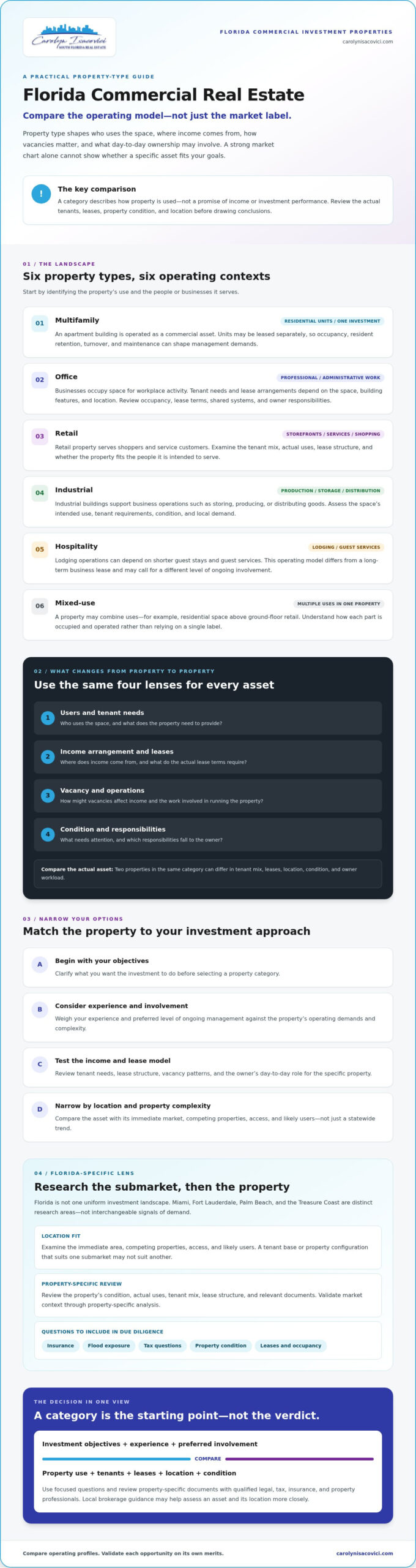
Commercial real estate investment is property acquired primarily for business use or income-producing operations. It can include multifamily housing, offices, retail spaces, industrial buildings, hospitality properties, and mixed-use developments. A property’s category describes its use, not a promise of income or investment performance. The commercial real estate overview provides a useful introduction to common property categories.
How does this differ from residential investing? A home purchased for personal occupancy is primarily a place to live. Commercial investment focuses on operating a property for business activity or income. Multifamily is a useful example: although people live in its units, an apartment building held and operated as an investment is commonly assessed as a commercial asset. The types of commercial real estate investments Florida buyers consider therefore involve different tenants, operations, and income arrangements.
- Multifamily: Residential units operated as one investment property.
- Office: Space leased to businesses for professional or administrative work.
- Retail: Properties used for storefronts, services, or shopping.
- Industrial: Buildings supporting activities such as storage, production, or distribution.
- Hospitality: Lodging properties whose operations can depend on short stays and guest services.
- Mixed-use: A property combining uses, such as residential space above ground-floor retail.
How commercial property types differ from one another
The category is only a starting point. Tenant needs, lease terms, vacancy patterns, and building operations determine how an individual property functions. For example, a long-term business lease can create a different owner workload from lodging operations that serve guests for shorter stays. A building may also combine retail, office, and residential uses, so its classification depends in part on how its space is occupied and operated. Review the actual uses, leases, and property condition rather than relying on the marketing label.
Florida markets are not one uniform investment landscape
Miami, Fort Lauderdale, Palm Beach, and the Treasure Coast are distinct research areas, not interchangeable signals of demand. A tenant base and property configuration that suit one submarket may not suit another. Examine the immediate area, competing properties, access, and likely users to test whether an asset fits its location. For broader market context, pair this property-type overview with a Florida commercial real estate investor guide, then validate each opportunity through property-specific analysis and local brokerage guidance.
How Florida multifamily, office, retail, and industrial investments work
These four asset classes serve different users, which shapes leasing, maintenance, and the owner’s day-to-day role. Multifamily houses residents, office accommodates workplace activity, retail serves shoppers and service customers, and industrial supports production, storage, or distribution. That distinction is a useful starting point, not a shortcut for judging a property’s income potential.
Comparing the types of commercial real estate investments Florida buyers encounter means looking beyond the building label. Ask who the likely tenants are, what they need from the space, how leases are structured, and what vacancies could mean for income and operations. Check demand for the specific property and submarket rather than assuming a broad statewide trend applies to an individual asset.
Multifamily and office properties: tenants, leases, and operations
Multifamily is a residential asset operated as a commercial investment. Each unit may be leased separately, so occupancy, resident retention, turnover, and maintenance all affect management demands. An office property, by contrast, is occupied by businesses. Lease arrangements and tenant needs can depend on the space, building features, and location. Review current occupancy and lease terms, the condition of shared systems, and which responsibilities fall to the owner.
Office performance can vary between buildings, even in the same area. A property’s layout, condition, access, and fit with prospective tenants’ needs matter, as do current local conditions. Don’t treat the office category as evidence of either strong demand or excessive risk. Evaluate the tenant profile and leasing situation at the property level.
Retail and industrial properties: location and use matter
Retail depends on the relationship between a property, its tenants, and the customers those businesses need to reach. Examine visibility, convenient access, tenant mix, and the surrounding trade area. A storefront that suits a service business may not work as well for a retailer with different space or customer-access requirements.
Industrial properties serve functions such as storage, production, and distribution. Building configuration, loading and access, logistics requirements, and tenant-specific needs all affect suitability. For a property near I-95 or PortMiami, investigate whether its actual access and location support the intended use. Proximity alone doesn’t establish tenant demand. In every category, compare lease obligations and owner responsibilities. For statutory context on certain commercial real estate sales and leasing commission provisions, consult the Florida commercial real estate statutes and seek qualified legal advice about a specific transaction.
A focused property search starts with a clear asset type and location. If you’re weighing those choices, you can discuss your Florida property goals with a local real estate professional.
How hospitality, mixed-use, and specialized properties compare
These assets can involve more than collecting rent from a long-term tenant. Hotels depend on guest bookings and daily operations; mixed-use buildings combine different income-producing uses; and specialized properties serve particular businesses or customers. Compare the types of commercial real estate investments Florida buyers may consider by their operating demands and tenant or customer base, not just by the property label.
Hospitality and mixed-use investments require closer operating review
Hotels and similar lodging properties can have operating patterns unlike buildings leased to long-term tenants. Before considering one, investigate how guest demand, seasonality, staffing, and day-to-day operations shape the business model. A mixed-use property may combine apartments with retail, office, or other space. Evaluate each component by its lease terms, occupants, and condition, then examine shared systems, maintenance responsibilities, and building-wide obligations. Combined uses can bring different activities under one ownership, but they also add coordination and diligence.
| Property type | Typical use | Operating complexity | Demand drivers and due-diligence questions |
|---|---|---|---|
| Hospitality | Short-stay lodging | High, with guest-facing operations | Investigate booking patterns, seasonality, staffing needs, operating records, and the property’s condition. |
| Mixed-use | Combined uses, such as residential and retail | Varies by the number and type of uses | Assess each component’s tenants, leases, occupancy, maintenance needs, and shared obligations separately. |
| Healthcare | Space for healthcare-related services | Can depend on specialized space and tenant requirements | Confirm permitted use, suitability of the physical space, tenant needs, and the expertise needed to operate the asset. |
| Self-storage | Storage units rented to customers | Depends on facility operations and customer needs | Review the property’s condition, permitted use, local customer demand, and the operational knowledge required. |
Specialized commercial properties need specialized diligence
Healthcare and self-storage illustrate why a familiar property label isn’t enough. A healthcare space must suit its intended use and tenant requirements; a storage facility calls for review of the site, physical condition, and operating model. Neither category guarantees demand or performance. Check permitted use and consult qualified property professionals, alongside relevant legal, tax, and insurance advisers, before drawing conclusions. A Florida property investment metrics guide can help organize a deeper financial evaluation.
How to choose a commercial real estate investment type in Florida
A popular asset class isn’t automatically the right fit. Start with your objectives, experience, and capacity to oversee the property. Use this process to narrow the options before comparing individual opportunities.
- Set your objectives. Decide whether you prioritize income stability, growth potential, active involvement, or diversification. Clarify your time horizon and how much uncertainty you can reasonably accommodate.
- Be realistic about your experience and involvement. Consider whether you want regular tenant contact and operating decisions or a property with responsibilities you can delegate. Staffing, property management needs, tenant relationships, and capital requirements vary by asset and property condition.
- Match goals to the operating model. Compare tenant type, lease structure, vacancy exposure, maintenance demands, and property complexity. A property that fits your objectives on paper may still require more hands-on management or capital than you’re prepared to provide.
- Shortlist submarkets. Compare the exact city and neighborhood, access, likely tenant base, and competing properties. Don’t assume demand is uniform across Florida or rely on statewide trends as proof that a specific building is a sound acquisition.
- Test the property-level assumptions. Review occupancy, lease information, building condition, zoning and permitted use, and potential resilience needs. Check the property’s flood exposure using FEMA flood maps and obtain property-specific insurance information during diligence. Confirm current details with relevant professionals, since conditions and coverage can vary by property.
- Review the numbers with qualified advisers. Model your assumptions and possible operating scenarios with qualified financial and tax professionals where appropriate. Treat projections as assumptions to test, not guaranteed outcomes.
Match your goals and capacity to the property type
What level of involvement suits you? A property with several tenants or active operations can call for more oversight than its category name suggests. Consider who will handle routine responsibilities, how tenant turnover could affect operations, and whether you have the experience and resources to respond to building needs. The right choice balances your investment objectives with the work and complexity you’re prepared to take on.
Assess Florida location and property-level exposure
Location diligence is specific. Two properties in the same broad market can differ in access, nearby competition, tenant fit, building condition, and flood exposure. Use a Florida investment property evaluation guide to organize the financial review, then assess each candidate using its own records and circumstances.
For help comparing a target property type with a Florida location, discuss your commercial property goals with a Florida real estate professional.
Plan your Florida commercial property search with informed guidance
A focused search follows a clear sequence: choose an asset category, define target locations, then assess individual properties. Comparing the types of commercial real estate investments Florida buyers may consider is only the first step. Use consistent assumptions and verified property information to compare opportunities rather than relying on broad market impressions or labels.
What to prepare before reviewing investment opportunities
Start with a short brief that notes your preferred property types, target cities, investment objectives, and desired level of operational involvement. For each property under consideration, gather available records and keep unanswered questions visible. Depending on the opportunity, useful materials may include:
- Current leases, tenant details, and occupancy information
- Operating records and available property expense information
- Inspection reports, maintenance records, and known building issues
- Available insurance information and details about any known coverage concerns
- Relevant zoning or permitted-use information
Ask a qualified legal professional to review transaction documents and property-use questions. Consult a tax professional about tax considerations, an insurance professional about property-specific coverage, and qualified property professionals about condition and operating needs. Write down details that need confirmation, along with the assumptions behind your comparison, so each adviser can address the right questions.
When a Florida commercial real estate broker can help
A commercial real estate broker can help identify and compare properties, provide local market context, and guide a buyer through the sales transaction. Brokerage guidance is distinct from legal representation, tax advice, insurance advice, and lending. Engage the appropriate professionals for those areas, and use property-specific documents to verify details. Local perspective can be useful when comparing target locations and assessing how an individual property fits your objectives.
Florida Commercial Investment Properties provides brokerage and sales support for commercial and investment properties. A productive discussion can begin with your target asset type, preferred location, and questions about a specific opportunity. You don’t need to have every detail settled first. A clear set of goals and open questions is a practical starting point.
Discuss your Florida commercial property goals with Carolyn Isacovici, a Florida real estate professional.
Take the Next Step Toward a Property That Fits
The right choice among the types of commercial real estate investments Florida offers depends on more than the asset category. Compare how each property earns income, the tenant or customer it serves, and the operational demands it brings. Then narrow your search by location and evaluate each opportunity using verified property information, not broad market assumptions.
A practical plan starts with your goals and preferred level of involvement, followed by a focused review of leases, operations, building condition, location, and property-specific exposures. Each asset has its own details, so careful comparison can help you make a more informed decision.
Florida Commercial Investment Properties provides brokerage support for commercial and investment property sales, with a focus on Florida markets across South Florida and the Treasure Coast. If you’re considering locations such as Miami, Miami Beach, Hollywood, Fort Lauderdale, Palm Beach, Palm Beach Gardens, Stuart, Jupiter, Palm City, Port Saint Lucie, Fort Pierce, Vero Beach, or Melbourne, discuss your Florida commercial property goals with Carolyn Isacovici. Start with your target property type and location to define a thoughtful next step.
Frequently Asked Questions
What are the main types of commercial real estate investments in Florida?
The main types include multifamily, office, retail, industrial, hospitality, mixed-use, and specialized properties such as healthcare facilities or self-storage. Each category serves different tenants or customers and can involve distinct lease arrangements and operating responsibilities. For example, an apartment building is operated for residential occupancy, while an industrial property may support storage or distribution. Compare each opportunity by its use, tenants, condition, and financial information rather than assuming the category predicts performance.
Is multifamily real estate considered commercial property in Florida?
Yes, multifamily property held and operated as an investment is commonly considered a commercial asset, even though residents live in its units. Owners typically evaluate the building as an operating property, including occupancy, leases, maintenance, expenses, and tenant turnover. That differs from buying a home for personal use. For a particular property, confirm its classification and intended use with qualified professionals who can review the transaction and relevant documents.
Which commercial property types can generate rental income?
Multifamily, office, retail, industrial, mixed-use, and some specialized properties may generate income through leases or rental agreements. Hospitality can also earn revenue from guest stays, but its operating pattern may differ from long-term leasing and can depend on bookings and guest services. Income is never assured by property type alone. Review actual leases, occupancy, operating records, expenses, and property condition to understand the opportunity and risks.
How do retail and industrial real estate investments differ?
Retail properties serve customers through stores or services, so visibility, access, tenant mix, and the surrounding trade area are key review points. Industrial properties support functions such as storage, production, or distribution, making building layout, access, logistics, and tenant requirements especially relevant. Both depend on a property’s suitability for its intended use. Check current tenants and competing properties in the immediate area rather than relying on broad market assumptions.
Can commercial real estate investments in Florida include mixed-use properties?
Yes, mixed-use properties combine two or more uses, such as residential units above retail or office space alongside other commercial uses. Each component may have different tenants, lease terms, operating needs, and sources of demand, so evaluate them separately. Also examine shared systems, maintenance responsibilities, and building-wide obligations. A combined property can be more complex to assess than a single-use asset, making property-specific documents and professional review important.
What Florida-specific risks should I check before buying commercial property?
Review flood exposure, property-specific insurance availability, building condition, zoning, permitted use, and resilience needs. Compare local evidence across Miami, Miami Beach, Hollywood, Fort Lauderdale, Palm Beach, Palm Beach Gardens, Jupiter, Stuart, Palm City, Port Saint Lucie, Fort Pierce, Vero Beach, and Melbourne. Conditions differ by property and neighborhood, so verify details using relevant records and qualified insurance, property, and legal professionals before making a decision.
How do I choose the right type of commercial property investment?
Start with your objectives, experience, and preferred level of involvement. Then compare property types by tenant needs, lease structure, operating demands, complexity, and the capital and expertise required. Narrow the search to locations that suit your criteria, then test each property using verified leases, operating information, condition, and local evidence. A Florida real estate broker can help with property search, local context, and sales transaction guidance, while other advisers address legal, tax, and insurance matters.