
What if the strongest Miami opportunity isn’t the most visible one, but the property that best fits your family office’s mandate and holding horizon? For family offices searching “commercial real estate investment broker Miami,” local insight matters because broad market claims can’t show whether a specific asset fits your acquisition goals. A focused brokerage process can turn those goals into practical property criteria and a more relevant search.
It’s reasonable to want more than a promising listing. You need a clear way to compare locations and assets, assess broker fit, and keep property review, negotiation, and closing steps aligned across stakeholders. This guide explains how to evaluate Miami commercial opportunities against your investment criteria, identify questions that sharpen a shortlist, and build an acquisition plan. You’ll also see how Florida Commercial Investment Properties supports investment property acquisitions and real estate sales, from identifying opportunities through the sales process. The aim is a practical path from strategy to acquisition, without relying on one-size-fits-all market assumptions.
Key Takeaways
- A commercial real estate investment broker Miami family offices can rely on should help translate investment goals into clear property criteria, not simply present listings.
- Separate must-haves from preferences across asset type, location, and review priorities to create a more focused shortlist.
- Compare Miami locations such as Brickell and Doral against your mandate. Neither is the right fit for every investment strategy.
- Assess broker fit through local knowledge, relevant asset experience, communication, and a clear process for evaluating opportunities.
- Map the path from investment brief through property review, negotiation, and closing, allowing for the needs of each property and transaction.
What a Miami Commercial Real Estate Investment Broker Does for a Family Office
Property access is only the starting point. A family office may see a steady flow of listings and introductions yet still need a way to determine which opportunities fit its investment mandate. A commercial real estate investment broker Miami family offices work with can bridge that gap by translating broad priorities into a focused search, organizing relevant property information, and guiding the sales process from opportunity identification toward acquisition.
A Miami commercial investment broker helps a family office identify and evaluate property opportunities against its stated objectives, then supports the real estate sales process. The broker clarifies what the family wants to acquire, identifies potential matches, and helps organize the review. That structure is useful when principals, investment staff, and advisers are weighing different aspects of an opportunity.
How brokerage support fits a family-office investment mandate
Start with an investment brief that describes the target asset type, preferred locations, holding horizon, and decision priorities. For example, a family office considering commercial property may need to weigh a long holding horizon against a preference for a particular location or asset profile. The broker can use those priorities to shape the search and present opportunities for review.
Clear criteria help prevent a search from drifting toward properties that look interesting but don’t fit the mandate. Identify which requirements are essential and which are flexible. Then organize property information around those criteria so principals and investment staff have a shared basis for discussion and advisers can focus their input. The broker doesn’t make the family’s investment decision. The goal is to make relevant options easier to compare.
What a Miami investment broker does, and does not, do
Brokerage support can include identifying investment opportunities, sharing relevant property information, helping the buyer assess how an opportunity aligns with its criteria, and coordinating communication and steps in the sales process. Florida Commercial Investment Properties provides brokerage support for commercial and residential real estate sales, including investment property acquisitions in Miami and throughout Florida.
Those responsibilities have clear boundaries. A broker’s guidance is not a promise of investment performance, exclusive access to every available property, or a guarantee that a transaction will close. Lending, legal advice, tax advice, and ongoing property management are separate roles. Those functions address financing, legal interpretation, tax matters, and operations after acquisition, while brokerage focuses on property opportunities and the sale process.
For a family office, that distinction supports a coordinated decision. Principals can weigh the opportunity against the mandate, investment staff can review the information, and advisers can contribute within their areas of responsibility. The broker helps keep the property search and transaction aligned with the family’s stated objectives, while the family retains control of its investment decision.
How to Turn a Family Office Investment Mandate into Miami Property Criteria
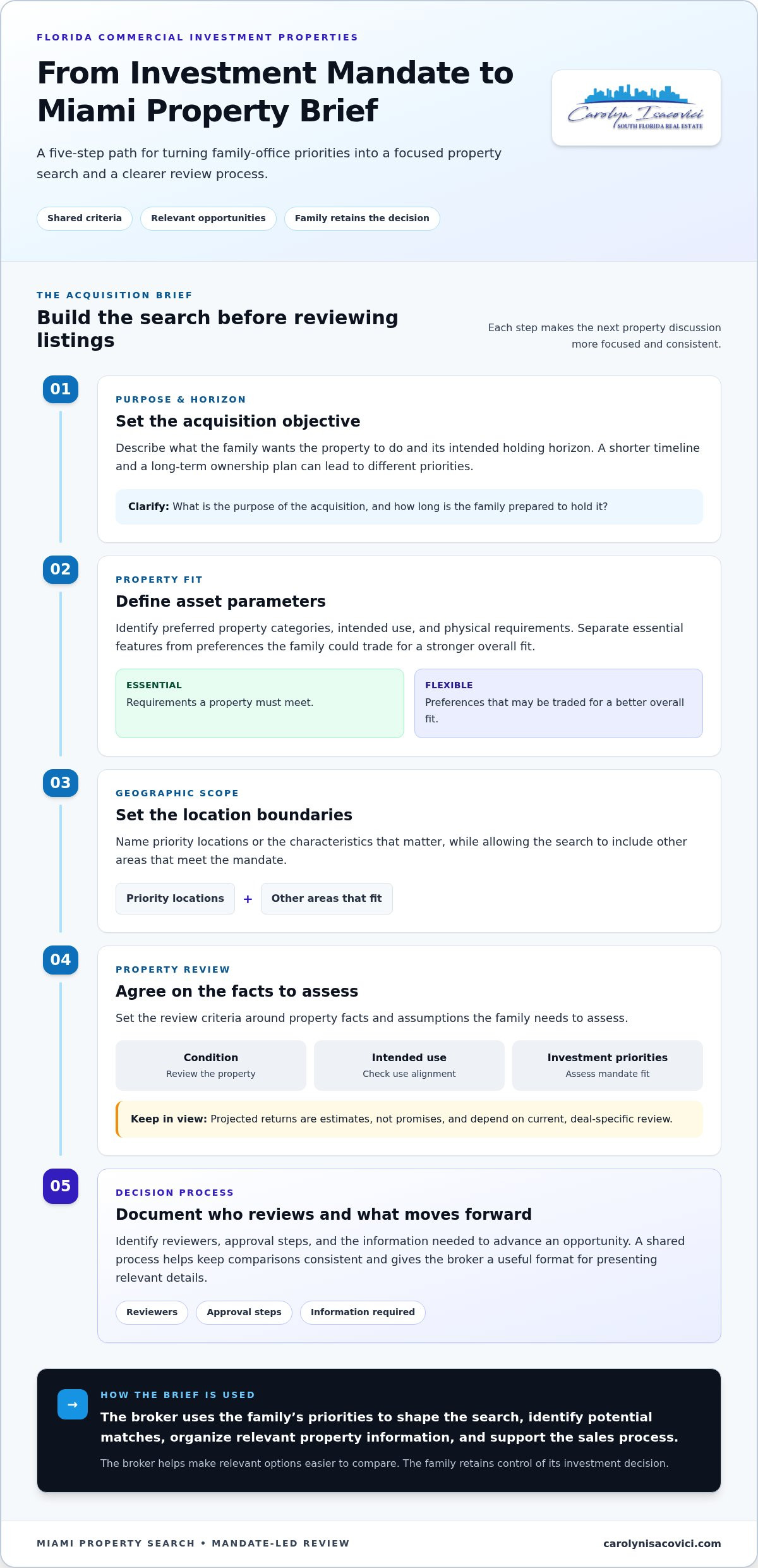
A clear mandate turns a broad investment objective into a practical search. Before reviewing listings, agree on what the family wants the property to do, which conditions are non-negotiable, and who will weigh in on a decision. This gives a commercial real estate investment broker Miami family offices engage a defined brief to work from, while leaving room to consider suitable opportunities across the Miami area.
Define acquisition priorities before reviewing listings
Start with the family’s objectives and approval process. Record who reviews opportunities, who can advance a property for further consideration, and how principals make the final decision. A shared process helps prevent promising options from stalling because responsibilities or next steps aren’t clear.
- Set the objective. Describe the purpose of the acquisition and intended holding horizon. A shorter timeline and a long-term ownership plan can lead to different priorities.
- Define asset parameters. Identify preferred property categories, intended use, and physical requirements. Separate essential features from preferences the family could trade for a stronger overall fit.
- Set the geographic scope. Name priority locations or characteristics that matter, while allowing the search to include other areas that meet the mandate.
- Establish review criteria. Agree on which property facts and assumptions the family needs to assess, such as condition, intended use, and fit with its investment priorities. Projected returns are estimates, not promises, and depend on current, deal-specific review.
- Document the decision process. Identify reviewers, approval steps, and the information needed to move an opportunity forward. This makes comparisons more consistent and helps the broker present relevant details in a useful format.
Build a practical Miami property brief
Keep the brief concise enough to guide a search and specific enough to rule out clear mismatches. Include target use, location, physical needs, timing preferences, holding horizon, and risk tolerance. Distinguish verified property facts from assumptions that still need diligence. Resources from the National Association of REALTORS® commercial real estate resources offer broader context on commercial real estate practice and market research, but the family’s criteria should remain specific to its own objectives.
Risk tolerance shapes the trade-offs. A family prioritizing a particular use may be more flexible on location; one with a firm location preference may need flexibility on physical characteristics. Mark each item as a must-have or a preference. That distinction helps keep an attractive but unsuitable listing from consuming valuable review time.
Don’t treat early projections as established outcomes. Property assumptions and potential returns require current review for each specific opportunity, and the family’s advisers may need to assess them from their respective perspectives. Florida Commercial Investment Properties helps clients identify investment property opportunities and navigate the sales process. A Florida investment property discussion can be a practical next step for shaping the brief around the family’s acquisition priorities.
How Miami Submarkets and Property Types Change the Broker Search
Miami isn’t one uniform investment market. A property’s fit depends on how its location supports the intended use and what the family office needs to learn about that asset. A commercial real estate investment broker Miami investors work with should discuss location and property type in practical terms, framing questions to investigate rather than treating a neighborhood name as a conclusion.
Judge a property’s location by how well it serves its intended use, not by reputation alone. Brickell offers an urban-core context to compare with locations elsewhere in Miami-Dade, such as Doral. That contrast can help a family office examine access, surrounding uses, and the users a property is meant to serve. It doesn’t make either location universally superior. The right comparison depends on the acquisition mandate and the property itself.
Compare Miami locations against the property’s intended use
Start with the purpose of the asset. For office property, consider how the site fits the intended business use and the needs of prospective occupants. For retail, examine surrounding uses and how the location relates to the customers the property is intended to serve. Industrial review may focus on access and suitability for the planned use, while multifamily review considers the location in relation to residential demand and the property’s intended role in the portfolio.
These are questions for property-level review, not assumptions about performance. A broker familiar with the relevant locations can help identify distinctions to investigate and keep comparisons tied to the investment criteria.
| Location context | Property use | Access to consider | Tenant context | Questions for review |
|---|---|---|---|---|
| Brickell, urban core | Office or retail | How the site connects to the intended users and surrounding activity | Who might occupy or use the property? | Does the location support the planned use and tenant profile? |
| Doral, elsewhere in Miami-Dade | Industrial or other commercial use | Does access align with the property’s intended function? | What users or businesses suit the property? | Which property and location facts need further review? |
| Other Miami-Dade locations | Multifamily or another target asset | How does the site serve residents or intended users? | What tenant context fits the family’s strategy? | What assumptions need property-specific validation? |
Match broker experience to the relevant asset type
Asset types call for different lines of inquiry. Retail, office, industrial, and multifamily properties each have distinct uses and tenant contexts, so relevant transaction experience can help identify which details deserve closer attention. Compare a broker’s experience with the intended property type, and discuss how the review would be structured for that asset and location.
Broader market context can inform those questions, but it shouldn’t replace property-specific review. Florida Commercial Investment Properties supports clients in identifying investment property opportunities and managing the sales process. Keep each comparison grounded in the mandate, intended use, and available facts about the property.
How to Evaluate a Miami Commercial Investment Broker Before Engaging
A strong broker fit is about alignment, not a headline transaction total. For a family office, the useful question is whether the broker’s local knowledge, relevant asset experience, and working process suit the acquisition mandate. A commercial real estate investment broker Miami buyers consider should connect those elements to the locations and property types under review, then explain how brokerage support works through the sale.
Assess local knowledge and relevant transaction experience
Relevant experience has context. A history with a different asset type or location may say less about fit than experience that reflects the family’s target property and Miami-area search. Florida Commercial Investment Properties specializes in commercial and residential real estate sales and provides brokerage support for investment property acquisitions across Florida, including Miami.
Use these points to assess fit:
- Location familiarity: Consider how the broker distinguishes the areas in the search and relates local context to the property’s intended use.
- Asset relevance: Compare the broker’s experience with the property category the family is considering, such as office, retail, industrial, or multifamily.
- Comparable examples: Transaction examples can help show how experience relates to the target asset and location. Their usefulness comes from relevance, not simply the number of deals represented.
- Mandate understanding: The broker’s explanation of the family’s priorities should reflect its stated criteria, holding horizon, and decision structure, rather than defaulting to a generic search.
Don’t use reported transaction volume as a stand-in for likely results. A firm’s performance figures don’t establish what a particular buyer will achieve. Focus on how clearly the broker connects the search process to the family’s acquisition priorities.
Check communication, alignment, and process transparency
Good communication makes a complex review easier to manage. The brokerage process should set clear expectations for how opportunities are shared, what information accompanies them, and how next steps are coordinated. For a family office with several decision-makers, establish who receives updates and how material questions or changes reach the people involved.
Alignment becomes clearer in the way opportunities are presented. Are they connected to the family’s criteria, with a distinction between property facts and points that need further review? Is it clear what the broker handles in the sales process and where other responsibilities, such as legal, lending, tax, or property management, sit? Clarity on representation, communication, and transaction responsibilities helps the family understand the scope of brokerage support.
Before engaging, compare the proposed process with the family’s approval structure and preferred communication rhythm. This keeps expectations grounded and helps determine whether the working relationship can support a deliberate acquisition decision.
For a Florida-focused perspective on investment property brokerage and the sales process, explore Carolyn Isacovici’s real estate services.
From Miami Property Search to Closing: What Brokerage Support Looks Like
A focused acquisition moves through a series of decisions, not just a series of listings. A commercial real estate investment broker Miami family offices work with can help keep the search, property review, and sales process connected to the family’s established priorities. The broker coordinates the brokerage process, while the family and its advisers assess the opportunity and decide whether to proceed.
A defined investment mandate gives the property search direction and helps evaluate each opportunity against the family’s priorities. New information can change how a property fits, so each stage should support an informed next step rather than push the buyer toward a predetermined outcome.
Move from property shortlist to informed review
Once potential properties emerge, the broker can organize available property facts against the buyer’s stated criteria and coordinate communication as the review progresses. The buyer’s team can consider what information is established, what needs further diligence, and whether the opportunity remains aligned with the mandate. Legal interpretation and financing advice belong with qualified advisers, not the brokerage process.
- Confirm the investment brief. Align on the target asset, location priorities, intended use, timing preferences, and the family’s decision process.
- Review relevant opportunities. Compare available property information with the stated criteria and identify where an opportunity appears to fit or diverge.
- Organize property diligence. Coordinate the flow of information and track questions for the buyer’s team. Depending on the property, review areas may include condition, intended use, occupancy information, and other matters the family’s advisers assess.
- Reassess fit as facts develop. New information may strengthen the case for further review, raise questions, or change the property’s fit with the mandate. The family can decide whether to continue, adjust its position, or move on.
- Coordinate negotiation and closing steps. The broker supports the sales process and communication around the transaction. Specific requirements and timing depend on the property and the parties involved.
Keep the process clear as decisions advance
Good coordination helps principals, investment staff, and advisers stay oriented as the transaction progresses. Agree on who receives updates, how questions are routed, and what decision is needed at each stage. The broker can clarify brokerage responsibilities and next steps, while legal, tax, and financing questions remain with the appropriate advisers. There’s no universal timeline: property details, buyer and seller needs, and the parties’ review processes all shape the path to closing.
To begin, outline the asset types you’re considering, the Miami locations that matter to your family, and your decision timing. Florida Commercial Investment Properties provides brokerage support for commercial and investment property sales across Florida, including Miami. If your family is considering an acquisition, discuss your objectives with Carolyn Isacovici and identify a practical next step that suits your decision process.
Set Your Next Acquisition Decision in Motion
A useful next step doesn’t have to be a commitment to buy. It can be a focused conversation to clarify what your family office wants to pursue, what still needs discussion, and which decision should come first. Bring your asset preferences, location priorities, holding horizon, and key questions into one working brief. That gives stakeholders a shared starting point and makes future property conversations more purposeful.
The right commercial real estate investment broker Miami family offices choose should connect that brief to a considered acquisition process, while leaving investment decisions with the family. Florida Commercial Investment Properties supports commercial and investment property sales in Miami and throughout Florida, helping clients identify opportunities and navigate the sales process.
Discuss your Miami commercial property investment goals with Carolyn Isacovici. A clear first conversation can help turn an investment objective into a practical next step.
Frequently Asked Questions
What does a commercial real estate investment broker in Miami do?
A commercial real estate investment broker helps buyers identify property opportunities and supports the real estate sales process. For a family office, a commercial real estate investment broker Miami buyers engage can help compare an opportunity with the buyer’s priorities, organize property information, and coordinate transaction steps. For example, if an office property’s intended use or occupancy details raise questions, the broker can help direct those questions into the review process without making the family’s investment decision.
How is a commercial real estate broker different from an investment adviser?
A commercial real estate broker focuses on property opportunities and the purchase or sale process, while an investment adviser may help assess broader portfolio strategy and how an investment fits the client’s financial objectives. The roles can contribute different perspectives to a family office’s decision. For example, the broker can help review a particular building as a property opportunity, while the family’s adviser considers its place within the overall investment plan.
Which Miami areas should a family office compare for commercial property?
Compare locations that fit the intended property use rather than assuming one area is best. A Miami search might consider Brickell or Doral, then extend to Miami Beach, Hollywood, or Fort Lauderdale based on the property brief. A wider Florida search may also include Palm Beach, Palm Beach Gardens, Stuart, Jupiter, Palm City, Port St. Lucie, Fort Pierce, Vero Beach, and Melbourne. Assess each location against the asset’s purpose and intended users.
How can a family office assess whether a Miami commercial property fits its investment goals?
Use a consistent screening method: compare the property’s intended use, location, physical characteristics, and available operating information with the family’s acquisition priorities. For instance, a property that meets location preferences but requires a use the family hasn’t planned for may be a poor fit. Treat financial projections as assumptions to review for that specific opportunity, and note which facts are verified and which require further diligence before advancing.
What should a family office prepare before speaking with a Miami commercial real estate broker?
Prepare a short brief describing the property types under consideration, preferred locations, intended use, holding horizon, and decision timing. Identify the people who will review opportunities and how the family expects to make decisions. It also helps to distinguish firm requirements from flexible preferences. This gives the conversation a useful starting point, even if some details are still being refined, and makes it easier to discuss what information the family needs to evaluate opportunities.
Can a commercial real estate broker help with both property sourcing and the sales process?
Yes. Florida Commercial Investment Properties helps clients identify investment property opportunities and manage real estate sales processes across Florida, including Miami. That connects the search for a suitable asset with transaction coordination as the buyer evaluates and pursues an opportunity. The broker’s role is distinct from legal, tax, lending, or property-management work, which involves separate responsibilities and expertise.
What should investors review before making an offer on Miami commercial property?
Before making an offer, organize the information needed to judge the opportunity against the investment brief. Review the property’s condition, intended use, occupancy details, and assumptions behind any projected performance. Note unanswered questions and decide which need further review by the buyer’s advisers. The broker can help coordinate property information and sales-process communication, but legal interpretation and financing advice should come from the appropriate qualified advisers.
Leave a Reply