
Fort Lauderdale’s investment-property search is best understood through the available listings, not a headline number alone. Examples include a 21,516-square-foot multifamily property at 1401 NE 17TH Court and a 3,157-square-foot multifamily property at 1730 NE 7th St #1-5, giving buyers distinct options to consider as they look for an investment property for sale in Fort Lauderdale.
It’s natural to want a clear picture of what’s available before deciding where to focus your search for an investment property for sale in Fort Lauderdale. The right fit depends on more than property type: your investment goals, expected operating responsibilities, and comfort with rental ownership all matter.
Here, you’ll learn how to interpret available listings, explore the kinds of properties on offer, and weigh factors such as insurance, taxes, maintenance, and rental demand. With a steadier picture of the choices, you can narrow your search around the goals that matter most to you.
Key Takeaways
- Use neighborhood and ZIP code as practical ways to organize your search, and remember that available listings can change.
- Compare property types and features to see which options best align with your investment approach.
- Set your goals alongside ownership costs and rental risks before deciding which property merits closer consideration.
- Assess rental demand using local housing inventory and occupancy, then weigh those signals against potential income and ongoing expenses.
How many investment properties are available for sale in Fort-lauderdale?
Fort Lauderdale inventory changes as properties enter the market or go under contract. A count can quickly become outdated, so organize your search by property type, neighborhood, and ZIP code. These filters help identify listings that match your preferred location and investment approach.
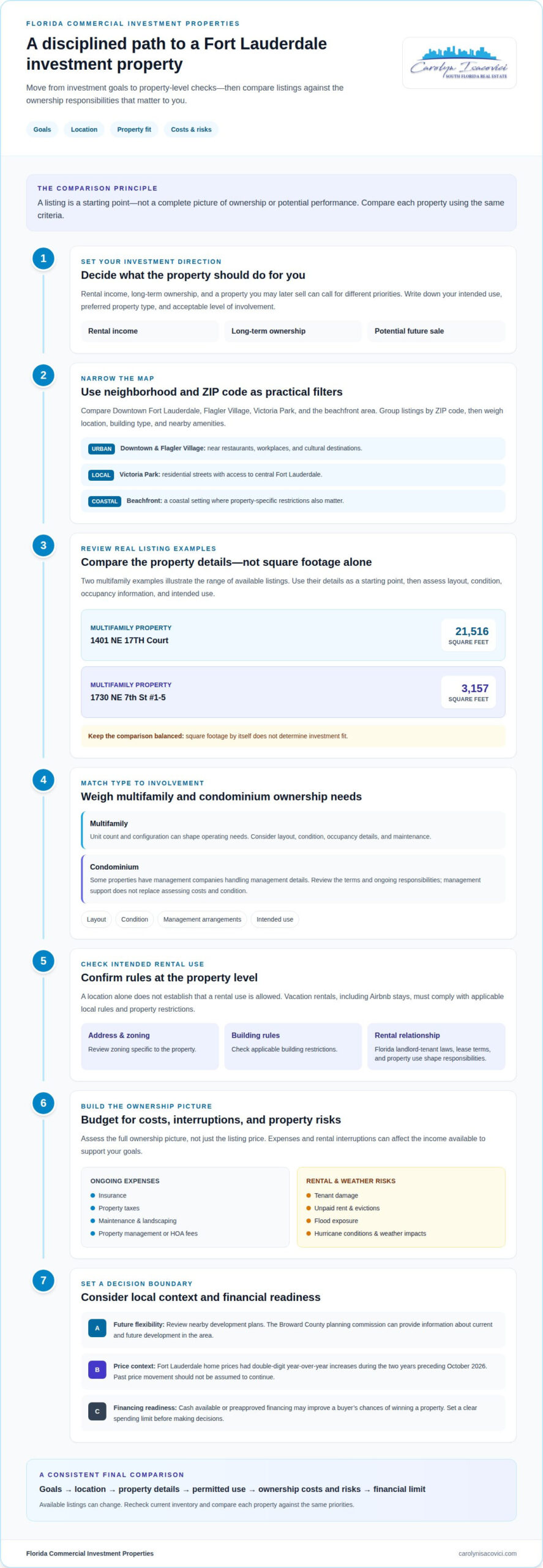
Neighborhoods provide useful context, while ZIP codes help narrow the map. Compare listings in Downtown Fort Lauderdale, Flagler Village, Victoria Park, and the beachfront area. Then group properties by ZIP code to compare location, building type, and nearby amenities.
Location shapes how a property may serve residents or visitors. Downtown and Flagler Village offer an urban setting near restaurants, workplaces, and cultural destinations. Victoria Park combines residential streets with access to central Fort Lauderdale. Beachfront locations offer a coastal setting, but property-specific restrictions also matter.
There’s no universally best neighborhood. Consider Downtown or Flagler Village for an urban residential focus, Victoria Park for neighborhood character, or beachfront areas for a coastal setting. Treat these as starting points, then compare the property itself, intended use, operating needs, and nearby amenities.
Vacation rentals, including Airbnb stays, must comply with applicable local rules and property restrictions. Permitted use can depend on the address, zoning, and building rules, so a listing’s location alone does not establish eligibility.
Florida landlord-tenant laws govern rental relationships, while lease terms and the property’s use shape day-to-day responsibilities. When assessing rental risks, account for tenant damage, unpaid rent, and evictions.
In Fort Lauderdale, zoning and short-term rental restrictions are specific to the property. Review its zoning and any applicable building restrictions to determine whether the planned rental use is suitable.
Flood exposure and hurricane conditions are important property-level risks in Fort Lauderdale. Include insurance, maintenance, and potential weather-related impacts in your ownership assessment. Landscaping and property management or HOA fees also affect ongoing expenses.
Investment property listings in Fort Lauderdale
Listing types help clarify what each Fort Lauderdale property could offer. Two multifamily examples are 1401 NE 17TH Court and 1730 NE 7th St #1-5. Their addresses identify specific opportunities, but the property details and intended use should guide your comparison. A listing is a starting point, not a complete picture of ownership or potential performance.
Read each listing systematically. Identify the property type and stated features, then review its layout, condition, and any occupancy details provided. Consider whether it suits your intended rental approach. For multifamily homes, unit count and configuration can shape operating needs. Don’t use square footage alone to judge investment fit.
Condominiums have a different ownership structure to evaluate. Some Fort Lauderdale condos for sale have property management companies handling management details. This may suit buyers seeking a managed setting, but review the property’s terms and ongoing responsibilities. Management support does not replace assessing the property itself.
Compare listings using the same criteria. For example, place a multifamily home beside a condominium and weigh layout, condition, management arrangements, and intended use. Consider the practical work each may require, including maintenance and coordination. A consistent comparison helps distinguish features that support your goals from details that merely look appealing in a listing.
For buyers considering an investment property for sale in Fort Lauderdale, organize listing details around property type, intended use, and ownership responsibilities. Then focus on options that align with your priorities. To review listings for an investment property for sale in Fort Lauderdale, explore local property listings and consider how each fits your investment direction.
Choosing an investment property and setting investment goals
Start by defining the outcome you want from a Fort Lauderdale property. Rental income, long-term ownership, and a property you may later sell call for different priorities. Write down your intended use, preferred property type, and acceptable level of involvement. These choices create a practical filter for reviewing listings.
Assess the full ownership picture, not just the listing price. Budget for insurance, property taxes, maintenance, landscaping, and property management or HOA fees. For a rental, also consider tenant damage, unpaid rent, and eviction risks. These expenses and interruptions can affect the income available to support your goals.
- For rental income: Compare the layout and condition with your planned use. A multifamily property and a condominium may involve different management needs.
- For less hands-on ownership: Consider whether a condo’s property management arrangement matches your expectations. Management support doesn’t remove the need to assess the property’s costs and condition.
- For future flexibility: Review nearby development plans. The Broward County planning commission can provide information about current and future development in the area.
Fort Lauderdale home prices had double-digit year-over-year increases during the two years preceding October 2026. That context makes disciplined comparisons useful: focus on a property’s condition, operating expenses, and fit with your intended holding strategy, rather than assuming past price movement will continue.
Financing readiness can shape your approach. Cash available or preapproved financing may improve a buyer’s chances of winning a property. Set a clear spending limit before making decisions, then compare each candidate with that limit and your expected ownership responsibilities.
Finally, rank your priorities. Decide whether location, property type, management needs, or renovation demands matter most. A written shortlist helps you assess Fort Lauderdale opportunities consistently and identify trade-offs before moving forward.
Fort Lauderdale rental property average rent and rental yields
Average rent alone cannot show whether a Fort Lauderdale property fits your investment goals. Rent varies by property type, location, condition, layout, and rental arrangement. Compare similar properties, such as multifamily homes with other multifamily homes, rather than treating a citywide average as a reliable estimate for every listing.
Rental yield relates expected rent to the amount invested. A basic gross-yield calculation compares annual rental income with the property’s purchase price. Net yield offers a more practical view by accounting for ongoing expenses before assessing remaining income. Neither calculation replaces a property-specific review.
Build a realistic operating estimate for each candidate. Include insurance, property taxes, maintenance, landscaping, and property management or HOA fees where applicable. Account for periods without a tenant, since vacancy affects collected rent. Tenant damage, unpaid rent, and eviction risks can further affect actual income and operating demands.
Demand matters, too. Investors considering Fort Lauderdale rentals should assess local housing inventory and occupancy rates to understand whether rental demand may remain strong. Read these signals together: available housing can shape competition, while occupancy helps indicate how much existing rental supply is in use. Neither factor alone establishes the income a specific property will produce.
For a useful comparison, place each property’s expected rent, likely vacancy, and operating costs side by side. Consider whether the remaining income aligns with your goals and the work you’re prepared to manage. A larger multifamily property, for example, may require a different operating plan than a condominium, even if both seem attractive at first glance.
Use the same assumptions across every listing, then revisit them when property details differ. That makes rental estimates easier to compare without confusing gross income with what remains after expenses. Explore Fort Lauderdale investment properties and assess each option against your rental-income priorities.
Florida Commercial Investment Properties
Florida Commercial Investment Properties helps buyers consider Fort Lauderdale property opportunities in light of their investment goals. Its commercial, residential, and investment property sales serve buyers considering different property types. Turn to the company when you’ve narrowed your priorities and want to explore listings suited to your intended direction. Whether you’re weighing a multifamily property, condominium, or commercial opportunity, focus on your preferred use, ownership responsibilities, and decision criteria. Contact Florida Commercial Investment Properties to discuss your Fort Lauderdale investment property goals.
Move Forward With a Clear Investment Plan
Turn your priorities into a focused search. Decide what role you want the property to play, what responsibilities suit you, and which trade-offs you’ll accept. This framework can help you assess an investment property for sale in Fort Lauderdale with purpose, rather than reacting only to a listing’s most appealing features.
Florida Commercial Investment Properties can support your real estate search through Commercial Property Sales, Residential Real Estate Sales, and New Construction Homes. If you’re ready to discuss the kind of property that aligns with your plans, contact Florida Commercial Investment Properties. Bring your investment priorities and preferred property direction to the conversation, and take the next step with a clearer sense of what you’re looking for.