Is the era of “buy anything and watch it grow” in the Sunshine State officially over? Many investors feel the weight of rising insurance premiums and wonder if the legendary Florida boom has finally hit a ceiling. It’s a valid concern, especially as the median listing price hovers around $419,000 and inventory has climbed to over 285,000 active listings. You might be asking yourself if the window for high-yield returns has closed or if the complexity of current regulations has made the risk too high.
The truth is that the Florida real estate market for investors has transitioned from a sprint into a strategic marathon. While the days of accidental appreciation are behind us, 2026 offers a unique landscape for those who know where to look. We’ll help you cut through the noise to discover the most lucrative sectors and geographic hubs that are built to last. This guide provides a clear outlook on identifying recession-proof sub-markets, understanding the new cap rate reality, and selecting assets that offer genuine growth. By the end of this article, you’ll have the roadmap needed to build a resilient, high-growth portfolio in a stabilizing market.
Key Takeaways
- Learn how to navigate the 2026 “flight to quality” by effectively underwriting rising insurance costs into your long-term cap rate calculations.
- Discover why the Florida real estate market for investors remains resilient through a combination of zero state income tax and transformative infrastructure projects like the Brightline expansion.
- Evaluate whether multi-family commercial assets or new construction “build-to-rent” residential models offer the best path for your specific cash flow goals.
- Pinpoint the geographic sweet spots between Miami and the Treasure Coast that provide a strategic mix of luxury appreciation and recession-proof suburban growth.
- Master the essential steps for defining your asset class and partnering with a seasoned local broker to navigate South Florida’s complex micro-market nuances.
Navigating the 2026 Florida Real Estate Landscape: Opportunity or Oversaturation?
Is the Florida real estate market for investors finally cooling off? While headlines might suggest a retreat, what we’re actually seeing is a healthy rationalization. The speculators who once relied on rapid, unearned appreciation are exiting the stage. In their place, sophisticated investors are doubling down on high-quality assets that offer long-term stability. This “flight to quality” is a hallmark of a maturing market where micro-location and property fundamentals matter more than ever before. It isn’t a bubble; it’s a recalibration.
How do you handle the “insurance elephant” in the room? You underwrite it from day one. Savvy owners are no longer surprised by premiums; they’re factoring these costs into their cap rate calculations to ensure cash flow remains durable. This shift from a speculative model to a data-driven approach is what separates the professionals from the amateurs in 2026. To learn more about utilizing AI-powered analytics to evaluate these risks, investors are increasingly leveraging advanced property platforms. By focusing on properties with updated mitigation features and robust reserves, investors can maintain healthy margins despite rising operational costs.
Florida has evolved beyond its reputation as a simple vacation destination. The state has transformed into a global hub for tech and finance, which has fundamentally reshaped Florida’s economic landscape. This diversification provides a safety net that simply didn’t exist in previous cycles. When you invest here now, you aren’t just betting on sunshine; you’re betting on a robust, multi-industry economy that supports high-income tenants and commercial growth.
The Reality of Investor Sentiment in 2026
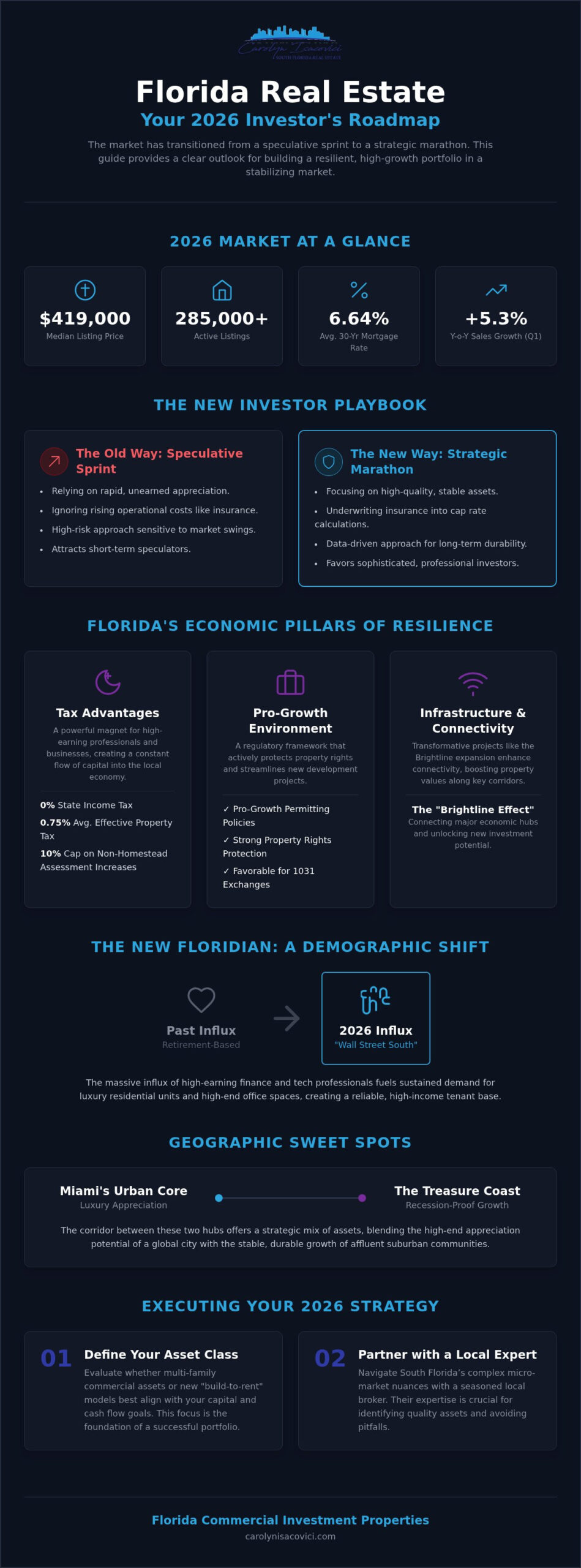
Why are high-net-worth individuals still buying? They look at institutional data rather than anecdotal fear. Even with 30-year fixed mortgage rates averaging 6.64% as of late August 2026, the demand for premium Florida property remains steadfast. Investors recognize that the “recession-proof” nature of the state is backed by real businesses moving their headquarters to the region. The impact of recent interest rate adjustments has actually helped clear out the noise, allowing serious buyers to negotiate with more leverage as inventory levels rise to approximately 285,600 active listings.
Migration Patterns: Who is Moving to Florida Now?
The demographic is shifting. We’re seeing a transition from purely retirement-based moves to a massive influx of high-earning professionals. The “Wall Street South” movement is a reality, not a slogan, as finance and tech firms continue to establish permanent roots in Miami and Palm Beach. This shift fuels the demand for both luxury residential units and high-end office spaces. The sustained demand is evidenced by a 5.3% year-over-year increase in closed single-family home sales recorded in the first quarter of 2026. This influx of wealth creates a “sticky” population that is less sensitive to minor economic fluctuations, providing a reliable tenant base for your portfolio.
The Economic Pillars Driving Florida’s Investment Resilience
Why does the Florida real estate market for investors continue to outpace other regions? It isn’t just the climate; it’s a structural advantage built on fiscal common sense. Florida’s lack of a state income tax remains a powerful magnet for high-earning professionals and business owners who want to keep more of what they earn. This financial incentive creates a constant stream of fresh capital flowing into the local economy, supporting everything from retail centers to luxury residential developments. When you combine this with a regulatory environment that actively protects property rights, you have a foundation designed for long-term growth.
Tax and Regulatory Benefits for Out-of-State Investors
Many investors are currently using 1031 Exchanges to move capital from high-tax, high-regulation states into Florida’s commercial and residential sectors. It’s a move that makes sense when you look at the numbers. Florida’s average effective property tax rate is a manageable 0.75%, and for non-homestead properties, the annual assessment increase is capped at 10%. This cap provides a level of predictability for your carrying costs that is hard to find elsewhere. Additionally, the state’s pro-growth permitting policies ensure that new construction projects can move forward without the years of red tape common in other coastal markets.
Infrastructure and Connectivity Growth
The “Brightline Effect” is more than a buzzword; it’s a transformation of how people live and work in South Florida. By connecting Miami to Orlando with high-speed rail, the state has created new “commuter hubs” in cities that were previously considered too far for daily travel. This connectivity is driving a fresh wave of appreciation along the rail corridor. We’re also seeing massive port expansions that are fueling industrial demand, particularly in the Treasure Coast. Port St. Lucie has emerged as a primary target for institutional players who recognize the value of its growing population and strategic location. Identifying these infrastructure-led opportunities early is key to securing high-yield assets before the market fully prices them in.
The tourism sector has also matured into what we call “Tourism 2.0.” Instead of the “buy anything” approach to short-term rentals seen in previous years, the current market rewards professional management and strategic location. Florida remains one of the most landlord-friendly states in the U.S., offering a streamlined legal framework that respects the business of property ownership. If you’re looking to capitalize on these shifts, aligning with a strategic real estate partner who understands these micro-market nuances is the best way to ensure your portfolio remains resilient through 2026 and beyond.
Asset Class Showdown: Commercial, Residential, or New Construction?
Which asset class truly deserves your capital in 2026? It’s a question that requires looking beyond simple appreciation. In the current Florida real estate market for investors, the “buy and flip” frenzy has cooled, replaced by a sophisticated focus on long-term yield. While residential units remain a staple, the strategic middle ground between small-scale rentals and larger commercial holdings is where many private portfolios are finding their most resilient growth. Your choice depends on whether you’re chasing immediate cash flow or long-term portfolio stability.
The Case for Florida Commercial Property Sales
Multi-family and industrial properties remain the primary drivers of cash flow this year. Why? Because they offer a level of scalability that single-family units often lack. We’re seeing a particular surge in “medical office” and “boutique retail” spaces that cater to the high-earning professionals moving into the region. These assets provide stable, long-term leases that are less sensitive to consumer spending fluctuations. For a deeper dive into these opportunities, our Florida commercial real estate guide offers a detailed breakdown of current cap rates across major South Florida hubs.
Why New Construction is Winning the Residential Game
Residential strategies have undergone a significant shift. The traditional fix-and-flip model has become more challenging as the median number of days on market has reached 80. Instead, savvy participants are moving toward build-to-rent strategies that prioritize consistent monthly income over quick capital gains. Are you worried about the “insurance trap”? You aren’t alone. One of the most effective ways to bypass the rising costs of property insurance is to focus on new builds. Modern building codes and hurricane-rated materials allow these properties to secure much more favorable premiums compared to older inventory. Check out our guide on Buying New Construction Homes in Florida to see how builder incentives are currently helping investors secure better financing terms than they’d find in the resale market.
Evaluating your risk tolerance is the final step in this showdown. If you’re seeking maximum stability and have a longer horizon, commercial multi-family assets are likely your best bet. If you prefer a hands-off approach with lower maintenance liabilities, new construction residential homes offer a compelling alternative. The key is to match your asset choice with your specific 2026 portfolio goals, ensuring every dollar is working as hard as possible in this evolving market.
Geographic Sweet Spots: From Miami’s Urban Core to the Treasure Coast
Where is the smart money moving in 2026? While the entire state enjoys a reputation for growth, the Florida real estate market for investors is currently defined by a distinct northward migration of capital. Miami remains the undisputed anchor for luxury and high-value commercial assets, but the real story lies in the “geographic ripple effect.” As the urban core reaches a point of high-value stabilization, secondary markets are emerging as the primary engines for high-yield opportunities. It’s a shift from chasing raw appreciation to securing long-term, resilient cash flow.
South Florida: Miami to West Palm Beach
Miami is the anchor. Even with a more balanced environment, it continues to attract global wealth and institutional interest. However, if you’re tracking the latest Miami real estate market trends, you’ll notice that the “sweet spot” has expanded into Broward and Palm Beach Counties. Cities like Hollywood and Fort Lauderdale have matured into sophisticated investment hubs that offer a compelling mix of multi-family and suburban residential growth. Further north, Palm Beach Gardens and Jupiter remain magnets for high-net-worth individuals, creating a rock-solid foundation for residential rental demand that is largely insulated from broader economic shifts.
The Treasure Coast Expansion
The Treasure Coast is no longer a hidden gem; it’s a primary target for 2026. Stuart and Port St. Lucie are currently facing a massive residential demand versus supply gap that is driving significant interest from institutional “build-to-rent” players. Port St. Lucie, in particular, has transformed into a hub for modern residential developments that bypass the maintenance hurdles of older inventory. Why is this happening? It’s a combination of available land, pro-growth local policies, and a population that has grown tired of the congestion further south.
Vero Beach and Melbourne represent the “quiet wealth” segment of the market. These areas are successfully transitioning from seasonal vacation spots into year-round economies. We’re seeing a surge in commercial potential here as boutique retail and professional services expand to meet the needs of a permanent, affluent resident base. It’s a classic example of identifying a market shift before it becomes common knowledge. If you’re ready to capitalize on these micro-market shifts, partnering with a local expert who specializes in South Florida investment properties is the most effective way to secure your position in these high-growth corridors.
Executing Your 2026 Florida Investment Strategy
How do you transform these geographic insights into a tangible, high-performing portfolio? It starts with a shift from passive observation to active execution. The Florida real estate market for investors in 2026 isn’t a place for hesitation, but it certainly rewards the disciplined. Success now requires a methodical approach that balances your appetite for growth with the reality of current carrying costs. By following a structured roadmap, you can move from a state of uncertainty to one of strategic advantage.
- Step 1: Define your asset class. Are you seeking immediate, income-focused cash flow through multi-family commercial units, or are you positioned for long-term appreciation-focused growth in new construction residential hubs? Your primary goal dictates every subsequent decision.
- Step 2: Partner with a local expert. You need a navigator who understands the micro-market nuances that a spreadsheet can’t capture. A broker who knows which street in Stuart is poised for rezoning or which Miami neighborhood is truly hitting saturation is your greatest asset.
- Step 3: Conduct deep due diligence. Don’t just look at the purchase price. Focus on meticulous insurance underwriting and 2026 property tax estimates. Utilizing professional verification services like VULPIN Capital can help ensure your asset integrity and financial projections are accurate. Remember that while the average tax rate is 0.75%, non-homestead properties face a 10% annual assessment cap that must be factored into your long-term ROI.
- Step 4: Diversify your geographic zones. Mitigate localized risk by spreading your capital across different regions. Combining a commercial asset in Broward County with a new construction residential build in the Treasure Coast creates a balanced, resilient foundation.
The Role of a Seasoned Florida Real Estate Broker
Why is a local partner so critical in 2026? It’s about access. While there are approximately 285,600 active listings across the state, the most lucrative opportunities often never hit the public market. Finding value in a competitive landscape requires “off-market” connections that only come with decades of local presence. Carolyn Isacovici leverages 20 years of experience, having navigated every Florida cycle since 2006, to secure high-yield assets for her clients. This advisory-first relationship moves beyond the simple transaction; it’s about having a “steady hand” to guide your acquisitions and ensure your portfolio remains durable through any market shift.
Building a Resilient Florida Portfolio
The most successful strategies this year involve a careful balance between commercial cash flow and residential appreciation. You don’t have to choose one over the other. Instead, look for ways to layer these assets to create a self-sustaining financial engine. For a deeper look at how to structure these moves, our Florida real estate portfolio building guide provides the technical framework you need. Florida’s fundamentals are ultimately built on people, and the data shows the people are still coming. As long as the migration continues and the economy diversifies, the opportunity for growth remains. You just need the right map and a trusted partner to lead the way.
Securing Your Legacy in a Maturing Market
The 2026 landscape is no longer about chasing every shiny object; it’s about the precision of your next move. We’ve explored how the Florida real estate market for investors has transitioned into a phase of healthy rationalization, where quality and micro-location are the true drivers of yield. Whether you’re targeting the high-speed connectivity of the Brightline corridor or the “build-to-rent” potential of the Treasure Coast, the fundamentals of the state remain incredibly strong. You have the data and the roadmap; now you just need the right partner to help you execute.
Success in this cycle requires more than just a transaction. It demands a navigator who has seen every peak and valley of the last two decades. With 20 years of local expertise spanning from Miami to Vero Beach, our firm specializes in commercial, residential, and new construction brokerage. We’re here to help you turn market complexity into a strategic advantage. Partner with a seasoned Florida investment expert to secure your next high-yield asset today. The opportunities are waiting, and with the right guidance, your portfolio is ready to thrive.
Frequently Asked Questions
Is Florida real estate still a good investment in 2026?
Yes, Florida remains a premier destination for capital because the underlying demand drivers are still active. With a 5.3% increase in closed single-family home sales in early 2026, the market has proven its resilience against higher interest rates. The lack of state income tax continues to draw high earners from across the country. Success now depends on moving from speculative flipping toward long-term, yield-focused strategies in high-growth corridors like the Treasure Coast.
Which cities in Florida have the highest rental yield for 2026?
Investors are finding the most attractive rental yields in emerging suburban hubs like Port St. Lucie and Stuart. These areas benefit from a supply-demand gap that supports consistent rent growth. Additionally, cities like Hollywood and Fort Lauderdale offer a “sweet spot” for multi-family assets as they capture professionals priced out of Miami’s urban core. The median rental price across the state has stabilized around $2,500, providing a solid baseline for cash flow projections.
How do rising insurance costs affect Florida real estate ROI?
The choice depends on whether you prioritize scalability or ease of entry. Commercial multi-family and industrial spaces currently represent the gold standard for high-volume cash flow in the Florida real estate market for investors. Conversely, residential new construction offers a hands-off approach with lower maintenance liabilities. Many private investors are now building a balanced portfolio that uses commercial assets for steady income while utilizing residential builds for long-term appreciation.
What are the benefits of buying new construction homes as an investor?
New construction offers three primary advantages: lower maintenance costs, higher energy efficiency, and better insurance eligibility. Properties built to 2026 codes are significantly cheaper to insure, which directly improves your monthly cash flow. Additionally, many builders are offering financing incentives that are often more favorable than those found in the resale market. These homes attract high-quality tenants who are willing to pay a premium for modern amenities and lower utility bills.
What is a good cap rate for a Miami multi-family property in 2026?
In the stabilized 2026 market, a “good” cap rate for a Miami multi-family property typically ranges between 5.5% and 6.5%. While these numbers are more conservative than in previous years, they reflect a more sustainable and less volatile environment. Institutional-grade assets in prime neighborhoods might trade at the lower end of that range due to their lower risk profile. It’s essential to look at the “spread” between your cap rate and current mortgage rates to ensure the deal remains accretive.
How does the 1031 exchange work for Florida investment properties?
A 1031 exchange allows you to defer capital gains taxes by reinvesting the proceeds from a property sale into a “like-kind” investment in Florida. This is a common strategy for investors moving capital from high-tax states into our pro-business environment. By working with a qualified intermediary and a seasoned broker, you can transition from management-intensive assets into stabilized commercial buildings or new residential portfolios without immediate tax friction, effectively compounding your wealth over time.
What is the “Brightline Effect” on Florida property values?
The “Brightline Effect” refers to the significant appreciation and development surge occurring along the high-speed rail corridor connecting Miami to Orlando. By reducing commute times, the rail system has turned cities like West Palm Beach and Stuart into viable hubs for high-earning professionals. Properties within a short distance of these stations are seeing increased demand for both residential rentals and boutique commercial spaces, making them prime targets for investors seeking infrastructure-led growth.