Is the sun finally setting on the South Florida boom, or are we simply watching the dawn of a more sophisticated investment era? You’ve likely felt the tension of conflicting data lately. One report highlights a 98% surge in inventory while another showcases a 26% jump in luxury sales, leaving many to wonder if they’re buying at a precarious peak. It’s natural to feel a bit of hesitation when the landscape feels this complex.
The truth is that 2026 marks a transition from frantic velocity to strategic quality. By understanding the current Miami real estate market trends, you can move past the noise and focus on what actually drives value. We’re here to help you transform that uncertainty into a calculated advantage. This guide provides a clear roadmap for your Florida portfolio, identifying high-yield asset classes and the neighborhoods where growth is just beginning. We’ll look at how new legislative updates and climate assessments are shaping the market, ensuring you have the confidence to build a legacy that lasts.
Key Takeaways
- Understand why the 2026 “Stabilization Phase” is creating a rare window of opportunity for buyers seeking long-term stability over short-term volatility.
- Discover how the “Wall Street South” migration and major infrastructure expansions continue to underpin property values across the region.
- Identify the specific high-growth neighborhoods and asset classes, from luxury condos to emerging value pockets, that are currently outperforming the broader market.
- Learn to navigate modern complexities like climate resilience and evolving insurance costs by integrating these factors into a robust Miami real estate market trends strategy.
- See why shifting from a transactional mindset to an advisory partnership is the key to securing off-market deals and maximizing your 2026 portfolio returns.
The 2026 Miami Landscape: Decoding Current Market Dynamics
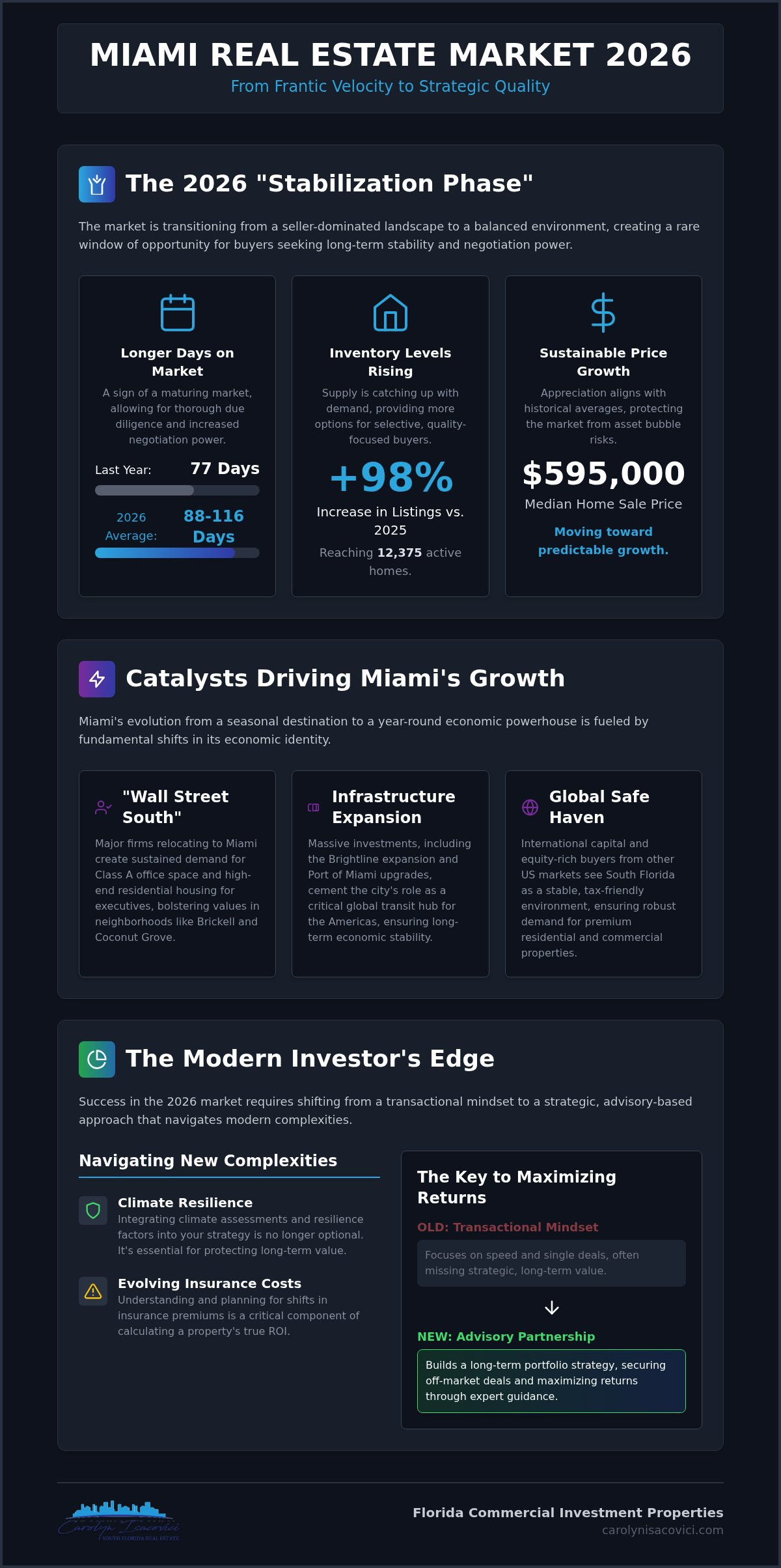
The frenzy has faded. After the unprecedented surge that defined the post-2020 era, the Miami real estate market trends in 2026 point toward a much-needed “Stabilization Phase.” It’s a transition that many seasoned investors find refreshing. Why is that? Because a balanced market allows for strategy rather than just speed. We’ve moved away from the seller-dominated landscape into an environment where buyers have room to breathe and negotiate. The 2026 market is a period of rationalization for South Florida assets.
One of the most visible indicators of this shift is the increase in “days on market.” Recent data shows homes are selling in an average of 88 to 116 days, a noticeable climb from the 77-day average we saw last year. This isn’t a sign of weakness; it’s a sign of a maturing market. You now have the luxury of time to conduct thorough inspections and perform the due diligence that high-value investments require. This extra time translates directly into increased negotiation power, allowing you to secure terms that were simply impossible two years ago.
Inventory Levels and Price Appreciation Trends
Supply is finally catching up with demand. In August 2026, active listings in Miami reached 12,375 homes, representing a 98% increase compared to 2025. This growth in inventory across the Miami metropolitan area is helping to moderate price growth. While the median home sale price stood at $595,000 this August, the rate of appreciation is aligning more closely with historical averages rather than the double-digit spikes of the recent past.
- Institutional Support: Large-scale investors continue to hold properties, creating a stable price floor that prevents significant downward volatility.
- Inventory Growth: The surge in listings provides more options for selective buyers who prioritize quality over quick acquisition.
- Sustainable Growth: Price appreciation is moving toward a more predictable range, protecting the market from the risks of an asset bubble.
The Impact of the Secondary Market Cooling
How does the broader U.S. economy affect our local landscape? As secondary markets across the country experience a cooling period, Miami’s status as a global hub only strengthens. We’re seeing a high concentration of “equity-rich” buyers who are liquidating assets in other regions to reinvest in South Florida’s stability. Additionally, Miami remains a premier safe haven for international capital. Global investors recognize the long-term value of Florida’s tax-friendly environment and its position as a gateway to the Americas, ensuring that demand for premium residential and commercial property remains robust despite shifts in other states.
Catalysts for Growth: What is Driving Miami Real Estate in 2026?
What makes Miami different in 2026? It’s the evolution from a seasonal playground to a year-round economic powerhouse. While other metropolitan areas are struggling with stagnant growth, the Miami real estate market trends we’re seeing today are fueled by a fundamental shift in the city’s economic identity. We’ve moved beyond the “sun and sand” narrative into a reality where Miami serves as a global center for finance, technology, and logistics. This transformation is anchored by massive infrastructure investments, such as the completed Brightline expansion and recent upgrades to the Port of Miami, which have cemented our role as a critical transit hub for the Americas.
Corporate Relocation and the Commercial Ripple Effect
The “Wall Street South” movement isn’t just a headline; it’s a structural change. As major firms continue to establish permanent headquarters here, they create a sustained demand for Class A office space. This commercial activity has a direct and positive impact on residential values. When a high-profile firm relocates, it brings a wave of executives and professionals who need high-end housing. If you’re looking to understand how these business moves translate into investment opportunities, our Florida Commercial Real Estate: 2026 Investor’s Guide provides a deeper dive into these localized dynamics. This corporate influx has kept rental yields strong in “Executive Neighborhoods” like Brickell and Coconut Grove, where the proximity to new office hubs remains a top priority for affluent tenants.
New Construction and Pre-Construction Momentum
Why are so many savvy investors pivoting toward new construction homes Florida this year? It comes down to a preference for efficiency and modern resilience. In 2026, the allure of pre-construction isn’t just about the potential for appreciation; it’s about the security of hurricane-resistant materials and energy-efficient systems that lower long-term carrying costs. Additionally, new state legislation like the 2026 update to the “Live Local Act” (HB 1389) has encouraged developers to increase supply in strategic areas, offering more variety for those looking to enter the market at a competitive price point.
Locking in pre-construction pricing allows you to capture value while the surrounding infrastructure matures. If you’re ready to explore how these emerging pockets fit into your long-term portfolio, seeking expert guidance can help you identify the projects with the highest growth potential before they reach the open market. This proactive approach is what separates a standard purchase from a truly strategic investment in the current Florida landscape.
Neighborhood and Asset Class Performance: Where the Value Lies
Where is the smart money moving this year? As we navigate the current Miami real estate market trends, a clear distinction has emerged between asset classes. While the entire region is stabilizing, single-family homes in the luxury sector are outperforming nearly everything else. In the second quarter of 2026, sales for single-family homes priced at $1 million and above jumped by 26% year-over-year. Luxury condominiums also showed strength with a 12% increase, yet the preference for land and privacy continues to drive the highest appreciation in the residential sector.
If you find the core Miami prices a bit steep, you aren’t alone. Many investors are looking just north to “Value Pockets” like Hollywood, Fort Lauderdale, and Stuart. These areas offer a compelling entry point with similar lifestyle draws but more room for capital growth. For a comprehensive overview of where to focus your capital right now, our guide to Miami real estate investment opportunities breaks down the high-yield neighborhoods and asset classes that are truly emerging in 2026. For those focused on consistent cash flow, the resilience of multi-family property for sale Miami remains a cornerstone of a healthy portfolio. Rental demand stays high as the population grows, providing a safety net that single-asset investments sometimes lack.
To help you visualize the current landscape, here is a breakdown of estimated Cap Rates across South Florida’s primary sub-markets for 2026:
| Sub-Market | Estimated Cap Rate (2026) | Primary Asset Driver |
|---|---|---|
| Brickell / Downtown Miami | 4.2% to 4.8% | Corporate Finance Hub |
| Fort Lauderdale | 5.1% to 5.8% | Marine & Tech Growth |
| Hollywood / Hallandale | 5.5% to 6.3% | Tourism & Redevelopment |
| Stuart / Port Saint Lucie | 6.0% to 6.9% | Industrial & Logistics |
Emerging Neighborhoods to Watch in 2026
Are you looking for the next big growth area? Palm Beach Gardens and Jupiter have become the gold standard for high-value residential migration, attracting executives who want a blend of luxury and tranquility. Further north, we’re seeing an industrial boom in Port Saint Lucie and Fort Pierce, driven by the need for regional distribution centers. Meanwhile, Stuart and Palm City are attracting long-term portfolio builders who recognize the value of limited inventory and high demand for quality waterfront living. For a data-driven breakdown of where infrastructure, zoning changes, and lifestyle trends are converging to create genuine long-term value, our analysis of the best neighborhoods to invest in Miami provides a precise framework for evaluating each sub-market in 2026.
Commercial vs. Residential: A 2026 Strategic Pivot
The most successful investors this year are those willing to pivot. While residential property offers stability, the yield spreads in “Mixed-Use” developments are currently the winner for institutional-grade portfolios. These projects, which combine retail, office, and residential units, capitalize on the modern desire for “live-work-play” environments. We are also seeing a significant rise in “Build-to-Rent” communities. These developments offer the privacy of a home with the professional management of an apartment complex, meeting the needs of a mobile, high-income workforce that isn’t quite ready to commit to a 30-year mortgage. Investors who want to scale across multiple asset classes will find that a disciplined approach to Florida real estate portfolio building is the most effective way to balance yield, diversification, and long-term resilience in today’s market.
Strategic Implementation: Navigating Risks and Climate Resilience
How do we handle the “insurance elephant” in the room? It’s a question many investors ask when reviewing Miami real estate market trends in 2026. While the headlines often lean toward the alarmist, the reality is far more manageable for the informed buyer. State regulators recently approved a statewide average rate cut for Citizens Property Insurance Corporation policies, effective July 1, 2026. This move, including an 8.8% reduction for multiperil policies, signals a stabilizing trend that rewards proactive owners who prioritize resilient assets. We view these conditions not as a deterrent, but as a filter that separates high-quality investments from speculative risks.
Success in this environment hinges on a commitment to rigorous investment property due diligence Florida. By framing climate resilience as a tangible value-add, you can identify properties that will command a significant premium as we move toward 2030. Use this four-point checklist to evaluate “Climate-Ready” assets during your search:
- Elevation and Drainage: Verify the property’s specific height relative to local flood mitigation infrastructure.
- Structural Integrity: Confirm the completion of milestone inspections for condos or hurricane-resistant upgrades for single-family homes.
- Energy Efficiency: Prioritize homes with impact-resistant windows and insulated roofing that qualify for insurance credits.
- Disclosure Compliance: Ensure all lease agreements include the mandatory 2026 written flood disclosures for tenants.
Mitigating the Cost of Ownership in South Florida
Managing the “bottom line” requires a sophisticated approach to property taxes and assessments. For residential owners, the 2026 homestead exemption has increased to $51,411, providing a helpful buffer against inflation. In the condo market, the “Surfside” legislation has matured. While mandatory structural reserves have increased some monthly assessments, they have also made buildings more attractive to conventional lenders. Investing in properties that meet modern construction standards is the most effective way to lower long-term carrying costs and secure your equity.
The Long-Term Forecast: Miami in 2030 and Beyond
What does the future hold? We are seeing a distinct “High Ground” premium emerge, where natural elevation is becoming a primary driver of land value. However, the most strategic moves involve following the “Path of Progress.” This means looking beyond the immediate water view and focusing on neighborhoods benefiting from municipal sea-level rise mitigation projects. These public investments act as a catalyst for private property appreciation, ensuring your portfolio remains resilient for decades. If you are ready to secure a property that stands the test of time, reach out for a strategic portfolio review today.
The Competitive Edge: Leveraging Expert Brokerage in an Evolving Market
Is your current strategy built for a sprint or a marathon? In 2026, the era of the “transactional” agent has passed, replaced by the necessity of the “Advisory Broker.” As we have seen throughout this guide, the Miami real estate market trends currently favor those who prioritize due diligence over speculative speed. You don’t just need someone to find a listing; you need a partner who understands the underlying 20-year market cycle. Florida Commercial Investment Properties specializes in this precise level of strategic navigation. Since 2006, Carolyn Isacovici has guided investors through every peak and valley of the South Florida landscape, providing the steady hand needed to avoid common “cycle traps” and identify value where others see uncertainty.
One of the primary advantages of working with a seasoned brokerage is access to the invisible market. While public inventory has grown, many of the highest-yield opportunities remain off-market. Our deep-rooted connections across the Miami real estate market trends allow us to identify these “quiet” deals before they reach the general public. We don’t just present you with data; we interpret it through the lens of your specific financial goals, ensuring that every acquisition serves as a pillar for your long-term Florida portfolio.
Customized Portfolio Strategy for 2026
How do you effectively balance a high-yield multi-family asset in Miami with a resilient new construction home in Stuart? It starts with a unified vision and local boots-on-the-ground knowledge. We help our clients bridge the gap between commercial and residential sectors, providing end-to-end sales management for both individual and institutional investors. Whether you are analyzing the industrial boom in the Treasure Coast or the luxury high-rise stabilization in Miami Beach, our team provides the granular insights required for success. We ensure your portfolio is strategically aligned with the infrastructure and migration catalysts that are currently reshaping the state.
Next Steps: Securing Your Florida Position
Are you ready to move from observation to execution? Securing your position in the 2026 market requires more than just awareness; it requires a partner who can transform those trends into actionable results. We provide specialized brokerage support for new construction, high-value residential sales, and complex commercial acquisitions. The path forward is built on clarity and professional wisdom. You can Schedule your 2026 Miami market strategy session with Carolyn Isacovici today to begin refining your approach and identifying your next high-value opportunity. Let’s turn the current market dynamics into your most significant competitive advantage.
Building Your South Florida Legacy in a Stabilized Market
How do we move from market insight to meaningful action? The 2026 landscape isn’t about chasing the next frantic spike; it’s about securing high-quality assets that offer long-term stability and growth. We’ve explored how corporate relocations and massive infrastructure upgrades are creating a permanent floor for property values. By focusing on emerging value pockets and prioritizing climate resilience, you’re doing more than just buying a property. You’re building a resilient Florida portfolio that can weather any cycle.
Staying ahead of Miami real estate market trends is only the first step. The real advantage comes from strategic execution. Since 2006, our team has specialized in navigating these complex conditions across Miami, Broward, and Palm Beach. We combine deep local knowledge with a specialized focus on commercial and high-value residential sales to ensure your investments are protected and positioned for success. Are you ready to transform these insights into your next strategic move? Partner with Florida Commercial Investment Properties for your 2026 strategy. The future of South Florida is bright, and we are here to help you navigate it with confidence.
Frequently Asked Questions
Is the Miami real estate market expected to crash in 2026?
No, the market is currently in a stabilization phase rather than a crash. While inventory has increased by 98% compared to 2025, the demand from institutional investors and corporate relocations provides a strong price floor. We’re seeing a transition to a balanced market where days on market have increased to over 80 days. This shift allows for more rational decision-making and negotiation power for buyers, which is a healthy sign of a maturing economic landscape.
Which Miami neighborhoods offer the best ROI for investors in 2026?
High-growth “value pockets” like Hollywood, Fort Lauderdale, and Stuart are offering some of the best returns this year. While core Miami areas remain strong, these secondary markets provide lower entry points with significant upside from regional expansion. We also see high performance in Palm Beach Gardens for luxury residential and Port Saint Lucie for industrial assets. These locations benefit from the continued migration of high-earning professionals who prioritize lifestyle and accessibility over traditional urban cores. For a detailed breakdown of where to focus your capital, explore our guide to Miami real estate investment opportunities in 2026.
How are high insurance rates affecting Miami property values?
While insurance is a major talking point, recent Miami real estate market trends show that property values remain resilient due to proactive state regulations. Effective July 1, 2026, Citizens Property Insurance Corporation implemented an 8.8% rate cut for multiperil policies, helping to ease the cost of ownership. Investors are focusing on modern, hurricane-resistant construction to secure lower premiums and protect long-term value. This flight to quality ensures that well-maintained assets continue to appreciate despite broader regional costs.
Should I invest in commercial or residential property in Florida right now?
The choice depends on your specific goals, but 2026 is seeing a significant pivot toward mixed-use developments and multi-family assets. These asset classes offer diversified income streams and capitalize on the “live-work-play” lifestyle currently in high demand. Residential properties, particularly luxury single-family homes, still show strong appreciation, but commercial retail and office spaces in corporate hubs like Brickell are providing attractive yields for those seeking a more institutional-grade portfolio strategy.
What is the “Brightline effect” on Florida real estate trends?
The “Brightline effect” refers to the substantial increase in property values and rental demand near high-speed rail stations. By connecting Miami to Fort Lauderdale, West Palm Beach, and Orlando, the rail system has expanded the viable “commuter belt” for high-income professionals. This connectivity makes neighborhoods that were once considered remote much more attractive for residential and commercial investment. It’s a fundamental shift that rewards investors who position themselves along these primary transit corridors.
Are new construction homes a better investment than resale properties in Miami?
New construction homes are often the superior choice in 2026 because they meet the newest building codes and energy efficiency standards. These modern features translate directly into lower insurance premiums and reduced maintenance costs over the first decade of ownership. While resale properties may offer more established locations, the peace of mind and structural resilience of a new build are highly valued by today’s sophisticated tenants and buyers in the Florida market.
How does climate change impact real estate investment in South Florida?
Climate change has introduced a “high ground” premium where natural elevation and municipal mitigation projects directly influence land value. Forward-thinking investors aren’t avoiding the market; they’re performing deeper due diligence on flood infrastructure and sea-level rise projections. Miami-Dade’s inclusion of climate vulnerability in property assessments means that assets with modern resilience features are becoming more valuable. Investing in the “path of progress” now involves looking at both infrastructure and environmental readiness.
What are the benefits of working with a specialized investment broker in Florida?
A specialized investment broker acts as a navigator who can identify off-market opportunities and help you avoid common “cycle traps.” With a perspective dating back to 2006, our team understands the nuances of both commercial and residential sectors across South Florida. We move beyond simple transactions to provide a comprehensive portfolio strategy. This level of advisory support is essential for navigating modern complexities like new state legislation, insurance shifts, and localized growth catalysts.
Leave a Reply