
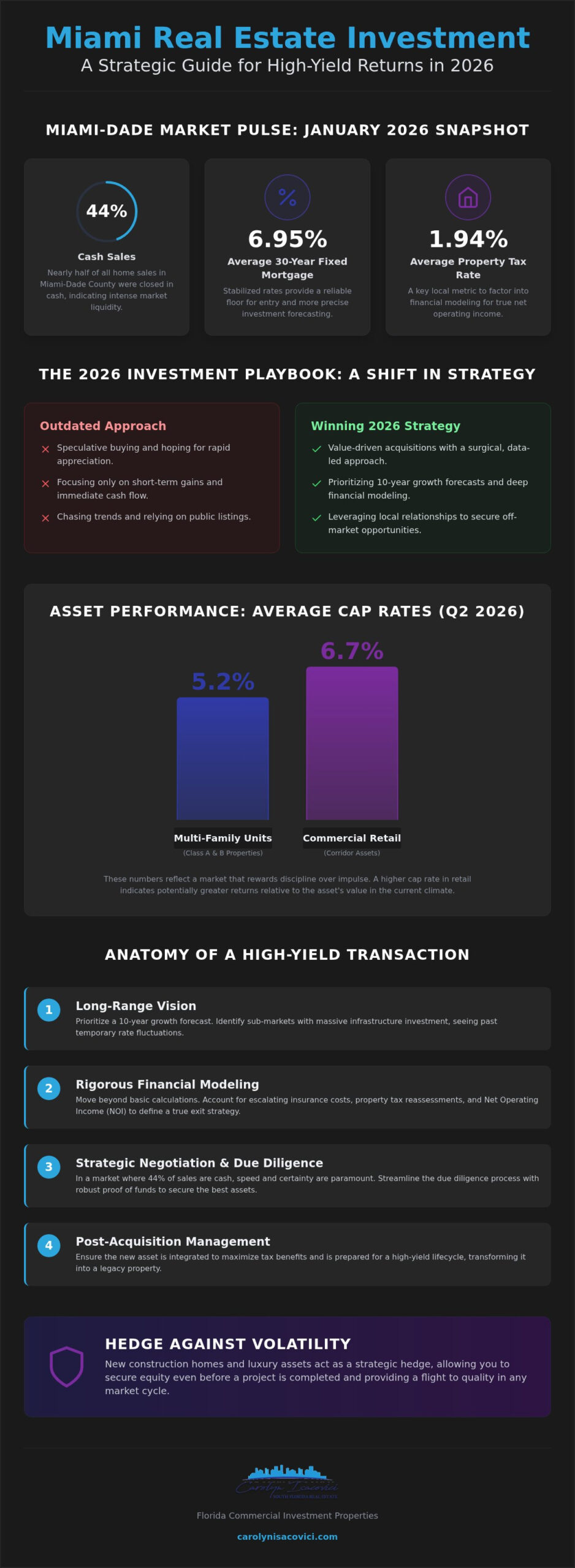
Did you know that nearly half of all local real estate transactions are now closed in cash? In January 2026, cash sales accounted for 44% of all home sales in Miami-Dade County. This figure highlights the intense competition and liquidity currently defining the landscape. Is it still possible to find high-value opportunities amidst such a fast-paced environment? Absolutely. Success in this cycle simply requires a more surgical approach to acquisition and a steady hand at the helm.
We understand that the current market can feel complex. Between 30-year fixed mortgage rates averaging 6.95% and the intricacies of new structural integrity laws, you might wonder if the window for high-yield returns is narrowing. It isn’t. This guide provides the exact strategies and market insights required to navigate Miami investment property sales with confidence and precision in 2026. You will discover how to identify true off-market value, manage the nuances of South Florida due diligence, and secure the long-term capital appreciation your portfolio deserves. We will break down the shift toward luxury assets and the impact of recent insurance rate cuts to ensure your next move is your most profitable one yet.
Key Takeaways
- Identify the shift from speculative buying to value-driven acquisitions to maintain growth in the resilient 2026 Miami market.
- Master a two-step framework for high-yield transactions that prioritizes long-term growth forecasts and deep financial modeling over short-term gains.
- Compare the performance metrics of multi-family units against commercial retail corridors to refine your approach to Miami investment property sales in the current climate.
- Explore how new construction homes and luxury assets act as a hedge against volatility, allowing you to secure equity before a project is even completed.
- Learn how to transition from a traditional buyer to a strategic partner by aligning with expert brokerage support to build a diversified Florida legacy.
Navigating Miami Investment Property Sales in the 2026 Landscape
Is the Miami market still a viable arena for high-value returns? The answer is a resounding yes, though the rules of engagement have changed. In 2026, we’ve moved past the era of buying and hoping. Resilience has replaced rapid speculation as the primary driver of growth. While looking at the historical context of Florida’s land booms reminds us of the region’s cyclical nature, today’s market is underpinned by permanent shifts in where people work and live. We are no longer seeing the frantic, uncalculated surges of the past; instead, we are witnessing a deliberate flight to quality that rewards the patient, informed investor.
The 2026 Market Pulse: Opportunity vs. Noise
Why does Miami continue to attract global capital? It’s the persistent concentration of wealth and the ongoing tech migration that hasn’t slowed. With interest rates stabilizing around 6.95% for 30-year fixed loans as of August 2026, investors have finally found a reliable floor for entry. This stability allows for more precise forecasting when evaluating South Florida investment properties. The noise of market volatility often masks the underlying strength of the region. By focusing on the “sweet spot” in Miami-Dade and Broward where infrastructure is expanding, you can identify assets that offer both immediate cash flow and long-term security. Success here isn’t about chasing the latest trend, it’s about recognizing which neighborhoods have the staying power to weather any cycle.
Key Metrics for the Modern Miami Investor
What metrics actually matter right now? Price per square foot is a helpful starting point, but net operating income (NOI) and future cap rates are the real North Star for 2026. In the second quarter of 2026, multifamily cap rates for Class A and B properties in Miami averaged 5.2%, while retail assets reached 6.7%. These numbers reflect a market that rewards discipline over impulse. You must also account for the local tax landscape, particularly the 1.94% average property tax rate in Miami-Dade. Navigating these costs requires a strategic partner who can uncover off-market opportunities that never reach public listings. In a landscape where high-quality inventory is constrained, the most successful Miami investment property sales are those secured through deep local relationships rather than generic search engines.
Ultimately, the 2026 landscape is one of maturity. It’s a market where the calm expert thrives by looking past the headlines and focusing on the underlying data. Whether you are looking at a commercial strip in a bustling corridor or a residential portfolio in an emerging neighborhood, the goal remains the same: sustainable, high-value returns. By aligning your strategy with these current realities, you transform market complexity into a distinct competitive advantage.
The Anatomy of a High-Yield Miami Real Estate Transaction
What does a successful acquisition look like on the ground? It begins with a shift in perspective. While many look at immediate cash flow, the highest performers in Miami investment property sales prioritize a 10-year growth forecast. This long-range view allows you to see past temporary interest rate fluctuations and focus on sub-markets with massive infrastructure investment. Once you have identified a target, rigorous financial modeling is the next non-negotiable step. We often tell our clients that the first year is just the beginning. You must account for escalating insurance costs and property tax reassessments to understand your true exit strategy.
Negotiating a close in 2026 requires more than just a high offer. With cash sales making up 44% of the market, your proof of funds and speed of due diligence are your greatest assets. We help you move from the initial walkthrough to a signed contract by streamlining the complex due diligence process inherent to South Florida. Finally, post-acquisition management ensures your new asset integrates seamlessly into your existing portfolio. This phase maximizes the tax benefits of Florida’s unique regulatory environment while preparing the asset for a high-yield lifecycle.
Evaluating the Cap Rate: A Miami Specific View
How do you determine if a deal is actually a deal? To accurately evaluate investment property Florida metrics, you must look beyond the surface. Coastal properties carry specific expenses, such as the new structural integrity requirements for older condos and the evolving insurance landscape. While Miami’s multifamily cap rates averaged 5.2% in Q2 2026, comparing these to the slightly higher yields in Fort Lauderdale or the luxury stability of Palm Beach is essential. This context ensures you aren’t just buying a property, but investing in a specific yield profile that matches your long-term legacy goals.
The Broker Advantage in Transactional Execution
Why involve a broker in a high-demand market? A seasoned expert identifies red flags, like deferred maintenance or zoning hurdles, long before they become liabilities. The art of the offer isn’t just about the price; it’s about positioning your capital to win without overpaying in a low-inventory environment. By leveraging local relationships, we can often secure access to off-market inventory that never hits the public eye. This “insider” access is often the difference between a standard return and a truly exceptional one. If you are ready to refine your strategy, exploring professional investment brokerage can provide the clarity needed to move forward with certainty.
Case Study: Multi-Family vs. Commercial Asset Performance
Are you torn between the steady hum of residential rent and the structured stability of a commercial lease? This choice often defines the trajectory of your portfolio. In 2026, Miami investment property sales have branched into two distinct paths, each offering unique advantages depending on your tolerance for management and your desire for yield. We’ve seen that the most successful investors don’t just pick a category; they pick a scenario that aligns with their five year exit strategy. Let’s look at how these two asset classes performed in the most recent quarter to find the right fit for your capital.
Multi-Family Success: The Income Generator
Consider a recent 12-unit acquisition in Hollywood, FL. This emerging neighborhood has become a magnet for professionals priced out of the urban core. In the second quarter of 2026, multifamily cap rates for Class A and B properties in the region averaged 5.2%. Why does this matter? It shows that demand for housing remains incredibly resilient despite shifting interest rates. In this specific case study, the investor focused on a value-add play, upgrading interiors to capture the 22% growth in luxury rental demand seen earlier in the year. By implementing professional management, the owner was able to maintain a 96% occupancy rate, proving that residential assets are the ultimate hedge against market fluctuations. It’s about turning a physical building into a predictable, high-yield income stream.
Commercial Assets: The Stability Play
On the other side of the coin, we have the rebound of Miami office space for sale. While some feared for the future of the office, Class B and C properties in established corridors saw cap rates average 7.9% in Q2 2026. This is a significant spread compared to residential yields. The commercial play is often built on the back of Triple-net (NNN) leases. These agreements are a favorite for passive investors because the tenant handles taxes, insurance, and maintenance. By securing a diverse tenant mix, from boutique law firms to tech startups, investors in this sector have enjoyed long-term lease stability that residential units simply can’t match. It’s a “set it and forget it” strategy for those who prioritize time as much as they do returns.
The lessons learned from this cycle are clear. The ongoing debate regarding commercial vs residential investment Florida isn’t about which is “better” in a vacuum. It’s about whether you want the high-touch, high-growth potential of multifamily or the hands-off, high-cap-rate stability of commercial corridors. Both paths lead to a diversified Florida legacy if you navigate them with the right data. We’re here to help you weigh these scenarios against your specific financial goals, ensuring your next acquisition is a strategic triumph.
Strategic Selection: Why New Construction and Luxury Assets Win
Why is the luxury sector thriving while other segments stabilize? In the first quarter of 2026, sales of homes priced over $1 million in South Florida increased by 22% year-over-year. This surge isn’t accidental. Investors are increasingly viewing high-end assets as “recession-resistant” stores of value. When you engage in Miami investment property sales within the luxury tier, you aren’t just buying a building; you’re securing a piece of a globally recognized brand. From the vertical growth in Brickell to the curated exclusivity of the Design District, “New Miami” hubs are redefining what a high-value portfolio looks like.
The Pre-Construction Investor Roadmap
The 2026 surge in new construction homes Florida serves as a powerful hedge against the maintenance costs of older inventory. By locking in a pre-construction price, you effectively secure equity before the project is even finished. However, success requires a clear roadmap. You must vet developer reputations and understand the specific deposit structures that characterize these deals. Is the project’s long-term viability supported by local infrastructure? We help you answer these questions by timing your exit strategy, whether you plan to hold for appreciation or flip for a tactical gain.
Luxury Residential as a High-Value Asset
Why does residential investment property Miami continue to act as a global magnet? The data tells the story. Foreign buyers invested $4.4 billion in South Florida real estate in 2025, a 42% increase from the previous year. This influx of capital targets scarcity. Waterfront locations and premium zip codes never go out of style, even as broader market conditions shift. In June 2026, while the condo supply sat at 12.9 months, the luxury segment maintained a competitive edge with a sale-to-list price ratio of 94.68%. This stability allows you to leverage high-value real estate for true portfolio diversification.
If you’re ready to explore these exclusive opportunities, our team can guide you through the latest new construction sales to find the perfect fit for your legacy. We specialize in identifying projects that offer the best balance of luxury and long-term financial security.
Securing Your Florida Legacy with Expert Brokerage Support
How do you bridge the gap between a single transaction and a multi-generational legacy? It requires a fundamental shift in perspective. You aren’t just looking for a vendor; you’re seeking a strategic partner who views your success as their own. In the high-stakes arena of Miami investment property sales, having a guide who has navigated various market cycles since 2006 is invaluable. Carolyn Isacovici and her team at Florida Commercial Investment Properties provide more than just access to listings. They offer the analytical mind of a strategist combined with the steady hand of a seasoned consultant. This approach transforms the stress of acquisition into a structured path toward high-yield returns. By aligning yourself with an expert who understands the nuances of both residential and commercial sectors, you ensure your capital is working its hardest.
The Florida Commercial Investment Properties Difference
What sets this approach apart? It’s the depth of experience in both commercial buildings and new construction. We’ve seen the market’s ebbs and flows, and we remain unruffled by temporary shifts. Our expertise is rooted in high-yield acquisitions for both institutional and individual investors. We don’t just present data; we interpret it within the context of your specific goals. Whether you’re looking for passive income from a retail corridor or capital appreciation from luxury residential assets, our advisory remains focused on the long-term health of your portfolio. We believe that clarity is the ultimate competitive advantage.
Your Next Steps: From Inquiry to Closing
Are you ready to move from observation to execution? Your journey begins with a portfolio consultation designed to align your financial objectives with the current 2026 market reality. This isn’t a generic sales pitch. It’s a deep dive into the metrics that matter most to you, from cap rates to tax reassessments. From there, we provide access to exclusive, off-market investment listings that never reach the public eye. These hidden gems often represent the best value in a low-inventory environment. By executing with confidence and precision, you can secure your place in Florida’s future. The 2026 market offers a unique sense of opportunity for those who are prepared. We invite you to take that first step with a partner who values your legacy as much as you do.
Building Your Florida Legacy in 2026 and Beyond
Is the 2026 market complex? Yes, but it’s also filled with unprecedented opportunity for the strategic investor who knows where to look. We’ve explored how a shift toward value-driven acquisitions and a clear-eyed view of asset class performance can transform market volatility into a distinct advantage. Whether you’re prioritizing the steady cash flow of a multi-family unit or the stability of a new construction luxury asset, the key is execution backed by deep local insight. Navigating Miami investment property sales requires more than just a list of properties; it demands a partner who has seen various cycles and remains unruffled by change.
With over 20 years of Florida market expertise, Carolyn Isacovici specializes in high-yield commercial and residential assets. Her proven track record in new construction acquisitions ensures that your portfolio is built on a foundation of quality and foresight. You don’t have to navigate these waters alone. Contact Carolyn Isacovici to start your Miami investment journey today and turn your long-term vision into a tangible Florida legacy. The future of your portfolio starts with a single, confident step forward.
Frequently Asked Questions
Is Miami real estate still a good investment in 2026?
Yes, Miami remains a premier destination for capital due to sustained tech migration and high net-worth interest. In the first quarter of 2026, luxury sales rose by 22%, signaling that the top end of the market is incredibly resilient. While interest rates have stabilized around 6.95%, the influx of foreign buyers, who invested $4.4 billion in 2025, continues to drive demand. It’s a market built on solid growth rather than just speculation.
What is the average cap rate for Miami investment properties right now?
Cap rates vary significantly by asset class according to Q2 2026 data. Multifamily and industrial properties currently average 5.2%, reflecting their high demand and stability. If you are looking for higher yields, retail properties average 6.7%, while Class B and C office spaces reach approximately 7.9%. These figures provide a clear benchmark for evaluating Miami investment property sales and help you determine which sector aligns best with your specific cash flow requirements.
How do I choose between commercial and residential investment in Florida?
Your choice depends on your desired involvement level and risk appetite. Residential properties often provide higher liquidity and benefit from the 22% growth in the luxury sector we saw early this year. Commercial investments, particularly those with Triple-net (NNN) leases, offer a more hands-off experience with tenants covering taxes and insurance. We recommend evaluating your long-term legacy goals before deciding which asset class will anchor your diversified Florida portfolio.
What are the best neighborhoods in Miami for high-yield rental property?
High-yield opportunities are currently concentrated in emerging neighborhoods and established luxury hubs. Areas like Hollywood, FL, are seeing strong multifamily performance with cap rates around 5.2%. For luxury seekers, the Design District and Brickell remain global magnets, supported by the 44% of transactions closed in cash this year. Identifying the right pocket requires looking at 10-year infrastructure plans rather than just current occupancy rates to ensure sustainable, long-term appreciation for your assets.
How does a 1031 exchange work for Florida investment property sales?
A 1031 exchange allows you to defer capital gains taxes by reinvesting proceeds from one property sale into a “like-kind” replacement. This is a powerful tool for scaling your Florida real estate portfolio without immediate tax liabilities. You must follow strict IRS timelines, including identifying a new property within 45 days and closing within 180 days. It’s an essential strategy for investors looking to transition from residential units into larger commercial buildings.
Can I buy Miami investment property through an LLC?
Purchasing through an LLC is a standard practice for sophisticated investors in the Florida market. This structure provides a vital layer of asset protection by separating your personal liabilities from your real estate holdings. Additionally, an LLC can offer tax flexibility and ease the process of transferring ownership among multiple partners. It’s a strategic move that aligns well with the professional and institutional nature of modern Miami investment property sales.
What are the closing costs for commercial property in Florida?
Closing costs in Florida generally range between 2% and 5% of the total purchase price. For commercial transactions, these costs include title insurance, documentary stamp taxes on the deed, and professional surveys. You should also budget for environmental assessments and specialized inspections, which are critical in South Florida’s coastal environment. While we don’t provide legal services, we help you factor these concrete expenses into your initial financial modeling to ensure no surprises.
Why should I work with a specialized investment broker like Carolyn Isacovici?
Working with a specialist like Carolyn Isacovici gives you a distinct advantage in a low-inventory market. With expertise dating back to 2006, she provides access to exclusive off-market listings that generic platforms simply cannot offer. Her team focuses on the end-to-end sales process for high-yield acquisitions, combining the analytical mind of a strategist with deep local relationships. This ensures your investment is backed by two decades of wisdom and a commitment to your success.