What if the traditional residential rental you’ve been eyeing is actually more complex to manage in 2026 than a high-yield commercial building? It’s a question many investors are asking as they look at a Florida market that finally shows signs of stabilization. You’ve likely noticed the headlines about shifting insurance premiums and the new 2.7 percent homestead assessment cap. It’s natural to feel a bit of hesitation when weighing a commercial vs residential investment Florida strategy, especially with the nuances of South Florida’s growth.
We understand that the choice between these asset classes often feels like a trade-off between simplicity and scale. This guide is designed to replace that uncertainty with a clear, strategic framework for your 2026 financial goals. You’ll discover how current 6.625 percent mortgage rates and the recent 8 to 25 percent drop in commercial insurance premiums impact your bottom line. We will explore high-growth corridors from Miami to Melbourne and compare the hands-off nature of NNN leases against the steady demand for new construction homes. By the end, you’ll have the insight needed to navigate these cycles with the confidence of a seasoned strategist.
Key Takeaways
- Identify how the 2026 economic shift toward corporate relocations creates unique entry points for both asset classes across Florida’s high-growth corridors.
- Evaluate the stability of long-term commercial lease structures and how they compare to the shorter turnover cycles of residential properties.
- Discover how to balance your portfolio by weighing the lower barrier to entry of a commercial vs residential investment Florida strategy against the high demand for new construction homes.
- Gain clarity on the 2026 insurance landscape, including recent rate decreases that are helping to protect and preserve your investment yields.
- Learn why multi-family units serve as the ideal bridge for investors looking to transition from residential stability to commercial-scale income.
Understanding the Florida Real Estate Landscape in 2026
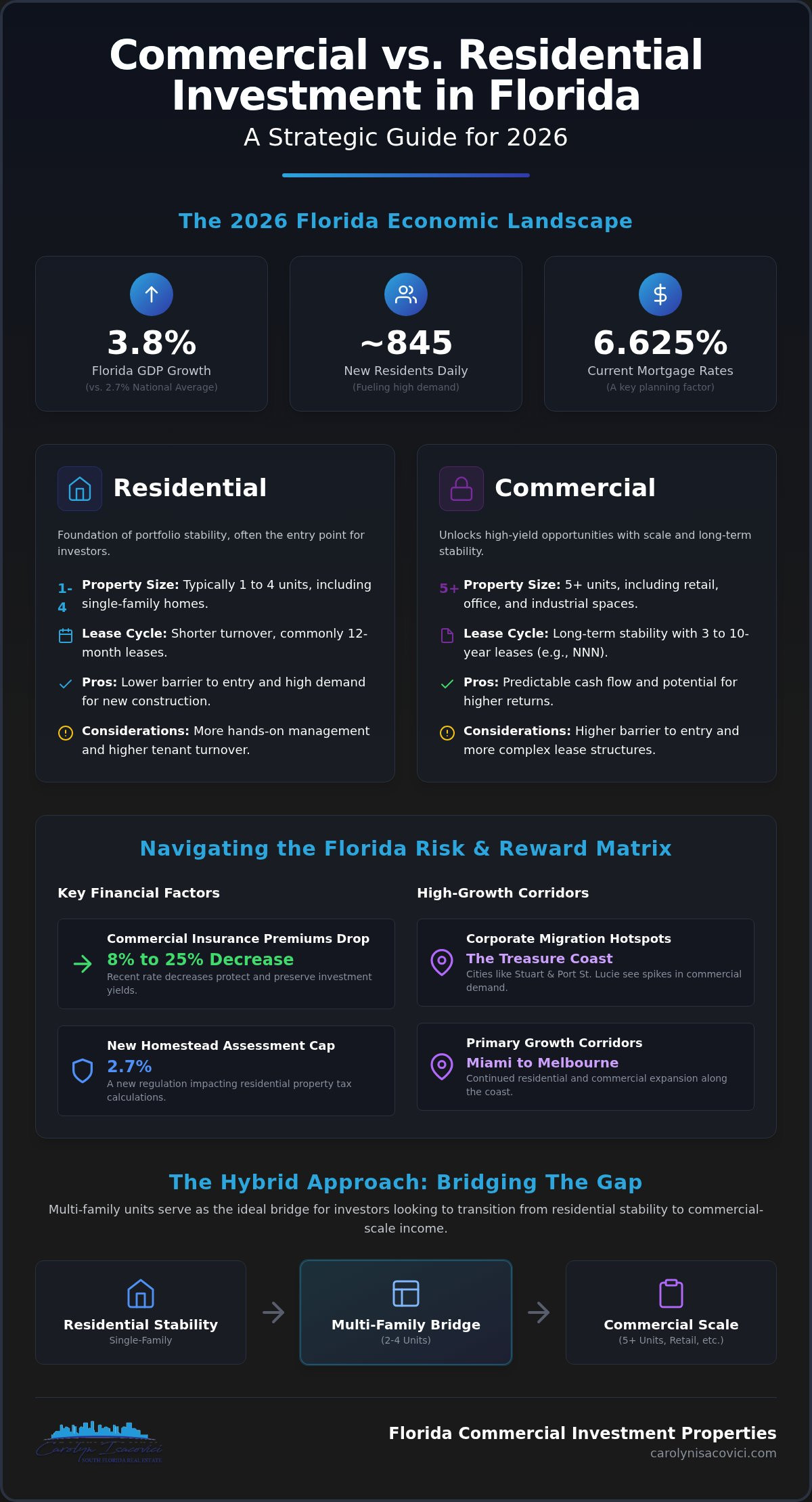
Florida has evolved into much more than a vacation destination. It’s now a premier hub for remote work and major corporate headquarters. With a GDP growth rate of 3.8 percent outstripping the national average of 2.7 percent, the state’s economic engine is firing on all cylinders. But how do you balance this growth against a 2026 climate of 6.625 percent mortgage rates? You look at the data. Successful real estate investing principles suggest that while inflation presents challenges, Florida’s fundamental demand remains a powerful hedge.
Choosing between a commercial vs residential investment Florida strategy is rarely about personal preference. It’s about math. From a brokerage perspective, we view this choice as a cold, strategic calculation rather than an emotional attachment to a specific property type. Is your goal immediate cash flow or long-term wealth preservation? The answer dictates your path. This decision requires a steady hand and a clear eye on the horizon.
The 2026 Florida Migration Effect
Population growth continues to surge. Florida welcomes roughly 845 new residents every single day. While Miami and Fort Lauderdale remain the primary magnets for residential demand, a significant shift is occurring. Businesses are migrating toward the Treasure Coast. Cities like Stuart and Port Saint Lucie are seeing a spike in commercial availability as firms seek lower overhead and better quality of life for employees. This 2026 “flight to quality” means investors are no longer just buying any plot of land; they’re seeking assets with modern infrastructure and resilient locations.
Commercial vs Residential: The Core Definitions
Understanding the technical boundaries is the first step toward a sound portfolio. Residential real estate typically includes 1 to 4 units, ranging from single-family houses to new construction homes in Florida. These are often the entry point for many looking for stability. Conversely, commercial assets involve 5 or more units, retail spaces, offices, and industrial warehouses. They offer a different scale of commercial vs residential investment Florida opportunities that often appeal to those ready for complex lease structures.
There’s a fascinating “gray area” in the current market. Short-term rentals in Miami Beach often function like commercial assets due to their high turnover and management intensity, even if they’re legally residential. This nuance is why a seasoned guide is essential to help you categorize your assets correctly for tax and insurance purposes.
The Florida Investment Core is the precise point where you achieve a sustainable balance between property appreciation and consistent cash flow.
Commercial Investment: Unlocking High-Yield Opportunities in Florida
Why do seasoned investors often gravitate toward the commercial sector? It’s the promise of scale and stability. While residential units offer a familiar entry point, Florida commercial real estate (CRE) provides a different level of income potential that aligns with ambitious 2026 financial goals. Think about the difference in commitment. A residential tenant might sign for 12 months, but a commercial lease often spans 3 to 10 years. This long-term horizon provides a predictable cash flow that many find reassuring during economic shifts. For those ready to dive deeper into a commercial vs residential investment Florida strategy, our Florida Commercial Real Estate: 2026 Investor’s Guide offers a comprehensive look at current opportunities.
The 2026 market is particularly favorable for commercial acquisitions. With commercial mortgage rates as low as 6.34 percent for single-tenant net lease properties, the math for high-yield returns is becoming increasingly attractive. This asset class allows you to move beyond the limitations of individual unit management and into a space where the property’s value is driven by its business performance.
Key Metrics: Cap Rates and NOI in the Florida Market
Net Operating Income (NOI) is simply the money left after all operating expenses are paid, but before you account for taxes and interest. It’s the heartbeat of your investment. In 2026, Miami’s industrial sector and Palm Beach’s retail hubs are showing robust cap rates, typically ranging between 5 and 8 percent. Unlike residential properties, commercial value is tied directly to income. This allows for “forced appreciation.” If you improve the lease terms or manage the property more efficiently, the value rises. It’s a strategic lever that residential owners rarely have.
The Power of the NNN (Triple Net) Lease
Have you considered who pays the property taxes and insurance? In a Triple Net (NNN) lease, the tenant does. This structure is particularly attractive in 2026. While some property costs fluctuate, the NNN lease shifts these burdens to the tenant, protecting your margins. This makes it the “Gold Standard” for passive income in the current market. With commercial property insurance rates decreasing by 8 to 25 percent in 2026, the largest drop since 2016, the cost-sharing model is even more sustainable for your tenants. We see significant strength in medical offices, industrial flex-spaces, and neighborhood retail centers that serve local communities. Investors seeking owner-occupied assets should also explore Miami office space for sale, where the 2026 market is presenting a unique window of opportunity in premium, amenity-rich environments.
If you’re weighing the pros and cons of commercial vs residential investment Florida, it’s helpful to consult with a specialist who understands these local nuances. Deciding on the right asset class is the first step toward a resilient 2026 portfolio.
Residential Investment: The Foundation of Florida Portfolio Stability
Residential investing often feels like coming home. For many, it’s the emotional favorite because it’s relatable. We understand houses. We understand neighborhoods. Beyond the sentiment, the barrier to entry is significantly lower than in the commercial sector. With current 30-year fixed mortgage rates at 6.625 percent, acquiring a single-family home or a duplex is a manageable step for those building a financial foundation. When weighing a commercial vs residential investment Florida strategy, liquidity is a major factor. It’s simply faster to sell a well-located home in a high-demand area than it is to offload a multi-million dollar office building. This flexibility provides a safety net that many investors find reassuring.
New Construction vs. Resale: The 2026 Debate
The conversation in 2026 has shifted heavily toward new construction homes in Florida. Why? It’s the “Warranty Advantage.” In growth hubs like Port Saint Lucie and Melbourne, new builds offer a level of predictability that older resale homes often lack. These properties are built to the most rigorous modern codes, which serves as your best defense against insurance costs. While Citizens Property Insurance approved an average rate decrease of 8.8 percent for multiperil policies in 2026, new construction often qualifies for even steeper discounts due to impact-resistant windows and reinforced roofing. In Miami and Broward County, these modern developments are commanding premium rental yields as tenants prioritize safety and lower utility costs.
The Scalability of Single-Family Rentals (SFR)
Can you scale a residential portfolio without losing your peace of mind? Absolutely. Many of our clients manage a successful cluster of homes across the Treasure Coast, transforming individual properties into a streamlined income engine. The key is professional property management. It turns a hands-on job into truly passive income. There’s also the tax perspective to consider. Residential properties allow for a 27.5-year depreciation schedule, offering a faster tax write-off than the 39 years required for commercial assets. This accelerated benefit, combined with the 2.7 percent homestead assessment cap for those who make Florida their primary residence, creates a robust environment for wealth building. Whether you’re focused on Miami’s fast-paced market or the steady growth of Stuart, residential investment property Miami strategies demonstrate how targeted acquisitions in high-migration corridors can provide a reliable bedrock for your commercial vs residential investment Florida strategy.
Navigating the Florida Risk-Reward Matrix: Insurance, Taxes, and Regulations
“Is Florida property insurance going to eat my profit?” This is the most common concern we hear from investors entering the 2026 market. The answer is a reassuring no, provided you’re looking at the data. For the first time in years, we’re seeing genuine stabilization. In 2026, commercial property insurance rates have decreased by 8 to 25 percent. Simultaneously, Citizens Property Insurance has implemented an 8.8 percent average cut for multiperil policies. With 17 new carriers entering the market since recent reforms, competition is finally working in your favor.
Understanding these nuances is vital when deciding on a commercial vs residential investment Florida path. It requires a risk-first perspective. We recommend learning how to evaluate investment property in Florida to ensure your pro-forma accounts for these shifting costs.
The Insurance Factor: Commercial vs. Residential
How do these asset classes differ in their protection? Commercial properties often utilize master policies that cover multiple units or buildings, which can provide more leverage during negotiations than individual residential homeowners insurance. Location plays a massive role here. Properties in Stuart or Vero Beach often command lower premiums compared to high-exposure oceanfront sites in Miami Beach. By focusing on “hardened” properties with modern mitigation features, you can lock in the lowest possible rates for 2026.
Operational Complexity and Management
Management styles vary wildly between these two worlds. Residential investments typically involve higher turnover and more frequent maintenance requests. It’s the classic “toilets and tenants” scenario. However, the demand for housing remains incredibly stable. Commercial investments, by contrast, offer professional tenants and complex lease negotiations that require specialized property management.
If you find your current asset class isn’t serving your 2026 goals, don’t forget the power of the 1031 Exchange. This allows you to swap a residential property for a commercial one, or vice versa, while deferring capital gains taxes. It’s a strategic move for those looking to pivot their portfolio without a heavy tax hit. Florida’s current non-homestead assessment cap is 10 percent for 2026, though a proposed amendment could lower this to 5 percent in 2027. Ready to refine your strategy? You should speak with an investment specialist to review your specific risk-reward profile today.
Designing Your Florida Investment Strategy: The Hybrid Approach
Why limit yourself to a single property type when you can bridge the gap? Many investors feel torn between the simplicity of a single-family home and the high-yield potential of a warehouse. A hybrid approach often provides the most resilient path forward. By diversifying across asset classes, you create a portfolio that can weather different economic cycles. The goal is to find the precise balance that matches your risk tolerance and your 2026 financial objectives.
Success in navigating the commercial vs residential investment Florida landscape requires a shift in perspective. It’s not just about what you buy; it’s about how you scale. Whether you’re focused on the high-energy markets of Miami or the steady appreciation of the Treasure Coast, a hybrid strategy allows you to capture growth wherever it appears. Staying informed on the latest Miami real estate market trends is essential for identifying where the next wave of opportunity is emerging across South Florida’s evolving landscape.
The Multi-Family Bridge
Have you considered the unique advantages of 2 to 4 unit properties? These are the perfect “Gateway Assets.” While buildings with 5 or more units are classified as commercial, these smaller multi-family properties qualify for residential financing. This means you can secure a 30-year fixed mortgage at 6.625 percent while enjoying multiple streams of rental income. In cities like Hollywood and Fort Lauderdale, small apartment buildings are in high demand. They offer a natural stepping stone for those looking to move from a single home into a more professional investment structure without the immediate complexity of a large commercial lease.
Actionable Steps to Start Your 2026 Florida Investment
Ready to move forward? Follow this clear roadmap to ensure your 2026 acquisitions are grounded in data and strategy.
- Step 1: Define your management threshold. Decide early if you prefer the hands-on nature of residential rentals or the more passive, professional structure of commercial NNN leases.
- Step 2: Secure your financial standing. The Florida market moves quickly. Having a pre-approval or proof of funds ready is essential to remain competitive.
- Step 3: Partner with local expertise. Work with a broker who understands the nuances of the entire Stuart to Miami corridor. Local insight is the difference between a good deal and a great one.
- Step 4: Conduct rigorous due diligence. Focus on the 2026 tax assessments and insurance requirements. Remember that non-homestead properties currently have a 10 percent assessment cap, which impacts your long-term carry costs.
The best time to invest in Florida was a decade ago. The second best time is 2026. With insurance markets stabilizing and corporate relocations continuing to drive demand, the opportunity for growth is significant. By taking a methodical, advisory-led approach, you can transform the current market’s complexity into your greatest strategic advantage. Those committed to long-term wealth creation should explore strategic Florida real estate portfolio building to understand how diversification across asset classes creates a structure that thrives regardless of market cycles.
Your 2026 Roadmap to Florida Real Estate Success
The choice between asset classes in 2026 isn’t a matter of guesswork; it’s a strategic calculation. You’ve seen how the stabilization of insurance rates and the rise of corporate relocations are reshaping the landscape from Miami to the Treasure Coast. Whether you choose the predictable cash flow of a Triple Net lease or the high demand for new construction homes, your success depends on a data-driven approach. Balancing a commercial vs residential investment Florida strategy allows you to remain agile as market conditions evolve.
Since 2006, we’ve served as a seasoned guide for investors navigating these very cycles. We specialize in identifying high-yield commercial assets and “recession-proof” residential opportunities that align with your long-term wealth goals. Our calm, advisory mindset ensures that you move forward with clarity rather than hesitation. Secure your next high-value Florida investment with Carolyn Isacovici’s expert brokerage services.
The Florida market remains one of the most vibrant engines for growth in the nation. It’s time to transform today’s uncertainty into your next great opportunity. Let’s build your legacy with the confidence you deserve.
Frequently Asked Questions
Is commercial or residential real estate more profitable in Florida for 2026?
Profitability is relative to your specific exit strategy and risk tolerance. While commercial property offers long-term lease escalations that act as a powerful hedge against inflation, residential assets in the current market provide unmatched liquidity and ease of sale. A commercial vs residential investment Florida decision should prioritize your immediate cash flow needs. Commercial yields are currently bolstered by the state’s 3.8 percent GDP growth, whereas residential returns are driven by the sustained demand for housing in high-migration corridors.
How does Florida property insurance affect commercial vs residential returns?
Insurance is becoming a more manageable variable in 2026. With 17 new carriers increasing competition across the state, the previous burden on your ROI is starting to lighten. Commercial master policies offer unique economies of scale for larger portfolios, while residential investors are benefiting from the recent rate cuts for multiperil policies. Both asset classes are seeing improved net returns as the market moves away from the volatility of previous years and toward a more predictable cost structure.
Can I use a 1031 exchange to move from residential to commercial property in Florida?
Yes, a 1031 exchange is a standard tool for Florida investors looking to defer capital gains while upgrading their portfolio. You can transition from a single-family home into a multi-tenant commercial property to increase your scale. This move is particularly effective when you want to shift from active residential management to the more passive nature of a Triple Net lease structure. It allows you to preserve your wealth while pivoting toward assets with higher professional management standards.
What is the “barrier to entry” for commercial real estate in Miami?
The barrier to entry in Miami is largely defined by the initial capital required for high-value urban assets. However, the corridor from Stuart to Hollywood FL offers more accessible entry points for those starting their commercial journey. By utilizing the 2 to 4 unit multi-family bridge, you can access residential financing while building the track record needed for larger institutional commercial acquisitions. This approach lowers the initial hurdle while keeping you positioned in high-demand growth markets.
Are new construction homes in Florida a better investment than older commercial buildings?
It depends on your appetite for management and your desire for predictability. New construction homes in growth hubs like Melbourne provide a maintenance-free experience with modern building codes that lower insurance costs from day one. Older commercial buildings, while requiring more oversight and capital for improvements, offer the opportunity for “forced appreciation” through professional lease management. Both play a vital role in a diversified portfolio, depending on whether you seek immediate stability or long-term value-add potential.
Which Florida cities offer the best cap rates for commercial property in 2026?
Melbourne and Stuart are currently seeing strong cap rate expansion due to the tech and business migration toward the Treasure Coast. While Miami and Fort Lauderdale attract significant institutional capital, these northern corridors often offer higher cap rates for retail and industrial assets. By looking toward cities like Port Saint Lucie or Vero Beach, you can often find properties with less competition and stronger cash-on-cash returns compared to the more saturated South Florida metros.
How do Florida landlord-tenant laws differ between commercial and residential assets?
Commercial assets are primarily governed by the specific terms of the lease contract, offering landlords more flexibility in structuring tenant responsibilities. Residential assets are more strictly regulated by Florida statutes designed to protect individual tenants and ensure habitability. This distinction makes a commercial vs residential investment Florida strategy a choice between the standardized protections of residential law and the customizable, business-oriented nature of commercial lease agreements, which often favor the landlord in dispute resolutions.
Is a multi-family property considered commercial or residential in Florida?
Classification depends entirely on the unit count of the property. Buildings with 1 to 4 units are residential, whereas 5 or more units are classified as commercial. This distinction dictates whether you can use a 30-year fixed residential mortgage or if you must secure a commercial loan with different amortization terms and down payment requirements. Understanding this threshold is essential for planning your financing strategy and calculating your long-term return on investment across different Florida markets.
Leave a Reply