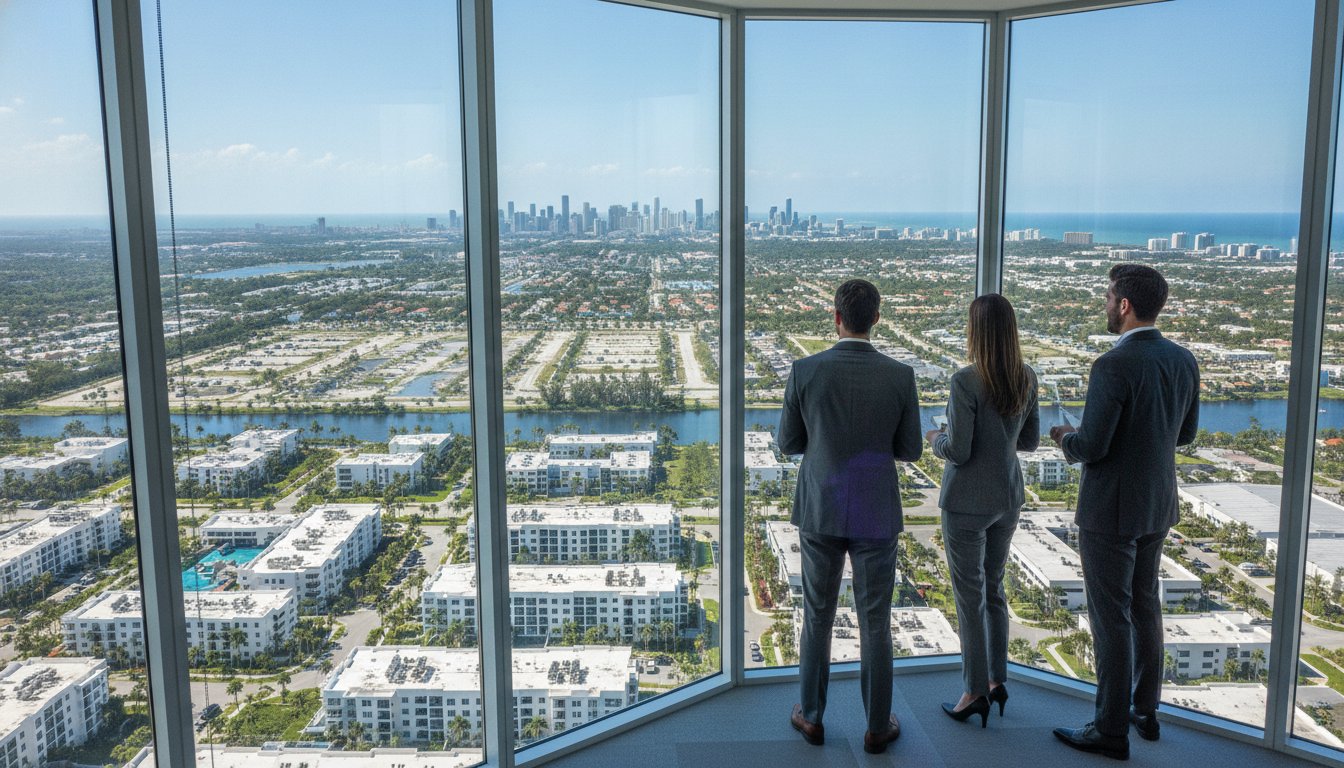
Is the era of the “Miami-only” play officially over? While the glitz of the Brickell skyline remains undeniable, the most sophisticated investors are looking elsewhere to find the alpha that a saturated core can no longer provide. It’s a common concern for fund managers who see the primary markets tightening while insurance premiums and regulatory shifts create a new layer of complexity. You’ve likely noticed that finding institutional-grade stability in Florida commercial real estate for private equity firms now requires a sharper lens than it did just a few years ago.
We understand that the 2026 market feels like a puzzle of high stakes and high rewards. This guide is designed to help you navigate these changes, from the total repeal of the commercial lease sales tax to the expansive opportunities created by the Live Local Act 4.0. You’ll discover how to identify high-growth secondary markets and access the off-market deals that never hit the public wire. We’ll explore the 2026 yield landscape and the specific sub-markets where your capital can work the hardest, ensuring your portfolio remains both resilient and profitable.
Key Takeaways
- Move beyond the crowded Miami core to discover institutional-grade multi-family opportunities in high-growth corridors like Stuart, Jupiter, and Port Saint Lucie.
- Identify why industrial logistics and multi-family assets remain the primary drivers of yield as the Florida market enters a healthy stabilization phase.
- Master the nuances of Florida commercial real estate for private equity firms by shifting focus from speculative plays to secure, core-plus assets.
- Learn how to access the “Quiet Sale” market through local networks, ensuring your firm secures high-value assets before they ever reach public exchanges.
- Understand how a seasoned local partner transforms complex regulatory and insurance shifts into clear strategic advantages for your institutional portfolio.
The 2026 Florida Landscape: Why Private Equity is Doubling Down
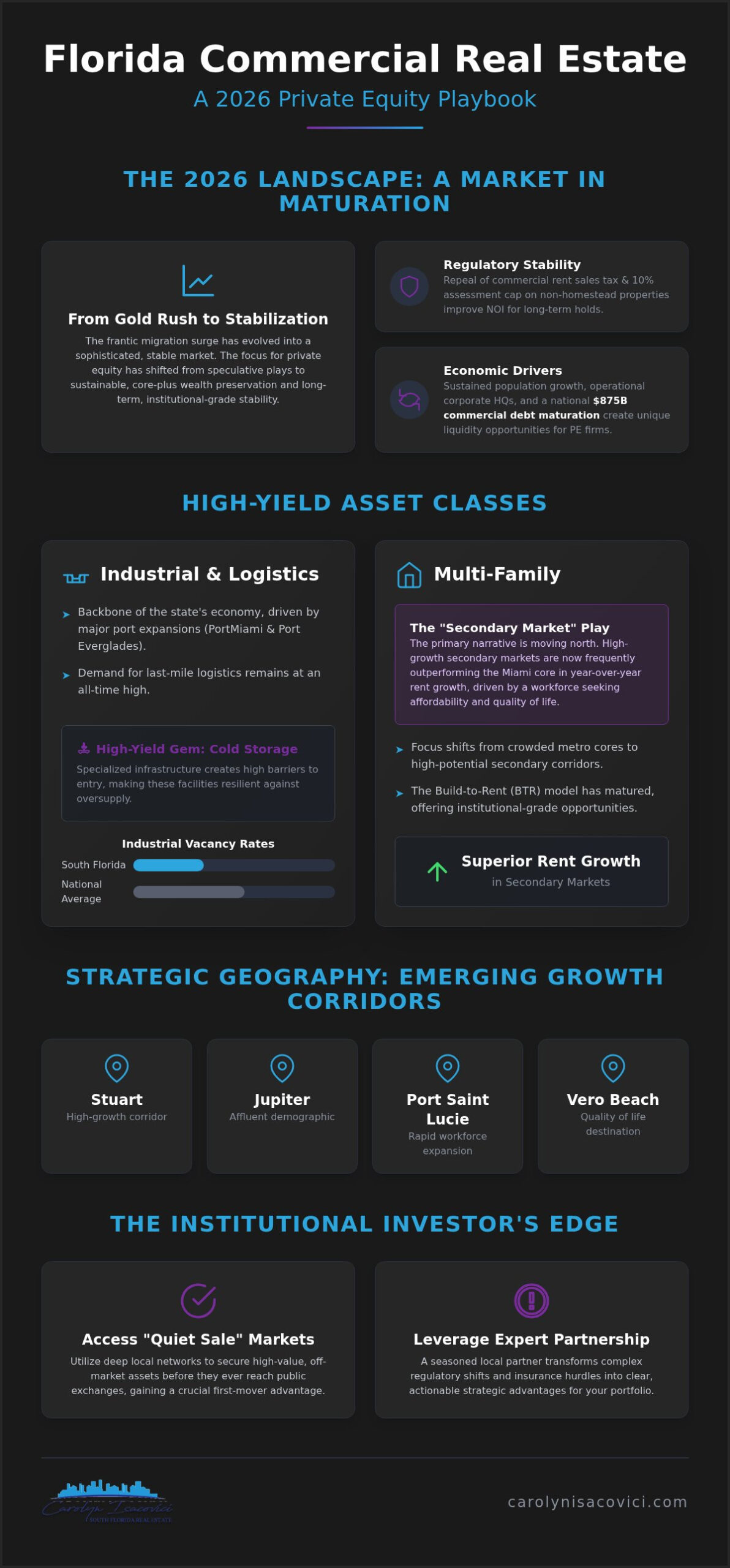
Has the Florida gold rush finally cooled? Not exactly. It’s simply matured. We’ve moved past the frantic, often speculative migration surge of the early 2020s and entered a sophisticated stabilization phase. For those managing what private equity real estate is today, this shift represents a strategic move toward sustainable, core-plus wealth preservation. Florida commercial real estate for private equity firms has transitioned into a seasoned market where the noise of the boom has been replaced by the clarity of long-term data and institutional-grade stability.
Regulatory stability serves as a powerful anchor for 2026. The complete repeal of the state sales tax on commercial rent, which took full effect in October 2025, has significantly improved net operating income across institutional portfolios. When you combine this with the 10% assessment cap on non-homestead properties, the environment for a long-term hold becomes incredibly compelling. A seasoned guide sees market volatility not as a threat, but as a window for strategic acquisition. While others may hesitate due to shifting insurance premiums, the calm expert recognizes that these hurdles often lead to more favorable entry prices for well-capitalized firms.
Post-Migration Market Dynamics
What happens when the initial rush subsides? Growth becomes predictable. In 2026, Florida continues to see sustained population increases, though at a more manageable pace that allows infrastructure and housing supply to synchronize. Corporate headquarters are no longer just exploring South Florida; they’re fully operational, which drives consistent demand in the Class A office and industrial sectors. This isn’t a temporary spike but a permanent realignment of the American economic map. The 2026 yield environment represents a definitive maturation cycle for institutional investors seeking stability over volatility.
The Institutional Shift to Florida
Why choose Florida over traditional hubs like New York or California? The answer lies in the friction-less business environment and the absence of state income tax. There’s a massive amount of dry powder currently targeting the 2026 market, especially as an estimated $875 billion in commercial debt matures nationwide this year. This creates a unique opportunity for private equity to step in with liquidity and secure high-quality assets. To understand the full scope of these opportunities, consult our 2026 Investor Guide. This is the moment to capitalize on assets that offer both safety and upside, ensuring that Florida commercial real estate for private equity firms remains a top-tier allocation for the coming decade.
High-Yield Asset Classes for Institutional Portfolios
Which sectors offer the most resilient returns in this matured market? It’s no longer about chasing any available square footage; it’s about precision. For those managing Florida commercial real estate for private equity firms, the focus has shifted toward essential infrastructure and demographic-driven demand. We see a landscape where the most successful portfolios are built on assets that serve the fundamental needs of a growing, aging, and increasingly affluent population. By aligning capital with these structural shifts, firms can secure the institutional-grade stability that defines the 2026 outlook.
Industrial and Cold Storage Demand
Industrial assets continue to be the backbone of the state’s economic engine. The ongoing expansions at PortMiami and Port Everglades have created a ripple effect, keeping industrial cap rates compressed and demand for last-mile logistics at an all-time high. Cold storage, in particular, has emerged as a high-yield “hidden gem” for institutional investors. These facilities require specialized infrastructure that creates high barriers to entry, making them incredibly resilient against oversupply. In 2026, industrial vacancies in South Florida remain well below national averages, providing a reassuring safety net for those deploying significant capital in the logistics space.
The Multi-Family “Secondary Market” Play
The narrative of Florida multi-family is moving north. While the Miami core remains a destination for trophy assets, secondary markets like Port Saint Lucie and Vero Beach are frequently outperforming the metropolitan core in terms of year-over-year rent growth. This shift is driven by a workforce seeking a balance between affordability and quality of life. The Build-to-Rent (BTR) model has also matured into a respected commercial asset class, offering the operational efficiency of a traditional multi-family complex with the privacy of single-family living. Mastering how to evaluate investment property metrics in these emerging corridors is the key to unlocking superior risk-adjusted returns.
Beyond housing and logistics, Medical Office Buildings (MOB) are benefiting from the state’s unique demographic tailwinds. As the population continues to age, these facilities provide long-term, recession-resistant leases that appeal to core-plus strategies. Simultaneously, high-street retail in luxury corridors is experiencing a vibrant resurgence. This isn’t just about shopping; it’s about providing premium physical experiences for a high-net-worth demographic that has permanently relocated to the Sunshine State. If you are looking to refine your acquisition strategy in these sectors, consulting with a local investment specialist can provide the ground-level clarity needed to move forward with confidence.
Strategic Geography: Beyond Miami to Florida’s Growth Corridors
While the Florida market remains a primary engine for growth, sophisticated firms are also monitoring global trends in sustainability and regenerative design. Projects like The ARK are at the forefront of this movement, offering a glimpse into how future-proofed communities can be structured to provide both ecological and institutional value.
Is Miami still the only game in town? While it remains a global magnet for trophy assets, the intense competition has created high barriers to entry that can occasionally compress yields beyond institutional comfort. For those managing Florida commercial real estate for private equity firms, the most compelling opportunities in 2026 are found in the corridors connecting our major hubs. We are seeing a strategic migration of capital toward markets that offer institutional-grade stability without the “Miami premium.” It’s a shift from chasing status to chasing scalable, sustainable growth. This strategic pursuit often leads sophisticated investors to explore international diversification through resources like Keys to Israel.
Hollywood and Fort Lauderdale have matured into primary targets for firms looking to capture the region’s economic energy. These cities are no longer just alternatives; they are essential components of a diversified South Florida portfolio. The Brightline rail expansion has been a literal engine for value, turning transit-oriented developments into high-performing commercial assets that command premium rents. This connectivity allows firms to benefit from the region’s shared workforce and infrastructure while finding more attractive entry points. For a granular look at how specific neighborhoods are evolving, our guide on Miami Real Estate Market Trends 2026 provides the data necessary for precise capital allocation.
The Rise of the Treasure Coast
Why are we seeing a surge of institutional interest in Port Saint Lucie, Stuart, and Fort Pierce? It comes down to the yield spread. Secondary markets in 2026 often offer cap rates that are 50 to 100 basis points higher than the compressed figures found in the Miami core. Private equity firms are moving north because the infrastructure has finally synchronized with the population growth. In places like Jupiter and Stuart, new multi-family developments are meeting a professional demographic that demands quality. When you compare the risk-adjusted returns of these secondary markets against primary hubs, the Treasure Coast emerges as a vital frontier for institutional multi-family and retail portfolios.
We also advise looking toward Melbourne and the Space Coast. This region has transformed into a tech-driven industrial powerhouse, fueled by aerospace and defense contracts. This creates a unique commercial landscape where industrial assets aren’t just warehouses; they are sophisticated manufacturing hubs with long-term, credit-worthy tenants. By diversifying across these specific growth corridors, institutional investors can build a Florida footprint that balances the prestige of the core with the high-yield potential of the emerging coast.
Navigating Off-Market Deal Flow and Due Diligence
Why do the most lucrative institutional assets in the Sunshine State seem to trade behind closed doors? The reality is that “Quiet Sales” dominate the high-value landscape. In a market as competitive as Florida, the best assets often change hands before a listing agreement is even signed. For those managing Florida commercial real estate for private equity firms, relying on public exchanges or saturated digital platforms often means looking at “stale” inventory that has already been picked over by local insiders. Accessing true alpha requires a direct line to the source.
Sourcing Proprietary Deals
Securing a “first-look” opportunity requires more than capital; it requires a relationship with a broker who is deeply embedded in the local fabric. These seasoned professionals act as gatekeepers to proprietary deal flow, connecting institutional capital with private owners who value discretion over a public auction. Discretionary capital is your strongest lever here. When a local partner knows your firm can move with speed and certainty, you become the first call for off-market opportunities. In 2026, maintaining access to off-market inventory is the primary competitive advantage for private equity firms looking to outpace the broader market.
2026 Due Diligence Checklist
Moving from selection to closing requires a modern approach to due diligence. The regulatory environment has evolved, and your checklist must reflect these shifts to ensure long-term stability. Consider the following priorities:
- Analyze the Live Local Act 4.0: This legislation has transformed zoning, allowing for multifamily density on sites previously reserved for industrial or commercial use.
- Evaluate Insurance Strategies: The 2026 landscape shows a stabilization of rates for hardened, resilient assets, but verifying the insurability of a specific site remains paramount.
- Vet Climate Resiliency: Assessing the physical durability and drainage infrastructure of an asset is no longer optional; it’s a core component of institutional-grade due diligence.
For a deeper dive into structuring these acquisitions, explore our Strategic Portfolio Building Guide. Vetting local operators and sponsors is just as critical as the physical asset. A seasoned guide helps you see past the pro-forma and into the operational reality of the Florida market. If you’re ready to explore exclusive off-market opportunities, connect with our team to discuss your firm’s specific acquisition criteria.
Scaling Your Florida Footprint with Expert Brokerage
Can a simple transaction build a legacy? For institutional investors, the answer is rarely. In the complex landscape of Florida commercial real estate for private equity firms, the difference between a standard acquisition and a strategic victory often lies in the depth of your local partnership. We believe that scaling a footprint in the Sunshine State requires more than just a broker who can find a building; it requires a seasoned guide who understands the rhythm of our market cycles. By aligning your firm’s specific mandates with ground-level intelligence, you can transform the inherent uncertainty of a shifting market into a clear, strategic advantage.
Carolyn Isacovici specializes in facilitating these end-to-end institutional transactions. Whether your team is targeting new construction or established investment property sales, our approach is built on the foundation of your specific investment criteria. We don’t just present deals; we vet them against the backdrop of Florida’s 2026 regulatory and economic landscape. This ensures that every asset you consider meets the high standards of institutional-grade stability your investors expect.
The Advisory Advantage
Why does out-of-state capital often struggle to find the right entry point? It’s often a lack of historical context. Moving from transaction-based relationships to strategic partnerships allows your team to leverage 20 years of market cycle experience. This depth of knowledge is what mitigates risk when evaluating assets in emerging corridors like the Treasure Coast or the Space Coast. Local market intelligence isn’t just about knowing what’s for sale; it’s about knowing why an asset is trading and what the neighborhood will look like five years from now. This foresight is the “calm expert” perspective that turns a potentially stressful acquisition into a confident step forward.
Next Steps for PE Acquisition Teams
Ready to sharpen your firm’s Florida strategy? The first step is a comprehensive mandate review. This allows us to align our sourcing efforts with your specific risk profile and yield requirements. Once your criteria are established, we can set up custom deal-flow alerts that prioritize the asset classes and geographies we’ve explored in this outlook. By establishing this communication rhythm, your team gains a “first-look” advantage on proprietary opportunities that never reach the public eye.
- Mandate Review: Define target yields, asset types, and geographic focus.
- Deal-Flow Integration: Establish a direct line for off-market institutional assets.
- Operational Vetting: Leverage our local network to evaluate sponsors and operators.
If your team is looking to expand its reach with confidence, we invite you to reach out for a professional advisory consultation. Let’s work together to ensure your 2026 Florida portfolio is built for long-term institutional-grade stability and superior risk-adjusted returns.
Securing Your Institutional Legacy in the 2026 Florida Market
The 2026 landscape isn’t about the frantic chase of the previous decade; it’s about the disciplined pursuit of institutional-grade stability. By looking beyond the Miami core to high-growth corridors like the Treasure Coast and mastering the nuances of the Live Local Act, your firm can capture yields that others overlook. Success in Florida commercial real estate for private equity firms requires a blend of macro-strategy and ground-level intelligence that only comes from navigating multiple market cycles. You don’t have to navigate these complexities alone.
With over 20 years of Florida market expertise and specialized institutional-grade brokerage, our team provides the localized intelligence you need across Miami, Broward, and the Treasure Coast to move with absolute confidence. It’s time to turn market maturation into your firm’s greatest strategic advantage. Partner with a seasoned Florida CRE guide for your next PE acquisition to ensure your next transaction is backed by the insight and discretion it deserves. The Sunshine State’s next chapter is yours to write, and we’re here to help you lead it.
Frequently Asked Questions
Why is Florida commercial real estate attractive to private equity in 2026?
Pro-business policy and the total repeal of the commercial lease sales tax are primary drivers. Florida has transitioned from a high-growth migration phase to a stable maturation cycle. This provides a predictable environment for long-term holds. The lack of state income tax and steady corporate relocations continue to bolster demand for institutional-grade assets across the state’s major hubs, offering the stability private equity firms prioritize.
What are the best-performing commercial asset classes in Florida right now?
Industrial logistics and necessity-based retail are the standout performers in 2026. Industrial vacancy rates in Miami remain well below national averages, while the retail sector is incredibly tight with vacancies around 3.2%. Multi-family also remains a core allocation, specifically in secondary markets where rent growth is outpacing the primary core. These asset classes offer the institutional-grade stability required for modern private equity portfolios.
How do PE firms access off-market commercial deals in Miami and Fort Lauderdale?
Accessing “Quiet Sales” requires a deep-rooted local network rather than a digital platform. Many high-value assets in Miami and Fort Lauderdale trade privately before ever reaching a public exchange. By partnering with a seasoned broker who has decades of local experience, firms gain a “first-look” advantage. This relationship-driven approach is the most effective way to secure Florida commercial real estate for private equity firms without facing trophy-asset competition.
What impact does the 2026 insurance market have on Florida CRE investments?
The insurance market is entering a phase of stabilization for hardened, resilient assets. While premiums were a source of friction in previous years, 2026 data shows that modern construction and climate-resilient designs are seeing more favorable terms. We advise firms to conduct rigorous site-specific vetting during due diligence. This careful approach transforms a perceived market hurdle into a strategic filter for identifying high-quality, durable holdings.
Are secondary markets like Port Saint Lucie suitable for institutional capital?
Yes, markets like Port Saint Lucie and Stuart have matured into prime targets for institutional capital. These regions offer a yield spread that is often 50 to 100 basis points higher than the Miami core. With infrastructure expanding to meet population growth, the Treasure Coast provides the scalability needed for multi-family and industrial mandates. It’s a strategic frontier for firms seeking risk-adjusted returns outside of oversaturated primary markets.
How do a local Florida broker assist with PE due diligence?
A local broker acts as a strategic navigator through Florida’s unique regulatory and geographic nuances. We assist by vetting local sponsors, analyzing site-specific insurance trends, and interpreting zoning changes like the Live Local Act. This advisory role goes beyond the transaction. It provides out-of-state acquisition teams with the ground-level clarity needed to validate pro-forma assumptions and ensure long-term portfolio resilience in a complex market.
What is the “Live Local Act” and how does it affect Florida property investment?
The Live Local Act 4.0 is a significant zoning incentive that allows for multifamily development on land previously zoned for commercial or industrial use. It prohibits local governments from restricting building heights below the tallest building within a mile in qualifying areas. For private equity firms, this creates immediate value-add opportunities. It allows for the densification of underutilized commercial sites to meet the state’s persistent housing demand.
How do cap rates in South Florida compare to the national average in 2026?
South Florida cap rates remain compressed relative to the national average due to high demand and limited supply. In late 2025 and early 2026, multi-family cap rates in Miami hovered around 4.85%, while Fort Lauderdale sat near 4.95%. While these figures reflect a premium, the strong rent growth and tax advantages often result in superior net returns. Florida commercial real estate for private equity firms continues to be a top-tier allocation for capital preservation.