
What if the “peak” of the Miami market isn’t a ceiling, but rather the foundation of a more sophisticated, institutional-grade era of growth? It’s natural to feel a sense of hesitation right now. You’re likely balancing the allure of South Florida’s legendary returns against the very real pressure of rising insurance costs and the fear of buying at the top of a cycle. When every corner of the city is labeled the “next big thing,” the noise can become deafening. Identifying the best neighborhoods to invest in Miami requires moving past the hype and looking toward the data.
This guide cuts through the clutter to reveal where the market is actually heading in 2026. We’ve analyzed the precise locations where major infrastructure projects, shifting zoning laws like the Live Local Act, and lifestyle trends converge to create genuine, long-term value. You’ll gain a clear framework for evaluating the synergy between residential demand and commercial growth, transforming market uncertainty into a strategic advantage.
We will explore the specific drivers behind Miami’s most resilient hubs, from the luxury surge in Pinecrest to the “flight to quality” in Brickell’s evolving office sector. By the end of this guide, you’ll have the analytical tools and the confidence needed to move past the research phase and secure assets with significant upside potential.
Key Takeaways
- Understand why 2026 marks a transition from rapid appreciation to a sophisticated market where institutional capital and infrastructure drive sustainable growth.
- Identify the best neighborhoods to invest in Miami by utilizing a data-driven “Next-Gen Hub” framework that prioritizes proximity to major transit and commercial centers.
- Uncover the strategic link between booming industrial corridors and residential demand to pinpoint high-yield “value-add” opportunities in emerging districts.
- Learn how to accurately calculate true ROI in the current climate by factoring in 2026 property tax rates and specific insurance premium adjustments.
- Gain the confidence to build a balanced portfolio by leveraging professional brokerage insights to bridge the gap between lifestyle-driven residential assets and commercial returns.
The 2026 Miami Investment Landscape: From Boom to Strategic Growth
Has the window of opportunity closed in South Florida? Quite the opposite. While the frantic bidding wars of the early 2020s have faded, they’ve been replaced by a market that is far more predictable and professional. 2026 represents a sophisticated entry point because the “noise” of speculative flippers has quieted, leaving the floor to strategic investors who prioritize long-term fundamentals. Understanding Miami’s economic landscape reveals a city that has successfully transitioned from a seasonal vacation spot into a global corporate powerhouse. Choosing the best neighborhoods to invest in Miami now requires looking at where institutional capital is landing rather than following social media trends.
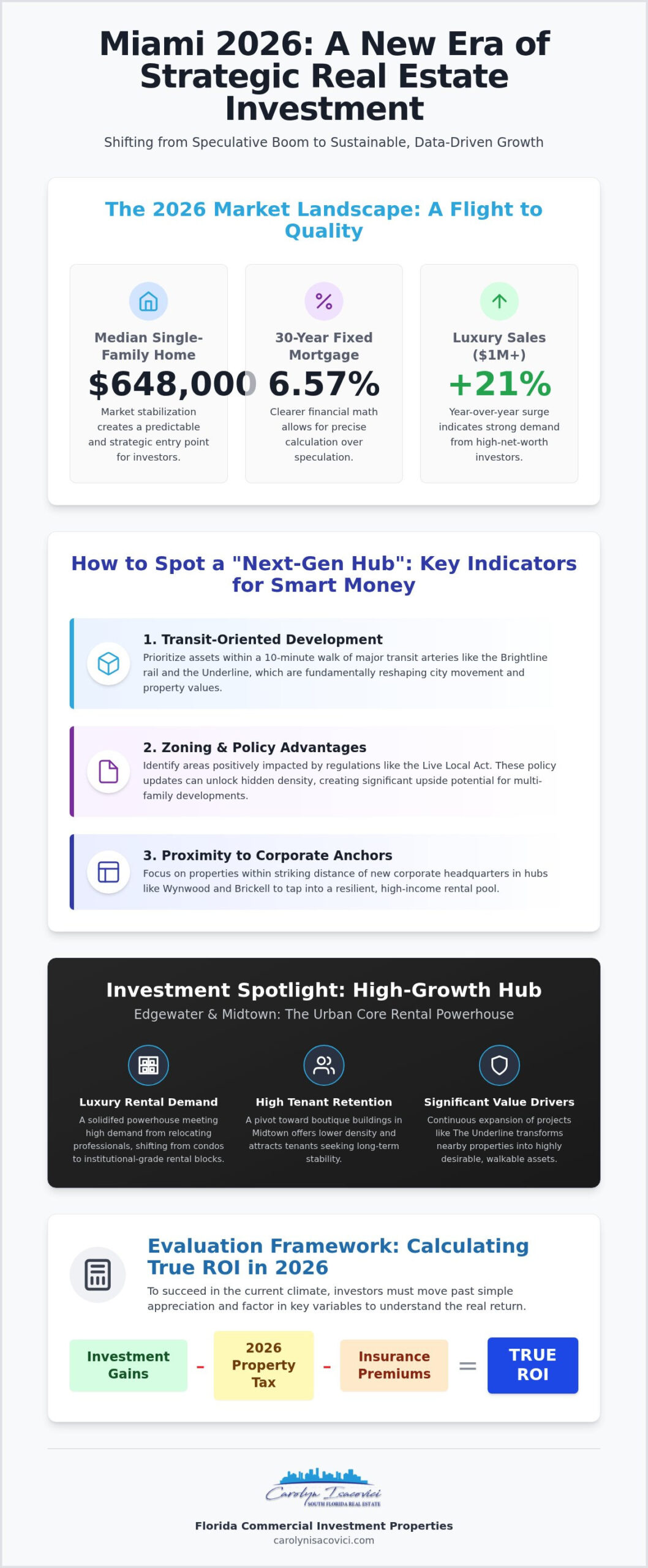
We’ve entered an era of “data-backed acquisition.” With the median single-family home price stabilizing around $648,000 and 30-year fixed mortgage rates averaging 6.57 percent, the math has become clearer. Investors are no longer guessing about future growth; they’re calculating it based on confirmed corporate relocations and massive infrastructure completions. This shift from speculation to strategy is exactly what a seasoned portfolio needs to thrive in the coming decade. For a broader view of how the late 2025 market reset has created a more predictable foundation, the Florida market real estate opportunities 2025 roundup offers essential context on inventory shifts and insurance reforms shaping the current cycle.
Understanding the 2026 Market Cycle
The current market cycle is defined by a “flight to quality.” We’re seeing this most clearly in the luxury sector, where sales for properties over $1 million surged by 21 percent year-over-year. High-net-worth individuals and institutional funds aren’t just looking for any roof; they’re looking for assets in areas with limited supply and high barriers to entry. Miami’s tax-friendly environment remains a primary magnet for this capital, especially as other states grapple with shifting fiscal policies. It’s a reassuring environment for those who value stability over volatility. Investors seeking to capitalize on this trend should explore Miami luxury condos for investment, where scarcity assets and global brand equity are redefining what it means to own a premier property in this market.
Identifying the ‘Smart Money’ Indicators
How do you spot a “Next-Gen Hub” before the rest of the market catches on? You follow the transit. The expansion of the Brightline and the continuous development of the Underline have fundamentally changed how residents move through the city. Properties with high “Walk Scores” and proximity to these transit arteries are seeing faster appreciation than isolated suburban pockets. Mixed-use developments are proving to be the safest bet for 2026 portfolios because they diversify risk. When a single building combines high-end residential units with ground-floor commercial space, it creates its own ecosystem of demand. This synergy is the hallmark of the best neighborhoods to invest in Miami right now.
- Transit Proximity: Look for assets within a ten-minute walk of major rail extensions.
- Zoning Advantages: Pay attention to areas affected by the 2026 updates to the Live Local Act, which can unlock hidden density.
- Corporate Anchors: Areas within striking distance of new headquarters in Wynwood or Brickell offer the most resilient rental pools.
Top 5 Neighborhoods for Residential and Multi-Family Investment
Selecting the right location is about matching your specific risk profile with a neighborhood’s unique growth stage. In 2026, the market isn’t a monolith. It’s a collection of micro-markets, each offering different levers for wealth creation. Whether you’re seeking high-yield multi-family assets or stable residential holdings for asset preservation, the current landscape offers distinct pockets of opportunity. Identifying the best neighborhoods to invest in Miami requires a look beyond the skyline to the infrastructure and zoning changes driving long-term value.
Edgewater & Midtown: The Urban Core Rental Market
Edgewater has solidified its position as a luxury rental powerhouse. By 2026, the condo-to-rental ratio has shifted as more institutional investors have secured blocks of units to meet the demand from relocating professionals. We’re seeing a notable pivot toward Midtown’s boutique buildings, where investors find lower density and higher tenant retention. The continuous expansion of the Underline project has acted as a significant value driver, turning nearby properties into walkable, high-demand assets. These areas remain some of the best neighborhoods to invest in Miami for those prioritizing the urban core’s resilient rental pool.
Allapattah & Little Haiti: The Next Appreciation Wave
Allapattah has emerged as the premier “Value-Add” frontier for multi-family investment. Investors are successfully converting older industrial structures into modern residential units, capturing a demographic that wants proximity to the Health District without the Brickell price tag. Nearby, the Magic City Innovation District in Little Haiti serves as a massive catalyst, drawing in tech-oriented residents and long-term capital. Understanding how the City of Miami’s Real Estate Portfolio is strategically managed provides a reassuring look at the city’s commitment to revitalizing these emerging corridors through smart public-private synergy.
For investors focused on family-driven demand and long-term stability, Kendall is the standout winner of 2026. With a median single-family home price that remains attractive compared to the coast, it offers a reliable hedge against volatility. On the other end of the spectrum, Coconut Grove continues to be the “Blue Chip” choice for luxury asset preservation. Its historic charm and strict zoning create high barriers to entry, ensuring your capital is protected in one of the most desirable residential enclaves in the country. If you’re looking to identify specific residential real estate sales that align with these growth drivers, having a seasoned guide to navigate the local nuances is your most valuable asset.
- Edgewater: High-density luxury with institutional-grade rental demand.
- Allapattah: The top choice for industrial-to-residential “Value-Add” plays.
- Kendall: Unmatched stability fueled by family demographics and school proximity.
- Coconut Grove: Limited inventory and high prestige for capital preservation.
Commercial and Industrial Corridors Driving Investment Value
Why do seasoned investors look at warehouse data when they’re planning to buy residential property? It’s because commercial activity is the most reliable leading indicator of future housing demand. In 2026, the synergy between where people work and where they live has never been tighter. While many focus solely on beachside condos, the “smart money” is tracking the industrial and corporate engines that power the city’s economy. Identifying the best neighborhoods to invest in Miami requires understanding these commercial corridors, as they provide the high-quality tenant pool and economic stability that every portfolio needs.
The Doral Industrial Powerhouse
Doral has become the backbone of Miami’s logistics-driven growth. The “Amazon Effect” and the rising trend of nearshoring have kept industrial vacancy rates remarkably low, hovering between 6.1 percent and 6.9 percent in early 2026. Average industrial rents have reached between $16.40 and $17.56 per square foot (NNN), reflecting a robust demand for flex-space and warehousing. This industrial strength directly impacts the local residential market. As more logistics firms establish roots here, the demand for workforce housing and new construction homes in the area continues to climb. It’s a reassuring cycle of growth for those seeking stable, long-term assets.
Wynwood & Design District Commercial Synergy
Wynwood has completed its evolution from an artsy enclave into a premier corporate headquarters hub. We’re seeing a consistent influx of tech and finance firms that prefer the neighborhood’s modern, high-quality office spaces over traditional high-rises. With gross asking rents for office space hitting a historic high of $62.75 per square foot, the commercial upside is undeniable. This corporate energy spills over into the Design District and Buena Vista, where high-end retail and “micro-offices” are accelerating neighborhood gentrification. These micro-offices are particularly influential, as they allow smaller firms to plant a flag in high-traffic areas, further stabilizing the local economy.
Don’t overlook the Health District, often referred to as the Civic Center. It remains a recession-proof investment anchor due to the massive concentration of medical and legal institutions. The constant flow of high-earning professionals into this district ensures that nearby residential properties maintain high occupancy rates. When you analyze these corridors, you aren’t just looking at buildings; you’re looking at the best neighborhoods to invest in Miami based on verified economic drivers. Bridging the gap between commercial investment ROI and residential lifestyle is the key to a truly diversified Florida portfolio.
- Industrial Vacancy: 6.1 percent to 6.9 percent in Doral, indicating high demand.
- Office Rents: Historic highs of $62.75 per square foot in corporate hubs like Wynwood.
- Recession-Proof Anchors: The Health District provides unmatched stability for nearby rental assets.
- Flex-Space Growth: Rising demand for industrial-residential synergy in logistics corridors.
Evaluation Framework: Analyzing ROI in the 2026 Market
How do you separate a “good deal” from a “great asset” in today’s stabilized environment? It comes down to the quality of your math. While historical appreciation was the primary driver for years, the 2026 landscape demands a more balanced approach between current cap rates and future growth potential. Identifying the best neighborhoods to invest in Miami is only half the battle. The other half is applying a rigorous due diligence framework to ensure your net yield remains protected against evolving costs.
Calculating the Real Cost of Ownership
Many investors fall into the trap of looking at “Gross Yield.” This is a dangerous metric in 2026. To find your true ROI, you must account for the “Florida Factor.” This includes property taxes, which in Miami-Dade average about 1.94 percent of the property’s assessed fair market value. Recent insurance reforms have begun to stabilize the market, but premiums still vary significantly based on the age of the building and its proximity to the coast. Projecting a five-year appreciation in a stabilized market requires a conservative eye. You can find a step-by-step breakdown of these variables in our How to Evaluate Investment Property in Florida guide.
New Construction as an Investment Hedge
Why are so many institutional players shifting toward new builds? It’s often a strategic hedge against maintenance and insurance volatility. New construction homes in Miami are built to the latest building codes. This frequently translates to lower insurance premiums and higher tenant demand. When you look at the 2026 pipeline, pre-construction opportunities in areas like Edgewater or Doral offer a way to lock in today’s prices for tomorrow’s delivery. For a deeper look at navigating these contracts, see our guide on Buying New Construction Homes in Florida.
Success in this cycle isn’t about chasing the highest possible number on a flyer. It’s about building a resilient portfolio that can withstand market shifts. If you’re ready to move beyond the spreadsheets and identify the best neighborhoods to invest in Miami for your specific goals, we can help you navigate investment property sales with confidence. Our team focuses on finding the intersection of lifestyle and institutional-grade returns.
- Property Tax Baseline: Factor in approximately 1.94 percent to 2.0 percent for Miami-Dade assessments.
- Insurance Advantage: Prioritize new construction to secure lower premiums and modern resilience.
- Cap Rate Focus: Look for Class A and B multi-family properties maintaining 94-96 percent occupancy.
- Appreciation Strategy: Target neighborhoods with confirmed infrastructure completions in the 2026-2027 window.
Building Your Portfolio with Florida Commercial Investment Properties
How do you move from identifying the best neighborhoods to invest in Miami to actually owning a high-performing asset? It’s about execution. In 2026, the most successful investors aren’t just looking for one-off deals; they’re building multi-asset portfolios that balance the stability of residential real estate with the high-yield potential of commercial property sales. This dual approach provides a safety net during market shifts while maximizing your exposure to South Florida’s economic expansion. By bridging the gap between where residents live and where businesses thrive, you create a portfolio that is resilient, diversified, and prepared for long-term growth.
Strategic Diversification in South Florida
While the best neighborhoods to invest in Miami often steal the spotlight, a truly strategic investor looks at the entire tri-county area. Balancing your Miami holdings with assets in Broward or Palm Beach can provide a necessary hedge against hyper-local volatility. For instance, while Miami offers unmatched urban energy, neighboring counties might offer different entry points for industrial or multi-family acquisitions. You can explore a broader perspective on these shifts in our Miami Real Estate Market Trends 2026 guide. This regional view ensures that your capital is always positioned in the path of progress, regardless of which specific zip code is leading the current cycle.
Your Partner in Florida Real Estate
The complexities of the Florida market, from the 20.03 millage rates in the city to evolving insurance requirements, require more than just a broker. They require a seasoned guide. Carolyn Isacovici has been navigating these cycles since 2006, providing the “calm expert” persona needed to transform uncertainty into opportunity. Whether you’re interested in new construction homes or complex investment property sales, the focus remains on a bespoke advisory experience. We don’t just show properties; we identify the strategic drivers that align with your specific wealth goals, ensuring that every acquisition is backed by data and professional insight.
Starting your journey is a methodical process designed to build trust and clarity. It begins with an initial consultation to define your risk tolerance and target yield. From there, we leverage local brokerage expertise to uncover off-market opportunities that never reach the public portals. We guide you through every stage of the transaction, from rigorous due diligence to a successful closing and beyond. If you’re ready to move from research to acquisition, Contact Florida Commercial Investment Properties for a Portfolio Review today. 2026 is the year of the strategic buyer, and with the right partner, the path forward is clear.
- Multi-Asset Strategy: Combine residential stability with commercial yield for a balanced portfolio.
- Bespoke Advisory: Leverage expertise in navigating 2026 tax and insurance complexities.
- Off-Market Access: Discover high-value opportunities through deep local brokerage connections.
- Regional View: Consider the synergy between Miami-Dade, Broward, and Palm Beach assets.
Securing Your Strategic Advantage in South Florida
The 2026 Miami market offers a unique moment for the disciplined investor. We’ve moved past the era of speculative frenzy into a period where infrastructure, institutional capital, and corporate relocations define real value. By focusing on the best neighborhoods to invest in Miami, from the industrial corridors of Doral to the luxury enclaves of Coconut Grove, you can build a portfolio that thrives on fundamental demand rather than market hype. Success now requires a sharp eye for detail. It’s especially true when calculating the impact of taxes and insurance on your long-term yield.
Managing these complexities is easier with a seasoned guide by your side. Since 2006, Carolyn Isacovici has provided specialized brokerage support for those seeking high-yield commercial and residential assets. Our team offers comprehensive end-to-end sales management, ensuring every acquisition aligns with your broader wealth strategy. Are you ready to transform these insights into a concrete action plan? You can Schedule a Strategic Investment Consultation with Carolyn Isacovici to review your holdings or identify your next acquisition. The opportunities in South Florida are vast. The right partnership makes all the difference.
Frequently Asked Questions
What is the best neighborhood in Miami for first-time real estate investors in 2026?
Kendall is arguably the premier choice for first-time investors seeking stability and predictable entry costs. With a median single-family home price hovering around $699,990, it offers a reliable family-driven demographic that stays resilient during market shifts. First-time buyers often find the lower volatility here reassuring compared to the high-density urban core. It’s a strategic starting point for building a Florida portfolio while learning the nuances of property management and local tax assessments.
How do Florida’s insurance costs affect investment property ROI right now?
Insurance premiums act as a significant line item that reduces your gross yield, though recent 2025 and 2026 reforms have brought much-needed stability to the market. Smart investors now prioritize newer construction or properties with updated wind-mitigation features to secure more favorable rates. While these costs are higher than in previous decades, they’re manageable when factored into a conservative ROI calculation. We recommend budgeting for these premiums early in your due diligence process.
Is Brickell still a good place to invest in 2026, or is it overpriced?
Brickell remains a top-tier choice for investors prioritizing rental cash flow and institutional-grade assets. While prices have stabilized, the area continues to see historic high gross asking rents for office space at $62.75 per square foot. This corporate growth ensures a steady stream of high-earning tenants for residential units. It isn’t overpriced for those seeking long-term stability; however, it’s no longer a neighborhood suited for speculative, short-term flipping.
Should I focus on residential or commercial property in Miami for better cash flow?
Commercial properties, particularly in the industrial and flex-space sectors, often provide higher yield and longer lease terms in the current market. Industrial vacancy rates in hubs like Doral stay low, between 6.1 percent and 6.9 percent, driving consistent returns. However, residential real estate sales offer more liquidity and are often easier for individual investors to finance. A balanced approach that combines both asset classes usually yields the most resilient and diversified results.
What are the emerging ‘up-and-coming’ neighborhoods in Miami for 2026?
Allapattah and Little Haiti are the primary emerging hubs where we see the most significant appreciation potential. These areas are benefiting from a direct spillover of interest from Wynwood and the Design District. Allapattah is specifically gaining traction as one of the best neighborhoods to invest in Miami for industrial-to-residential conversions. The Magic City Innovation District continues to act as a massive catalyst, drawing tech-focused capital and younger professionals into these evolving corridors.
How does the Brightline expansion affect property values in South Florida?
The Brightline expansion has created a noticeable “transit premium” for properties located within a ten-minute walk of its stations. We’ve observed that these areas experience faster appreciation and higher rental demand as residents seek to avoid highway congestion. This connectivity has effectively turned Miami, Fort Lauderdale, and West Palm Beach into a single, cohesive economic region. Investors who target these transit-oriented developments often see more resilient valuations even during broader market shifts.
What is the average cap rate for multi-family properties in Miami in 2026?
Average cap rates for multi-family properties generally range between 5 percent and 6.5 percent, depending on the asset class and specific location. Class A and B properties are maintaining high occupancy levels of 94 percent to 96 percent in early 2026, providing a reassuring floor for net operating income. While these rates are more compressed than in previous years, they reflect the increased institutional demand and the overall maturation of the market.
Is it better to buy new construction or an existing property for an investment?
New construction is often the better choice for investors looking to minimize maintenance headaches and secure lower insurance premiums. These buildings meet the strictest modern codes, which is a significant advantage in the current landscape. Conversely, existing properties offer “value-add” opportunities where you can increase equity through strategic renovations. Your choice should align with whether you prioritize immediate passive income or long-term forced appreciation through physical improvements and modern updates.