What if the most dangerous risk to your Florida portfolio isn’t a market downturn, but a simple line item on a tax bill you didn’t anticipate? It’s a question many seasoned investors are asking as we move through 2026. Avoiding real estate investment mistakes in Florida has become a sophisticated balancing act where traditional wisdom often falls short of the current reality.
You likely already know that the Sunshine State offers incredible growth potential, yet you might feel a lingering unease about rising insurance premiums or neighborhoods that feel overhyped. We understand that uncertainty. This guide is designed to transform those concerns into a clear, actionable strategy for your next acquisition. You’ll learn how to accurately calculate post-sale tax adjustments, identify high-growth zones that others are overlooking, and master the distinct due diligence required for both residential and commercial assets. We’re providing a complete roadmap so you can move forward with the confidence of a partner who has managed these cycles before.
Key Takeaways
- Learn why the entry price is only half the story in 2026’s mature market and how to identify true value-driven opportunities.
- Discover the secret to avoiding real estate investment mistakes in Florida by accurately forecasting property tax resets instead of relying on a seller’s outdated bill.
- Gain clarity on the critical differences between residential vacation rentals and commercial lease structures to protect your long-term returns.
- Develop a 2026 due diligence framework that looks past cosmetic finishes to evaluate the structural and electrical integrity of your assets.
- Understand how a seasoned broker provides access to exclusive off-market inventory in premier locations like Palm Beach and the Treasure Coast.
The Florida Real Estate Landscape in 2026: Why Most Investors Stumble
The era of the post-pandemic frenzy has officially transitioned into a sophisticated, value-driven era. Are the days of easy gains over? Not at all. They’ve simply become more calculated. In 2026, success is found by those who understand the “Florida Premium,” a concept where the entry price is merely the first chapter of a much larger story. Many investors stumble by focusing exclusively on the acquisition cost while ignoring the long-term carry. Success requires looking deeper.
Buying into the hype of Miami or Fort Lauderdale often leads to sub-par yields if you aren’t careful. It’s easy to get swept up in the glamour of South Florida’s skylines, but high-growth neighborhoods aren’t always the ones on the front page of the news. Avoiding real estate investment mistakes in Florida requires a shift in mindset. You must move past the psychological trap of assuming the double-digit appreciation rates of years past will continue indefinitely. Instead, we focus on sustainable growth and resilient assets.
Understanding the 2026 Market Cycle
Interest rate stabilization has finally brought a sense of calm to the market, turning frantic bidders into deliberate strategists. While institutional investors still hold significant inventory, their focus has shifted toward high-quality, long-term holds. Why does this matter to you? It means the generic national real estate trends you see on the news are less relevant than ever. Localized insights into specific blocks in the Treasure Coast or South Florida are what drive modern returns. Local knowledge is king.
The Cost of Being a ‘Hands-Off’ Investor
Can you really trust a remote dashboard to tell the whole story? Relying solely on digital data is a common pitfall. Generic investment calculators often fail to capture micro-market nuances like shifting neighborhood boundaries or upcoming infrastructure projects. To succeed, you need a comprehensive due diligence framework that combines data with physical reality. This is why partnering with a professional broker is essential; they act as a filter to help you distinguish between a truly discounted asset and one that is simply distressed beyond repair. Whether you are looking at commercial property sales or new construction homes, having local boots on the ground ensures your 2026 strategy is built on facts, not just projections.
Overlooking the ‘Florida Factors’: Insurance, Taxes, and Hidden Costs
Why do many investors find their margins thinning after the first year of ownership? It’s often because they missed the “hidden” variables that are unique to the Sunshine State. Avoiding real estate investment mistakes in Florida requires looking past the purchase price and into the operational reality of 2026. Coastal properties in Hollywood FL or Miami Beach offer stunning views, but they also require specialized forecasting for insurance and climate resilience. If you aren’t factoring in the long-term costs of flood mitigation and wind protection, your projected yields may be at risk. It’s not just about the beauty of the location; it’s about the durability of the investment.
The Property Tax Trap for New Investors
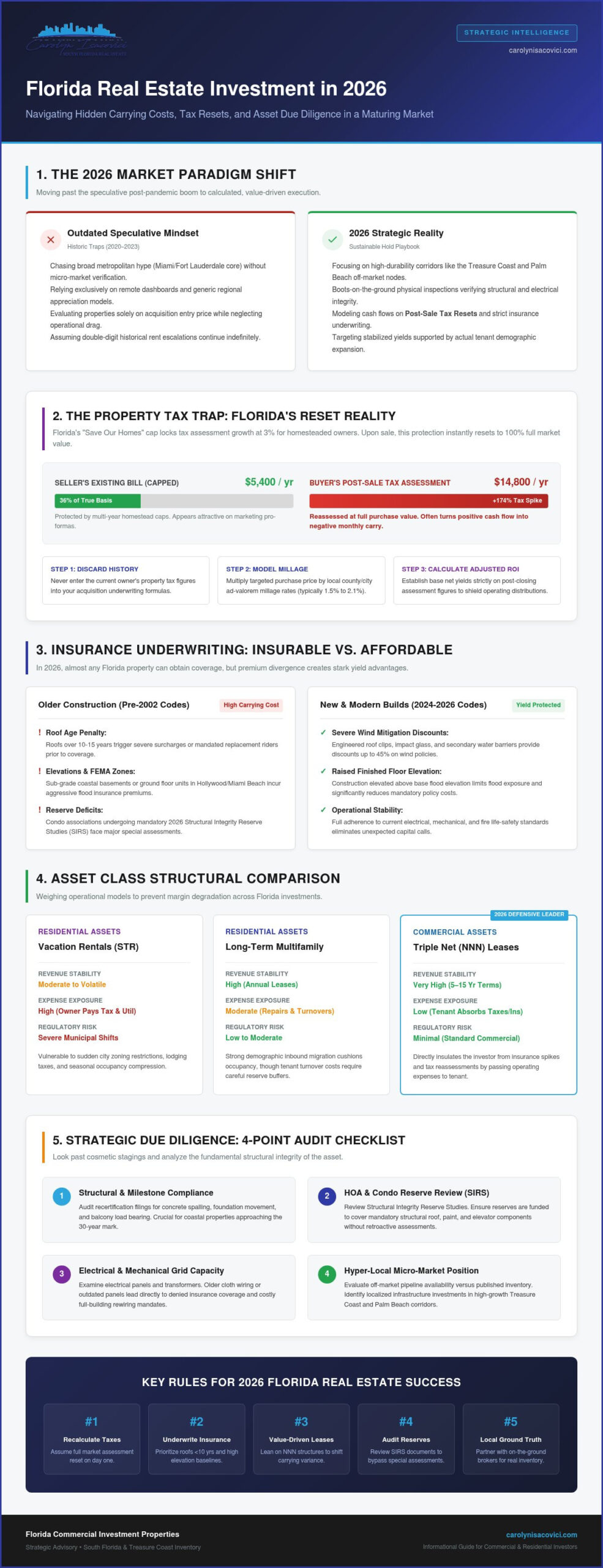
Have you checked the seller’s current tax bill? Don’t let those numbers fool you. Florida’s “Save Our Homes” cap limits annual assessment increases for homesteaded owners, but that protection vanishes the moment the deed transfers. According to the Florida Department of Revenue Property Tax Oversight, the property is reassessed at full market value upon sale. This often results in a massive tax jump that can catch buyers off guard. When evaluating investment property Florida metrics, you must calculate an “Adjusted ROI” based on the projected post-sale assessment. Relying on historical data is a mistake that can turn a cash-flowing asset into a monthly liability overnight.
Insurance as a Strategic Variable
Is the property just insurable, or is it actually affordable? In 2026, the gap between those two terms has widened significantly. While almost any property can find coverage, the premium costs vary wildly based on the age of the roof and the elevation of the structure. Many investors are finding that new construction homes in Florida offer a distinct strategic advantage. Because these properties are built to the latest, most stringent wind and flood codes, they frequently qualify for substantial insurance discounts that older buildings simply cannot access. Beyond insurance, you must also analyze the health of association reserves in older buildings. Post-2024 regulations have made fully funded reserves a requirement for many Florida communities, which can lead to unexpected special assessments if the board hasn’t been diligent. Partnering with a knowledgeable investment broker allows you to identify these risks during the due diligence phase, ensuring your acquisition strategy is built on a foundation of clarity rather than guesswork.
Asset Class Errors: Commercial vs. Residential Pitfalls
Does a beachfront condo in Miami Beach perform the same as an industrial warehouse in Fort Pierce? Of course not. Yet, many investors stumble by applying the same financial logic to vastly different asset classes. Avoiding real estate investment mistakes in Florida requires a nuanced understanding of how risk profiles shift between the commercial and residential sectors. While residential properties often feel more familiar, the commercial side requires a different level of analytical rigor to ensure long-term stability and growth.
Commercial Property Missteps
In the industrial hubs of Miami, misjudging lease structures is a frequent error. A Triple Net (NNN) lease shifts costs like taxes and insurance to the tenant, while a Gross lease leaves the owner vulnerable to rising operating expenses. It’s vital to consult a Florida commercial real estate guide to grasp how cap rate variances affect your bottom line in different sub-markets. You should also be aware of these common commercial hurdles:
- Shadow Vacancy: Watch for retail spaces that are leased but underutilized, as this often signals future tenant turnover.
- Zoning Shifts: In growing areas like Port Saint Lucie or Stuart, localized zoning changes can alter a property’s potential overnight.
- Expense Forecasting: Use the Florida wind mitigation inspection and discount guidelines to accurately budget for commercial insurance premiums.
Residential and New Construction Risks
On the residential side, treating a vacation rental like a stable long-term income asset is a common pitfall. Short-term markets are inherently more volatile and sensitive to economic shifts compared to annual leases. If you’re looking at new construction homes Florida, avoid the trap of over-customizing. High-end personal touches might look beautiful, but they often don’t return their full value at resale. Instead, focus on features that appeal to the broadest possible pool of tenants or future buyers.
Don’t assume all new developments in Fort Lauderdale will appreciate at the same rate. The commercial vs residential investment Florida debate often comes down to your 5-year liquidity needs. Commercial assets might offer higher yields, but they often require longer lead times to sell. By diversifying your portfolio across both asset classes, you can hedge against local market fluctuations and build a more resilient wealth strategy for 2026.
Strategic Due Diligence: A 2026 Framework for Success
Is the old ‘1% Rule’ still a reliable compass for your portfolio? In the current market, relying on such a simplified metric can be one of the costliest errors you make. Avoiding real estate investment mistakes in Florida requires a more sophisticated approach that balances immediate cash flow with long-term appreciation potential. In high-demand areas, a property might not hit that traditional 1% mark today, but its location in a ‘path-of-progress’ neighborhood could yield significant wealth over the next decade. You aren’t just buying a building; you’re buying into a trajectory. Success comes from understanding where the growth is moving before the rest of the market catches up.
Market liquidity is another vital factor that often goes overlooked during the excitement of an acquisition. How fast can you exit this asset if the economy shifts? A high-yield property in a remote area might look excellent on a spreadsheet, but if it takes twelve months to find a qualified buyer, your capital is effectively trapped. We prioritize assets that maintain demand across various market conditions, ensuring you always have a clear exit strategy. This foresight transforms a stressful “what if” into a manageable part of your broader financial plan.
Advanced Metrics for 2026 Investors
Modern investors must look deeper than simple gross yields. Calculating your Cash-on-Cash return while accounting for 2026 financing costs is essential for a realistic outlook. On the commercial side, understanding ‘Net Effective Rent’ during lease negotiations prevents you from overestimating your actual income after concessions and tenant improvements. By using Miami real estate market trends to forecast 5-year appreciation, you can move past guesswork and base your acquisition strategy on documented neighborhood performance. Data provides the clarity you need to move forward with conviction.
The Physical Due Diligence Checklist
A ‘deep dive’ inspection is your best defense against post-closing surprises. Don’t just look at the fresh paint; you need to verify the structural and electrical integrity that generic inspections might miss. Avoiding real estate investment mistakes in Florida means being meticulous with your physical due diligence. Your checklist should include:
- 4-Point Inspections: Essential for securing insurance, these focus on the roof, electrical, plumbing, and HVAC systems.
- Wind Mitigation Reports: These documents are the key to unlocking significant insurance discounts on both residential and commercial assets.
- Environmental Reports: For commercial sites in industrial zones, these are non-negotiable to ensure there are no hidden liabilities in the soil or structure.
- Permit Verification: Always verify that past renovations were properly permitted to avoid inheriting city liens or safety issues.
Taking these steps ensures that your 2026 acquisition is as solid as it looks on paper. If you’re ready to build a portfolio backed by rigorous due diligence, contact our expert brokerage team to begin your search.
Navigating the Market with a Professional Broker
Why do some investors always seem to find the best opportunities before they hit the open market? It’s rarely luck. Usually, it’s the result of a deep-rooted local network. A professional broker acts as your first line of defense against the ‘Mistake of the Month,’ providing a layer of protection that automated platforms simply can’t offer. Avoiding real estate investment mistakes in Florida becomes significantly more manageable when you have a partner who has navigated the state’s unique market cycles since 2006. They don’t just show you what’s available; they show you what’s worth your capital.
In high-demand areas like Palm Beach and Jupiter, the most lucrative inventory often never reaches a public listing. Accessing these off-market deals requires a broker with established relationships and a reputation for closing. Beyond finding the right asset, the value of professional negotiation cannot be overstated. A seasoned expert can often secure terms that save you more on the final purchase price than the entire cost of the commission. This level of advocacy ensures that Florida real estate portfolio building is a strategic, calculated journey rather than a series of disconnected transactions.
The Broker as a Strategic Partner
Carolyn Isacovici provides the kind of nuanced insight that a spreadsheet alone can’t capture. Have you considered how a new local development might impact traffic patterns or tenant demand three years from now? These are the variables a seasoned guide brings to the table. By leveraging a vast local network, we can provide referrals for property management and specialized contractors, ensuring your transition from acquisition to operation is seamless. We aim to help you move from a single transaction to a robust, multi-asset strategy that aligns with your 2026 goals. You aren’t just a client; you’re a partner in success.
Next Steps for Your 2026 Florida Portfolio
Where do you want to be in five years? Defining your risk tolerance and investment timeline is the first step toward a resilient portfolio. Whether you are focused on commercial property sales or the latest new construction homes, your strategy should be as unique as your financial objectives. We invite you to set up a consultation to review current market opportunities and refine your acquisition criteria. Success in this market isn’t just about avoiding real estate investment mistakes in Florida; it’s about proactively positioning yourself for growth. When you’re ready to take the next step, Contact Florida Commercial Investment Properties to begin your strategic journey with a team you can trust.
Building Your 2026 Legacy with Confidence
Are you ready to turn market complexity into your greatest strategic advantage? The path to success in 2026 isn’t found in generic advice, but in the meticulous details of tax resets, insurance forecasting, and localized asset selection. By prioritizing a rigorous due diligence framework and understanding the distinct nuances between residential and commercial risks, you’re doing more than just protecting your capital; you’re positioning it for resilient growth. Avoiding real estate investment mistakes in Florida is a matter of preparation and partnership. It’s about looking past the initial hype to find the enduring value underneath.
With 20 years of market expertise and a specialization in high-value assets from Miami to the Treasure Coast, we’re here to guide you through every market cycle. You don’t have to navigate these waters alone. Secure your Florida investment future with expert brokerage support and move forward with the clarity of a seasoned strategist. Your next high-yield opportunity is waiting, and we’re ready to help you capture it.
Frequently Asked Questions
What is the biggest mistake first-time Florida investors make?
The biggest error is often miscalculating the post-sale property tax adjustment. Many first-time buyers use the seller’s current tax bill for their projections. However, Florida reassesses property at market value upon sale, which can cause taxes to double or triple. Avoiding real estate investment mistakes in Florida requires you to use the local appraiser’s estimator tool. This ensures your ROI remains healthy even after the first year of ownership.
How do I account for rising insurance costs in my ROI calculations?
You should prioritize properties with recent wind mitigation upgrades and modern roof certifications. In 2026, insurance is a strategic variable rather than a fixed cost. We recommend obtaining a preliminary insurance quote during the inspection period rather than waiting for the closing phase. Focus on properties built after 2002 to access more competitive rates. This proactive step prevents your cash flow from being unexpectedly drained by rising premiums in coastal areas.
Is it better to invest in Miami or emerging markets like Port Saint Lucie in 2026?
Both markets offer unique advantages depending on your 2026 acquisition strategy. Miami and Miami Beach provide high liquidity and premium rental demand, making them ideal for institutional-grade assets. Conversely, emerging markets like Port Saint Lucie or Vero Beach offer lower entry points and significant appreciation potential as the path-of-progress moves north. We help you balance these options by analyzing your 5-year liquidity needs and desired yield profile across the Treasure Coast.
Can I avoid property tax increases by buying through an LLC?
No, buying through an LLC doesn’t shield you from tax reassessments. The Florida Department of Revenue considers a change in control of an LLC as a transfer of ownership. This triggers a reset of the assessed value to current market rates. While an LLC offers vital liability protection, it isn’t a loophole for property taxes. You must budget for the full market assessment to ensure your investment remains profitable over the long term.
What should I look for in a Florida commercial real estate broker?
Look for a partner who has navigated multiple market cycles and maintains a deep local network. A broker like Carolyn Isacovici, with experience dating back to 2006, provides insights that a spreadsheet simply can’t capture. You need someone specialized in both commercial and residential high-value assets. They should offer access to off-market inventory in areas like Palm Beach Gardens and Jupiter, acting as your first line of defense against overpriced assets.
Are new construction homes a safer investment than resale properties in Florida?
New construction homes in Florida often represent a more resilient investment in the 2026 landscape. These properties are built to the most stringent wind and flood codes, which directly translates to significant insurance discounts. While the initial purchase price might be higher, the lower maintenance costs and modern energy efficiencies often lead to better net returns. They attract high-quality tenants who value modern amenities and the peace of mind that comes with structural integrity.
How has the 2026 market changed the due diligence process?
The process has shifted from simple cash flow analysis to a deep dive into structural and environmental health. In 2026, we look past the cosmetic finishes to verify the integrity of the electrical and plumbing systems. Avoiding real estate investment mistakes in Florida means verifying every permit and past renovation to ensure there are no hidden city liens. Due diligence now includes a thorough review of association reserves for condos and environmental reports for commercial sites.
What are the risks of investing in South Florida coastal properties?
The primary risks involve climate resilience and the potential for special assessments in older buildings. Properties in areas like Hollywood FL or Miami Beach must meet updated safety standards, which can lead to high costs for aging structures. We advise focusing on buildings with fully funded reserves and modern flood mitigation features. By selecting assets that exceed current building codes, you can protect your portfolio from the unpredictability of shifting regulations and environmental factors.
Leave a Reply