
The most prestigious address isn’t automatically the right asset. For buyers weighing Florida real estate for high net worth individuals, the better choice depends on what the property needs to do, whether as a primary residence, a second home, or an investment.
Migration headlines and well-known coastal destinations can draw attention, but Florida’s markets differ in property types, lifestyle, and ownership considerations. A compelling location still needs to fit your priorities. Flood exposure, insurance, maintenance, and future resale deserve attention alongside views and amenities.
This 2026 guide outlines how to define your acquisition goals, compare local markets using consistent property-level criteria, and identify questions to address before a high-value purchase. We’ll look at communities from Miami and Miami Beach to Fort Lauderdale, Hollywood, Palm Beach, Jupiter, Stuart, Port St. Lucie, Vero Beach, and Melbourne, then walk through a practical approach to due diligence and brokerage support. With a clear purpose and a consistent comparison, you can assess opportunities more deliberately.
Key Takeaways
- Start with the property’s purpose: a primary residence, second home, or investment asset. Clear priorities help narrow the search.
- Compare Florida real estate for high net worth individuals by access, property type, lifestyle fit, ownership responsibilities, and holding period.
- Look beyond broad market labels. Neighborhood and individual property conditions can shape how well an opportunity fits your plans.
- Review property records, inspections, and operating assumptions before making a high-value offer. Prestige alone doesn’t guarantee resilience.
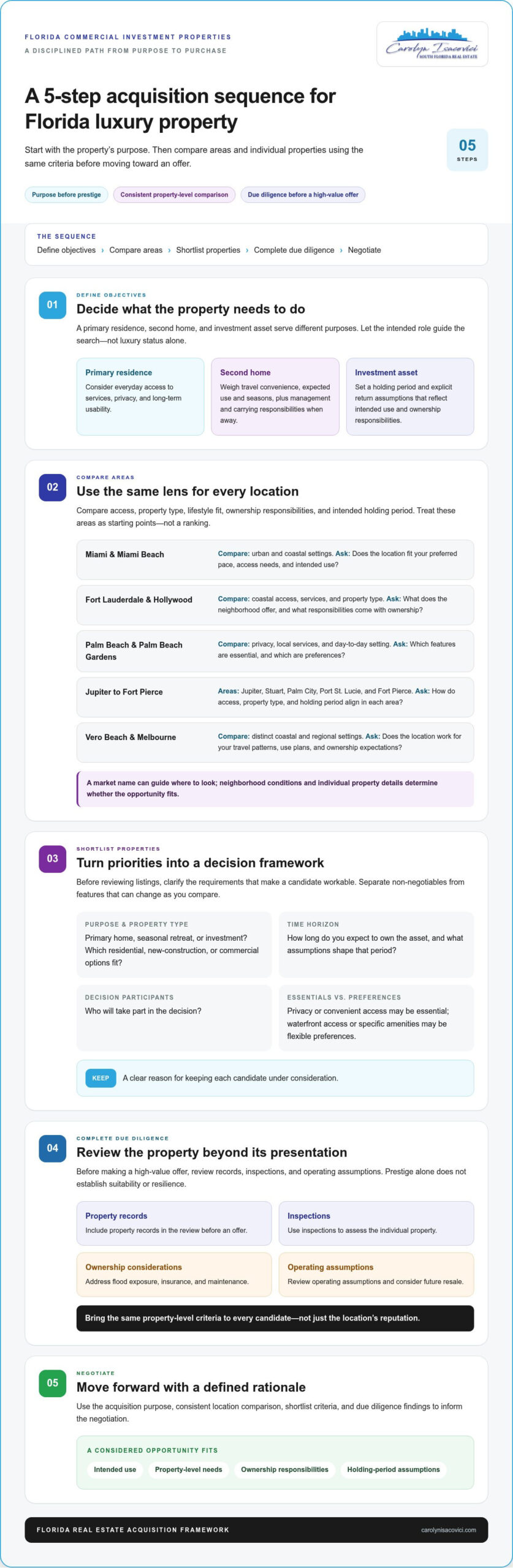
- Use a clear acquisition sequence: define objectives, compare areas, shortlist properties, complete due diligence, and negotiate.
Florida Real Estate for High-Net-Worth Individuals Starts with the Right Acquisition Purpose
A broad budget can open the door to many kinds of property, but lifestyle, privacy, and investment goals often point in different directions. A secluded waterfront home may suit one buyer, while another may prioritize convenient access to services or an asset that fits a wider portfolio. Begin by deciding what the property is meant to do.
For Florida real estate for high net worth individuals, luxury status alone doesn’t establish suitability, resilience, or future liquidity. A polished property can still be a poor fit if its location, ongoing responsibilities, or likely holding period don’t align with your plans. Let acquisition purpose guide the search: define the property’s role first, then screen for the features that make that role workable.
How primary homes, second homes, and investment assets differ
A primary residence should support everyday life. Consider access to services, privacy, and long-term usability, not only the property’s appearance. A second home has a different rhythm: weigh travel convenience, how often and in which seasons you expect to use it, and the management and carrying responsibilities when you’re away.
An investment or portfolio asset calls for a clear holding period and explicit return assumptions. Those assumptions should reflect the property’s intended use and ownership responsibilities rather than broad market optimism. Residential property, new construction, and commercial assets may each suit different objectives, but none is automatically the right choice.
What high-net-worth buyers should define before searching
Set your decision framework before reviewing listings. Clarify the intended use, preferred property type, time horizon, and who will participate in the decision. Then separate essentials from preferences. Privacy or convenient access, for example, might be essential, while waterfront access or specific amenities may be desirable but flexible.
- Purpose: Will the property be a primary home, a seasonal retreat, or an investment?
- Property type: Which residential, new-construction, or commercial options suit that purpose?
- Time horizon: How long do you expect to own the asset, and what assumptions shape that period?
- Decision criteria: Which requirements are non-negotiable, and which can change as you compare properties?
Florida housing includes varied forms and architectural styles, with historical context that can help frame a search. For a broad introduction, see the Florida Housing Overview, then bring the focus back to specific neighborhoods and properties.
If your goal is to build or refine a portfolio, the Florida real estate portfolio-building guide offers a related perspective. A defined purpose turns a wide search into a more disciplined shortlist, with a clear reason for keeping each candidate under consideration.
Compare Florida Luxury Markets from Miami to the Treasure Coast
Once you know what a property needs to do, compare locations against the same criteria: access, property type, lifestyle fit, ownership responsibilities, and intended holding period. A regional reputation can help focus a search, but it can’t tell you whether a particular property is suitable. A market’s name tells you where to look; the individual property determines whether the opportunity fits your investment and lifestyle goals.
For Florida real estate for high net worth individuals, use the following comparisons as a starting framework, not a ranking. Neighborhood conditions and property details matter more than broad market labels.
| Search area | Useful comparison lens | Questions to bring to the property review |
|---|---|---|
| Miami and Miami Beach | Urban and coastal settings | Does the location support your preferred pace, access needs, and intended use? |
| Fort Lauderdale and Hollywood, FL | Compare coastal access, services, and property type with your priorities | What does the specific neighborhood offer, and what ownership responsibilities come with the property? |
| Palm Beach and Palm Beach Gardens | Consider privacy, local services, and the setting you want day to day | Which features are essential, and which are preferences? |
| Jupiter, Stuart, Palm City, Port St. Lucie, and Fort Pierce | Assess each area as its own search, rather than treating the Treasure Coast as one market | How do access, property type, and your expected holding period align? |
| Vero Beach and Melbourne | Compare distinct coastal and regional settings | Does the location work for your travel patterns, use plans, and ownership expectations? |
South Florida choices from Miami through Palm Beach
Miami and Miami Beach may appeal to buyers seeking an urban-coastal setting, while Fort Lauderdale and Hollywood, Florida, offer different areas to compare across Broward. Palm Beach and Palm Beach Gardens can be assessed against priorities such as privacy and convenient local services. None of these labels settles the question. Compare waterfront access, privacy, and services at the neighborhood and property level, then consider how they fit your intended use. For Miami-specific context, see the Miami real estate market trends guide.
Treasure Coast and Space Coast options for different priorities
Jupiter, Stuart, Palm City, Port Saint Lucie, and Fort Pierce each merit a property-by-property comparison. Extend the search to Vero Beach or Melbourne if a different coastal or regional setting better matches your plans. Across every area, weigh access, property type, ongoing ownership responsibilities, and holding period consistently. Florida Commercial Investment Properties provides brokerage support for residential, commercial, and investment property sales across Florida. Explore Florida real estate brokerage guidance to help organize a focused search.
Choose Between a Florida Luxury Home, Second Home, or Investment Property
A property can serve more than one purpose, but those purposes shouldn’t be treated as interchangeable. A home chosen for daily comfort may not suit an income strategy, and an investment-oriented asset may require a different level of oversight than a seasonal retreat. Start with intended use and ownership responsibilities, rather than ranking property categories in the abstract.
For Florida real estate for high net worth individuals, expected income, appreciation, and future liquidity are assumptions to examine, not promised outcomes. A disciplined review considers how each possibility depends on the property, its location, its operating costs, and the buyer’s intended holding period.
When a primary residence or second home may fit
A primary residence should support household needs and regular routines, so consider location, access, privacy, and how the home may work over time. For a second home, weigh how often you’ll use it, travel convenience, and the management and carrying responsibilities during periods when it’s unoccupied. Personal enjoyment can matter alongside investment considerations, but the two aren’t identical: a home that’s valuable to your lifestyle doesn’t automatically meet an investment objective.
New construction is another option, with its own timing and evaluation considerations. Align the purchase process with your intended use and assess the specific property and its stage of completion rather than assuming that newness alone makes it a better fit.
When an income-oriented property deserves closer analysis
Residential and commercial investments involve different property types and operating considerations. Each may call for a distinct approach to evaluating occupancy, expenses, and ongoing responsibilities. In either case, build a property-level view before relying on projected performance.
Test the assumptions behind a potential investment: What income is being considered? Which expenses could affect it? How might occupancy change the picture? Then weigh those assumptions against the property’s resale context and your expected time horizon. This analysis won’t eliminate uncertainty, but it can clarify whether the opportunity fits your objectives.
- Primary residence: Prioritize household needs, everyday usability, and location.
- Second home: Consider use frequency, travel, and responsibilities while away.
- Investment asset: Review operating assumptions, holding period, and resale context.
If you’re weighing residential and commercial asset classes, explore this commercial versus residential investment comparison. The goal isn’t to find a universally superior category. It’s to choose a property whose purpose, responsibilities, and uncertainties make sense together.
Assess Florida Property Risks Before Making a High-Value Offer
A prestigious address and a substantial purchase price don’t automatically make a property resilient. Flood exposure, insurance terms, maintenance needs, zoning, and building condition can vary from one property to the next, even within the same area. For Florida real estate for high net worth individuals, careful due diligence helps distinguish an appealing presentation from a property that fits your ownership plans.
Use a sequence, not a single reassuring detail. FEMA flood maps can help identify potential exposure, but they’re only one input. They don’t replace a property-level review of local drainage, coastal exposure, access, and insurance. Coverage availability, policy terms, and applicable local requirements can change, so verify current details for each property rather than relying on assumptions or older information.
Build a disciplined property-level diligence sequence
Move from basic records to the assumptions that will shape ownership. The exact documentation and checks depend on property type, but this order provides a practical framework:
- Review property records and documentation. Organize available ownership records and property materials, noting details that need clarification during the transaction.
- Assess location and exposure. Review FEMA flood mapping alongside local drainage, coastal conditions, access, and the property’s specific setting.
- Examine building condition. Arrange appropriate inspections and review findings for the home or commercial property, including components that may affect future maintenance.
- Understand insurance and requirements. Examine property-specific insurance availability and terms, and verify current applicable local requirements. A general market estimate isn’t a substitute for property-level information.
- Review ongoing responsibilities. Identify known maintenance obligations and assess how they fit the intended use and holding period.
- Test operating assumptions. For an investment, examine income assumptions, expenses, occupancy considerations, and resale context. Keep projections distinct from established facts.
For a condominium, also examine available association information, reserves, building-condition materials, and assessment information. These records add context to the unit itself and its anticipated ownership responsibilities.
Requirements and property conditions can change, so use current, property-specific information when evaluating an offer. For a deeper investment-focused framework, read the Florida investment-property evaluation guide.
A thoughtful review doesn’t remove every uncertainty. It gives you a clearer basis for deciding which questions matter and whether the property aligns with your objectives. Review a Florida property search with brokerage guidance to bring the location, property details, and acquisition purpose into one considered plan.
Work with a Florida Brokerage to Turn Your Search into an Acquisition Plan
A focused search turns a broad set of possibilities into a manageable acquisition process. Florida Commercial Investment Properties provides brokerage support for commercial buildings, residential homes, new construction, and investment property sales. The process can start by translating your objectives into criteria, comparing communities, and identifying opportunities that fit your brief. For Florida real estate for high net worth individuals, keeping privacy, location, property type, and decision criteria aligned helps the search stay purposeful as you assess properties.
A practical sequence connects each decision to the next:
- Define objectives: Clarify intended use, timing, privacy needs, and essential property features.
- Compare areas: Weigh communities against access, lifestyle, property type, and ownership priorities.
- Shortlist properties: Focus on candidates that meet the brief, while identifying trade-offs.
- Assess diligence: Keep property-specific records, condition, exposure, and operating assumptions in view.
- Negotiate: Use the findings and priorities established during the search to inform the transaction process.
What a focused Florida property search looks like
Start with a search brief describing intended use, preferred communities, property criteria, and timing. Carolyn Isacovici’s Florida market knowledge can help buyers compare opportunities across Miami, Miami Beach, Fort Lauderdale, Hollywood, Palm Beach, Palm Beach Gardens, Jupiter, Stuart, Palm City, Port Saint Lucie, Fort Pierce, Vero Beach, and Melbourne. As you review properties, keep your priorities and property-specific due diligence in view, so attractive features don’t distract from the requirements that matter most.
Prepare for a productive brokerage conversation
Before discussing the search, outline how you plan to use the property, which locations interest you, and your decision-making timeline. Note essential criteria, such as property type or privacy needs, alongside trade-offs you’d consider. This gives the conversation a practical starting point and helps shape a search around your priorities, without requiring every detail to be settled in advance.
From there, the next step might be refining the brief, comparing areas, or reviewing a shortlist. A measured process leaves room to learn as you go while keeping the acquisition purpose clear. To discuss your Florida acquisition goals with Carolyn Isacovici, start a conversation about your property search.
Make Your Florida Property Search More Intentional
The strongest acquisition plan begins with a clear purpose. Decide whether a property is meant to be a primary home, a second-home retreat, or an investment, then compare locations and individual properties against that goal. Before making a high-value offer, give property-specific condition, exposure, insurance, and ownership responsibilities careful attention.
That framework makes Florida real estate for high net worth individuals easier to evaluate with focus. Local reputation can help guide where you look, but a property’s suitability depends on its details and how well they align with your priorities and time horizon.
Carolyn Isacovici provides brokerage services for residential, commercial, new-construction, and investment property sales, with Florida market knowledge spanning South Florida, the Treasure Coast, and Melbourne. A thoughtful conversation can help turn your goals into a practical search plan.
Ready to define your criteria and compare Florida properties? Discuss your real estate goals with Carolyn Isacovici.
Frequently Asked Questions
Is Florida real estate a good investment for high-net-worth individuals?
It can be a fit, but no property or market guarantees income, appreciation, or resale liquidity. Florida real estate for high net worth individuals should be assessed against a clear purpose, holding period, and property-level assumptions. Review potential income alongside expenses, occupancy, condition, insurance, and resale context. A strong investment case depends on how those details align with your objectives, not simply on a luxury label or broad market headlines.
Which Florida cities do high-net-worth individuals consider for real estate?
Buyers may compare Miami and Miami Beach with Fort Lauderdale, Hollywood, Palm Beach, and Palm Beach Gardens, among other South Florida communities. Farther north, Jupiter, Stuart, Palm City, Port Saint Lucie, Fort Pierce, Vero Beach, and Melbourne offer distinct settings to evaluate. Rather than choosing by reputation alone, compare access, property type, lifestyle fit, ownership responsibilities, and the specific neighborhood against your intended use and time horizon.
How should I choose between a Florida primary home, second home, and investment property?
Choose according to how you expect the property to serve you. A primary home should support household needs and daily routines; a second home should fit travel patterns, seasonal use, and responsibilities while you’re away. For an investment property, define the holding period and examine income, expenses, occupancy, and resale assumptions. Personal enjoyment and investment potential can coexist, but one doesn’t automatically establish the other.
What risks should high-net-worth buyers review before purchasing Florida property?
Review the property’s condition, records, maintenance needs, insurance terms, flood exposure, and applicable zoning or building requirements. FEMA flood maps can be a useful starting point, but they aren’t a complete property-risk assessment. Consider local drainage, coastal exposure, and access, and verify current property-specific insurance information and applicable requirements. For condominiums, examine available association, reserve, building-condition, and assessment information as part of your review.
Can high-net-worth buyers find suitable Florida properties outside Miami and Palm Beach?
Yes. Buyers can compare opportunities in Jupiter, Stuart, Palm City, Port Saint Lucie, and Fort Pierce, as well as Vero Beach and Melbourne. These areas shouldn’t be treated as interchangeable, and suitability depends on the property and your priorities. Compare access, setting, property type, and ownership responsibilities, then consider how each candidate fits your intended use and holding period. A focused search can extend beyond the best-known South Florida markets.
How much does it cost to buy luxury real estate in Florida?
There isn’t one reliable statewide figure for a luxury purchase. The amount depends on the property, location, type, condition, and transaction details, so compare specific properties rather than relying on a broad estimate. Also account for ongoing ownership expenses, which may include property taxes, insurance, and maintenance. Review those costs for the individual property as part of your acquisition planning, without assuming that luxury status predicts the full cost of ownership.
What happens if a Florida luxury property is in a flood zone?
A flood-zone designation signals that you should investigate the property’s exposure and ownership implications, not make a decision from a map alone. Review FEMA mapping alongside local drainage, coastal conditions, access, and the property’s condition. Then verify current insurance availability and terms for that specific address, along with applicable local requirements. Conditions and requirements can vary, so use current property-level information when weighing the purchase.
Do high-net-worth buyers need a Florida real estate broker?
A broker can help organize a search and acquisition, though your needs depend on the transaction and goals. Florida-focused brokerage guidance can help compare local communities, identify residential, commercial, investment, and new-construction opportunities, and keep your property criteria visible as you review options. Carolyn Isacovici’s market experience spans Miami, Miami Beach, Fort Lauderdale, Hollywood, Palm Beach, the Treasure Coast, and Melbourne, supporting a more structured path from search brief to negotiation.
Leave a Reply