What if the “average” commercial property price in Palm Beach gives you the wrong starting point? The average cost of commercial property in Palm Beach depends on what listing data includes and which Palm Beach market it describes. As of September 30, 2026, reported average asking prices were $10,146 per square foot in Palm Beach and $388 per square foot in West Palm Beach. These are asking-price averages, not a single reliable price for every property or location. A single listing can be even less representative.
Those differences can make early budgeting feel uncertain, but the numbers become more useful when you compare like with like. This guide explains how to interpret Palm Beach asking prices, why property type, size, location, and price measure can shift the picture, and how to build a more realistic acquisition estimate. It also explains why clarifying whether you mean the Town of Palm Beach, West Palm Beach, or a wider area matters before relying on a market average. With the right context, you can assess listings more confidently and identify what to gather before evaluating a commercial acquisition.
Key Takeaways
- Interpret the average cost of commercial property in Palm Beach in context: clarify the geography and distinguish asking prices from completed sales.
- Compare properties by asset type, size, condition, occupancy, and income rather than relying on one market-wide average.
- Use price per square foot as a comparison tool only when the properties and data are meaningfully comparable.
- Build a more realistic acquisition budget by separating the purchase price from financing, due diligence, taxes, insurance, repairs, and operating costs.
- Define your target location, property type, and comparison criteria to focus your search and acquisition estimates.
What Does the Average Cost of Commercial Property in Palm Beach Actually Mean?
“Average cost” sounds like one clear number. In practice, it depends on what’s being measured, which properties are included, and where they’re located. A listing price is what a seller is asking, not proof of what a buyer paid. A completed sale price records a transaction, while a mean or median summarizes a group of prices in different ways. These measures answer different questions, so identify the figure before using it to plan an acquisition.
An asking-price benchmark summarizes advertised prices in a defined set of listings; a verified sale-price benchmark summarizes completed transactions in a defined market and period. Neither automatically predicts the value of a particular property.
Which Palm Beach geography does the price data cover?
Palm Beach can mean the Town of Palm Beach, Palm Beach County, or West Palm Beach. These are distinct geographies, and a figure labeled only “Palm Beach” doesn’t establish which boundary or properties it covers. For parcel-level context, use Palm Beach County Property Appraiser records to verify a property’s location. This overview of the Palm Beach County, Florida economy provides broader county context.
The distinction matters when you compare prices. A countywide sample can include properties in multiple municipalities, while a West Palm Beach sample concerns a separate city. Don’t assume a number labeled “Palm Beach” represents the Town of Palm Beach unless its geographic boundary is defined. Before comparing figures, note the stated geography and check that the properties fall within it.
Average, median, and asking price: which figure answers your question?
The mean is the total of all included prices divided by the number of properties. A few unusually high-priced properties can pull it upward. The median is the middle price when properties are ordered from lowest to highest, so extreme values usually have less influence. Neither measure is inherently better. The right one depends on your question and the quality of the sample.
A single advertised property shows what one seller is asking, but it can’t establish a local mean or median. A mixed sample of offices, retail spaces, and other assets can also distort comparisons because those properties differ in use and characteristics.
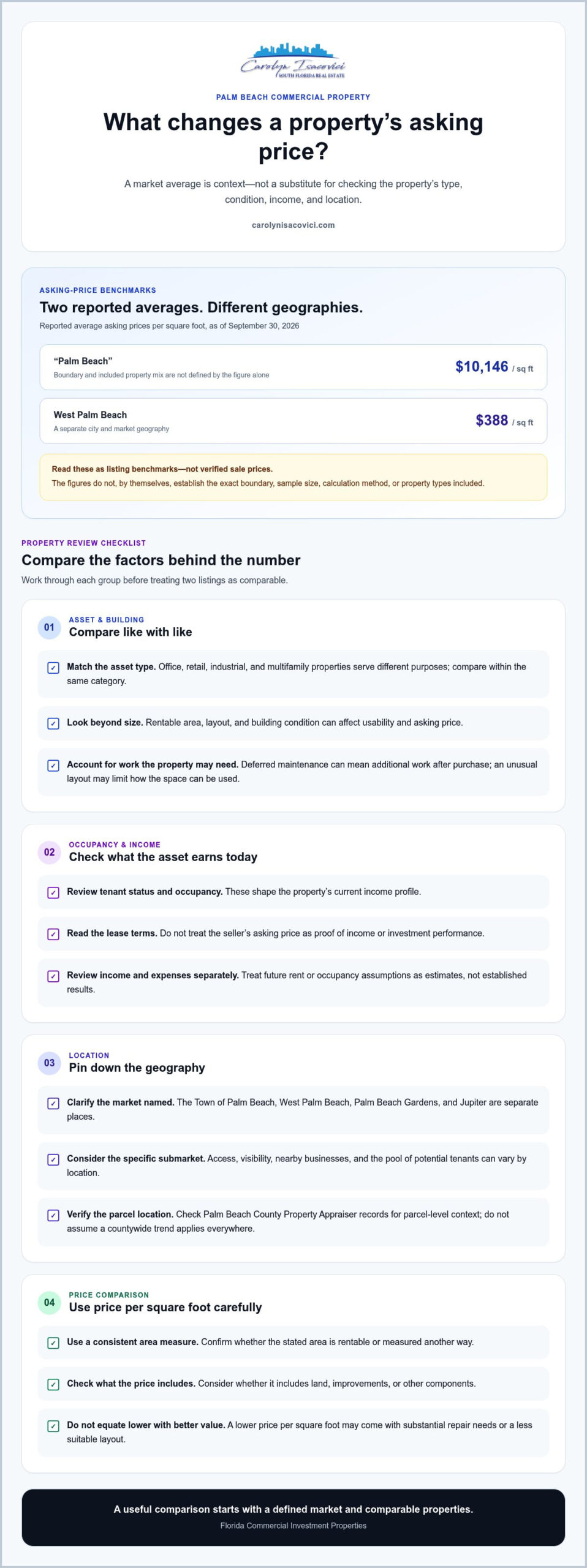
As of September 30, 2026, reported average asking prices were $10,146 per square foot for “Palm Beach” and $388 per square foot for West Palm Beach. Treat these as listing benchmarks, not verified sale prices. The figures alone don’t define the exact Palm Beach boundary, property mix, calculation method, or sample size, so use them as context rather than as a complete picture of the market.
- Record whether the figure is an asking price or a completed sale price.
- Note the named geography and the observation date.
- Look for the property types included, calculation method, and sample size.
If those details are missing, use the number as a starting signal, not a dependable market-wide average. A well-defined benchmark can frame a search, but a property-specific assessment still depends on the asset and its circumstances.
What Drives Commercial Property Costs Across Palm Beach?
Two properties can share a ZIP code and still have very different asking prices. The difference often comes down to what the building can support today, what it may cost to operate or improve, and how its location fits a buyer’s plans. Understanding these factors makes the average cost of commercial property in Palm Beach useful as context, rather than a substitute for assessing an individual asset.
How property type and condition affect asking prices
Office, retail, industrial, and multifamily properties serve different purposes, so compare each within its own category. Even within one category, rentable area, layout, building condition, and tenant status matter. Deferred maintenance may mean additional work after purchase, while an unusual layout may limit how a buyer can use the space. Current occupancy and lease terms also shape the property’s income profile.
Similar-sized properties can have different asking prices because size alone doesn’t capture condition, usability, occupancy, lease income, or the costs a buyer may take on. A seller’s asking price reflects a marketing position, not proof of the property’s income or investment performance. Review income and expenses separately, and treat assumptions about future rents or occupancy as estimates rather than established results.
Price per square foot can help compare properties, but only if the figures use a consistent area measure and the assets are broadly comparable. Confirm whether the stated area is rentable or measured another way, and consider whether the price includes land, improvements, or other components. A lower price per square foot doesn’t automatically mean better value if the property needs substantial repairs or has a less suitable layout.
How location and market demand shape Palm Beach pricing
Location can influence access, visibility, nearby businesses, and the pool of potential tenants, but broad labels can hide meaningful differences. The Town of Palm Beach, West Palm Beach, Palm Beach Gardens, and Jupiter are separate places, and the specific submarket matters. Avoid assuming that a price trend in one area applies across the county. The Palm Beach County Property Appraiser’s Office is a useful starting point for checking parcel records and property details, though those records don’t establish what a property will sell for.
Demand can also vary by property type and location. Reports of strong leasing interest, tenant preferences, or new development can help frame a search, but they need a dated reference and clearly defined geography before they’re treated as evidence. Check whether a market claim concerns asking rents, signed leases, vacancy, or completed sales. Those measures describe different conditions.
For a practical review, separate property-specific factors from market context:
- Property: asset type, usable area, condition, occupancy, lease terms, and income.
- Market: municipality, submarket, nearby activity, and dated evidence of demand.
Once you define these factors, local commercial real estate and investment brokerage can help connect property comparisons to your goals.
How to Compare Palm Beach Commercial Property Prices Fairly
A useful comparison starts with a consistent set of properties, not the largest collection of listings you can find. Match the geography, asset type, transaction status, and key property characteristics, then record the date and source for every observation. This makes it easier to understand what a figure represents and prevents asking prices from being mistaken for completed-sale evidence.
Which properties belong in the same comparison set?
Compare properties in the same municipality or clearly defined submarket, and keep offices, retail, industrial, and multifamily assets in separate groups. Match approximate size and relevant characteristics, such as condition, occupancy, and use. Flag or exclude mixed-use and unusual properties if their features make them difficult to compare with typical examples.
Use a consistent record for each property. If the sample is small or covers only a short period, state that plainly rather than implying it represents the full market.
| Geography | Asset type | Status | Area | Observation date | Source and sample |
|---|---|---|---|---|---|
| Municipality or submarket | Office, retail, industrial, or multifamily | Active asking price or verified sale | Area and measurement basis | Date recorded or date range | Source name and number of observations |
| Municipality or submarket | Same category as comparison set | Active asking price or verified sale | Comparable area | Date recorded or date range | Source name and number of observations |
Keep active listings separate from verified transactions. Listings show sellers’ current asking prices and can change or be withdrawn; recorded sales reflect completed transactions, though records can vary in timing, property detail, or coverage. Don’t combine the two into one average. The average cost of commercial property in Palm Beach is meaningful only when the underlying data is described clearly enough to interpret.
When should investors look beyond price per square foot?
Price per square foot is a useful screening measure, not a complete valuation. It can hide differences in condition, lease terms, income, and the area measurement used. Check that the properties are comparable before using the figure to rank them, and treat the result as an initial reference rather than a final conclusion.
For investment decisions, consider net operating income and cap rate as separate measures. Net operating income helps describe property income after operating expenses; cap rate relates that income to a property’s price or value. Neither replaces due diligence, and neither can be inferred from an asking price alone. Broader acquisition context appears in Florida Commercial Real Estate: 2026 Investor’s Guide, while How to Evaluate Investment Property in Florida: A Strategic 2026 Guide explores investment measures in greater depth.
Once the comparison set is consistent, you can interpret price differences with more confidence and identify which properties deserve closer review.
How to Build a Realistic Palm Beach Commercial Property Budget
A useful acquisition estimate is more than the seller’s asking price. Bring the property, transaction, and operating assumptions into one clear view so you can identify what needs further investigation before deciding whether an opportunity fits your plan. The average cost of commercial property in Palm Beach can offer context, but your budget should be built around the specific location, asset, and intended use.
Build the estimate in sequence:
- Define the geography. Specify the Town of Palm Beach, West Palm Beach, or another target area, and keep countywide comparisons separate.
- Choose the asset class. Focus on the type of property that matches your goals, such as office, retail, industrial, or multifamily.
- Gather comparable data. Record similar properties and note whether each figure is an asking price or a completed sale, along with its source and date.
- Model the project. Start with the purchase price, then add separate estimates for transaction, property, and operating costs.
What information belongs in an initial acquisition estimate?
Make the estimate easy to update as better information becomes available. For each property, record the asking price, area and measurement basis, transaction status, source, and date accessed. Keep financing assumptions in their own section. They affect your project plan but aren’t part of the property’s asking price.
Use distinct estimate lines for due diligence, insurance, taxes, repairs, and ongoing operating items. The amounts depend on the property and should be based on current, property-specific information rather than a generic allowance. If an amount is not yet known, label it as an open item instead of letting it disappear inside the purchase-price figure.
How can buyers test whether a price fits their investment plan?
Compare verified property income and expenses with your own assumptions. Then test different scenarios: how would the estimate change if occupancy were lower than expected, repairs were needed sooner, or financing terms differed from your initial assumptions? This exercise doesn’t predict returns. It shows which assumptions have the greatest effect and where you need stronger information.
Keep measures such as net operating income and cap rate separate from price per square foot. They can help frame an investment analysis, but they don’t replace a review of leases, expenses, condition, and other property details. Use consistent assumptions when comparing assets, and distinguish verified figures from projections.
A clear estimate is a working document, not a promise of performance. It helps you compare opportunities against your objectives, identify unanswered questions, and revise your plan as reliable details emerge. For acquisition guidance connected to your Palm Beach goals, discuss your commercial property plans with Carolyn.
Plan Your Palm Beach Commercial Property Search With Local Brokerage Guidance
Market research is most useful when it leads to a clear acquisition brief. Before comparing opportunities, decide which Palm Beach location fits your goals, what kind of commercial property you’re seeking, and which factors matter most. That focus keeps broad averages in perspective and makes it easier to assess each opportunity against your priorities.
Turn market research into a focused property brief
Start with a defined municipality or submarket, then identify your preferred asset class and intended use. An office property for your business, for example, calls for different comparison criteria than an investment property you plan to lease. Add your budget assumptions and timing, along with the property features that matter most to your plans.
- Location: Name the target municipality or submarket rather than using “Palm Beach” as a catch-all.
- Property: Specify the asset type, intended use, and essential characteristics.
- Investment priorities: Clarify what matters most, such as income potential, occupancy, or the flexibility to adapt the space.
- Budget and timing: Note your working assumptions and target timeframe, keeping estimates distinct from property information.
- Comparison criteria: Decide which details you’ll use to assess each opportunity, including area, condition, occupancy, and transaction status.
A focused brief makes comparisons more meaningful because it gives every listing the same frame of reference. It also helps reveal when a property may not match your intended use, even if its asking price initially looks appealing.
Take the next step with Florida commercial property guidance
Florida Commercial Investment Properties supports commercial property sales and investment acquisitions across Florida, including Palm Beach. The firm also serves buyers and sellers in Miami, Miami Beach, Hollywood, Fort Lauderdale, Palm Beach Gardens, Stuart, Jupiter, Palm City, Port St. Lucie, Fort Pierce, Vero Beach, and Melbourne. Carolyn Isacovici’s focus on the Florida market brings relevant regional context to conversations about your location, property type, and acquisition goals.
Bring your target area, preferred asset class, and working budget assumptions into the discussion. Those details create a practical starting point for evaluating opportunities against your objectives, rather than relying on a broad average alone. A clear brief also makes it easier to refine your comparison criteria as you learn more about the properties under consideration.
To discuss your Palm Beach commercial property search, talk with Carolyn about your acquisition goals.
Move From Market Research to a Confident Next Step
A commercial acquisition is easier to approach when you’re clear about what success means for your business or investment plan. Use your research to set priorities, identify the trade-offs you’re comfortable making, and decide what information you’ll need before moving forward. That gives the average cost of commercial property in Palm Beach a practical role: a point of reference for your decision, not a decision in itself.
Your criteria may evolve as you consider specific opportunities, and that’s a natural part of the process. A thoughtful conversation can help bring your goals into focus and connect them with the realities of a Palm Beach property search. Carolyn Isacovici works with buyers pursuing commercial property sales and investment acquisitions across Florida, including Palm Beach.
To take the next step, discuss your Palm Beach commercial property goals with Carolyn Isacovici.
Frequently Asked Questions
How much does commercial property cost in Palm Beach?
There isn’t one dependable purchase price for every Palm Beach commercial property. Reported average asking-price figures updated September 30, 2026, include $607 per square foot for office, $369 for retail, and $329 for multifamily properties labeled Palm Beach. These are listing benchmarks, not completed-sale prices, and the figures don’t define the geographic boundaries or sample details. Use the average cost of commercial property in Palm Beach as a starting point, then assess comparable properties individually.
Is Palm Beach commercial property data about the Town or the whole county?
It depends on the dataset, so the label alone may not tell you. The Town of Palm Beach is a municipality; Palm Beach County includes multiple municipalities, and West Palm Beach is a separate city. For a property under consideration, use its parcel information to identify its municipality before applying a local benchmark. If a published figure doesn’t define its boundaries, treat it cautiously and avoid assuming it describes the Town or the entire county.
Can one listing price represent the average commercial property cost?
No. One listing describes one seller’s current asking price, not the range or typical level across the market. It may be repriced, withdrawn, or remain unsold, so it can’t show what buyers ultimately paid. For a useful benchmark, collect multiple comparable properties and note the observation period. A small sample can still inform your search, but describe it as a limited snapshot rather than a market-wide average.
What is the difference between commercial property asking price and sale price?
An asking price is the amount a seller advertises; a sale price is the amount recorded for a completed transaction. The figures can differ because buyers and sellers negotiate, and a listing may never close at its advertised amount. For a transaction comparison, focus on completed sales and record when they occurred. Also check that the property type and location match your target, since a sale elsewhere may not be a useful guide.
Why do Palm Beach commercial property prices change from one year to another?
Prices can shift as buyer demand, available properties, borrowing conditions, rents, and expectations about future income change. Local factors matter too: a new development or a change in tenant interest may affect one property type or submarket more than another. Year-to-year comparisons are most useful when they use the same geography, asset category, and price measure. Otherwise, an apparent change may reflect a different sample rather than a market trend.
Does commercial property size alone determine its asking price?
No. Area matters, but two buildings with similar square footage can differ in layout, condition, occupancy, lease terms, and income. The area measurement may also need clarification, since a listing’s stated square footage may not represent the space in the same way as another property’s figure. Compare size alongside the building’s use and characteristics. A price-per-square-foot comparison is more informative when those details are reasonably aligned.
What happens if current Palm Beach listing data shows a wide price range?
A wide range often signals that the listings aren’t directly comparable, rather than proving that one figure is wrong. Separate the results by municipality, property type, size, condition, and occupancy, then check whether each price is current and whether the property is still available. If the range remains broad within a well-matched group, report that spread instead of relying on one average. It can help identify which property features deserve closer review.
Leave a Reply