
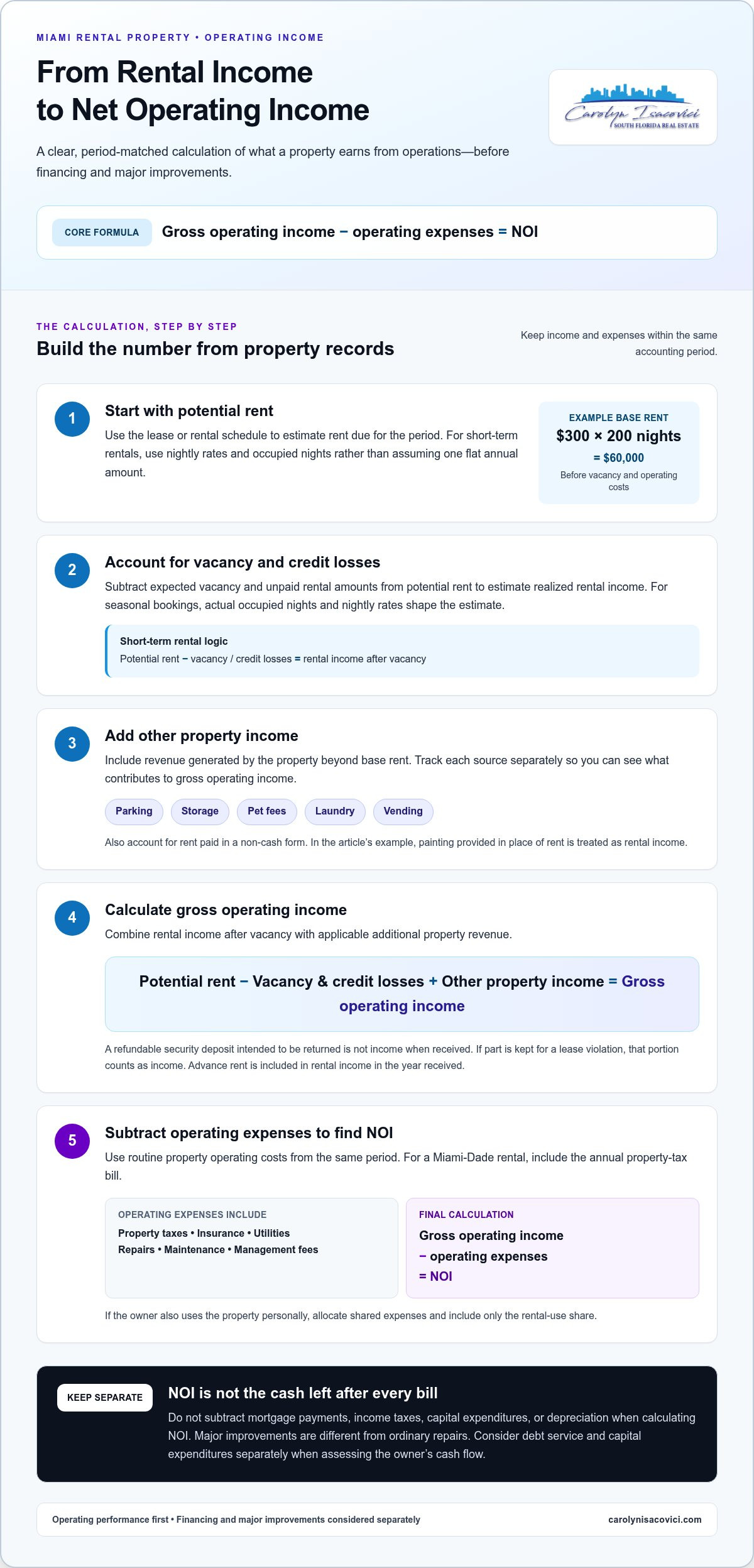
Strong rent doesn’t automatically mean strong cash flow. When calculating net operating income for rental property in Miami, add gross operating income and other property income, then subtract operating expenses. NOI excludes debt service, income taxes, and capital expenditures, so it isn’t the same as the cash left after every bill.
That distinction matters when comparing rentals: a property can produce a healthy NOI but deliver a different cash result after financing and major improvements. The calculation itself is straightforward and gives you a consistent starting point for evaluating a property.
This guide explains how to estimate rental income, account for vacancy and other revenue, and identify which operating costs belong in the calculation. You’ll also see how NOI informs cash-flow analysis and capitalization rate, and why it tells only part of the investment story. Together, these steps help you assess a Miami rental and weigh its income against the costs and financing that shape returns.
Key Takeaways
- Separate rental revenue from operating costs to see what a property earns before financing and major improvements are considered.
- Account for vacancy and income beyond base rent to build a more realistic picture of a property’s operating income.
- Use the NOI formula consistently, and keep debt service, income taxes, and capital expenditures outside the calculation.
- Compare NOI with purchase price to understand cap rate, then consider financing separately when assessing cash flow.
- Look beyond a single estimate: income, vacancies, and operating costs all shape a rental property’s cash-flow outlook.
What Is Net Operating Income?
Net operating income (NOI) is a rental property’s income minus its operating expenses. For a Miami-Dade rental, include the annual property-tax bill as an operating expense. The amount reflects taxable value and applicable local tax rates.
Operating Expenses and Rental Income
NOI measures property revenue after operating costs are subtracted. It helps you determine whether rental income covers routine expenses before financing or major improvements are considered.
Start with rent and add other income generated by the property, such as parking, storage, laundry, or vending revenue. Subtract operating expenses, including property taxes, insurance, utilities, repairs, maintenance, and management fees. A building with paid parking has additional revenue to include, while repair and insurance bills reduce NOI.
Keep the accounting period consistent by comparing income and expenses from the same period. If the owner also uses the property personally, allocate shared expenses between rental and personal use. Only the rental-use share belongs in the operating expense calculation, so careful allocation produces a more useful NOI figure.
Expenses Excluded from NOI
NOI excludes costs that don’t represent routine property operations, including mortgage payments, income taxes, capital expenditures, and depreciation. Keeping these items separate makes it easier to compare operating performance without mixing in the owner’s financing or tax situation.
Capital expenditures are major purchases or improvements, not ordinary repairs. Replacing a major building system is different from fixing a routine maintenance issue. Capital expenditures reduce the owner’s available cash, but they don’t reduce NOI like recurring operating expenses do.
This distinction matters when assessing rental cash flow. First, calculate NOI from property income and operating expenses. Then account separately for debt service and capital expenditures to see how much cash remains after those obligations. A property can show positive NOI while major work or mortgage payments reduce the owner’s cash flow.
Calculating gross operating income
Gross operating income starts with the rent a property could earn when fully occupied. Subtract vacancy costs from potential rent, then include other property-related revenue. For a Miami rental, distinguish scheduled rent from income the property actually earns. This provides a clearer starting point for assessing operations before deducting expenses.
Build your estimate from the lease or rental schedule. For a long-term unit, annualize the rent due, then account for expected vacancy. Add property income such as parking, storage, pet fees, laundry, or vending revenue. Track these items separately so you can see whether rent or additional services contribute more to gross income.
Short-term rentals require a different income estimate because bookings vary by season. A rental charging $300 per night and booking 200 nights earns $60,000 in base rental income in the example. That is potential revenue before vacancy and operating costs. Actual booked nights and nightly rates shape the estimate, so a seasonal schedule can make projections more useful than one flat rate.
Include rent paid in forms other than cash. According to the Internal Revenue Service’s painting example, a tenant who paints a rental property instead of paying 2 months’ rent provides rent that the landlord includes in income and may also deduct as a painting expense. A refundable security deposit intended for return is not income when received. If the landlord keeps part for a lease violation, that portion counts as income.
Advance rent also affects the income period. For a U.S. rental, advance rent is included in rental income in the year received, even if it covers a later period. A landlord using the cash method reports rent when actually or constructively received. These timing details help align the income estimate with the correct accounting period.
After estimating gross rental income, subtract vacancy costs and add applicable ancillary income to determine gross operating income. Keep the gross rent multiplier separate: divide a property’s purchase price by its annual gross rental income. This comparison can help assess purchase prices, but it excludes expenses, financing, and other investment factors.
Use the measures to answer different questions. Gross operating income captures income after vacancy and additional property revenue; the gross rent multiplier compares purchase price with gross rent. Neither accounts for operating expenses, so neither alone shows the property’s NOI or cash flow.
NOI formula
Calculate NOI by adding gross operating income and other property income, then subtracting total operating expenses. Account for vacancy and credit losses by subtracting them from potential rent before adding other income. Use records from the same accounting period.
When calculating net operating income for rental property in Miami, organize income and expense records by property and period, then classify each item. This keeps the calculation focused on property operations rather than the owner’s financing.
Short-Term Rental NOI
For a short-term rental, calculate NOI by adding booking income and other property revenue, then subtracting operating expenses. First account for vacant nights and unpaid booking amounts when estimating realized rental income. Then include separate income, such as parking or laundry, if it isn’t already included in bookings. This shows how occupancy and costs shape performance.
Booking records connect nightly rates with occupied nights, while invoices document turnover and maintenance expenses. Keep both within the same accounting period. Seasonal rental income can shift throughout the year, so a full-year calculation provides a more complete view when records are available.
Vacancy and Credit Losses
Vacancy and credit losses reduce potential rental income before operating expenses are subtracted. Vacancy is rent lost when a unit or booking night is unoccupied; credit loss is rent expected but not collected. Including both makes the calculation more realistic than treating every scheduled payment as income received.
Compare rent scheduled under a lease with payments in the rent ledger. Record an empty unit separately from an unpaid tenant balance, then subtract each loss once. This avoids double-counting a shortfall and makes the estimate more useful when comparing Miami rentals.
Records and Steps for Accurate Calculations
Accurate NOI depends on records that match the property and calculation period. Use leases, booking statements, rent ledgers, deposit records, utility bills, maintenance invoices, insurance statements, and property-tax bills. Together, these documents distinguish rent collected from rent scheduled and property costs from owner-level expenses.
Classify each record as potential rent, vacancy or credit loss, other income, or operating expense. Add gross operating income and separate property income, then subtract eligible operating expenses. Reconcile the totals with bank and booking statements. For a Miami property used personally as well as for rentals, include only the rental-use share of shared expenses.
A spreadsheet makes calculating net operating income for rental property in Miami repeatable. Use one row per category and keep the supporting record. Compare the total with source documents before relying on it to assess the property. Consistent categories make changes in income or expenses easier to trace over time.
NOI in cash flow and capitalization rate calculations
NOI helps answer two related questions: how a rental performs operationally and how its income compares with its purchase price. The capitalization rate, or cap rate, uses NOI to express that relationship, while cash-flow analysis also accounts for financing and other cash obligations.
Calculate cap rate by dividing a property’s NOI by its purchase price. For example, a property with $50,000 in NOI and a $500,000 value has a 10% cap rate. The result gives you a way to compare operating income with the price paid, but it doesn’t include mortgage payments or an investor’s individual tax situation.
Comparisons are most useful when the properties are genuinely similar. Look at buildings in the same neighborhood with comparable use, condition, and operating performance. A cap rate below what an investor expects for that neighborhood may indicate an overly high purchase price, though operating income and the property’s potential matter too. Appraisers and brokers can often provide information about local cap rates.
NOI can also help estimate a rental property’s value. Divide the property’s NOI by the typical cap rate for similar buildings in the area. This method connects local market expectations with the property’s income, so changes in either figure affect the estimated value. It’s a useful comparison, not a substitute for assessing the property’s full circumstances.
Cash-flow analysis takes the calculation further. Start with NOI, then subtract debt service and account for capital expenditures. These costs are outside NOI, but they affect the cash an owner retains. A building may show solid operating profitability while mortgage payments or a major repair reduce the cash available after expenses.
Routine maintenance belongs in operating expenses, so it reduces NOI before the cash-flow calculation. A major replacement or improvement is a capital expenditure, so it stays outside NOI and is accounted for separately. Keeping these categories distinct prevents routine work and large projects from distorting the same measure.
For a fuller return comparison, calculate annual pre-tax cash flow and divide it by total cash invested, including the down payment and closing costs. This is the cash-on-cash return. Unlike cap rate, which compares NOI with property price, cash-on-cash return reflects the investor’s financing and invested funds.
Use these measures together: NOI describes operating performance, cap rate relates that income to purchase price, and cash flow reflects financing and capital needs. For a Miami investment, comparing the figures across similar properties can clarify whether the expected income supports your purchase strategy.
Rental-property cash flow analysis
NOI shows how a rental performs before financing and major improvements; cash flow shows what remains after those obligations. To estimate cash flow, start with NOI, then subtract mortgage payments and capital expenditures. This distinction matters in Miami, where strong operating results can still leave less cash available after financing or necessary building work.
Operating costs can change the picture substantially. Long-term rental expenses are commonly budgeted at 35% to 40% of gross rent, while vacation rentals often use 50% to 60% or more. Short-term operating expenses can range from 30% to 70% of gross revenue. Treat these as planning context, not a substitute for the property’s actual income and bills.
Short-term rentals also have cost and occupancy patterns that deserve separate scrutiny. Vacancy can reach 30% to 40% or higher, depending on location and competition. Cleaning and turnover can consume 10% to 15% of gross revenue, while platform commissions take 3% to 5% of each reservation. Compare these costs with actual booking records rather than assuming every available night generates income.
Forecasting improves when you review history alongside current conditions. J.P. Morgan recommends examining 2- to 3-year property income and expenditure trends when beginning an operating cash-flow forecast. Management fees and repair costs can be relatively stable, while rental income and utility costs may shift with inflation, wage growth, unemployment, interest rates, and nearby construction.
Comparing similar buildings can help show whether a forecast is realistic. Apartment buildings in the same neighborhood with similar management, age, and unit characteristics should have comparable rents and per-unit operating expenses. If a property’s NOI falls below that of comparable buildings, investigate the reasons, such as vacancy, utility use, or maintenance needs, before assuming its income potential.
Debt adds another useful lens. Debt service coverage ratio is NOI divided by annual principal and interest payments; lenders typically require a ratio of 1.2 to 1.5. This measure tests whether operating income covers scheduled debt payments, while cash flow after debt and capital expenditures shows the owner’s remaining funds. Neither replaces the other.
A below-market NOI doesn’t automatically rule out a property if there’s a practical plan to improve operating cash flow. Identify the source of the gap, estimate how rent, occupancy, or expenses affect the result, and compare the revised outlook with your purchase strategy. A careful forecast grounds the decision more firmly than gross rent alone.
Florida Commercial Investment Properties: Commercial Property Sales
Florida Commercial Investment Properties supports commercial property sales and investment property sales. When a Miami property’s NOI, cap rate, and projected cash flow align with your investment priorities, the firm’s brokerage services can help you evaluate an acquisition.
Use your calculations to clarify what the property earns, which operating costs reduce NOI, and how financing and capital needs affect cash flow. This can help you decide whether a commercial or residential investment fits your objectives. Florida Commercial Investment Properties also handles residential real estate sales and new construction homes for those considering those property paths.
For a conversation about your real estate goals, contact Florida Commercial Investment Properties or visit carolynisacovici.com.
Turn Your Analysis Into a Clear Next Step
Calculating net operating income for a rental property in Miami gives you a clearer perspective for your next decision. Use the figures to define what you need from a property, how much operating uncertainty you’re prepared to manage, and what role the investment should play in your broader plans. This framework helps you assess opportunities without reacting to a single attractive feature.
Before moving forward, consider which trade-offs matter most: predictable rental income, room to improve operations, or a property that fits a longer-term strategy. Your priorities shape how you interpret the financial picture and which opportunity deserves closer attention.
When you’re ready to explore a real estate opportunity, contact Florida Commercial Investment Properties to discuss your goals. A thoughtful next step can turn careful analysis into a more confident property decision.
Frequently Asked Questions
What is net operating income (NOI) for a rental property?
NOI is the income a rental property generates after operating expenses are deducted. For example, compare a Miami property’s rent and parking revenue with costs such as utilities, insurance, and routine repairs. The result helps compare properties’ operating performance before financing and owner-specific taxes enter the picture. It’s a property-level measure, not necessarily the amount an owner takes home.
What income is included when calculating rental property NOI?
Include rent and other property-generated income, such as parking, storage, pet fees, laundry, or vending revenue. For a Miami building, track each source separately so rent and ancillary income aren’t counted twice. Advance rent belongs in rental income for the year received. A refundable security deposit intended to be returned isn’t income when received, but an amount kept may count.
Which operating expenses should be included in rental property NOI?
Include expenses tied to operating the rental, such as property taxes, insurance, utilities, repairs, maintenance, management, payroll, and professional services. A Miami owner can sort bills by category and property to distinguish recurring costs from expenses for personal use. Marketing and accounting costs can also form part of operating expenses. Use costs from the same accounting period as the income to produce a meaningful comparison.
Which costs are excluded from NOI, such as mortgage payments, income taxes, and depreciation?
Mortgage principal and interest, income taxes, depreciation, and capital expenditures are excluded from NOI. They affect the owner’s finances or the property’s long-term investment picture, but don’t measure routine operations. For example, consider a major building-system replacement separately from ordinary maintenance. Keep these items separate in your Miami rental analysis so NOI remains useful for comparing operating performance.
How can I estimate rental income and vacancy rates for a Miami property?
Estimate potential rent from the property’s leases or expected rental schedule, then account for periods without tenants or bookings. For Miami, consider the rental format, seasonal demand, and comparable local properties when forecasting. Review actual occupancy and collected rent alongside scheduled income. For a short-term rental, booking records show how nightly rates and vacant nights affect revenue across seasons.
What are typical Miami rental property operating expenses and property management fees?
Operating costs depend on property type, occupancy, services, and maintenance needs. Long-term rentals are commonly budgeted at 35% to 40% of gross rent for operating expenses; vacation rentals often use 50% to 60% or more. Short-term rental management fees typically range from 20% to 30% of gross bookings. Treat these figures as planning context, then assess the property’s own records and operating model.
How do Florida insurance premiums, hurricane coverage, and flood insurance affect Miami rental property expenses?
Insurance premiums for the rental property belong among operating expenses, so they reduce NOI for the period they cover. In a Miami analysis, distinguish insurance bills from mortgage costs and major repairs, and record the actual premiums associated with the rental. Hurricane or flood coverage affects insurance expenses when included in the property’s policy; the amount depends on the property and its coverage.
How do Miami condo association fees and special assessments affect NOI?
Classify recurring condo association charges according to what they cover. Regular fees for shared operations or maintenance can be treated as operating expenses when they relate to running the rental. A special assessment for a major improvement is a capital cost, not an NOI operating expense, so account for it separately in cash-flow analysis. For a Miami condo, review the fee breakdown to distinguish ongoing operations from larger projects.
Leave a Reply