Tag: cap rate

  • Income Producing Properties Miami: The 2026 Strategic Investor’s Guide

    Income Producing Properties Miami: The 2026 Strategic Investor’s Guide

    Could the most lucrative investment in the 2026 market actually be the one that requires the least amount of your time? It’s a question many investors are asking as they evaluate the current landscape of income producing properties Miami offers. You’ve likely noticed that while median sale prices have stabilized around $595,000, the entry point for the urban core remains high; meanwhile, the fear of hidden maintenance costs in older buildings keeps many on the sidelines. You want the legendary growth Florida provides, but you don’t want the stress of unpredictable repairs or complex tax implications.

    This guide is designed to transform that uncertainty into a clear strategic advantage. You’ll learn how to identify high-yield assets that prioritize quality and lease structure over raw unit count. We will examine the nuances of NNN leases versus residential yields and provide a 2026 roadmap for a diversified, low-maintenance portfolio. By focusing on asset quality and professional insight, you can build a resilient wealth stream that thrives regardless of market shifts. It is time to move past the confusion and start securing assets that work as hard as you do.

    Key Takeaways

    • Learn why Miami’s unique mix of population growth and tax status continues to solidify its position as a top-tier destination for rental revenue in 2026.
    • Contrast the hands-off stability of Commercial Net Lease (NNN) properties with the robust, traditional cash flow found in residential multi-family investments.
    • Gain the tools to accurately calculate Cap Rates and Cash-on-Cash returns to ensure the income producing properties Miami has available meet your yield requirements.
    • Explore the strategic expansion of growth corridors from Miami to Port Saint Lucie to build a diversified portfolio that minimizes localized risk.
    • Understand the “pocket listing” advantage and why the most lucrative, low-maintenance assets often require a navigator with deep local roots to uncover.

    What Defines Income Producing Properties in Miami for 2026?

    What exactly makes a property “income producing” in the eyes of a seasoned strategist? At its core, the term refers to assets specifically acquired to generate recurring rental revenue. While appreciation is a welcome bonus, your primary objective is the consistent monthly check that lands in your account. Understanding the Fundamentals of real estate investing is essential here, as it shifts your focus from being a mere homeowner to becoming a strategic business owner. In the current market, identifying the right income producing properties Miami offers means looking beyond the stucco and paint to the underlying numbers.

    Why does Miami remain a global capital haven in 2026? The answer lies in a powerful combination of steady population growth and a favorable tax climate. Investors are no longer just looking for a place to park cash; they are seeking a “Passivity Spectrum” where their involvement is minimal but their returns are optimized. This leads to a mandatory mantra for the modern high-net-worth individual: “Selection over Sweat.” Choosing the right asset at the start is far more valuable than trying to outwork a bad investment later. It’s about finding properties with high-quality tenants and low-maintenance needs from day one.

    The Shift Toward Strategic Passivity

    The 2026 investor is moving away from the headache of DIY landlording. Why spend your weekends managing tenants when professional systems can do it for you? Time freedom has become the ultimate luxury, and securing it requires a shift in mindset. When you begin Florida real estate portfolio building, you aren’t just buying buildings; you’re acquiring income streams. Professional management doesn’t just protect your time. It ensures your asset remains in peak condition, preserving its value for the long haul. This approach transforms a stressful job into a resilient wealth engine.

    Miami’s Unique Economic Advantage

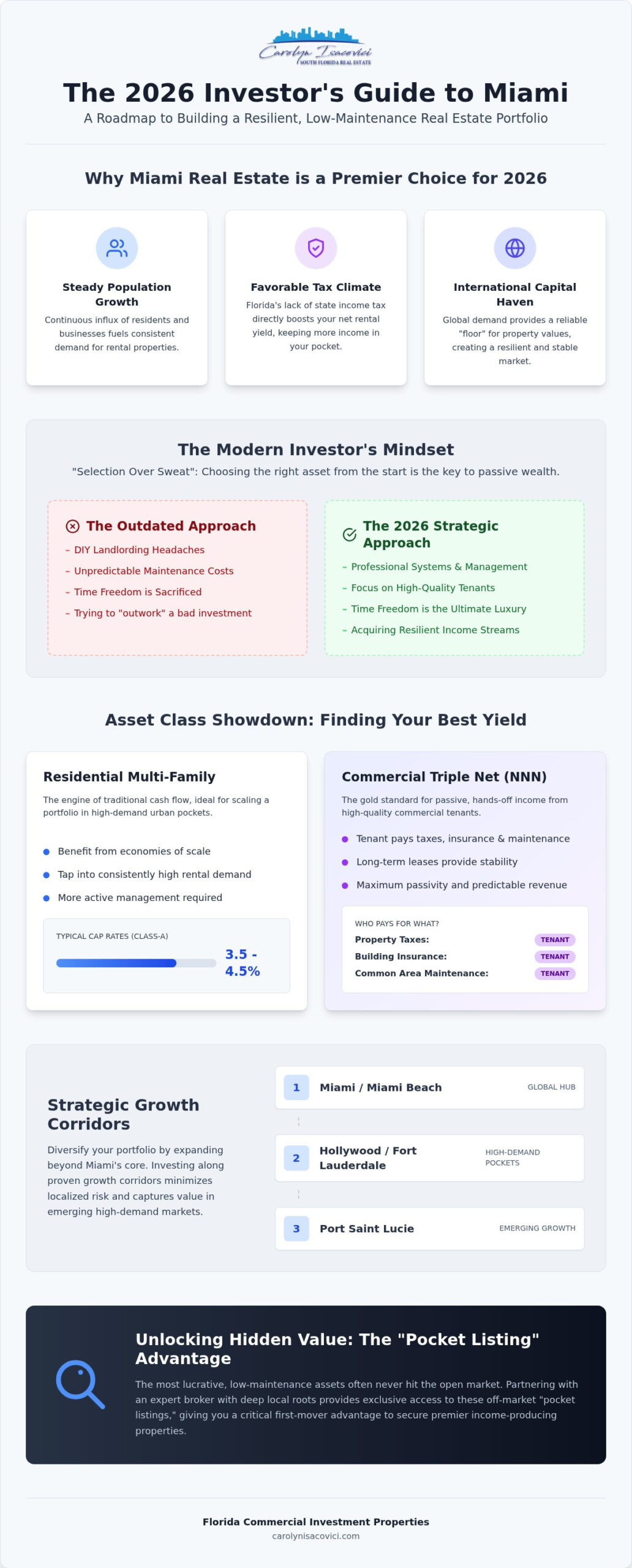
    Florida’s lack of state income tax is a massive tailwind for your net rental yield. It’s a simple calculation: more of your rental income stays in your pocket compared to high-tax states. We see significant growth trends in areas like Miami Beach and Hollywood, FL, where demand for rental housing continues to outpace supply. For Class-A multi-family assets, cap rates are currently hovering in the 3.5% to 4.5% range, reflecting the stability of the market. International demand provides a reliable “floor” for Miami property values. Because Miami is a global destination, it attracts capital from around the world, making the market less susceptible to local economic dips. This global interest creates a resilient market that feels both stable and full of opportunity for those who act with precision.

    Comparing Asset Classes: Which Miami Property Produces the Best Yield?

    Which asset class truly aligns with your financial goals? Selecting from the diverse pool of income producing properties Miami offers requires more than just looking at the sticker price. It’s about matching the property type to your desired level of involvement. While residential multi-family units provide the traditional backbone of local cash flow, commercial Triple Net (NNN) leases are often viewed as the gold standard for those seeking a truly hands-off experience. Both paths offer distinct advantages, but the right choice depends on whether you prioritize raw yield or maximum passivity.

    Multi-Family: Scaling Your Residential Income

    Residential multi-family remains a favorite for a reason. It’s intuitive. You might start by evaluating 2-4 unit properties in high-demand pockets like Fort Lauderdale, where rental demand stays consistently high. As you move into larger buildings, you benefit from significant economies of scale. One roof, one landscaping contract, and one insurance policy cover multiple rent checks. If you’re weighing these options, it helps to review a detailed commercial vs residential investment Florida guide to see which path fits your risk profile. While multi-family requires more active management than commercial assets, the sheer volume of renters in South Florida provides a reliable safety net for your investment.

    The Power of the Triple Net (NNN) Lease

    For the investor who values time above all else, the Triple Net lease is the ultimate vehicle. In this structure, the tenant takes on the responsibility for property taxes, insurance, and all maintenance costs. This shifts the operational burden away from you entirely. Institutional investors favor these assets because they offer long-term, low-stress wealth. Finding credit-worthy tenants in the Miami and Palm Beach markets is the key to success here. Think of national pharmacies or established medical groups. These tenants are unlikely to vanish, providing a level of stability that residential leases sometimes lack.

    Beyond these common choices, specialized assets like industrial property for sale Miami or medical office spaces offer unique advantages when looking for income producing properties Miami investors can trust. These sectors have shown remarkable resilience in 2026, driven by the ongoing need for logistics hubs and healthcare infrastructure. Each class has its own rhythm and requirements. If you feel overwhelmed by the choices, reaching out to a specialized investment broker can help clarify which asset will best serve your long-term vision. The goal is to build a portfolio that doesn’t just grow, but stays secure through every market cycle.

    The Investor’s Math: Decoding Miami Property Metrics

    How do you separate a high-performing asset from a stagnant one? Identifying the best income producing properties Miami offers requires a blend of current yield and future potential. The answer lies in mastering the metrics that seasoned investors prioritize. While surface-level prices tell part of the story, the underlying math reveals the true potential for wealth creation. Understanding these numbers doesn’t just make you a better buyer; it gives you the confidence to act when others are hesitant. You need a clear framework for how to evaluate investment property Florida assets to ensure every dollar is working efficiently.

    Cap rates are the starting point for any serious discussion. Cap Rate is the Net Operating Income divided by the current market value. In 2026, a “good” rate depends entirely on the district and asset class. While short-term rentals can generate gross yields of 6% to 9%, Class-A multi-family properties in the Miami core typically hover between 3.5% and 4.5%. With mortgage rates currently ranging from 6.375% to 6.75%, the strategic use of leverage is more important than ever. Financing allows you to boost your Cash-on-Cash return, provided the asset’s yield exceeds the cost of debt.

    Analyzing Cap Rates Across South Florida

    Is a higher yield always better? Not necessarily. Lower cap rates in premier Miami districts usually signal a flight to quality. These are assets with high occupancy and credit-worthy tenants. If you’re looking for higher initial cash flow, you might look toward emerging markets like Stuart or Jupiter. These areas often offer more approachable entry prices compared to the Miami median list price of $640,000, allowing for a higher cap rate even if the long-term appreciation curve differs. Balancing your portfolio across these regions is a smart way to manage risk while maintaining steady growth.

    Total Return: Cash Flow + Appreciation

    True wealth is built by looking at the total return, which combines monthly cash flow with long-term appreciation. In areas like Miami Beach, the “Appreciation Factor” can often outweigh the initial cash flow. Property values here have shown incredible resilience, often rising even when broader market conditions fluctuate. You can also take control of this growth through “forced appreciation” by making strategic property improvements that increase the rental value. To see which neighborhoods are poised for the most significant growth, check the latest Miami real estate market trends 2026 forecasts. This data-driven approach ensures you aren’t just buying a building, but a growing financial engine that secures your future.
    Income Producing Properties Miami: The 2026 Strategic Investor’s Guide

    Strategic Locations for Income Producing Properties in 2026

    Where should you point your compass for the best returns? While the Miami core remains an iconic destination for global capital, the 2026 growth story extends far beyond the city limits. The I-95 and Turnpike corridors have become the primary lifelines of the South Florida economy, connecting established hubs with emerging residential centers. For those seeking income producing properties Miami investors can rely on, the secret lies in geographic diversification. Spreading your portfolio across Miami-Dade, Broward, and Palm Beach counties doesn’t just increase your options. It acts as a shield against localized risk, such as specific municipal tax shifts or zoning changes.

    Many successful investors are now looking toward the “New Construction” strategy to maximize their strategic passivity. By 2026, the preference for modern, hurricane-resistant builds has shifted from a luxury to a requirement for many high-quality tenants. Buying into these projects early allows you to capture equity before the first tenant even moves in. It’s a calculated move that prioritizes long-term stability over the constant repair cycle often found in older coastal buildings. If you’re ready to explore these opportunities, you can browse current investment property sales to see which districts are currently showing the strongest momentum.

    The New Construction Advantage

    Why are new construction homes Florida becoming the preferred choice for the hands-off investor? The answer is simple: predictability. New builds come with extensive builder warranties that protect your bottom line from major capital expenditures in the early years. High-quality tenants are naturally drawn to these properties for their modern finishes and energy efficiency, which often leads to longer lease terms and lower turnover costs. Pre-construction pricing provides a unique window to secure an asset below its future market value, effectively “baking in” equity from day one.

    Emerging Hubs: Stuart, Jupiter, and Beyond

    The “commuter effect” is reshaping rental demand in Northern Palm Beach County. As more professionals seek a balance between urban access and suburban tranquility, cities like Stuart and Jupiter have seen a surge in interest. Evaluating cash flow investment property Florida in these secondary markets often reveals a more favorable entry price compared to Miami’s $799,900 median for single-family homes. Further north, the long-term play in Port Saint Lucie and Fort Pierce remains strong. These areas offer “Cash Flow Pockets” where rental demand is driven by a growing local workforce, providing a reliable foundation for residential income. Looking even further to Vero Beach and Melbourne can uncover high-yield opportunities that the average aggregator often misses.

    How to Secure High-Yield Assets: The Expert Brokerage Advantage

    Why do the most lucrative deals often remain invisible to the public? In a market as competitive as South Florida, the highest-quality income producing properties Miami offers are frequently traded before they ever hit a public listing site. Relying solely on aggregators means you’re often seeing the leftovers. A broker with dual expertise in both commercial and residential investment provides a distinct advantage. They understand the nuances of a multi-family cap rate just as clearly as the legal intricacies of a commercial lease. This specialized knowledge ensures that your acquisition aligns with your long-term wealth strategy rather than just being another line item on a spreadsheet.

    Success isn’t just about the purchase. It’s about the due diligence that happens behind the scenes. Your broker should act as a shield, ensuring your passive income doesn’t transform into an active headache. This involves verifying rent rolls, assessing hidden maintenance liabilities, and positioning your portfolio for future growth. For many, this includes planning for a 1031 exchange. This powerful tool allows you to defer taxes and roll your equity into larger, more productive assets, accelerating your path to financial freedom. It’s about looking three steps ahead to ensure your capital is always working at its highest potential.

    Accessing Off-Market “Pocket Listings”

    Carolyn Isacovici of Florida Commercial Investment Properties brings nearly 20 years of local roots, providing a bridge to unlisted deals. These “pocket listings” are the lifeblood of the strategic investor. Having a “calm expert” navigator in a fast-moving market is essential. You gain the competitive advantage of seeing commercial opportunities before the general market can react. This isn’t just about speed; it’s about the professional relationships built since 2006 that open doors others don’t even know exist. Whether you’re looking in the Miami core or along the coast toward Melbourne, these off-market connections are often where the best yields are found.

    Transitioning from Buyer to Portfolio Owner

    What happens after the closing? The most successful investors view brokerage as a partnership, not just a transaction. Your post-sale roadmap should include connections to reliable property managers and tax strategists who understand the Florida landscape. This holistic approach ensures your transition from buyer to portfolio owner is seamless and secure. By surrounding yourself with a team of experts, you transform a single property into a resilient wealth engine. Ready to define your roadmap? Carolyn Isacovici and the team at Florida Commercial Investment Properties can help. You can schedule a consultation for personalized Florida investment planning today. Let’s turn your vision of a high-yield portfolio into a reality.

    Charting Your Path to Resilient Wealth

    Building a successful portfolio in South Florida is no longer about chasing every available listing. It’s about precision. By 2026, the most effective strategy for income producing properties Miami offers is one that prioritizes asset quality and professional insight over sheer volume. You’ve seen how the right math and a focus on strategic locations like the I-95 corridor can transform a simple purchase into a generational wealth engine. Whether you’re leaning toward the stability of a Triple Net lease or the robust cash flow of multi-family units, the key is to act with clarity and confidence.

    With nearly 20 years of expertise since 2006, Carolyn Isacovici provides the seasoned guidance you need to navigate this dynamic market. From identifying off-market “pocket listings” to securing high-yield assets from Miami to Melbourne, FL, you don’t have to walk this path alone. It’s time to move from observation to action. Start Your Miami Investment Journey with Carolyn Isacovici and secure the professional partnership your success deserves. Your future in Florida real estate is bright, and the right opportunity is waiting for you to claim it.

    Frequently Asked Questions

    Is Miami still a good place for income producing properties in 2026?

    Miami continues to be a premier destination for capital due to its unique tax climate and steady population influx. While prices have stabilized, the demand for income producing properties Miami investors seek remains robust because of the international “floor” on property values. You aren’t just buying real estate; you’re securing a position in a global market that historically resists local downturns. It’s an environment where strategic selection leads to long-term resilience.

    What is the average cap rate for a multi-family property in Miami?

    For Class-A multi-family assets in the urban core, you can expect cap rates between 3.5% and 4.5% in 2026. If you look at the broader residential market, some yields average closer to 6.84%, though these often involve higher maintenance or different risk profiles. Understanding this math is vital for aligning your purchase with your specific financial goals. A lower cap rate often signals a high-quality, lower-risk asset with more reliable appreciation potential.

    Are commercial NNN leases more passive than residential rentals?

    Commercial Triple Net (NNN) leases are significantly more passive than traditional residential rentals. In an NNN structure, the tenant is responsible for property taxes, insurance, and all maintenance costs. This shifts the operational burden entirely away from you. It’s the ideal choice for those who want a monthly check without the “sweat equity” of managing repairs or tenant disputes. This setup offers institutional-grade stability for your personal wealth stream and long-term time freedom.

    How much down payment is typically required for a Florida investment property?

    Most investment property acquisitions in Florida require a down payment of 20% to 25% of the purchase price. You should also account for buyer’s closing costs, which typically range from 2% to 5%. While mortgage rates in late 2026 are between 6.375% and 6.75%, the strategic use of leverage can still boost your cash-on-cash return. Proper planning ensures you have the liquidity needed to secure high-yield assets without overextending your capital reserves.

    Can I manage a Miami income property if I live in another state?

    Managing a property from out of state is completely feasible when you prioritize “Selection over Sweat.” By choosing low-maintenance assets or new construction, you reduce the frequency of issues that require physical presence. Most successful out-of-state investors partner with local property managers to handle daily operations. This allows you to focus on the high-level strategy of your Florida portfolio while your assets generate income and appreciation without requiring your constant daily attention.

    What are the best neighborhoods in Miami for rental yield right now?

    High rental yields are currently found in areas with strong demand and growing infrastructure, such as Hollywood, FL, and parts of Miami Beach. If you’re looking for higher initial cash flow, the growth corridors along I-95 toward Port Saint Lucie and Vero Beach offer lower entry prices and rising demand. Diversifying across these “Cash Flow Pockets” allows you to balance the high appreciation of the Miami core with the higher immediate yields of secondary markets.

    How does new construction compare to older properties for income potential?

    New construction generally offers higher income potential through reduced maintenance costs and premium rental rates. Older buildings in Miami can hide significant repair liabilities that eat into your net yield. A new build comes with warranties and energy-efficient features that attract high-quality tenants and keep your occupancy high. It’s a strategic move for the 2026 investor who values predictability and wants to avoid the stress of unexpected or hidden capital expenditures.

    What is a 1031 exchange and how can it help my Florida portfolio?

    A 1031 exchange is a tax-deferred strategy that allows you to sell an investment property and reinvest the proceeds into a “like-kind” asset. This helps your portfolio grow by deferring capital gains taxes, effectively giving you more capital to purchase larger or higher-yielding properties. It’s a powerful tool for scaling your wealth over time. By rolling your equity forward, you can transition from smaller residential units into institutional-grade commercial assets like industrial property for sale in Miami without a major tax hit.
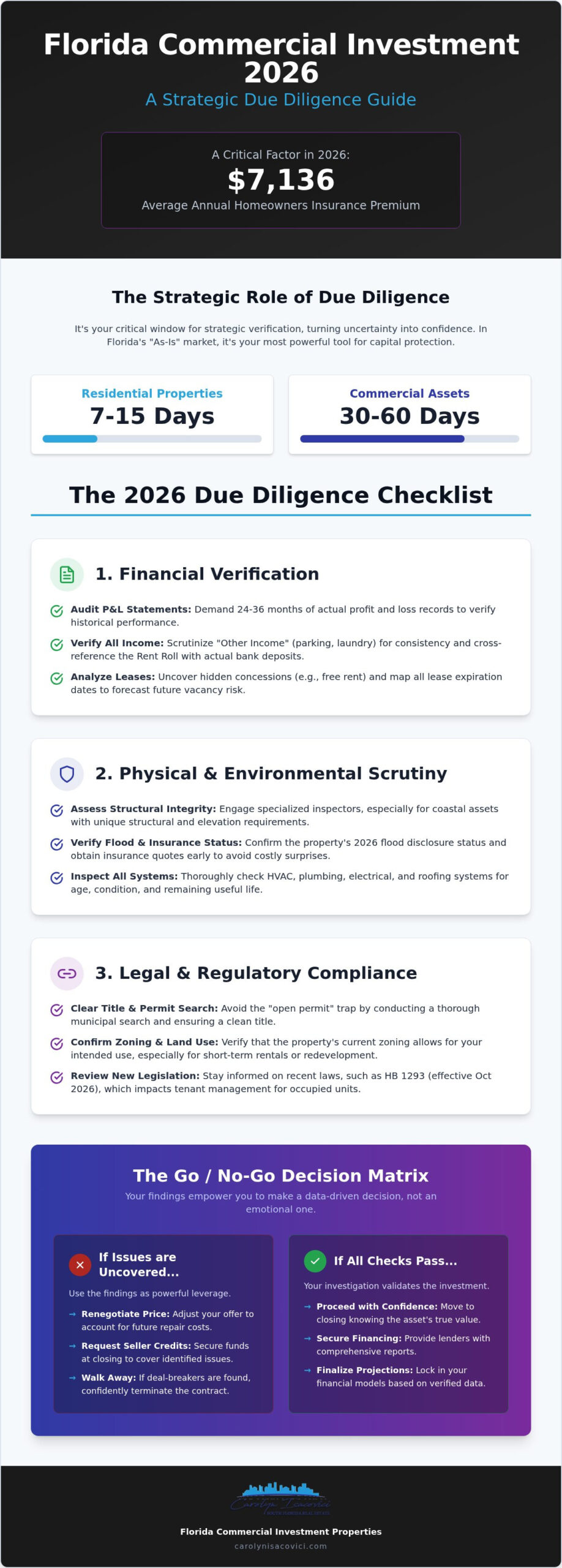
  • Investment Property Due Diligence Florida: The Definitive 2026 Checklist

    Investment Property Due Diligence Florida: The Definitive 2026 Checklist

    Did you know that by August 2026, Florida homeowners insurance premiums for many properties have reached an average of $7,136 annually? It is a striking figure that can quickly erode your margins if it isn’t accounted for early in the process. You likely feel the weight of this uncertainty, perhaps worrying about hidden structural issues or the maze of local short-term rental restrictions. It is natural to seek a sense of security before committing your hard-earned capital. Can you truly mitigate these risks without losing the deal? The answer is a resounding yes.

    Mastering investment property due diligence Florida is about more than just checking boxes; it is a strategic audit of an asset’s financial truth. This guide will show you how to verify your property’s value and protect your portfolio from unforeseen liabilities. We will walk through a definitive 2026 checklist that covers everything from mandatory flood disclosures to the latest regulations regarding fraudulent tenancies. By the end, you will have a repeatable process to ensure your investment hits its projected cap rates while keeping your capital safe and sound.

    Key Takeaways

    • Discover why the due diligence period serves as your critical window for strategic verification, providing the leverage needed to navigate Florida’s “As-Is” contracts with confidence.
    • Learn how to audit seller-provided pro-formas and financial data to ensure your projected income aligns with the actual market reality of 2026.
    • Master the physical side of investment property due diligence Florida by identifying specialized structural needs and interpreting the latest elevation requirements for coastal assets.
    • Avoid the “open permit” trap and zoning hurdles by conducting a thorough legal review to confirm your property’s intended use is fully protected.
    • Develop a clear “Go/No-Go” decision matrix that transforms your inspection findings into powerful tools for professional price renegotiation or capital protection.

    The Strategic Role of Investment Property Due Diligence in Florida (2026)

    What is the true purpose of a due diligence period? It is far more than a simple exit hatch in a contract. For the strategic investor, due diligence represents a vital window of strategic verification. This is the moment where you pull back the curtain on a listing to ensure the numbers, the structure, and the legal standing align with your goals. In Florida, the “As-Is” contract is the industry standard. This means the seller isn’t obligated to make repairs, but you have the absolute right to walk away if the property doesn’t meet your standards. It makes this phase the most critical part of your acquisition.

    Timing is everything. In residential transactions, you usually have a 7 to 15 day window to complete your checks. Commercial assets typically offer a more generous 30 to 60 day period. Regardless of the timeline, the goal is to move from a state of uncertainty to one of absolute confidence. By using data-driven investigation, you replace “what if” with “I know.” This clarity is what allows you to commit to a closing with a steady hand.

    Why 2026 Requires a New Due Diligence Standard

    The Florida market in August 2026 demands a deeper level of scrutiny than in previous years. Why has the bar been raised? Legislative updates have changed the landscape significantly. For instance, the new HB 1293 law taking effect October 1, 2026, targets fraudulent residential entries, adding a layer of security for landlords but also requiring stricter tenant vetting during the acquisition of occupied units. Surface-level inspections are no longer sufficient. With insurance premiums averaging $7,136 annually, you must verify the insurability and the 2026 flood disclosure status of the asset before the period expires. This is where a professional partner becomes essential. You need someone who sees beyond the aesthetics to identify the financial and legal health of the property.

    Setting Your Objectives Before the Clock Starts

    How do you ensure you don’t waste precious time? You set clear objectives before the contract is even signed. Your investment property due diligence Florida process must align with your specific exit strategy. If you’re planning a short-term rental, your focus will be on local zoning and the latest municipal restrictions. If it’s a long-term hold, structural integrity and the 2026 tax assessment caps become the priority. Identifying your deal-breakers early allows you to use findings as negotiation levers rather than just reasons to cancel. It’s about having your expert team, from inspectors and financial partners like Allen Capital Funding to local brokers, on standby the moment the clock starts ticking.

    Financial Verification: Auditing the Numbers Behind the Deal

    How often do the numbers on a glossy listing brochure match the reality of the bank statements? Rarely. While a pro-forma offers a vision of potential, your job during investment property due diligence Florida is to uncover the historical truth. This requires a “Trust but Verify” mindset. You should demand at least 24 to 36 months of actual profit and loss statements to see how the asset performs across different seasons. It’s also vital to look closely at “Other Income” like parking, laundry, or storage fees. Are these figures consistent, or were they inflated to make the deal look more attractive? For a deeper dive into these metrics, see our guide on how to evaluate investment property Florida.

    Comprehensive commercial real estate due diligence involves more than just reading a summary. It’s about auditing the paper trail to ensure the cash flow is resilient and sustainable for the long term.

    The Rent Roll and Lease Audit

    Is the income shown on the rent roll actually hitting the bank account? You must cross-reference monthly bank deposits with the provided rent roll to ensure every dollar is accounted for. This audit should uncover several key factors:

    • Hidden concessions: Look for credits or “free rent” months given to current tenants that mask the true market rent.
    • Lease expirations: Forecast upcoming vacancy risks by mapping out exactly when contracts end.
    • Tenant quality: Review payment histories to identify chronic late payers or potential defaults.

    If a large percentage of your tenants are scheduled to leave in the next six months, you aren’t just buying a building. You’re buying a vacancy risk that requires immediate capital. Identifying these “hidden” concessions early allows you to adjust your offer before you’re committed to the closing table, or you can leverage Koval Investments to access 0% interest funding and credit repair services that strengthen your financial position.

    Expense Scrutiny and the ‘Real’ Cap Rate

    Expenses in Florida are shifting. In 2026, you must account for the “Florida Tax,” which includes rising property taxes and utility costs. The average effective property tax rate in the state is 0.75%, but this varies by county. For instance, rates are around 1.00% in St. Lucie County, which impacts properties in Port Saint Lucie and Fort Pierce. To find your true return, you must calculate the cap rate for Miami investment property by dividing the verified net operating income by the purchase price. Don’t forget to compare current management fees against local market averages. If the current owner is self-managing, your projected expenses will likely rise once you hire professional help. Partnering with a seasoned investment property specialist ensures you see these financial nuances before they become costly surprises.

    Physical and Environmental Scrutiny: Protecting the Asset’s Integrity

    Can you trust a basic four-point inspection to reveal the true health of a multi-million dollar asset? Probably not. While standard reports cover the basics, sophisticated investment property due diligence Florida requires a deeper dive into specialized structural evaluations. In 2026, the most critical document for coastal markets is the Elevation Certificate. This determines not only your flood risk but your long-term financial viability. You should also consult Florida’s environmental regulations to ensure the property complies with the latest shoreline protection and drainage standards. This level of scrutiny transforms a potential liability into a verified opportunity.

    High-ticket items deserve their own spotlight. You need to know the remaining useful life of the HVAC systems, the roof, and, for waterfront properties, the seawall. A seawall repair in Miami or Fort Lauderdale can easily reach six figures, and neglecting such hazards can increase your risk of premises liability claims, which charleslegalpl.com notes are a significant concern for property owners. By identifying these costs now, you gain a powerful negotiation lever. Similarly, while geological stability concerns are often associated with other regions, investors in the Treasure Coast and South Florida should still prioritize soil density tests for new construction or older coastal structures. It’s about ensuring the ground beneath your feet is as solid as your financial projections.

    The 2026 Florida Insurance Feasibility Study

    Why wait until the closing table to discover your insurance costs? With the average annual premium in Florida hitting $7,136 in August 2026, obtaining a firm quote during the due diligence period is non-negotiable. You must understand the specific “Windstorm” and “Flood” components of your policy. Some properties may even be deemed uninsurable due to outdated roofing materials or proximity to the coast. This feasibility study ensures your projected cap rates remain intact after the bills are paid. It’s about replacing anxiety with an accurate line item in your budget.

    Environmental Assessments and Coastal Resilience

    For commercial assets, a Phase I Environmental Site Assessment (ESA) is the gold standard for identifying past contamination. Don’t stop there. Florida’s humidity makes mold and moisture intrusion a perennial challenge. Every inspection should include a thorough check for hidden leaks or ventilation issues. For waterfront investments, evaluating seawall integrity is paramount. A failing seawall isn’t just a repair; it’s a threat to the entire structure. Taking these steps now provides the physical protection your capital deserves. It allows you to move toward closing knowing your asset is resilient and secure.

    For those whose investment strategy includes high-end marine assets alongside coastal property, Preferred Yachts offers the specialized brokerage and due diligence expertise required to navigate the complexities of the yachting market.

    Investment Property Due Diligence Florida: The Definitive 2026 Checklist

    What if your perfect duplex isn’t actually a legal duplex? It happens more often than you might think. While the physical structure and the financial pro-forma might look enticing, the legal foundation of your deal rests on zoning and regulatory compliance. Effective investment property due diligence Florida requires you to confirm that the property’s current use aligns perfectly with local municipal codes. A building that has been used as a four-plex for twenty years might still be zoned for a single-family home, creating a massive liability for a new owner. You must also watch out for the “Open Permit” trap. Unclosed building permits from previous owners can haunt you, preventing future renovations or triggering fines long after you’ve closed the deal. For those seeking expert counsel on business law and corporate protection, click here to learn more about Matthew Fornaro, P.A.

    Your investigation should also include a deep dive into the Preliminary Title Report. Look for easements that might limit your ability to expand the footprint or add amenities like a pool or additional parking. In the 2026 market, it’s also vital to verify that all HOA or Condo Association fees are current. With many Florida associations increasing assessments to meet new reserve requirements, you don’t want to inherit a surprise five-figure bill on day one of ownership.

    Short-Term Rental (STR) and AirBnB Restrictions

    Are you planning to capitalize on Florida’s tourism? If so, you must investigate local ordinances with extreme care. Hotspots like Miami Beach and Hollywood, FL, have specific, often restrictive, rules regarding short-term rentals. As of 2026, state-level preemption laws have brought some uniformity to the vacation rental landscape, but local “home rule” still allows cities to enforce registration and safety standards. Always review the “Condo Docs” for specific “right to lease” clauses. Some associations require a minimum stay of 30 or 90 days, which can instantly evaporate your projected AirBnB returns. Understanding these nuances is the difference between a high-yield asset and a legal headache.

    Title, Liens, and Encroachments

    Title insurance is your shield, but it only protects what is documented. A fresh survey is essential to identify “boundary creep,” where a neighbor’s fence or shed has crossed onto your lot. You should also search for municipal liens, utility debts, and unrecorded code violations that may not appear on a standard title search. These “hidden” debts stay with the property, not the previous owner. Ensuring a clear path to comprehensive title insurance is the final step in securing your capital. If you find yourself overwhelmed by these variables, seeking professional investment guidance can help you navigate the fine print with confidence.

    Finalizing the Investigation: From Findings to the Closing Table

    How do you transform a stack of inspection reports and bank statements into a successful closing? You synthesize the data into a “Go/No-Go” decision matrix. This is the moment where your investment property due diligence Florida efforts culminate in a clear path forward. If the physical, legal, and financial findings align with your investment thesis, you move toward the table with confidence. If they don’t, you use that data as a strategic tool for professional price renegotiation. It’s about replacing guesswork with a verified audit of the asset’s true value.

    One of the most frequent debates at this stage is the “Repair Credit” versus “Seller Repair” choice. Which is safer for the investor? In the 2026 Florida market, a credit at closing is almost always the superior option. It gives you total control over the quality of the work and the choice of contractors. Seller-led repairs are often completed as quickly and cheaply as possible just to clear the inspection hurdle. By taking a credit, you ensure the asset’s integrity is maintained to your specific standards while keeping the deal moving toward the finish line.

    The Negotiation Strategy

    Presenting your findings to a seller requires a steady, advisory hand. Instead of a list of complaints, you present a list of verified facts. This approach transforms a potentially emotional standoff into a professional adjustment of the deal’s terms. Your broker plays a pivotal role here, maintaining deal momentum even when difficult discoveries come to light. Understanding how a seller’s agent approaches these negotiations can also be beneficial; you can explore Seller Representation with County Properties to gain insight into the professional advocacy provided to listing clients. But you must also know when to walk away. Unfixable zoning flaws or severe structural issues that threaten your capital protection are clear signals that the real opportunity lies in the next deal, not this one. A successful investor knows that “no” is often as profitable as “yes.”

    Transitioning to Ownership

    Once the terms are finalized, it’s time to refine your Florida commercial property investment returns forecast. You now have the actual insurance quotes, the verified 2026 tax assessments, and a clear understanding of immediate capital needs. Before you sign the final papers, perform a rigorous walkthrough to ensure the property condition hasn’t changed since your last visit. Ensure all warranties and service contracts are transferred into your name at the closing table to prevent any gap in coverage. Ready to secure your next Florida asset? Connect with Carolyn Isacovici for expert brokerage guidance.

    Step Into Your Next Florida Opportunity With Confidence

    How do you move from initial interest to successful ownership with absolute peace of mind? You rely on a process that prioritizes clarity over guesswork. We’ve explored how a rigorous financial audit, environmental scrutiny, and legal verification form the bedrock of a successful deal. By mastering investment property due diligence Florida, you aren’t just avoiding pitfalls; you’re actively positioning your capital for long-term resilience in the 2026 market.

    Success in this evolving landscape requires more than just a checklist. It demands a partner who understands the nuances of high-yield Miami and South Florida markets. Whether you’re navigating new construction or commercial assets, having a strategist by your side ensures every finding is interpreted through the lens of your specific goals. This level of insight transforms uncertainty into a distinct competitive advantage for your portfolio.

    Additionally, protecting your real estate holdings through proper legal structures is a key part of long-term wealth management. To ensure your assets are shielded and your legacy is preserved, you can visit Flex Legal, PLLC for specialized estate planning and probate law support.

    Secure your Florida investment with a seasoned brokerage partner who provides comprehensive end-to-end support and strategic 2026 market analysis for every client. The path to a high-performing portfolio is paved with informed, data-driven decisions. Take that first step today and watch your vision for Florida real estate become a rewarding reality.

    Frequently Asked Questions

    How long is the typical due diligence period for an investment property in Florida?

    In Florida, the timeline depends on the asset type. Residential contracts typically allow for a 7 to 15 day inspection window. Commercial deals generally offer a more extensive 30 to 60 day period. This duration is negotiated at the time of the offer. It’s your essential window to perform a deep dive into the property’s health without financial risk.

    Can I cancel a Florida real estate contract during the due diligence period for any reason?

    Yes, the standard “AS-IS” residential contract allows you to cancel for any reason before the inspection period ends. It provides you with a “sole discretion” right to terminate the deal if you aren’t satisfied. This flexibility is designed to protect your capital. Just ensure your written notice reaches the seller before the clock runs out to secure your deposit.

    What is the difference between a residential and commercial due diligence checklist in Florida?

    While both require scrutiny, the scope varies significantly. Residential investment property due diligence Florida focuses heavily on structural integrity and local short-term rental ordinances. Commercial checklists go deeper, requiring financial audits, Phase I environmental site assessments, and tenant estoppel certificates. Each path requires a tailored strategy to ensure you’re buying a resilient asset rather than a hidden liability.

    Is a Phase I Environmental Assessment required for all Florida investment properties?

    No, a Phase I Environmental Site Assessment is not mandatory for every deal. It’s a standard requirement for commercial properties to protect against future liability for contamination. For residential investments, it’s rarely performed unless the land had a previous industrial use. Your broker can help you decide if this extra layer of protection is necessary for your specific acquisition.

    What happens to my escrow deposit if I find a major issue during due diligence?

    Your escrow deposit remains protected as long as you act within your contract’s timelines. If you discover a major issue and choose to cancel during the due diligence period, you’re entitled to a full refund of your deposit. This is why tracking your deadlines is so vital. It’s the mechanism that ensures your capital stays safe while you investigate the deal’s truth.

    Why is an elevation certificate so important for Florida property due diligence in 2026?

    An elevation certificate is crucial because it directly impacts your bottom line through insurance premiums. In August 2026, Florida homeowners insurance averaged $7,136 per year, with flood components being a major variable. This certificate verifies the property’s height relative to flood zones. Without it, you can’t accurately forecast your cap rate or ensure the asset remains insurable in the long term.

    Does the seller have to fix everything found during a Florida property inspection?

    No, a seller is not legally obligated to make repairs under a standard “AS-IS” contract. However, you can use your inspection findings as a powerful tool for negotiation. Many buyers successfully secure a “repair credit” at the closing table to cover the costs of necessary fixes. This allows you to maintain control over the repair quality after you take ownership.

    How do I verify the zoning of a potential investment property in Miami?

    To verify zoning in Miami, you should consult the Miami 21 zoning code or the city’s interactive GIS maps. These tools show the specific land-use designations that impact your investment property due diligence Florida process. It’s also wise to contact the municipal planning department directly. They can confirm if your intended use, such as a short-term rental, is legally permitted on that specific lot.

  • Cap Rate for Miami Investment Property: A Strategic 2026 Analysis

    Cap Rate for Miami Investment Property: A Strategic 2026 Analysis

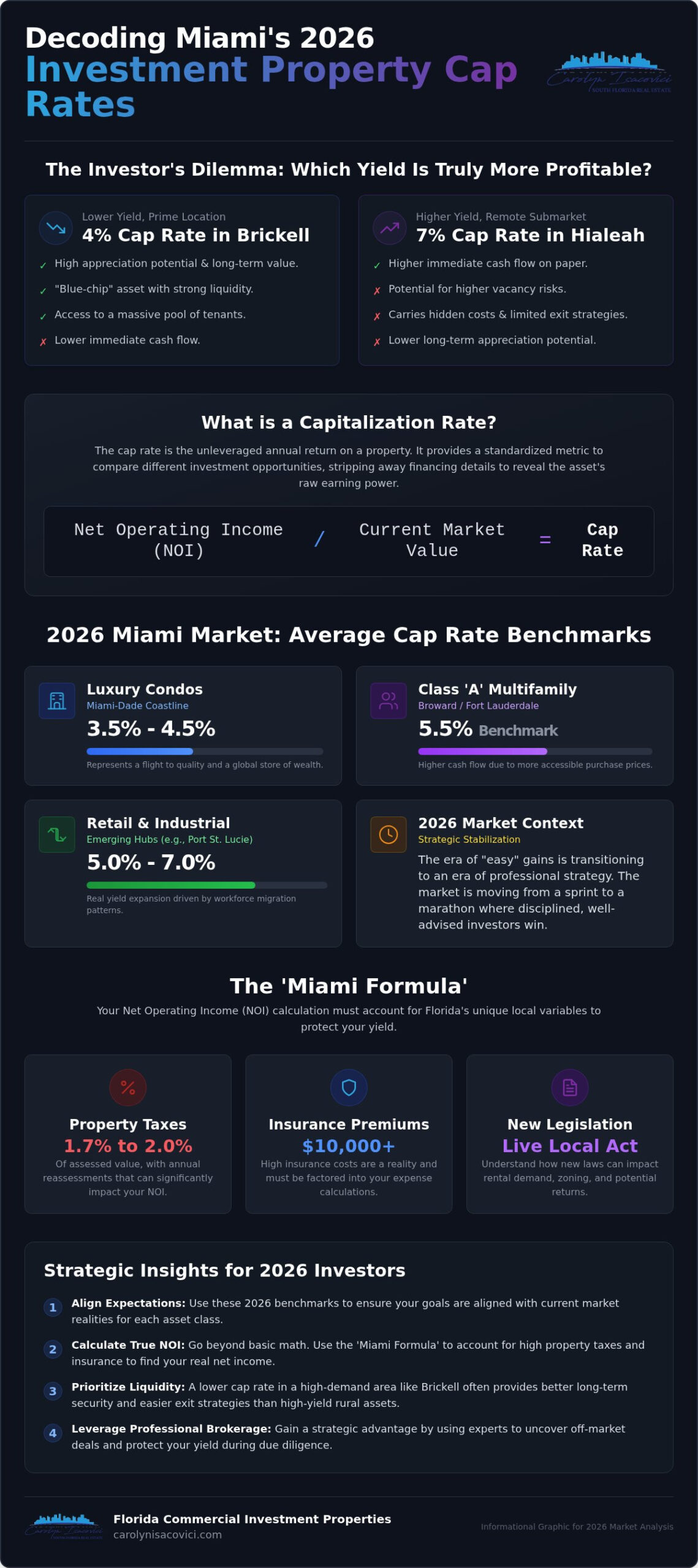
    Is a 4% yield in Brickell actually more profitable than a 7% return in Hialeah? When evaluating a cap rate Miami investment property in 2026, the numbers on the surface rarely tell the whole story. You might feel a sense of hesitation as rent growth stabilizes or worry that the county’s 2% property tax rate will erode your margins. It’s a common concern. Many seasoned investors are currently looking at the same spreadsheets and wondering if the “Miami premium” still makes sense in a shifting market.

    I’m here to tell you that it does, provided you have the right map. This analysis will help you master the nuances of Florida capitalization rates, from the impact of the Live Local Act to the reality of $10,000 insurance premiums. We’ll move beyond basic math to build a reliable formula for Net Operating Income that accounts for every local variable. By the time you finish reading, you’ll have the benchmarks and the clarity needed to identify high-yield opportunities while avoiding the common pitfalls that stall most acquisitions.

    Key Takeaways

    • Establish clear 2026 benchmarks for various asset classes to ensure your expectations align with current market realities.
    • Calculate your true Net Operating Income using a local formula that accounts for Miami’s unique 1.7% to 2% property tax reassessments.
    • Learn why a lower cap rate Miami investment property in a high-demand area often provides better long-term liquidity than high-yield rural assets.
    • Navigate the complexities of the 2026 market with confidence by understanding how new legislation like the Live Local Act impacts your potential returns.
    • Gain a strategic advantage by leveraging professional brokerage to uncover off-market opportunities and protect your yield during the due diligence phase.

    What is Cap Rate and Why Does it Matter for Miami Real Estate?

    Pure math. That is the essence of a capitalization rate. At its core, the Capitalization rate, or cap rate, is the ratio of a property’s Net Operating Income (NOI) to its current market value or purchase price. It provides a snapshot of the unleveraged return an investor can expect in a single year. Why does this matter so much for a cap rate Miami investment property? In a market as dynamic as South Florida, having a standardized metric is the only way to compare a sleek condo in Edgewater to a sprawling warehouse in Doral without getting lost in the noise.

    Miami is unique. Unlike many Midwestern markets where investors chase double-digit yields, Miami often commands lower “entry” cap rates. This isn’t a sign of weakness. Instead, it reflects the high appreciation potential and global demand that define our skyline. Investors are often willing to accept a 4% yield today because they recognize the long-term value of the land and the location. It’s about balancing immediate cash flow with the “liquidity moat” that prime Florida real estate provides.

    Why would a seasoned guide recommend a 4% cap in Brickell over an 8% cap in a more remote submarket? It comes down to risk-adjusted returns. In the heart of Miami’s financial district, you are buying into a high-liquidity environment with a massive pool of potential tenants and a history of steady growth. The 8% yield elsewhere might look better on paper, but it often carries hidden costs, such as higher vacancy risks or limited exit strategies. For a cap rate Miami investment property, the lower percentage often signals a “blue-chip” asset that will hold its value through various market cycles.

    Cap Rate vs. Cash-on-Cash Return

    Does the cap rate tell you everything? Not quite. While the cap rate assumes you’ve paid all cash for valuation purposes, most investors use leverage. This is where cash-on-cash return enters the picture. In 2026, with interest rates finding a new equilibrium, your actual take-home yield depends heavily on your financing structure. Professional brokers rely on the cap rate as the primary “apples-to-apples” metric because it allows us to strip away the specifics of your bank loan and look at the raw earning power of the asset itself.

    The 2026 Miami Market Context

    The frenzy has cooled. After the massive rent surges seen in 2024 and 2025, we are seeing a necessary flattening of the curve. This doesn’t mean the opportunity has vanished. It simply means the era of “easy” gains is transitioning into an era of professional strategy. The 2026 cap rate environment is a period of strategic stabilization for Florida investors. Confidence remains robust because the underlying fundamentals, such as steady migration and a business-friendly climate, haven’t changed. We are moving from a sprint to a marathon, where the disciplined investor wins.

    2026 Benchmarks: Average Cap Rates by Miami Asset Class

    What does a “good” return look like in today’s market? It depends entirely on where you plant your flag. For many investors, a cap rate Miami investment property in the luxury condo sector represents a flight to quality rather than a hunt for high immediate yield. Currently, these assets hover between 3.5% and 4.5%. While those numbers might seem modest, they reflect the immense international demand and long term appreciation potential of the Miami-Dade coastline. These properties serve as a global store of wealth, offering a level of security that higher yielding assets in less stable markets simply cannot match.

    This global perspective often extends to how investors manage their lifestyle; for those who frequent other top-tier destinations, you can learn more about GAAM Ibiza to access luxury villas and bespoke concierge services that mirror the high standards of Miami’s elite properties.

    Are you seeking higher raw yields? You might look north. Broward and Fort Lauderdale frequently outperform Miami proper when it comes to monthly cash flow. In these submarkets, “Class A” multifamily assets have established 5.5% as the new reliable benchmark. This shift occurs because purchase prices in Broward often remain more accessible while rental demand stays white hot. Understanding these regional variances is essential, especially when considering how macroeconomic shifts influence Cap Rates, Explained by institutional leaders like JPMorgan Chase.

    Residential vs. Commercial Yields

    The landscape changes when you move into the commercial sector. For those interested in a multi-family property for sale Miami, the 5.5% target is a healthy goal for stabilized, high quality assets. However, the real yield expansion is happening in retail and industrial hubs. Emerging centers like Port Saint Lucie are seeing cap rates in the 5% to 7% range. These areas benefit from the “Live Local” migration patterns as workforce housing follows new infrastructure. Investors looking to benchmark these returns against the broader state should review the latest data on Florida commercial property investment returns across key asset classes and submarkets. For a broader view of these trends, see The Expert Guide to Florida Commercial Property Sales.

    Neighborhood Spotlights: From Brickell to Jupiter

    Location dictates your liquidity. Brickell remains the undisputed “liquidity moat” for high value real estate Miami, attracting consistent international capital that keeps cap rates compressed but exit strategies fast. If you are a yield seeking investor, growth sectors like Palm Beach Gardens and Stuart are becoming increasingly attractive. These neighborhoods offer a unique blend of suburban stability and rising commercial interest. In contrast, Hollywood, FL, provides a compelling middle ground, often delivering better yields than the ultra luxury markets of Miami Beach while still benefiting from coastal proximity.

    Short term rentals (STR) present another fascinating 2026 dynamic. While gross yields can reach 6% to 9% in unrestricted markets, the high management overhead and 8% to 12% property management fees can quickly erode those gains. Additionally, investors must be wary of “yield compression” for new construction deliveries arriving in late 2026. Many of these units were purchased at 2024 price peaks, and rent growth is only now beginning to catch up. If you are navigating these timing risks, a strategic look at Investment Property Sales can help you identify which assets are truly positioned for growth.

    The ‘Miami Formula’: Calculating Your Real Net Operating Income

    How do you find the truth behind a listed percentage? While the Capitalization rate is a simple fraction, the variables within it require a local lens. Calculating the true yield for a cap rate Miami investment property starts with Gross Potential Income (GPI). In 2026, we’ve moved away from the double-digit rent spikes of the mid-2020s. Today, a realistic GPI assumes a stabilized vacancy rate of around 5% to 7% for multifamily units, reflecting a market that has finally caught up with supply. If your pro forma assumes 100% occupancy year-round, it’s time for a more grounded approach.

    The most common mistake investors make is falling into the “Property Tax Trap.” You might see a seller’s current tax bill and assume those costs will carry over. They won’t. In Florida, the “Save Our Homes” cap and other exemptions often keep a long-term owner’s taxes artificially low. Upon sale, the property is reassessed based on the new purchase price. For your 2026 projections, you should budget between 1.7% and 2% of the purchase price for annual property taxes. This single adjustment can shift a 6% cap rate down to a 4.5% overnight if you aren’t prepared.

    High-rise living brings its own set of mathematical requirements. Beyond basic maintenance, HOA fees in Miami’s luxury towers often cover significant amenities and staff, which cuts deeper into your NOI. You have to look past the surface level. To ensure your cash flow remains resilient, you must integrate Florida’s unique insurance premiums, often ranging from $3,500 to over $10,000 annually for landlord policies, directly into your line-item operating expenses to account for essential wind and flood coverage. Investors seeking to maximize returns despite these rising costs should explore the specific sectors and corridors identified as top performers in our analysis of high yield investment property Florida opportunities for 2026.

    Accounting for the ‘Miami Extras’

    Professional oversight isn’t just a luxury; it’s a safeguard for your yield. In the 2026 market, management fees for high-touch investment properties typically range from 10% to 15% of gross rent. This covers the rigorous tenant screening and compliance required in a post-Live Local Act environment. Additionally, if you are vetting older buildings, you must account for potential special assessments. With the 40/50-year recertification rules now strictly enforced across Miami-Dade, an aging building with “deferred maintenance” is often a liability in disguise.

    The Critical Phase of Acquisition

    Why is due diligence the most critical phase of your Florida acquisition? It’s the moment where you verify if the “Miami Formula” actually holds water. You don’t want to discover a massive assessment or a tax reassessment shock after you’ve already closed. Learn more about the full assessment process in our guide on How to Evaluate Investment Property in Florida. Taking a methodical, educational approach to these numbers transforms a stressful purchase into a confident strategic move.

    Cap Rate for Miami Investment Property: A Strategic 2026 Analysis

    Beyond the Number: When a Lower Cap Rate is a Smarter Buy

    Is a higher number always better? Not necessarily. When you analyze a cap rate Miami investment property, it’s easy to get fixated on the immediate percentage. However, seasoned investors know that the cap rate is merely the starting line, not the finish. In the 2026 landscape, a lower cap rate often signals a “blue-chip” asset with a massive liquidity moat. Think of a 4% cap in Brickell as a high-grade bond. It’s easy to sell, attracts high-quality tenants, and sits on land that historically appreciates at a pace far outstripping rural or secondary markets. In contrast, an 8% cap in a remote area might look lucrative today, but it can quickly become a “marriage” to an asset that is difficult to exit when you need capital.

    Risk mitigation is the silent partner in every successful acquisition. Prime locations protect you during market shifts by maintaining high occupancy when secondary markets falter. Furthermore, new construction homes and condos offer a distinct advantage in late 2026. While their entry yields might be compressed, these assets bypass the heavy maintenance costs and the strict 40/50-year recertification expenses currently hitting older Miami buildings. You’re trading a bit of immediate cash flow for a “cleaner” Net Operating Income and a much higher probability of significant equity growth over the next decade. Investors weighing these trade-offs across property types should consult the comprehensive benchmarks outlined in the 2026 strategic outlook for Florida commercial property investment returns to calibrate expectations by asset class.

    The ‘Class’ Debate: A, B, or C?

    The 2026 market is currently defined by a “Flight to Quality.” Class A assets offer low cap rates but unmatched stability in prime Miami corridors. For those with a higher risk appetite, Value-Add opportunities in Class B or C properties can still achieve 6.5% yields or higher. These require strategic renovation and a deep understanding of local tenant demands. Institutional investors are increasingly leaning toward Class A, prioritizing the preservation of capital and steady, predictable growth over the volatile hunt for double-digit returns in emerging submarkets.

    Short-Term vs. Long-Term Strategy

    Where should you park your capital for the most reliable return? Short-term rental (STR) yields often look impressive on paper, with gross returns reaching 9% in some pockets. However, once you strip away the 10% to 15% management fees and the volatility of a saturated market, the net result can be surprisingly thin. This is why many are pivoting back to long-term multifamily stability. Fort Lauderdale is currently ranked #1 for profitability in this sector, offering a perfect balance between consistent cash flow and long-term equity. If you’re ready to look beyond the spreadsheet and find an asset that fits your long-term goals, explore our current Investment Property Sales.

    How a Miami Investment Broker Secures Your Yield

    How do you bridge the gap between a spreadsheet and a successful closing? While understanding the math behind a cap rate Miami investment property is essential, the most lucrative opportunities often never reach the public market. A seasoned broker acts as your eyes and ears on the ground, uncovering off-market assets that offer superior yields before they are bid up by the general public. This insider access is particularly vital in 2026, where “strategic stabilization” means the best deals require deep local connections and a proactive approach to acquisition.

    Expertise is more than just finding a property; it’s about protecting your Net Operating Income during the most vulnerable phase of the transaction. During due diligence, a professional guide verifies every expense, from the post-sale property tax reassessment to the specific wind mitigation credits on an insurance policy. We ensure that the 5.5% cap rate you were promised doesn’t evaporate due to overlooked special assessments or hidden maintenance liabilities. By managing the end-to-end sales process, we allow you to move from analysis to acquisition with total confidence.

    The Carolyn Isacovici Advantage

    Experience matters when navigating the complexities of the Florida market. With 20 years of market cycle experience, Carolyn Isacovici specializes in both residential and commercial investment property sales across Miami, Broward, and Palm Beach. Whether you are an institutional investor seeking high-value assets or an individual looking for new construction homes as a vehicle for wealth, we provide the steady hand needed to transform uncertainty into opportunity. We understand the specific nuances of neighborhoods like Miami Beach, Hollywood, and Palm Beach, where local regulations can significantly impact your final yield.

    Next Steps for Your 2026 Portfolio

    Are you ready to move beyond the search bar? Transitioning to a professional acquisition strategy starts with a clear understanding of your target submarket. We can provide a custom cap rate analysis tailored to your specific goals, helping you identify which neighborhoods currently offer the best balance of cash flow and appreciation. Don’t leave your returns to chance in a shifting market. Partner with an expert Miami real estate broker for your next investment and secure your place in Florida’s future.

    Turning Market Insight into Miami Acquisition

    Success in the 2026 market requires more than just a passing glance at a spreadsheet. We have navigated the complexities of the “Miami Formula,” emphasizing how property tax reassessments and insurance premiums define your actual Net Operating Income. You now understand that a lower cap rate Miami investment property in a high-demand corridor often provides superior long term security and liquidity compared to high-yield assets in emerging submarkets. It’s about finding the balance between immediate cash flow and the enduring value of Florida real estate.

    Are you ready to transform these insights into a high-performing portfolio? Since 2006, our firm has specialized in identifying end-to-end sales opportunities for commercial and residential assets across Miami, Fort Lauderdale, and Palm Beach. We provide the steady hand and local expertise needed to navigate various market cycles with ease. Secure your high-yield Miami investment with professional brokerage guidance and move forward with the confidence of a seasoned strategist. The opportunities are there for those who know where to look. Let’s find yours together.

    Frequently Asked Questions

    What is considered a ‘good’ cap rate for Miami investment property in 2026?

    A “good” yield depends on your specific goals and the asset class you’re targeting. In prime areas like Brickell, a 4% to 5% return is considered strong for Class A multifamily assets due to high demand and liquidity. If you’re looking for higher cash flow, industrial properties or retail centers in emerging submarkets often reach the 6% to 7.5% range. The key is to find a cap rate Miami investment property that balances immediate yield with the long-term appreciation potential of the neighborhood.

    How do property taxes affect the cap rate of a new purchase in Florida?

    Property taxes are often the largest expense in your calculation. In Florida, properties are reassessed upon sale, which usually results in a tax bill between 1.7% and 2% of the purchase price. If the previous owner had a “Save Our Homes” cap, their taxes might be significantly lower than what you’ll pay. This reassessment can lower your Net Operating Income, meaning the cap rate you see on a listing is often higher than the one you’ll actually realize.

    Are Miami luxury condos still a good investment if the cap rate is under 4%?

    They can be an excellent choice for investors prioritizing wealth preservation and liquidity. While a 3.5% yield might seem modest, these assets sit in global demand hubs that historically outpace other regions in appreciation. You’re trading a bit of monthly cash flow for a “blue-chip” asset that is easy to exit and holds its value during market shifts. It’s a strategic move for those looking for stability over high-risk returns.

    How do short-term rental cap rates compare to long-term rentals in Miami Beach?

    Short-term rentals (STR) often show gross yields as high as 6% to 9%, which looks impressive on paper. However, once you factor in the 10% to 15% management fees and higher maintenance costs, the net return often settles closer to the 4% seen in long-term rentals. Long-term multifamily assets provide a much more predictable income stream with significantly less operational overhead and regulatory risk than the volatile STR market.

    What is the difference between a cap rate and a cash-on-cash return?

    It’s all about how you pay for the property. The capitalization rate assumes an all-cash purchase to measure the raw earning power of the asset itself. Cash-on-cash return factors in your financing, showing the actual return on the specific amount of cash you invested. Professional brokers use the cap rate to compare properties on an “apples-to-apples” basis before the details of a bank loan change the final numbers.

    Can I find 6% or higher cap rates in South Florida right now?

    You certainly can, though it requires looking at specific asset classes or submarkets. Higher yields are typically found in “Value-Add” Class B or C properties where renovation can drive higher rents. You might also explore emerging hubs like Hollywood or Port Saint Lucie, where cap rates for retail and industrial assets often range from 6% to 8%. These areas offer a compelling opportunity for investors who are willing to look beyond the luxury coastal towers.

    How does the 2026 vacancy rate in Miami impact my NOI calculations?

    Accuracy in your projections is vital for long-term success. In 2026, the market has moved toward strategic stabilization, and a realistic vacancy rate of 5% to 7% should be used for your calculations. Baking this into your pro forma ensures your Net Operating Income is grounded in reality rather than an optimistic 100% occupancy model. This discipline leads to a much more reliable cap rate Miami investment property assessment and protects your margins.

    Why should I use a broker for an investment property sale instead of buying direct?

    A broker serves as your strategic partner and a safeguard against common pitfalls. We provide access to off-market opportunities that never reach public sites and manage the intense due diligence required in the Florida market. From verifying insurance premiums to projecting post-sale tax reassessments, our local expertise ensures you aren’t overpaying for a yield that doesn’t exist. We transform a complex transaction into a confident, professional acquisition.

  • How to Evaluate Investment Property in Florida: A Strategic 2026 Guide

    How to Evaluate Investment Property in Florida: A Strategic 2026 Guide

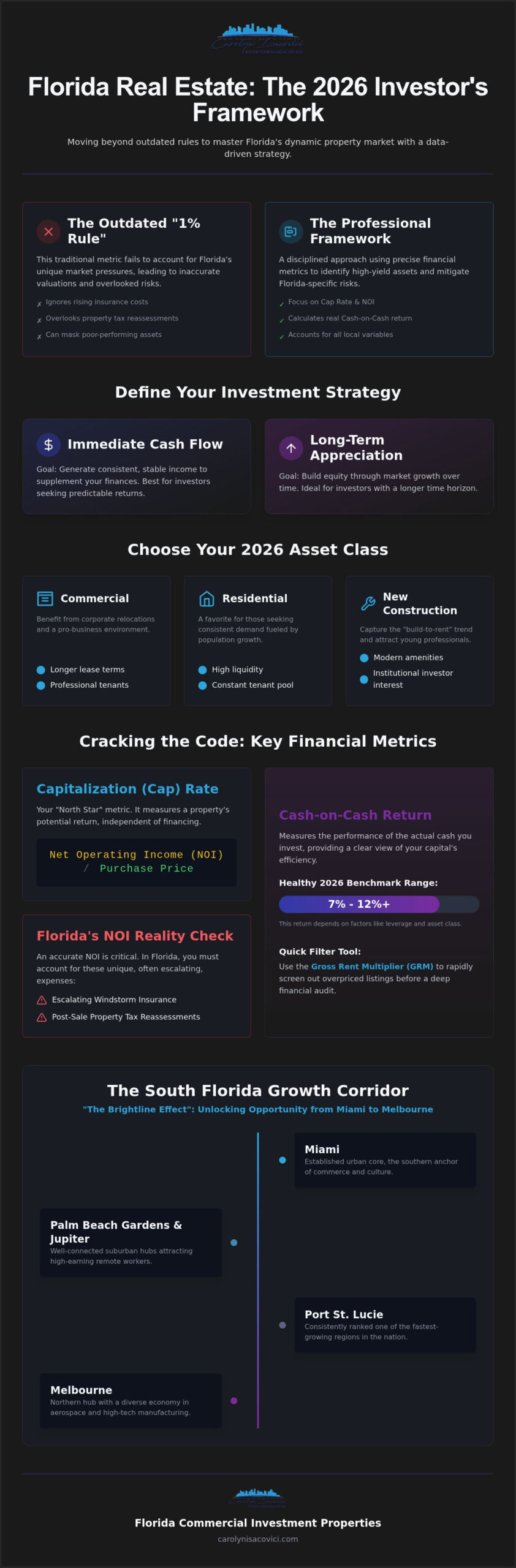
    The traditional 1% rule is no longer the reliable compass it once was for Florida real estate. In 2026, relying on outdated metrics might cause you to overlook some of the most lucrative opportunities currently emerging in the South Florida corridor. You’ve likely felt the pressure of rising insurance costs or the worry that you might be overpaying in such a competitive market. It’s completely normal to feel cautious when county regulations and tax assessments seem to shift so quickly.

    We are here to help you transform that uncertainty into a clear strategic advantage. You’re about to discover how to evaluate investment property Florida using the exact framework seasoned brokers use to identify and secure high-yield assets. This guide moves past the guesswork to provide you with a repeatable evaluation checklist and a deep dive into calculating real ROI with precision. We will explore South Florida’s most promising growth corridors and the specific hidden costs you must account for to ensure your portfolio remains resilient and profitable for years to come.

    Key Takeaways

    • Learn to align your investment goals with Florida’s most lucrative asset classes, including commercial properties and new construction homes.
    • Master the professional framework for how to evaluate investment property Florida by utilizing precise Cap Rate and Net Operating Income (NOI) calculations.
    • Identify the “Brightline Effect” and find emerging opportunities within the high-growth corridor stretching from Miami to Melbourne.
    • Protect your bottom line by uncovering the truth about property tax reassessments and navigating the 2026 insurance landscape with confidence.
    • Discover the strategic advantage of partnering with a specialized broker to uncover off-market opportunities and build a high-performing deal team.

    The Foundation: Defining Your Florida Investment Strategy

    Florida isn’t just a sunshine destination; it’s a powerhouse of economic growth that continues to outpace much of the nation in 2026. Why does the East Coast corridor remain a top-tier choice for capital? The answer is found in the relentless migration of both people and businesses toward the Atlantic coast. For example, the Port St. Lucie area has consistently ranked as one of the fastest-growing regions in the nation, reflecting a broader trend of residents seeking the balance of lifestyle and opportunity found between Miami and Melbourne. Learning how to evaluate investment property Florida starts with recognizing that this growth isn’t accidental. It’s the result of a deliberate, pro-business environment that rewards strategic entry.

    Before you scout specific addresses, you must define your “Exit Strategy” mindset. Are you searching for immediate, stable cash flow to supplement your income, or are you positioned for long-term equity growth through appreciation? Your answer will dictate which market you enter. While many are tempted to simply follow the crowds to the most established urban centers, savvy investors are looking toward emerging hubs where the entry price is lower and the “Path of Progress” is clearly visible. Before committing your capital, it’s wise to ground your approach in the fundamentals of real estate investing to ensure your risk tolerance matches your chosen asset class.

    Commercial vs. Residential: Choosing Your Vehicle

    Selecting the right asset class is your first critical decision. Commercial property sales in Florida currently benefit from the massive corporate relocations seen over the last few years, offering longer lease terms and professional tenants. Conversely, residential real estate sales remain a favorite for those seeking high liquidity and consistent demand. If you are weighing the trade-offs between these two paths, our detailed breakdown of the commercial vs residential investment Florida strategy for 2026 provides a clear framework for understanding how current mortgage rates and shifting insurance premiums impact each asset class. We are also seeing a significant rise in interest for new construction homes Florida, particularly as institutional investors pivot toward “build-to-rent” models to capture the growing population of young professionals who prefer renting in modern, amenity-rich communities; similarly, for those looking to diversify their portfolio with international residential assets, Spaindinavia provides expert insights into property sales and rentals in Spain’s Costa Cálida and Costa Blanca regions.

    The 2026 Market Pulse

    The 2026 market is being reshaped by the permanence of remote work and the continued lack of state income tax, which acts as a powerful magnet for high-earning individuals from the Northeast and West Coast. These factors have shifted demand zones away from just the urban cores and into well-connected suburban hubs like Palm Beach Gardens and Jupiter. Market resilience in Florida is defined by a diverse economic base that spans aerospace, tourism, and high-tech manufacturing, ensuring that demand remains steady even during broader national shifts. This diversity provides a reassuring safety net for your portfolio, transforming market volatility into a series of calculated opportunities; for those looking to diversify globally, Chainex Real Estate offers expert services in the similarly high-growth Dubai market.

    Cracking the Code: Key Financial Metrics for Florida Real Estate

    Numbers don’t lie. While the aesthetic appeal of a waterfront condo or a sleek commercial storefront is undeniable, your long-term success depends on the cold, hard data behind the facade. Knowing how to evaluate investment property Florida means moving beyond the asking price to understand the underlying economic engine of the asset. By stripping away the emotion and focusing on standardized metrics, you can compare a multi-family unit in Orlando to a retail space in Miami with absolute clarity.

    What is the “North Star” for most professional investors? It is the Capitalization Rate, or Cap Rate. This metric provides a snapshot of an asset’s potential return, independent of financing. However, the Cap Rate is only as accurate as your Net Operating Income (NOI) calculation. In Florida, your NOI must account for unique variables like escalating windstorm insurance and the nuances of official Florida property tax exemptions, which can significantly alter your bottom line if you aren’t prepared for the post-sale reassessment.

    Beyond the Cap Rate, you should look at your Cash-on-Cash return. This measures the performance of the actual liquid capital you’ve put into the deal. In 2026, a healthy benchmark for Florida properties typically ranges between 7% and 12% or more, depending on your leverage. To optimize your financing strategy with products that don’t require tax returns, you can discover Simplified Commercial Lending. For those screening multiple Miami investment property options quickly, the Gross Rent Multiplier (GRM) serves as a helpful “back of the envelope” tool to filter out overpriced listings before you commit to a deeper financial audit.

    Calculating the Real Cap Rate

    The formula is straightforward: divide your annual NOI by the purchase price. But are you including every expense? A common mistake is overlooking property management fees, which typically range from 8% to 12% in Florida—you can learn more about Morgan Property Solutions Inc. to see how professional oversight fits into your budget—or failing to set aside a realistic vacancy reserve. In 2026, a Cap Rate between 5% and 8% is generally considered a solid target for long-term rentals. You might find tighter yields in high-demand South Florida markets, while the Treasure Coast often offers slightly higher Cap Rates in exchange for different growth profiles. If a deal looks too good to be true, it’s often because the “hidden” costs haven’t been fully baked into the math. For a deeper understanding of how neighborhood-level variables like the Live Local Act and $10,000 insurance premiums affect your returns, our strategic 2026 analysis of cap rate Miami investment property breaks down exactly why a 4% yield in Brickell can outperform a 7% return in Hialeah.

    Cash Flow vs. Appreciation

    Is a high immediate yield always the best choice? Not necessarily. Some high-demand pockets in Miami might offer lower Cap Rates today but boast exceptional 10-year equity forecasts due to restricted supply and high desirability. You have to weigh the comfort of monthly cash flow against the wealth-building power of appreciation. For a deeper look at how these dynamics play out in different sectors, you can explore our Expert Guide to Florida Commercial Property Sales. Balancing these two forces is where true portfolio wisdom resides. If you find yourself unsure which metric to prioritize for your specific goals, consulting a seasoned Florida real estate professional can provide the clarity you need.

    Beyond the Numbers: Evaluating the ‘South Florida Corridor’ Opportunity

    Does a single city represent the entire market? Certainly not. When you consider how to evaluate investment property Florida, you must look at the state as a collection of micro-economies. The corridor stretching from Miami up to Melbourne is currently experiencing a transformation driven by massive infrastructure investments. By looking beyond the obvious tourist traps, you find pockets of immense potential that the casual observer might miss. Understanding how to evaluate investment property Florida requires a shift from statewide statistics to the specific dynamics of the South Florida corridor. Have you noticed how property values seem to climb along the path of the Brightline? This isn’t a coincidence. The ‘Brightline Effect’ is actively reshaping the region by connecting major hubs like Miami and Fort Lauderdale to emerging markets further north, such as Stuart and Vero Beach. By following these transportation arteries, you can identify ‘Path of Progress’ areas before they reach peak pricing. Investors who want to understand which specific sectors and geographic corridors are delivering the strongest returns right now can explore our detailed breakdown of high yield investment property Florida opportunities for 2026, including a close look at the resilient West Palm Beach office market and the critical yield differences between commercial and residential assets.

    For investors looking to explore high-potential markets further south, Krissy in the Keys (Krissy Carnahan, Realtor) offers specialized local expertise in coastal and island properties that are often overlooked by mainland-focused investors.

    A strategic analysis of Florida’s markets reveals that hyper-local data is your most potent tool. While a county-wide average might suggest a cooling trend, a specific neighborhood near a new tech hub or a renovated port could be seeing double-digit growth. Balancing your portfolio between established commercial hubs and quiet residential enclaves allows you to capture both immediate stability and long-term upside. This dual-lens approach ensures you aren’t just buying a building, but rather a stake in a growing community’s future.

    Regional Deep-Dive: Miami to Vero Beach

    Miami and Fort Lauderdale remain the crown jewels for high-value commercial property sales and luxury residential assets. Investors seeking this level of prestige might also consider the European market, where King Estates represents premier luxury listings across Spain’s Costa del Sol. These Florida markets offer high competition but unmatched prestige and liquidity. Moving north, the Palm Beaches provide a perfect middle ground, with a heavy focus on new construction homes Florida investors are targeting and expanding residential sectors. For those seeking emerging value, the Treasure Coast, specifically Stuart and Fort Pierce, offers a longer-term hold opportunity where the initial capital requirement is often more accessible. Each region requires a unique lens, but the underlying growth story remains consistent.

    The Infrastructure Factor

    Proximity to logistics hubs is a non-negotiable factor in your evaluation. Properties near I-95, the Florida Turnpike, and major international airports or ports enjoy a built-in demand from both commercial tenants and residential commuters. We are seeing a significant shift in how new construction homes are designed, with many being integrated into master-planned ‘live-work-play’ developments. In these environments, the ’15-minute city’ trend is taking hold, creating self-contained communities where residents can access all their daily needs within a short walk or bike ride from their front door. This level of convenience is a major driver of tenant retention and property value resilience.

    How to Evaluate Investment Property in Florida: A Strategic 2026 Guide

    The Florida Reality Check: Insurance, Taxes, and Due Diligence

    Securing a property in a high-growth corridor is an exciting milestone, but the true test of an investor’s wisdom lies in the due diligence phase. Beyond the surface-level appeal and the initial financial projections, you must account for the unique operational realities of the Sunshine State. Understanding how to evaluate investment property Florida involves a deep dive into “hidden” carrying costs that can fluctuate based on local legislation and environmental factors. While these variables might seem daunting at first, they are simply part of the landscape that a prepared investor navigates with ease.

    One of the most significant hurdles for newcomers is the property tax reset. Many investors make the mistake of looking at the current owner’s tax bill and assuming their costs will be similar. In Florida, property is reassessed at the full market value upon sale. While the “Save Our Homes” cap protects primary residents, as an investor, you’ll be looking at a non-homestead assessment cap. Currently, this limits annual increases in the assessed value to 10%. This cap provides a level of predictability for your long-term carrying costs, but your starting point will likely be higher than the previous owner’s, especially if they held the asset for many years.

    Insurance is another critical component of your reality check. In 2026, the market is showing signs of stabilization, but premiums in South Florida counties like Miami-Dade and Palm Beach still typically range between $3,500 and $8,000 or more per year. Navigating this requires more than just a quote; it requires a strategy. Savvy investors often look into the surplus lines market or utilize 1031 Exchanges to transition into newer, more resilient assets that command lower premiums. The recent 8 to 25 percent drop in commercial insurance premiums has also made a commercial vs residential investment Florida comparison increasingly favorable for those willing to explore non-traditional asset classes. If you want to ensure your next acquisition is a sound financial move, it is vital to partner with a specialized Florida investment broker who can guide you through these local complexities.

    The ‘New Owner’ Tax Adjustment

    Florida’s ad valorem tax system means your tax burden is tied directly to the just value of the property. To avoid surprises, you should use county property appraiser tools to estimate your 2026 tax burden based on your expected purchase price rather than historical data. Remember that while your taxes will reset, the 10% non-homestead cap will protect you from extreme spikes in the years following your purchase, allowing for more accurate cash flow forecasting.

    Navigating the Insurance Landscape

    Your insurance strategy should begin before you even make an offer. A 4-point inspection and a wind mitigation report are non-negotiable tools for lowering your costs. In coastal cities like Hollywood or Jupiter, an elevation certificate can be the difference between a profitable deal and a high-overhead burden. By focusing on property hardening, such as installing impact-resistant windows or working with Renegade Roofing Co. to update roof-to-wall connections, you can often secure significant credits on your windstorm coverage, directly improving your net operating income.

    HOA and COA Due Diligence

    If your target asset is part of a homeowners or condo association, your due diligence must extend to the association’s financial health. Request a copy of the most recent “reserve study” to ensure the building has adequate funds for major repairs. In 2026, Florida’s stricter structural integrity reserve requirements mean that underfunded associations may be facing large special assessments. Identifying these potential costs early is a fundamental part of how to evaluate investment property Florida effectively.

    Execution: How to Secure High-Value Florida Holdings

    Evaluation is the map, but execution is the journey. You now understand how to evaluate investment property Florida by analyzing cap rates, navigating tax resets, and identifying growth corridors. However, even the most perfect financial model won’t secure a property in a market as competitive as the South Florida corridor. Success in 2026 requires more than just spreadsheets; it demands a tactical approach to the acquisition process. How do you move from an interested observer to a deed-holding owner? You do it by surrounding yourself with a specialized “Deal Team” that transforms complex variables into a streamlined path to closing. To see how specialized lending and investment partners operate in other high-growth markets, you can learn more about KC Home Offers LLC.

    Your Deal Team is your greatest asset. This group typically includes a specialized broker, a meticulous inspector, a real estate attorney, and a tax professional. For investors targeting the Space Coast, Morgan Financial serves as a valuable local mortgage resource to help navigate appraisal requirements and financing hurdles. In Florida, the contract process often begins with a Letter of Intent (LOI), especially in commercial property sales. This document outlines your terms without the immediate legal weight of a full purchase agreement, allowing for a smoother negotiation phase. Why walk this complex path alone when expert guidance is a phone call away? Having a partner who understands the nuances of Florida’s “as-is” contracts and due diligence periods ensures that your interests are protected at every turn.

    The Value of Local Brokerage

    The best opportunities in Miami, Fort Lauderdale, or Melbourne often never reach the public portals. Carolyn Isacovici and her team provide that essential “calm expert” hand, offering you access to off-market deals and deep-rooted local relationships. This is particularly vital when looking for commercial real estate South Florida markets where timing and reputation are everything. For those managing a diverse portfolio, utilizing a streamlined service like Congress Realty for sales in other regions can free up the time and capital needed to focus on these high-stakes Florida acquisitions. A local broker doesn’t just find a property; they provide the hyper-local context that tells you why one side of a street in Miami Beach might be a better long-term hold than the other. This insight is the final piece of the puzzle in how to evaluate investment property Florida effectively.

    Investors who appreciate the importance of hyper-local specialization and are looking to diversify their holdings internationally can discover 富盛地產|有巢氏太平中山富盛店 for expert insights into the thriving real estate markets of Taichung, Taiwan.

    For investors looking to apply these principles of hyper-local expertise to the Australian market, you can learn more about Anna O’Neill Buyer’s Agent for boutique property acquisition services in Brisbane.

    Your 2026 Action Plan

    Ready to move forward? Follow this methodical progression to ensure your entry into the Florida market is both confident and secure:

    • Step 1: Secure Your Foundation. Ensure your financing is ready. In 2026, DSCR loans remain a popular choice for investors, qualifying you based on the property’s income rather than personal debt-to-income ratios; for those seeking a mortgage brokerage with a reputation for professional service, integrityestatesrealty.com provides the type of expertise required to navigate these specialized financial products.
    • Step 2: Align with a Specialist. Partner with a broker who has a proven track record in your specific asset class, whether that is residential real estate sales or new construction homes; for example, those exploring the Southwest market can discover Galloway Realty for boutique agency and custom building expertise.
    • Step 3: Iterate and Offer. Begin the process of evaluation. Don’t be afraid to walk away from deals that don’t meet your criteria, and be prepared to move decisively when you find an asset that does.

    The Florida market is full of potential for those who approach it with clarity and professional support. Ready to begin? Contact Florida Commercial Investment Properties today for a strategic consultation and take the first step toward securing your high-yield Florida holding.

    Your Future in the Florida Market

    The blueprint for your success is now clear. You’ve moved from basic curiosity to a sophisticated understanding of how to evaluate investment property Florida by mastering the math of cap rates and identifying the geographical shifts of the South Florida corridor. Success in 2026 isn’t about chasing every listing. It’s about recognizing that every tax reset and insurance quote is an opportunity to out-calculate the competition. By focusing on high-value assets and building a resilient “Deal Team,” you transform the complexities of the market into a reliable path for wealth creation; if you are looking to apply these principles to the Gulf Coast, you can visit DeFeo Luxury Properties for expert assistance in the Tampa and Sarasota regions.

    Why navigate these shifting tides alone? With over 20 years of Florida market expertise and a specialized focus on high-value commercial and residential assets, Carolyn Isacovici provides the steady hand you need. Our team serves the entire South Florida and Treasure Coast corridor, ensuring your portfolio is built on a foundation of professional wisdom and strategic timing. Secure Your High-Yield Florida Investment Strategy with Carolyn Isacovici. The opportunity you’ve been waiting for is ready. Let’s find it together.

    Frequently Asked Questions

    What is a good Cap Rate for an investment property in Florida in 2026?

    A solid cap rate in 2026 generally falls between 5% and 8% for long-term residential rentals. You might find tighter yields in high-demand pockets of Miami Beach, while emerging markets in Port Saint Lucie or Vero Beach often offer higher initial returns. It is essential to balance this metric against long-term appreciation potential when you are learning how to evaluate investment property Florida. To understand precisely how neighborhood-level factors shift these numbers across Miami’s submarkets, our in-depth cap rate Miami investment property analysis for 2026 provides the granular data you need to make a confident decision.

    How do property taxes work for out-of-state investors in Florida?

    Florida uses an ad valorem tax system where properties are reassessed at full market value upon a change of ownership. Out-of-state investors pay the same rates as locals, but they don’t qualify for the homestead exemption. You should always estimate your future tax burden based on your purchase price rather than relying on the previous owner’s historical bill, as the “reset” can be significant.

    Is it better to invest in commercial or residential property in South Florida?

    The choice depends on your specific goals for cash flow and management intensity. Commercial property sales often provide longer lease terms and professional tenants, while residential real estate sales offer higher liquidity and a broader tenant pool. Both sectors are currently benefiting from the massive population growth seen across the corridor from Miami to Melbourne; for a data-driven breakdown of how these two asset classes compare under 2026 market conditions, our commercial vs residential investment Florida strategic comparison outlines exactly which path aligns with your financial goals. For those who also invest in the Midwest, you can learn more about Lisa Hansen Realtor for expert residential representation in the Greater Twin Cities area.

    What are the hidden costs of owning a rental property in Florida?

    Beyond the mortgage, you must account for insurance premiums, property management fees, and potential Community Development District (CDD) fees. Annual insurance costs in South Florida often range between $3,500 and $8,000 or more depending on the property’s age and location. To manage these costs, consulting with an independent agency like All Insurance LLC can help you find a strategy that protects your assets without unnecessary fees. Additionally, professional management typically requires 8% to 12% of collected rent, which can impact your net operating income if not factored in early.

    How does the ‘Save Our Homes’ act affect real estate investors?

    The ‘Save Our Homes’ assessment cap only applies to primary residences with a homestead exemption. As an investor, you won’t benefit from this specific 3% limit. Instead, your property is protected by a 10% annual assessment cap for non-homesteaded properties. This cap helps keep your long-term tax increases predictable even in a rapidly appreciating market, though it doesn’t prevent the initial post-sale reset.

    Why is flood insurance so important for Florida investment properties?

    Flood insurance is vital because standard homeowners’ policies do not cover water damage from rising tides or storm surges. Since FEMA periodically updates its flood maps, a property’s risk status can change over time. Securing adequate coverage protects your capital and is often a mandatory requirement for specialized financing like DSCR loans in coastal zones like Jupiter or Hollywood.

    What should I look for in a Florida real estate broker for investors?

    Look for a partner who offers hyper-local market data and has a deep understanding of how to evaluate investment property Florida across different asset classes. A great broker provides more than just listings; they connect you with a full “Deal Team” of inspectors, attorneys, and tax professionals. You want a seasoned guide who has navigated various market cycles and remains focused on securing high-yield assets. If you are also considering the Canadian market, Pinnacle Realty provides similar comprehensive residential and commercial services throughout the Greater Toronto Area.

    Can I use a 1031 exchange for a Florida investment property?

    Yes, you can use a 1031 exchange to defer capital gains taxes when selling one investment property to purchase another “like-kind” asset in Florida. This is a powerful strategic tool for scaling your portfolio or transitioning from residential units into larger commercial holdings; if you need to liquidate an older property to facilitate such an exchange, visit LPS Real Estate Group to learn about their direct acquisition services. It allows you to keep more of your equity working for you in the high-growth Florida market rather than losing it to immediate taxation.