
An LLC can separate a Florida investment property’s legal ownership from your personal ownership, but it does not remove every risk or replace insurance. Buying investment property through an LLC in Florida may help organize liability and rental finances, while financing can be more restrictive than borrowing as an individual. The right choice depends on how you plan to use, finance, and hold the property.
Before choosing how to take title, weigh potential liability separation against added paperwork and lending tradeoffs. This article explains when an LLC may suit a rental investment, which financing and ownership issues matter, and why a primary residence raises a separate homestead question.
You’ll also learn how LLC ownership works for rental property and what practical tradeoffs to consider before buying. With these factors in view, you can better judge which ownership structure fits your investment plans.
Key Takeaways
- Weigh an LLC’s potential liability separation against the added filing and ongoing administration before choosing how to hold a rental property.
- Compare financing options with ownership structure in mind: lender requirements, down payments, and personal guarantees can affect the tradeoff.
- Keep Florida homestead considerations separate from rental-property decisions, especially when the property is your primary residence.
- Understand how an LLC’s ownership records, operating agreement, and tax treatment can shape rental management and co-owner responsibilities.
Should I Form an LLC for My Investment Property?
An LLC may suit a Florida rental investment when separating property ownership and expenses supports your goals. For example, the LLC, rather than you personally, can hold title to the rental.
Liability Protection for Rental Properties
LLC liability protection generally separates company obligations from an owner’s personal assets. If a tenant or visitor brings a claim related to the rental, the LLC structure may help keep the dispute focused on company assets. This distinction matters when weighing the approach against your risk strategy and investment plans.
Protection has limits. An LLC does not replace property or liability insurance, and it does not remove personal responsibility for your own conduct. A personal guarantee or a claim based on an owner’s actions can also involve that owner directly. Treat the entity as one part of your plan, not a substitute for insurance or careful property management.
Property-Risk Separation and LLC Limits
Separate LLCs can organize income, expenses, and property-related liability by asset. For example, an owner with two rentals could keep each property’s records and obligations distinct through separate entities. This can make financial tracking clearer, but requires managing separate company records and filings. The added administration is worthwhile only when the organizational benefits fit your needs.
Personal ownership can expose an owner’s assets to lawsuits or debts connected with a property. An LLC can create a boundary between rental and personal finances, but mixing funds or treating company obligations as personal can weaken that separation. Keep rental transactions distinct and maintain appropriate property insurance.
Consider a primary residence separately. Florida homestead protection concerns a home used as a primary residence, while an LLC is commonly considered for investment property. Estate and income-tax figures address different questions. For an estate of any decedent dying in calendar year 2025, the basic exclusion amount is $13,990,000 for determining the amount of the unified credit against estate tax under § 2010, according to the Internal Revenue Service.
The Internal Revenue Service lists $3,777.00 plus 37% for the $15,650 taxable-income entry. This tax entry doesn’t establish that an LLC is right for a rental owner. Compare the property’s risks, insurance, expenses, and ownership plans before choosing a structure.
How does financing work when buying a property under an LLC?
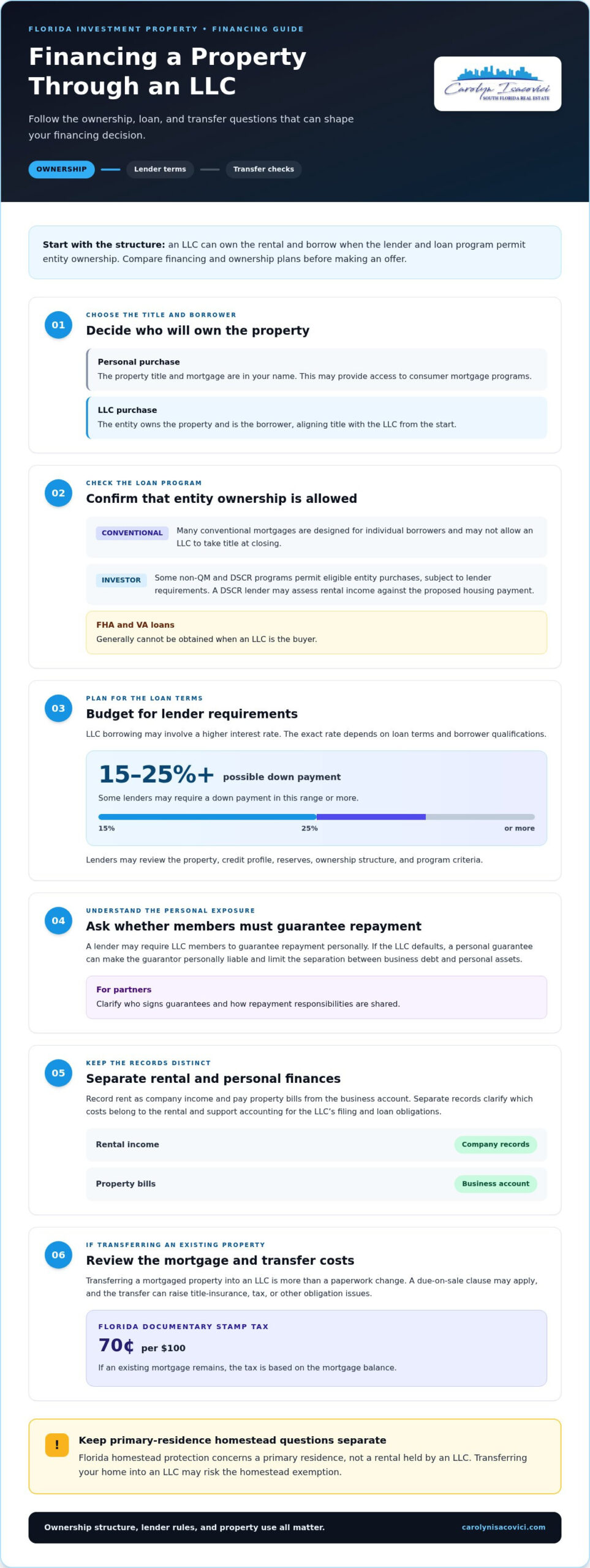
A Florida LLC can get an investment-property mortgage when the lender and loan program permit entity ownership; down payments may be 15-25% or more, while rates depend on loan terms. Transferring a mortgaged property into an LLC may trigger a due-on-sale clause and affect title insurance, taxes, or other obligations.
Buying Personally or Through an LLC
Buying personally puts the property title and mortgage in your name; buying through an LLC makes the entity the owner and borrower. That distinction matters because many conventional mortgages are designed for individual borrowers and may not allow an LLC to take title at closing. Some investor-focused non-QM and DSCR programs permit eligible entity purchases, subject to lender requirements, which is why consulting an investor-focused brokerage such as LoansByJB (The Nuhome Team) can be valuable when navigating complex loan scenarios.
Compare your financing path with your ownership strategy before making an offer. A personal purchase may provide access to consumer mortgage programs, while an LLC can align title with the entity from the start. FHA and VA loans generally cannot be obtained when an LLC is the buyer. A DSCR lender may assess rental income against the proposed housing payment.
Lender Requirements and Personal Guarantees
With LLC financing, the lender evaluates the entity and may also require members to guarantee repayment personally. That guarantee can make you personally liable if the LLC defaults, limiting the separation between business debt and personal assets. Lenders may review the property, credit profile, reserves, ownership structure, and program criteria.
Plan for lender requirements before choosing an entity purchase. Some lenders may require a down payment of 15-25% or more, and LLC borrowing may involve a higher interest rate. The exact rate follows the lender’s loan terms and borrower qualifications. Partners should understand who signs guarantees and how repayment responsibilities are shared.
Separating Business and Personal Finances
Keep the LLC’s property income and expenses separate from personal transactions. For example, record rent as company income and pay property bills from the business account. Separate records clarify which costs belong to the rental and support accounting for the LLC’s filing and loan obligations.
When a personally owned property has a mortgage, transferring title isn’t just a paperwork change. A due-on-sale clause may apply, and the transfer can raise title-insurance or tax issues. In Florida, documentary stamp tax on a real estate transfer is 70 cents per $100; if an existing mortgage remains, the tax is based on the mortgage balance. Review those consequences as part of the transfer strategy.
Florida homestead protection and LLC ownership
Florida homestead protection applies to a primary residence, not a rental held by an LLC; transferring your home into an LLC may risk the homestead exemption. A rental transfer may also trigger property-tax reassessment, while documentary stamp tax is 70 cents per $100 and, with an existing mortgage, is based on its balance.
Ownership Structure for Multiple Investors
A multi-member LLC lets investors own real estate together through one company, with ownership and responsibilities set out in an operating agreement. The agreement can define each partner’s share, duties, and profit distributions, helping prevent disagreements as the portfolio develops. Align its terms with each investor’s contributions and decision-making role.
Forming and maintaining a Florida LLC involves a state filing fee, an annual report fee, and a registered agent. The required fees depend on the applicable filing, while the operating agreement records how the owners will manage the investment. A lender must also permit entity ownership; some programs may require a down payment of 15-25% or more.
Benefits and Drawbacks of LLC Ownership
An LLC can separate investment ownership from owners’ personal names and organize responsibilities across a portfolio. The tradeoff is continuing administration, including annual reports and company records. For all-cash residential purchases through entities or trusts, a beneficial-owner disclosure rule is stated to begin December 1, 2025. This requirement is a separate consideration from homestead protection.
For rental property, weigh the LLC’s ownership and organizational advantages against filing obligations and lender conditions. Florida provides unlimited homestead protection for primary residences, subject to acreage limits; this protection is distinct from an LLC’s role in holding investment real estate. Keep the intended use clear: a rental investment and the home where an owner lives involve different ownership considerations.
Florida LLCs for rental and investment property
A Florida LLC can hold title to a rental, receive rental income, and organize property finances under one entity. Its value depends on how ownership, taxes, insurance, and property use fit the investment.
Florida has no state income tax, while an LLC’s tax treatment depends on its membership and elections. LLCs are typically pass-through entities, so income passes to their owners; federal tax obligations still depend on the applicable tax treatment. Record rental income and property expenses separately to keep the finances organized.
Landlord, short-term rental, and zoning rules affect how a property can be used and operated. Requirements can vary by locality and property, so a home suited to one rental approach may not suit another. For example, investors planning short stays should account for local rules and permitted use when assessing projected rental income.
Insurance remains part of the ownership plan. When an LLC owns a rental, update the policy so the LLC is listed as the insured or an additional insured. Property and liability coverage address risks that ownership structure alone does not cover. Match the insurance arrangements to the property’s actual rental use.
To establish the rental entity, form the LLC, file Articles of Organization, and obtain an Employer Identification Number from the IRS. Set up an operating agreement, registered agent, and business bank account, then keep up with state filings. Use the LLC’s exact legal name in the purchase agreement, loan documents, title work, and insurance. An authorized member or manager signs for the LLC at closing.
Ready to assess a property for rental ownership? Explore Florida investment property opportunities with the ownership and intended rental use in mind.
Florida Commercial Investment Properties: Commercial Property Sales
Florida Commercial Investment Properties helps buyers evaluate opportunities through Commercial Property Sales and Investment Property Sales. Turn to the firm when comparing properties and seeking real estate guidance that reflects your ownership and rental strategy. Residential Real Estate Sales may suit a residential rental search, while New Construction Homes are another option when a newly built property fits your plans.
Before pursuing a property, consider how its use, ownership structure, financing requirements, and expected rental income fit together. These choices can shape whether a particular opportunity supports your investment goals. Florida Commercial Investment Properties helps buyers navigate Florida real estate transactions and assess property acquisitions. For commercial property opportunities, visit carolynisacovici.com or contact Florida Commercial Investment Properties.
Turn Your Investment Plan Into a Clear Next Step
Start by defining what success means for this property and the portfolio around it. Consider whether you prioritize rental income, long-term appreciation, or a structure that can support future acquisitions. Then assess each opportunity against that goal, including how its intended use and ownership approach fit together. A clear investment brief keeps the purchase decision focused, rather than making the LLC the decision itself.
Buying investment property through an LLC in Florida is one ownership strategy, not a substitute for choosing the right asset. Florida Commercial Investment Properties can help you assess real estate opportunities and move toward a purchase aligned with your investment goals.
When you’re ready to explore the next opportunity, contact Florida Commercial Investment Properties. A thoughtful plan can make your next property decision feel focused and achievable.
Frequently Asked Questions
Should I Put My Rental Property in an LLC in Florida?
An LLC can make sense when you want a rental property held separately from your personal assets. For example, an investor with rentals in Miami and Palm Beach may use separate entities to organize each property’s income and expenses. Weigh the administrative work against the potential separation, and maintain appropriate insurance. An LLC does not make a primary residence exempt from Florida homestead considerations.
Who should consider buying a house under an LLC?
Investors buying a rental, investing with partners, or building a portfolio may consider purchasing through an LLC. The structure can clarify ownership and responsibilities, especially when several people contribute funds. Buyers purchasing a home to live in should weigh Florida homestead protection before using an LLC. Intended use and financing options are central to the decision.
Can an LLC get a residential mortgage?
An LLC can obtain financing for an investment property if the lender and loan program allow entity ownership. Many conventional mortgages are designed for individual borrowers, and standard consumer programs, including FHA or VA loans, generally are not available when an LLC is the buyer. Investor-focused DSCR or non-QM programs may permit eligible properties. For a Miami rental, projected property income and program criteria matter.
First, what’s an LLC?
An LLC, or limited liability company, is a business entity that can own property separately from its members. For example, an LLC can appear as the owner on title for a Florida rental, while an authorized member or manager signs company documents. The operating agreement can describe owners’ responsibilities and profit distributions. Tax treatment depends on membership and elections.
How does an LLC get approved for a mortgage?
A lender evaluates the property, the LLC’s ownership structure, credit profile, reserves, and the loan program’s rules. For a DSCR loan, rental income divided by the proposed mortgage payment may need to exceed 1.00 to meet the stated threshold. The lender may also require members to guarantee the loan personally. Consistent entity names across the application and purchase documents help align the transaction.
Should You Hold Real Estate in an LLC, S-Corp, or Trust in Florida?
An LLC is commonly considered for rental property, while an S-Corp may be a poor fit for long-term appreciating real estate because it can forfeit a basis step-up. Trusts serve different estate-planning purposes: a revocable trust can help Florida property pass to heirs without probate. These structures have distinct tax and ownership effects, so compare them against the property, partners, and succession goals.