Tag: investment property

  • Cash Flow Investment Property Florida: 2026 Strategic Examples and Yield Analysis

    Cash Flow Investment Property Florida: 2026 Strategic Examples and Yield Analysis

    The traditional Florida real estate playbook, once centered solely on the glittering skyline of Miami, has officially been rewritten for 2026. You’ve likely noticed that finding a cash flow investment property Florida is becoming a more complex puzzle as insurance premiums and entry prices in the major metros continue to climb. It’s natural to feel a bit of hesitation when the old rules no longer seem to apply. Is it still possible to find a double-digit yield in a market that feels this crowded? The answer is a definitive yes, provided you know where to look.

    We’ve seen these cycles before, and we know that uncertainty is often just another word for opportunity. This article will show you exactly how to pivot your strategy toward the yield migration currently moving into high-growth corridors like the Treasure Coast. You’ll gain a clear framework for calculating true net cash flow in today’s environment, along with specific geographic examples that offer the best balance of risk and reward. Let’s explore how to approach the 2026 market with the confidence of a seasoned strategist and a professional partner by your side.

    Key Takeaways

    • Learn why the 2026 market shift actually creates new opportunities for investors who look beyond the saturated coastal cores.
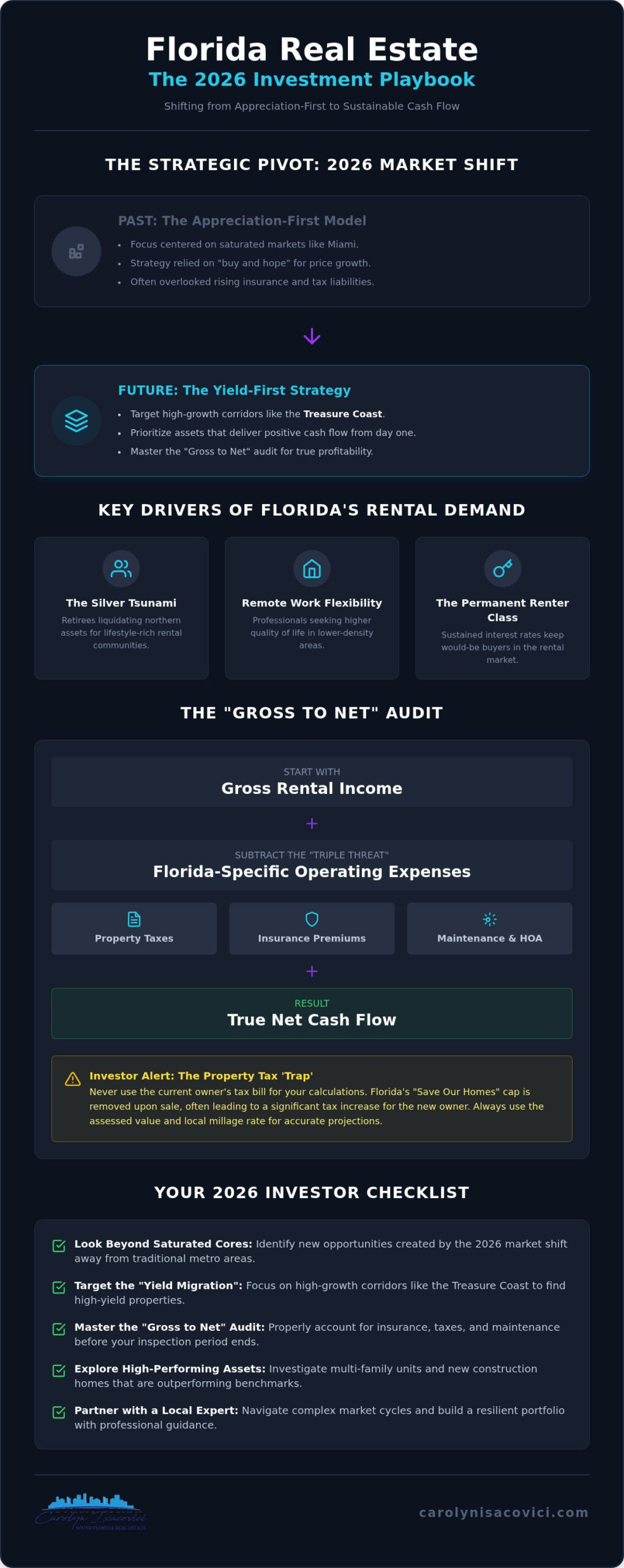
    • Discover how to identify a high-yield cash flow investment property Florida by targeting the “yield migration” toward high-growth corridors like the Treasure Coast.
    • Master the “Gross to Net” audit to properly account for insurance, taxes, and maintenance before your inspection period ends.
    • Explore specific examples of multi-family assets and new construction homes that are currently outperforming traditional benchmarks.
    • Understand how a local expert partner helps you navigate complex market cycles to build a resilient and profitable real estate portfolio.

    Is Cash Flow Still Possible in Florida? The 2026 Reality Check

    If you spend any time on investment forums, you’ve likely heard the chorus of skeptics claiming that the sun has set on the Sunshine State. They point to rising insurance premiums and high entry prices as evidence that a cash flow investment property Florida is a relic of the past. However, we’ve seen these cycles before; while the market has certainly matured, the narrative of “impossible cash flow” often overlooks the strategic shifts happening on the ground. Yield hasn’t disappeared. It has simply migrated.

    Success in 2026 requires a disciplined definition of profitability. In this modern context, cash flow is the net income remaining after all operational expenses, mortgage obligations, and the critical 2026 “Florida Insurance Premium” adjustment have been fully satisfied. While the noise on social media focuses on the hurdles, seasoned investors are focusing on the underlying math. High costs don’t kill yield if rental demand scales proportionally, and in Florida, that demand remains remarkably resilient.

    The Shift from Appreciation to Yield

    The era of “buy and hope” appreciation has evolved into a sophisticated, yield-first approach. Investors are no longer banking on double-digit price growth to justify an acquisition. Instead, they’re looking for assets that perform on day one. This shift is supported by Florida’s favorable tax climate; the absence of state income tax allows more of your gross rental income to flow directly to your bottom line, a factor that often offsets higher insurance costs when compared to high-tax states. It’s vital to distinguish between “Paper Cash Flow,” which looks good in a brochure, and “Real-World Yield,” which accounts for the actualities of 2026 property management and localized tax assessments.

    Migration Patterns and Rental Demand

    Where are the 2026 inbound residents actually landing? While Miami-Dade continues to attract global capital and corporate headquarters, we’re seeing a significant “yield migration” toward the Treasure Coast. This area offers a more accessible entry point for a cash flow investment property Florida while benefiting from the same massive population tailwinds. Several factors are driving this sustained demand:

    • The Silver Tsunami: Retirees continue to liquidate high-value northern assets to find lifestyle-rich rental communities in Florida.
    • Remote Work Flexibility: Professionals are choosing the lower density and higher quality of life found in areas like Port Saint Lucie and Vero Beach.
    • The Permanent Renter Class: Sustained interest rates have kept many would-be buyers in the rental market, creating a deep pool of qualified tenants in South Florida.

    By positioning your portfolio in the path of these migration patterns, you aren’t just buying real estate; you’re securing a piece of an ongoing demographic shift that supports long-term rental stability. The key is to look where the people are going, not just where they’ve already been.

    The Mechanics of Florida Cash Flow: Taxes, Insurance, and Cap Rates

    Understanding the mechanical drivers of yield is what separates a speculative purchase from a sound acquisition. In Florida, this means mastering the “Triple Threat”: property taxes, HOA fees, and homeowners insurance. While these figures might seem daunting at first glance, they are simply variables in a larger equation. By applying a structured how to evaluate investment property Florida framework, you can strip away the noise and focus on the net numbers that actually matter for your portfolio.

    Insurance often dominates the headlines, yet the 2026 carrier landscape is showing signs of stabilization as new capacity enters the market. A calm approach involves sourcing quotes early and looking for properties with recent mitigation upgrades that attract more competitive premiums. Is a 5% cap rate in Miami better than an 8% cap rate in Port Saint Lucie? Not necessarily. The answer depends on your long-term objectives for a cash flow investment property Florida and your tolerance for different risk profiles. High-growth areas often command lower initial caps because the market expects significant future rent growth.

    Understanding the Florida Property Tax ‘Trap’

    Many new investors make the mistake of looking at the current owner’s tax bill. It’s a dangerous baseline. In Florida, the “Save Our Homes” cap limits annual assessment increases for primary residents, but this protection vanishes the moment the property sells. As an investor, you must calculate your holding costs based on the new purchase price. This reassessment can lead to a significant jump in expenses that catches the unprepared off guard. Working with an expert in investment property sales ensures you have an accurate forecast of these carrying costs before you commit capital.

    Cap Rate Analysis for 2026 Markets

    In a high-interest environment, the spread between your cap rate and your mortgage rate is tighter than in previous years. This makes “Cash-on-Cash” return a more vital metric for those using leverage. For a Miami investment property in 2026, a “good” cap rate often hovers around 4.5% to 5.5% for Class A assets, reflecting the city’s global desirability and long-term stability. If you’re seeking higher immediate flow, you might look for “value-add” opportunities. These are properties where strategic renovations or management efficiencies allow you to force appreciation and increase the monthly yield simultaneously. Identifying these pockets of value requires a seasoned guide who understands the nuances of local submarkets.

    Strategic Examples: Where Cash Flow Meets Opportunity

    Theory only takes an investor so far. To truly understand where the 2026 market is moving, we must look at specific corridors where the numbers align with long-term growth. Identifying a cash flow investment property Florida today requires a balance between established urban cores and emerging secondary markets. While the high-profile glitz of the coast captures headlines, the most resilient yields are often found in the strategic “middle ground” where rental demand outpaces supply.

    In Miami’s urban core, we’re seeing a sophisticated pivot toward industrial and commercial assets. These properties often provide more stable, long-term lease structures that are less sensitive to the seasonal fluctuations of the residential market. Investors seeking to capitalize on this trend should explore the growing demand for industrial property for sale Miami, where last-mile logistics and global supply chain dynamics are creating compelling yield opportunities in submarkets like Hialeah. For those focused on residential data, staying informed on Miami real estate market trends is essential for pinpointing which neighborhoods are currently undervalued relative to their income potential. It’s about finding the intersection of local lifestyle shifts and institutional capital flow.

    The Treasure Coast: The New Frontier for Yield

    Port Saint Lucie and Fort Pierce have transitioned from sleepy coastal towns into primary targets for yield-hungry investors. The 2026 market shows a distinct trend: South Florida commuters are moving north in search of affordability, bringing high rental demand with them. This “yield migration” offers lower entry prices compared to Broward or Miami-Dade, allowing for more favorable cash-on-cash returns. We frequently recommend exploring new construction homes in these areas. Modern builds offer a significant “New Construction Advantage” because they feature the latest wind-mitigation technology, which leads to lower insurance premiums and minimal maintenance reserves in your first five years of ownership.

    Miami and Broward: The Commercial and Multi-Family Play

    For investors with higher capital reserves, the multi-family property for sale Miami market remains a powerful hedge against inflation. In areas like Hollywood and Fort Lauderdale, multi-family assets benefit from a dense population and a shortage of workforce housing. This creates a reliable environment for steady monthly income. While the debate between short-term rentals and long-term leases continues in Miami Beach, many are finding that long-term stability in pockets like Hollywood or Palm Beach Gardens offers a more predictable cash flow investment property Florida. These submarkets provide:

    • Consistent Occupancy: Proximity to major employment hubs in Fort Lauderdale and West Palm Beach.
    • Management Efficiency: Concentrated units allow for streamlined operations and lower per-unit costs.
    • Appreciation Potential: Continued infrastructure investment in Broward County supports long-term asset value.

    Success isn’t about finding the “perfect” city, but rather the perfect asset within a city that matches your specific yield requirements. Investors seeking to maximize returns should also explore the full spectrum of income producing properties Miami offers, from NNN-leased commercial assets to high-quality residential rentals that prioritize lease structure and long-term stability. By looking at these strategic examples, you can begin to see how 2026 market cycles are creating fresh opportunities for the observant investor.
    Cash Flow Investment Property Florida: 2026 Strategic Examples and Yield Analysis

    Calculating Your Path to Passive Income: A Due Diligence Checklist

    Turning a vision into a viable asset requires more than just local knowledge. It requires a rigorous, data-driven approach to due diligence. While the potential for a cash flow investment property Florida is significant, the margin for error has narrowed. This checklist serves as your roadmap to ensure that every dollar of capital is protected and positioned for growth.

    A “Gross to Net” audit is your first line of defense. It’s easy to get caught up in high rental rates, but your net income is what pays the bills. We recommend factoring in a 10% vacancy rate and a 5% maintenance reserve as non-negotiable line items in your projections. Next, prioritize your insurance quote. In the 2026 market, you must secure a firm quote before your inspection period ends. If the premium is higher than anticipated, you need that information while you still have the leverage to renegotiate or exit the contract. Finally, verify zoning and local regulations. This is especially vital for short-term rental plays, as Florida municipalities frequently update their ordinances. Your exit strategy must be robust; a quality asset should remain profitable even if you are forced to hold through a market down-cycle.

    The Investor’s Due Diligence Toolkit

    Utilizing a comprehensive investment property due diligence Florida checklist is the best way to avoid expensive surprises. A specialized commercial broker acts as your eyes and ears on the ground, identifying “hidden” costs like impending HOA assessments or deferred maintenance that a standard inspection might miss. Protecting your passive income also means vetting property management companies with the same intensity you use to vet the property itself. A poor manager can turn a high-performing asset into a headache overnight.

    Financing for Cash Flow

    The lending environment in 2026 offers sophisticated tools for the modern investor. Debt Service Coverage Ratio (DSCR) loans have become a staple, as they focus on the property’s ability to generate income rather than just your personal debt-to-income ratio. For those looking to maximize early-phase cash flow, “Interest-Only” periods can be a strategic choice. This reduces your monthly debt service during the initial years, allowing you to build up a healthy cash reserve. Whether you choose a traditional mortgage or portfolio lending, your financing should align with your long-term goals. If you are ready to move from analysis to acquisition, contact our investment property sales team to review current opportunities that meet these strict criteria.

    Building Your Florida Portfolio with Expert Guidance

    Success in the current market isn’t a matter of luck; it’s a matter of design. A robust Florida real estate portfolio building strategy requires more than just access to the MLS. It demands a local partner who can interpret shifting regulations and identify the quiet signals of growth before they become common knowledge. Carolyn Isacovici has spent decades transforming market uncertainty into clear opportunity for both global and local investors. By moving beyond a single-asset mindset, you can create a diversified collection of Florida real estate holdings that weather different economic climates with resilience.

    We believe that 2026 is a year for the strategic, not the swift. While the temptation to rush into a deal is always present, the most profitable portfolios are built through methodical acquisition and disciplined management. Transitioning from a single residential unit to a sophisticated mix of assets allows you to spread risk and capture yield across various sub-markets. This balanced approach ensures that your wealth isn’t just growing, but is also protected against localized shifts in demand or insurance costs.

    Why Experience Matters in the Florida Market

    Navigating the hyper-local sub-markets of Miami and Fort Lauderdale is a nuanced task. One block might offer prime rental demand while the next faces zoning restrictions that could stifle your yield. We provide the bridge between raw data and street-level reality. Our clients often gain access to “off-market” commercial and residential opportunities that never reach public listings. This insider access is a critical advantage when searching for a cash flow investment property Florida in a competitive environment. You need a broker who speaks the language of cap rates and net operating income while understanding the cultural heartbeat of the neighborhoods.

    Next Steps: Your 2026 Investment Roadmap

    The most successful investors are those who act with deliberation. Your journey begins by setting very specific criteria for what constitutes a viable cash flow investment property Florida within your unique risk profile. Whether you’re looking to acquire your first multi-family unit or expand into commercial assets, a structured roadmap is essential for long-term success. We invite you to schedule a strategic consultation to review your goals and analyze current market inventory through the lens of a seasoned guide. Ready to take the first step toward a more profitable future? Contact Carolyn Isacovici to start your Florida investment journey.

    Charting Your Path to Florida Real Estate Success in 2026

    The landscape of Florida real estate has shifted, but the fundamental promise of yield remains for those who move with precision. By focusing on high-growth corridors like the Treasure Coast and performing a rigorous “Gross to Net” audit, you can bypass the skepticism of the crowd and secure assets that perform on day one. Finding a cash flow investment property Florida today is about using local insight to turn market complexity into a strategic advantage. It’s a journey that rewards the patient, the analytical, and the well-advised.

    With a proven track record in Florida real estate since 2006, Carolyn Isacovici provides expert brokerage for Miami, Broward, and the Treasure Coast. We specialize in high-yield commercial and residential assets, helping you navigate the “Triple Threat” of taxes, insurance, and fees with a steady hand. We don’t just find properties; we partner with you to build a resilient portfolio designed for long-term stability.

    Secure Your High-Yield Florida Investment Property with Carolyn Isacovici

    The market cycle of 2026 is full of potential for the prepared investor. We’re here to ensure you navigate it with confidence and clarity.

    Frequently Asked Questions

    What is a good cash flow for an investment property in Florida in 2026?

    A strong benchmark for a cash flow investment property Florida in 2026 typically ranges between 5% and 8% depending on the specific asset class. While core Miami properties often trade at lower cap rates due to their high appreciation potential, you can find higher immediate yields in growth markets like the Treasure Coast. It’s vital to balance your desire for monthly income with the long-term stability of the neighborhood to ensure your portfolio remains resilient.

    How do I calculate the ‘True Net’ cash flow for a Miami property?

    Calculating “True Net” involves subtracting every possible expense from your gross rental income. Start with your projected rent, then deduct property taxes reassessed at your purchase price, current insurance premiums, and any HOA fees. Don’t forget to set aside 10% for vacancy and 5% for ongoing maintenance. This disciplined approach ensures you aren’t surprised by hidden costs, allowing you to move forward with the confidence that your investment is truly profitable.

    Is it better to invest in Miami or the Treasure Coast for cash flow?

    Both regions offer unique advantages. Miami provides global desirability and significant long-term appreciation, making it ideal for wealth preservation. In contrast, the Treasure Coast currently offers a more accessible entry point and higher immediate yield due to lower property taxes and insurance costs. Choosing between them depends on whether you prioritize monthly cash flow or capital growth. We often recommend a diversified approach that includes assets from both areas to maximize your total return.

    How does Florida property insurance affect my monthly cash flow?

    Insurance is a significant factor in your monthly expenses, but it doesn’t have to be a deal-breaker. By selecting properties with modern wind-mitigation features or newer construction, you can often secure more competitive rates. It’s essential to obtain a firm insurance quote before your inspection period ends. This proactive step allows you to adjust your cash flow projections accurately and ensures that the property’s yield meets your specific investment criteria before you close the deal.

    Can I find cash-flowing new construction homes in Florida?

    You certainly can, particularly in high-growth corridors like Port Saint Lucie or Vero Beach. New construction homes are highly attractive for a cash flow investment property Florida because they require minimal maintenance reserves and benefit from lower insurance premiums due to modern building codes. These properties often attract high-quality tenants who are willing to pay a premium for a brand-new living space, creating a stable and predictable stream of passive income for your portfolio.

    What is a DSCR loan and how does it help with cash flow?

    A DSCR loan stands for Debt Service Coverage Ratio, and it’s a powerful tool for scaling your portfolio. Unlike traditional mortgages that focus on your personal income, these loans qualify you based on the property’s ability to cover its own debt service. This allows you to acquire more properties without being limited by personal debt-to-income ratios. It’s an excellent option for investors who want to focus purely on the cash-flowing potential of their real estate assets.

    Are there still high-yield investment properties in South Florida?

    High-yield opportunities still exist in South Florida for investors who look beyond the obvious residential listings. Strategic pockets in Hollywood, Fort Lauderdale, and Miami’s urban core offer commercial and multi-family assets with strong income potential. Success in these areas requires a “value-add” mindset, where you identify properties that can benefit from management efficiencies or light renovations. These improvements allow you to force appreciation and increase your monthly yield, even in a mature market. For a deeper look at the full range of assets available, reviewing the landscape of income producing properties Miami has to offer can help you identify which asset classes best align with your yield and management goals.

    How do property taxes change after I buy an investment property in Florida?

    In Florida, property taxes are reassessed upon the sale of a property, typically based on the new purchase price. It’s a common mistake to rely on the seller’s current tax bill, which may be artificially low due to the “Save Our Homes” cap. As an investor, you won’t benefit from that primary-resident protection. We always advise calculating your holding costs using an estimated tax rate of 1.5% to 2% of the purchase price to ensure your projections are accurate.

  • Miami Investment Property Sales: A Strategic 2026 Case Study for High-Value Returns

    Miami Investment Property Sales: A Strategic 2026 Case Study for High-Value Returns

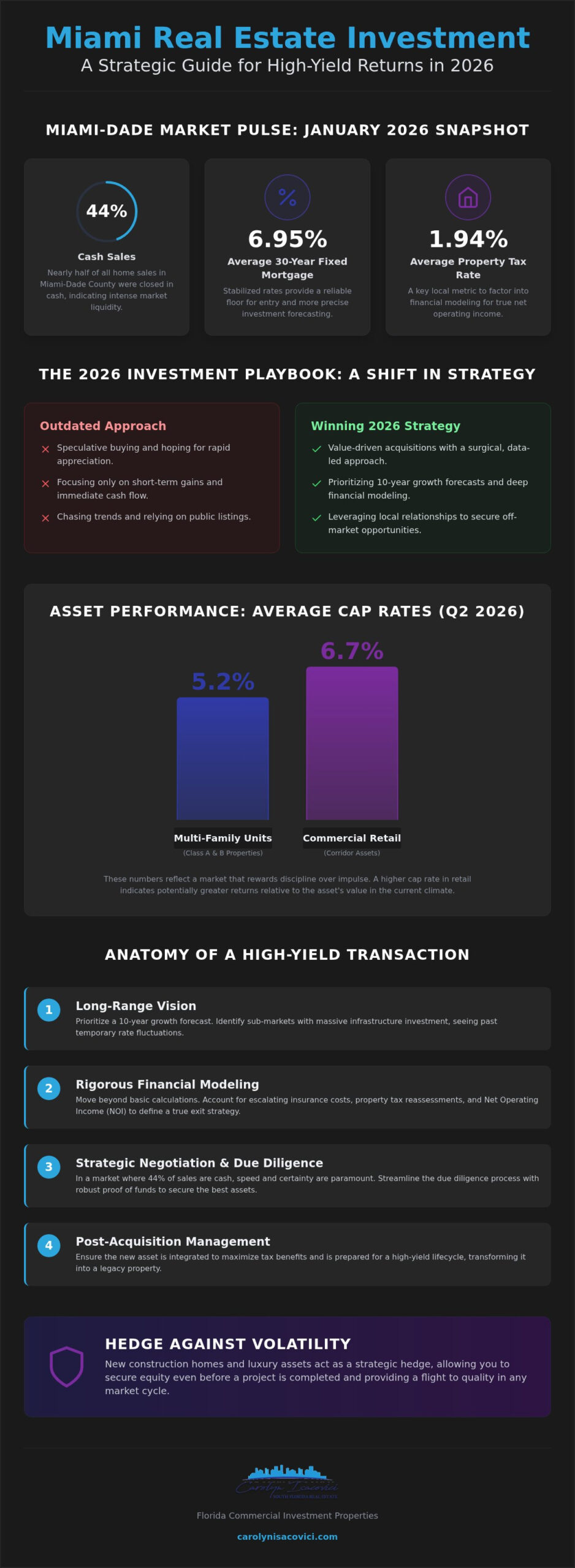
    Did you know that nearly half of all local real estate transactions are now closed in cash? In January 2026, cash sales accounted for 44% of all home sales in Miami-Dade County. This figure highlights the intense competition and liquidity currently defining the landscape. Is it still possible to find high-value opportunities amidst such a fast-paced environment? Absolutely. Success in this cycle simply requires a more surgical approach to acquisition and a steady hand at the helm.

    We understand that the current market can feel complex. Between 30-year fixed mortgage rates averaging 6.95% and the intricacies of new structural integrity laws, you might wonder if the window for high-yield returns is narrowing. It isn’t. This guide provides the exact strategies and market insights required to navigate Miami investment property sales with confidence and precision in 2026. You will discover how to identify true off-market value, manage the nuances of South Florida due diligence, and secure the long-term capital appreciation your portfolio deserves. We will break down the shift toward luxury assets and the impact of recent insurance rate cuts to ensure your next move is your most profitable one yet.

    Key Takeaways

    • Identify the shift from speculative buying to value-driven acquisitions to maintain growth in the resilient 2026 Miami market.
    • Master a two-step framework for high-yield transactions that prioritizes long-term growth forecasts and deep financial modeling over short-term gains.
    • Compare the performance metrics of multi-family units against commercial retail corridors to refine your approach to Miami investment property sales in the current climate.
    • Explore how new construction homes and luxury assets act as a hedge against volatility, allowing you to secure equity before a project is even completed.
    • Learn how to transition from a traditional buyer to a strategic partner by aligning with expert brokerage support to build a diversified Florida legacy.

    Is the Miami market still a viable arena for high-value returns? The answer is a resounding yes, though the rules of engagement have changed. In 2026, we’ve moved past the era of buying and hoping. Resilience has replaced rapid speculation as the primary driver of growth. While looking at the historical context of Florida’s land booms reminds us of the region’s cyclical nature, today’s market is underpinned by permanent shifts in where people work and live. We are no longer seeing the frantic, uncalculated surges of the past; instead, we are witnessing a deliberate flight to quality that rewards the patient, informed investor.

    The 2026 Market Pulse: Opportunity vs. Noise

    Why does Miami continue to attract global capital? It’s the persistent concentration of wealth and the ongoing tech migration that hasn’t slowed. With interest rates stabilizing around 6.95% for 30-year fixed loans as of August 2026, investors have finally found a reliable floor for entry. This stability allows for more precise forecasting when evaluating South Florida investment properties. The noise of market volatility often masks the underlying strength of the region. By focusing on the “sweet spot” in Miami-Dade and Broward where infrastructure is expanding, you can identify assets that offer both immediate cash flow and long-term security. Success here isn’t about chasing the latest trend, it’s about recognizing which neighborhoods have the staying power to weather any cycle.

    Key Metrics for the Modern Miami Investor

    What metrics actually matter right now? Price per square foot is a helpful starting point, but net operating income (NOI) and future cap rates are the real North Star for 2026. In the second quarter of 2026, multifamily cap rates for Class A and B properties in Miami averaged 5.2%, while retail assets reached 6.7%. These numbers reflect a market that rewards discipline over impulse. You must also account for the local tax landscape, particularly the 1.94% average property tax rate in Miami-Dade. Navigating these costs requires a strategic partner who can uncover off-market opportunities that never reach public listings. In a landscape where high-quality inventory is constrained, the most successful Miami investment property sales are those secured through deep local relationships rather than generic search engines.

    Ultimately, the 2026 landscape is one of maturity. It’s a market where the calm expert thrives by looking past the headlines and focusing on the underlying data. Whether you are looking at a commercial strip in a bustling corridor or a residential portfolio in an emerging neighborhood, the goal remains the same: sustainable, high-value returns. By aligning your strategy with these current realities, you transform market complexity into a distinct competitive advantage.

    The Anatomy of a High-Yield Miami Real Estate Transaction

    What does a successful acquisition look like on the ground? It begins with a shift in perspective. While many look at immediate cash flow, the highest performers in Miami investment property sales prioritize a 10-year growth forecast. This long-range view allows you to see past temporary interest rate fluctuations and focus on sub-markets with massive infrastructure investment. Once you have identified a target, rigorous financial modeling is the next non-negotiable step. We often tell our clients that the first year is just the beginning. You must account for escalating insurance costs and property tax reassessments to understand your true exit strategy.

    Negotiating a close in 2026 requires more than just a high offer. With cash sales making up 44% of the market, your proof of funds and speed of due diligence are your greatest assets. We help you move from the initial walkthrough to a signed contract by streamlining the complex due diligence process inherent to South Florida. Finally, post-acquisition management ensures your new asset integrates seamlessly into your existing portfolio. This phase maximizes the tax benefits of Florida’s unique regulatory environment while preparing the asset for a high-yield lifecycle.

    Evaluating the Cap Rate: A Miami Specific View

    How do you determine if a deal is actually a deal? To accurately evaluate investment property Florida metrics, you must look beyond the surface. Coastal properties carry specific expenses, such as the new structural integrity requirements for older condos and the evolving insurance landscape. While Miami’s multifamily cap rates averaged 5.2% in Q2 2026, comparing these to the slightly higher yields in Fort Lauderdale or the luxury stability of Palm Beach is essential. This context ensures you aren’t just buying a property, but investing in a specific yield profile that matches your long-term legacy goals.

    The Broker Advantage in Transactional Execution

    Why involve a broker in a high-demand market? A seasoned expert identifies red flags, like deferred maintenance or zoning hurdles, long before they become liabilities. The art of the offer isn’t just about the price; it’s about positioning your capital to win without overpaying in a low-inventory environment. By leveraging local relationships, we can often secure access to off-market inventory that never hits the public eye. This “insider” access is often the difference between a standard return and a truly exceptional one. If you are ready to refine your strategy, exploring professional investment brokerage can provide the clarity needed to move forward with certainty.

    Case Study: Multi-Family vs. Commercial Asset Performance

    Are you torn between the steady hum of residential rent and the structured stability of a commercial lease? This choice often defines the trajectory of your portfolio. In 2026, Miami investment property sales have branched into two distinct paths, each offering unique advantages depending on your tolerance for management and your desire for yield. We’ve seen that the most successful investors don’t just pick a category; they pick a scenario that aligns with their five year exit strategy. Let’s look at how these two asset classes performed in the most recent quarter to find the right fit for your capital.

    Multi-Family Success: The Income Generator

    Consider a recent 12-unit acquisition in Hollywood, FL. This emerging neighborhood has become a magnet for professionals priced out of the urban core. In the second quarter of 2026, multifamily cap rates for Class A and B properties in the region averaged 5.2%. Why does this matter? It shows that demand for housing remains incredibly resilient despite shifting interest rates. In this specific case study, the investor focused on a value-add play, upgrading interiors to capture the 22% growth in luxury rental demand seen earlier in the year. By implementing professional management, the owner was able to maintain a 96% occupancy rate, proving that residential assets are the ultimate hedge against market fluctuations. It’s about turning a physical building into a predictable, high-yield income stream.

    Commercial Assets: The Stability Play

    On the other side of the coin, we have the rebound of Miami office space for sale. While some feared for the future of the office, Class B and C properties in established corridors saw cap rates average 7.9% in Q2 2026. This is a significant spread compared to residential yields. The commercial play is often built on the back of Triple-net (NNN) leases. These agreements are a favorite for passive investors because the tenant handles taxes, insurance, and maintenance. By securing a diverse tenant mix, from boutique law firms to tech startups, investors in this sector have enjoyed long-term lease stability that residential units simply can’t match. It’s a “set it and forget it” strategy for those who prioritize time as much as they do returns.

    The lessons learned from this cycle are clear. The ongoing debate regarding commercial vs residential investment Florida isn’t about which is “better” in a vacuum. It’s about whether you want the high-touch, high-growth potential of multifamily or the hands-off, high-cap-rate stability of commercial corridors. Both paths lead to a diversified Florida legacy if you navigate them with the right data. We’re here to help you weigh these scenarios against your specific financial goals, ensuring your next acquisition is a strategic triumph.

    Miami Investment Property Sales: A Strategic 2026 Case Study for High-Value Returns

    Strategic Selection: Why New Construction and Luxury Assets Win

    Why is the luxury sector thriving while other segments stabilize? In the first quarter of 2026, sales of homes priced over $1 million in South Florida increased by 22% year-over-year. This surge isn’t accidental. Investors are increasingly viewing high-end assets as “recession-resistant” stores of value. When you engage in Miami investment property sales within the luxury tier, you aren’t just buying a building; you’re securing a piece of a globally recognized brand. From the vertical growth in Brickell to the curated exclusivity of the Design District, “New Miami” hubs are redefining what a high-value portfolio looks like.

    The Pre-Construction Investor Roadmap

    The 2026 surge in new construction homes Florida serves as a powerful hedge against the maintenance costs of older inventory. By locking in a pre-construction price, you effectively secure equity before the project is even finished. However, success requires a clear roadmap. You must vet developer reputations and understand the specific deposit structures that characterize these deals. Is the project’s long-term viability supported by local infrastructure? We help you answer these questions by timing your exit strategy, whether you plan to hold for appreciation or flip for a tactical gain.

    Luxury Residential as a High-Value Asset

    Why does residential investment property Miami continue to act as a global magnet? The data tells the story. Foreign buyers invested $4.4 billion in South Florida real estate in 2025, a 42% increase from the previous year. This influx of capital targets scarcity. Waterfront locations and premium zip codes never go out of style, even as broader market conditions shift. In June 2026, while the condo supply sat at 12.9 months, the luxury segment maintained a competitive edge with a sale-to-list price ratio of 94.68%. This stability allows you to leverage high-value real estate for true portfolio diversification.

    If you’re ready to explore these exclusive opportunities, our team can guide you through the latest new construction sales to find the perfect fit for your legacy. We specialize in identifying projects that offer the best balance of luxury and long-term financial security.

    Securing Your Florida Legacy with Expert Brokerage Support

    How do you bridge the gap between a single transaction and a multi-generational legacy? It requires a fundamental shift in perspective. You aren’t just looking for a vendor; you’re seeking a strategic partner who views your success as their own. In the high-stakes arena of Miami investment property sales, having a guide who has navigated various market cycles since 2006 is invaluable. Carolyn Isacovici and her team at Florida Commercial Investment Properties provide more than just access to listings. They offer the analytical mind of a strategist combined with the steady hand of a seasoned consultant. This approach transforms the stress of acquisition into a structured path toward high-yield returns. By aligning yourself with an expert who understands the nuances of both residential and commercial sectors, you ensure your capital is working its hardest.

    The Florida Commercial Investment Properties Difference

    What sets this approach apart? It’s the depth of experience in both commercial buildings and new construction. We’ve seen the market’s ebbs and flows, and we remain unruffled by temporary shifts. Our expertise is rooted in high-yield acquisitions for both institutional and individual investors. We don’t just present data; we interpret it within the context of your specific goals. Whether you’re looking for passive income from a retail corridor or capital appreciation from luxury residential assets, our advisory remains focused on the long-term health of your portfolio. We believe that clarity is the ultimate competitive advantage.

    Your Next Steps: From Inquiry to Closing

    Are you ready to move from observation to execution? Your journey begins with a portfolio consultation designed to align your financial objectives with the current 2026 market reality. This isn’t a generic sales pitch. It’s a deep dive into the metrics that matter most to you, from cap rates to tax reassessments. From there, we provide access to exclusive, off-market investment listings that never reach the public eye. These hidden gems often represent the best value in a low-inventory environment. By executing with confidence and precision, you can secure your place in Florida’s future. The 2026 market offers a unique sense of opportunity for those who are prepared. We invite you to take that first step with a partner who values your legacy as much as you do.

    Building Your Florida Legacy in 2026 and Beyond

    Is the 2026 market complex? Yes, but it’s also filled with unprecedented opportunity for the strategic investor who knows where to look. We’ve explored how a shift toward value-driven acquisitions and a clear-eyed view of asset class performance can transform market volatility into a distinct advantage. Whether you’re prioritizing the steady cash flow of a multi-family unit or the stability of a new construction luxury asset, the key is execution backed by deep local insight. Navigating Miami investment property sales requires more than just a list of properties; it demands a partner who has seen various cycles and remains unruffled by change.

    With over 20 years of Florida market expertise, Carolyn Isacovici specializes in high-yield commercial and residential assets. Her proven track record in new construction acquisitions ensures that your portfolio is built on a foundation of quality and foresight. You don’t have to navigate these waters alone. Contact Carolyn Isacovici to start your Miami investment journey today and turn your long-term vision into a tangible Florida legacy. The future of your portfolio starts with a single, confident step forward.

    Frequently Asked Questions

    Is Miami real estate still a good investment in 2026?

    Yes, Miami remains a premier destination for capital due to sustained tech migration and high net-worth interest. In the first quarter of 2026, luxury sales rose by 22%, signaling that the top end of the market is incredibly resilient. While interest rates have stabilized around 6.95%, the influx of foreign buyers, who invested $4.4 billion in 2025, continues to drive demand. It’s a market built on solid growth rather than just speculation.

    What is the average cap rate for Miami investment properties right now?

    Cap rates vary significantly by asset class according to Q2 2026 data. Multifamily and industrial properties currently average 5.2%, reflecting their high demand and stability. If you are looking for higher yields, retail properties average 6.7%, while Class B and C office spaces reach approximately 7.9%. These figures provide a clear benchmark for evaluating Miami investment property sales and help you determine which sector aligns best with your specific cash flow requirements.

    How do I choose between commercial and residential investment in Florida?

    Your choice depends on your desired involvement level and risk appetite. Residential properties often provide higher liquidity and benefit from the 22% growth in the luxury sector we saw early this year. Commercial investments, particularly those with Triple-net (NNN) leases, offer a more hands-off experience with tenants covering taxes and insurance. We recommend evaluating your long-term legacy goals before deciding which asset class will anchor your diversified Florida portfolio.

    What are the best neighborhoods in Miami for high-yield rental property?

    High-yield opportunities are currently concentrated in emerging neighborhoods and established luxury hubs. Areas like Hollywood, FL, are seeing strong multifamily performance with cap rates around 5.2%. For luxury seekers, the Design District and Brickell remain global magnets, supported by the 44% of transactions closed in cash this year. Identifying the right pocket requires looking at 10-year infrastructure plans rather than just current occupancy rates to ensure sustainable, long-term appreciation for your assets.

    How does a 1031 exchange work for Florida investment property sales?

    A 1031 exchange allows you to defer capital gains taxes by reinvesting proceeds from one property sale into a “like-kind” replacement. This is a powerful tool for scaling your Florida real estate portfolio without immediate tax liabilities. You must follow strict IRS timelines, including identifying a new property within 45 days and closing within 180 days. It’s an essential strategy for investors looking to transition from residential units into larger commercial buildings.

    Can I buy Miami investment property through an LLC?

    Purchasing through an LLC is a standard practice for sophisticated investors in the Florida market. This structure provides a vital layer of asset protection by separating your personal liabilities from your real estate holdings. Additionally, an LLC can offer tax flexibility and ease the process of transferring ownership among multiple partners. It’s a strategic move that aligns well with the professional and institutional nature of modern Miami investment property sales.

    What are the closing costs for commercial property in Florida?

    Closing costs in Florida generally range between 2% and 5% of the total purchase price. For commercial transactions, these costs include title insurance, documentary stamp taxes on the deed, and professional surveys. You should also budget for environmental assessments and specialized inspections, which are critical in South Florida’s coastal environment. While we don’t provide legal services, we help you factor these concrete expenses into your initial financial modeling to ensure no surprises.

    Why should I work with a specialized investment broker like Carolyn Isacovici?

    Working with a specialist like Carolyn Isacovici gives you a distinct advantage in a low-inventory market. With expertise dating back to 2006, she provides access to exclusive off-market listings that generic platforms simply cannot offer. Her team focuses on the end-to-end sales process for high-yield acquisitions, combining the analytical mind of a strategist with deep local relationships. This ensures your investment is backed by two decades of wisdom and a commitment to your success.

  • High Yield Investment Property Florida: 2026 Market Trends & Opportunities

    High Yield Investment Property Florida: 2026 Market Trends & Opportunities

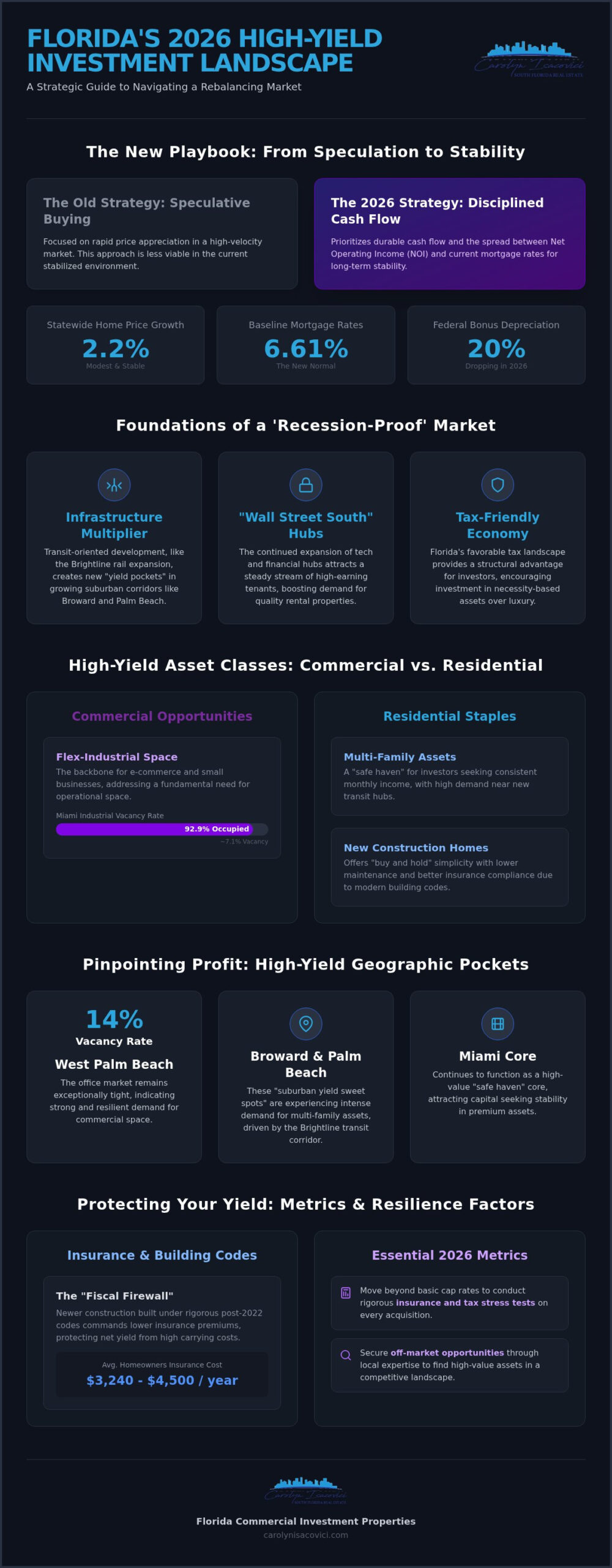
    Is it still possible to find a high yield investment property in Florida when insurance premiums are climbing and competition for turnkey assets feels relentless? You aren’t alone if you’ve felt a sense of caution lately. With the statewide home price growth projected at a modest 2.2 percent and federal bonus depreciation dropping to 20 percent in 2026, the strategy for success has fundamentally changed. It’s no longer about following the crowd; it’s about identifying where the actual value resides in a rebalancing market.

    We’re here to transform that uncertainty into a clear strategic advantage. This article promises to guide you through the specific sectors and geographic corridors, such as the resilient West Palm Beach office market with its tight 14 percent vacancy rate, that are delivering the highest yields right now. You’ll gain a professional framework for evaluating acquisitions while understanding the critical yield differences between commercial and residential assets in this new environment.

    We will examine the impact of 2026 legislative shifts, including the new protected series LLCs and enhanced flood disclosures, to ensure your portfolio remains both compliant and profitable. By the end of this guide, you’ll have the insight needed to navigate these cycles with the confidence of a seasoned partner.

    Key Takeaways

    • Learn why the 2026 market favors disciplined cash-flow accumulation over speculative buying and how to pivot your strategy for long-term stability.
    • Discover how to identify a high yield investment property Florida by comparing traditional multi-family assets with high-performing emerging sectors like flex-industrial.
    • Explore strategic geographic corridors from Miami’s high-value “safe haven” core to the suburban yield sweet spots found throughout Broward and Palm Beach.
    • Master the essential 2026 performance metrics, moving beyond basic cap rates to conduct rigorous insurance and tax stress tests on every potential acquisition.
    • Understand why securing off-market opportunities through local expertise is the most reliable path to finding high-value assets in a competitive landscape.

    The 2026 Florida Investment Landscape: Beyond the Migration Boom

    The era of speculative “easy wins” in the Sunshine State has evolved into a more sophisticated, data-driven environment. While the frantic migration peak of 2022 has subsided, the market in 2026 offers something far more valuable for the disciplined investor: stability. Finding a high yield investment property Florida today requires a shift in perspective. We no longer look solely at rapid price appreciation, which is currently hovering around 2.2 percent statewide. Instead, we focus on the spread between net operating income and the 6.61 percent mortgage rates that have become the new baseline in August 2026. High yield now means durable cash flow that can withstand market fluctuations.

    Why is the sentiment so optimistic among seasoned pros? It’s because the state’s growth is now anchored by three immovable pillars. First, massive infrastructure projects are redrawing the map of profitability. Second, the expansion of tech and financial hubs in the “Wall Street South” corridor continues to attract high-earning tenants. Finally, Florida’s overall economic landscape remains one of the most tax-friendly in the nation, providing a structural advantage that few other states can match. This has led to a “recession-proof” mantra where investors prioritize necessity-based assets over luxury fluff.

    The Infrastructure Multiplier: The Brightline and Beyond

    Transit-oriented development is the quiet engine driving 2026 yields. The continued expansion of the Brightline rail service has fundamentally changed how people live and work on the East Coast. We’re seeing new “yield pockets” emerge within a ten-mile radius of these transit hubs. As workers seek relief from the high costs of Miami’s core, they’re moving north into Broward and Palm Beach counties. This shift is driving intense demand for residential multi-family assets in areas that were once considered sleepy suburbs. When you align your portfolio with these transit corridors, you aren’t just betting on a building; you’re betting on the literal path of progress.

    Market Resilience: Navigating Insurance and Climate Factors

    It’s time for a calm, realistic look at the insurance conversation. While average homeowners insurance costs range from $3,240 to $4,500 per year in 2026, the market is finally showing signs of stabilization. Tort reforms passed in previous years are now bearing fruit, with some insurers actually filing for rate reductions. The key for a high yield investment property Florida is a “flight to quality.” Newer construction, built under the state’s rigorous post-2022 building codes, often commands significantly lower premiums and higher occupancy rates.

    Modern building codes in 2026 act as a fiscal firewall, reducing insurance premiums while ensuring structural longevity in a changing climate. By focusing on assets that meet these enhanced standards, you’re not just protecting the physical structure. You’re protecting your net yield from the erosion of high carrying costs. This strategic focus on resilience is what separates the casual buyer from the professional investor in 2026.

    Identifying High-Yield Asset Classes: Commercial vs. Residential

    Choosing between commercial and residential assets requires a clear understanding of your risk tolerance and income goals. In 2026, the landscape has bifurcated. While residential multi-family remains a “safe haven” for those seeking consistent monthly checks, commercial sectors are offering specialized opportunities for those willing to look beyond traditional office space. For instance, the medical and wellness sector remains a high-demand niche, and Healthcare Biz Brokers, Inc. specializes in facilitating the valuation and sale of these healthcare-related businesses. Experienced seekers of a high yield investment property Florida are also currently eyeing “Flex-Industrial” spaces. These versatile units serve as the backbone for small businesses and e-commerce startups, maintaining an industrial vacancy rate of approximately 7.0-7.2 percent in Miami. This sector often outperforms luxury assets because it addresses a fundamental need for operational space rather than discretionary lifestyle spending. For a comprehensive look at how these dynamics translate into measurable returns, our analysis of Florida commercial property investment returns across key sub-markets provides the cap rate benchmarks and regional data you need to evaluate each sector with confidence.

    New construction homes also remain a staple for passive investors. They offer a “buy and hold” simplicity that older assets can’t match, especially when you consider the lower maintenance costs and modern insurance compliance. According to a recent Florida TaxWatch forecast, long-term population growth continues to fuel demand for workforce housing. This is where the true resilience lies. While the luxury market can be volatile, the demand for high-quality, attainable housing for Florida’s growing workforce provides a durable foundation for your portfolio.

    Commercial Real Estate South Florida: Retail and Industrial Trends

    The “Last Mile” delivery phenomenon has turned industrial hubs in Miami and Fort Lauderdale into yield powerhouses. Businesses need to be closer to their customers than ever before. Interestingly, neighborhood retail centers across the South Florida corridor are showing remarkable resilience. These centers provide essential services that internet shopping can’t replace, maintaining high occupancy rates in established communities from Hollywood to Jupiter. For a deeper dive into these specifics, explore our Florida Commercial Real Estate: 2026 Investor’s Guide. If you’re ready to explore these sectors, partnering with an investment-focused brokerage can help you uncover the right entry point.

    Residential Multi-Family: The Cash Flow King

    Multi-family assets, particularly duplexes and triplexes in Broward County, continue to be the primary vehicle for cash flow. With a multi-family vacancy rate of 6.6 percent in Miami, the rental market remains tight enough to support healthy yields. Many investors are successfully utilizing the BRRRR method (Buy, Rehab, Rent, Refinance, Repeat) to build equity rapidly. The secret to finding a high yield investment property Florida in established Miami neighborhoods is targeting “value-add” opportunities. These are properties that need cosmetic updates or better management to reach their full market potential. By identifying buildings with below-market rents or underutilized square footage, you can create a margin of safety that protects your investment while securing a steady income stream. This regional demand also supports a thriving hospitality sector, where luxury properties like those within the Koosh Collection in Hollywood set the standard for high-end asset performance.

    Strategic Geographic Pockets: From Miami to the Space Coast

    Where should you place your capital to ensure the best risk-adjusted returns? While many investors fixate on the same few cities, the real opportunity in 2026 lies in the strategic corridor stretching from the Miami core up to the Space Coast. Miami remains the “safe haven” for international and institutional capital, offering a level of liquidity that few global markets can match, supported by mission-critical facilities like 3EX Hosting. However, the search for a high yield investment property Florida often leads us slightly north. Broward and Palm Beach counties have become the sweet spot for suburban multi-family yields, especially as the CBRE 2026 U.S. Real Estate Market Outlook highlights the continued strength of the South Florida commercial and residential sectors.

    West Palm Beach stands out with an office vacancy rate of just 14.0 percent, the tightest in the state. This commercial stability creates a halo effect for nearby residential assets. As workforce demand remains high, the pressure on existing inventory ensures that well-located multi-family units stay occupied with minimal concessions. It’s a balanced environment where the seasoned navigator sees not just a building, but a piece of a thriving economic engine. We don’t just look for growth; we look for the kind of stability that protects your bottom line during market shifts, including specialized niches like luxury automotive real estate where Robert Zinzell offers expert market insight.

    The Rise of the Treasure Coast: Port St. Lucie and Stuart

    Why has Port St. Lucie become a primary destination for high yield investment property Florida? The answer is simple: population overflow. As South Florida’s cost of living pushes families further north, the Treasure Coast has transformed from a quiet region into a primary growth engine. New construction homes in Port St. Lucie and Stuart offer lower entry points than Miami, yet they maintain high rent-to-price ratios that are increasingly rare elsewhere. Investors in Stuart and Palm City are finding that new development homes provide the modern amenities and storm resilience that today’s tenants prioritize, all while keeping insurance and maintenance costs predictable.

    Melbourne and the Space Coast: A Tech-Driven Yield Play

    Can a region’s economy be truly resilient? The Space Coast is making a strong case for it. With the aerospace and defense industries booming, Melbourne and Palm Bay are experiencing a tech-driven rental demand surge that shows no signs of slowing. The current lack of existing inventory has created a massive opportunity for new builds. High-earning professionals in the engineering and tech sectors are looking for quality housing, and they’re willing to pay a premium for it. This makes the region a favorite for those looking to diversify their real estate portfolios with assets that aren’t tied solely to tourism, providing a steady path forward for your capital.

    While the East Coast attracts significant attention, Southwest Florida remains a premier destination for residential investment. By working with specialists like Team239, investors can access professional expertise in residential properties and new construction deals across the Gulf Coast. This allows for a balanced portfolio that captures growth from both of Florida’s primary coastal corridors, ensuring long-term resilience against localized market shifts.

    High Yield Investment Property Florida: 2026 Market Trends & Opportunities

    Calculating Real Returns: Performance Metrics That Matter in 2026

    How do we measure success when interest rates have established a new baseline? In August 2026, with the 30-year fixed mortgage rate at 6.61 percent, the metrics we used three years ago no longer tell the full story. Finding a high yield investment property Florida today requires moving beyond the basic cap rate to focus on Cash-on-Cash returns. This metric is your ultimate truth-teller because it measures the actual cash flow earned on the specific amount of capital you’ve deployed. It accounts for debt service in a higher-rate environment, giving you a clear view of your actual monthly income. For a deeper dive into these calculations, see our How to Evaluate Investment Property in Florida: A Strategic 2026 Guide.

    We also have to consider the “Exit Cap Rate” with a steady hand. In a stabilizing market where statewide price growth is projected at 2.2 percent, we don’t rely on aggressive market heat to bail out a poor purchase. Instead, we build our models on conservative exit assumptions. This approach ensures that your wealth is built on the property’s performance rather than speculative hope, transforming market uncertainty into a structured opportunity for growth.

    Stress-Testing Your Florida Investment

    Due diligence in 2026 is an exercise in precision. We utilize a three-step stress test: verifying actual income versus pro-forma projections, auditing the insurance requirements under 2026 flood disclosure laws, and calculating the post-sale property tax reassessment. While the statewide average effective property tax rate is 0.75 percent, a new acquisition often triggers a significant jump in assessed value. Net Operating Income (NOI) is the only metric that doesn’t lie because it focuses on the property’s operational efficiency. A typical 2026 expense ratio for a professionally managed Miami multi-family property generally falls between 35 and 45 percent of gross income. To ensure every step of this process is properly covered, our investment property due diligence Florida checklist walks you through the mandatory flood disclosures, insurance audits, and tax reassessment factors that can make or break your acquisition. If you want to ensure your pro-forma is grounded in reality, consult with a specialist to review your next acquisition.

    Understanding Cap Rate vs. Appreciation in 2026

    Does a higher cap rate always mean a better deal? Not in a “split market” like Florida’s. A 5 percent cap rate in a supply-constrained Miami neighborhood is often a safer, more resilient play than an 8 percent cap rate in a rural area with a shallow tenant pool. In the core markets, you’re investing in liquidity and the potential for long-term appreciation that rural markets simply cannot match. We look at the “Total Return,” which combines steady yield with the equity growth provided by Florida’s resilient economic base. You can explore these regional nuances in our Cap Rate for Miami Investment Property: A Strategic 2026 Analysis. By balancing immediate cash flow with strategic location, you secure a high yield investment property Florida that stands the test of time.

    Securing Your High-Yield Asset: The Role of a Strategic Broker

    How do you bridge the gap between identifying a growth corridor and successfully closing on a high yield investment property Florida? In a market characterized by high competition for turnkey assets, the most valuable opportunities rarely make it to the public portals. Florida Commercial Investment Properties specializes in bridging this gap by leveraging a deep network of off-market relationships developed over decades. Having a seasoned navigator on your side means you aren’t just reacting to the market; you’re anticipating it. We transform the data points we’ve discussed, from Brightline expansion to industrial vacancy rates, into actionable acquisitions.

    Local knowledge is your strongest shield against the friction of modern real estate transactions. Florida’s regulatory environment is unique, with hyper-specific zoning laws and building codes that can make or break an investment’s profitability. Whether it’s navigating the 2026 flood risk disclosure requirements or understanding the nuances of the new protected series LLC legislation, our team ensures you’re making decisions based on reality rather than projections. We approach these complex market conditions with a steady, confident hand, allowing you to invest with a sense of calm authority.

    The Advantage of a Full-Service Brokerage

    Florida Commercial Investment Properties provides a comprehensive suite of services that goes beyond simple transaction management. We understand that a high yield investment property Florida requires a holistic view of the asset’s lifecycle. Since 2006, Carolyn Isacovici has guided investors through various market cycles, focusing on high-value property holdings and portfolio building. Our firm assists with both residential and commercial asset selection, ensuring that every acquisition serves your broader goal of wealth preservation. We manage the transition from identifying a property to a successful closing, providing the professional authority needed to navigate South Florida’s specific regulatory landscape.

    Next Steps: Your 2026 Acquisition Strategy

    How does your current portfolio stack up against the 2026 growth corridors we’ve explored? Now is the time to identify gaps and reposition your capital toward the sectors delivering the highest yields. For our international and out-of-state clients, we provide the essential local perspective needed to enter the Florida market with confidence. We offer a methodical approach to asset selection that prioritizes data, timing, and strategic advantage. If you’re ready to move beyond general market observations and take decisive action, it’s time to transform your investment goals into a Florida reality with Carolyn Isacovici.

    Charting Your Path to Florida Real Estate Success

    Are you ready to move from observation to action? The Florida market in 2026 is no longer a game of chance; it’s a landscape designed for the strategic, well-informed investor. We’ve explored how identifying the right asset classes, such as resilient flex-industrial or transit-oriented multi-family units, provides the stability your portfolio needs. By focusing on the growth corridors stretching from Miami up through the Treasure Coast and Space Coast, you’re aligning your capital with the literal path of progress. Success today isn’t about chasing the latest headline. It’s about securing a high yield investment property Florida through disciplined analysis and local expertise.

    Carolyn Isacovici has provided expert brokerage since 2006, offering a portfolio-driven approach to real estate wealth that transforms market complexity into a clear advantage. Specialized in the South Florida and Treasure Coast growth corridors, we’re here to serve as your trusted navigator in an evolving market. Your next move should be grounded in data and executed with confidence. Secure your next high-yield Florida asset with Carolyn Isacovici and begin building a more resilient financial future today. The opportunities are waiting for those who know where to look.

    Frequently Asked Questions

    Is Florida still a good place for high-yield investment in 2026?

    Florida remains a top-tier choice in 2026 as the market shifts from a seller’s peak to a balanced environment. With over 162,000 homes listed statewide, buyers now have the leverage to negotiate favorable terms. While price growth has moderated to 2.2 percent, the state’s enduring popularity as a global hub for tourism and tropical travel—supported by services like Sunlover Travel—ensures a steady influx of high-earning professionals and visitors, maintaining a robust pipeline of demand for long-term holds.

    What is considered a “good” cap rate for Florida investment property right now?

    In an environment where mortgage rates hover around 6.61 percent, a “good” cap rate for a high yield investment property Florida is generally between 5.5 and 7 percent. While core Miami assets may offer tighter yields due to their high demand and lower risk, looking toward the Treasure Coast can often yield higher cash-on-cash returns for investors prioritizing immediate income over rapid appreciation.

    How do Florida insurance costs impact the net yield of a property?

    Insurance costs, which typically range from $3,240 to $4,500 annually in 2026, are a critical variable in your net yield calculation. However, the market is stabilizing as past legislative reforms take hold. By focusing on newer construction in areas like Jupiter or Palm Beach Gardens, you can often secure lower premiums and higher net operating income compared to older, non-compliant structures.

    Which Florida cities have the highest rental demand in 2026?

    Rental demand is currently strongest in the Miami core, West Palm Beach, and the high-growth corridor of Port St. Lucie. Melbourne and the Space Coast are also seeing a massive surge due to the expansion of the aerospace and defense sectors. These regions are attracting a permanent workforce that requires high-quality housing and access to essential community services; you can find out more about the specialized wellness and mental health support available for families in these growing hubs. This keeps vacancy rates low and rental rates resilient across the East Coast.

    Should I invest in commercial or residential property in Florida for better yields?

    The choice depends on your specific goals, but both sectors show strength in 2026. Residential multi-family in Hollywood and Fort Lauderdale offers consistent demand, while flex-industrial spaces in the Miami-Dade area provide a specialized high yield investment property Florida play. Neighborhood retail centers in Palm Beach County are also proving resilient, serving as essential hubs for local communities that internet shopping cannot replace. To benchmark your expected returns across these asset types, review the detailed 2026 strategic outlook for Florida commercial property investment returns, which covers cap rates from prime retail to emerging industrial hubs.

    How does the Brightline expansion affect property values in South Florida?

    The Brightline has fundamentally redrawn the map of South Florida real estate by making suburban markets more accessible to the Miami workforce. This “transit-oriented” shift has significantly increased property values in Broward and Palm Beach counties. Investors who align their portfolios with these transit hubs are seeing both higher rental demand and superior long-term appreciation potential as commuting patterns evolve.

    What are the tax benefits of owning investment property in Florida?

    Investors benefit from Florida’s lack of state income tax and a total homestead exemption of $51,411 for 2026. Additionally, the effective July 1, 2026, legislation allowing protected series LLCs provides a robust framework for asset protection. These tax and legal advantages, combined with an average property tax rate of 0.75 percent, make Florida one of the most efficient states for building real estate wealth.

    Can I find high-yield opportunities in Miami, or is it too expensive?

    High-yield opportunities definitely exist in Miami, but they require a shift toward off-market deals and value-add strategies. With a multi-family vacancy rate of 6.6 percent, the demand for quality housing remains high. By identifying properties with management inefficiencies or targeting emerging neighborhoods within the Miami-Dade area, you can still secure the competitive returns typically associated with much smaller markets.

  • How to Evaluate Investment Property in Florida: A Strategic 2026 Guide

    How to Evaluate Investment Property in Florida: A Strategic 2026 Guide

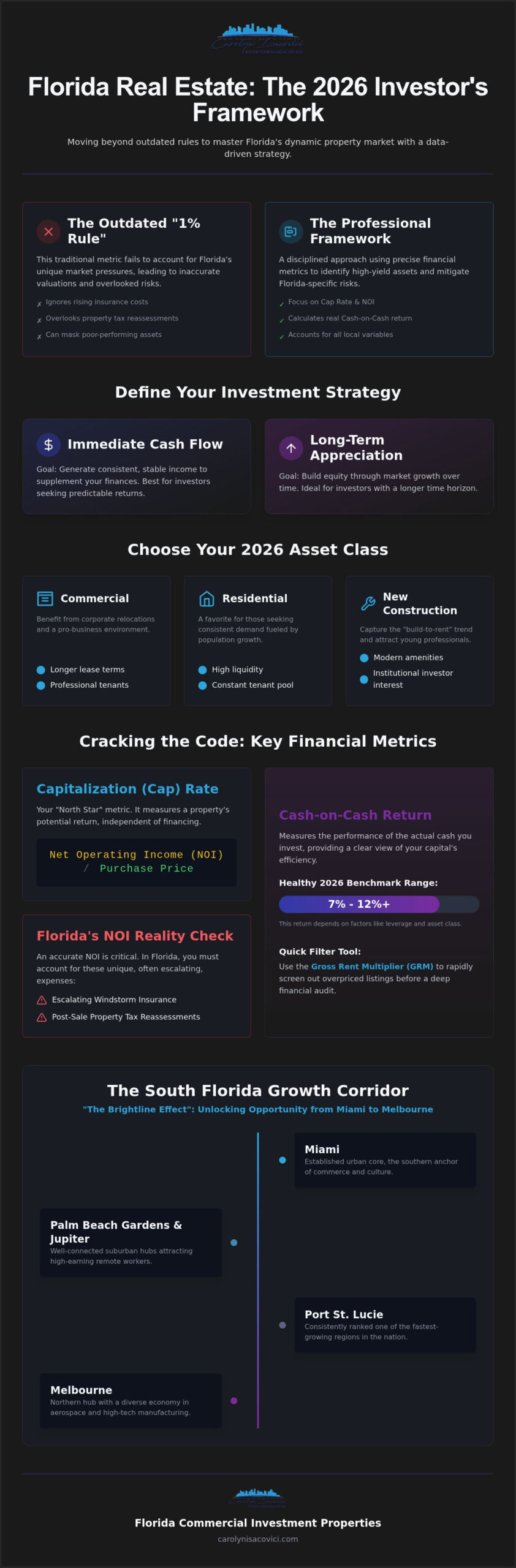
    The traditional 1% rule is no longer the reliable compass it once was for Florida real estate. In 2026, relying on outdated metrics might cause you to overlook some of the most lucrative opportunities currently emerging in the South Florida corridor. You’ve likely felt the pressure of rising insurance costs or the worry that you might be overpaying in such a competitive market. It’s completely normal to feel cautious when county regulations and tax assessments seem to shift so quickly.

    We are here to help you transform that uncertainty into a clear strategic advantage. You’re about to discover how to evaluate investment property Florida using the exact framework seasoned brokers use to identify and secure high-yield assets. This guide moves past the guesswork to provide you with a repeatable evaluation checklist and a deep dive into calculating real ROI with precision. We will explore South Florida’s most promising growth corridors and the specific hidden costs you must account for to ensure your portfolio remains resilient and profitable for years to come.

    Key Takeaways

    • Learn to align your investment goals with Florida’s most lucrative asset classes, including commercial properties and new construction homes.
    • Master the professional framework for how to evaluate investment property Florida by utilizing precise Cap Rate and Net Operating Income (NOI) calculations.
    • Identify the “Brightline Effect” and find emerging opportunities within the high-growth corridor stretching from Miami to Melbourne.
    • Protect your bottom line by uncovering the truth about property tax reassessments and navigating the 2026 insurance landscape with confidence.
    • Discover the strategic advantage of partnering with a specialized broker to uncover off-market opportunities and build a high-performing deal team.

    The Foundation: Defining Your Florida Investment Strategy

    Florida isn’t just a sunshine destination; it’s a powerhouse of economic growth that continues to outpace much of the nation in 2026. Why does the East Coast corridor remain a top-tier choice for capital? The answer is found in the relentless migration of both people and businesses toward the Atlantic coast. For example, the Port St. Lucie area has consistently ranked as one of the fastest-growing regions in the nation, reflecting a broader trend of residents seeking the balance of lifestyle and opportunity found between Miami and Melbourne. Learning how to evaluate investment property Florida starts with recognizing that this growth isn’t accidental. It’s the result of a deliberate, pro-business environment that rewards strategic entry.

    Before you scout specific addresses, you must define your “Exit Strategy” mindset. Are you searching for immediate, stable cash flow to supplement your income, or are you positioned for long-term equity growth through appreciation? Your answer will dictate which market you enter. While many are tempted to simply follow the crowds to the most established urban centers, savvy investors are looking toward emerging hubs where the entry price is lower and the “Path of Progress” is clearly visible. Before committing your capital, it’s wise to ground your approach in the fundamentals of real estate investing to ensure your risk tolerance matches your chosen asset class.

    Commercial vs. Residential: Choosing Your Vehicle

    Selecting the right asset class is your first critical decision. Commercial property sales in Florida currently benefit from the massive corporate relocations seen over the last few years, offering longer lease terms and professional tenants. Conversely, residential real estate sales remain a favorite for those seeking high liquidity and consistent demand. If you are weighing the trade-offs between these two paths, our detailed breakdown of the commercial vs residential investment Florida strategy for 2026 provides a clear framework for understanding how current mortgage rates and shifting insurance premiums impact each asset class. We are also seeing a significant rise in interest for new construction homes Florida, particularly as institutional investors pivot toward “build-to-rent” models to capture the growing population of young professionals who prefer renting in modern, amenity-rich communities; similarly, for those looking to diversify their portfolio with international residential assets, Spaindinavia provides expert insights into property sales and rentals in Spain’s Costa Cálida and Costa Blanca regions.

    The 2026 Market Pulse

    The 2026 market is being reshaped by the permanence of remote work and the continued lack of state income tax, which acts as a powerful magnet for high-earning individuals from the Northeast and West Coast. These factors have shifted demand zones away from just the urban cores and into well-connected suburban hubs like Palm Beach Gardens and Jupiter. Market resilience in Florida is defined by a diverse economic base that spans aerospace, tourism, and high-tech manufacturing, ensuring that demand remains steady even during broader national shifts. This diversity provides a reassuring safety net for your portfolio, transforming market volatility into a series of calculated opportunities; for those looking to diversify globally, Chainex Real Estate offers expert services in the similarly high-growth Dubai market.

    Cracking the Code: Key Financial Metrics for Florida Real Estate

    Numbers don’t lie. While the aesthetic appeal of a waterfront condo or a sleek commercial storefront is undeniable, your long-term success depends on the cold, hard data behind the facade. Knowing how to evaluate investment property Florida means moving beyond the asking price to understand the underlying economic engine of the asset. By stripping away the emotion and focusing on standardized metrics, you can compare a multi-family unit in Orlando to a retail space in Miami with absolute clarity.

    What is the “North Star” for most professional investors? It is the Capitalization Rate, or Cap Rate. This metric provides a snapshot of an asset’s potential return, independent of financing. However, the Cap Rate is only as accurate as your Net Operating Income (NOI) calculation. In Florida, your NOI must account for unique variables like escalating windstorm insurance and the nuances of official Florida property tax exemptions, which can significantly alter your bottom line if you aren’t prepared for the post-sale reassessment.

    Beyond the Cap Rate, you should look at your Cash-on-Cash return. This measures the performance of the actual liquid capital you’ve put into the deal. In 2026, a healthy benchmark for Florida properties typically ranges between 7% and 12% or more, depending on your leverage. To optimize your financing strategy with products that don’t require tax returns, you can discover Simplified Commercial Lending. For those screening multiple Miami investment property options quickly, the Gross Rent Multiplier (GRM) serves as a helpful “back of the envelope” tool to filter out overpriced listings before you commit to a deeper financial audit.

    Calculating the Real Cap Rate

    The formula is straightforward: divide your annual NOI by the purchase price. But are you including every expense? A common mistake is overlooking property management fees, which typically range from 8% to 12% in Florida—you can learn more about Morgan Property Solutions Inc. to see how professional oversight fits into your budget—or failing to set aside a realistic vacancy reserve. In 2026, a Cap Rate between 5% and 8% is generally considered a solid target for long-term rentals. You might find tighter yields in high-demand South Florida markets, while the Treasure Coast often offers slightly higher Cap Rates in exchange for different growth profiles. If a deal looks too good to be true, it’s often because the “hidden” costs haven’t been fully baked into the math. For a deeper understanding of how neighborhood-level variables like the Live Local Act and $10,000 insurance premiums affect your returns, our strategic 2026 analysis of cap rate Miami investment property breaks down exactly why a 4% yield in Brickell can outperform a 7% return in Hialeah.

    Cash Flow vs. Appreciation

    Is a high immediate yield always the best choice? Not necessarily. Some high-demand pockets in Miami might offer lower Cap Rates today but boast exceptional 10-year equity forecasts due to restricted supply and high desirability. You have to weigh the comfort of monthly cash flow against the wealth-building power of appreciation. For a deeper look at how these dynamics play out in different sectors, you can explore our Expert Guide to Florida Commercial Property Sales. Balancing these two forces is where true portfolio wisdom resides. If you find yourself unsure which metric to prioritize for your specific goals, consulting a seasoned Florida real estate professional can provide the clarity you need.

    Beyond the Numbers: Evaluating the ‘South Florida Corridor’ Opportunity

    Does a single city represent the entire market? Certainly not. When you consider how to evaluate investment property Florida, you must look at the state as a collection of micro-economies. The corridor stretching from Miami up to Melbourne is currently experiencing a transformation driven by massive infrastructure investments. By looking beyond the obvious tourist traps, you find pockets of immense potential that the casual observer might miss. Understanding how to evaluate investment property Florida requires a shift from statewide statistics to the specific dynamics of the South Florida corridor. Have you noticed how property values seem to climb along the path of the Brightline? This isn’t a coincidence. The ‘Brightline Effect’ is actively reshaping the region by connecting major hubs like Miami and Fort Lauderdale to emerging markets further north, such as Stuart and Vero Beach. By following these transportation arteries, you can identify ‘Path of Progress’ areas before they reach peak pricing. Investors who want to understand which specific sectors and geographic corridors are delivering the strongest returns right now can explore our detailed breakdown of high yield investment property Florida opportunities for 2026, including a close look at the resilient West Palm Beach office market and the critical yield differences between commercial and residential assets.

    For investors looking to explore high-potential markets further south, Krissy in the Keys (Krissy Carnahan, Realtor) offers specialized local expertise in coastal and island properties that are often overlooked by mainland-focused investors.

    A strategic analysis of Florida’s markets reveals that hyper-local data is your most potent tool. While a county-wide average might suggest a cooling trend, a specific neighborhood near a new tech hub or a renovated port could be seeing double-digit growth. Balancing your portfolio between established commercial hubs and quiet residential enclaves allows you to capture both immediate stability and long-term upside. This dual-lens approach ensures you aren’t just buying a building, but rather a stake in a growing community’s future.

    Regional Deep-Dive: Miami to Vero Beach

    Miami and Fort Lauderdale remain the crown jewels for high-value commercial property sales and luxury residential assets. Investors seeking this level of prestige might also consider the European market, where King Estates represents premier luxury listings across Spain’s Costa del Sol. These Florida markets offer high competition but unmatched prestige and liquidity. Moving north, the Palm Beaches provide a perfect middle ground, with a heavy focus on new construction homes Florida investors are targeting and expanding residential sectors. For those seeking emerging value, the Treasure Coast, specifically Stuart and Fort Pierce, offers a longer-term hold opportunity where the initial capital requirement is often more accessible. Each region requires a unique lens, but the underlying growth story remains consistent.

    The Infrastructure Factor

    Proximity to logistics hubs is a non-negotiable factor in your evaluation. Properties near I-95, the Florida Turnpike, and major international airports or ports enjoy a built-in demand from both commercial tenants and residential commuters. We are seeing a significant shift in how new construction homes are designed, with many being integrated into master-planned ‘live-work-play’ developments. In these environments, the ’15-minute city’ trend is taking hold, creating self-contained communities where residents can access all their daily needs within a short walk or bike ride from their front door. This level of convenience is a major driver of tenant retention and property value resilience.

    How to Evaluate Investment Property in Florida: A Strategic 2026 Guide

    The Florida Reality Check: Insurance, Taxes, and Due Diligence

    Securing a property in a high-growth corridor is an exciting milestone, but the true test of an investor’s wisdom lies in the due diligence phase. Beyond the surface-level appeal and the initial financial projections, you must account for the unique operational realities of the Sunshine State. Understanding how to evaluate investment property Florida involves a deep dive into “hidden” carrying costs that can fluctuate based on local legislation and environmental factors. While these variables might seem daunting at first, they are simply part of the landscape that a prepared investor navigates with ease.

    One of the most significant hurdles for newcomers is the property tax reset. Many investors make the mistake of looking at the current owner’s tax bill and assuming their costs will be similar. In Florida, property is reassessed at the full market value upon sale. While the “Save Our Homes” cap protects primary residents, as an investor, you’ll be looking at a non-homestead assessment cap. Currently, this limits annual increases in the assessed value to 10%. This cap provides a level of predictability for your long-term carrying costs, but your starting point will likely be higher than the previous owner’s, especially if they held the asset for many years.

    Insurance is another critical component of your reality check. In 2026, the market is showing signs of stabilization, but premiums in South Florida counties like Miami-Dade and Palm Beach still typically range between $3,500 and $8,000 or more per year. Navigating this requires more than just a quote; it requires a strategy. Savvy investors often look into the surplus lines market or utilize 1031 Exchanges to transition into newer, more resilient assets that command lower premiums. The recent 8 to 25 percent drop in commercial insurance premiums has also made a commercial vs residential investment Florida comparison increasingly favorable for those willing to explore non-traditional asset classes. If you want to ensure your next acquisition is a sound financial move, it is vital to partner with a specialized Florida investment broker who can guide you through these local complexities.

    The ‘New Owner’ Tax Adjustment

    Florida’s ad valorem tax system means your tax burden is tied directly to the just value of the property. To avoid surprises, you should use county property appraiser tools to estimate your 2026 tax burden based on your expected purchase price rather than historical data. Remember that while your taxes will reset, the 10% non-homestead cap will protect you from extreme spikes in the years following your purchase, allowing for more accurate cash flow forecasting.

    Navigating the Insurance Landscape

    Your insurance strategy should begin before you even make an offer. A 4-point inspection and a wind mitigation report are non-negotiable tools for lowering your costs. In coastal cities like Hollywood or Jupiter, an elevation certificate can be the difference between a profitable deal and a high-overhead burden. By focusing on property hardening, such as installing impact-resistant windows or working with Renegade Roofing Co. to update roof-to-wall connections, you can often secure significant credits on your windstorm coverage, directly improving your net operating income.

    HOA and COA Due Diligence

    If your target asset is part of a homeowners or condo association, your due diligence must extend to the association’s financial health. Request a copy of the most recent “reserve study” to ensure the building has adequate funds for major repairs. In 2026, Florida’s stricter structural integrity reserve requirements mean that underfunded associations may be facing large special assessments. Identifying these potential costs early is a fundamental part of how to evaluate investment property Florida effectively.

    Execution: How to Secure High-Value Florida Holdings

    Evaluation is the map, but execution is the journey. You now understand how to evaluate investment property Florida by analyzing cap rates, navigating tax resets, and identifying growth corridors. However, even the most perfect financial model won’t secure a property in a market as competitive as the South Florida corridor. Success in 2026 requires more than just spreadsheets; it demands a tactical approach to the acquisition process. How do you move from an interested observer to a deed-holding owner? You do it by surrounding yourself with a specialized “Deal Team” that transforms complex variables into a streamlined path to closing. To see how specialized lending and investment partners operate in other high-growth markets, you can learn more about KC Home Offers LLC.

    Your Deal Team is your greatest asset. This group typically includes a specialized broker, a meticulous inspector, a real estate attorney, and a tax professional. For investors targeting the Space Coast, Morgan Financial serves as a valuable local mortgage resource to help navigate appraisal requirements and financing hurdles. In Florida, the contract process often begins with a Letter of Intent (LOI), especially in commercial property sales. This document outlines your terms without the immediate legal weight of a full purchase agreement, allowing for a smoother negotiation phase. Why walk this complex path alone when expert guidance is a phone call away? Having a partner who understands the nuances of Florida’s “as-is” contracts and due diligence periods ensures that your interests are protected at every turn.

    The Value of Local Brokerage

    The best opportunities in Miami, Fort Lauderdale, or Melbourne often never reach the public portals. Carolyn Isacovici and her team provide that essential “calm expert” hand, offering you access to off-market deals and deep-rooted local relationships. This is particularly vital when looking for commercial real estate South Florida markets where timing and reputation are everything. For those managing a diverse portfolio, utilizing a streamlined service like Congress Realty for sales in other regions can free up the time and capital needed to focus on these high-stakes Florida acquisitions. A local broker doesn’t just find a property; they provide the hyper-local context that tells you why one side of a street in Miami Beach might be a better long-term hold than the other. This insight is the final piece of the puzzle in how to evaluate investment property Florida effectively.

    Investors who appreciate the importance of hyper-local specialization and are looking to diversify their holdings internationally can discover 富盛地產|有巢氏太平中山富盛店 for expert insights into the thriving real estate markets of Taichung, Taiwan.

    For investors looking to apply these principles of hyper-local expertise to the Australian market, you can learn more about Anna O’Neill Buyer’s Agent for boutique property acquisition services in Brisbane.

    Your 2026 Action Plan

    Ready to move forward? Follow this methodical progression to ensure your entry into the Florida market is both confident and secure:

    • Step 1: Secure Your Foundation. Ensure your financing is ready. In 2026, DSCR loans remain a popular choice for investors, qualifying you based on the property’s income rather than personal debt-to-income ratios; for those seeking a mortgage brokerage with a reputation for professional service, integrityestatesrealty.com provides the type of expertise required to navigate these specialized financial products.
    • Step 2: Align with a Specialist. Partner with a broker who has a proven track record in your specific asset class, whether that is residential real estate sales or new construction homes; for example, those exploring the Southwest market can discover Galloway Realty for boutique agency and custom building expertise.
    • Step 3: Iterate and Offer. Begin the process of evaluation. Don’t be afraid to walk away from deals that don’t meet your criteria, and be prepared to move decisively when you find an asset that does.

    The Florida market is full of potential for those who approach it with clarity and professional support. Ready to begin? Contact Florida Commercial Investment Properties today for a strategic consultation and take the first step toward securing your high-yield Florida holding.

    Your Future in the Florida Market

    The blueprint for your success is now clear. You’ve moved from basic curiosity to a sophisticated understanding of how to evaluate investment property Florida by mastering the math of cap rates and identifying the geographical shifts of the South Florida corridor. Success in 2026 isn’t about chasing every listing. It’s about recognizing that every tax reset and insurance quote is an opportunity to out-calculate the competition. By focusing on high-value assets and building a resilient “Deal Team,” you transform the complexities of the market into a reliable path for wealth creation; if you are looking to apply these principles to the Gulf Coast, you can visit DeFeo Luxury Properties for expert assistance in the Tampa and Sarasota regions.

    Why navigate these shifting tides alone? With over 20 years of Florida market expertise and a specialized focus on high-value commercial and residential assets, Carolyn Isacovici provides the steady hand you need. Our team serves the entire South Florida and Treasure Coast corridor, ensuring your portfolio is built on a foundation of professional wisdom and strategic timing. Secure Your High-Yield Florida Investment Strategy with Carolyn Isacovici. The opportunity you’ve been waiting for is ready. Let’s find it together.

    Frequently Asked Questions

    What is a good Cap Rate for an investment property in Florida in 2026?

    A solid cap rate in 2026 generally falls between 5% and 8% for long-term residential rentals. You might find tighter yields in high-demand pockets of Miami Beach, while emerging markets in Port Saint Lucie or Vero Beach often offer higher initial returns. It is essential to balance this metric against long-term appreciation potential when you are learning how to evaluate investment property Florida. To understand precisely how neighborhood-level factors shift these numbers across Miami’s submarkets, our in-depth cap rate Miami investment property analysis for 2026 provides the granular data you need to make a confident decision.

    How do property taxes work for out-of-state investors in Florida?

    Florida uses an ad valorem tax system where properties are reassessed at full market value upon a change of ownership. Out-of-state investors pay the same rates as locals, but they don’t qualify for the homestead exemption. You should always estimate your future tax burden based on your purchase price rather than relying on the previous owner’s historical bill, as the “reset” can be significant.

    Is it better to invest in commercial or residential property in South Florida?

    The choice depends on your specific goals for cash flow and management intensity. Commercial property sales often provide longer lease terms and professional tenants, while residential real estate sales offer higher liquidity and a broader tenant pool. Both sectors are currently benefiting from the massive population growth seen across the corridor from Miami to Melbourne; for a data-driven breakdown of how these two asset classes compare under 2026 market conditions, our commercial vs residential investment Florida strategic comparison outlines exactly which path aligns with your financial goals. For those who also invest in the Midwest, you can learn more about Lisa Hansen Realtor for expert residential representation in the Greater Twin Cities area.

    What are the hidden costs of owning a rental property in Florida?

    Beyond the mortgage, you must account for insurance premiums, property management fees, and potential Community Development District (CDD) fees. Annual insurance costs in South Florida often range between $3,500 and $8,000 or more depending on the property’s age and location. To manage these costs, consulting with an independent agency like All Insurance LLC can help you find a strategy that protects your assets without unnecessary fees. Additionally, professional management typically requires 8% to 12% of collected rent, which can impact your net operating income if not factored in early.

    How does the ‘Save Our Homes’ act affect real estate investors?

    The ‘Save Our Homes’ assessment cap only applies to primary residences with a homestead exemption. As an investor, you won’t benefit from this specific 3% limit. Instead, your property is protected by a 10% annual assessment cap for non-homesteaded properties. This cap helps keep your long-term tax increases predictable even in a rapidly appreciating market, though it doesn’t prevent the initial post-sale reset.

    Why is flood insurance so important for Florida investment properties?

    Flood insurance is vital because standard homeowners’ policies do not cover water damage from rising tides or storm surges. Since FEMA periodically updates its flood maps, a property’s risk status can change over time. Securing adequate coverage protects your capital and is often a mandatory requirement for specialized financing like DSCR loans in coastal zones like Jupiter or Hollywood.

    What should I look for in a Florida real estate broker for investors?

    Look for a partner who offers hyper-local market data and has a deep understanding of how to evaluate investment property Florida across different asset classes. A great broker provides more than just listings; they connect you with a full “Deal Team” of inspectors, attorneys, and tax professionals. You want a seasoned guide who has navigated various market cycles and remains focused on securing high-yield assets. If you are also considering the Canadian market, Pinnacle Realty provides similar comprehensive residential and commercial services throughout the Greater Toronto Area.

    Can I use a 1031 exchange for a Florida investment property?

    Yes, you can use a 1031 exchange to defer capital gains taxes when selling one investment property to purchase another “like-kind” asset in Florida. This is a powerful strategic tool for scaling your portfolio or transitioning from residential units into larger commercial holdings; if you need to liquidate an older property to facilitate such an exchange, visit LPS Real Estate Group to learn about their direct acquisition services. It allows you to keep more of your equity working for you in the high-growth Florida market rather than losing it to immediate taxation.