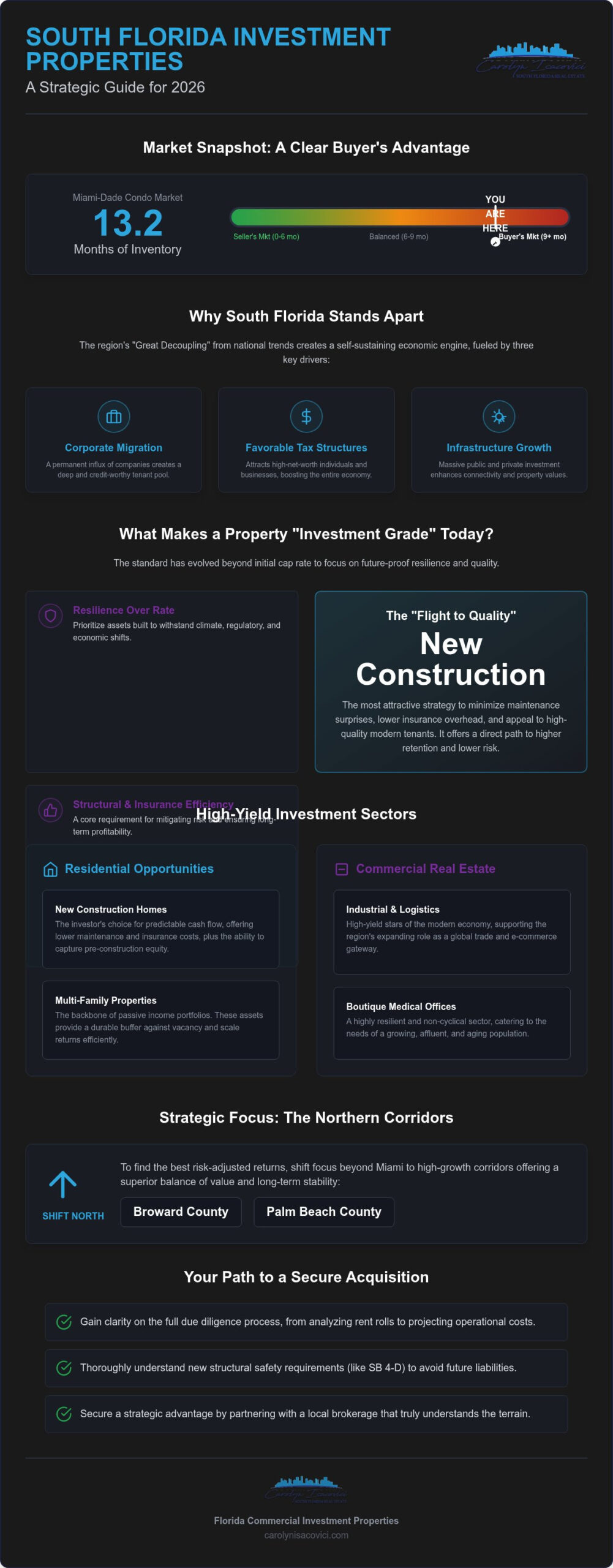
Did you know that while many national markets are tightening, Miami-Dade’s condo sector currently holds a 13.2-month supply of inventory? This shift signals a clear buyer’s market, offering a rare window for those looking to secure South Florida investment properties at a more favorable entry point than we have seen in years.
You have likely felt the pressure of rising insurance premiums and the weight of new structural safety regulations like SB 4-D. It is natural to feel cautious when these complexities dominate the conversation. However, we believe these moments of transition are exactly when the most disciplined investors find their greatest opportunities. It is simply a matter of having the right data and a steady hand to guide your capital toward the most resilient assets.
We will help you transform that uncertainty into a confident strategy for 2026. This roundup identifies high-growth corridors across Broward and Palm Beach counties, explains the essential balance between residential and commercial assets, and provides the clarity you need to choose a local brokerage partner who truly understands the terrain. By the end of this guide, you will have a clear path to high-yield opportunities in an evolving market.
Key Takeaways
- Explore how new construction homes provide a reliable path to lower maintenance and higher tenant retention in an evolving market.
- Uncover the high-yield potential within the commercial sector, focusing on the strategic growth of industrial logistics and boutique medical office spaces.
- Shift your focus to the northern corridors, where Broward and Palm Beach counties offer a unique balance of value and long-term stability.
- Secure a strategic advantage by identifying South Florida investment properties that offer the best risk-adjusted returns through 2026 and beyond.
- Gain clarity on the due diligence process, from analyzing rent rolls to understanding structural safety requirements, to ensure a secure and profitable acquisition.
The South Florida Investment Landscape in 2026
Capital doesn’t just wander; it seeks stability and growth. Why does the South Florida region continue to attract record levels of domestic and international investment? It’s because this market has achieved what analysts call the “Great Decoupling.” While other national markets may struggle with volatility, South Florida’s unique mix of corporate migration, favorable tax structures, and massive infrastructure growth creates a self-sustaining economic engine. We view these cycles not as hurdles, but as opportunities to refine your strategy with a steady, confident hand.
What defines South Florida investment properties in this current environment? It’s no longer just about buying a piece of the sun. In 2026, an investment property is defined by its ability to withstand climate and regulatory shifts while tapping into the influx of high-net-worth residents. Corporate relocations to hubs like Miami and West Palm Beach have shifted from a trend to a permanent fixture of the economy, providing a deep pool of credit-worthy tenants for both residential and commercial assets.
The Shift Toward Resilient Asset Classes
Are you looking for safety or scale? Investors are increasingly prioritizing recession-resistant assets that offer predictable cash flow. Multi-family housing remains a cornerstone of the 2026 portfolio because the demand for quality rentals continues to outpace supply. Similarly, industrial and logistics properties have become high-yield stars as they support the region’s growing role as a global trade gateway. The “South Florida Corridor” represents a unified investment zone stretching from the urban density of Miami through the commercial hubs of Broward and into the high-wealth enclaves of Palm Beach.
What Makes a Property “Investment Grade” Today?
Is the market overpriced? This is the question we hear most often. While entry costs are higher than in previous decades, “investment grade” is now measured by future-proofing rather than just the initial cap rate. Today, a top-tier property must account for structural integrity and insurance efficiency from the outset. This is why new construction has become so attractive; it offers a “flight to quality” that minimizes maintenance surprises and appeals to modern tenants. Identifying high-growth neighborhoods requires looking beyond the obvious luxury zip codes to areas where infrastructure projects are just beginning to break ground. By focusing on these fundamentals, you can navigate the competitive environment with the wisdom of a seasoned strategist.
Residential Opportunities: From New Construction to Multi-Family
The residential sector is undergoing a significant transformation. According to the latest housing market data, home sales across the state increased by 7.8% in the first half of 2026. This momentum isn’t just a byproduct of population growth; it’s a reflection of a fundamental shift in where capital is moving. Investors are increasingly seeking South Florida investment properties that offer a blend of capital appreciation and operational simplicity. While the statewide median single-family home price reached $425,000 in July 2026, the real story lies in the specific pockets of growth where demand remains insatiable.
The Case for New Construction Homes in Florida
Why are seasoned investors prioritizing new builds? It comes down to predictability. Modern energy standards and comprehensive builder warranties significantly reduce the maintenance overhead that can often erode rental margins. When buying new construction homes Florida, you’re essentially securing an asset that is already “future-proofed” against the rising costs of insurance and repairs. In markets like Broward County, where the median sale price hit $645,000 in June 2026, securing pre-construction pricing allows you to capture equity before the first tenant even moves in. This “flight to quality” is particularly relevant given the recent structural safety regulations affecting older buildings.
Miami Multi-Family: Scaling Your Portfolio
Multi-family assets remain the backbone of passive income. Whether you’re looking at a duplex in an emerging neighborhood or a small apartment complex near a major employment hub, these properties provide a necessary buffer against vacancy. Finding the right residential investment property Miami requires a keen eye for transit corridors and corporate relocation trends. With the median home price in Miami holding at $584,000 as of August 2026, the rental market continues to see strong pressure from professionals who prefer the flexibility of high-end rentals. Managing these assets effectively involves understanding local regulations and maintaining a standard that attracts long-term, reliable tenants. For investors seeking a deeper understanding of how transactions are structured in this environment, our analysis of Miami investment property sales reveals how nearly half of all local deals are now closed in cash and what that means for your acquisition strategy.
The path to a resilient portfolio is built on clarity and timing. If you’re ready to see how these trends translate into specific opportunities, you can view our current residential inventory to find a property that fits your strategic vision. We’re here to ensure your transition into the South Florida market is both profitable and seamless.
Commercial Real Estate: Diversifying into High-Value Sectors
While residential assets provide a familiar entry point, the commercial sector offers a distinct brand of stability. Why do sophisticated investors often pivot toward commercial assets? It’s the security of long-term leases and the potential for triple-net structures that shift maintenance costs to the tenant. According to a recent Southeast Florida housing market analysis, the regional economy is diversifying rapidly, creating a ripple effect across industrial and office sectors. For those seeking South Florida investment properties with lower turnover, commercial assets are the logical next step in a strategic portfolio.
Industrial Property for Sale: The Logistics Boom
Industrial assets have become the high-yield stars of the 2026 market. This isn’t a coincidence. Proximity to PortMiami and the Fort Lauderdale-Hollywood International Airport is critical for businesses managing global supply chains. As e-commerce matures, the demand for “last-mile” delivery warehouses has intensified, keeping vacancy rates low. In the first half of 2026, cap rates for South Florida commercial assets ranged from 3.5% to 6.5%, depending on the specific class and location. Broward County multifamily and industrial assets, for instance, averaged between 4.5% and 5.5%, offering a compelling balance of risk and reward for those looking to scale beyond single-family homes.
Boutique Office and Medical CRE
The office market isn’t disappearing; it’s evolving. We are seeing a powerful “flight to quality” where tenants prioritize modern, boutique spaces over sprawling, dated floor plans. This trend is particularly evident when looking at Miami office space for sale, where high-end amenities and prime locations in Edgewater or Wynwood command a premium. Medical office buildings also show incredible resilience. Florida’s demographic shift continues to drive demand for healthcare services, making medical CRE a cornerstone for investors who value long-term tenant retention and recession-resistant income. Retail opportunities are also shifting toward high-traffic mixed-use developments, where foot traffic is built into the design, ensuring that your commercial investment remains a vibrant part of the community’s daily life.
Strategic Markets: Beyond Miami to the Gold Coast
Is your capital limited to Miami’s skyline? While Miami often captures the headlines, the most savvy capital is quietly moving north along the coast. We believe the true strength of South Florida investment properties in 2026 lies in the “Gold Coast” corridor, where value and stability meet. In Broward County, the market has transitioned into a clear buyer’s territory with a 9.84-month supply of inventory. With a median sale price of $645,000 as of June 2026, Broward offers a strategic middle ground between Miami’s intensity and the premium pricing of the northern enclaves.
High-density zones like Hollywood and Hallandale Beach are seeing significant interest. These areas benefit from their proximity to major transit hubs and coastal amenities, yet they often provide more accessible entry points for multi-family and residential investors. It’s about finding the balance between current yield and future growth. We see these pockets as essential for a diversified portfolio that seeks to hedge against the volatility of single-city exposure.
Palm Beach County: Stability and Appreciation
Why are institutional investors moving North to secure South Florida investment properties that offer both luxury and stability? It is the “Wall Street South” effect. As financial firms relocate to West Palm Beach, the demand for high-end residential and boutique commercial space has surged. Palm Beach County saw a remarkable 11.82% year-over-year price increase, reaching a median of $700,000 by mid-2026. Markets like Palm Beach Gardens and Jupiter are no longer just retirement havens; they are now primary targets for long-term appreciation. This northward migration of wealth is creating a “flight to quality” that stabilizes the market even during broader economic shifts.
The Treasure Coast: The Next Frontier
Looking for the next wave of growth? The Treasure Coast, including Port Saint Lucie and Vero Beach, represents the frontier of affordability. This region is attracting a new generation of remote professionals and families seeking lower costs of living without sacrificing the Florida lifestyle. New construction trends in Palm City and Fort Pierce are particularly strong, as developers respond to the demand for modern, storm-resilient homes. Long-term appreciation forecasts for these northern markets remain optimistic, driven by infrastructure improvements and a steady influx of residents from higher-priced southern counties.
The geographic diversity of the region is its greatest asset. If you are ready to explore these high-growth pockets, you can contact our team for a personalized market analysis. We are here to help you navigate these diverse sub-markets with the confidence and precision that only deep local knowledge can provide.
Navigating the Acquisition: Expert Guidance and Strategy
Why do some acquisitions become cornerstones of wealth while others create unforeseen friction? The answer often lies in the depth of the partnership between the investor and their guide. In a market as nuanced as this one, having a specialized broker isn’t just a convenience; it’s a strategic necessity. We’ve seen various cycles since 2006, and we know that the most successful South Florida investment properties are those secured through a combination of analytical rigor and local intuition.
Evaluating the “True” Cap Rate in 2026 requires looking beyond the immediate cash flow. With interest rates for investment properties currently hovering between 7.3% and 7.8%, your margin for error is slimmer than in previous years. You must account for the 0.75% effective property tax rate and the rising costs of insurance, which can range from $4,200 to over $10,000 annually depending on coastal proximity. A resilient strategy isn’t built on optimistic guesses; it’s built on a steady, clear-eyed assessment of every operational expense. Understanding the competitive dynamics of Miami investment property sales in 2026, where cash buyers account for nearly half of all transactions, is essential context for structuring a winning offer.
The Due Diligence Process
Are you prepared for the complexities of Florida’s regulatory landscape? The due diligence phase is where the most critical work happens. For commercial assets, this means a deep dive into environmental reports and a meticulous audit of rent rolls to ensure tenant stability. In the residential sector, especially with older condominiums, you must verify the status of the Structural Integrity Reserve Study (SIRS) mandated by SB 4-D before the December 31, 2026, deadline. Understanding how to evaluate investment property Florida involves more than just checking a price tag; it requires a comprehensive look at the financial health of the association or the physical state of the building. Local market knowledge is the lens that brings a property’s true potential into focus, turning raw data into a reliable roadmap.
Closing the Deal and Managing Growth
How do you transition from a successful closing to long-term asset management? The end-to-end sales process involves navigating closing costs that typically range from 2% to 5% of the purchase price. Once the keys are in hand, the focus shifts to preserving value and maximizing growth. Whether you are managing a multi-family complex in Broward or a boutique office space in Miami, your strategy must remain flexible enough to adapt to market normalization. We believe that a well-structured portfolio is one that grows with the region, benefiting from the steady influx of capital and residents that defines this unique economy. Ready to explore? Contact Florida Commercial Investment Properties today to begin your next chapter with a partner who is deeply invested in your success.
Building Your Resilient Future in the Sunshine State
Success in this market isn’t about chasing the latest headline; it’s about identifying the steady currents of growth that others might overlook. We’ve explored how the Gold Coast corridor and the Treasure Coast are offering new value plays, and how modern, energy-efficient construction is becoming the gold standard for risk-averse investors. By shifting your focus toward these resilient asset classes and maintaining a rigorous approach to due diligence, you can transform market complexity into a distinct strategic advantage.
Finding the right South Florida investment properties requires a partner who has navigated every cycle since 2006. Our advisory-led approach ensures that every acquisition in Miami, Fort Lauderdale, or the Palm Beaches is backed by deep local insight and a commitment to your long-term success. We handle the intricacies of the end-to-end sales process so you can focus on the growth of your portfolio with total confidence.
Are you ready to turn these insights into action? Secure Your Next South Florida Investment Opportunity with Carolyn Isacovici and benefit from expert brokerage services designed for the modern investor. The opportunities of 2026 are within reach, and we are here to guide you every step of the way.
Frequently Asked Questions
Is South Florida a good place for real estate investment in 2026?
South Florida remains a premier choice for 2026 because the market has stabilized after years of rapid growth. While national trends might show volatility, this region benefits from a “Great Decoupling” driven by continuous corporate relocations and a favorable tax climate. Investors find confidence in the steady demand for both housing and commercial space. It’s a landscape where timing and local insight allow you to transform market normalization into a long-term strategic advantage.
What is the average cap rate for Miami investment property?
Average cap rates in the region vary significantly by asset class and specific location. For luxury condos in Miami-Dade, you can expect cap rates between 3.5% and 4.5%. If you are looking for slightly higher yields, multifamily assets in Broward County have recently averaged between 4.5% and 5.5%. These figures reflect a healthy, balanced market where investors can still find reliable returns by matching their capital to the right neighborhood and property type.
How does commercial vs residential investment in Florida compare?
Choosing between commercial and residential assets depends on your goals for stability versus liquidity. Commercial properties often provide longer lease terms and triple-net structures, which shift maintenance costs to the tenant. Residential properties, particularly multi-family units, offer consistent demand and easier entry points for many investors. Both sectors are currently benefiting from the region’s economic diversification, allowing you to build a balanced portfolio that captures both high-yield logistics growth and steady rental income.
Are there still affordable investment opportunities in South Florida?
Affordable opportunities are still available if you look beyond the traditional luxury centers of Miami. The Treasure Coast, specifically Port Saint Lucie and Vero Beach, offers more accessible price points with significant growth potential. Additionally, pockets of Broward County currently indicate a buyer’s market with nearly 10 months of inventory. These areas allow you to secure South Florida investment properties without the high entry costs of the urban core while still benefiting from the region’s overall appreciation.
What are the benefits of buying new construction homes in Florida as an investor?
Investing in new construction offers a “flight to quality” that significantly reduces your operational risks. These properties come with builder warranties and meet the latest energy standards, which translates to lower maintenance costs and higher tenant appeal. Perhaps most importantly, new builds often qualify for lower insurance premiums because they adhere to the most stringent modern building codes. This predictability makes new construction a cornerstone for investors who prioritize long-term stability and minimal management friction.
How do I find high-yield commercial real estate opportunities in Florida?
Finding high-yield opportunities requires focusing on sectors with high barriers to entry and sustained demand, such as industrial logistics and medical offices. Industrial properties near PortMiami or Fort Lauderdale-Hollywood International Airport are particularly resilient due to the ongoing e-commerce boom. Medical office buildings also offer stability, as Florida’s demographic shifts ensure a constant need for healthcare services. Partnering with a broker who understands these micro-markets is essential for identifying assets before they hit the open market.
What cities in South Florida have the highest property appreciation?
Palm Beach County has recently led the region in appreciation, with single-family home prices rising 11.82% year-over-year to a median of $700,000. Cities like Jupiter and Palm Beach Gardens are seeing a surge in value as high-net-worth professionals migrate north. Broward County cities like Hollywood and Hallandale Beach also show strong potential due to high-density development. These areas provide a reassuring combination of luxury appeal and long-term capital growth for disciplined investors.
Do I need a local broker to buy South Florida investment properties?
A local broker is indispensable for navigating the unique complexities of the Florida market, such as the SB 4-D condo safety laws. We provide the deep due diligence and “calm expert” guidance needed to ensure you don’t overpay in a competitive environment. Since 2006, our team has helped investors identify the most resilient South Florida investment properties. Having a partner on the ground ensures you understand every multi-city regulation and can close deals with absolute confidence.
Leave a Reply