What if the most significant asset in your 2026 portfolio isn’t a high-rise office, but a strategic distribution hub positioned perfectly for the last-mile economy? It’s a question many investors are asking as they look at a landscape where industrial space has become the bedrock of regional commerce. You likely feel the pressure of a tightening market, where finding a quality Miami warehouse for sale often feels like searching for a needle in a very expensive haystack. With small-bay vacancy rates hovering at a lean 4.2 percent, the frustration of rising land costs and complex zoning regulations is a reality we all recognize.
There’s a path through this complexity. We’re here to provide the strategic framework you need to identify and secure high-yield warehouse opportunities in this competitive environment. By the end of this guide, you’ll understand which sub-markets are currently offering the most attractive cap rates and how to manage the specific environmental hurdles of Miami-Dade. We will explore the shift toward modern Class-A facilities and the essential steps to partnering with experts who can grant you access to the off-market inventory that rarely hits the public listing sites.
Key Takeaways
- Understand the evolution of Miami’s industrial sector and why these assets now serve as the primary drivers of regional ROI.
- Navigate the nuances of different asset classes, from versatile flex spaces to high-demand last-mile delivery hubs.
- Pinpoint high-yield corridors like Airport West and Hialeah to refine your search for a Miami warehouse for sale in 2026.
- Secure your investment by mastering the critical due diligence steps required to clear environmental and zoning hurdles in Florida.
- Gain a strategic advantage by learning how professional brokerage unlocks off-market inventory that isn’t available to the general public.
The 2026 Miami Industrial Landscape: Why Warehouses Are the New Gold
Miami’s identity has undergone a profound transformation. While it remains a premier global destination for travel, the true engine of the city’s economy has shifted toward the concrete and steel of industrial corridors. Why has this happened? The answer lies in the city’s unique geography. It serves as the primary gateway between the Americas and the global market, turning industrial assets into “gold” for savvy investors who recognize that land is finite but demand is not.
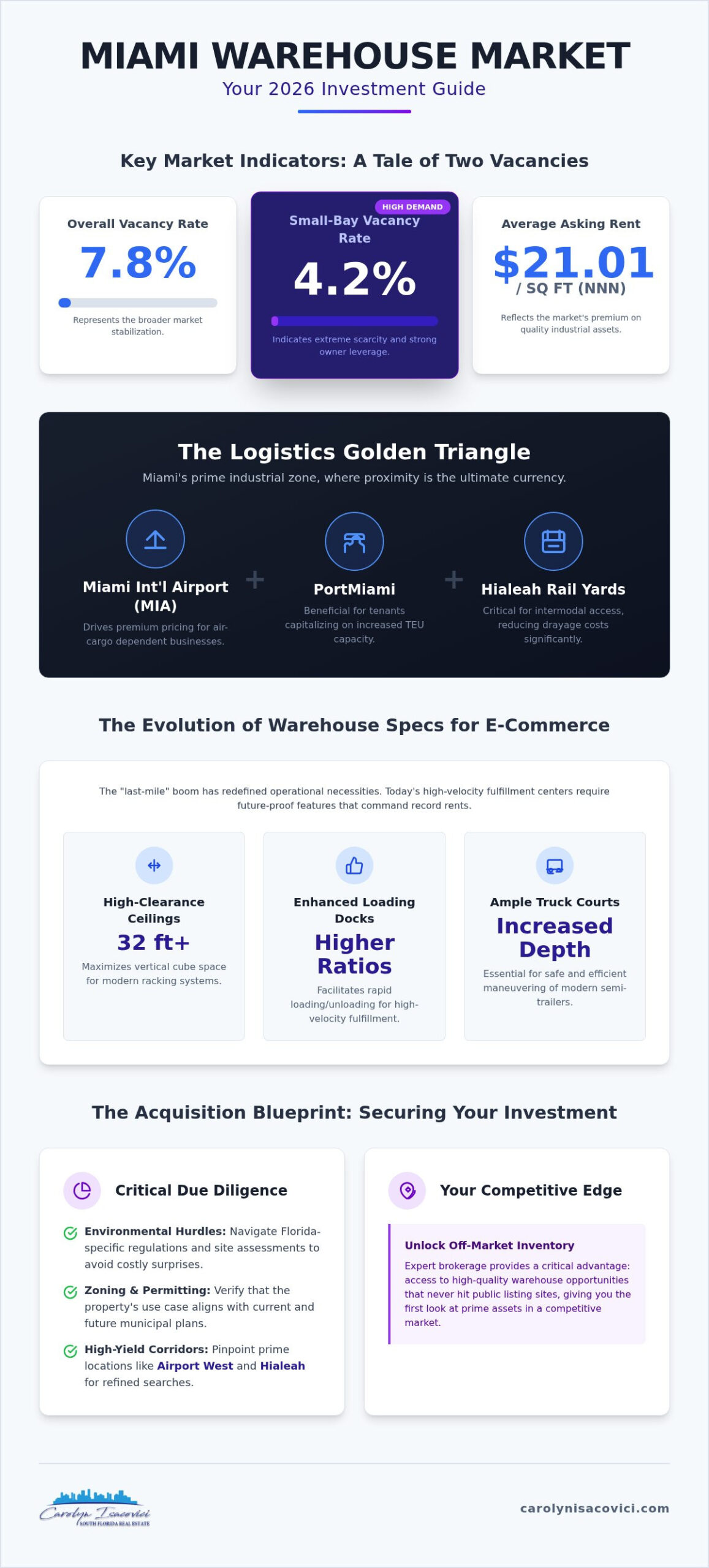
In 2026, the data tells a story of stabilization and strength. Despite broader economic shifts, the industrial sector remains Florida’s most resilient asset class. The average asking rent has climbed to $21.01 per square foot (NNN) as of the third quarter, reflecting a market that rewards quality. Finding a Miami warehouse for sale requires a nuanced understanding of these metrics. While the overall vacancy rate sits at 7.8 percent, the real story is in the small-bay market, where vacancy is a remarkably tight 4.2 percent. This scarcity drives consistent value for owners and keeps competition high for prime assets.
The PortMiami and MIA Connection
Proximity is the ultimate currency in Miami real estate. Properties located near Miami International Airport (MIA) or PortMiami command a significant premium because they minimize the time and cost of moving goods. Speed is everything in 2026. Intermodal connectivity allows businesses to shift cargo seamlessly from ship to rail to air, bypassing the congestion that slows down less strategic locations. The Logistics Golden Triangle is the prime industrial zone bounded by PortMiami, Miami International Airport, and the Hialeah rail yards.
- MIA Proximity: Dictates higher price-per-square-foot due to air-cargo reliance.
- Port-Adjacent Assets: Benefit from the recent PortMiami expansions and increased TEU (twenty-foot equivalent unit) capacity.
- Intermodal Access: Reduces drayage costs, making these properties highly attractive to institutional tenants.
E-commerce and the 2026 Supply Chain
The “last-mile” boom has redefined what tenants need. It isn’t just about storage anymore; it’s about high-velocity fulfillment. If you are exploring what is a warehouse in the modern sense, you’ll find that today’s facilities are sophisticated tech hubs. E-commerce tenants are willing to pay record rents for modern specs that allow them to fulfill orders in hours rather than days. When you evaluate a Miami warehouse for sale, look for features that future-proof the investment.
Modern fulfillment requires high-clearance ceilings, often 32 feet or higher, to maximize vertical cube space. Enhanced loading dock ratios and ample truck court depths are no longer luxuries; they’re operational necessities. Investors who secure properties with these modern specifications are positioning themselves at the center of a permanent shift in consumer behavior, ensuring their assets remain in high demand regardless of broader market fluctuations.
Decoding Warehouse Types: From Flex Space to Last-Mile Distribution
Choosing the right property requires more than just looking at square footage. It’s about matching the building’s physical DNA to the tenant’s operational needs. Are you looking for a stable, multi-tenant property or a high-velocity fulfillment center? According to recent Miami industrial market data, the diversity of assets in South Florida allows for a tailored approach to risk and reward. Understanding these distinctions is the first step toward securing a high-value Miami warehouse for sale that aligns with your long-term strategy.
Flex Industrial: The Versatile Choice
Flex space is the chameleon of the industrial world. These properties typically feature a higher ratio of office or showroom space compared to traditional warehouses, often ranging from 25 percent to 50 percent office build-out. Why is this attractive? Small-to-medium businesses drive this demand. They need a professional front-facing office combined with functional back-end storage. In mixed-use zoning areas, flex properties often command higher rents per square foot because they cater to a broader range of service-based businesses, from specialized tech firms to boutique distributors.
Distribution and Logistics Hubs
For those targeting institutional-grade investments, distribution hubs are the gold standard. These facilities are built for speed and volume. In the 2026 market, Class A assets are defined by their efficiency. You’ll want to look for 32-foot clear heights, ESFR (Early Suppression, Fast Response) sprinkler systems, and significant truck court depths. Trailer parking is another critical factor. As logistics companies face tighter delivery windows, the ability to stage trailers on-site becomes a massive competitive advantage.
While Class A properties offer the newest tech, Class B assets shouldn’t be overlooked. These older buildings often sit in land-locked infill locations closer to the urban core. They might have lower ceilings, but their proximity to the consumer base can lead to superior cap rate optimization for investors who value location over modern aesthetics. Finding the right balance between building age and location is where many investors find their greatest success.
Don’t forget the specialized niches. Cold storage remains a high-barrier, high-reward sector in South Florida, driven by our proximity to international food supply chains. It’s a complex niche, but the returns often reflect the specialized nature of the equipment. Whether you’re interested in a specialized facility or a standard bay, having an advisor who understands these operational nuances is essential. You can explore our current investment property sales to see how these different asset types perform in the current market landscape.
Location Strategy: Mapping Miami’s High-Yield Industrial Corridors
Success in commercial real estate is often a matter of geography. In Miami, the “best” location depends entirely on your operational goals. Are you prioritizing immediate access to international cargo, or is a deep local labor pool your main concern? As you evaluate a Miami warehouse for sale, it’s helpful to view the map through the lens of specialized corridors. Each area offers a unique balance of accessibility, zoning flexibility, and long-term value.
Airport West and Doral: The Premium Choice
Doral remains the crown jewel of the South Florida industrial market. It isn’t just about proximity to the airport; it’s about the ecosystem. This area hosts a high concentration of corporate headquarters and international trade firms, creating a synergy that supports consistently high property valuations. While entry prices here are among the highest in the county, the stability of the tenant base provides a reassuring layer of security. Investors in the Airport West corridor are paying for prestige and a location that is essentially irreplaceable in the global supply chain.
Medley and Hialeah: The Industrial Workhorses
If Doral is the front office, Medley and Hialeah are the engine room. Medley is particularly valuable for its heavy industrial zoning, which allows for specialized operations that are restricted in other sub-markets. This flexibility makes it a magnet for manufacturing and recycling firms. Hialeah offers a different advantage: a massive, skilled labor pool and historical significance as a hub for local production. Both areas benefit from exceptional connectivity to the Palmetto Expressway and Florida’s Turnpike, ensuring that goods can move north or south with minimal friction.
We are also seeing a strategic shift toward emerging hubs. Opa-locka and North Miami are attracting attention as urban infill opportunities become scarce in the traditional core. These areas often offer more competitive entry points while still providing the “last-mile” proximity that e-commerce tenants crave. For those with a longer investment horizon, the South Dade expansion is a frontier worth watching. This region offers something increasingly rare in Miami-Dade: available land for larger footprints. While it requires a visionary approach, the ongoing infrastructure improvements suggest these southern zones will be essential links in the 2026 logistics network. Securing a Miami warehouse for sale in these growth corridors can be a brilliant move for those focused on significant capital appreciation.
The Acquisition Blueprint: Due Diligence and Market Navigation
Securing a Miami warehouse for sale is a significant milestone, but the path to a successful closing is paved with meticulous verification. How do you transform a promising listing into a secure, high-performing asset? It starts with a disciplined approach to due diligence that looks far beyond the surface of the building. You aren’t just buying square footage; you’re acquiring a complex set of legal permissions and physical capabilities that must align with your investment goals.
Beyond the paperwork, the physical integrity of the asset is paramount. Does the roof have a remaining life of at least ten years? Are the floor slabs thick enough to support the heavy racking systems modern tenants require? Even the electrical capacity can be a deal-breaker if a tenant plans to implement advanced automation or cold storage. These physical attributes aren’t just maintenance items; they’re the foundation of your asset’s marketability and long-term value.
Environmental and Zoning Hurdle
Environmental assessments are your first line of defense, especially in Miami’s older industrial corridors where legacy soil contamination can be a hidden liability. A Phase I assessment is standard, but don’t be surprised if the results necessitate a Phase II to ensure the ground beneath your feet is as clean as the deal itself. Simultaneously, you must decipher Miami-Dade County’s specific zoning codes. Whether it’s IU-1 for light industrial use or the more flexible IU-3 for unlimited manufacturing, the code determines what your tenants can actually do on-site. The highest and best use of a Miami warehouse is the legally permissible, physically possible, and financially feasible use that results in the highest property value.
Financial Due Diligence for 2026
Financial modeling in 2026 requires a steady hand and a sharp eye for detail. With average industrial cap rates sitting at 5.9 percent as of the third quarter, the margin for error has tightened. You must account for the local tax environment, including a total millage rate of approximately 17.59 mills, and the rising costs of property insurance. These factors directly impact your net operating income and your ultimate yield. To master these calculations, you can explore our guide on how to evaluate investment property Florida.
Navigating these complexities is easier when you have a partner who understands the local nuances of the South Florida market. If you’re ready to move from analysis to action, we invite you to review our current investment property sales to find an asset that meets your criteria.
Securing Your Investment: Why Expert Brokerage is Your Competitive Edge
Why do some investors always seem to find the right property while others are left browsing outdated listings? Finding a Miami warehouse for sale in 2026 is a task that requires more than just an internet connection; it requires a network. In a climate where vacancy rates for small-bay warehouses are at a razor-thin 4.2 percent, the traditional route of searching public databases often leads to a dead end. This is where specialized brokerage becomes your most powerful tool. A seasoned guide doesn’t just find buildings. They navigate the unwritten rules of Miami-Dade real estate, from understanding the specific motivations of local sellers to anticipating the legal shifts in Florida’s 2026 commercial framework.
Managing the transition from offer to close is a complex dance of logistics and legalities. A specialized broker acts as the steady hand that keeps the deal on track when environmental hurdles or zoning nuances arise. They ensure that your acquisition isn’t just a transaction, but a strategic step toward building a resilient industrial portfolio. By partnering with a firm that views the market through a lens of long-term value, you transform the stress of a competitive market into a sense of clear opportunity.
The Value of Local Relationships
The most coveted deals in the 2026 market often happen behind closed doors. Institutional buyers and private family offices frequently prefer quiet transactions to avoid the noise of a public bidding war. By the time a property appears on major listing sites, it has often been picked over by those with early access. Carolyn Isacovici’s approach focuses on these high-value property holdings, leveraging deep-rooted connections to secure assets before they are widely known. This insider perspective is essential for identifying new construction or pre-leased facilities that offer immediate, reliable cash flow.
Your Next Steps in the Miami Market
Success starts with clarity. You need to define your investment criteria early, determining your preferred scale, target sub-markets like Doral or Medley, and a realistic budget for 2026 valuations. Timing is everything. When an opportunity for a Miami warehouse for sale arises, the ability to execute quickly separates the successful owner from the spectator. Planning for the long term is just as vital as the initial purchase. You can begin crafting your roadmap by reading about Florida real estate portfolio building to ensure every acquisition serves a larger strategic purpose.
Positioning Your Portfolio for the Next Logistics Cycle
The 2026 market offers a unique window for those who approach industrial assets with a strategist’s mindset. Success in this landscape isn’t about chasing every listing; it’s about understanding the synergy between modern specs and high-yield corridors. By prioritizing rigorous due diligence and focusing on the “last-mile” potential of infill locations, you turn market scarcity into a distinct advantage. Identifying the right Miami warehouse for sale requires a blend of data-driven analysis and the local relationships that reveal off-market opportunities.
Timing and insight are your greatest allies. We specialize in high-yield Florida commercial investments, providing the expert guidance and end-to-end brokerage support you need to secure high-value property holdings. Whether you’re expanding an existing footprint or entering the Miami market for the first time, our firm is here to ensure your transaction is smooth and strategically sound. Secure your Miami industrial asset with Carolyn Isacovici and move forward with confidence. The future of South Florida logistics is bright, and your place within it is waiting.
Frequently Asked Questions
What is the average price per square foot for a Miami warehouse in 2026?
The average sale price for industrial space in Miami-Dade County reached approximately $280 per square foot as of the third quarter of 2026. This figure acts as a general benchmark for the market. Specific prices for a Miami warehouse for sale can fluctuate based on proximity to the airport or port. Modern Class-A facilities typically command a premium, while older infill properties might offer a more accessible entry point for investors.
Which Miami neighborhoods are best for last-mile distribution centers?
Doral and the Airport West corridor remain the premier choices for last-mile distribution due to their immediate proximity to Miami International Airport. Hialeah and Medley are also highly effective hubs, offering exceptional access to major arteries like the Palmetto Expressway. For those seeking emerging value, Opa-locka and North Miami provide strategic urban infill opportunities. These locations allow businesses to reach dense consumer populations quickly, which is the primary goal of any last-mile strategy.
What are the most common zoning codes for industrial property in Miami-Dade?
Industrial operations in Miami-Dade are primarily governed by IU-1, IU-2, and IU-3 zoning codes. IU-1, or Light Industrial, is the most common designation, accommodating a wide range of wholesale and distribution activities. Understanding these codes is vital because they dictate everything from allowable noise levels to the types of materials stored on-site. We recommend verifying the specific land-use regulations for any property to ensure it supports your intended business operations without legal friction.
How do I check for environmental issues before buying a Florida warehouse?
Performing a Phase I Environmental Site Assessment (ESA) is the standard first step to identify potential contamination or historical liabilities. If the Phase I report suggests concerns, a Phase II assessment involving soil or groundwater sampling becomes necessary. In Florida’s industrial zones, these checks are essential for protecting your investment capital. Working with a specialized broker ensures you have the right consultants to navigate these technical evaluations before your closing date arrives.
Are there tax incentives for buying commercial property in Miami?
Florida’s lack of a state personal income tax remains a significant indirect incentive for individual investors and business owners. Certain areas within Miami-Dade may also qualify for federal benefits if they are located within designated growth zones. While the 2025 millage rate is approximately 17.59 mills for taxes due in 2026, we advise consulting with a tax professional. They can help you explore specific local credits or exemptions that might apply to your commercial property acquisition.
What is the typical cap rate for industrial real estate in South Florida right now?
The average cap rate for industrial real estate in the Miami market is approximately 5.9 percent as of late 2026. While this represents a stabilization from previous years, individual rates vary significantly by asset class. Class-A distribution centers in prime locations may see lower rates due to their stability. Finding a Miami warehouse for sale with an optimal cap rate requires balancing the age of the building against its potential for future rent growth.
Can I buy a warehouse in Miami for a 1031 exchange?
Industrial properties are excellent candidates for a 1031 exchange, allowing you to defer capital gains taxes by reinvesting proceeds into a like-kind asset. Many investors transition from residential or office holdings into the industrial sector to capture higher yields and stable tenant profiles. Because the 1031 process involves strict timelines, partnering with an experienced brokerage firm is essential. This helps you identify and secure a suitable replacement property within the required 45-day identification period.
Leave a Reply