What if the highest initial yield on paper is actually your riskiest bet? In Fort Lauderdale, commercial property value reflects long-term stability and resilience rather than sheer raw yield. If you’ve spent time reviewing recent offerings across Broward County, you already know how quickly an aggressive pro forma can unravel once property insurance premiums and realistic operating reserves take hold. Evaluating an authentic cap rate for commercial real estate Fort Lauderdale investments requires looking past surface marketing numbers to measure how durable an asset’s income stream will remain over time.
Turning that uncertainty into a strategic advantage starts with disciplined underwriting. This 2026 guide equips you to master commercial capitalization rates across retail, industrial, office, and multifamily properties so you can accurately benchmark yields, project realistic operating expenses, and spot genuine value. We’ll break down current sector baselines across Greater Fort Lauderdale, examine reliable methods to calculate Net Operating Income in our coastal market, and identify the submarkets best positioned to deliver steady cash flow alongside capital preservation.
Key Takeaways
- Learn how evaluating an authentic cap rate for commercial real estate Fort Lauderdale properties helps you balance long-term asset stability against headline yields.
- Benchmark 2026 capitalization rate profiles across primary asset classes, including industrial logistics hubs, multifamily assets, retail centers, and modern office spaces.
- Discover how to recalibrate seller pro formas using authentic Broward County operating figures, accounting directly for local tax millage and commercial property insurance shifts.
- Examine geographic pricing variances between high-barrier submarkets like Downtown Las Olas and emerging opportunities across suburban corridors.
- Master a disciplined pre-acquisition due diligence process that spots hidden lease concessions and protects your net operational margins.
Understanding Cap Rates in the Fort Lauderdale Commercial Real Estate Market
Numbers tell a story, but only if you know how to read them. Far too many investors view capitalization rates simply as an isolated return percentage shown on a listing flyer. In reality, a capitalization rate functions as a live indicator of perceived risk, operational stability, and forward-looking growth. When you analyze a cap rate for commercial real estate Fort Lauderdale properties, you are not just measuring yield. You are pricing the tenant’s likelihood of paying rent on time and the enduring appeal of the underlying parcel.
Following a massive surge in 2025 where Broward County commercial sales hit roughly $5.5 billion, the local market entered a measured digestion phase in 2026. Macroeconomic interest rate shifts have recalibrated expectations across the board. Rather than freezing activity, this normalization has rewarded disciplined buyers who recognize that compressed yields often accompany sustained tenant demand and high barriers to entry.
The Core Capitalization Rate Formula for South Florida Assets
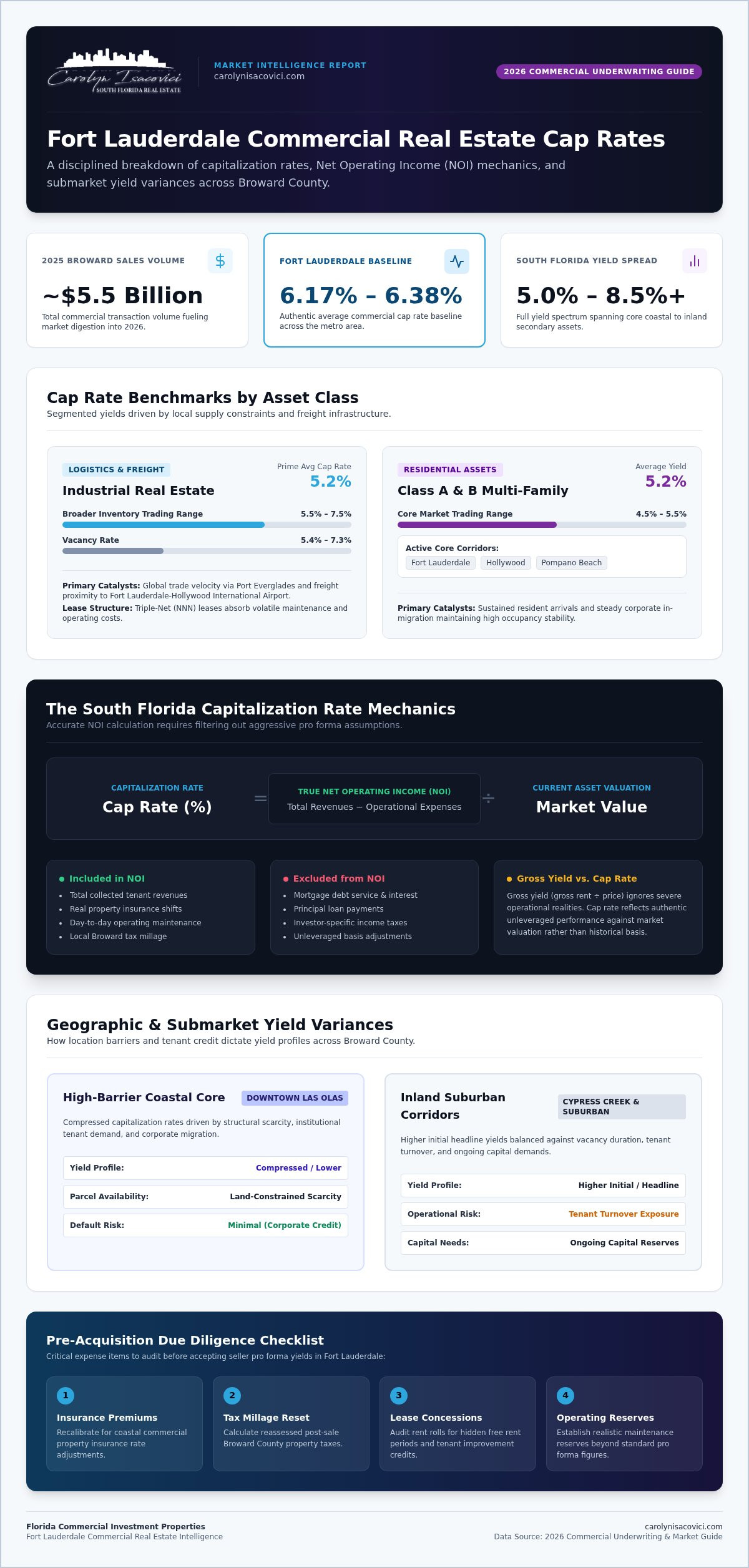
Precision matters. The formula divides a property’s Net Operating Income (NOI) by its current market value or purchase price:
- NOI Calculation: Authentic NOI equals total collected revenues minus day-to-day operational expenses, specifically excluding debt service, principal payments, and investor-specific income taxes.
- Gross Yield vs. Cap Rate: Gross yield simply divides annual gross rent by the purchase price, ignoring real-world expenses. In contrast, the cap rate reflects the true unleveraged operating return.
- Current Value Over Basis: Your calculations must use current market valuation rather than historical purchase basis to benchmark performance accurately.
Why Cap Rates Fluctuate Across the Fort Lauderdale Market
Why do two identical retail buildings just three miles apart trade at completely different yields? Creditworthiness and physical location dictate the spread. A long-term corporate lease backed by an investment-grade tenant commands a lower, more defensive yield because default risk remains minimal.
Simultaneously, sustained corporate migration into Southeast Florida continues to channel private capital into our core corridors. Land-constrained coastal parcels naturally command lower capitalization rates due to structural scarcity. Inland suburban properties, while offering higher upfront headline yields, reflect a different balance between vacancy risk, tenant turnover, and ongoing capital demands. Mastering the cap rate for commercial real estate Fort Lauderdale demands recognizing this delicate balance before committing capital.
Fort Lauderdale Commercial Cap Rates by Sector: Industrial, Retail, Office, and Multi-Family
Commercial performance in Fort Lauderdale is deeply segmented. While overall yields across South Florida span from 5.0% to 8.5% or higher, the baseline cap rate for commercial real estate Fort Lauderdale buyers encounter averages between 6.17% and 6.38%. Each asset class answers to its own supply realities, lease dynamics, and local demand drivers.
Industrial and Logistics Real Estate Performance
Logistics assets remain exceptionally competitive. Supported by global trade through Port Everglades and freight velocity near Fort Lauderdale-Hollywood International Airport, industrial vacancy holds near 5.4% to 7.3%. Cap rates for prime distribution hubs average 5.2%, with broader inventory trading between 5.5% and 7.5%. Triple-net (NNN) leases deliver steady, predictable cash flows because tenants absorb volatile maintenance and operational expenses, resulting in high retention rates across Broward County transport corridors.
Multi-Family and Retail Investment Yields
Steady resident arrivals continue to support residential and retail commercial space. For a broader statewide perspective, explore our Florida Commercial Real Estate: 2026 Investor’s Guide. Multi-family cap rates have compressed to an average of 5.2% for Class A and B assets, trading within a tight 4.5% to 5.5% range across Fort Lauderdale, Hollywood, and Pompano Beach, with vacancy sitting at 6.2%.
Retail properties average a 6.7% yield with regional vacancy hovering near 3.6% to 7.8%. Unanchored strip centers average around 6.4%, single-tenant net lease retail posts roughly 6.80%, while high-credit NNN storefronts trade between 5.0% and 6.25%. Active consumer spending along tourist and coastal strips continues to give retail landlords steady pricing power.
Office and Healthcare Real Estate Realities
Office assets reflect a distinct flight to quality. While general office vacancy reached 16.7% to 18.0% with average cap rates expanding to 7.9%, top-tier spaces tell a different story. Trophy Class A towers command $58.18 per square foot NNN, whereas Class B suburban parks offer attractive yield premiums for investors willing to actively manage renewals. Meanwhile, outpatient medical office facilities serve as highly resilient, defensive holdings insulated from remote work pressures. When underwriting these complex sector shifts, evaluating current tax assessments through the Broward County Property Appraiser is essential. You can consult with Carolyn Isacovici for tailored property acquisition guidance across these distinct sectors.
The Broward County NOI Formula: Factoring Insurance, Taxes, and Operating Expenses
Paper yields can be deceiving. A pro forma might project a stellar return, but if it relies on generic national expense ratios, your actual cash flow will disappoint. In Southeast Florida, accurate Net Operating Income calculations hinge on two heavily localized variables: windstorm insurance premiums and ad valorem property tax reassessments. Understanding how holding costs interact with your projected cap rate for commercial real estate Fort Lauderdale investments allows you to preserve your net margins and underwrite deals with confidence.
Commercial holding costs are manageable when anticipated early. Diligent buyers actively reserve for coastal wear, structural integrity reserves, and tropical weather mitigation. Reviewing the official Broward County economic assessment provides useful context on how local infrastructure investments and environmental factors shape long-term commercial asset valuation.
Navigating Florida Commercial Insurance and Windstorm Underwriting
Property casualty insurance requires immediate scrutiny. Annual insurance for a 5,000-square-foot retail strip in coastal Florida generally runs between $5,800 and $9,500, with costs climbing significantly higher for properties within one mile of the ocean. While reinsurance markets stabilized somewhat with an 11% reduction in 2025 renewals, state-backed Citizens filed for an average 10.4% commercial lines increase in mid-2026.
Mitigation pays tangible dividends. Modern hurricane impact glazing, certified roof tie-downs, and elevated mechanical systems meaningfully reduce underwriting risk. Structuring agreements under triple-net (NNN) terms passes these recurring operational spikes directly to commercial tenants, protecting your unleveraged return.
Property Tax Reassessment Realities in Broward County
Never rely on a seller’s existing tax bill. Under Florida statutes, a change in ownership triggers a property reassessment based on the new acquisition value in the following tax year. For Fiscal Year 2026, the estimated effective property tax rate across Broward County ranges from 0.94% to 1.44%, based on an average combined millage rate near 19.8394 mills.
If you purchase a long-held commercial building at a substantial premium over its historical assessed value, your millage liability will increase accordingly. For deeper operational frameworks, review How to Evaluate Investment Property in Florida: A Strategic 2026 Guide. Accounting for this adjustment ensures your projected cap rate for commercial real estate Fort Lauderdale remains an accurate guide for your capital allocation.
Submarket Variance: Evaluating Cap Rates from Downtown Las Olas to Cypress Creek
Location dictates performance. Treating Broward County as a monolithic market is one of the most common missteps an investor can make. In reality, the baseline cap rate for commercial real estate Fort Lauderdale buyers encounter swings considerably depending on the micro-neighborhood. Urban cores with limited dirt command compressed yields, while suburban commerce hubs trade at attractive premiums to compensate for broader physical availability.
Downtown Fort Lauderdale and the Las Olas Financial District
Downtown represents the premier financial core. Heavy foot traffic and intense corporate tenant demand keep capitalization rates tightly compressed along Las Olas Boulevard. Retail spaces here command peak asking rents ranging up to $75 per square foot NNN, buoyed by affluent residential towers that supply immediate ground-floor foot traffic. Investors in this submarket willingly trade lower upfront yields for elite liquidity, rapid tenant backfilling, and superior long-term capital preservation.
Cypress Creek, Uptown, and Suburban Commercial Corridors
Suburban corridors provide compelling cash-flow alternatives. Areas like Cypress Creek, Sunrise, and Plantation feature stabilized commercial parks where yields frequently run 100 to 150 basis points above the urban core. Strategic proximity to Interstate 95 and Florida’s Turnpike gives corporate flex parks enduring logistics value. Uptown Fort Lauderdale, supported by targeted zoning overlays, offers investors exceptional value-add upside through the repositioning of well-located corporate footprints.
The Maritime, Industrial, and Airport Logistics Corridors
Specialized commercial real estate thrives near our transit epicenters. Marine-focused industrial assets along State Road 84 serve Fort Lauderdale’s multibillion-dollar yachting sector, commanding exceptional tenant stickiness. Meanwhile, logistics facilities surrounding the Port Everglades Expressway benefit from severe geographic land constraints. Because new development is restricted by existing infrastructure and urban boundaries, warehouse asking rents have held firm between $12 and $22 per square foot NNN, keeping industrial yields resilient across airport corridors.
Identifying the exact balance between location prestige and operational yield takes seasoned local guidance. If you want to evaluate prime investment listings or source off-market opportunities across these dynamic submarkets, partner with Carolyn Isacovici for specialized commercial property sales across South Florida.
Strategic Due Diligence: Securing High-Yield Fort Lauderdale Commercial Property
Due diligence makes or breaks commercial returns. In Florida, real estate operates firmly under the principle of caveat emptor, or buyer beware. Relying on marketing decks without conducting independent underwriting invites avoidable surprises. Securing an authentic cap rate for commercial real estate Fort Lauderdale acquisitions requires a methodical review of operational records, physical structures, and tenant obligations.
Every commercial property type involves distinct risk profiles. If you are comparing non-residential cash flows against residential portfolios, our analysis on Commercial vs Residential Investment in Florida: The 2026 Strategic Comparison outlines those trade-offs clearly. Protecting your margins requires uncovering whether an asset’s past performance will match its future yield.
Auditing Leases, Rent Rolls, and Tenant Credit
Never take a rent roll at face value. A thorough lease audit separates headline numbers from collectible revenue:
- Tenant Estoppel Certificates: Require signed estoppel letters directly from occupants to verify rent rates, security deposits, and ensure no unrecorded side agreements exist.
- Concessions and Abatements: Examine historical rent rolls to confirm that stated yields do not hide unamortized tenant improvement allowances or temporary free rent periods.
- Reimbursement Reconciliations: Confirm that operating expense pass-throughs for maintenance, insurance, and utilities match real-world year-end reconciliations.
- Lease Expirations: Map rollover timelines to avoid clustered lease terminations that could spike unexpected vacancy.
Partnering with Local Commercial Investment Specialists
Local relationships unlock real value. Sourcing under-managed retail plazas or off-market distribution facilities often happens well before properties hit public exchanges. For investors executing time-sensitive 1031 tax-deferred exchanges, having immediate access to pre-vetted inventory helps you satisfy statutory identification deadlines without sacrificing return standards.
Working alongside an experienced brokerage partner ensures your underwriting accounts for local municipal zoning, ongoing code compliance, and localized operational shifts. Since 2006, our brokerage team has guided private capital and institutional buyers through complex South Florida market cycles. If you are ready to evaluate vetted opportunities and identify the right cap rate for commercial real estate Fort Lauderdale holdings, connect directly through Florida Commercial Investment Properties to discuss your acquisition strategy.
Positioning Your Commercial Portfolio for Sustained Value
Navigating South Florida’s evolving commercial landscape comes down to operational clarity. When you look beyond generic marketing pro formas and accurately underwrite coastal operating expenses, insurance adjustments, and municipal taxes, you turn market complexity into a distinct advantage. Whether you’re targeting prime core assets along Las Olas or seeking yield premiums in suburban logistics corridors, evaluating an authentic cap rate for commercial real estate Fort Lauderdale properties ensures your capital works effectively from day one.
Achieving sustained performance requires both analytical discipline and genuine boots-on-the-ground perspective. As a dedicated commercial and investment sales brokerage advising local and national investors across Broward County, Miami-Dade, and Palm Beach since 2006, our team helps you uncover vetted opportunities and navigate complex transaction cycles smoothly. When you’re ready to secure properties that balance resilient income with long-term appreciation, partner with Florida Commercial Investment Properties to move forward with total confidence.
Frequently Asked Questions
What is considered a good cap rate for commercial real estate in Fort Lauderdale?
A solid return depends on the asset class and your risk tolerance, but prime commercial properties in Fort Lauderdale generally trade between 5.0% and 7.0%. High-demand industrial and Class A multifamily assets compress near 5.2%, whereas suburban retail and office properties often range between 6.5% and 8.0%. A good cap rate for commercial real estate Fort Lauderdale buyers target reflects durable tenant credit and low vacancy rather than just an inflated upfront percentage.
How do high insurance costs in South Florida affect commercial property cap rates?
Surging insurance costs compress actual net operating income, which directly lowers operational yield unless owners pass those expenses through to tenants. In coastal Broward County, premiums for windstorm and flood coverage represent a major portion of overall operating overhead. If an investor underwrites a deal using generic national insurance ratios rather than authentic local quotes, their real-world capitalization rate will fall significantly below initial marketing expectations.
What is the difference between cap rate and cash-on-cash return for commercial assets?
Cap rate evaluates a property’s unleveraged profitability by dividing net operating income by the purchase price, assuming an all-cash acquisition. Cash-on-cash return measures the actual annual cash flow against the specific equity invested, factoring in ongoing mortgage debt service. While the cap rate benchmarks the inherent operational performance of the real estate, cash-on-cash return reflects your levered return based on how you finance the deal.
Why do industrial properties in Fort Lauderdale often have lower cap rates than office buildings?
Industrial assets trade at lower cap rates because tenant demand remains exceptionally strong while supply is structurally constrained. Geographic boundaries, alongside freight hubs like Port Everglades and the airport, restrict new warehouse development. In contrast, office buildings face elevated vacancy rates near 17% to 18% and ongoing workplace shifts, prompting investors to demand higher cap rates to offset tenant turnover, longer downtime, and expensive improvement allowances.
How does Broward County reassess property taxes after a commercial sale?
Under Florida law, a commercial property sale triggers an ad valorem reassessment by the Broward County Property Appraiser the year following the transaction. The appraiser adjusts the assessed value closer to the recorded purchase price, resetting any statutory assessment caps held by the prior owner. Accurately projecting your cap rate for commercial real estate Fort Lauderdale purchases requires accounting for this reset millage burden rather than relying on historical tax bills.
Can triple-net (NNN) leases protect investors from rising operating expenses in Florida?
Yes, triple-net leases provide powerful protection because tenants assume responsibility for property taxes, building insurance, and common area maintenance. When coastal insurance premiums or municipal tax assessments rise, those expenses pass directly through to the occupant rather than reducing your net cash flow. This structure insulates your returns against local cost spikes, making NNN retail and single-tenant industrial spaces favorite targets for passive income and 1031 exchange buyers.
Leave a Reply