What if a Florida property’s most appealing headline yield is also the one most exposed to costs that could reduce your return? That’s why commercial real estate risks and returns Florida investors weigh deserve a closer look than a cap rate alone. Insurance availability, storm and flood exposure, vacancies, and local operating costs can all change the picture.
Comparing a retail center, apartment building, and industrial property takes more than looking at their asking yields. Each has different income drivers, expenses, and physical or leasing risks. A consistent, property-level review helps make those trade-offs clearer. This guide explains how Florida conditions may affect returns in 2026 and what to examine before deciding whether an opportunity fits your goals.
We’ll look at how insurance and physical exposure can shape expenses, why property type and location matter when comparing yields, and how vacancies and operating assumptions affect income. You’ll also find practical questions to investigate, from zoning to property condition, and learn when brokerage guidance can help you evaluate an opportunity. The goal is not to predict a return, but to help you compare properties with greater clarity.
Key Takeaways
- Assess potential returns alongside the uncertainty, expenses, vacancy, and sale assumptions behind them, not from headline yield alone.
- Compare multifamily, retail, office, industrial, and land using the same factors, including income drivers, tenant structure, capital needs, and local exposure.
- Commercial real estate risks and returns in Florida vary by property and location, so statewide averages offer limited guidance.
- Use a consistent due-diligence sequence: define your objectives, review income, inspect condition, check exposure, and test assumptions against available evidence.
- Separate verified property facts from seller projections and your own assumptions to identify what needs further investigation.
Florida commercial real estate risks and returns: what investors should assess first
A promising rent roll is only one part of the investment picture. Commercial property returns depend on income collected, operating expenses, vacancy, financing terms, the holding period, and assumptions about a future sale. Assess what may remain after costs and uncertainty rather than treating a quoted yield as a complete forecast.
That distinction matters in Florida, where conditions can vary considerably from one property to another. The Florida real estate market includes varied local economies and property trends, but statewide context cannot replace a close review of a specific address, building, and intended use.
What counts as return on a commercial property?
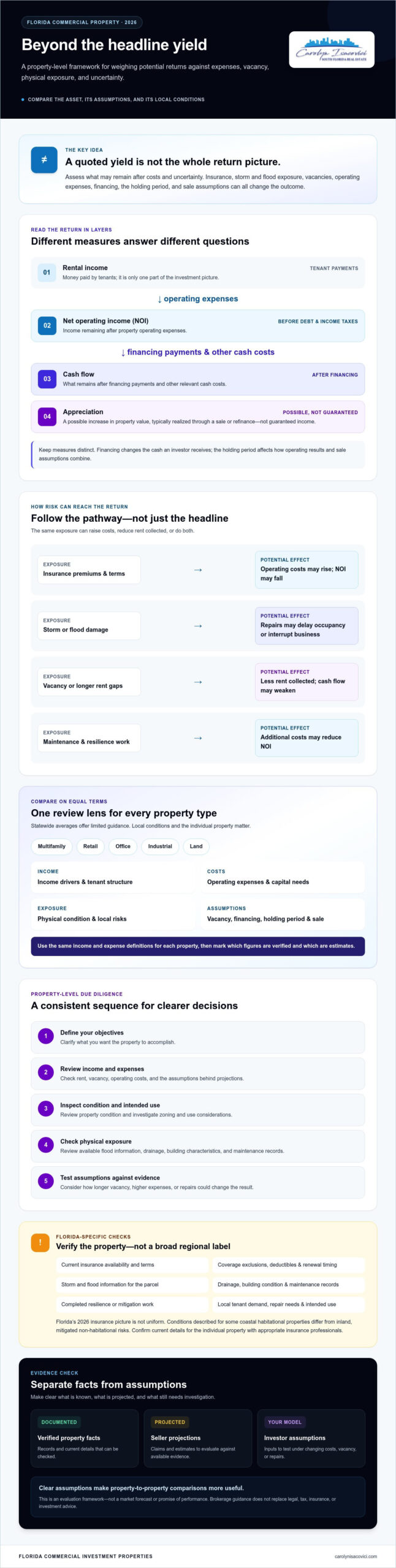
Start by separating the income measures. Rental income is money paid by tenants. Net operating income (NOI) is income remaining after property operating expenses, before debt payments and income taxes. Cash flow reflects what remains after financing payments and other relevant cash costs. Appreciation is a possible increase in property value, typically realized through a sale or refinance. It is not guaranteed income.
Financing can change the cash an investor receives, while the holding period affects how operating results and sale assumptions combine. Keep these measures distinct when comparing opportunities because they answer different questions. For a practical comparison, use the same income and expense definitions for each property, then note which figures are verified and which are estimates.
Which Florida risks can change the investment picture?
Insurance availability and premiums, storm exposure, flooding, vacancy, maintenance, and other operating expenses can affect net income or interrupt rent collection. Exposure depends on the property’s address, condition, construction, and use. Two buildings in the same city may have different flood concerns, repair needs, tenant demand, and insurance options.
Florida’s 2026 insurance picture is not uniform. Research describes a more challenging environment for some coastal habitational properties than for inland, mitigated non-habitational risks. Treat that as a reason to investigate the individual property, not as a substitute for current insurance information.
Risk-adjusted thinking means weighing potential return against the uncertainty involved. Ask whether the expected income still makes sense if vacancy lasts longer, expenses rise, or repairs interrupt operations. Separate documented property facts from seller projections and your assumptions, then consider how each change affects the result.
This is an evaluation framework, not a market forecast or promise of performance. The phrase commercial real estate risks and returns Florida captures a property-specific question: what income might this asset produce, and what could change that outcome? Clear assumptions make the question easier to assess. Brokerage guidance can help you evaluate commercial and investment property opportunities, but it does not replace legal, tax, insurance, or investment advice.
How Florida property risks affect commercial real estate returns
Property risks can affect both sides of the operating picture: they may increase expenses, reduce rent collected, or do both. Insurance premiums and coverage terms, ongoing maintenance, and resilience work can reduce net operating income. If a storm or flood damages a building, repairs may delay tenant occupancy or interrupt business activity, creating a gap between expected and actual cash flow.
How do storms, flooding, and insurance affect a property?
Start with the specific parcel and building, not a broad regional label. Review available flood information, drainage conditions, building characteristics, maintenance records, and relevant insurance documents. Confirm current coverage terms, exclusions, deductibles, renewal timing, and availability directly with appropriate insurance professionals. These details can change, so do not assume another property’s experience applies.
Ask whether resilience or mitigation work has been completed and whether supporting records are available. Qualified building and environmental professionals can assess physical conditions and advise on further review within their expertise. A location’s exposure alone does not tell you how well a property is prepared or what a future claim would involve.
Which operating and leasing risks can weaken returns?
Look beyond total rent. Review the rent roll, lease expirations, vacancy history, tenant concentration, and each lease’s expense responsibilities. A property that relies heavily on one tenant may be particularly sensitive if that tenant leaves or stops paying. Vacancy can reduce income while the owner continues to carry expenses and seeks a replacement occupant.
Deferred maintenance can create a similar mismatch. Projections may rely on income without accounting for repairs or capital needs. Compare stated expenses with available records, inspect the property, and identify upcoming lease rollover and building needs before relying on projected performance.
Financing and resale assumptions deserve their own stress test. Interest-rate changes can affect borrowing costs, while refinancing terms and the timing or price of a future sale can influence the investor’s final outcome. These variables cannot be predicted with certainty. Florida Realtors’ overview of 2026 commercial real estate issues also highlights portfolio risk and maturing loans as considerations for the year.
When assessing commercial real estate risks and returns in Florida, connect each concern to a property-level assumption: insurance to expenses, physical exposure to possible interruption, and leasing to income stability. Once your criteria are clear, brokerage guidance can help you review commercial and investment property opportunities in context. Explore Florida commercial property sales, while relying on appropriate specialists for insurance, building, legal, tax, and investment questions.
Compare Florida commercial property returns by asset type and location
Two properties with similar asking yields can have very different income stability, expense responsibilities, and capital needs. Compare them using the same criteria before deciding whether either fits your objectives. The table below is a screening tool, not a ranking or forecast. Actual performance depends on the property, leases, condition, and market evidence.
How do commercial asset types differ in risk and income drivers?
Income structure matters. A multi-tenant property spreads rent across occupants, while a single-tenant asset may depend heavily on one lease. Lease terms also determine which expenses tenants pay and which remain with the owner. Land may produce limited or no income during a holding period. Carrying costs, entitlement uncertainty, and permitted use need careful review with relevant local professionals.
| Asset type | Income and vacancy considerations | Capital needs and exposure to assess |
|---|---|---|
| Multifamily | Rental income comes from multiple units; turnover and vacancies can reduce collected rent. | Review building systems, unit condition, ongoing maintenance, and local flood or storm exposure. |
| Retail | Tenant mix, lease terms, and customer demand influence income; a major tenant departure can affect a center. | Check shared-area upkeep, tenant expense responsibilities, building condition, and access. |
| Office | Income depends on tenant retention and lease rollover; larger spaces can make individual vacancies consequential. | Assess building systems, potential re-leasing work, location, and tenant requirements. |
| Industrial | Lease length, tenant concentration, and facility suitability shape income continuity. | Review roof and infrastructure condition, site access, and property-specific environmental or flood concerns. |
| Land | Often has no rental income unless leased for a permitted use; returns may depend on future use or sale assumptions. | Verify zoning, permitted use, access, utilities, carrying costs, and any required approvals. |
What changes between South Florida and the Treasure Coast?
Compare submarkets using current evidence for the property type you’re considering, such as nearby lease activity, vacancies, tenant demand, and comparable sales. Miami, Broward, and Palm Beach each include varied submarkets, and the Treasure Coast should not be treated as a simple extension of South Florida. Check that market data matches the property’s use, location, and time period before drawing conclusions.
Coastal proximity alone does not establish a property’s flood exposure. Check the parcel, building, access, and available drainage and insurance information. For broader context, see this Florida commercial real estate investor guide.
The right comparison for commercial real estate risks and returns Florida investors assess is property-specific: align lease and expense assumptions, then weigh them against local evidence and physical conditions. That approach helps identify which opportunities merit closer review without declaring one asset class or region universally superior.
A practical due-diligence framework for evaluating Florida property risk
A disciplined review turns a listing’s claims into questions you can verify. Use the same sequence for each opportunity: define your objectives, review income, inspect condition, check property-specific exposure, and test the assumptions behind the return estimate. This makes comparisons clearer and surfaces unanswered questions before they become part of your decision.
Which property records and assumptions should buyers verify?
Start with the documents that support the income and expense picture. Compare the rent roll with leases, review operating statements and maintenance records, and consider relevant inspection findings. Check that reported occupancy, rents, recurring costs, and tenant responsibilities match the underlying records rather than relying on a summary.
Then verify property-specific details. Confirm zoning and permitted use with appropriate local authorities or qualified professionals, and review access and title matters with real estate legal professionals. Use current documentation to examine property taxes, insurance terms, flood information, and recurring expenses. Engineering, environmental, and insurance specialists can assess issues within their expertise. Brokerage guidance can help with commercial and investment property sales, but it does not replace those professional reviews. For metric definitions and a wider evaluation framework, see Florida investment property evaluation metrics.
How can investors stress-test a return estimate?
Separate confirmed information from projections. Label documented lease terms, invoices, and inspection findings as verified. Identify seller-provided forecasts separately and mark your own estimates as assumptions. Then model a base case and a downside case. These are planning scenarios, not predictions.
- Occupancy and collections: Consider how lower occupancy, slower leasing, or delayed rent collection would change income.
- Expenses and repairs: Test higher operating costs or repairs that records or inspections suggest may be needed.
- Financing and exit: Check whether the result changes under different refinancing terms or future sale assumptions, without assuming rates or values will move in a particular direction.
For a Miami property, ground assumptions in relevant local evidence rather than applying statewide averages. This Miami commercial real estate market trends resource can add market context. Across Florida, the commercial real estate risks and returns investors assess are easier to compare when each scenario uses clear, property-level inputs.
Once your criteria and open questions are organized, explore commercial and investment property sales for brokerage guidance on evaluating opportunities. Seek qualified legal, tax, engineering, environmental, and insurance professionals for advice in their respective fields.
Turn a Florida risk review into a confident investment next step
A property may merit closer review when its income is supported by records, operating costs are understandable, and its main risks can be investigated. That does not mean the opportunity is right for every investor. Consider whether the asset fits your objectives, intended holding period, desired level of involvement, and comfort with uncertainty.
Pause if key documents are missing, important expenses remain unclear, or material questions about condition, insurance, use, or leasing have not been resolved. Treat these as follow-up items, not proof that a property is either a sure opportunity or an automatic rejection. Ask what evidence would help answer them, then decide whether the remaining uncertainty fits your criteria.
When is a Florida commercial property worth a closer look?
Compare property-specific evidence, not just headline yields or statewide averages. Check whether income assumptions are documented, expenses are reasonably understood, and the risks have a practical path for further review. Commercial real estate risks and returns in Florida are ultimately tied to the particular asset and its fit with your goals, not simply its location or property type.
What should investors prepare before speaking with a broker?
A clear brief makes a brokerage conversation more useful. Consider outlining:
- Preferred asset type and locations: Identify the property categories and Florida areas you’re considering.
- Timeline and investment objectives: Share your anticipated holding period and what you hope the property will contribute to your plans.
- Operating role and criteria: Clarify how involved you want to be and which property characteristics matter most.
- Key assumptions and open questions: Note the income, expense, or risk factors you’re evaluating. Share only the financial details needed for the discussion, and avoid sending sensitive information unnecessarily.
A Florida commercial brokerage can help identify and evaluate opportunities and guide buyers through the purchase process. Brokerage guidance is not a substitute for legal, tax, insurance, engineering, environmental, or investment advice, so involve qualified specialists for those questions.
If you’ve defined your criteria and would like to discuss commercial or investment property opportunities, connect about your Florida property goals. A conversation can help clarify what to investigate next, without promising a particular return or asking you to commit before you’re ready.
Make your next Florida property decision with clarity
Strong commercial property decisions start with more than an attractive headline yield. Compare documented income with operating costs, vacancy, insurance, building condition, and financing or resale assumptions. Then weigh those factors against your objectives and holding period. A property-specific comparison is more useful than statewide averages, which cannot show how an individual building, lease, or location may affect your results.
A thoughtful review does not eliminate uncertainty, but it can help you identify what is supported by evidence, what needs further investigation, and whether an opportunity fits your plans. That’s the practical value of understanding commercial real estate risks and returns Florida investors may encounter: clearer questions, more grounded comparisons, and a deliberate next step.
Florida Commercial Investment Properties facilitates commercial and investment property sales in areas including Miami, Miami Beach, Hollywood, Fort Lauderdale, Palm Beach, Palm Beach Gardens, Stuart, Jupiter, Palm City, Port St. Lucie, Fort Pierce, Vero Beach, and Melbourne. If you’re ready to discuss your criteria and explore potential opportunities, discuss your Florida commercial property goals with Carolyn Isacovici. Involve appropriate specialists for legal, tax, insurance, and other professional advice.
Frequently Asked Questions
Are commercial real estate investments in Florida risky?
Yes, they can carry risks, but exposure depends on the specific property, its tenants, condition, location, and financial assumptions. Storm or flood exposure, insurance terms, vacancies, maintenance needs, and lease expirations can affect income and expenses. A retail property in Miami and an industrial property near Stuart may face different operating and market considerations. Review evidence for each asset rather than treating Florida as one uniform market.
What affects commercial real estate returns in Florida?
Returns reflect rental income, operating costs, vacancy, financing, holding period, and assumptions about a future sale. Insurance, repairs, tenant turnover, and lease responsibilities can change the income left after expenses. That’s central to assessing commercial real estate risks and returns in Florida: compare potential income with the property-specific costs and uncertainties behind it. Use current records and local evidence, not headline yields alone.
Which Florida commercial property type has the best returns?
No property type is best for every investor. Multifamily income depends on unit occupancy and operating needs; retail and office can be sensitive to tenant mix and lease rollover; industrial performance depends on tenant demand and facility suitability. Land may have limited income while owners investigate permitted use and future plans. Compare properties with your objectives, risk tolerance, and holding period in mind, using property-level evidence from markets such as Broward or Palm Beach.
How can I evaluate flood and hurricane risk for a Florida commercial property?
Review the parcel’s flood information, drainage, building characteristics, access, maintenance history, and available mitigation records. Ask for current insurance documents, then confirm coverage terms and availability directly with an insurance professional. A city name alone cannot establish a property’s exposure: a site in Miami Beach may have different conditions from another parcel nearby. Consider qualified engineering or environmental professionals for physical assessments and specialized questions.
Can insurance costs change a Florida commercial property’s returns?
Yes. Premiums, deductibles, exclusions, and coverage availability can affect operating expenses and reduce net operating income or cash flow. Storm damage or a business interruption may also affect occupancy and rent collection. Request current, property-specific insurance documentation and verify terms with an insurance professional instead of relying on statewide averages or another owner’s experience. Include confirmed insurance assumptions in your financial review before comparing properties.
How much due diligence should I do before buying commercial real estate in Florida?
Do enough to verify the assumptions behind your decision, with the scope shaped by the property and unresolved questions. Review leases, rent rolls, operating statements, maintenance records, zoning and permitted use, taxes, insurance, flood information, and relevant inspection findings. Engage qualified legal, tax, engineering, environmental, and insurance professionals for their areas of expertise. Whether considering a property in Fort Lauderdale or Port St. Lucie, do not rely on seller projections alone.
Can a commercial real estate broker help assess investment risks and returns?
A commercial real estate broker can help identify and evaluate property opportunities and guide buyers through the sales process, while specialist questions require the appropriate professionals. Florida Commercial Investment Properties facilitates commercial and investment property sales in areas that include Miami, Miami Beach, Hollywood, Fort Lauderdale, Palm Beach, Palm Beach Gardens, Stuart, Jupiter, Palm City, Port St. Lucie, Fort Pierce, Vero Beach, and Melbourne. Brokerage guidance does not guarantee returns or replace legal, tax, or insurance advice.