A Florida portfolio isn’t diversified simply because it includes more properties. Effective diversification strategies for real estate investors in Florida spread exposure across property types, locations, and investment approaches, so one market or asset doesn’t carry the entire plan. The goal is a more balanced portfolio, not a risk-free one.
Looking beyond a single property or neighborhood can make sense: local conditions shift, and different kinds of real estate may respond differently. A considered mix can create more than one path to income and growth while keeping the portfolio aligned with your goals.
This guide explains how residential, commercial, and other property types fit into a portfolio, how core and higher-risk strategies differ, and how location and market volatility shape decisions. You’ll come away with a practical framework for considering diversification in Florida, without treating “more variety” as a strategy on its own.
Key Takeaways
- Think beyond the number of properties: consider how property type, location, and investment approach shape your overall exposure.
- Weigh residential, commercial, industrial, land, and special-use properties against your goals and familiarity with each category.
- Match core, value-add, and opportunistic investments to the level of risk and involvement you can manage.
- Spread exposure across locations and local markets to avoid relying too heavily on one area’s conditions.
1. What does diversifying your real estate portfolio mean?
Diversification means spreading real estate assets across property types, locations, and investment strategies. Instead of relying on one rental home or local market, an investor might combine residential rentals, commercial property, and real estate funds. These assets may respond differently to shifts in demand, helping build a more resilient portfolio without eliminating risk. A practical approach to diversification strategies for real estate investors in Florida starts by identifying where current holdings are concentrated.
Florida investors can diversify by property type, including residential, commercial, industrial, land, or special-use property. They can also vary how they invest: direct ownership, partnerships, publicly traded REITs, and private funds involve different levels of participation and exposure. A mix of rental income and development opportunities can target different return profiles, with higher potential returns often accompanied by greater risk.
Geographic diversification means spreading holdings across neighborhoods, cities, states, or countries instead of relying on one location. In Palm Beach County, West Palm Beach, Lake Worth, Boca Raton, Boynton Beach, and Greenacres each have distinct local market conditions to assess. No city is automatically the best choice: compare demand and other market factors. Adding properties in different regions can reduce reliance on one city’s rental market.
What diversification strategies are available to Florida real estate investors? Consider combining property types, locations, and investment structures, then match each choice to your goals, timeline, and capacity to manage it. A residential property in Boca Raton and commercial property in another market illustrate how a portfolio can vary by asset and location.
What financing options and down payment requirements apply to Florida investment properties? Investors may use cash, financing, partnerships, or fund structures. Down payment requirements depend on the financing arrangement, property, and borrower. These factors also shape the capital required and the investor’s exposure.
Start by mapping current assets by property type, location, and strategy. Then look for concentrations, such as several properties serving the same tenant demand in one city. Strong diversification strategies for real estate investors in Florida add different exposure only when it suits the portfolio’s objectives and practical management capacity.
2. Balancing residential, commercial, industrial, land, and special-use properties
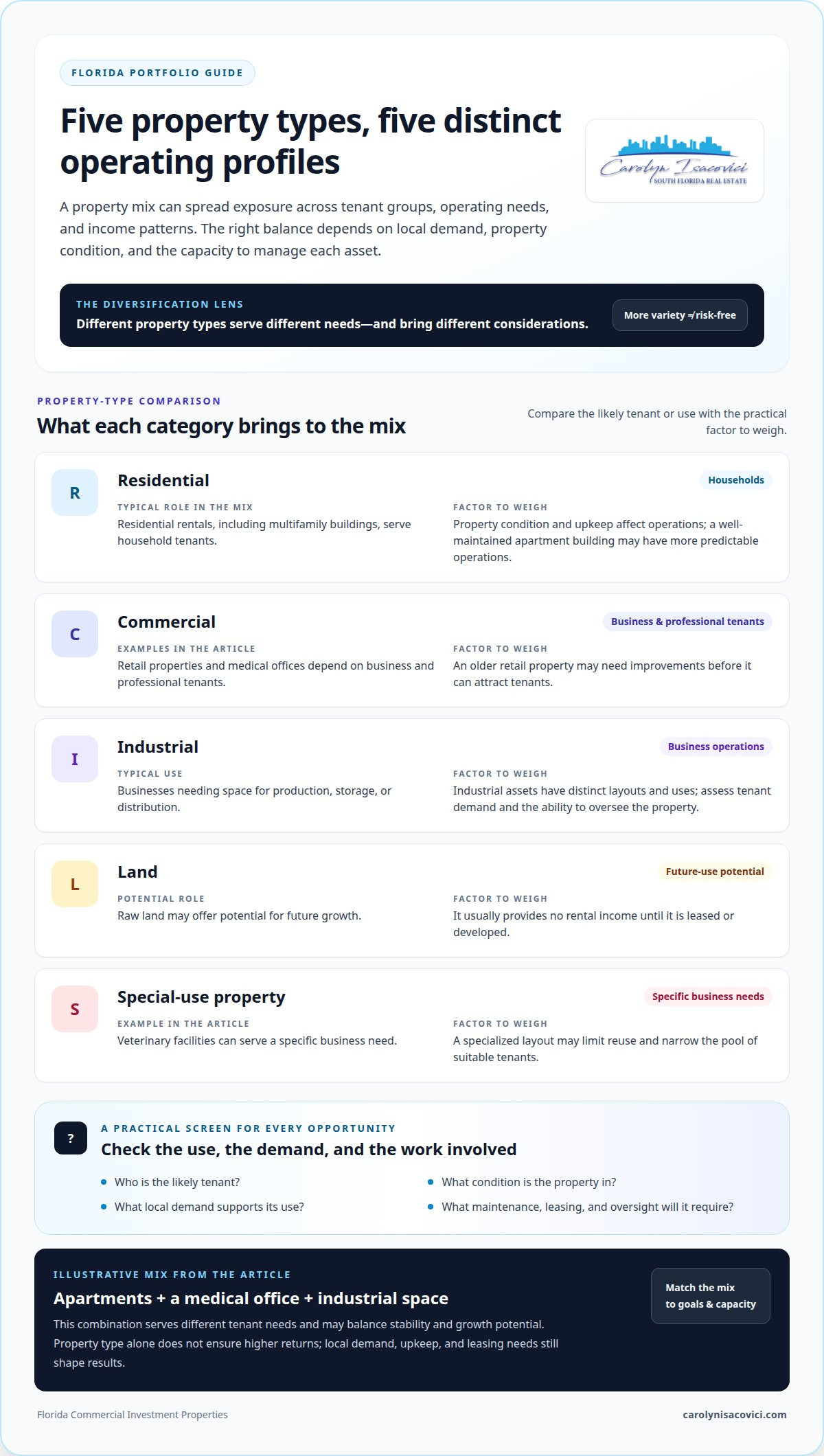
A portfolio can combine property types with different tenants, operating needs, and income patterns. Residential rentals, including multifamily buildings, serve households, while retail and medical offices depend on business and professional tenants. Industrial assets serve businesses that need space for production, storage, or distribution. These differences matter: balancing categories can reduce reliance on one tenant group or source of demand.
Property condition also affects the balance. A well-maintained apartment building may have more predictable operations, while an older retail property could need improvements before attracting tenants. Industrial space, medical offices, and veterinary properties each have distinct layouts and uses. Weigh those requirements against local tenant demand, expected maintenance, and your ability to oversee the asset. Specialized buildings may have a narrower pool of suitable tenants.
Land has a different profile. Raw land may offer potential for future growth, but usually provides no rental income until it is leased or developed. Special-use properties, such as veterinary facilities, can serve a specific business need, but their layout may limit reuse. Pairing either with residential or commercial property can diversify exposure, provided the overall mix matches your goals and operating capacity.
Assess each opportunity using the same practical questions: Who is the likely tenant? What condition is the property in? What demand supports its use? For example, a portfolio with apartments, a medical office, and industrial space serves different tenant needs. That mix may balance stability and growth potential, but property type alone does not ensure higher returns. Local demand, upkeep, and leasing needs still shape results.
Investors considering a property-type mix can explore residential and commercial real estate options as part of that evaluation.
3. Balancing core, core-plus, value-add, and opportunistic investments
Investment style adds another layer to a Florida portfolio. Core investments focus on newer properties with credit-quality tenants and aim to minimize risk. Core-plus generally involves some improvement or leasing work while retaining an established asset. Value-add projects seek to increase property value through capital investment and improvements. Opportunistic strategies involve new properties or redevelopment, with different timelines and execution demands.
How can Florida investors balance cash flow, appreciation, and risk across a real estate portfolio? Pair properties that produce recurring rental income with assets that offer renovation or redevelopment potential. A stabilized apartment building and a property needing improvements illustrate the difference. Consider each investment’s required work, timeline, and role alongside the portfolio’s existing income and liquidity needs.
Florida rental returns, prices, and vacancy rates vary by local market and property type. Compare the factors that influence them: tenant demand, property condition, leasing needs, and whether the asset is residential, retail, or industrial. These factors affect income and vacancy exposure, while purchase price determines the capital committed. No single property type or city guarantees the strongest result for every investor.
Vacation and short-term rentals also involve distinct operating costs, including furnishing, cleaning, maintenance, and management. Applicable rules depend on the location and property, so account for local requirements and operating arrangements when assessing this strategy. Seasonality and travel demand also affect how rental income compares with longer-term leasing.
During an economic downturn, a portfolio concentrated in one strategy may face pressure from the same market shift. Combining core holdings with selected value-add or opportunistic investments spreads exposure across different risk-and-return profiles. Keep liquidity in view: renovation and redevelopment can tie up capital differently from income-producing rentals. The right balance depends on your objectives, management capacity, and timeline for using that capital.
4. Managing exposure to market volatility and regional risks
Spreading ownership across markets can reduce reliance on one local economy, but it doesn’t eliminate real estate risk. A portfolio concentrated in one Florida city may feel a local downturn more sharply than holdings spread across regions. Geographic diversification means choosing locations with distinct economic drivers, not simply adding nearby addresses.
For example, an investor with several properties in one coastal market could consider exposure in a different city or state. Separate locations may have different employment trends, tenant demand, and natural-disaster risks. Diversifying across regions can help balance those pressures, though property management and leasing may become more complex when assets are far apart.
Within Florida, compare local market conditions before adding property. West Palm Beach, Boca Raton, and Lake Worth are distinct Palm Beach County locations, but proximity alone doesn’t mean their risks or performance will differ. Consider tenant demand, local job conditions, property use, and how a slowdown could affect each asset’s income. Then decide whether another city would meaningfully reduce concentration.
How do Florida property taxes, landlord laws, and local regulations affect investment strategies? They influence operating costs, rental arrangements, and which property uses are practical in a location. Evaluate these factors for each property and municipality, as they can change the income and management assumptions behind an investment.
Start with a simple exposure map: group assets by city, property type, tenant profile, and income source. If one local market or tenant group dominates, consider whether a different region or use better supports your goals. Account for liquidity and oversight, too: distant assets can require more coordination, and selling property may take time. To diversify your portfolio thoughtfully, weigh the potential resilience of a new location against its management demands and local conditions.
Explore Florida investment property opportunities with location and market exposure in mind.
West Palm Beach, Boca Raton, and Lake Worth are distinct Palm Beach County locations, but proximity alone doesn’t ensure meaningful diversification. Compare tenant demand, job conditions, property uses, and income risks, and consider another city or region if it would reduce concentration.
Florida Commercial Investment Properties: Residential Real Estate Sales
Florida Commercial Investment Properties helps investors explore residential and commercial property opportunities as they shape a Florida portfolio. The firm’s residential and commercial property sales, new construction homes, and investment property sales support buyers considering different property types or expanding their holdings.
Turn to the firm when you’re ready to evaluate a property purchase as part of your investment approach. Discussing your goals, preferred property type, and target location can help focus the search, whether you’re considering a residential property, commercial real estate, or a new construction home. The right fit depends on how the opportunity aligns with your portfolio and investment plans.
Contact Florida Commercial Investment Properties to discuss your real estate investment goals.
Put Your Next Investment Decision in Context
Before pursuing a particular property, write down what a new acquisition should accomplish. A clear plan for diversification strategies for real estate investors in Florida starts with priorities: the investment’s role, the capital you can commit, and the level of ongoing involvement you can manage. These criteria help keep an attractive listing from becoming a decision without a portfolio purpose.
Use that plan as a reference when opportunities arise, then assess each one against your objectives and existing holdings. Your priorities may change as circumstances evolve, so treat the portfolio as an active plan rather than a fixed collection of assets. A considered decision today can make future opportunities easier to evaluate with confidence.
For support with your next real estate decision, contact Florida Commercial Investment Properties. Take the next step when you’re ready to explore a property that fits your plans.
Frequently Asked Questions
What does diversifying your real estate portfolio mean?
Diversification means shaping a portfolio so its performance doesn’t depend on one property, tenant group, or income source. For example, owning several similar rentals in one neighborhood may leave an investor exposed to the same local conditions. Review each asset by location, use, tenant demand, and income source, then identify where the portfolio relies too heavily on one factor.
What Is Diversification?
Diversification spreads investments across assets that may respond differently to changing conditions. In real estate, holdings with lower correlation are less likely to move in the same direction at the same time. This can help balance a portfolio, but it doesn’t prevent losses or ensure that every investment performs well. The aim is to avoid relying on one outcome for the whole plan.
How can Florida investors diversify across property types such as residential, commercial, and industrial?
Investors can combine direct ownership of residential, commercial, and industrial assets, choosing each for a different portfolio role. For a regional comparison, consider how opportunities and demand differ across Miami, Miami Beach, Hollywood, Fort Lauderdale, Palm Beach, Palm Beach Gardens, Stuart, Jupiter, Palm City, Port St. Lucie, Fort Pierce, Vero Beach, and Melbourne. Assess each asset’s tenants, use, condition, and management needs before adding it.
How can investors diversify with REITs, real estate funds, or real estate crowdfunding in Florida?
REITs, funds, and crowdfunding can provide real estate exposure without directly purchasing an entire property. Publicly traded REIT shares can be bought or sold on stock exchanges, while crowdfunding investments are not publicly traded and may suit long-term, passive approaches. Funds and syndications offer other structures. Compare the assets held, liquidity, investment timeline, and fit with your goals.
What are the risks of Florida real estate investing, including hurricanes, flooding, and rising insurance costs?
Hurricanes and flooding can expose properties to physical damage, interrupted operations, and repairs, while rising insurance costs can reduce net rental income. Risk varies by property and location, so assess exposure at the individual asset level rather than assuming all Florida holdings face identical conditions. Include insurance and maintenance in your operating plan, and consider how an interruption could affect portfolio cash flow.
Which Florida cities and regions offer the best geographic diversification for real estate investors?
No city is identified as best. In Palm Beach County, investors can consider West Palm Beach, Lake Worth, Boca Raton, Boynton Beach, and Greenacres, comparing tenant demand, local job conditions, and whether each location meaningfully reduces reliance on one market.