What if the most competitive market in the country is actually your greatest opportunity for stability this year? It’s a question many seasoned investors are asking as they look at a median home price of $425,000 and 30-year mortgage rates hovering near 6.99%. You’ve likely noticed that the frantic pace of previous years has given way to a more balanced environment. This shift can feel uncertain, especially when you’re considering investing in Florida single-family homes while balancing 3.7% annual appreciation against the complexities of non-homestead tax caps. It’s natural to feel cautious, but in this stabilization, there’s profound opportunity for the disciplined buyer.
We believe that the current market requires a more nuanced strategy than it did in the past. This guide provides the clarity you need to move forward with confidence. You’ll discover why a stabilizing market is a gift for those seeking long-term yield and how recent insurance rate decreases in 51 counties are changing the ROI equation. We’ll walk through the best submarkets for growth, the specific advantages of new construction, and how professional brokerage support can help you secure the off-market assets that define a high-performing portfolio.
Key Takeaways
- Understand how demographic-driven demand is shifting the focus of investing in Florida single-family homes from simple appreciation to a reliable hedge against market volatility.
- Pinpoint the “Move North” corridors and high-tech hubs where job growth is outpacing housing supply to drive long-term value and rental demand.
- Master the financial nuances of the 2026 market, including property insurance mitigation strategies and the impact of non-homestead assessment caps on your total ROI.
- Evaluate the strategic trade-offs between the immediate yield of new construction and the hidden equity potential found in modernizing resale properties.
- Gain insight into how professional brokerage partnerships unlock off-market deals and provide a steady hand in competitive regions like Miami and the Treasure Coast.
The 2026 Landscape for Investing in Florida Single-Family Homes
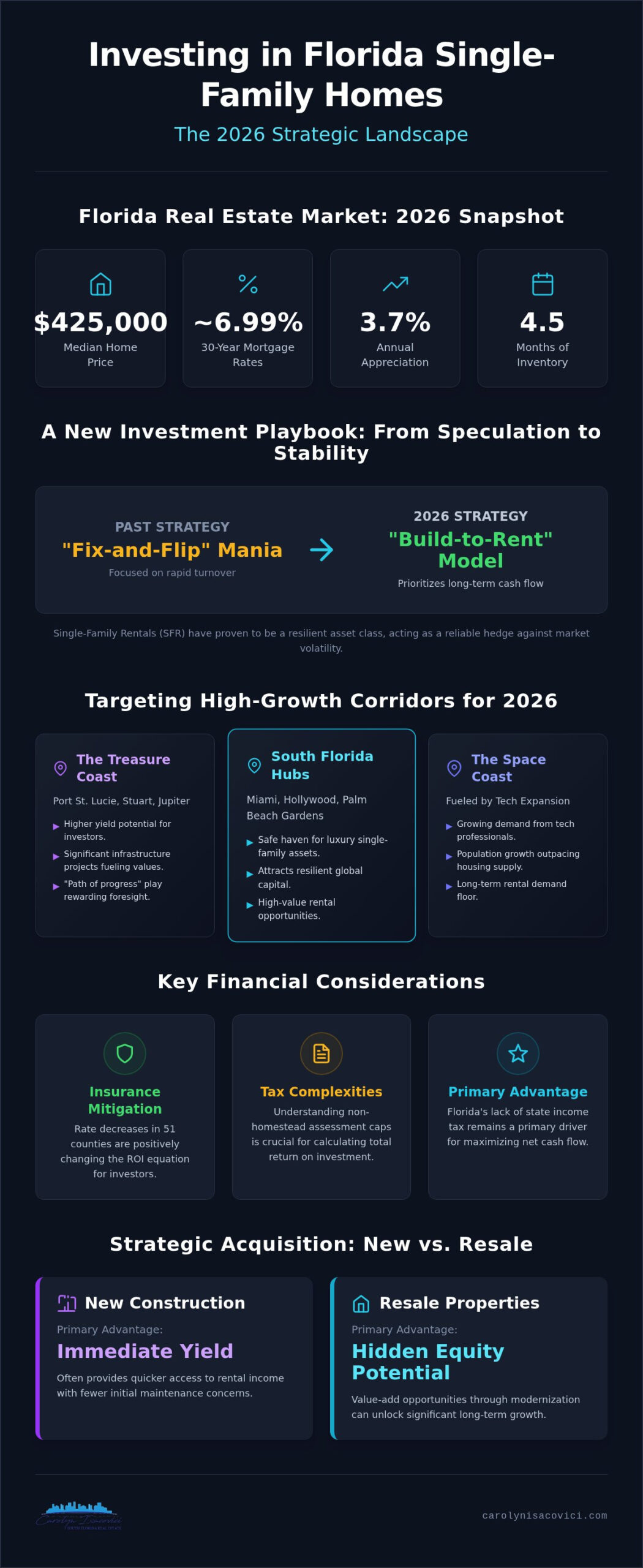
The market for investing in Florida single-family homes has entered a sophisticated new chapter in 2026. We’ve moved beyond the era of speculative frenzy into a period characterized by steady, demographic-led appreciation. While the median sale price reached $425,000 in mid-2026, the real story isn’t just the price; it’s the quality of the demand. High-net-worth individuals and corporate entities continue to relocate to the Sunshine State, seeking both lifestyle and fiscal advantages. This sustained in-migration has transformed the investment playbook. It’s a shift from the “fix-and-flip” mania of the early 2020s toward a more sustainable “build-to-rent” model that prioritizes long-term cash flow over rapid turnover.
The “Florida Premium”: Why Demographics Win
Population growth in 2026 remains robust, particularly among the 25-44 age bracket. These professionals are fueled by the ongoing tech expansion in South Florida and the Space Coast. Corporate relocations to hubs like Miami and West Palm Beach have created a permanent floor for rental demand that hasn’t been seen in previous cycles. Understanding the nuances of Florida property law, specifically how it governs tax liens and foreclosure processes, helps investors protect their capital in this competitive environment. Florida’s lack of state income tax remains the primary driver for out-of-state investors who want to maximize their net cash flow while building long-term wealth.
Single-Family Rentals (SFR) as a Volatility Hedge
Is your portfolio prepared for broader economic shifts? In 2026, single-family rentals have proven to be a remarkably resilient asset class when compared to the volatility of traditional equity markets. While commercial sectors face their own unique challenges, many are finding that a residential focus offers a more stable and predictable entry point. You can explore the specific trade-offs in our guide on commercial vs residential investment Florida.
By focusing on Florida real estate portfolio building, you aren’t just buying houses; you’re securing a position in a market that has shown a 3.7% year-over-year price increase even as interest rates stabilized around 6.773%. This balance of growth and stability is exactly what a “calm expert” looks for in a premier asset class. With inventory levels at 4.5 months, buyers finally have the breathing room to make strategic decisions rather than emotional ones. The 2026 landscape is about timing and wisdom, ensuring your capital is placed where the people are moving.
Targeting High-Growth Corridors: Where to Buy in 2026
Success in investing in Florida single-family homes isn’t about buying anywhere in the state; it’s about identifying the specific corridors where demand is outstripping supply. In 2026, we’re seeing a distinct “Move North” trend. While the iconic southern metros remain strong, investors are increasingly looking at the Treasure Coast and the Space Coast for higher yield potential. Why is this happening? The answer lies in a combination of corporate migration and a search for relative affordability without sacrificing the Florida lifestyle. It’s a calculated shift that prioritizes long-term stability over short-term speculation.
The Treasure Coast Opportunity: Port Saint Lucie to Stuart
Port Saint Lucie has solidified its position as a top-ranking city for residential growth this year. It offers a compelling entry point for those who find the South Florida price tags prohibitive. In nearby Stuart and Jupiter, the focus has shifted toward high-quality rental assets that cater to a growing professional class. These areas benefit from significant infrastructure projects that are currently fueling property values. We often see that when transit and utilities expand, appreciation follows closely behind. It’s a classic “path of progress” play that rewards those who act with foresight and patience.
South Florida Hubs: Miami and Palm Beach Gardens
Miami and Hollywood FL continue to serve as safe haven markets for luxury single-family assets. These regions attract global capital and offer high-value rental opportunities that remain resilient regardless of broader economic shifts. Further north, Palm Beach Gardens has become a primary target for family-oriented, long-term rental demand. The inventory here is often competitive, with many of the best opportunities never reaching the public portals. Securing these assets requires a deep local network and an understanding of neighborhood-level dynamics that only comes from years of market presence.
Melbourne and the Space Coast also deserve your attention in 2026. The influx of high-tech aerospace jobs has created a persistent residential scarcity that drives both rents and home values upward. Identifying these neighborhoods before appreciation peaks is the hallmark of a seasoned investor. If you’re ready to explore these high-growth submarkets, partnering with a specialized investment broker can provide the local insight necessary to identify deals before they hit the open market. It’s about moving with a steady hand in a market that rewards precision over speed.
Navigating the Financials: Insurance, Taxes, and ROI
Financial clarity is the foundation of any successful venture. While headlines often focus on rising costs, the reality of investing in Florida single-family homes in 2026 is far more nuanced and, for the prepared investor, quite promising. Success here requires moving past surface-level numbers to understand the specific levers that drive net operating income. By mastering the interplay between insurance premiums, tax assessments, and rental yields, you can transform a standard property into a high-performing asset. It’s about looking at the full balance sheet with the steady hand of a strategist.
The Insurance Equation: Risk vs. Reward
The insurance landscape has reached a pivotal turning point. In 2026, homeowners insurance rates decreased in 51 of Florida’s 67 counties, signaling the first broad stabilization since 2019. To capitalize on this, focus your search on properties built under post-2002 building codes or those featuring recent upgrades like impact windows and modern roofing systems. These features don’t just protect the structure; they significantly lower your annual premiums. While insurance premiums are a factor, they are frequently offset by Florida’s higher-than-average rental growth, which continues to outpace national trends.
Property Tax Planning for Non-Residents
Understanding your tax liability is essential for accurate modeling. While Florida residents enjoy the “Save Our Homes” 3% cap, investment properties are subject to a 10% annual assessment increase cap. It’s vital to remember that taxes typically reset based on the new purchase price after a sale. If you’re buying at the 2026 median of $425,000, your first-year tax bill will likely be higher than the previous owner’s. Many of our clients find that holding these assets within a corporate structure provides additional layers of liability protection and potential fiscal advantages. You can learn more about these variables in our guide on how to evaluate investment property Florida.
Yield Analysis: Cash Flow vs. Appreciation
In 2026, the Melbourne market serves as an excellent case study for yield. With a strong influx of aerospace professionals, these properties often provide a healthy balance of monthly cash flow and steady appreciation. In contrast, coastal South Florida markets like Miami often see appreciation outpace immediate cash flow, making them “equity plays” for long-term wealth. For those looking to scale, 1031 exchanges remain a powerful tool to transition from single-family holdings into larger commercial assets. Using professional brokerage ensures you find “value-add” opportunities where minor modernizations can lead to outsized rental increases. This methodical approach ensures your portfolio remains resilient regardless of broader market cycles.
Strategic Acquisition: New Construction vs. Resale
Should an investor buy brand new or look for a diamond in the rough? When investing in Florida single-family homes, the choice between new construction and resale often depends on your tolerance for active management versus your desire for predictable cash flow. For those targeting the Tampa or St. Petersburg markets, professional resources like myfloridahoamanager.com can simplify the complexities of community standards and association compliance. Both paths offer distinct advantages in the 2026 market, provided you understand the underlying math. It’s about matching the asset type to your specific portfolio goals while remaining unruffled by the noise of the broader market. We see successful investors thriving in both lanes by applying a disciplined, analytical approach.
The New Construction Advantage in 2026
Why do seasoned investors lean toward new construction homes Florida? The answer is found in the “Total Cost of Ownership.” In 2026, tenants are increasingly prioritizing energy-efficient, modern builds that can withstand the Florida climate while keeping utility costs low. For the out-of-state investor, the “hands-off” nature of a new build is a significant draw. You benefit from comprehensive builder warranties and virtually zero capital expenditure (CapEx) for the first five years. Additionally, homes built to current 2026 Florida Building Codes qualify for the most substantial insurance discounts, which is a critical factor in maximizing your net yield.
Maximizing Equity in the Resale Market
Can you still find hidden value in established neighborhoods? Absolutely. The resale market in areas like Hollywood FL or Fort Lauderdale remains a prime hunting ground for those comfortable with modernization projects. This is where the BRRRR method (Buy, Rehab, Rent, Refinance, Repeat) thrives. By identifying properties with “good bones” but dated interiors, you can manufacture equity in a way that new builds don’t allow. However, the inspection process for older Florida homes is non-negotiable. You must be diligent about checking for mold, the age of the roof, and the integrity of the plumbing to avoid unforeseen costs. It’s a more active strategy, but the rewards in terms of forced appreciation can be substantial.
Securing pre-construction pricing in emerging developments is another way to capture early-stage appreciation before a community is fully built out. This requires staying ahead of the curve and knowing which developers have the best track records for delivery and quality. Whether you prefer the predictability of a new build or the equity-building potential of a renovation project, we can help you navigate these choices. If you’re ready to see what’s available, you can browse our current investment property sales to find the right fit for your 2026 strategy. It’s a journey best taken with a partner who understands the nuances of both paths.
Partnering with a Florida Investment Expert
Is it possible to navigate a market as diverse as Florida’s on your own? While data is more accessible than ever, the wisdom to interpret it remains a rare commodity. When investing in Florida single-family homes, the difference between a standard purchase and a strategic acquisition often comes down to the quality of your partnership. A specialized investment broker doesn’t just show you houses; they provide a lens through which to view Miami real estate market trends and identify submarkets that align with your specific goals. This level of insight is particularly crucial in 2026, where the most lucrative opportunities often exist off-market, requiring a network built over decades.
Carolyn Isacovici facilitates the end-to-end sales and acquisition process with a steady, confident hand. Since establishing her firm around 2006, she has helped investors navigate multiple market cycles without losing sight of the opportunity. Whether you’re securing your first property or looking to scale your portfolio from single-family homes into commercial holdings, our firm provides the strategic oversight needed for true diversification. We understand that your success depends on precision, timing, and access to assets that the general public rarely sees.
Beyond the Transaction: Advisory and Strategy
What are your primary objectives for 2026? Defining your investment criteria is the first step toward a successful acquisition. Whether you prioritize high-yield rentals in Port Saint Lucie or luxury appreciation in Miami, you need a local expert who understands the nuances of over 15 Florida cities. The right decision today builds the foundation for your wealth tomorrow. Ready to secure your Florida asset? Contact Carolyn Isacovici for a strategic consultation.
Your Path Forward in the 2026 Florida Market
Florida’s real estate landscape in 2026 offers a unique window for those who value strategy over speculation. By focusing on high-growth corridors like Port Saint Lucie and leveraging the insurance advantages of modern construction, you’re doing more than just buying property. You’re building a resilient hedge against market volatility. Success in investing in Florida single-family homes this year depends on your ability to see past the noise and identify the submarkets with sustained demographic demand.
With 20 years of market experience, we specialize in helping you navigate both residential and commercial assets from Miami to the Treasure Coast. Our expertise ensures you have access to the off-market opportunities that define a high-yield portfolio. Are you ready to see what’s possible for your capital? View Exclusive Florida Investment Property Listings today to find your next premier asset. The right partnership makes all the difference, and we’re here to guide you every step of the way.
Frequently Asked Questions
Is Florida still a good place for real estate investment in 2026?
Florida remains a premier destination for investing in Florida single-family homes because of its balanced 4.5 months of inventory and steady 3.7% year-over-year price growth. While the market has stabilized compared to previous years, demand is fueled by persistent population growth and corporate relocations. This environment allows you to make strategic, data-driven decisions without the pressure of a hyper-competitive frenzy. It’s a healthy, mature market that rewards long-term holders.
How much should I budget for property insurance on a Florida single-family home?
You should typically budget between $5,500 and $11,000 annually for a home with $300,000 in dwelling coverage. It’s encouraging to see that homeowners insurance rates decreased in 51 of 67 counties in 2026, marking a significant shift in affordability. To keep your premiums on the lower end of this range, focus on properties built to modern codes or those with updated roofs and impact windows. Professional mitigation strategies are key to protecting your yield.
Which Florida cities offer the highest rental yields for single-family homes?
High-growth corridors like Port Saint Lucie, Fort Pierce, and Melbourne currently offer some of the most compelling rental yields. These “Move North” submarkets benefit from lower entry prices compared to Miami while attracting a professional tenant base. In Melbourne, the aerospace industry provides a steady stream of high-income renters. By targeting these “path of progress” areas, you can secure assets where rental demand consistently outpaces the existing housing supply.
Can I use a 1031 exchange to buy a single-family home in Florida?
Yes, you can absolutely use a 1031 exchange to acquire a Florida single-family home, provided the property is held for investment or business use. This is a powerful tool for deferring capital gains taxes while repositioning your capital into high-growth regions like the Treasure Coast. Many of our clients utilize this strategy to scale their portfolios, eventually moving from individual residential units into larger commercial property holdings with the help of specialized brokerage.
What are the tax benefits of investing in Florida residential property?
The most significant benefit is the lack of state income tax, which immediately improves your net cash flow. Additionally, Florida law limits annual assessment increases on non-homestead properties to 10%, providing a layer of predictability for your carrying costs. A proposed 2026 amendment could even lower this cap to 5% for non-school levies. These protections, combined with demographic-driven demand, make the state a fiscally attractive environment for both domestic and international investors.
Should I buy new construction or an existing home as an investment?
The choice depends on your specific goals for investing in Florida single-family homes this year. New construction offers lower insurance costs, builder warranties, and minimal maintenance for the first five years, making it ideal for a “hands-off” strategy. Conversely, existing homes in established areas like Hollywood FL allow for forced appreciation through renovation. If you prioritize immediate cash flow and lower capital expenditures, new builds are often the superior choice in the 2026 landscape.
What is the average appreciation rate for Miami real estate in 2026?
Miami real estate continues to see healthy growth, with the statewide median sale price increasing by 3.7% as of July 2026. While the rapid spikes of the early 2020s have moderated, Miami’s status as a global “safe haven” keeps demand high for luxury single-family assets. We’ve seen the median home price reach $425,000 across the state, with coastal metros often commanding a premium due to inventory scarcity and sustained interest from high-net-worth individuals.
How does the Florida “Homestead Exemption” affect investment properties?
The Homestead Exemption is reserved for primary residents and doesn’t apply to investment properties. This means your property will be assessed at its full market value upon purchase, and you won’t benefit from the $51,411 exemption. However, you’re still protected by the 10% annual assessment cap on non-homestead properties. Understanding this distinction is vital for accurately calculating your long-term ROI and ensuring your tax modeling reflects the reality for non-resident owners.