
What if the most valuable part of your next acquisition isn’t the soil itself, but the invisible layers of permits and zoning codes attached to it? It’s a realization that separates the casual buyer from the strategic investor. You already know that the Sunshine State offers unparalleled growth, yet the path to a successful closing often feels cluttered with opaque zoning laws and hidden environmental remediation costs. Searching for Florida commercial land for sale requires more than just a map; it requires a deep understanding of the regulatory landscape that defines true value.
We’re here to transform that uncertainty into a clear strategic advantage. This guide unlocks the complexities of the 2026 market, offering expert insights on everything from South Florida’s impact fee structures to the latest pre-application consultation laws. You’ll gain a reliable roadmap that leads from initial purchase to final development while mitigating the legal and environmental risks that often stall high-potential projects. We will examine how to identify high-yield opportunities in growth hubs like Port Saint Lucie and Stuart, ensuring your next move is backed by professional wisdom and precise timing.
Key Takeaways
- Understand why inventory for Florida commercial land for sale remains tight in high-growth corridors and how to position yourself to capture emerging opportunities.
- Learn to distinguish between Future Land Use and current zoning to accurately assess a property’s development potential and long-term value.
- Identify the non-negotiable environmental due diligence steps, including Phase I and II ESAs, that protect your investment from hidden remediation costs.
- Explore strategic acquisition models like land banking and learn how the “Greenbelt” agricultural exemption can significantly reduce your tax burden during the holding phase.
- Discover how a seasoned commercial broker provides access to exclusive off-market deals and coordinates the expert team required for a seamless closing.
The State of Florida Commercial Land for Sale in 2026
2026 marks a sophisticated chapter for the Sunshine State. Is there still opportunity? The answer is a definitive yes. While the days of abundant, cheap land are behind us, the current environment rewards those with a strategic eye. The market has matured, shifting from speculative buying to a focus on precision and regulatory alignment. This evolution means that the most successful investors aren’t just looking for acreage; they’re looking for potential that has been carefully vetted against the state’s shifting economic tides.
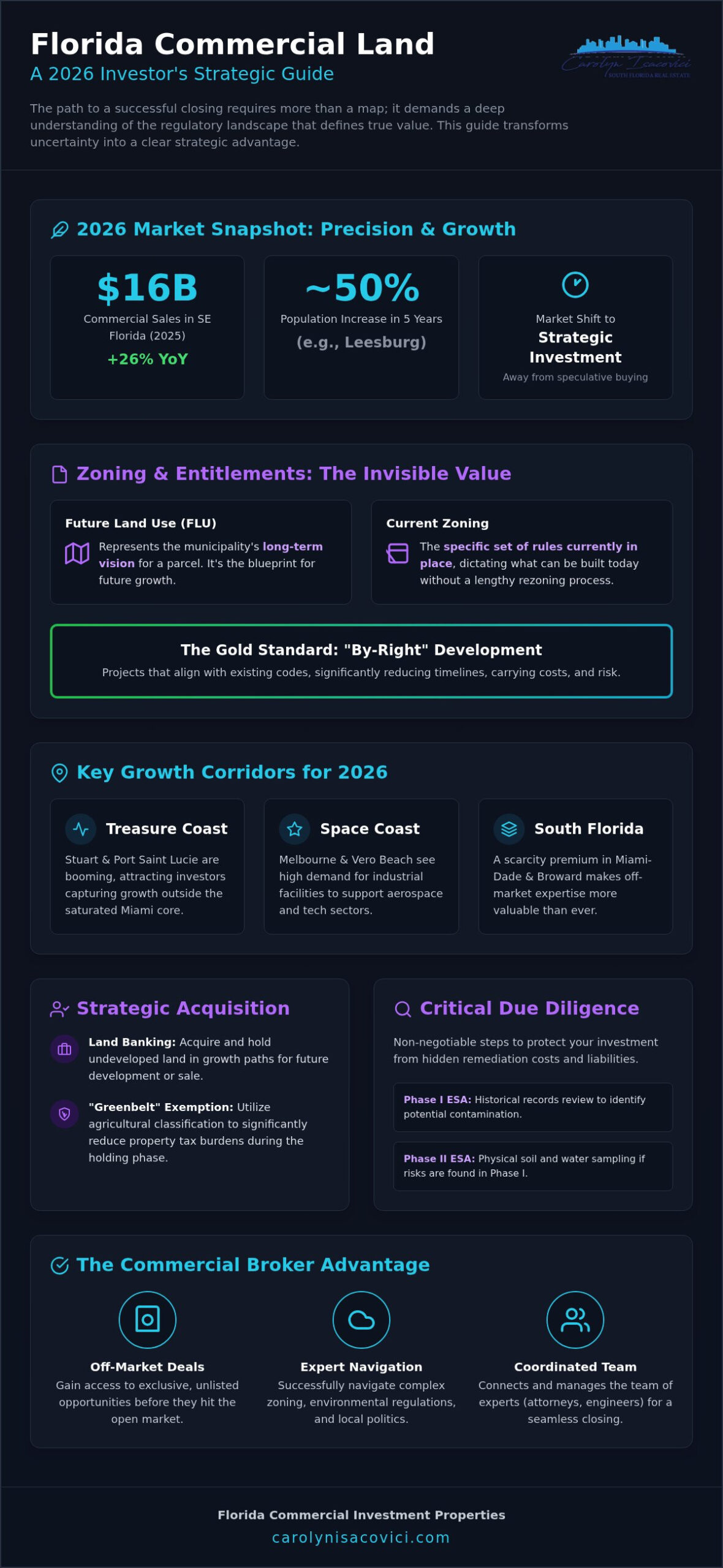
Inventory remains exceptionally tight in high-growth corridors like Miami and Fort Lauderdale. In 2025, commercial sales in Southeast Florida reached a staggering $16.0 billion, representing a 26% year-over-year increase. This velocity has pushed many investors toward in-fill development, where the focus shifts to maximizing smaller, underutilized parcels within established city limits. It’s a strategic pivot that requires more due diligence but often yields higher stability in the long run.
Migration patterns remain the primary engine for this demand. Consider that Leesburg was recently one of the fastest-growing cities in the country, seeing a nearly 50% population increase over five years. This influx creates a persistent need for retail centers and industrial pads to support new residents. Because Florida’s diverse geography includes complex wetlands and coastal plains, finding viable Florida commercial land for sale requires a nuanced understanding of where the ground is literally firm enough for your specific goals.
Defining Commercial Land Use in Florida
Understanding the distinction between raw land and entitled pads is the first step toward a secure acquisition. Raw land is essentially a blank canvas, often requiring significant time for zoning changes and infrastructure. Entitled pads, conversely, come with pre-approved uses, significantly shortening your timeline to construction. Highest and best use (HBU) is the most profitable, legally permissible, and physically possible use of a site that maximizes an investor’s return on investment.
- Retail: Focused on high-visibility frontage and traffic counts.
- Industrial: Prioritizing proximity to logistics hubs and highways.
- Office: Shifting toward Class A amenities and flexible layouts.
Key Growth Corridors for 2026
Where should you be looking right now? The Treasure Coast is currently booming, with Stuart and Port Saint Lucie attracting investors who want to capture growth outside the saturated Miami core. On the Space Coast, cities like Melbourne and Vero Beach are seeing high demand for industrial facilities to support the aerospace and tech sectors. In Miami-Dade and Broward, a scarcity premium now applies to almost every remaining parcel, making off-market expertise more valuable than ever for those seeking Florida commercial land for sale.
Zoning and Entitlements: The True Value of Land
Why do two adjacent parcels of similar size often carry vastly different price tags? The answer almost always lies in the entitlements. When you’re browsing Florida commercial land for sale, it’s easy to focus on the physical acreage, but the legal permissions attached to that dirt are what dictate your eventual return. Zoning is the invisible architecture of real estate. It defines not just what you can build today, but how much density the local government will permit. Without the right zoning, even the most beautiful waterfront lot is just an expensive view.
Understanding the distinction between Future Land Use (FLU) and current zoning is vital for any serious investor. FLU represents the municipality’s long-term vision for a parcel, while zoning is the specific set of rules currently in place. If a parcel has an FLU for “Commercial” but is currently zoned “Agricultural,” you’re looking at a multi-month, or even multi-year, rezoning process. Identifying parcels with “By-Right” development potential is the gold standard. It means your project already aligns with existing codes, significantly reducing your carrying costs and the stress of public hearings. Pursuing a zoning change can offer high rewards by unlocking a site’s potential, but it’s a path filled with political and financial risks that require a steady hand to navigate.
Understanding Local Comprehensive Plans
Every county and municipality in Florida operates under a “Comp Plan.” These documents are blueprints for the next decade of growth. Aligning your acquisition with these visions ensures you aren’t fighting an uphill battle against local planners. A key factor here is concurrency. Under Florida’s land development regulations, developers must often prove that adequate infrastructure, like roads and water, is available to support the new project. If the capacity isn’t there, your development could be deferred or require significant impact fees to move forward.
The Entitlement Process Roadmap
The journey from a site plan to a building permit is a methodical climb. As you secure approvals, the risk associated with the land drops, and its value rises. Many investors specialize in “entitling” land; they buy raw parcels, navigate the bureaucracy, and sell the project-ready site to a builder at a premium. This process is how you unlock the highest value for Florida commercial land for sale. For a deeper look at the numbers behind these acquisitions, see our guide on how to evaluate investment property in Florida.
Navigating these layers requires a partner who understands the local political climate and technical requirements. If you’re ready to explore these opportunities, connecting with an experienced commercial broker can help you identify parcels where the zoning already works in your favor.
Navigating Florida-Specific Land Challenges
What lies beneath the surface of a seemingly perfect parcel? Many investors are drawn to the competitive pricing of Florida commercial land for sale, but the physical dirt is only half the story. Environmental due diligence is non-negotiable. A Phase I Environmental Site Assessment (ESA) identifies past uses that might have left a legacy of contamination. If red flags appear, a Phase II ESA involving soil and groundwater testing becomes your shield against future liability. It’s a methodical process that transforms hidden risks into manageable data points while adhering to Florida’s official definition of commercial real estate.
Flood zone designations are another critical layer to peel back. These FEMA maps dictate your insurance premiums and, more importantly, the required elevation for your finished floor. A site that looks dry in June might be a regulatory challenge by August. Understanding these designations early ensures your project remains both buildable and insurable in the long term.
Environmental Constraints and Mitigation
It’s a common trap: finding “cheap” land that carries expensive environmental baggage. In Florida, this often means sharing your site with protected species. For instance, discovering Gopher Tortoises requires a relocation permit and specialized handlers before a single shovel hits the dirt. If your site contains wetlands, you’ll likely need to navigate the rules set by the Florida Department of Environmental Protection (DEP) or the Army Corps of Engineers. By 2026, purchasing wetland mitigation credits has become a standard way to offset development impacts, though these costs must be baked into your initial pro forma to avoid late-stage surprises.
Impact Fees and Concurrency in South Florida
When searching for Florida commercial land for sale in Palm Beach or Broward counties, you’ll encounter a complex web of impact fees. These are one-time charges designed to fund the schools, roads, and parks required by new growth. While these fees are substantial, savvy investors look for opportunities to negotiate impact fee credits, particularly when redeveloping older sites with existing infrastructure footprints. Concurrency serves as the ultimate gatekeeper; it’s a regulatory mechanism that prevents development if the surrounding infrastructure, like traffic capacity or water supply, is currently lacking to support the new project. Balancing these costs is essential for maintaining your project’s financial health.
Strategic Land Acquisition for Commercial Portfolios
How do you decide between a long-term hold and immediate construction? When you’re evaluating Florida commercial land for sale, your choice depends on your specific liquidity needs and risk tolerance. Active development offers the potential for faster returns but requires intense capital and management. Land banking, conversely, is a play on future demand. Diversifying your portfolio across different commercial land types, such as retail pads, medical office sites, and industrial parcels, ensures you aren’t overexposed to a single sector’s fluctuations. For a deeper look at how these assets compare to improved buildings, our commercial vs residential investment Florida analysis provides essential context for your decision.
One of the most effective ways to manage a long-term hold is through the “Agricultural Exemption,” commonly known as the Greenbelt law. If your land is currently used for bona fide agricultural purposes, your property tax assessment can be significantly lower than its market value. This is a vital tool for maintaining Florida commercial land for sale while waiting for the right market conditions. It’s also worth watching the November 2026 ballot; a proposed amendment could reduce the annual assessment cap for non-homestead properties from 10% to 5%, potentially lowering your future carrying costs even further.
The Land Banking Strategy
Success in land banking relies on identifying “path of progress” parcels. These are areas where infrastructure is expanding, such as new highway interchanges or utility extensions in the Treasure Coast or Space Coast regions. By maintaining the land with minimal carrying costs, you wait for the surrounding area to mature. Your exit strategy might involve selling the site to a developer who needs an entitled parcel but lacks the multi-year patience required for initial acquisition and planning.
Financing Commercial Land Acquisitions
Financing a land purchase differs significantly from buying an improved building. Lenders view raw land as a higher risk, typically requiring down payments between 30% and 50%. As of September 2026, conventional commercial mortgage rates in Florida range from 6.17% to 9.21%. If you’re looking for more stable options, SBA 504 loans offer rates around 6.53% to 6.59%. Seller financing is also a common tool in the 2026 market, allowing for flexible terms that institutional lenders might not provide. We recommend preparing a robust financial package that highlights the land’s future value and your specific development or exit timeline.
Ready to build your portfolio with a partner who understands these market cycles? Explore high-yield commercial land sales with our expert team today.
Partnering for Success: The Role of a Florida Commercial Broker
Why go it alone in a market this complex? You shouldn’t. A specialized broker does more than just find Florida commercial land for sale; they act as the architect of your entire acquisition strategy. While public listing sites offer a starting point, they rarely tell the whole story of a parcel’s potential or its pitfalls. A seasoned partner brings a network of vetted professionals, from environmental engineers to land-use attorneys, ensuring that every stone is turned before you commit significant capital. This collaborative approach transforms a high-stakes transaction into a methodical, manageable process that prioritizes your long-term success.
Negotiating the “Inspection Period” is perhaps the most critical service a broker provides. This window is your primary defense, allowing you to walk away if the due diligence reveals insurmountable issues. A broker ensures the contract language is robust enough to protect your earnest money while you investigate the soil, the titles, and the entitlements. It’s about creating a safety net that lets you explore opportunities with confidence rather than anxiety.
Accessing Off-Market Opportunities
Have you ever wondered how the most lucrative parcels disappear before they’re ever listed? These off-market deals are often considered the “holy grail” of land investing. They’re secured through decades of local relationships and a deep understanding of Miami real estate market trends. By targeting specific owners through strategic outreach, a broker can uncover opportunities that aren’t yet available to the general public. This gives you a significant advantage, allowing you to negotiate terms without the pressure of a crowded and expensive bidding war.
Managing the Due Diligence Period
The due diligence phase is a race against the clock. Your broker acts as the “project manager” for the acquisition, setting realistic timelines for soil tests, boundary surveys, and environmental assessments. Are the engineers on schedule? Are the surveyors aware of the specific easement concerns? Your broker keeps these moving parts in sync, ensuring that all findings are delivered well before your contingencies expire. This oversight is what protects your investment from unforeseen geological or legal hurdles that could stall development for years. Once the findings are clear, your broker manages the final transition from contract to deed, ensuring a smooth closing.
Ready to secure your piece of the Sunshine State? Contact Florida Commercial Investment Properties today to begin your strategic acquisition with a partner who knows the terrain.
Securing Your Strategic Advantage in the Florida Market
The landscape of Florida real estate is one of constant motion, but for the prepared investor, this movement represents a distinct window of opportunity. Success in 2026 isn’t found by simply reacting to the market; it’s achieved through the meticulous alignment of zoning entitlements and environmental due diligence. Whether you’re considering a long-term land banking strategy or seeking immediate development sites, the key is to look beyond the surface of a parcel. By understanding the nuances of impact fees and the protective benefits of the Greenbelt law, you transform a complex transaction into a clear path for sustainable growth.
Finding the right Florida commercial land for sale requires more than just access to a database. It demands a partner with over 20 years of local expertise who specializes in uncovering high-yield, off-market acquisitions. With strategic guidance spanning the corridors from Miami to Melbourne, our team is dedicated to turning your investment vision into a tangible asset. Ready to move forward with a trusted navigator? View Exclusive Florida Commercial Land Opportunities and discover how we can help you build a resilient portfolio. The Sunshine State continues to reward those who act with insight and precision.
Frequently Asked Questions
What is the difference between raw land and “pad-ready” commercial land in Florida?
Raw land is a blank canvas that hasn’t been improved with utilities or specific development permissions. Pad-ready land, however, has been graded, has utilities at the site, and often includes initial site plan approvals. While pad-ready sites command a higher price, they significantly reduce your time to market. When evaluating Florida commercial land for sale, your choice between these two depends on your timeline and whether you prefer immediate construction or long-term appreciation.
How much are typical commercial impact fees in Florida for 2026?
Impact fees are one-time charges used to fund infrastructure like roads and parks necessitated by new development. In 2026, these fees vary greatly across the Miami to Melbourne corridor, with Palm Beach County utilizing specific formulas based on square footage and use. Budgeting for these costs early is vital for your project’s financial health. It’s often possible to negotiate credits if your site has existing infrastructure, making professional guidance essential for navigating these complex fee structures.
Can I change the zoning of a commercial property after I buy it?
You can petition for a zoning change, but success depends on the local municipality’s Comprehensive Plan and Future Land Use map. If your project aligns with the city’s long-term vision, the path is much smoother. However, rezoning involves public hearings and political considerations that can be unpredictable. We recommend analyzing the local political climate during your inspection period to understand the likelihood of approval before you finalize the purchase of any commercial parcel.
What is a Phase I Environmental Site Assessment, and why do I need one?
A Phase I ESA is a historical review of a property to identify potential environmental contamination. You need one because it establishes “Innocent Landowner Defense,” which protects you from being held liable for pollution caused by previous owners. If the assessment reveals concerns, you’ll move to a Phase II study for soil testing. This is a non-negotiable step when buying Florida commercial land for sale, as it ensures you aren’t inheriting a costly remediation project.
How long does the entitlement process usually take in South Florida?
In South Florida, the entitlement process usually takes between six and eighteen months. The duration depends on whether you’re seeking a simple site plan approval or a more complex rezoning and comprehensive plan amendment. New 2026 legislation has introduced pre-application consultation programs to help streamline these timelines. Having an experienced broker act as your project manager ensures that your engineers, attorneys, and surveyors stay on track to meet your development goals without unnecessary delays.
What are Florida “concurrency” laws, and how do they affect land development?
Concurrency laws are a “pay-to-play” system requiring that public infrastructure, like roads and water, can handle the impact of your new project. If the current systems are at capacity, your development may be deferred until the city makes upgrades or you fund the improvements yourself. These regulations ensure that growth doesn’t outpace the community’s ability to support it. Checking concurrency early in your due diligence phase prevents your project from being blocked by infrastructure deficits.
Is it possible to get an agricultural tax exemption on commercial land?
Yes, the “Greenbelt” law allows for a significant property tax reduction if the land is used for bona fide agricultural activities. This is an excellent tool for investors who are land banking for future development. By maintaining cattle grazing or a nursery on the site, you can lower your carrying costs while waiting for the market to mature. It’s important to have the agricultural use in place by January 1st to qualify for that tax year.
What should I look for in a Florida commercial real estate broker for land?
Look for a broker who specializes in the Miami to Melbourne corridor and has a deep understanding of off-market acquisitions. You need a partner who has navigated multiple market cycles and can coordinate your entire due diligence team. Since 2006, we’ve focused on providing this exact level of strategic mentorship. A great broker doesn’t just find listings; they provide the analytical mind and local relationships required to secure high-yield assets in growth hubs like Stuart and Jupiter.