
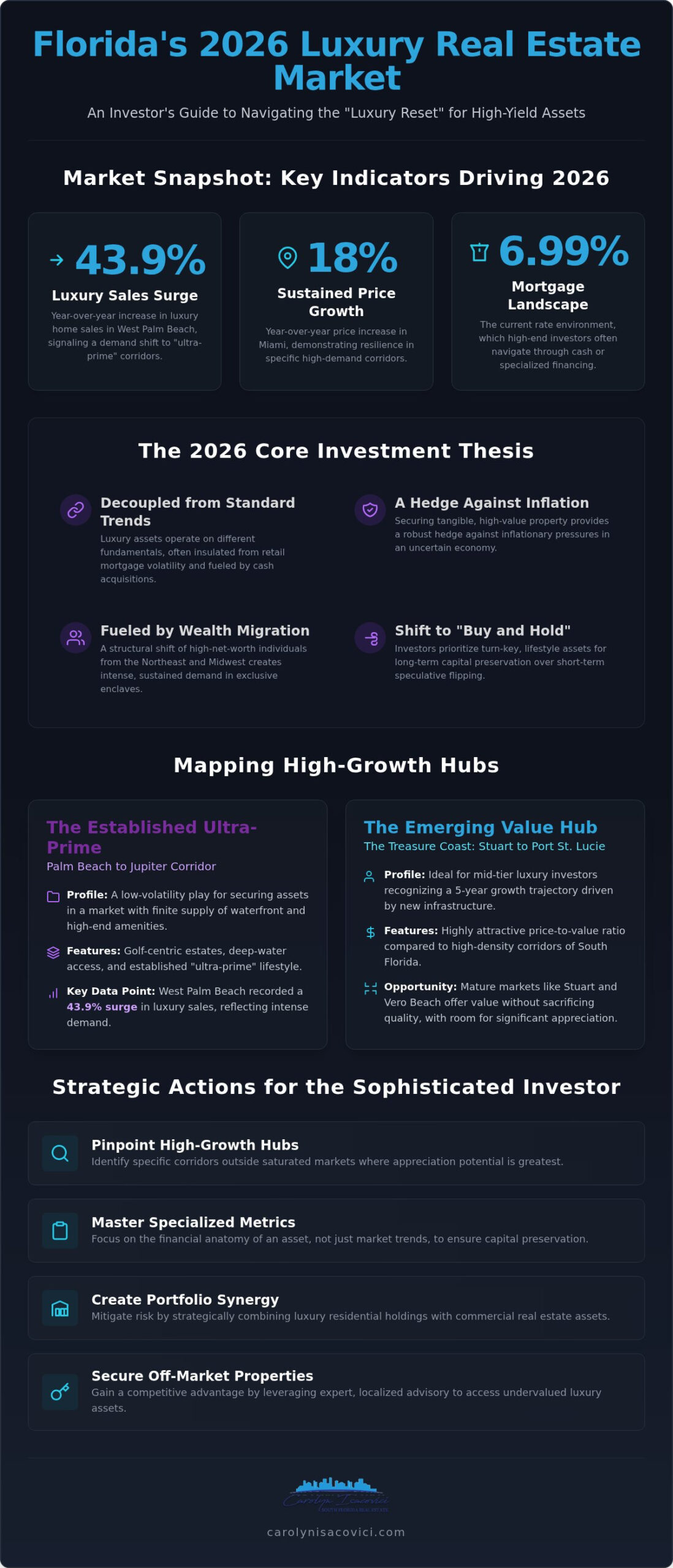
Did you know that while some analysts predicted a cooling period, luxury home sales in West Palm Beach actually surged by 43.9% this past July? It’s a striking figure that challenges the common narrative of a market in retreat. You’ve likely felt the weight of headlines focusing on Miami’s corridor saturation or the intricate dance of rising insurance premiums. It’s natural to wonder if the window for meaningful entry has closed. It hasn’t. The current “luxury reset” has simply created a more precise environment for those who value strategy over speculation.
This strategic advisory guide shows you how to master Florida luxury property investment by identifying high-yield assets that prioritize capital preservation. We’ll examine why the 18% year-over-year price growth in Miami remains sustainable for specific corridors and how to navigate the current 6.99% mortgage landscape with confidence. You’ll discover how to evaluate new construction inventory and leverage the 2026 insurance rate cuts to diversify your portfolio through Florida’s most resilient markets.
Key Takeaways
- Understand why luxury assets are decoupling from standard trends to serve as a resilient hedge for your capital.
- Pinpoint the specific high-growth hubs outside of Miami where the most significant appreciation potential exists in 2026.
- Master the specialized metrics required for a successful Florida luxury property investment, focusing on the financial anatomy that matters most to sophisticated investors.
- Learn how to mitigate risk by creating synergy between your luxury residential holdings and strategic commercial real estate assets.
- Gain insight into securing undervalued luxury properties through off-market channels and expert localized advisory.
The 2026 Florida Luxury Investment Thesis: Resilience in a New Cycle
Why does luxury real estate often thrive when the broader market feels uncertain? In 2026, we’re seeing a clear decoupling. While entry-level residential segments face inventory and affordability hurdles, the high-end sector operates on a different set of fundamentals. Standard residential trends often react sharply to interest rate fluctuations; however, luxury assets are frequently fueled by cash acquisitions or institutional-grade financing that remains insulated from retail mortgage volatility. Florida luxury property investment has matured. It’s no longer just about catching a wave of pandemic-era appreciation. It’s about securing a tangible hedge against inflationary pressures within a robust economic framework. Much of this stability is rooted in Florida’s economic resilience, which continues to outperform national averages and provide a steady foundation for high-value acquisitions.
Wealth Migration and the Demand for “Ultra-Prime” Assets
Is the migration to Florida slowing down? Not for the demographic that matters most to luxury investors. Corporate relocations aren’t just a post-pandemic fluke; they’ve become a structural shift. High-net-worth individuals from the Northeast and Midwest continue to follow capital and talent into the state. This influx creates intense pressure on exclusive enclaves like Palm Beach Gardens and Jupiter. In these markets, inventory remains structurally low. Because supply can’t easily expand in these established neighborhoods, 2026 has emerged as a unique “stabilization window.” Buyers are more deliberate now. They’re looking for value, but they’re also competing for a finite number of “ultra-prime” assets that simply don’t exist elsewhere. This competition ensures that even as the broader market normalizes, the floor for luxury pricing remains exceptionally firm.
Luxury as a Lifestyle-Investment Hybrid
What defines the successful investor in 2026? It’s the pursuit of utility. The days of speculative “buy and flip” have largely been replaced by a “buy and hold” mentality that prizes turn-key readiness. Modern investors want properties that are ready for immediate occupancy or high-end leasing without the headache of long-term renovations. This shift is particularly evident when you examine Miami real estate market trends, where move-in ready homes command a significant premium even as buyers take more time to finalize deals. By focusing on high-demand zones, you’re not just buying a home. You’re acquiring a lifestyle asset that balances personal utility with long-term capital preservation. This transition from speculative buying to strategic Florida luxury property investment is the hallmark of the current cycle, offering a sense of security for those who prioritize quality over volume.
High-Growth Hubs: Mapping the 2026 Luxury Landscape
Where is the smart money heading in 2026? While Miami continues to command attention with an 18% year-over-year price increase as of July 2026, many seasoned investors are looking further north. The “Next Miami” isn’t a single metropolitan area. Instead, it’s a series of high-growth pockets where infrastructure and lifestyle demand intersect. Florida luxury property investment has shifted toward hubs that offer more than just a skyline; they offer long-term stability and room for expansion. Comparing the Treasure Coast to South Florida reveals a fascinating narrative of “Quiet Luxury” taking center stage.
The Palm Beach to Jupiter Corridor
Why are Palm Beach Gardens and Jupiter consistently outperforming traditional urban centers? The answer lies in the barrier to entry. These enclaves offer a unique combination of golf-centric estates and deep-water access that is increasingly rare. For investors who value acreage and specialized lifestyle assets, the appeal of these Florida communities often mirrors the demand for premier equestrian estates found through Colorado Horse Property. In July 2026, West Palm Beach recorded a massive 43.9% year-over-year increase in luxury home sales. This surge reflects a clear preference for the “ultra-prime” lifestyle without the density of the Miami core. For investors, this corridor represents a low-volatility play. You aren’t just buying a residence; you’re securing an asset in a market with a finite supply of waterfront land and high-end amenities.
Is the Treasure Coast still considered a secondary market? Not anymore. Stuart, Palm City, and Vero Beach have matured into premier destinations for those seeking value without sacrificing quality. The price-to-value ratio in Stuart remains highly attractive compared to the high-density corridors of Broward County. Meanwhile, Port Saint Lucie and Fort Pierce are drawing mid-tier luxury investors who recognize the 5-year growth trajectory driven by new infrastructure and corporate expansion. These areas are effectively future-proofed by their accessibility and lifestyle appeal. If you’re looking to identify these emerging pockets before they reach peak saturation, it helps to consult with a localized expert who understands the nuances of each neighborhood.
Evaluating the infrastructure developments in these secondary hubs is critical. From expanded private aviation facilities to high-speed rail connections, the connectivity of the Treasure Coast has never been better. This evolution ensures that your investment remains liquid and continues to appreciate as more domestic wealth migrates toward these serene, high-yield environments. By focusing on these high-growth corridors, you’re positioning your portfolio to benefit from the next wave of Florida’s economic evolution.
Evaluating Luxury Assets: Metrics That Matter in 2026
How do you determine the true value of a property when the price tag reaches eight figures? It isn’t just about the panoramic views or the designer finishes. In 2026, the financial anatomy of a high-end asset requires a much deeper level of scrutiny. While aesthetics drive emotional appeal, long-term success depends on your ability to how to evaluate investment property Florida metrics through a luxury lens. This involves looking beyond simple cap rates to analyze the “Replacement Cost” in a market where construction labor and material costs remain historically high. If the cost to build a similar estate today exceeds the current market price, you’ve likely identified a significant margin of safety for your capital.
Yield potential in the luxury sector has also evolved. Investors must decide between the high-touch, high-reward nature of luxury short-term rentals and the stability of long-term holds. With Florida’s median single-family home price reaching $425,000 as of August 2026, the luxury tier remains a distinct ecosystem. Successful Florida luxury property investment strategies now prioritize properties that offer “utility,” meaning they are move-in ready and capable of generating immediate cash flow or serving as a primary residence without the need for immediate, costly renovations.
New Construction vs. Value-Add Luxury
Should you buy a legacy estate or look toward the horizon? There is currently a significant premium on new construction homes Florida. Modern buyers are willing to pay more for the peace of mind that comes with updated building codes and energy-efficient systems. For those seeking maximum equity capture, pre-construction remains a compelling path, though it requires a patient hand and a trusted advisor to navigate developer timelines. Conversely, renovating legacy estates in Miami Beach offers high rewards but carries the complexity of modernizing older structures to meet current flood and wind standards. It’s a calculated risk that requires a seasoned eye for structural integrity.
Due Diligence for High-Value Holdings
Due diligence in 2026 is largely a conversation about resilience. Navigating insurance requirements is paramount, especially for waterfront assets. While Citizens Property Insurance implemented a statewide average rate cut of 8.8% for multiperil policies on July 1, 2026, private market premiums for coastal luxury homes remain a major line item in any pro forma. Understanding local zoning and sea-level mitigation is no longer optional; it’s a fundamental part of protecting long-term value. This is where the expertise of Florida Commercial Investment Properties becomes invaluable. Carolyn Isacovici specializes in uncovering off-market luxury opportunities that haven’t been picked over by the general public, ensuring you’re evaluating assets based on true market data rather than just list price hype.
Risk Mitigation and Portfolio Synergy
Is there a bubble? It’s the question that often lingers in the minds of high-net-worth investors whenever a market reaches a new plateau. In 2026, the answer is found in the data rather than the noise. While we’ve seen a “luxury reset” toward more deliberate pricing, the fundamental drivers of demand remain remarkably firm. Florida luxury property investment is no longer a speculative gamble based on rapid appreciation; it’s a sophisticated play for capital preservation. By adopting a “calm expert” perspective, you can view 2026 interest rate fluctuations as a timing variable rather than a barrier to entry. Stability is the new growth.
Synergy is the secret to a resilient portfolio. Many of our clients find that balancing high-end residential holdings with Florida commercial real estate for sale creates a powerful defensive posture. This approach allows you to offset the carrying costs of a personal estate with the consistent cash flow of a commercial asset. It’s about building a unified strategy that thrives across different market cycles.
Diversification Within the Florida Market
Why choose between sectors when they can work together? A strategic mix of commercial vs residential investment Florida often provides the most attractive risk-adjusted return. Luxury condos frequently serve as liquid entry points for those looking to establish a footprint quickly. These assets offer ease of management while you identify larger opportunities, such as multi-family luxury developments in high-demand corridors. The goal is to create a tiered portfolio that captures both high-yield rental income and long-term appreciation in exclusive enclaves.
Tax advantages further strengthen this thesis. Leveraging 1031 exchanges allows you to defer capital gains and roll equity into higher-value assets without immediate tax friction. For those establishing residency, Florida’s homestead rules provide a significant safety net. In 2026, the assessment increase for homesteaded properties is capped at 2.7%, ensuring your primary investment remains protected from runaway tax hikes.
Managing the Asset: Beyond the Purchase
The real work begins after the closing. For the absentee investor, professional management is the difference between a passive asset and a mounting headache. Maintaining “Asset Alpha” requires a focus on capital improvements that actually drive ROI, such as modernizing smart-home systems or investing in advanced sea-level mitigation. The “Luxury Hedge” is the strategic acquisition of high-utility, supply-constrained real estate that preserves capital by decoupling from broader market volatility through intrinsic lifestyle value. If you’re ready to refine your holdings, you can partner with Florida Commercial Investment Properties to audit your current strategy and identify new avenues for growth.
Securing Your 2026 Florida Luxury Portfolio with Carolyn Isacovici
How do you bridge the gap between market insight and a signed deed? In a landscape as dynamic as 2026, the answer lies in localized, advisory-first brokerage. Success in Florida luxury property investment isn’t just about finding a listing; it’s about navigating a complex ecosystem of insurance, tax caps, and structural integrity studies with a steady hand. Florida Commercial Investment Properties, led by Carolyn Isacovici, provides the analytical mind of a strategist combined with the empathetic ear of a consultant. We don’t just sell property. We partner with you to transform market uncertainty into a clear, actionable sense of opportunity.
One of the most significant advantages we offer is access. While many buyers wait for notifications from public portals, the most compelling opportunities often never reach the MLS. Carolyn Isacovici leverages deep-rooted local relationships to identify undervalued luxury assets before they’re exposed to the broader market. This “off-market” edge is critical in high-demand enclaves where inventory remains structurally low. This strategy of private matching is a hallmark of elite markets globally, much like how DealDeed connects vetted buyers with exclusive off-market properties in Dubai. Our end-to-end support model ensures that from the initial selection to the final closing, every detail is managed with precision.
Why does a 20-year history matter? It means we’ve seen every phase of the cycle. From the rapid growth of the Miami corridor to the emerging serenity of the Treasure Coast, our firm has navigated the shifts that define Florida real estate. We maintain a local presence in key corridors like Palm Beach and Jupiter, providing you with boots-on-the-ground intelligence that data alone can’t replicate. Whether you’re looking for new construction homes Florida or high-yield commercial assets, we provide a unified portfolio strategy. If you’re ready to move beyond the headlines, you can schedule a private portfolio consultation for 2026 to discuss your specific wealth preservation goals.
Final Strategic Takeaways
The 2026 luxury outlook is one of normalization and precision. Opportunity favors the prepared investor who recognizes that luxury real estate is a sophisticated institutional-grade hedge. As we’ve explored, the decoupling of luxury assets from broader market trends provides a unique window for capital preservation and long-term appreciation. Before you make your next move, consider reviewing our comprehensive guide on Florida real estate portfolio building. When you’re ready to secure your position in this resilient market, you can partner with Carolyn Isacovici for your next Florida luxury acquisition. We’re here to guide you through every step of the journey.
Your Path to Resilient Wealth in 2026
Are you ready to transform these market insights into a high-yield reality? The 2026 landscape offers a unique stabilization window for those who prioritize quality over volume. By focusing on asset utility and the supply-constrained enclaves of the Treasure Coast and Palm Beach, you’re positioning your capital for long-term preservation. Florida luxury property investment has matured into an institutional-grade hedge; however, success still hinges on the precision of your entry and the strength of your due diligence.
Carolyn Isacovici has specialized in high-value Florida assets since 2006, providing deep local expertise across Miami, Palm Beach, and the Treasure Coast. Our advisory-first approach is built on the belief that your success is measured by long-term yield, not just a single closing. We’re here to help you navigate this cycle with confidence and clarity. It’s time to build a portfolio that reflects your vision for the future.
Connect with Carolyn Isacovici for a Strategic Luxury Portfolio Consultation and secure your place in Florida’s most resilient markets. The right time to act is when you have the right partner by your side.
Frequently Asked Questions
Is 2026 a good year to invest in Florida luxury property?
Yes, 2026 is a strategic year for acquisition because the market has transitioned into a “luxury reset.” While mortgage rates for a 30-year fixed sat at 6.99% in September 2026, the market has normalized from pandemic peaks. This shift means pricing is more precise and buyers have more leverage. Florida luxury property investment remains a resilient choice as domestic wealth migration continues to provide a firm floor for high-end asset values.
Which Florida cities offer the highest ROI for luxury real estate?
Miami and West Palm Beach currently offer the strongest momentum for luxury investors. As of July 2026, Miami saw an 18% year-over-year price increase, while West Palm Beach recorded a massive 43.9% surge in luxury sales volume. For those seeking long-term appreciation with lower volatility, the “Quiet Luxury” hubs of Jupiter and Stuart offer compelling price-to-value ratios. These areas benefit from limited inventory and high demand for waterfront estates.
What are the main risks of luxury property investment in Florida?
Rising insurance premiums and identifying true value in saturated corridors are the primary risks in 2026. Although Citizens Property Insurance implemented an 8.8% average rate cut on July 1, 2026, coastal coverage remains a significant line item. Modern investors must also pay close attention to condominium milestone inspection reports and structural integrity reserve studies. Ensuring a property is move-in ready is critical, as luxury buyers now prioritize assets that don’t require immediate renovations.
How does new construction compare to resale for luxury investors?
New construction is currently the preferred choice for investors seeking immediate utility and updated building codes. These homes command a premium because they meet 2026 energy-efficiency standards and offer modern flood mitigation. While resale legacy estates provide unique architectural character, they often come with higher insurance costs and potential modernization hurdles. Pre-construction remains a favorite for capturing equity, provided you have a trusted advisor to navigate developer timelines and structural integrity studies.
Are there specific tax benefits for investing in Florida luxury real estate?
Florida remains a premier destination for tax-conscious investors due to its lack of state income tax. In 2026, the homestead assessment increase is capped at 2.7%, protecting residents from rapid tax hikes. Investors should also watch the November 2026 ballot for a proposed constitutional amendment. If passed, it would significantly increase homestead exemptions in 2027. These favorable conditions continue to drive Florida luxury property investment as a primary strategy for capital preservation.
What is the typical entry price for a luxury investment property in Miami vs. Stuart?
Entry prices for luxury properties are significantly higher than the statewide median of $425,000. In Miami’s ultra-prime neighborhoods, luxury assets typically start well into the multi-million dollar range, driven by consistent 18% annual growth. Stuart offers a more accessible entry for “Quiet Luxury,” providing similar waterfront utility at a more favorable price-per-square-foot. Both markets reflect the premium of exclusive coastal living, but Stuart offers a higher price-to-value ratio for those seeking more space.
How do I find off-market luxury listings in South Florida?
Finding off-market opportunities requires a localized, advisory-first brokerage partner with deep community roots. Many high-value estates in Palm Beach and the Treasure Coast never reach public portals to maintain seller privacy. Carolyn Isacovici uses 20 years of established relationships to identify these “pocket listings” before they face general competition. This approach allows you to negotiate based on intrinsic value rather than responding to the pressure of a public bidding war.
Can I use a 1031 exchange for a Florida luxury investment property?
You can absolutely use a 1031 exchange to defer capital gains tax when selling an investment property and reinvesting in a Florida luxury asset. This is a common strategy for building portfolio synergy between commercial and residential holdings. By rolling equity into a higher-value asset of equal or greater value, you maintain your investment momentum without immediate tax friction. It’s a powerful tool for long-term wealth accumulation within the resilient Florida market.