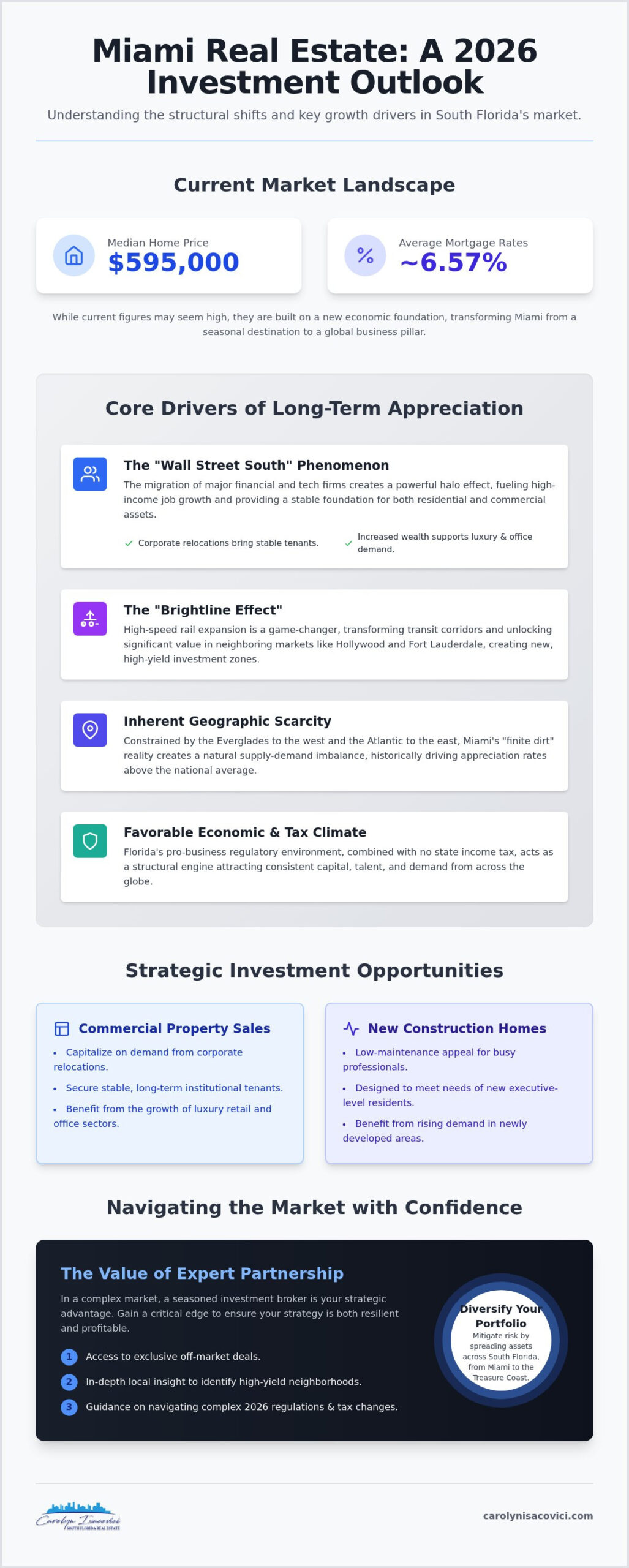
What if the market peak you’re dreading is actually the foundation of Miami’s next decade of growth? It’s natural to feel a sense of hesitation when the median home price sits at $595,000 and mortgage rates hover near 6.57%. You might worry that you’ve missed the window for the best Miami real estate investment opportunities, or perhaps the shifting tax regulations and building recertification rules feel like an overwhelming maze. We understand that uncertainty. It’s why we’re here to provide a steady hand and a clear perspective on why this city has evolved from a seasonal playground into a structural pillar of the global economy.
You deserve to move forward with confidence rather than confusion. In this guide, you’ll discover how to identify high yield neighborhoods that are truly emerging in 2026 and receive a strategic framework for choosing between residential assets and commercial property sales. We’ll explore the economic drivers fueling Florida’s growth and help you navigate complex changes like bonus depreciation reductions and new building recertification timelines. By the end, you’ll have a professional roadmap to ensure your long term strategy is as resilient as it is profitable.
Key Takeaways
- Understand the structural shift that has transformed Miami into a primary global business hub, providing a stable foundation for long-term property appreciation.
- Explore the “Brightline Effect” to see how new transit corridors are unlocking significant value in neighboring markets like Hollywood and Fort Lauderdale.
- Evaluate diverse Miami real estate investment opportunities by comparing the strategic benefits of commercial property sales with the low-maintenance appeal of new construction homes.
- Learn to mitigate risk through geographic diversification, spreading your assets across South Florida’s most promising regions from Miami to the Treasure Coast.
- Discover how partnering with an expert broker grants you access to off-market deals and the local insight needed to navigate complex 2026 regulations.
Why Miami Real Estate Remains a Global Investment Magnet in 2026
Miami has matured far beyond its reputation as a sun-drenched getaway. It is now a sophisticated center of global commerce that continues to attract capital from every corner of the globe. Why does this momentum persist? The foundation lies in Florida’s economic landscape, which offers a rare combination of no state income tax and a pro-business regulatory environment. This fiscal advantage is not just a perk; it’s a structural engine that drives consistent demand for high-quality assets.
For many, the current market feels complex. You might see fluctuating interest rates or new regulations and feel a sense of hesitation. However, experienced investors recognize that these periods of recalibration often unveil the most compelling Miami real estate investment opportunities. The city’s “Gateway to the Americas” status ensures a steady flow of international trade and human capital, making the local economy more resilient than many interior U.S. markets. When uncertainty causes others to pause, it often signals the ideal entry point for those with a long term vision.
The Resilience of the South Florida Market
Physical geography plays a silent but powerful role in protecting your investment. Miami is uniquely constrained by the Everglades to the west and the Atlantic Ocean to the east. This “finite dirt” reality means that supply cannot simply expand outward to meet demand. When you combine this limited land supply with the 2026 infrastructure improvements, including expanded transit corridors, you see a market built for long term appreciation rather than short term speculation. Historically, South Florida has frequently outpaced national appreciation averages because of this inherent supply-demand imbalance.
The Shift Toward “Wall Street South”
The migration of major financial institutions and tech giants to Miami and Palm Beach has reached a critical mass. This phenomenon, often called “Wall Street South,” has fundamentally changed the local demographic. High-income job growth is no longer a projection; it is a reality that fuels the residential sector and creates a significant halo effect for commercial property sales. This influx of institutional capital provides a layer of security for those seeking Miami real estate investment opportunities. You aren’t just buying a property; you’re taking a position in a city that is successfully competing with New York and London for global relevance.
- Corporate relocations bring stable, long term tenants to the region.
- Increased local wealth supports high-end luxury retail and office demand.
- New construction homes are increasingly designed to meet the needs of executive-level professionals.
Understanding the Drivers of Miami Property Appreciation
What actually makes a property grow in value? In a high-demand coastal market like South Florida, appreciation isn’t a mystery; it’s a measurable result of scarcity meeting demand. While national trends might fluctuate, the local drivers here are deeply structural. One of the most visible catalysts is the “Brightline Effect.” This high-speed rail expansion has transformed formerly overlooked areas in Hollywood and Fort Lauderdale into transit-oriented hubs, significantly increasing property values for assets within walking distance of the stations.
This growth is further fueled by demand-pull inflation. As out-of-state wealth continues to pour in from high-tax states, the purchasing power in the local market remains exceptionally buoyant. You can see the evidence in the Miami-Dade County Economic Reports, which highlight the steady rise in median household income and corporate investment. This influx doesn’t just impact luxury estates; it creates a lift across the entire spectrum of Miami real estate investment opportunities.
Infrastructure and Urban Revitalization
Have you noticed the transformation of the Design District or Wynwood? These aren’t just aesthetic upgrades. They are the result of strategic public-private partnerships that turn industrial zones into global cultural destinations. When a neighborhood gains a luxury retail anchor or a new transit hub, it creates a localized appreciation “pocket” where values can outpace the broader market. These revitalized districts attract a new demographic of high-earning professionals, making them prime targets for Miami real estate investment opportunities. Investors seeking to capitalize on this trend should also explore Miami luxury condos for investment, which are increasingly concentrated in these high-demand urban corridors.
Supply Constraints and Zoning Impacts
The supply of land is our greatest constraint. In Miami, prime waterfront and “in-fill” development sites are almost entirely accounted for. This scarcity naturally pushes asset values higher as developers compete for limited space. To address this, we’re seeing significant zoning changes designed to allow for higher density. These shifts create unique openings for commercial property sales, as older low-density structures are replaced by modern, high-yield mixed-use developments. Rising construction costs also play a role, setting a higher floor for new inventory and protecting the value of existing assets.
Miami property appreciation is the result of sustained net-migration and corporate capital inflow. If you’re looking to identify which specific pockets are poised for the next growth spurt, consulting with a local investment broker can provide the clarity you need.
Exploring High-Yield Miami Real Estate Investment Opportunities
Which asset class aligns best with your financial goals? It’s the central question for anyone evaluating Miami real estate investment opportunities today. While residential assets offer familiarity, commercial sectors often provide the institutional edge needed for significant scaling. In 2026, we’re seeing a distinct trend toward high-yield multi-family units. These assets balance the stability of residential demand with the professional management structures of commercial property sales, providing consistent cash flow even as the market matures. By diversifying your holdings, you don’t just grow your wealth; you insulate it against localized shifts.
Commercial Real Estate: The Institutional Edge
Why are industrial and warehouse spaces the quiet winners of 2026? The answer lies in the continued logistics boom servicing the South Florida population. As more people move to the region, the demand for “last-mile” delivery centers remains relentless. Beyond large-scale warehouses, boutique office spaces are seeing a resurgence. As firms relocate to the region, they seek high-end, smaller footprints that offer prestige without the overhead of massive towers. This demand extends beyond the city core. Retail opportunities in high-growth corridors like Port Saint Lucie are becoming increasingly attractive as residential rooftops multiply along the Treasure Coast, creating new pockets of consumer demand.
Residential and New Construction Strategies
For many investors, the path to luxury appreciation leads north of the city. Areas like Palm Beach Gardens and Jupiter have become magnets for affluent families seeking a specific lifestyle, driving demand for high-end inventory. One of the most effective ways to capture this value is by buying new construction homes Florida investors can secure. Pre-construction pricing allows you to lock in today’s value while the property is being built, often resulting in immediate equity upon completion. These properties are particularly attractive to those seeking Miami real estate investment opportunities because they require minimal maintenance and appeal to the modern tenant’s preference for hurricane-resistant, energy-efficient designs.
Identifying the difference between “established” and “emerging” neighborhoods is vital for timing your entry. Miami Beach remains an established anchor with high demand, but the stretch toward Stuart offers emerging pockets where the entry price is lower and the potential for long-term appreciation is higher. Success in this market isn’t just about finding a property; it’s about finding the right location at the right moment. Whether you’re looking at Miami luxury condos for investment in Brickell or a new construction home in the suburbs, the key is to prioritize assets that serve the growing professional class. Our in-depth analysis of the best neighborhoods to invest in Miami can help you pinpoint exactly where these opportunities are converging in 2026.
Strategic Portfolio Building: Timing and Risk in South Florida
Is the South Florida market a bubble waiting to burst? It’s a question we hear often, especially with the median home sale price reaching $595,000 in August 2026. While the rapid growth of previous years has slowed to a more predictable pace, the underlying drivers remain solid. We aren’t seeing the speculative frenzy of decades past; instead, we’re witnessing a structural migration of wealth and industry. For those seeking Miami real estate investment opportunities, the most resilient path forward is a long-term hold strategy that prioritizes value over quick flips.
Risk mitigation starts with geographic diversification. While Miami is the anchor, a balanced portfolio might include assets in Fort Lauderdale or as far north as Melbourne. This spread protects your capital from localized market shifts. To scale effectively, many of our clients utilize 1031 exchanges. This tool allows you to defer capital gains taxes by reinvesting proceeds into “like-kind” properties, effectively compounding your wealth within the Florida market without the immediate tax drag.
Evaluating the Cap Rate and ROI
How do you distinguish a good deal from a great one? It requires looking beyond the sticker price. You need a clear understanding of the how to evaluate investment property Florida investors should follow. While cash-on-cash return is vital for monthly liquidity, the total return on investment often comes from long-term appreciation in high-growth corridors. In 2026, successful investors are balancing these two metrics to ensure their portfolio remains healthy through various interest rate cycles.
Navigating Insurance and Environmental Factors
Rising insurance premiums are a reality, but they don’t have to be a deal-breaker. The key is to budget effectively and target “resilient” properties. We look for assets that meet modern building codes and sit at higher elevations to minimize risk. This is where new construction often shines. Because these buildings utilize the latest hurricane-resistant materials and energy-efficient designs, they frequently offer the best insurance-to-value ratio. By focusing on quality and compliance, you turn a potential obstacle into a competitive advantage. If you’re ready to build a portfolio designed for the future, consult with a strategic investment partner today.
Navigating the Miami Market with a Seasoned Investment Broker
Why do some investors always seem to find the best deals before they ever hit the open market? It isn’t luck; it’s the “Insider Advantage.” In a competitive environment like South Florida, the most lucrative Miami real estate investment opportunities are often found through off-market channels and private networks. A seasoned broker doesn’t just provide data; they provide context. While a spreadsheet can show you that average rent in the region is $3,008, it won’t tell you why a specific block in Hollywood is poised for a value surge because of a planned boutique development nearby. We bridge that gap between cold numbers and local market sentiment.
Are you an international investor looking for a stable US dollar hedge, or a domestic builder looking to scale a residential portfolio? The strategy for each is vastly different. International buyers often prioritize residential real estate sales in established zones like Brickell for their liquidity and prestige. Conversely, domestic investors might focus on high-yield commercial property sales or new construction homes along the Treasure Coast to capture higher cap rates. Understanding these nuances is essential for long-term success, as explored in our comprehensive Miami Real Estate Market Trends 2026: Investor Guide.
The Florida Commercial Investment Properties Difference
Our reach extends far beyond the neon lights of Miami. From the vibrant urban core to the quiet, rapid growth of Vero Beach, Florida Commercial Investment Properties operates with a deep local knowledge that spans the entire South Florida coastline. We specialize in navigating the complexities of commercial property sales and new developments, ensuring every acquisition is backed by rigorous analysis. We don’t see ourselves as salespeople; we are your “Professional Partner.” Our goal is to ensure you feel both informed and looked after throughout the entire lifecycle of your investment.
Taking the Next Step in Your Investment Journey
How do you turn these insights into a tangible asset? It starts with a conversation. We offer custom market analyses tailored to your specific target area, helping you visualize the potential ROI before you commit capital. A personal consultation allows us to align your portfolio goals with the specific trends of 2026, from navigating new building recertification rules to capitalizing on transit-oriented development. Don’t let market complexity lead to paralysis. It’s time to transform your insight into action and secure your place in the future of Florida real estate.
Your Path to Long-Term Florida Prosperity
Miami’s transition into a global financial and tech hub is a structural shift that offers lasting stability for your capital. While the pace of growth has normalized, the combination of limited land supply and consistent corporate migration ensures that high-quality assets remain in high demand. You now have a framework for identifying high-yield neighborhoods and understanding how infrastructure like the Brightline expansion creates localized pockets of value. Moving from analysis to action is the final step in securing your financial future.
Identifying the most resilient Miami real estate investment opportunities requires more than just looking at listings; it demands a strategic approach to risk, timing, and local regulations. Whether you’re interested in new construction homes or complex commercial property sales, having a guide to navigate insurance shifts and tax deferral strategies is vital for your success. Our team provides the deep local expertise and strategic advisory needed to scale your portfolio from Miami to the Treasure Coast with absolute confidence.
Are you ready to turn these market insights into a high-value reality? Secure your next high-value asset with Florida Commercial Investment Properties. We’re here to ensure your investment journey is as rewarding as it is clear. Let’s build your legacy together.
Frequently Asked Questions
Is Miami real estate still appreciating in 2026?
Yes, though the market has transitioned to a more moderate and predictable pace compared to previous years. In August 2026, the median home sale price reached $595,000, reflecting steady demand. Appreciation is now driven by structural shifts, including corporate relocations and a finite supply of land, rather than speculative fever. This creates a stable environment for those pursuing Miami real estate investment opportunities over a long term horizon.
What are the best neighborhoods for investment in Miami right now?
The most compelling opportunities are currently found in transit-oriented zones and areas seeing significant urban revitalization. The “Brightline Effect” has made neighborhoods in Hollywood and Fort Lauderdale increasingly attractive for multi-family assets. For luxury seekers, Palm Beach Gardens and Jupiter continue to see strong demand from affluent families. Investors are also looking toward high-growth corridors in Port Saint Lucie where residential development is expanding rapidly along the Treasure Coast. For a data-driven breakdown of where to focus your capital, explore our guide to the best neighborhoods to invest in Miami in 2026.
How does Florida’s tax structure benefit real estate investors?
Florida offers a highly favorable environment because it lacks a state income tax, which significantly increases the net yield for property owners. Investors can also utilize 1031 exchanges to defer capital gains taxes, allowing for more efficient portfolio scaling. For primary residents, the Homestead Exemption can reduce the taxable value of a home by $51,411. These fiscal advantages make the region a premier destination for domestic and international capital alike.
What is the average cap rate for commercial property in South Florida?
Cap rates vary by asset class, but industrial and warehouse spaces currently lead the market with strong, stable returns. While retail and boutique office spaces in high-growth corridors are seeing competitive yields, the exact rate depends heavily on the property’s location and tenant strength. We recommend requesting a custom market analysis to calculate the real return on any specific commercial property sales you are considering in the current 2026 market.
Should I invest in new construction or existing homes in Miami?
New construction often provides a strategic advantage in 2026 due to modern building codes and hurricane-resistant materials. These features typically lead to lower insurance premiums and reduced maintenance costs compared to older assets. While existing homes may offer a lower initial entry price, new construction homes allow investors to lock in pre-construction pricing and appeal to the high-income professionals currently migrating to the South Florida region.
How do I manage a Miami investment property if I live out of state?
Successful out-of-state ownership relies on building a reliable local team. You’ll need a professional property management firm to handle day-to-day operations, tenant relations, and maintenance. Partnering with a seasoned investment broker is also essential, as they provide the boots-on-the-ground insight needed to monitor market shifts and identify when it is time to exit or reinvest. This collaborative approach allows you to scale your Florida portfolio with total confidence from anywhere.
What are the risks of investing in the Miami real estate market?
The primary risks in 2026 involve rising insurance premiums and evolving building recertification requirements. Properties located within three miles of the coastline now require recertification at 25 years of age. To mitigate these risks, we advise diversifying your assets across different geographic zones, such as moving inland or north toward Vero Beach. Focusing on resilient properties with modern elevation and building standards helps protect your capital against environmental and regulatory shifts.
How can a Florida real estate broker help me find off-market deals?
A seasoned broker provides access to private networks and “pocket listings” that never reach public platforms. We use our deep local reach to identify sellers who prefer discreet transactions, giving you an “Insider Advantage” in a competitive market. By bridging the gap between data and market sentiment, we help you secure Miami real estate investment opportunities that align perfectly with your specific financial goals and risk tolerance.
Leave a Reply