Tag: Treasure Coast

  • Cash Flow Investment Property Florida: 2026 Strategic Examples and Yield Analysis

    Cash Flow Investment Property Florida: 2026 Strategic Examples and Yield Analysis

    The traditional Florida real estate playbook, once centered solely on the glittering skyline of Miami, has officially been rewritten for 2026. You’ve likely noticed that finding a cash flow investment property Florida is becoming a more complex puzzle as insurance premiums and entry prices in the major metros continue to climb. It’s natural to feel a bit of hesitation when the old rules no longer seem to apply. Is it still possible to find a double-digit yield in a market that feels this crowded? The answer is a definitive yes, provided you know where to look.

    We’ve seen these cycles before, and we know that uncertainty is often just another word for opportunity. This article will show you exactly how to pivot your strategy toward the yield migration currently moving into high-growth corridors like the Treasure Coast. You’ll gain a clear framework for calculating true net cash flow in today’s environment, along with specific geographic examples that offer the best balance of risk and reward. Let’s explore how to approach the 2026 market with the confidence of a seasoned strategist and a professional partner by your side.

    Key Takeaways

    • Learn why the 2026 market shift actually creates new opportunities for investors who look beyond the saturated coastal cores.
    • Discover how to identify a high-yield cash flow investment property Florida by targeting the “yield migration” toward high-growth corridors like the Treasure Coast.
    • Master the “Gross to Net” audit to properly account for insurance, taxes, and maintenance before your inspection period ends.
    • Explore specific examples of multi-family assets and new construction homes that are currently outperforming traditional benchmarks.
    • Understand how a local expert partner helps you navigate complex market cycles to build a resilient and profitable real estate portfolio.

    Is Cash Flow Still Possible in Florida? The 2026 Reality Check

    If you spend any time on investment forums, you’ve likely heard the chorus of skeptics claiming that the sun has set on the Sunshine State. They point to rising insurance premiums and high entry prices as evidence that a cash flow investment property Florida is a relic of the past. However, we’ve seen these cycles before; while the market has certainly matured, the narrative of “impossible cash flow” often overlooks the strategic shifts happening on the ground. Yield hasn’t disappeared. It has simply migrated.

    Success in 2026 requires a disciplined definition of profitability. In this modern context, cash flow is the net income remaining after all operational expenses, mortgage obligations, and the critical 2026 “Florida Insurance Premium” adjustment have been fully satisfied. While the noise on social media focuses on the hurdles, seasoned investors are focusing on the underlying math. High costs don’t kill yield if rental demand scales proportionally, and in Florida, that demand remains remarkably resilient.

    The Shift from Appreciation to Yield

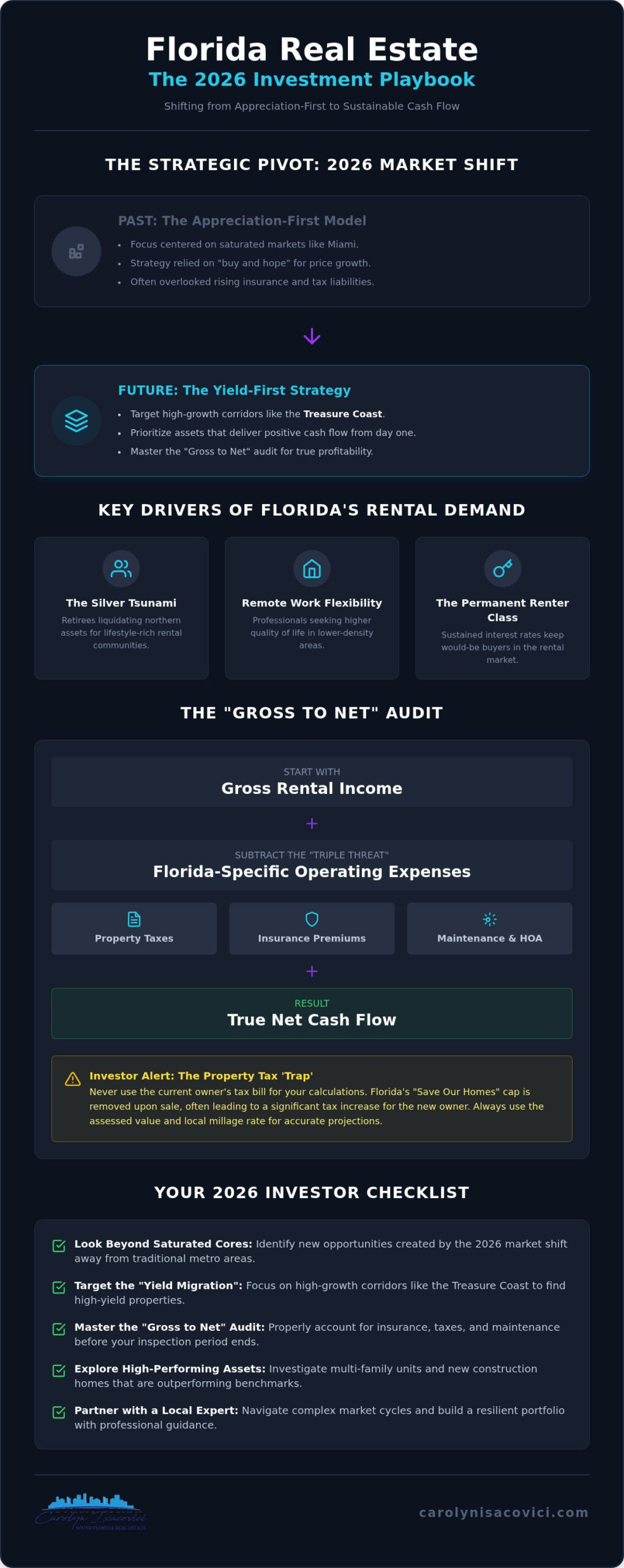
    The era of “buy and hope” appreciation has evolved into a sophisticated, yield-first approach. Investors are no longer banking on double-digit price growth to justify an acquisition. Instead, they’re looking for assets that perform on day one. This shift is supported by Florida’s favorable tax climate; the absence of state income tax allows more of your gross rental income to flow directly to your bottom line, a factor that often offsets higher insurance costs when compared to high-tax states. It’s vital to distinguish between “Paper Cash Flow,” which looks good in a brochure, and “Real-World Yield,” which accounts for the actualities of 2026 property management and localized tax assessments.

    Migration Patterns and Rental Demand

    Where are the 2026 inbound residents actually landing? While Miami-Dade continues to attract global capital and corporate headquarters, we’re seeing a significant “yield migration” toward the Treasure Coast. This area offers a more accessible entry point for a cash flow investment property Florida while benefiting from the same massive population tailwinds. Several factors are driving this sustained demand:

    • The Silver Tsunami: Retirees continue to liquidate high-value northern assets to find lifestyle-rich rental communities in Florida.
    • Remote Work Flexibility: Professionals are choosing the lower density and higher quality of life found in areas like Port Saint Lucie and Vero Beach.
    • The Permanent Renter Class: Sustained interest rates have kept many would-be buyers in the rental market, creating a deep pool of qualified tenants in South Florida.

    By positioning your portfolio in the path of these migration patterns, you aren’t just buying real estate; you’re securing a piece of an ongoing demographic shift that supports long-term rental stability. The key is to look where the people are going, not just where they’ve already been.

    The Mechanics of Florida Cash Flow: Taxes, Insurance, and Cap Rates

    Understanding the mechanical drivers of yield is what separates a speculative purchase from a sound acquisition. In Florida, this means mastering the “Triple Threat”: property taxes, HOA fees, and homeowners insurance. While these figures might seem daunting at first glance, they are simply variables in a larger equation. By applying a structured how to evaluate investment property Florida framework, you can strip away the noise and focus on the net numbers that actually matter for your portfolio.

    Insurance often dominates the headlines, yet the 2026 carrier landscape is showing signs of stabilization as new capacity enters the market. A calm approach involves sourcing quotes early and looking for properties with recent mitigation upgrades that attract more competitive premiums. Is a 5% cap rate in Miami better than an 8% cap rate in Port Saint Lucie? Not necessarily. The answer depends on your long-term objectives for a cash flow investment property Florida and your tolerance for different risk profiles. High-growth areas often command lower initial caps because the market expects significant future rent growth.

    Understanding the Florida Property Tax ‘Trap’

    Many new investors make the mistake of looking at the current owner’s tax bill. It’s a dangerous baseline. In Florida, the “Save Our Homes” cap limits annual assessment increases for primary residents, but this protection vanishes the moment the property sells. As an investor, you must calculate your holding costs based on the new purchase price. This reassessment can lead to a significant jump in expenses that catches the unprepared off guard. Working with an expert in investment property sales ensures you have an accurate forecast of these carrying costs before you commit capital.

    Cap Rate Analysis for 2026 Markets

    In a high-interest environment, the spread between your cap rate and your mortgage rate is tighter than in previous years. This makes “Cash-on-Cash” return a more vital metric for those using leverage. For a Miami investment property in 2026, a “good” cap rate often hovers around 4.5% to 5.5% for Class A assets, reflecting the city’s global desirability and long-term stability. If you’re seeking higher immediate flow, you might look for “value-add” opportunities. These are properties where strategic renovations or management efficiencies allow you to force appreciation and increase the monthly yield simultaneously. Identifying these pockets of value requires a seasoned guide who understands the nuances of local submarkets.

    Strategic Examples: Where Cash Flow Meets Opportunity

    Theory only takes an investor so far. To truly understand where the 2026 market is moving, we must look at specific corridors where the numbers align with long-term growth. Identifying a cash flow investment property Florida today requires a balance between established urban cores and emerging secondary markets. While the high-profile glitz of the coast captures headlines, the most resilient yields are often found in the strategic “middle ground” where rental demand outpaces supply.

    In Miami’s urban core, we’re seeing a sophisticated pivot toward industrial and commercial assets. These properties often provide more stable, long-term lease structures that are less sensitive to the seasonal fluctuations of the residential market. Investors seeking to capitalize on this trend should explore the growing demand for industrial property for sale Miami, where last-mile logistics and global supply chain dynamics are creating compelling yield opportunities in submarkets like Hialeah. For those focused on residential data, staying informed on Miami real estate market trends is essential for pinpointing which neighborhoods are currently undervalued relative to their income potential. It’s about finding the intersection of local lifestyle shifts and institutional capital flow.

    The Treasure Coast: The New Frontier for Yield

    Port Saint Lucie and Fort Pierce have transitioned from sleepy coastal towns into primary targets for yield-hungry investors. The 2026 market shows a distinct trend: South Florida commuters are moving north in search of affordability, bringing high rental demand with them. This “yield migration” offers lower entry prices compared to Broward or Miami-Dade, allowing for more favorable cash-on-cash returns. We frequently recommend exploring new construction homes in these areas. Modern builds offer a significant “New Construction Advantage” because they feature the latest wind-mitigation technology, which leads to lower insurance premiums and minimal maintenance reserves in your first five years of ownership.

    Miami and Broward: The Commercial and Multi-Family Play

    For investors with higher capital reserves, the multi-family property for sale Miami market remains a powerful hedge against inflation. In areas like Hollywood and Fort Lauderdale, multi-family assets benefit from a dense population and a shortage of workforce housing. This creates a reliable environment for steady monthly income. While the debate between short-term rentals and long-term leases continues in Miami Beach, many are finding that long-term stability in pockets like Hollywood or Palm Beach Gardens offers a more predictable cash flow investment property Florida. These submarkets provide:

    • Consistent Occupancy: Proximity to major employment hubs in Fort Lauderdale and West Palm Beach.
    • Management Efficiency: Concentrated units allow for streamlined operations and lower per-unit costs.
    • Appreciation Potential: Continued infrastructure investment in Broward County supports long-term asset value.

    Success isn’t about finding the “perfect” city, but rather the perfect asset within a city that matches your specific yield requirements. Investors seeking to maximize returns should also explore the full spectrum of income producing properties Miami offers, from NNN-leased commercial assets to high-quality residential rentals that prioritize lease structure and long-term stability. By looking at these strategic examples, you can begin to see how 2026 market cycles are creating fresh opportunities for the observant investor.
    Cash Flow Investment Property Florida: 2026 Strategic Examples and Yield Analysis

    Calculating Your Path to Passive Income: A Due Diligence Checklist

    Turning a vision into a viable asset requires more than just local knowledge. It requires a rigorous, data-driven approach to due diligence. While the potential for a cash flow investment property Florida is significant, the margin for error has narrowed. This checklist serves as your roadmap to ensure that every dollar of capital is protected and positioned for growth.

    A “Gross to Net” audit is your first line of defense. It’s easy to get caught up in high rental rates, but your net income is what pays the bills. We recommend factoring in a 10% vacancy rate and a 5% maintenance reserve as non-negotiable line items in your projections. Next, prioritize your insurance quote. In the 2026 market, you must secure a firm quote before your inspection period ends. If the premium is higher than anticipated, you need that information while you still have the leverage to renegotiate or exit the contract. Finally, verify zoning and local regulations. This is especially vital for short-term rental plays, as Florida municipalities frequently update their ordinances. Your exit strategy must be robust; a quality asset should remain profitable even if you are forced to hold through a market down-cycle.

    The Investor’s Due Diligence Toolkit

    Utilizing a comprehensive investment property due diligence Florida checklist is the best way to avoid expensive surprises. A specialized commercial broker acts as your eyes and ears on the ground, identifying “hidden” costs like impending HOA assessments or deferred maintenance that a standard inspection might miss. Protecting your passive income also means vetting property management companies with the same intensity you use to vet the property itself. A poor manager can turn a high-performing asset into a headache overnight.

    Financing for Cash Flow

    The lending environment in 2026 offers sophisticated tools for the modern investor. Debt Service Coverage Ratio (DSCR) loans have become a staple, as they focus on the property’s ability to generate income rather than just your personal debt-to-income ratio. For those looking to maximize early-phase cash flow, “Interest-Only” periods can be a strategic choice. This reduces your monthly debt service during the initial years, allowing you to build up a healthy cash reserve. Whether you choose a traditional mortgage or portfolio lending, your financing should align with your long-term goals. If you are ready to move from analysis to acquisition, contact our investment property sales team to review current opportunities that meet these strict criteria.

    Building Your Florida Portfolio with Expert Guidance

    Success in the current market isn’t a matter of luck; it’s a matter of design. A robust Florida real estate portfolio building strategy requires more than just access to the MLS. It demands a local partner who can interpret shifting regulations and identify the quiet signals of growth before they become common knowledge. Carolyn Isacovici has spent decades transforming market uncertainty into clear opportunity for both global and local investors. By moving beyond a single-asset mindset, you can create a diversified collection of Florida real estate holdings that weather different economic climates with resilience.

    We believe that 2026 is a year for the strategic, not the swift. While the temptation to rush into a deal is always present, the most profitable portfolios are built through methodical acquisition and disciplined management. Transitioning from a single residential unit to a sophisticated mix of assets allows you to spread risk and capture yield across various sub-markets. This balanced approach ensures that your wealth isn’t just growing, but is also protected against localized shifts in demand or insurance costs.

    Why Experience Matters in the Florida Market

    Navigating the hyper-local sub-markets of Miami and Fort Lauderdale is a nuanced task. One block might offer prime rental demand while the next faces zoning restrictions that could stifle your yield. We provide the bridge between raw data and street-level reality. Our clients often gain access to “off-market” commercial and residential opportunities that never reach public listings. This insider access is a critical advantage when searching for a cash flow investment property Florida in a competitive environment. You need a broker who speaks the language of cap rates and net operating income while understanding the cultural heartbeat of the neighborhoods.

    Next Steps: Your 2026 Investment Roadmap

    The most successful investors are those who act with deliberation. Your journey begins by setting very specific criteria for what constitutes a viable cash flow investment property Florida within your unique risk profile. Whether you’re looking to acquire your first multi-family unit or expand into commercial assets, a structured roadmap is essential for long-term success. We invite you to schedule a strategic consultation to review your goals and analyze current market inventory through the lens of a seasoned guide. Ready to take the first step toward a more profitable future? Contact Carolyn Isacovici to start your Florida investment journey.

    Charting Your Path to Florida Real Estate Success in 2026

    The landscape of Florida real estate has shifted, but the fundamental promise of yield remains for those who move with precision. By focusing on high-growth corridors like the Treasure Coast and performing a rigorous “Gross to Net” audit, you can bypass the skepticism of the crowd and secure assets that perform on day one. Finding a cash flow investment property Florida today is about using local insight to turn market complexity into a strategic advantage. It’s a journey that rewards the patient, the analytical, and the well-advised.

    With a proven track record in Florida real estate since 2006, Carolyn Isacovici provides expert brokerage for Miami, Broward, and the Treasure Coast. We specialize in high-yield commercial and residential assets, helping you navigate the “Triple Threat” of taxes, insurance, and fees with a steady hand. We don’t just find properties; we partner with you to build a resilient portfolio designed for long-term stability.

    Secure Your High-Yield Florida Investment Property with Carolyn Isacovici

    The market cycle of 2026 is full of potential for the prepared investor. We’re here to ensure you navigate it with confidence and clarity.

    Frequently Asked Questions

    What is a good cash flow for an investment property in Florida in 2026?

    A strong benchmark for a cash flow investment property Florida in 2026 typically ranges between 5% and 8% depending on the specific asset class. While core Miami properties often trade at lower cap rates due to their high appreciation potential, you can find higher immediate yields in growth markets like the Treasure Coast. It’s vital to balance your desire for monthly income with the long-term stability of the neighborhood to ensure your portfolio remains resilient.

    How do I calculate the ‘True Net’ cash flow for a Miami property?

    Calculating “True Net” involves subtracting every possible expense from your gross rental income. Start with your projected rent, then deduct property taxes reassessed at your purchase price, current insurance premiums, and any HOA fees. Don’t forget to set aside 10% for vacancy and 5% for ongoing maintenance. This disciplined approach ensures you aren’t surprised by hidden costs, allowing you to move forward with the confidence that your investment is truly profitable.

    Is it better to invest in Miami or the Treasure Coast for cash flow?

    Both regions offer unique advantages. Miami provides global desirability and significant long-term appreciation, making it ideal for wealth preservation. In contrast, the Treasure Coast currently offers a more accessible entry point and higher immediate yield due to lower property taxes and insurance costs. Choosing between them depends on whether you prioritize monthly cash flow or capital growth. We often recommend a diversified approach that includes assets from both areas to maximize your total return.

    How does Florida property insurance affect my monthly cash flow?

    Insurance is a significant factor in your monthly expenses, but it doesn’t have to be a deal-breaker. By selecting properties with modern wind-mitigation features or newer construction, you can often secure more competitive rates. It’s essential to obtain a firm insurance quote before your inspection period ends. This proactive step allows you to adjust your cash flow projections accurately and ensures that the property’s yield meets your specific investment criteria before you close the deal.

    Can I find cash-flowing new construction homes in Florida?

    You certainly can, particularly in high-growth corridors like Port Saint Lucie or Vero Beach. New construction homes are highly attractive for a cash flow investment property Florida because they require minimal maintenance reserves and benefit from lower insurance premiums due to modern building codes. These properties often attract high-quality tenants who are willing to pay a premium for a brand-new living space, creating a stable and predictable stream of passive income for your portfolio.

    What is a DSCR loan and how does it help with cash flow?

    A DSCR loan stands for Debt Service Coverage Ratio, and it’s a powerful tool for scaling your portfolio. Unlike traditional mortgages that focus on your personal income, these loans qualify you based on the property’s ability to cover its own debt service. This allows you to acquire more properties without being limited by personal debt-to-income ratios. It’s an excellent option for investors who want to focus purely on the cash-flowing potential of their real estate assets.

    Are there still high-yield investment properties in South Florida?

    High-yield opportunities still exist in South Florida for investors who look beyond the obvious residential listings. Strategic pockets in Hollywood, Fort Lauderdale, and Miami’s urban core offer commercial and multi-family assets with strong income potential. Success in these areas requires a “value-add” mindset, where you identify properties that can benefit from management efficiencies or light renovations. These improvements allow you to force appreciation and increase your monthly yield, even in a mature market. For a deeper look at the full range of assets available, reviewing the landscape of income producing properties Miami has to offer can help you identify which asset classes best align with your yield and management goals.

    How do property taxes change after I buy an investment property in Florida?

    In Florida, property taxes are reassessed upon the sale of a property, typically based on the new purchase price. It’s a common mistake to rely on the seller’s current tax bill, which may be artificially low due to the “Save Our Homes” cap. As an investor, you won’t benefit from that primary-resident protection. We always advise calculating your holding costs using an estimated tax rate of 1.5% to 2% of the purchase price to ensure your projections are accurate.

  • Buying New Construction Homes in Florida: The 2026 Investor’s Guide

    Buying New Construction Homes in Florida: The 2026 Investor’s Guide

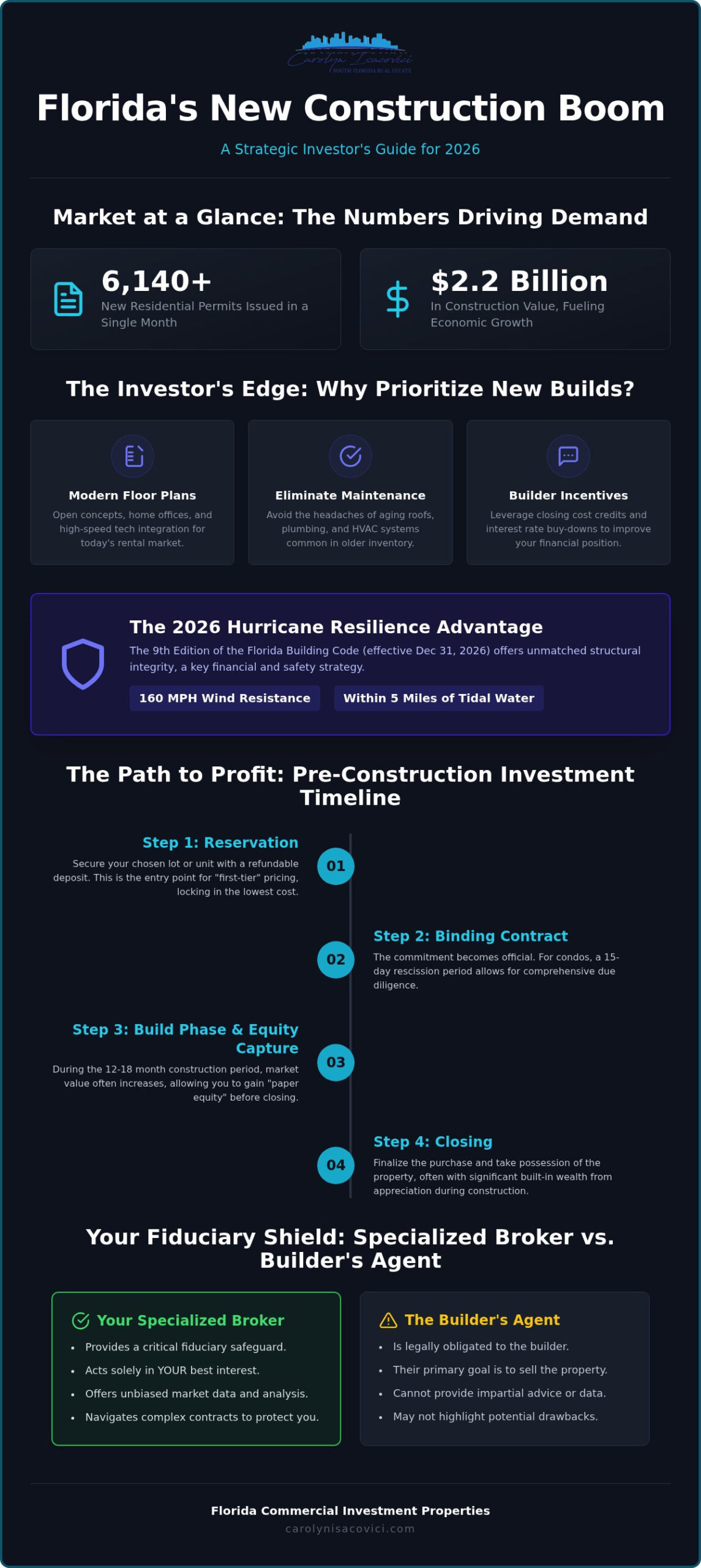
    Did you know that Florida issued over 6,140 new residential permits in a single month this year? This represents a staggering $2.2 billion in construction value, proving that the market for new construction homes Florida is currently offering more than just housing; it’s a primary driver of the state’s economic future. Does this level of activity make you wonder if you can still find a strategic entry point without overpaying? You aren’t alone in that concern.

    It’s common to feel a sense of hesitation when mortgage rates hover near 6.7% and new building codes are on the horizon. You want to ensure your capital is placed in regions with the highest appreciation potential while avoiding the confusion of complex builder timelines. This guide will transform that uncertainty into a clear roadmap for success. You’ll learn how to identify the most promising growth corridors and leverage the financial benefits of modern builds.

    We’ll examine the specific regions, from the burgeoning growth corridors of the Treasure Coast and Space Coast to the premium values in Southeast Florida, that are defining the 2026 market. By the end of this article, you’ll understand the pre-construction process and how to partner with an expert like Florida Commercial Investment Properties to secure a high-yield investment with total peace of mind.

    Key Takeaways

    • Understand how ongoing migration patterns and the 2026 market landscape create specific strategic advantages for residential and commercial investors.
    • Master the pre-construction timeline to secure first-tier pricing on new construction homes Florida, maximizing your potential appreciation before the project is even completed.
    • Identify high-growth corridors and regional shifts, specifically comparing luxury density in Miami with the emerging urban-suburban appeal of the Treasure Coast.
    • Navigate the financial complexities of new builds by distinguishing between CDD fees and traditional HOAs using our comprehensive due diligence checklist.
    • Learn why partnering with a specialized broker provides a critical fiduciary safeguard and access to unbiased market data that builder agents cannot offer.

    The State of New Construction Homes in Florida for 2026

    The 2026 market for new builds isn’t just surviving; it’s thriving with a renewed focus on durability and strategic expansion. With over 6,140 residential permits issued in early 2026 alone, representing over $2.2 billion in construction value, the state is actively building to meet the needs of a growing population. Why does demand stay so high in South Florida? It’s simple: people are still moving here for the favorable tax climate and the robust job market. This influx has transformed the Florida housing market into a landscape where inventory is finally catching up to the needs of modern families.

    Investors are particularly focused on the shift toward the 9th Edition of the Florida Building Code, which takes effect on December 31, 2026. These new standards mandate 160 mph wind resistance for homes within five miles of tidal water statewide, offering a level of hurricane resilience that older inventory simply cannot match. This structural integrity isn’t just about safety; it’s a financial strategy. By purchasing new construction homes Florida early in the development cycle, you can benefit from equity capture. This occurs when the property gains market value during the 12 to 18 months it takes to complete the build, allowing you to walk into the closing with built-in wealth.

    Why Investors are Prioritizing New Builds Now

    Why deal with the headaches of a 30-year-old roof or outdated plumbing? Investors are increasingly opting for new builds to eliminate the immediate maintenance costs that plague older Florida inventory. Modern floor plans, designed for the 2026 rental market, prioritize open concepts, home offices, and high-speed tech integration. Builders are also currently offering creative incentives, such as closing cost credits or interest rate buy-downs. These perks often make a new home significantly more affordable than a resale property in the same neighborhood.

    The 2026 Economic Outlook for Florida Real Estate

    Infrastructure is the backbone of this sustained growth. The expansion of the Brightline rail system and the emergence of new tech hubs in cities like Miami and Orlando are creating permanent value in surrounding residential areas. The 2026 Florida market functions as a calibrated balance where steady inventory growth meets persistent, high-quality demand. Real estate remains a powerful hedge against inflation because a new home is a tangible resource in a high-demand geography. It’s a strategic asset that preserves purchasing power while providing a functional utility that people will always need.

    Understanding the Pre-Construction Investment Mechanism

    How does a plot of dirt transform into a high-yield portfolio piece? It is a calculated sequence of events. Buying new construction homes Florida requires a clear understanding of the timeline to maximize your return on investment. The process typically moves through four distinct stages: Reservation, Contract, Groundbreaking, and Closing. For the savvy investor, the goal is to enter as early as possible. Why? Because builders frequently utilize “first-tier” pricing during the initial phase. As each block of homes sells, the developer raises prices for the next release, meaning early adopters often see their paper equity grow before the foundation is even poured.

    While the prospect of build-time delays can feel daunting, it’s helpful to remember that builders are equally motivated to reach the finish line. In 2026, with over $2.2 billion in construction value currently active across the state, the industry is moving at a disciplined pace to capitalize on demand. This build phase is actually a strategic window. It allows you to select specific customization options, such as high-end finishes or energy-efficient appliances, that drive future resale value and attract premium tenants.

    Reservation vs. Binding Contract

    The journey begins with the reservation. This is often a refundable deposit that holds your specific lot or unit while you review the fine print. In Florida, condo buyers benefit from a 15-day rescission period, allowing for a thorough due diligence process. Once you move to a binding contract, the commitment becomes official. Having a seasoned guide to review these terms is vital, and you can connect with our team to ensure your interests are protected from day one. Securing a lot in a high-demand community requires quick action, but it should never be done without professional brokerage representation to navigate the builder’s specific requirements.

    The Financial Arc of a New Build

    The financial structure of a new build differs significantly from a traditional resale. You’ll typically encounter a tiered deposit structure, with funds held in escrow as the project hits specific milestones. This allows your capital to work for you through market appreciation during the 12 to 18 months of construction. While the base list price covers the structure, the final value of the property is determined by the strategic upgrades and lot premiums selected during the design phase. This appreciation “cushion” provides a reassuring layer of security, as many investors find their properties are worth more at closing than the original contract price from a year prior.

    Top Florida Markets: From Miami to the Treasure Coast

    Where should you place your capital to ensure the best long-term results? Florida isn’t a monolithic market; each county offers a distinct risk and reward profile. While Southeast Florida holds the highest average permit value at $472,201, other corridors offer a lower barrier to entry with significant upside. Knowing how to evaluate investment property Florida is the first step in distinguishing a stable asset from a speculative one. It’s about matching your financial goals with the specific regional DNA of the area you choose. Success here depends on recognizing where infrastructure and lifestyle meet. Investors who want a broader perspective on asset allocation should also consider a thorough commercial vs residential investment Florida analysis to determine which asset class best aligns with their 2026 financial goals.

    The South Florida Powerhouses: Miami and Broward

    Miami and Fort Lauderdale remain the primary engines of the state’s economy. In Miami, new construction homes Florida are increasingly concentrated in luxury vertical developments and emerging neighborhoods that were once overlooked. Staying current on Miami real estate market trends is essential for understanding which submarkets are transitioning from frantic velocity to strategic quality, and where new construction demand is being driven by a surge in luxury sales. For those considering buying a new construction home in Miami, understanding the specific contract terms and builder incentives available in Miami-Dade communities is essential to securing lasting appreciation. Broward County offers a compelling alternative. Fort Lauderdale’s downtown core is seeing a massive redevelopment that appeals to high-net-worth professionals. Investors seeking the best opportunities should explore the full landscape of new construction homes in Broward County, where total home sales have climbed 21.1 percent year over year and modern resilience meets high appreciation potential. This residential boom is closely linked to the availability of Florida commercial real estate for sale. When major corporations relocate to these hubs, they bring a workforce that requires high-quality housing, creating a symbiotic relationship between commercial and residential growth.

    Further north, Palm Beach Gardens and Jupiter are leading an “urban-suburban” shift. These areas combine the safety and space of the suburbs with the walkable amenities of a city center. It’s a perfect fit for families who want the luxury of a new build without the congestion of Miami’s urban core. You’ll find that these communities often feature the newest amenities and the latest architectural trends.

    The Treasure Coast: Florida’s Next Growth Frontier

    Looking for more space and better entry pricing? The Treasure Coast is where institutional investors are currently placing their bets. Cities like Port Saint Lucie and Fort Pierce have become magnets for large-scale residential projects because they offer a rare combination of lifestyle and relative affordability. In Stuart and Vero Beach, the appeal lies in a more relaxed atmosphere that still provides top-tier modern amenities. Growth forecasts for the Melbourne and Palm City corridors suggest these areas will continue to thrive as residents migrate north for lower density. It’s a strategic play for those seeking appreciation in a market that still has plenty of room to grow. It feels like the right time to explore these northern corridors before they reach full maturity.

    Buying New Construction Homes in Florida: The 2026 Investor’s Guide

    The 2026 Buyer’s Checklist: Due Diligence and Hidden Costs

    How do you ensure your investment remains profitable after the initial excitement of a new build fades? It starts with a rigorous due diligence process. While new construction homes Florida offer modern luxury and high-efficiency standards, they also come with unique financial structures that require a keen eye. It’s common for investors to focus solely on the purchase price, but the true value lies in understanding the long-term carrying costs. Use this 5-step checklist to evaluate any potential community before you commit:

    • Analyze the Site Map: Confirm lot premiums and check for future adjacent phases that might impact your view or privacy.
    • Audit the Fee Schedule: Request a full breakdown of CDD and HOA costs to avoid surprises on your closing statement.
    • Review Standard Features: Builders often showcase models with high-end upgrades; know exactly what is included in the base price.
    • Hire an Independent Inspector: Schedule a 3rd-party inspection during the framing stage and again before the final walkthrough.
    • Plan for Tax Reassessment: Remember that property taxes will be reassessed based on the fully improved value of the home, not just the vacant land.

    Navigating CDD Fees and HOA Regulations

    What exactly is a CDD? A Community Development District is an infrastructure bond paid by the homeowner to fund the roads, utilities, and amenities that make the neighborhood possible. These fees appear as a non-ad valorem assessment on your property tax bill and can last for 20 to 30 years. It’s vital to factor this into your ROI calculations. Additionally, always scrutinize the HOA “hidden” rules regarding rentals. Some communities in South Florida may require a minimum ownership period of one year before you can lease the property, which could significantly impact your initial cash flow strategy.

    Regarding the 2026 tax landscape, the statewide average effective property tax rate is approximately 0.75% of the home’s value. To protect your investment, ensure you file for the Homestead Exemption by the March 1 deadline. For 2026, this exemption totals $51,411, providing a substantial hedge against rising carrying costs.

    Warranty and Post-Closing Protection

    Protection doesn’t end the day you receive your keys. Florida builders typically follow a 1-2-10 year warranty standard: one year for workmanship, two years for systems like HVAC and plumbing, and ten years for structural integrity. Before your final walkthrough, your broker plays a critical role in ensuring builder accountability. We help you document “punch list” items, from minor paint scuffs to window seals, ensuring every detail is perfect before you sign the final papers. If you’re ready to navigate these complexities with a seasoned partner, you can browse our current Florida new construction inventory to find your next opportunity.

    Why You Need a Specialized Broker for New Construction

    Why do many investors walk into a builder’s sales center without their own representation? It is often because they don’t realize the friendly sales consultant on-site has a legal duty to the builder, not the buyer. This is what we call the “fiduciary gap.” When you are looking at new construction homes Florida, you deserve an advocate whose only priority is your success. A specialized broker provides the objective distance needed to evaluate a project’s true potential without the influence of a builder’s marketing team. We act as your steady, confident guide through every phase of the acquisition.

    The Value of Unbiased Representation

    Our role is to transform a standard transaction into a strategic partnership. We don’t just look at one community; we compare multiple developers to identify who is offering the best structural quality and the most favorable incentives. Can we negotiate for additional upgrades, premium lot selections, or significant closing cost credits? Builders often have “flex cash” or hidden incentives that aren’t advertised to the general public, and having a seasoned negotiator on your side is the only way to access these benefits. Because our firm has been navigating the Florida market since 2006, we understand the nuances of both residential and commercial assets. This dual expertise allows us to analyze a community’s infrastructure and surrounding commercial growth with a level of detail that protects your capital.

    Managing the end-to-end sales process means we are there for the difficult conversations. We ensure the builder stays accountable to the original contract and that your “punch list” items are addressed before you sign the final papers. This level of oversight provides a sense of security that is impossible to achieve when you are working directly with the developer’s staff.

    Your Next Steps in the Florida Market

    What are your specific goals for 2026? Perhaps you’re focused on the luxury high-rises of Miami or the emerging value in the Treasure Coast. The first step is a clear conversation about your timeline and desired outcomes. We’ll help you filter the vast inventory of new construction homes Florida to find the options that align with your vision. Identifying the right growth corridor early is the key to long-term appreciation, and we have the tools to help you do just that. From initial site visits to the final walkthrough, we provide the steady hand you need to navigate this exciting market with total peace of mind.

    Schedule a consultation with Carolyn Isacovici to find your Florida new construction home.

    Securing Your Future in the Sunshine State

    The 2026 market presents a unique window for those who understand that timing the pre-construction cycle is a strategic infrastructure play. By identifying growth corridors from Miami to the Treasure Coast and mastering the due diligence checklist, you’ve already taken the first step toward a high-yield acquisition. Why settle for uncertainty when you can move forward with a clear, data-driven roadmap? Securing new construction homes Florida requires more than just a search engine; it demands a partner who understands the nuances of both residential and commercial asset classes.

    With over 20 years of Florida market experience, Florida Commercial Investment Properties specializes in high-yield investment property acquisitions across the state’s most promising regions. We provide the end-to-end support you need to navigate builder contracts and maximize your equity capture. If you’re ready to transform these insights into a tangible asset, it’s time to take the next step. Partner with a Florida Real Estate Expert for Your New Construction Search and gain the specialized knowledge required to win in today’s competitive landscape. Your ideal investment is waiting, and we’re here to help you claim it with confidence.

    Frequently Asked Questions

    Is it better to buy a new construction home or a resale home in Florida?

    Buying new construction homes Florida is often superior for investors seeking low maintenance and modern building standards. While resale homes may offer established landscaping or lower entry prices, they often come with hidden costs like aging roofs or outdated HVAC systems. New builds provide a blank slate with full warranties, allowing for more predictable cash flow during the initial years of ownership.

    What are CDD fees in Florida new construction communities?

    CDD fees are non-ad valorem assessments used to repay bonds issued for community infrastructure like roads and utilities. These fees appear on your annual property tax bill and typically last for 20 to 30 years. It’s vital to factor these into your total carrying costs. Unlike traditional HOA fees, CDDs are government-backed and fund the essential bones of the neighborhood.

    Can I negotiate the price of a new construction home with a Florida builder?

    Negotiating the base price is challenging in a high-demand market, but you can often secure concessions in other areas. Builders are frequently willing to offer credits toward closing costs or designer upgrades to help move inventory without lowering the community’s comparable sales. Having a professional broker manage these discussions ensures you’re leveraging every available incentive to increase your overall value.

    How long does the pre-construction process typically take in South Florida?

    The pre-construction timeline usually spans between 12 and 18 months from the initial reservation to the final closing. This duration depends on the project’s complexity and the current permitting environment in South Florida. While it requires patience, this window allows for significant equity capture as the market value of the property often rises during the build phase.

    Do I need a real estate agent when buying directly from a builder?

    Yes, having your own agent is critical because the builder’s sales representative works exclusively for the developer. Your agent provides the fiduciary protection you need to navigate contracts and ensure builder accountability. Best of all, the builder typically pays the commission, meaning you receive expert guidance and market analysis at no additional cost to you.

    What are the benefits of buying new construction in the Treasure Coast area?

    The Treasure Coast offers a rare combination of lifestyle, relative affordability, and high growth potential. Areas like Port Saint Lucie and Stuart provide larger lots and modern amenities at a lower price point than Miami or Fort Lauderdale. This makes it an ideal frontier for institutional and individual investors looking for long-term appreciation in a less congested environment.

    What happens if a builder delays the completion of my home?

    Builder contracts usually include specific clauses regarding construction delays, often citing force majeure for weather or supply chain issues. It’s common for completion dates to shift by several months. Review your contract carefully with your broker to understand your rights and any potential remedies if the delay exceeds the builder’s estimated outside date.

    Are new construction homes in Florida more hurricane-resistant?

    Yes, new builds must comply with the latest Florida Building Code, which is among the strictest in the nation. The 9th Edition, effective late 2026, mandates 160 mph wind resistance for properties near tidal waters. These homes feature impact-resistant windows, reinforced roofs, and modern drainage systems that provide superior protection compared to older, non-compliant inventory.

  • Best Commercial Real Estate Opportunities in Florida: 2026 Investor Roundup

    Best Commercial Real Estate Opportunities in Florida: 2026 Investor Roundup

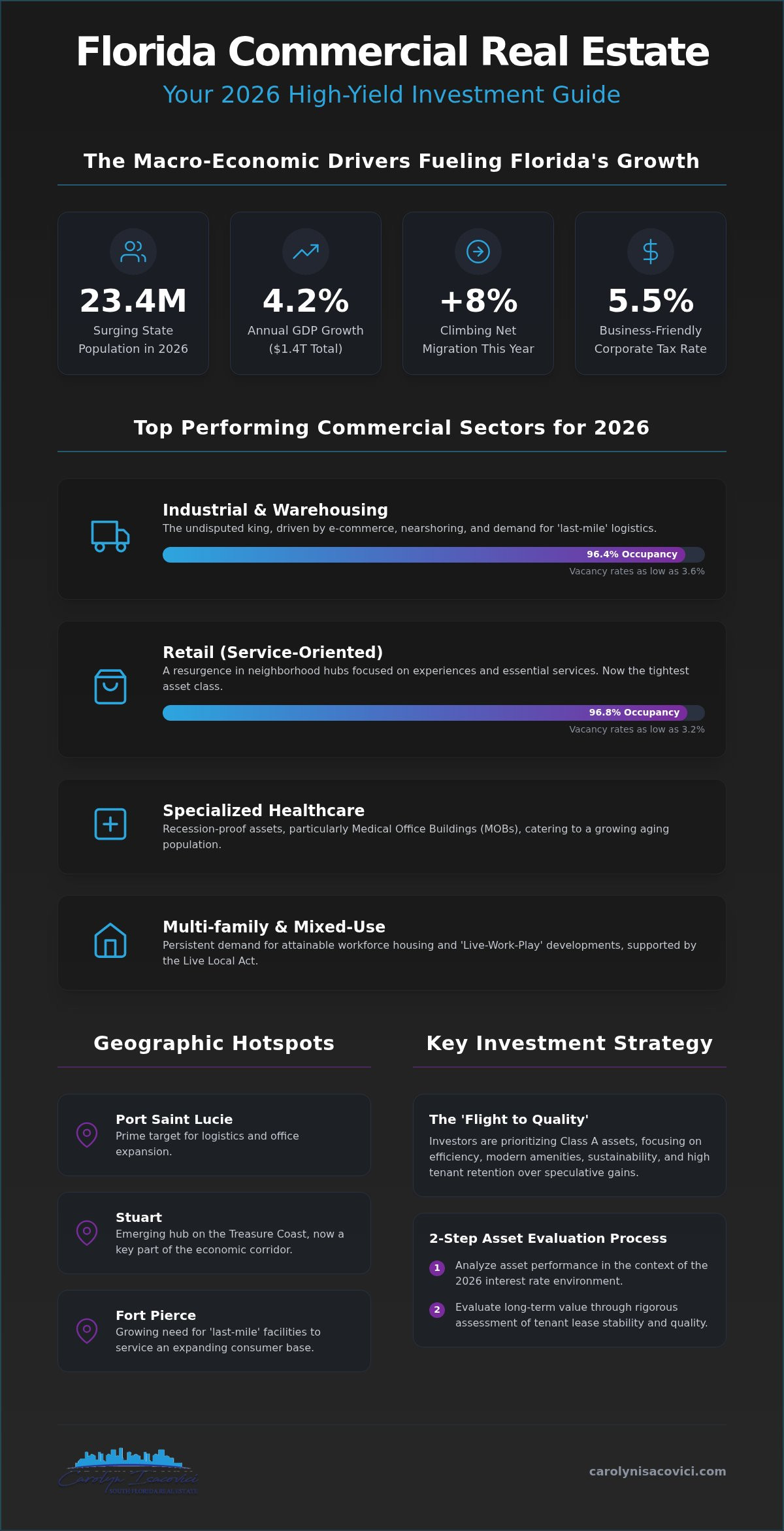
    What if the most stable path to high-yield returns in 2026 lies in the very sectors most investors ignored just three years ago? With Florida’s population surging to 23.4 million and net migration climbing by over 8% this year, the traditional investment playbook has fundamentally changed. It’s completely natural to feel a sense of hesitation amidst market volatility or the sheer noise of generic real estate advice. You aren’t just looking for a property; you’re looking for a strategic advantage that protects your capital while capturing the state’s 4.2% GDP growth.

    We understand that securing the best commercial real estate opportunities Florida has to offer requires a blend of macro-level data and the specific South Florida nuances that only a local expert can provide. This roundup will help you cut through the information overload to identify the highest-growth sectors and emerging geographic hubs that are currently undervalued. We’ll explore the continued dominance of the industrial sector, where vacancy rates sit as low as 3.6%, and analyze how the Live Local Act 4.0 is reshaping multifamily prospects in hubs like Port Saint Lucie. By the end of this guide, you’ll have a clear, professional roadmap to maximize your 2026 investment portfolio with confidence.

    Key Takeaways

    • Understand how continued net migration is driving commercial demand toward emerging Treasure Coast hubs like Stuart and Port Saint Lucie.
    • Pinpoint the best commercial real estate opportunities Florida provides by targeting high-performing industrial assets and logistics-driven properties.
    • Learn a specific two-step process for evaluating assets that accounts for the 2026 interest rate environment and tenant lease stability.
    • Gain the confidence to secure high-yield assets in a competitive market through a personalized, boutique brokerage approach that prioritizes your success.

    The 2026 Florida Commercial Real Estate Landscape

    Have you ever wondered why Florida’s market remains resilient while other regions face stagnation? It isn’t just luck. It’s a combination of deliberate policy, massive infrastructure investment, and shifting demographics. Florida has transitioned from the frantic recovery phase of the early 2020s into a period of mature, strategic growth. With the state population reaching 23.4 million in 2026, the demand for commercial infrastructure isn’t just growing; it’s evolving to meet a more sophisticated workforce.

    Investors are looking beyond surface-level statistics to find the best commercial real estate opportunities Florida provides. They want to understand the foundational Florida’s Economic Landscape, which currently boasts a $1.4 trillion GDP. This 4.2% year-over-year increase signals a robust environment for those seeking long-term stability. While national headlines might suggest a cooling period, local nuances in Broward County and the Treasure Coast tell a different story of sustained, high-level activity. Local knowledge beats national data every time in a market this fragmented.

    Economic Drivers Fueling Florida’s Growth

    Why do corporate headquarters keep moving to South Florida? The answer lies in the 5.5% corporate income tax rate and a business-friendly regulatory environment that rewards growth. For international enterprises looking to establish a foothold, the Israel Cross Border Law Firm provides the specialized legal support necessary for facilitating business and investment between Israel and the United States. Infrastructure is also playing a massive role. The continued expansion of the Brightline rail system has effectively shrunken the distance between Miami and the Treasure Coast. This connectivity transforms cities like Port Saint Lucie and Stuart into prime targets for logistics and office expansion. It’s no longer about being in a single city; it’s about being part of a connected economic corridor.

    The ‘Flight to Quality’ in 2026

    Have the requirements for a premium property changed? Absolutely. In 2026, we’re seeing a distinct flight to quality across all asset classes. Class A office spaces, rich with modern amenities and deep tech-integration, now account for up to 60% of leasing activity in South Florida. Investors are no longer just buying square footage. They’re buying efficiency, sustainability, and tenant retention. While market cycles can feel daunting, they actually create ideal entry points for the prepared investor. By focusing on high-performing assets rather than chasing speculative gains, you can secure a portfolio that thrives. We believe that clarity and timing are the ultimate tools for success in this mature market.

    Top Commercial Sectors for High-Yield Opportunities

    Which sectors are truly driving the highest returns in this mature 2026 market? While the landscape is broad, a few key areas stand out as the best commercial real estate opportunities Florida currently offers. It’s no secret that the industrial sector remains the undisputed king. With vacancy rates across the state hovering between 3.6% and 5.4%, the demand for logistics space is simply outpacing supply. This isn’t just about massive distribution centers. It’s about ‘last-mile’ facilities that can service the growing consumer base in areas like Port Saint Lucie and Fort Pierce.

    Industrial & Warehousing: The Backbone of E-commerce

    The industrial market in Florida continues to lead the nation, driven by e-commerce and a significant trend toward nearshoring. In South Florida’s industrial corridors, vacancy remains remarkably low, making it a landlord’s market where lease terms are increasingly favorable for owners. In 2026, Florida industrial cap rates have largely stabilized as investors prioritize long-term rental growth over immediate yield compression. This stability provides a reassuring foundation for those looking to park capital in assets with high tenant retention and consistent cash flow.

    What about the retail sector? Interestingly, it has become the tightest asset class in South Florida, with vacancy rates sitting between 3.2% and 3.5%. This resurgence is driven by service-oriented neighborhood hubs where people visit for experiences and essential services. Similarly, specialized healthcare properties, particularly medical office buildings, are proving to be recession-proof assets as the state’s aging population grows. For instance, the Miami CDL/DOT Physical Exam Center highlights how medical office space can cater to the essential logistics workforce. Meanwhile, the traditional office market continues its pivot; we’re seeing a decline in massive, centralized footprints in favor of boutique flex spaces that cater to a hybrid workforce.

    Multi-family & Mixed-Use Developments

    Why is everyone talking about workforce housing? The pivot toward attainable rental inventory is a direct response to the persistent demand for quality living spaces. The ‘Live-Work-Play’ model is thriving in neighborhoods like Hollywood FL and Miami Beach, where residents want everything within walking distance. The Live Local Act 4.0, which became effective on July 1, 2026, has further incentivized these developments by expanding eligible sites for affordable housing and tightening height protections. If you’re looking to evaluate the income potential of a high-density investment property sales opportunity, now’s the time to look at these emerging mixed-use corridors. By aligning your portfolio with these high-growth sectors, you transform market complexity into a clear path for wealth preservation.

    Geographic Hotspots: Where to Invest in 2026

    Where should you place your capital in 2026? While established cities provide stability, the map of opportunity has expanded significantly this year. Identifying the best commercial real estate opportunities Florida has available requires a dual focus: maintaining a presence in proven urban centers while securing early positions in emerging corridors. As net migration continues at a rate of 365,000 people annually, the demand for commercial infrastructure is following the rooftops into previously overlooked regions.

    The Miami & Fort Lauderdale Powerhouse

    Miami’s financial districts are no longer just for international banks; they’ve become primary hubs for domestic private equity and tech-driven startups. Fort Lauderdale has similarly matured, transforming into a maritime and tech powerhouse that rivals major national cities in terms of Class A demand. These areas reward investors who seek high-credit tenants and long-term stability in a mature market environment. If you’re looking for a structured approach to these high-density urban markets, our resource on Navigating Commercial Real Estate in South Florida provides a detailed framework for 2026.

    Broward County remains a sweet spot for mid-market acquisitions. Cities like Hollywood FL are seeing a revitalization of their commercial corridors, offering a balance of high demand and slightly more approachable entry prices compared to Miami’s core. Meanwhile, the inland expansion is well underway. As coastal land becomes scarce, logistics and distribution centers are moving deeper into Central-South Florida, following the infrastructure of the Brightline and major highways to service the state’s 23.4 million residents. This shift is creating a new tier of value for those focused on the logistics sector.

    Emerging Markets: The Treasure Coast and Beyond

    Is the Treasure Coast the next big thing? We believe so. Stuart and Palm City are currently seeing a surge in boutique commercial opportunities, where appreciation potential is driven by a steady influx of high-net-worth residents seeking a coastal lifestyle. Jupiter also remains a favorite for investors looking for high-end professional suites and medical offices. Further north, the aerospace and healthcare sectors are fueling growth in Vero Beach and Melbourne, creating a diverse range of assets for those willing to look beyond the major metros.

    Port Saint Lucie has emerged as the 2026 leader for industrial land acquisition. This isn’t a fluke. With the state’s GDP growing at 4.2%, the need for localized distribution is critical to support the expanding population. This city provides the space and connectivity that older, denser markets simply can’t offer. By diversifying across these hotspots, you’re not just buying property; you’re investing in the very fabric of Florida’s future. We see these emerging markets as the key to balancing a portfolio with both stability and high-growth potential.

    Best Commercial Real Estate Opportunities in Florida: 2026 Investor Roundup

    How to Evaluate a Commercial Opportunity in 2026

    How do you distinguish a genuine value from a property that’s simply priced to sell? In 2026, the margin for error has narrowed, requiring a more analytical eye than the market frenzy of years past. Identifying the best commercial real estate opportunities Florida offers today isn’t just about finding a low price; it’s about securing a sustainable yield in a stabilizing interest rate environment. With the Federal Reserve holding the funds rate between 3.50% and 3.75% as of April 2026, the spread between your cap rate and borrowing costs has become the most critical metric for success. It’s a time for precision, not speculation.

    Metrics That Matter: Beyond the Asking Price

    Understanding Net Operating Income (NOI) in a 2026 inflationary context is vital for protecting your capital. You must account for the 11% floating interest rate for taxes and the 5.5% corporate income tax rate when calculating your true bottom line. For private commercial investors, the cash-on-cash return often tells a more compelling story than the cap rate alone, especially when commercial mortgage rates for multifamily assets are starting around 5.78%. If you’re looking for a structured way to run these numbers, our Florida Commercial Real Estate: 2026 Investor’s Guide provides the necessary templates to ensure your projections remain grounded in reality.

    Beyond the spreadsheets, you must evaluate the ‘highest and best use’ for older commercial stock. Could an underperforming retail strip be reimagined as a medical hub? With the Live Local Act 4.0 now in full effect, many industrial and commercial sites are being rezoned for residential use, creating massive value-add potential for the prepared investor. It’s about seeing the future of the land, not just the current state of the building.

    The Importance of Local Due Diligence

    Local due diligence is your ultimate shield against market volatility. Navigating zoning laws in specific municipalities like Miami Beach requires a vastly different approach than in Stuart or Port Saint Lucie. You also need to factor in the potential impact of Proposed Property Tax Amendment 3, which could cap annual assessment increases for commercial buildings at 5% starting in 2027. A broker’s local network serves as the ultimate due diligence tool because it uncovers the off-market history and municipal nuances that raw data alone cannot capture. Environmental and flood zone assessments remain non-negotiable in the Florida market, ensuring your high-yield asset doesn’t come with unforeseen liabilities. If you’re ready to move from analysis to action, our team specializes in commercial property sales that align with your long-term wealth goals.

    Securing Your Florida Commercial Investment with Expert Guidance

    Does a large, national brokerage truly understand the pulse of a specific neighborhood in Hollywood FL or the subtle industrial zoning shifts in Port Saint Lucie? In the competitive 2026 market, the answer is often found in a more focused, boutique approach. While massive firms offer scale, they frequently lack the granular, on-the-ground insight required to secure the best commercial real estate opportunities Florida currently presents. You need a partner who sees beyond the generic data to find the strategic advantage hidden within market shifts. In a landscape defined by 5.78% multifamily rates and a 4.2% GDP growth, the difference between a good deal and a great one often comes down to who is navigating the transaction for you.

    The Carolyn Isacovici Advantage

    Carolyn Isacovici brings a unique blend of analytical strategy and empathetic mentorship to every transaction. With deep roots in the South Florida and Treasure Coast commercial markets, our firm doesn’t just list properties; we facilitate end-to-end investment property sales that align with your specific financial goals. Whether you’re an institutional investor or an individual looking to expand your portfolio, you deserve a navigator who has seen various cycles and remains unruffled by change. We prioritize transparent, data-driven advice that transforms the complexity of 2026 into a sense of clear opportunity. Our expertise spans from the high-value districts of Miami and Fort Lauderdale to the surging industrial hubs of Stuart and Vero Beach, ensuring you have a steady hand in every major Florida market.

    Start Your 2026 Investment Journey Today

    How do you move from interest to acquisition with total confidence? The first step is a confidential portfolio consultation to assess your current holdings and identify untapped potential in this mature market. Many of the most lucrative assets in Miami and the surrounding regions never reach public listing sites. By partnering with a local expert, you gain access to off-market commercial buildings for sale and first-hand knowledge of emerging hubs before they become mainstream. This “calm expert” approach ensures you don’t overpay in a competitive environment, even as net migration continues to drive demand across the state.

    The 2026 market is one of maturity and stability, but it rewards those who move with intention and professional guidance. We believe the best time to invest in Florida is always now, provided you have a trusted guide by your side to ensure every decision is grounded in wisdom and timing. Let’s work together to transform today’s market conditions into your next high-yield success story. Your path to a more robust, resilient commercial portfolio starts with a single, strategic conversation.

    Your Strategic Path Forward in Florida’s 2026 Market

    Success in 2026 isn’t about chasing the frenzy. It’s about recognizing that Florida has matured into a premier destination for strategic, long-term capital. You’ve seen how industrial assets and specialized multifamily developments are leading the way, particularly as emerging hubs in the Treasure Coast offer fresh inventory and high appreciation potential. By focusing on the best commercial real estate opportunities Florida provides, you’re positioning your portfolio to benefit from the state’s consistent GDP growth and massive population influx. It’s a time for precision and clarity.

    You don’t have to navigate these complex cycles alone. With over 20 years of experience and a specialized focus on high-yield investment property acquisitions across Miami, Broward, and the Treasure Coast, we’re here to transform market uncertainty into your strategic advantage. It’s time to move beyond generic data and secure assets that truly perform. Secure your next high-value Florida commercial asset with Carolyn Isacovici and step into the market with total confidence. The future of Florida commercial real estate remains bright, and with a trusted guide by your side, your investment journey is just beginning.

    Frequently Asked Questions

    What is considered a ‘good’ cap rate for Florida commercial real estate in 2026?

    A good cap rate in 2026 typically sits between 6.5% and 7.5% for stable assets like retail or industrial properties. Because commercial mortgage rates for multifamily loans are starting around 5.78%, investors look for a spread that ensures positive leverage. Achieving this range requires a disciplined approach to property selection and a clear understanding of current Net Operating Income (NOI) versus projected expenses.

    Is it better to invest in Miami or emerging markets like Port Saint Lucie?

    The choice depends on whether you prioritize immediate stability or long-term appreciation potential. Miami offers Class A assets with high-credit tenants and global prestige, while Port Saint Lucie provides lower entry costs and higher growth prospects for industrial and logistics space. Many of the best commercial real estate opportunities Florida currently provides are found by balancing a portfolio across both these established powerhouses and high-growth secondary markets.

    What are the biggest risks for commercial real estate investors in Florida right now?

    Refinancing gaps and rising insurance premiums remain the primary concerns for most investors. With a significant volume of commercial loans maturing between 2026 and 2030, it’s vital to ensure your property has a robust cash flow to meet new lending requirements. We manage these risks by conducting deep-dive due diligence on tenant health and meticulously analyzing force majeure clauses in every lease agreement.

    How do I find off-market commercial real estate opportunities in Florida?

    Securing off-market deals requires a partnership with a local broker who maintains deep, multi-generational roots in the South Florida community. Many high-value assets are traded privately to maintain confidentiality and avoid the noise of public listing sites. By tapping into a professional network, you gain early access to properties before they become the subject of a competitive bidding war.

    Are there specific tax benefits for investing in Florida commercial property?

    Florida’s tax-friendly environment includes the absence of a state personal income tax and a competitive 5.5% corporate income tax rate. Additionally, investors should watch the November 2026 ballot for Proposed Property Tax Amendment 3. If passed, this would cap annual assessment increases for non-homestead properties at 5%, providing a more predictable and stable expense outlook for commercial owners starting in 2027.

    How much liquid capital is typically required for a commercial real estate down payment?

    Most commercial lenders in the current 2026 environment require a down payment ranging from 25% to 35% of the total purchase price. While this varies based on the asset type and your specific credit profile, having this capital ready allows you to move quickly when a high-yield opportunity arises. It’s also wise to set aside additional liquidity for closing costs and potential capital expenditures during the first year of ownership; for comprehensive property finance and private equity solutions, you can visit The Federal Group.

    What is the outlook for retail commercial space in Florida for 2026?

    Retail is currently the tightest asset class in the region, with vacancy rates in South Florida sitting remarkably low between 3.2% and 3.5%. The demand is driven by service-oriented neighborhood hubs that cater to the daily needs of Florida’s 23.4 million residents. This sector has proven to be incredibly resilient because it focuses on essential services and experiences that cannot be easily replicated by online competitors.

    Why should I use a commercial broker instead of searching on public listing sites?

    Public listing sites often feature stale information or properties that have already been passed over by savvy institutional buyers. A specialized broker acts as your navigator, providing “first look” access to the best commercial real estate opportunities Florida has to offer while handling the complex negotiations that protect your interests. We transform a stressful search into a strategic acquisition process, ensuring you have a steady expert hand at every stage of the closing.

  • Florida Commercial Real Estate: 2026 Investor’s Guide

    Florida Commercial Real Estate: 2026 Investor’s Guide

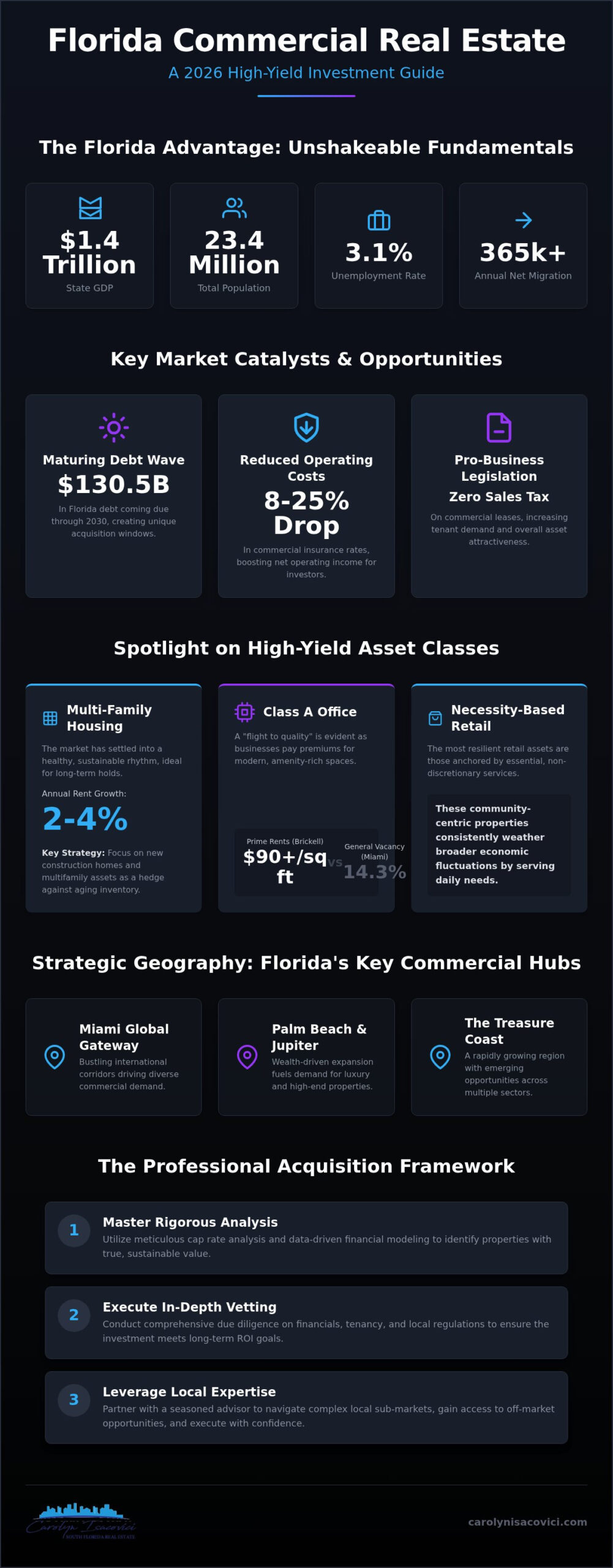
    Could the current wave of maturing loans actually be your greatest window of opportunity? Many investors feel a sense of hesitation when looking at the $130.5 billion in Florida debt coming due through 2030, fearing that market volatility might overshadow potential gains. It’s a valid concern. Finding quality Florida commercial real estate for sale requires more than just a search engine; it demands an understanding of how 2026’s shifting interest rates and new zoning laws like the Live Local Act are reshaping the ground beneath our feet. We believe these complexities don’t have to be barriers.

    In this guide, you’ll learn how to navigate these regulatory shifts and capitalize on the 8-25% drop in commercial insurance rates to secure high-yield assets. We’ll explore the specific hubs from Miami to the Treasure Coast where 3.1% unemployment and a surging $1.4 trillion GDP are driving demand. By the end of this article, you’ll have a clear, professional strategy for diversifying your portfolio and connecting with the localized expertise needed to uncover off-market gems. Let’s transform the challenge of a maturing market into your next successful acquisition.

    Key Takeaways

    • Understand why Florida’s robust GDP growth and steady net migration create a resilient foundation for high-level commercial investment in 2026.
    • Identify the specific high-yield sectors, ranging from recalibrated industrial spaces to necessity-based retail, currently defining Florida commercial real estate for sale.
    • Compare the strategic advantages of the Miami global gateway against the wealth-driven expansion occurring in the Palm Beach and Jupiter corridors.
    • Master a professional acquisition framework that utilizes rigorous cap rate analysis and financial vetting to ensure your investment meets long-term ROI goals.
    • Learn how partnering with a seasoned advisor can help you navigate complex local regulations and uncover off-market opportunities with confidence.

    The State of Florida Commercial Real Estate for Sale in 2026

    Growth isn’t just a buzzword in the Sunshine State; it’s a structural reality. As we move through 2026, the data tells a story of remarkable resilience. With a state GDP reaching $1.4 trillion and a population that has climbed to 23.4 million, the fundamentals supporting Florida commercial real estate for sale remain exceptionally strong. Why does this matter for your portfolio? It means the speculative phase of the post-pandemic boom has matured into a stable, opportunity-rich environment for those with a strategic eye. The 3.1% unemployment rate reflects a labor market that is both tight and productive, providing the necessary backbone for commercial success across various asset classes.

    Why Investors are Doubling Down on Florida

    Is it the weather or the balance sheet? While the lifestyle is a draw, the real magnet is a pro-business regulatory climate that continues to outperform national averages. A pivotal shift occurred in late 2025 when Florida eliminated the sales tax on commercial leases, a move that significantly lowered the operational costs for tenants and increased the attractiveness of retail and office holdings. This policy, combined with an annual net migration of 365,000 people, ensures a constant influx of consumers and labor. When you examine Florida’s Economic Landscape, you see a diversified engine that isn’t reliant on a single industry, making it the cornerstone of a modern Sun Belt portfolio strategy. It’s about more than just tax savings; it’s about being where the growth is inevitable.

    Identifying Market Resilience in 2026

    How do you distinguish a passing trend from a durable asset? Resilience in this cycle is found in sectors that serve daily human needs. While some office sectors are recalibrating toward high-quality Class A spaces, necessity-based retail and multifamily housing are showing steady strength, with rent growth normalizing to a sustainable 2-4% annually. We look for assets that are anchored by essential services, as these tend to weather broader economic fluctuations with grace. This flight to quality is a hallmark of the 2026 market, where discerning capital is moving away from high-risk speculation and toward proven, income-producing properties.

    Success in this market requires a partner who has seen these cycles before. Carolyn Isacovici brings nearly two decades of experience to the table, helping investors look past the noise of market volatility to find the quiet strength in specific sub-markets. Whether you are exploring Florida commercial real estate for sale in the bustling corridors of Miami or the growing Treasure Coast, having a seasoned guide ensures your acquisition is built on data rather than guesswork. The goal isn’t just to buy; it’s to secure an asset that works as hard as you do.

    High-Yield Asset Classes: What to Look For

    Are you wondering which sectors are currently offering the best risk-adjusted returns? In 2026, the answer lies in understanding the shift toward quality and utility. While the broader market finds its footing with federal funds rates held at 3.50-3.75%, specific asset classes are outperforming others by meeting the evolving needs of a growing population. We aren’t just looking for any Florida commercial real estate for sale; we’re looking for properties that possess structural advantages in a maturing cycle.

    The office sector provides a perfect example of this “flight to quality.” While general vacancy rates in Miami sit around 14.3%, prime Class A locations in Brickell are commanding rents exceeding $90 per square foot. This isn’t a contradiction. It’s a clear signal that businesses are willing to pay a premium for amenity-rich, modern spaces. Similarly, retail has evolved. The days of speculative shopping malls have given way to necessity-based centers that serve as the heartbeat of local communities. These assets remain resilient because they provide services that residents simply cannot do without. For a deeper look at how these dynamics play out across the region, our guide to commercial real estate in South Florida offers a comprehensive breakdown of the most resilient corridors and growth zones heading into 2026.

    Multi-Family and Residential Investment Properties

    How does a 2-4% annual rent growth strike you as a long-term strategy? After the explosive spikes of previous years, the multifamily market has settled into a healthy, sustainable rhythm. Investors are increasingly looking at new construction homes in Florida and multifamily assets as a hedge against aging inventory. This stability is bolstered by Florida’s Pro-Business Policies, which continue to attract high-income earners to Broward and Miami-Dade counties. If you’re looking to build a durable portfolio, these residential-adjacent assets offer a reliable foundation. You can reach out to our team to discuss which specific neighborhoods are currently showing the most promise for your ROI goals.

    Industrial and Flex Space: The Logistics Boom

    Why are Port Saint Lucie and Fort Pierce suddenly on every institutional investor’s radar? It’s all about the “last-mile.” As e-commerce continues to mature, the demand for warehouse and flex space near major transit corridors has skyrocketed. While South Florida’s industrial vacancy rate has nudged up to 5.7% due to new completions, this recalibration actually creates entry points for savvy buyers. Focus on these three drivers:

    • Strategic Location: Proximity to I-95 and Florida’s Turnpike for rapid transit.
    • E-commerce Integration: Facilities designed specifically for high-volume distribution.
    • Flexibility: Hybrid spaces that can adapt to light manufacturing or specialized logistics.

    These hubs are no longer just “alternative” markets; they are essential components of the Florida supply chain that offer significant long-term growth potential.

    Strategic Geography: Comparing Florida’s Commercial Hubs

    Where should you plant your flag? It’s the most common question we hear from investors looking at Florida commercial real estate for sale. Florida isn’t a monolith; it’s a collection of distinct economic engines, each firing at a different frequency. While Miami captures the headlines with its global prestige and the upcoming 2026 World Cup matches, the real story for many investors is the steady northward migration of wealth and industry. This geographic shift is creating a new map of opportunity that rewards those who look beyond the most obvious zip codes.

    The Miami and Fort Lauderdale Core

    In the Miami and Fort Lauderdale core, we see a global gateway in full bloom. Brickell has solidified its position as the “Wall Street of the South,” where high-value financial firms are driving demand for premium Class A office space despite national headwinds. Miami Beach and Hollywood continue to dominate the luxury retail sector, benefiting from a constant stream of international capital and high-net-worth residents. For those seeking high-yield investment property in metro hubs, these areas offer a level of liquidity and prestige that is difficult to match. Investors who want to understand the full spectrum of commercial buildings for sale Miami presents in 2026 will find that neighborhood-specific infrastructure and sub-sector dynamics play a decisive role in determining long-term returns. The competition is fierce, but the rewards for securing a prime asset here remain significant.

    The Treasure Coast and Beyond

    Moving north, the narrative shifts toward value and untapped potential. Why are areas like Stuart and Palm City becoming so attractive to seasoned investors? It’s because they offer a unique value proposition: high-quality infrastructure and a growing affluent population without the extreme density or price tags of the Miami core. Port Saint Lucie and Fort Pierce are no longer just quiet coastal towns; they are emerging industrial and residential powerhouses. According to the University of Florida Real Estate Research, these secondary markets are often where the most significant long-term appreciation is found, as both residents and businesses seek more space and lower operational costs.

    Finally, we must look at the Space Coast. Melbourne is experiencing a technology-driven surge, fueled by aerospace and defense contracts that provide a recession-resistant foundation for commercial demand. Whether you’re interested in retail in Stuart or industrial flex space near the Cape, the 2026 landscape is full of nuanced opportunities. Finding the right Florida commercial real estate for sale means looking beyond the surface and identifying where the next decade of growth is already taking root. It’s about matching your specific ROI goals with the unique economic heartbeat of each Florida corridor. The surge in new construction homes Florida communities across these growth corridors is a strong indicator of where residential and commercial demand will converge in the years ahead.

    Florida Commercial Real Estate: 2026 Investor's Guide

    The Acquisition Framework: Due Diligence and Closing

    How do you bridge the gap between identifying a potential asset and successfully securing the keys? It’s a journey that requires both analytical precision and local intuition. In a market where the federal funds rate sits at 3.50-3.75%, the margin for error in your financial modeling has narrowed. This makes a disciplined acquisition framework essential. When searching for Florida commercial real estate for sale, the process must move beyond simple browsing into a rigorous vetting phase that protects your capital and ensures long-term yield.

    The first step is establishing crystal-clear investment criteria. Are you seeking the 2-4% steady rent growth of a multifamily asset, or the higher-risk, higher-reward potential of an industrial flex space? Once your goals are set, the financial vetting begins. With commercial loan rates currently ranging between 5.28% and 12.75%, your cap rate analysis must be airtight to ensure the property can comfortably service its debt while providing a healthy return. We don’t just look at the numbers on the page; we look at the stability of the income behind them. Understanding how to evaluate investment property in Florida using a repeatable, broker-tested framework is essential to calculating real ROI with precision and avoiding the common pitfall of relying on outdated metrics like the 1% rule.

    The Importance of Local Due Diligence

    Florida presents unique regulatory and environmental hurdles that can surprise even seasoned out-of-state investors. Do you understand how the Bert Harris Act protects your property rights against government over-regulation? This state-specific legislation is a powerful tool for owners, but it requires a nuanced understanding of local land-use laws. Additionally, coastal assets require deep dives into environmental risks and insurance costs. Since the October 2025 flood disclosure laws took effect, transparency has improved, but you still need a local expert to interpret what those disclosures mean for your premiums. In the 2026 Miami multi-family market, the cap rate serves as a vital metric that expresses the net operating income as a percentage of the property’s purchase price, helping you gauge the asset’s yield relative to current financing costs.

    Financing and Structuring the Deal

    Securing favorable terms in 2026 often depends on the strength of your local banking relationships. While standard mortgage rates fluctuate, SBA 504 loan rates for August 2026 remain attractive, with the 25-year fixed rate at 6.17%. This is where professional brokerage support becomes your greatest advantage. Carolyn Isacovici doesn’t just find listings; she uncovers off-market opportunities that never reach the public portals. By facilitating the end-to-end sales process, from initial vetting to the final signature, our firm ensures that you aren’t just buying a building, but acquiring a strategic advantage. If you’re ready to move from analysis to action, schedule a consultation with our acquisition team to begin vetting your next investment.

    Partnering with Florida Commercial Investment Properties

    Why face the intricacies of the 2026 market alone? We’ve explored the $130.5 billion in maturing debt, the evolving zoning laws, and the specific hubs from Miami to the Space Coast. These figures can feel overwhelming if you’re looking at them through the lens of a search engine. However, for a seasoned guide, these same numbers represent a map of strategic opportunity. We believe that uncertainty is simply a call for better data and wiser counsel. Our role is to transform market complexity into a clear, actionable path for your capital.

    Finding the right Florida commercial real estate for sale is rarely about who has the most data; it’s about who has the best perspective. While automated platforms can provide a list of addresses, they cannot tell you why a specific flex space in Port Saint Lucie is a better long-term hold than a retail center in a saturated metro core. We provide that missing layer of insight. By combining the analytical mind of a strategist with the empathetic ear of a consultant, we ensure that every acquisition serves a clear purpose in your broader financial picture.

    A Seasoned Guide for Florida Markets

    Carolyn Isacovici has spent two decades mastering the nuances of the Florida market. Since establishing the firm around 2006, she has steered clients through multiple economic cycles with a steady, confident hand. This longevity provides a level of institutional knowledge that simply can’t be replicated by a boutique firm or a national franchise. We’re committed to high-value property holdings and personalized brokerage because we know that your success depends on the details that data alone can’t capture. It’s about more than just a transaction; it’s about a partnership built on trust and proven results.

    Start Your Florida Investment Journey

    Your portfolio deserves a strategy that is as dynamic as the state itself. Our reach extends from the luxury high-rises of Miami to the tech-driven corridors of Melbourne, giving you direct access to premier commercial, residential, and new construction assets. Whether you’re looking to secure your first high-yield asset or seeking to diversify a complex holding, we’re here to navigate the closing process with precision. The 2026 market is moving fast, but with the right advisor, you can move faster. You are invited to Connect with Carolyn Isacovici for a Portfolio Review and take the first step toward a more resilient investment future.

    Charting Your Path to Florida Investment Success

    The 2026 landscape offers a rare intersection of population growth and market recalibration, provided you have the right map. We’ve discussed how necessity-based retail and Class A office space are outperforming the broader market, and why the northward migration toward the Treasure Coast is a trend no serious investor can ignore. Success here isn’t about chasing the latest headline; it’s about applying a rigorous acquisition framework and leveraging deep, localized insight.

    Finding the right Florida commercial real estate for sale requires a partner who has navigated multiple cycles with a steady hand. With over 20 years of Florida market expertise, we specialize in high-yield investment property sales from the vibrant streets of Miami to the innovative corridors of the Space Coast. We don’t just facilitate transactions; we build resilient portfolios.

    Are you ready to transform these market insights into a tangible advantage? You can View Exclusive Florida Commercial Opportunities today and begin your next chapter with confidence. The Sunshine State’s future is bright, and your place in it is waiting.

    Frequently Asked Questions

    Is Florida commercial real estate a good investment in 2026?

    Florida remains a premier investment destination in 2026 because of its $1.4 trillion GDP and a steady net migration of 365,000 people annually. These economic fundamentals provide a level of structural stability that few other states can match. While interest rates have stabilized, the real opportunity lies in the state’s pro-business regulatory environment and the elimination of sales tax on commercial leases, which has significantly improved net operating income for property owners.

    What is a good Cap Rate for commercial property in Miami?

    A “good” cap rate in the Miami market typically ranges from 4.5% to 6.5% depending on the specific asset class and its location. Prime Class A office spaces in Brickell or luxury retail on Miami Beach often command lower cap rates due to their high demand and long-term stability. Conversely, you might find higher yields in secondary markets like the Treasure Coast, where risk-adjusted returns can be more attractive for investors seeking cash flow.

    How do I find off-market commercial buildings for sale in Florida?

    Finding off-market opportunities requires moving beyond public listing sites and establishing a direct relationship with a localized brokerage. Many of the most lucrative Florida commercial real estate for sale never reach a public portal because they are traded quietly between established professional networks. We maintain deep connections with property owners from Miami to Melbourne, allowing us to identify quiet sellers and unique opportunities before they ever hit the open market.

    What are the most ‘recession-proof’ commercial sectors in Florida right now?

    Necessity-based retail and medical office buildings are currently the most resilient sectors in the Florida market. Grocery-anchored shopping centers continue to perform well because they serve daily human needs that remain unaffected by broader economic shifts. Similarly, the growing and aging population in South Florida ensures a steady demand for healthcare-related real estate, making medical suites a reliable choice for investors looking for long-term stability and consistent tenant retention.

    Can I invest in Florida commercial real estate from out of state?

    Yes, you can successfully invest from out of state by utilizing a professional brokerage that acts as your local representative and advisor. Many of our clients are based across the country, relying on our “calm expert” oversight to handle site visits, local due diligence, and vendor coordination. We provide the boots-on-the-ground perspective needed to vet Florida commercial real estate for sale without requiring you to be physically present for every step of the acquisition process.

    What is the difference between commercial and residential investment in Florida?

    The primary difference lies in the lease structure and the fundamental nature of the tenant relationship. Residential investments typically involve shorter lease terms and higher management intensity, whereas commercial assets often utilize triple-net (NNN) leases where the tenant covers taxes, insurance, and maintenance. This shift often results in a more passive income stream; if you are also considering residential opportunities in the Westside of Los Angeles, click here to explore expert local insights.

    How much down payment is required for Florida commercial real estate?

    Most lenders require a down payment ranging from 20% to 35% for commercial property acquisitions in Florida. While residential properties might offer lower entry points, commercial financing is more focused on the property’s debt service coverage ratio and income potential. For small business owners, SBA 504 loans can offer more favorable terms, including down payments as low as 10% for owner-occupied properties, which is a strategic way to build equity.

    How does Carolyn Isacovici help international investors secure Florida assets?

    Carolyn Isacovici provides international investors with a comprehensive bridge to the Florida market by managing the complexities of cross-border transactions and local regulations. From navigating specific zoning laws to utilizing global property advertising platforms like HomesGoFast to reach a worldwide audience, we ensure that global capital is deployed safely and efficiently. Our 20 years of experience allow us to translate market uncertainty into clear strategic opportunities for investors who are new to the commercial real estate South Florida landscape.