
Could the very profit you’ve worked so hard to build become the biggest hurdle to your next acquisition? It’s a question many Florida investors face as they look at the significant appreciation in their portfolios. The 1031 exchange rules Florida 2026 offer a sophisticated path to keep that capital working for you instead of sending it to the IRS. You’ve likely spent nights worrying about the rigid 45-day identification window or wondering if your next target asset truly qualifies as like-kind. These concerns are natural. They’re the mark of a careful strategist who understands that in real estate, timing and precision are everything.
We’re here to transform that uncertainty into a clear, actionable advantage. This guide serves as your roadmap to successfully deferring capital gains tax while upgrading to higher-yield commercial or residential assets. We’ll demystify the role of the Qualified Intermediary and provide the clarity you need to avoid the dreaded “boot” and unexpected tax liabilities. By the end of this article, you’ll have the insight to master the 2026 landscape with the steady hand of a seasoned pro. Let’s explore how to turn these complex regulations into your most powerful tool for wealth compounding.
Key Takeaways
- Discover how the 1031 exchange rules Florida 2026 allow you to defer capital gains taxes and reinvest your full equity into high-performing assets.
- Master the critical 45-day identification window and the 180-day closing period to ensure your exchange remains fully compliant and stress-free.
- Learn why “like-kind” is a flexible term that lets you transition between diverse property types, such as shifting from residential units to commercial spaces.
- Identify the common pitfalls of “boot” and how a Qualified Intermediary protects your proceeds from becoming unexpected taxable liabilities.
- Gain a strategic edge by uncovering how to source replacement properties before you sell, keeping your investment momentum moving forward.
Understanding 1031 Exchange Rules in Florida for 2026
Who qualifies for these benefits? The rules are inclusive. Individuals, C-corporations, S-corporations, partnerships, and LLCs can all initiate an exchange. The key requirement is that the taxpayer selling the property must be the same taxpayer buying the new one. This consistency ensures the IRS can track the deferred gain through the life of the investment. In a market as dynamic as Florida’s, this continuity is the secret to building a high-value portfolio over time.
The Core Principle: Deferral vs. Elimination
It’s vital to understand that a 1031 exchange defers your tax liability; it doesn’t eliminate it entirely. You’ll eventually owe those taxes if you sell your final property without initiating another exchange. However, by keeping that money in your pocket now, you increase your buying power for the next deal. You’re essentially receiving an interest-free loan from the government to fund your growth. In the 2026 Florida real estate market, ‘like-kind’ refers to any real property held for productive use in a trade, business, or for investment, regardless of the specific asset class.
Why Florida Investors Have a 2026 Advantage
Florida offers a distinct edge because there’s no state-level income or capital gains tax. This means your federal deferral represents the entirety of your potential tax savings. When you combine this with the robust growth in South Florida, the opportunity for wealth compounding is immense. Savvy participants are currently studying Miami Real Estate Market Trends 2026: Investor Guide to find replacement properties that align with these tax advantages. Whether you’re looking in Miami or Palm Beach, the goal is to keep your capital working where it’s most effective. The synergy between federal tax policy and Florida’s tax-friendly environment makes 2026 an ideal time to execute a strategic swap.
The Strict Timelines: 45 Days to Identify and 180 Days to Close
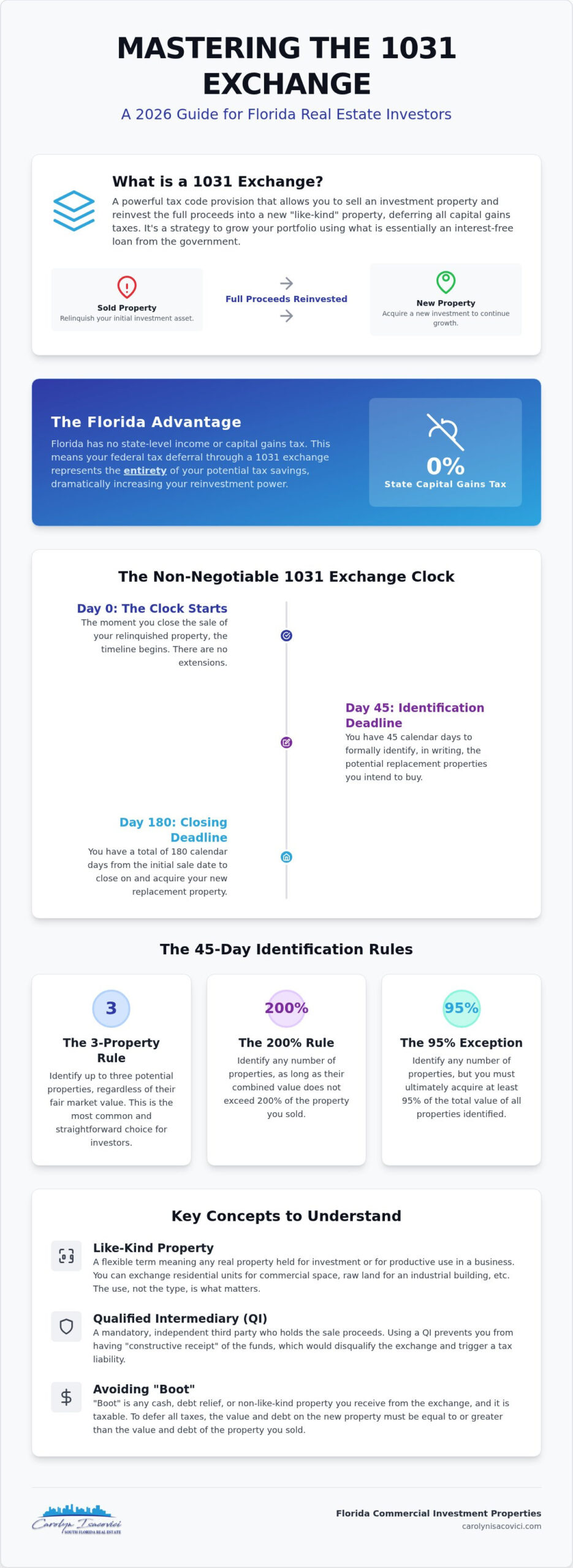
The moment you finalize the sale of your relinquished property, the clock starts on Day 0. This isn’t a suggestion; it’s a hard deadline that defines the 1031 exchange rules Florida 2026. You have exactly 45 calendar days to identify your replacement properties and a total of 180 days to close on them. Why are these dates so critical? The IRS offers no extensions for market volatility, financing delays, or personal emergencies. According to Fidelity’s guide to 1031 exchanges, missing a deadline by even one day can disqualify the entire exchange, leaving you with an immediate tax bill. While this sounds intense, a steady hand and a proactive strategy turn these constraints into a structured path toward your next successful acquisition.
Rules for Identifying Replacement Property
The 45-day identification window is often the most stressful phase for investors. To stay compliant, you must follow one of three specific IRS rules. Most investors choose the Three-Property Rule, which allows you to identify up to three potential properties regardless of their fair market value. If you need more options, the 200% Rule lets you identify any number of properties, provided their combined value doesn’t exceed 200% of the property you sold. For complex portfolio shifts, the 95% Exception allows you to identify any number of properties, but only if you eventually acquire at least 95% of the total value identified. These rules provide the flexibility to pivot if your primary choice falls through.
Managing the 180-Day Closing Pressure
Florida’s competitive landscape, especially in markets like Miami and Palm Beach, can present hurdles during the 180-day closing window. Tight inventory and detailed inspections often create friction that eats into your timeline. The best way to mitigate this pressure is to begin your search long before your first property sells. Performing deep research early ensures you aren’t rushing into a low-yield asset just to meet a deadline. Reviewing an Investment Property Due Diligence Florida Checklist can help you spot potential red flags early. By the time the clock starts, you should already have a clear vision of your target. If you’re feeling the pressure of a ticking clock, connecting with a specialized investment property broker can provide the off-market access needed to secure a replacement property with confidence.
Defining ‘Like-Kind’ in the Florida Market
Does a luxury condo in Miami share anything with a warehouse in Fort Lauderdale? Under the 1031 exchange rules Florida 2026, they’re essentially the same. Many investors believe they must swap a residential property for another residential one. That’s a misconception. Like-kind refers to the nature or character of the property, not its grade or quality. You can trade a single-family rental for a retail strip mall or even a parcel of raw land intended for future development. This broad definition is what makes Section 1031 such a versatile tool for wealth building.
This flexibility allows for incredible portfolio agility. You might choose to exchange a high-maintenance apartment building for a portfolio of new construction homes in growing markets like Port Saint Lucie. These newly built assets often qualify as long as your primary motivation is investment rather than personal use. The IRS focuses on your “investment intent,” meaning you must hold the property for productive use in a trade or business. As long as you aren’t buying the property primarily to live in it, the doors to diversification remain wide open, even allowing for transitions into out-of-state mountain land via nchighcountryrealestate.com.
Commercial to Residential: Strategic Diversification
Why are we seeing more investors pivot their strategy this year? In 2026, shifting from retail space to multi-family units has become a common way to secure steady cash flow. Broward County is seeing a surge in new construction that offers excellent like-kind opportunities for those exiting the commercial sector. For a deeper look at these shifts, explore our Commercial vs Residential Investment in Florida: The 2026 Strategic Comparison. This cross-sector movement is one of the most powerful ways to balance a portfolio against market shifts.
Excluded Property Types
While the definition is broad, it isn’t infinite. You can’t exchange your primary residence or a vacation home you use exclusively for family getaways. Similarly, “fix-and-flip” properties are generally excluded because the IRS views them as “dealer property” held for sale, not as long-term investments. To remain compliant, you should review the IRS Real Estate Tax Tips regarding personal use. Generally, the “14-day rule” suggests that if you use the property for personal reasons for more than 14 days (or 10% of the days it’s rented), it might lose its investment status. Understanding these boundaries keeps your exchange safe and your deferred gains protected.
Avoiding the ‘Boot’ and Selecting a Qualified Intermediary
What happens if you walk away from a closing with a check in your hand? Under the 1031 exchange rules Florida 2026, that check represents a failed exchange. Even if you intend to reinvest it the next morning, the IRS considers “constructive receipt” as a taxable event. To keep your capital working, you must avoid the “boot.” Boot is any non-like-kind property you receive during the transaction. It most commonly appears as cash left over after a purchase, but it also includes debt relief. If your new mortgage is smaller than your old one, the IRS views that difference as a taxable gain. This is why you must never technically touch the sale proceeds during the process.
This is where the Qualified Intermediary (QI) becomes your most essential partner. Think of them as a professional safe harbor for your equity. They hold your funds in a restricted account, ensuring the money moves directly from the sale of your old property to the purchase of the new one. Without a QI, the legal bridge for your tax deferral simply doesn’t exist. They provide the structure and the documentation necessary to prove to the IRS that you never had control of the cash.
Calculating and Minimizing Taxable Boot
Selection is about security and expertise. You should prioritize a QI that carries significant fidelity bonding and errors-and-omissions insurance. Can your long-time attorney or CPA act as your QI? Usually, the answer is no. The IRS classifies anyone who has acted as your agent within the last two years as a “disqualified person.” This includes your legal counsel, accountant, or real estate broker. When interviewing a QI, ask about their security protocols and their specific experience with the 1031 exchange rules Florida 2026. If you are looking for a vetted investment property specialist to help coordinate these professional relationships, starting that conversation early is the best way to protect your portfolio.
Executing Your 2026 Florida Exchange Strategy
Why wait for the pressure of a ticking clock when you can start with a clear advantage? The most successful investors don’t wait for their current property to close before they begin hunting for the next one. Under the 1031 exchange rules Florida 2026, the 45-day window is unforgiving, but it becomes a structured milestone when you’ve already done the legwork. By identifying potential replacement properties before you even list your relinquished asset, you transform a stressful deadline into a strategic window of opportunity. This proactive approach allows you to filter through the noise of the Miami and Hollywood markets to find assets that truly align with your long-term financial goals.
Accessing high-value opportunities in Florida often requires looking beyond public listings. Local brokerage expertise is your gateway to off-market commercial buildings and new construction homes that never hit the traditional portals. This “insider” access is particularly vital in 2026, as competitive demand continues to squeeze inventory in prime locations. Building a resilient portfolio isn’t just about saving on taxes today; it’s about positioning yourself for sustained growth over the next decade. Follow this final execution checklist to ensure your exchange remains on track:
- Confirm your investment intent for both the relinquished and replacement properties.
- Engage a vetted Qualified Intermediary before closing the sale of your current asset.
- Draft your potential property identification list during the listing phase of your sale.
- Submit the formal identification in writing to your QI by midnight on Day 45.
- Complete the acquisition and title transfer for the new property by Day 180.
Partnering with a Florida Investment Specialist
Carolyn Isacovici serves as the steady hand for investors navigating these complexities. Whether you’re looking for high-yield commercial assets in Port Saint Lucie or exploring the potential of new construction in Vero Beach, her local knowledge provides a distinct edge. She specializes in the rapid identification of assets, ensuring you meet the strict 1031 exchange rules Florida 2026 without compromising on property quality. Every search is customized to your specific needs, whether that means diversifying into multi-family units or securing a stable commercial footprint in the Treasure Coast.
Next Steps: Your 2026 Portfolio Growth
Transitioning from a single asset to a diversified Florida portfolio is a journey of precision and timing. As you look toward the future, consider how each exchange strengthens your overall market position. For a deeper dive into scaling your holdings, read our guide on Strategic Florida Real Estate Portfolio Building: The 2026 Investor Guide. The path to wealth compounding is open to those who plan with confidence. Ready to secure your next investment? Contact Carolyn Isacovici for a strategic consultation on your 1031 exchange today.
Mastering Your Florida Portfolio Growth
Success in real estate often comes down to the quality of your decisions under pressure. By mastering the 1031 exchange rules Florida 2026, you’ve already taken the first step toward transforming tax liabilities into powerful investment capital. You now understand that while the 45-day identification window is strict, it’s entirely manageable with a proactive search strategy. You also know that “like-kind” flexibility allows you to pivot from residential units to high-yield commercial assets with confidence. The key is to keep your equity working for you while avoiding the pitfalls of taxable boot through the use of a professional intermediary.
Are you ready to turn these insights into action? Navigating the Miami and Treasure Coast markets requires a steady hand and deep local insight. Whether you’re targeting new construction or established commercial property, having an expert guide ensures your identification process is seamless and compliant. Secure Your Next Florida Investment with Carolyn Isacovici and benefit from strategic guidance tailored to your specific portfolio goals. Your journey toward a high-value, tax-efficient future starts with a single, well-timed move. We’re here to ensure every step you take is a confident one.
Frequently Asked Questions
Can I use a 1031 exchange for a vacation home in Florida?
You can use an exchange for a Florida vacation home only if it meets specific IRS investment criteria. The property must be held for productive use in a trade or business or for investment. Under the 1031 exchange rules Florida 2026, you must rent the property at fair market value for at least 14 days in each of the two 12-month periods before and after the exchange. Personal use must be limited to the greater of 14 days or 10% of the days it’s rented.
What happens if I miss the 45-day identification deadline?
If you miss the 45-day deadline, the entire exchange is disqualified and your capital gains become immediately taxable. The IRS is exceptionally strict regarding this timeline; there are no extensions for market conditions or personal delays. This is why we recommend starting your search in Miami or Hollywood well before your current property closes. Having a backup list of identified properties ensures you aren’t left with an unexpected tax bill if your primary choice falls through.
How many properties can I identify in a Florida 1031 exchange?
You have two primary options for identification. The “Three-Property Rule” allows you to identify up to three properties of any value. Alternatively, the “200% Rule” lets you identify any number of properties as long as their total fair market value doesn’t exceed 200% of the property you sold. Most of our clients in the Treasure Coast find the three-property rule provides the best balance of flexibility and focus when securing high-yield replacement assets.
Is there a limit to how many times I can use a 1031 exchange?
There is no limit to the number of times you can perform a 1031 exchange. Many savvy investors use this “swap ’til you drop” strategy to build massive portfolios over several decades. By continually deferring taxes, you keep 100% of your equity working in the market. This compounding effect is a cornerstone of wealth building in competitive areas like Palm Beach and Port Saint Lucie, allowing you to upgrade assets as your investment goals evolve.
Do I need a special lawyer for a 1031 exchange in Miami?
While you don’t legally need a “special” lawyer, you are required to use a Qualified Intermediary (QI) to facilitate the transaction. A QI is an independent party that holds your funds to ensure you never take constructive receipt of the cash. Florida Commercial Investment Properties focuses on the brokerage side, helping you identify replacement assets. We always recommend that you consult with your own tax or legal professional to review the specific legal documents for your exchange.
Can I exchange a commercial building for a residential rental property?
Yes, you can absolutely exchange a commercial building for a residential rental property. The “like-kind” requirement under the 1031 exchange rules Florida 2026 refers to the nature of the investment rather than the specific type of building. You could sell a retail strip in Fort Lauderdale and reinvest into a portfolio of new construction homes in Vero Beach. As long as both properties are held for business or investment purposes, the exchange remains fully compliant.
What is a ‘Reverse 1031 Exchange’ and is it legal in Florida?
A reverse 1031 exchange occurs when you acquire your replacement property before selling your relinquished property. It is a perfectly legal and increasingly popular strategy in tight Florida markets where high-quality inventory moves quickly. This approach allows you to secure a prime asset in Miami or Palm Beach Gardens without the pressure of the 45-day clock. However, it requires a more complex structure and greater liquidity, so professional guidance during the identification phase is essential for success.
How much does a Qualified Intermediary typically cost in 2026?
Fees for Qualified Intermediaries vary based on the complexity of the exchange and the value of the assets involved. A standard delayed exchange typically carries a flat administrative fee, while more complex structures like reverse or improvement exchanges involve higher costs due to additional legal and holding requirements. While we don’t provide QI services directly, we can help you understand how these costs fit into your overall acquisition strategy as you build your Florida real estate portfolio.
Leave a Reply